


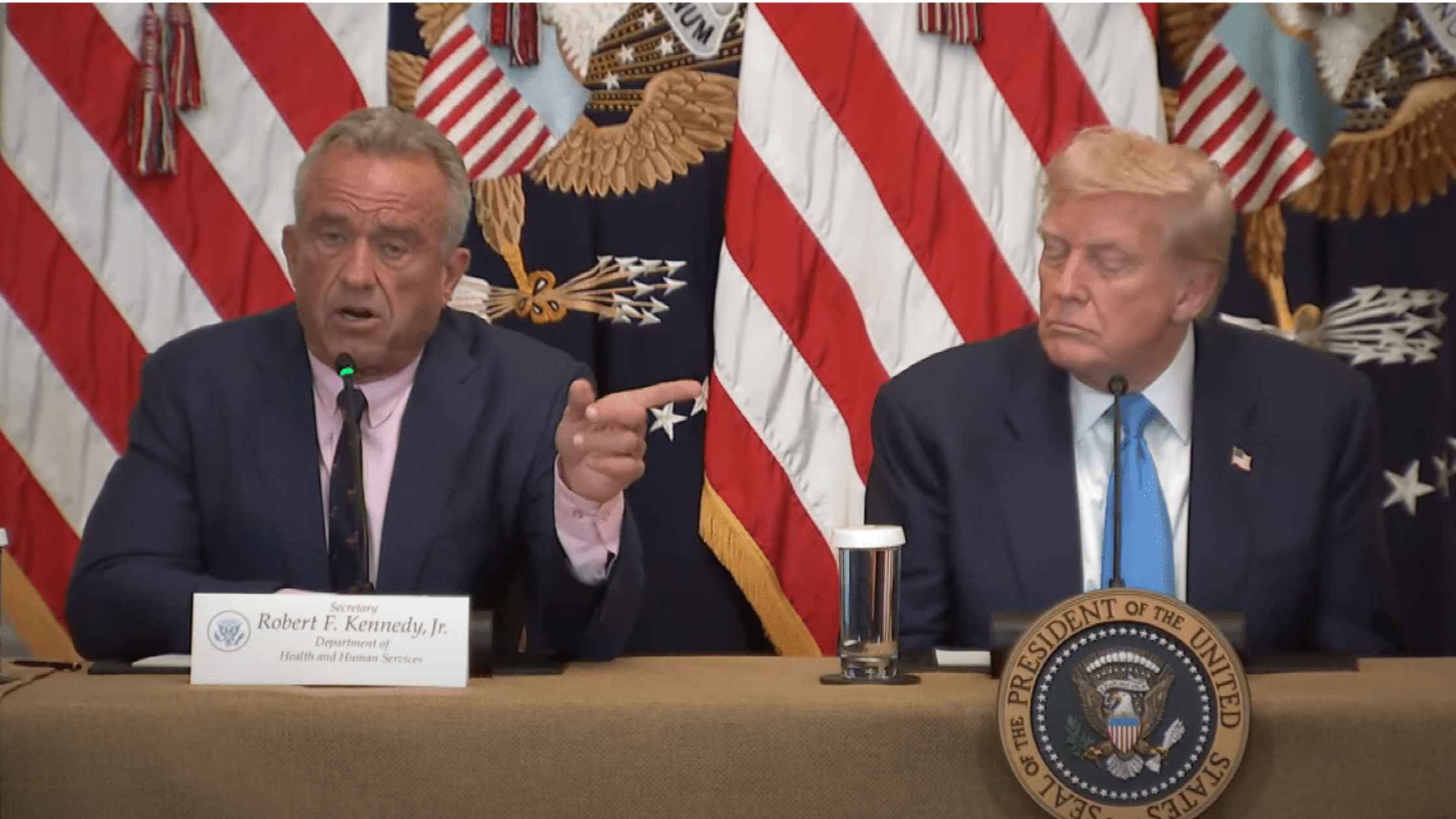
Speaker 1 (01:13):
Ladies and gentlemen, the President of the United States,
Donald Trump (01:49):
And we have a lot of great people here and we've been looking forward to this day, but we look forward to every day because we have a lot of surprises, most of which are good. Today you saw GDP was much higher than anticipated, and Scott, good job. Scott Bessent's been working, just got back from a little excursion and a meeting with China and Europe, and that went well. We've done very well with the EU deal. It's a very big deal, I guess. They say the biggest trade deal ever made by far. Probably is. Just completed Japan and many other countries and hundreds of billions of dollars is flowing into our country. We've never seen anything even close. And that's not me saying it, that's everybody saying it. And it's going to be something really, really very special. Maybe even more importantly, factories for AI and for cars and for lots of other things are being built in this country or planned to be built very shortly.
(03:00)
They'll be starting where they need great amounts of energy. For AI, I've given them approval and Lee Zeldin has given them very fast approval to build their own electric powering plants and they'll build them with a factory so we don't have to worry about an ancient grid and all of the other problems, the obstacles people thought we were going to have that would make it impossible. And we're leading AI by a lot and I think people are very impressed with our country.
(03:34)
As they said, the king of Saudi Arabia and various leaders and just about every leader I can even imagine. We were in the Middle East and Qatar, UAE, Saudi Arabia, they said, "One year ago, your country was dead, and today you have the hottest country anywhere in the world." And that's true. So I congratulate everybody in the room that's helped, but we're doing a good job together. I'd like to begin by saying a few words about the unbelievable kind of numbers that we've been putting up, and as I said, the number of 3% the pace, in the second quarter, we smashed all expectations. They thought it would be maybe a little bit less than two and it was a little bit more than three. Consumer spending is up, business investment is way up. Domestic manufacturing is way up. Real disposable family income is up, and personal savings are up. Other than that, we're not doing so great.
(04:41)
We have the hottest country, and I'll tell you, we're having a lot of fun with it. At the same time, we dramatically slashed government spending for the second quarter in a row down nearly 4%, which people were surprised at. We do a lot of cutting also. The private sector has boomed with nearly 600,000 jobs added way above expectations while we have reduced the federal workforce by 70,000 jobs, so these are private jobs that are coming back to our country. Federal jobs are being cut.
(05:15)
Critics said that our tariffs would hurt the economy, but the data shows the exact opposite, and the exact opposite is happening. The US Treasury has taken in $150 billion from tariffs and will be adding about $200 billion next month for totals that nobody's ever seen before, frankly. And foreign imports were down 30% in the second quarter while the domestic auto production surged by a stunning 36%. How about that number, Dr. Oz, right? That's good. That's good. We want to do that with your patients too. We're going to have a very healthy country. At the same time, inflation continues to fall faster than expectations, and for the fifth consecutive month, core inflation was lower than predicted substantially. This is truly the dawn of the golden age of America. That's what we're in. We want to keep it that way. This afternoon, we're gathered to announce another historic victory for the American people, very important one. Today, the dream of easily transportable electronic medical records finally becomes a reality.
(06:35)
I want to thank Secretary Scott Bessent, Robert F. Kennedy, Jr for joining us, as well as Administrator of the Centers for Medicine and Medicaid Services, Dr. Mehmet Oz, all friends of mine. White House AI and Crypto Czar, David Sacks, and acting Administrator of DOJ, Amy Gleason all here, and we have various great senators here. Senator Rounds, Senator Cassidy, thank you very much for being here and helping out.
(07:08)
I also want to thank representatives from Apple, Google, Samsung, Amazon, OpenAI, Anthropic, Epic, Oracle, Athena Health, Noom, and that's not a bad group of people and they're the top people. We don't play games. When you invite people to the White House, the top ones, that's a big net worth sitting in this room right now. Boy, oh boy, we better make sure the room is nice and safe. It's half the net worth of our country.
(07:44)
I'm also grateful to be joined by many numerous congressmen. I'm not going to name you, if you don't mind. I'll probably never get their vote again, but it's too many. Thank you very much for being here. The Congress has been great. Senators have been great, and the congressmen and women have been great. We just passed the most important, I think…
(08:03)
Look, I can't say most important, but certainly one of the most, but the most consequential and the largest bill in the history of Congress, and I call it the great Big Beautiful Bill. We call it different names, but it all means the same thing. For decades, America's healthcare networks have been overdue for a high-tech upgrade, and that's what we're doing. The existing systems are often slow, costly, and incompatible with one another. But with today's announcement, we take a major step to bring healthcare into the digital age, something that is absolutely vital. You got to do it, moving from clipboards and fax machines into a new ear of convenience, profitability, and speed, and frankly, better health for people. Under the leadership of Administrator Oz, we're officially launching the CMS digital health tech ecosystem to give healthcare providers, insurers and software companies the tools they need to empower Americans with a 21st century experience on health.
(09:10)
The key breakthrough we've made is getting many of the biggest names in the healthcare and technology to agree to industry-wide standards for electronic medical records. All of those great companies that you just heard have gotten together with this group of very brilliant people. I don't know who's more brilliant; them or them. I don't know. Could be them. I hate to tell you. It could very well be them, but I don't know. I'm going to take my team.
(09:39)
But the key breakthrough we've made is getting many of the biggest names in healthcare and technology to agree to those standards of electronic medical records that we talk about and you've heard about for so many years, and now it's happening. This will allow patients to easily transmit information from one doctor to another,
Donald Trump (10:01):
… even if they're different networks and using different record-keeping systems. No matter what system they use, they're all transferable. The new standards will also make it simple for patients to access their own personal health records. I don't want to see mine, please. I don't want to see. I don't know about you. They have all sorts of things. Sure, they can tell you exactly what your problem is going to be in six years. We can do it. They have all these different things. I don't know if they work or not, but I didn't want to hear it. I didn't want to hear it. If they got a problem, I don't want to know about it right now, but it is amazing what they're doing.
(10:38)
I don't know, does it actually work? Can they do that? All right. Well, then I'm glad I said I don't want to know. But thanks to this announcement, healthcare providers across the country will also finally be able to kill the clipboard. It's an expression that's used with a capital C, kill the clipboard. Instead of filling out the same tedious paperwork at every medical appointment, patients will simply be able to grant their doctors access to their records at the push of a button. Just a button and you're all set and all the information the doctor needs will be immediately transmitted.
(11:14)
The system will be entirely opt-in and there will be no centralized government-run database, which everyone is always concerned about. I'm less concerned than anybody. I say whatever it is, it is, but people are very, very concerned about the personal records. They want to keep them very quiet and that's their choice. I think it's a great thing because it'll be absolutely quiet. Instead, doctors and patients will always remain in control. The benefits to millions of Americans will be enormous. We will save time, we'll save money, and most importantly, we'll save lives. It's just going to make people live longer and be a lot healthier. I think that's really what you're looking to do.
(11:56)
Now, I'd like to ask Secretary Kennedy to say a few words followed by David Sacks, Dr. Oz, and Amy Gleason. Thank you very much, everybody.
Robert Kennedy (12:14):
Thank you very much, Mr. President. I just want to begin by making a comment that is irrelevant to what we're gathered here today to talk about. I've been coming to this building for 65 years and I have to say that it's never looked better. I've spent some time in the Oval Office, which really has… It's been transformed. I was looking at a picture of the Oval Office the other day when I was there, when I was a kid with my uncle, and it was extraordinary. It's always extraordinary to go into that sacred space, but I have to say they look drab in the pictures. They're black and white pictures but look drab and it looks the opposite of drab today.
(13:10)
I know all these portraits. I hope you get a chance to look at them when you go out there. They were hand-picked by the president and many of them hijacked from other agencies that were trying to keep them. My uncle, my Aunt Jackie who were deeply committed to design to beauty and who understood that it's important to have our public buildings be beautiful because it inspires us, it elevates the human spirit. It is a template and it's an exemplar for democracy, the releasing through freedoms of the creativity of the human spirit. This building of all buildings should look beautiful. And under your stewardship, it looks extraordinary today, so thank you, Mr. President, for that.
(14:10)
About three weeks ago, I met with the Indonesian health minister. Indonesia today is regarded as the highest flourishing nation on earth since 1990. It has increased the lifespan of its women by eight years, of its men by nine years. There is no country that has a record like that. There are two major innovations that allowed them to achieve that extraordinary outcome. One of those was to disincentivize people from eating processed foods. Oh, you are paid not to eat processed foods and you are penalized for eating processed foods.
(14:55)
The other innovation that really transformed Indonesia was allowing people control of their individual health records. He showed me the app that they use that everybody in Indonesia has. It shows your height, your weight, your blood type, your BMI, your cardiac markers, your diabetes markers, your cholesterol, and any kind of individualized treatments that you've had. If you go to a doctor in another town, he doesn't do what we have to do here, which is to sit there with a clipboard and a fax machine in order to get your health records. It's available and it allows them to give better treatment. It also allows you to make better choices over your life. There's other apps like Yuka in Indonesia that allow you to choose good foods when you go to the grocery store.
(15:54)
You can turn your app on your phone and you can get full information of those foods. Well, now, if you have your medical records, you can get personalized advice and that app will also give you advice about a better alternative. We met Dr. Oz and I met with the former Prime Minister Rudd of Australia just after the election during the transition phase. After his retirement as prime minister, he ran a commission to reorganize the Australian health system. They revolutionized and they vastly improved health in Australia. He said the single thing that he did that was most important to that transformation was the transparency that occurs when people control their own health records, because it gives people the choice over their own health decisions and over their own lives.
(16:52)
It gives them a sense of responsibility and allows them to measure the interventions if they change their diet, if they change their exercise. It can show you how many steps you took today. It can tell you if your glucose is spiking. All of that information will now be available to American citizens. 60 years ago today, we passed Medicaid and Medicare in this country and we have 60 CEOs in this room of these extraordinary companies, some of which the president just mentioned, and all agreed voluntarily to start sharing information. President Trump during his first term passed the interoperability rule and it was intended to do this for 20 years. The federal government has been trying to do this.
(17:46)
Everybody recognizes it's absolutely critical innovation for us, advancing the health of American citizens to give them responsibility and to give them control over their own healthcare choices. Unfortunately, you ran out of time the last time around. President Trump gave us instructions that he wanted this to happen within six months. We barely made it under the wire thanks to Dr. Oz's leadership, and within six months, every American's going to be doing it thanks to the cooperation of the corporate leaders in this room.
(18:21)
About three months ago, I met with the food executives and I asked them to voluntarily come forward and get rid of food dyes of the nine synthetic petroleum dyes. This is something, again, the government, Democrats and Republicans, have been trying to do for 20 years. The industry came forward and now 40% of the food industry in this country has taken the pledge to remove food dyes from all of their foods. That happened because of your leadership, Mr. President.
(18:54)
A month ago, after a lot of work by Chris Clump and Dr. Oz and a lot of other people in our agency, we got all the insurance executives to come together in our country and in our offices and agree to get rid of pre-authorization for 80% of the DSM codes. This is a voluntary agreement. 80% of the industry has now agreed to do that. This is happening because of good leadership. President Trump, you've asked us to think big, you've inspired us to dream big, and you've enabled us to accomplish things that no other president has been able to do.
(19:41)
I want to thank you for your leadership for allowing this to happen. And with your leadership, we're going to make America healthy again. Now, I want to introduce my friend, my colleague, the crypto czar, the acting administrator of DOGE, David Sacks.
Speaker 2 (19:59):
Thank…
David Sacks (20:03):
Thank you, Secretary Kennedy. I recently got a text message from a friend whose wife has been suffering from a chronic illness for something like a decade, and they've been trying to figure out what it is. They've never been able to figure it out. I just want to read this to you right off my phone. He said, "I uploaded my wife's blood work into one of our leading AI engines on Friday. It essentially diagnosed her as having a rare genetic defect that causes bone marrow failure. It's caused every single thing that's happened to her. She has every single symptom. It started at exactly the same age of presentation. It's 10 people out of one million. There's absolutely no way this is not it." So, wow, it's really an incredible example of what AI is already able to do just today, and we're just getting started. This was one person putting his wife's data in one of our consumer AI apps. He's already been able to get that diagnosis, and that's going to help them tremendously. The key here is the unlocking of the data. Because the more data that AI has, the better it performs. So kudos to Dr. Oz and Secretary Kennedy for this pledge today. They were able to get 60 major companies across different sectors of the economy to agree to unlock their data so that AI could use it to drive better patient outcomes. This is all due to your leadership and President Trump's leadership to put the American people's healthcare needs first. I remember Dr. Oz, he was one of the first people to call me during the transition when the president announced that the AIs are because he wanted to ask me about how AI could better be used in healthcare. So kudos to you, Dr. Oz. Your passion's really incredible, and kudos to you, Secretary Kennedy, for your passion as well. I remember a couple of years ago, I was a big fan of Bobby Kennedy when he was running as a Democrat.
Robert F. Kennedy Jr. (21:55):
[inaudible 00:21:57].
David Sacks (21:57):
Well, I remember thinking there's just one problem with Bobby Kennedy. He's not a Republican, but thanks to President Trump, I think we fixed that. I think that getting people like Dr. Oz and Bobby Kennedy into the administration's a testament to President Trump and the talent that he's able to attract and pull together and the partnerships that he's able to forge because these are people who could be doing other things. So it's really a testament to the great talent that President Trump always attracts around him. Today's pledge by these companies is going to tear down barriers that allows both startups and established firms to compete freely. We're opening up the playing field so that the best tools can scale, compete on value, and discover new methods for making Americans healthy again. Technologies like AI, they do things, like they will expand access to care, cut administrative costs, reduce fraud, and deliver better results for patients and doctors.
(22:56)
I want to thank you, President Trump, for your promise to only make Americans healthy again, but also to ensure that America is the predominant AI superpower. Just last week, you announced a major AI action plan with hundreds of billions of dollars of new investment in AI infrastructure and also getting red tape out of the way so that we can be the leading country in AI. It's these lifesaving applications that are going to be built on top of all that infrastructure. So thank you for your leadership in making the United States number one country in AI.
Donald Trump (23:31):
Thank you.
David Sacks (23:31):
Thank you. Now Dr. Oz.
Dr. Mehmet Oz (23:37):
Mr. President, today we are making American health technology remarkably great again. We've always been at the leadership. David's right. I called him early on after the president offered me the position, him as well. We began brainstorming under Secretary Kennedy from day one, appreciated the crisis that we're in, and how we needed to address it. So today is a remarkably important day, one that you will remember, I believe, for years to come for three reasons.
(24:02)
Yes, it is the 60th birthday of Medicare/Medicaid. The first patient, by the way, was Harry S. Truman, although Lyndon Johnson signed the legislation 60 years ago today, not far from here. It is not just the ability to bring 60 of the top incumbents and insurgents in health technology, hospital systems, insurance companies, electronic medical record companies, AI companies, the big players. You're all here and we appreciate that very much. But Mr. President, you used the power to convene. That's fundamentally what I think the president has been able to offer us. Secretary Kennedy offered us as a group some examples, but there are more to come and I want to touch on some of these.
(24:39)
First, I've got to do what doctors often have to do, which is to tell you the truth even if you don't want to hear it. So here it goes. These beautiful programs, which are the backbone of the social network, the social support system of this country, the safety net, they're flailing. They're flailing for a bunch of reasons. Medicaid is a unique entity. It has deviated from its original purpose by drift and by design. The One Big Beautiful Bill, the OB-III law, was elegant for that very reason.
(25:10)
President, I don't know if you remember this, I can share this, but he called me once and he was upset at me because I was going too strident at something. He said, "This is about fraud, waste, and abuse." That's what we're interested in doing, and that's exactly what the One Big Beautiful Bill accomplished. It especially did it to save Medicaid by putting $200 billion more dollars into it and allocating funds very specifically to use to support rural America. Primarily, some of that money will be used to support digital infrastructure, which is terribly lacking in many parts of the country. The money that's sent from Washington doesn't get to rural America. About 7% of Medicaid dollars get to rural hospitals. We now have an ability to infuse funds through this $50 billion Rural Health Transformation fund into that system. The gathering today is another example of how we can actually jumpstart that and accelerate it. The other reality is COVID broke the system. It did it for many reasons. Medicaid expenses went up 50% in five years. Medicare, the trust fund, that we met at actually Treasury with Bessent and Secretary Kennedy as trustees, it goes bankrupt in 2033, and that is actually a conservative estimate. It could go bankrupt as early as 2029. Thankfully through the economy, that's not going to happen. But we don't want to have to take that risk, and there are some fundamental changes we need to make accordingly.
(26:27)
Now, there's one other big reality about making the system more efficient, which is why what everyone here is talking about is so critical. Let's just pick an average American born in 1964. That average American born in '64 will retire this year at age 61. If just that one group of people born in '64 could work three years longer because they're healthy, because they feel like they want to do it, because they feel vital and vigorous and they're flourishing, just that one year working longer is a trillion dollars to the US GDP, and it's $300 billion of tax revenue to pay for a lot of the problems that people are concerned about. It's not just keeping people out of the hospital. Getting them to thrive and flourish that makes what we're doing so critical today.
(27:10)
I think there are a lot of realities to how healthcare has gone. Unfortunately, this system is frozen, and it has been for many reasons. Despite efforts in the first administration, it's frozen in time, so it cannot address the quality lags that exist. While Netflix and Airbnb and Uber drivers are racing ahead, making arrangements, identifying the problems that are challenging us in healthcare have become incredibly difficult. You can't make appointments. The average Americans are tired. They're tired of waiting for a doctor's appointment. They're tired of waiting for the surprise of what your hospital bill is going to offer. That's being addressed by one of the president's executive orders. They're tired of waiting for access to their medical records. You own your medical records. They're yours. Why you can't have access to them is a stunning reality in modern-day America.
(27:53)
They're also tired of waiting for Washington to take action. This president early on emphatically stated that wasn't going to happen anymore, and today we made that vision into a reality. There's a fine line between vision and hallucination. What you did today was show us a vision because you share it with us and we're moving ahead on it. That's what today's commitments essentially are reflecting. They are pledges. They're not laws. They're nimble, and they're fast, and they're quick because the president understands that you, each of you in your own way, understand these needs.
(28:21)
Secretary Kennedy spoke beautifully about the reality of what happens when you actually have electronic records, because what he said is happening in Indonesia we'll have here. Within a year on your device, and 91% of Medicaid patients have smartphones, on this device you'll get insights based on your records if you want. You don't have to take this. But if you desire, Amy Gleason is one of the smartest people I've ever worked with, has built a mechanism to be able to get you that information in a way with all these partners helping so that you can get nudged to pay attention to what you're eating and avoid processed foods that Secretary Kennedy smartly and wisely highlighted is so dangerous to our wellbeing. All this, by the way, is that it will be at the fingertips, in addition advice about which doctor to see, when to go see them, nudges reminding you why I didn't do certain things. If you're a doctor, like me, it's a very different story. It's to help you navigate the system better. It's giving you advice, decision support, which is becoming increasingly important as medicine gets more difficult.
(29:15)
But I'll tell you the best thing of all, how many of you have been with your doctor telling them something heartfelt, very emotional, and they're looking to the side, typing into their computer? It's common. Put your hands up. I just want to see it, most everybody. That's unfortunate because the whole sacrament, the whole covenant of being with the doctors, having them look you in the eyes and realize you're there for each other, that process is going to go away. We will, within the workflow of doctors, be able with your help allow physicians to take care of patients, gather the information while they're doing it, and will destroy the upcoding that has hurt Medicare Advantage and other programs in a similar fashion. The IT infrastructure that's going to change promises to improve a lot of things. We're going to cut fraud, waste, and abuse. Mr. President, we announced, with the DOJ
Dr. Mehmet Oz (30:00):
-- two weeks ago, a $15 billion bust. $15 billion. It's a multinational criminal syndicate based primarily, we believe, in the Soviet Union, in Russia, and what they did was hack using beneficiary numbers into the system. We'll be able to stop that, because of a system that Amy has put together, and the wonderful work of Amy Brandt has a fraud war room using this kind of technology because we'll know who you are and who your doctor is, we can block this.
(30:24)
We're going to have remarkable advances in how consumers can use their own records. We'll have beneficiaries be able to get MAHA advice and prevention tips and even be able to nudge them and reward them perhaps for that. And all this comes back to one fundamental issue, Mr. President, which is leadership. I think 60 people, the biggest, the best, the willing, came forward because of your leadership, because you weren't going to take no for an answer and they know it.
(30:49)
We are building a robust and safe, I emphasize that, safe system. It's going to protect the data better than we could have imagined. We're going to be able to accomplish goals that all of us wished from day one that they would be in place. These pledges are now confirmed, they're signed in public, and you have therefore empowered Americans to own their property, which is their medical records. Let me introduce Amy Gleason. She is acting director of DOGE, US Digital Service as well, and was actually the brilliant woman who pulled together the pieces of this puzzle with so many members of the audience. Amy Gleason.
Amy Gleason (31:30):
Good afternoon. First, I would like to thank President Trump for his leadership in this area, and Secretary Kennedy and Administrator Oz for driving this work with clarity and urgency. I would also like to thank my colleagues who have been instrumental to this and we've worked a lot of late nights and the hard times on this and it would not have been possible without them.
(31:50)
I want to start today with my daughter Morgan, who's here in the audience. If you'd please stand up. I'm so inspired and energized by your strength every day, and we also have two other patients here, Randy and Tom, who have been very inspiring. Thank you for being here today. You're why this all matters.
(32:09)
Let me start talking about my daughter's history. So 15 years ago, she was diagnosed with a rare disease. She was 11 years old and she started showing mysterious symptoms. Over the last year and a half after that, she saw the country's best doctors, but she still continued to get worse. At some point, she couldn't stand up off the floor or walk up the stairs and we still had no answers. I carried a binder of paper records to every doctor's appointment so that I could keep them aligned, and I truly believe that if one of those doctors had been able to see her whole history, they would've diagnosed her faster, and if we had just had today's AI, then they could have connected the dots that the humans missed.
(32:51)
Today, Morgan takes 21 pills a day, gets two infusions a month, and has over 40 patient portals. Her disease is very rare, but her experience, it's very common, and that is what we're here to fix today. Too many patients are forced to remember all the doctors that they've been to and log into portal after portal, repeating their story at every visit, and they don't have the digital tools to help them stay well.
(33:18)
Meanwhile, every other part of our life is digital. I can order groceries and have them delivered in minutes. I get personalized recommendations on my other apps, but in healthcare, we still see it on paper and manual situations. But today, thanks to President Trump, we're changing that. Over 15 years, we've tried to regulate our way to a better outcome and we have gotten a path forward, but they have not delivered the modern healthcare experience that Americans expect and deserve.
(33:46)
I'm so proud today that these 60 companies have voluntarily stepped forward to make a pledge to take action and to join us to say, we're ready. Let's fix this. We're in. We're trying something different. It's not regulation or rule making, this is a voluntary alignment around a shared vision, a commitment to work across boundaries, across competitors, and across silos. We're bringing together data sharing networks, electronic medical records, doctors, health systems, payers and app developers, and we're asking one simple question, what can we do right now to make this work for patients?
(34:23)
The companies pledging today are agreeing to collaborate, even with their direct competitors, because they know we can't keep kicking the can down the road. We have to stop talking about data interoperability and make the data flow. Here's something important. Not all patients will want these tools. Some will rely on their caregivers and others will rely on their doctors so they don't have to carry it themselves. But no matter how people engage, we must make sure it works for everyone.
(34:51)
CMS is doing its part. We're clearing the path for innovation by building the long overdue national provider directory, a kind of digital map for health care that connects systems in real time and helps patients get more coordinated care. We're also modernizing medicare.gov to feel more seamless and smart like other apps we use. But the government can't do this and shouldn't do it alone. These tools we need to make daily decisions must come from the private sector, and that's why this is so important.
(35:20)
So let me tell you what this might look like after our collaborative effort. So Morgan, in six months from now, might show up to her doctor's appointment, instead of filling out a clipboard with her 21 medications, 12 doctors and her entire medical history, she can just pull out her phone and tap or scan a QR code and seamlessly transfer her digital insurance card, her verified medical record and a digital summary that could help her provider get up to speed faster. We call this Kill the Clipboard, as President Trump said.
(35:50)
After the visit, Morgan opens her AI assistant, a tool that she has authorized to access her records and ask, what did the doctor say today? What did these results mean? What should I watch for now? And the assistant responds using her actual health history, explains her care plan in plain language, helps her track her symptoms and even schedules follow-up visits if she needs them. And lastly, she has a new favorite app that helps her manage her chronic conditions, because for years, Morgan has said what other patients say, I only see a doctor a few days a year, but I live with this disease every day.
(36:25)
Today we're starting with apps that can support patients 24 hours a day from anywhere in the world. They don't replace doctors, they just fill in the gap between visits so that care is continuous and not episodic. So what makes this effort different? Today we have all these apps that want to provide these services, but they can't get the data because it is so hard for patients to access their records. But today, we have 18 network companies who are here pledging to fix the infrastructure that makes this possible. They're doing this through modern data sharing networks that removes the burden on patients and providers and makes it available in real time using modern identity, just like when you check in at the airport.
(37:06)
These honor patient privacy and transparency, and most importantly, it's a movement to work together to remove the friction that's holding us back, because access to information shouldn't be a luxury, it should be a standard. So for all the Morgans out there, come join this movement with us at cms.gov. Let's kill the clipboard and ax the fax. Let's help make health tech great again. Or in this case, maybe it's for the first time. Thank you President Trump.
Donald Trump (37:38):
Thank you very much. That was great. Hello. You look very, very healthy to me. You look really great. So just, I want to thank all of the companies that are here. These are big names, great people, and now you're doing something that's so important for our country, really for the world. It's beyond our country, I suspect. It's really for the world. So just keep it up, and you've hit new highs almost virtually every day for the last few months, and that makes your job probably a little bit easier.
(38:19)
You're under very little stress, but someday you might have a little bit, but you're not going to have much. I think we're really going to great heights, but I just want to thank everybody, political people, and the teachers, and the companies and all of our cabinet. I even see Newt. Do I see Newt? I've seen Newt. Look at him. He's such a handsome man. He's a healthy man. We don't have to do any tests on him. But good to see you, Newt. But I just want to thank everybody. This is a very big undertaking and it's a very serious undertaking. It's going to make a lot of people lead a much better life. Thank you all very much for coming. Appreciate it. Thank you.
(38:59)
Thank you.
Dr. Mehmet Oz (38:59):
Can I call you about MFN?
Donald Trump (39:02):
Yeah.
Dr. Mehmet Oz (39:02):
Can we start …