


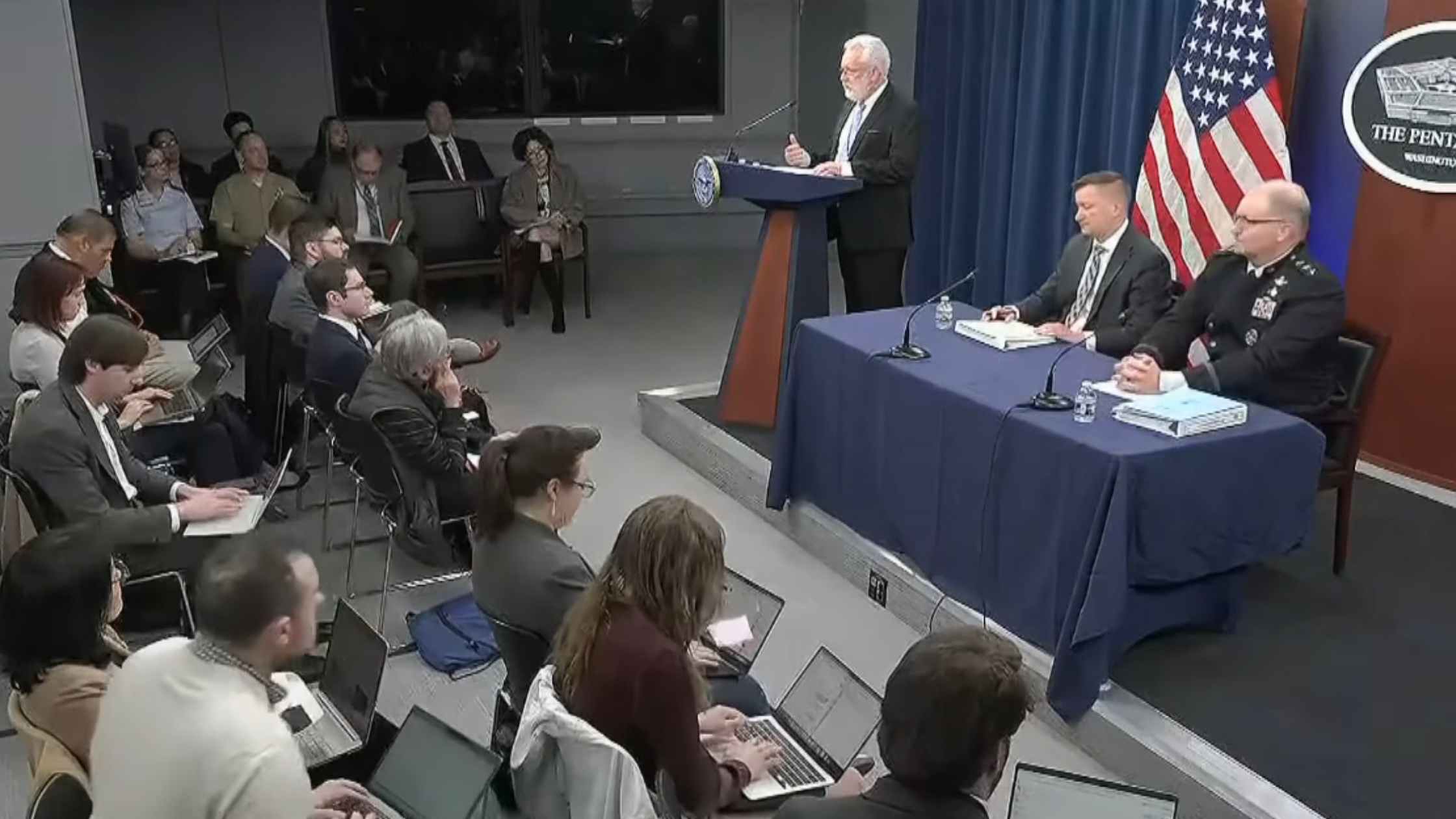
Bob Ditchey (00:13):
Okay. We should have everybody here now and we'll get started in just a second. I wanted to briefly mention materials. There are currently dash ones on the comptroller website and later today, as they become available, the J books will be posted on the comptroller website. And then by the end of the day, the slide presentation, which you'll see up here will also be posted to the comptroller website. And then a transcript of this briefing will be available and posted to war.gov transcripts.
Reporter (01:19):
Excuse me. Where will the transcript be?
Bob Ditchey (01:22):
The transcript will be on war.gov/[inaudible 00:01:26]. Okay. Good morning. My name is Bob Ditchey with the Pentagon press office. Today's briefing is on the Department of Defense Fiscal Year 2027 budget request. Speaking here today is the Undersecretary of Defense Comptroller, Chief Financial Officer, Honorable Jules, "Jay," Hurst III, and the Director of the Force Structure Resource and Assessment with the Joint Staff, Lieutenant General Steven P. Whitney. They will provide opening remarks and then we'll have time for questions.
(02:11)
Attribution is on the record. When we get to the question and answer period, please, when you ask your question, please state your name and the outlet that you're with. Please limit your questions to one and one follow-up. I'll let you know when we're nearing the end with a two-minute warning.
(02:35)
Following this brief, the Navy, Air Force and Army budget directors will hold their separate briefings sequentially here in the briefing room.
(02:45)
With that, it's my pleasure to introduce to you Honorable Jay Hurst and Lieutenant General Steven Whitney.
Jay Hurst (02:52):
Well, thanks for being here this morning. We'll go to the first slide.
(02:57)
We're facing one of the most complex and dangerous threat environments in our nation's 250-year history. Our adversaries are rapidly advancing capabilities across every war fighting domain, in the air, land, sea, space, and cyberspace, while years of underinvestment have strained our defense industrial base. To meet this moment, President Trump is submitting an FY27 national defense budget request of $1.5 trillion. This is a generational investment in the United States military, the Arsenal of Freedom.
(03:28)
This 42% increase will supercharge our defense industrial base by expanding production of major weapon systems while strengthening supply chains and supporting tens of thousands of small and medium-sized businesses. It secures our homeland and military advantage through investments in the Golden Dome Missile Defense System, drone dominance and space superiority, including nearly doubling the Space Force budget and tripling spending on drone and counter-drone capabilities. Finally, it ensures our military readiness by funding next generation platforms like the F-47 and B-21, modernizing our nuclear deterrent and delivering our commitments to our service members by putting forward the money to provide them with world-class housing and pay in line with the quality of their service.
(04:13)
Next slide, please.
(04:15)
Here's how that funding breaks down by service. The Department of the Army budget grows by 23.9%, the Department of the Navy by 24.3%, and the Department of the Air Force by 33.6%. While general Department of War funding increases by 22.6%. There is also a presidential priorities category in our budget, and that includes investments in Golden Dome, drone dominance, AI, and data infrastructure and, critically, the defense industrial base.
(04:45)
Next slide, please.
(04:48)
The FY27 defense budget will be the largest investment in military capabilities in over a generation. 52% of this budget will go to buy and develop war fighting systems, that's munitions, planes, tanks, and ships. In recent years, less than $400 billion has simply gone towards procurement and research development, test and evaluation funding. This budget allocates over $750 billion, nearly the size of the entire FY22 defense budget, just the capability development and procuring weapon systems. This budget represents the largest investment in drone warfare and space capabilities ever. The largest ship building request since 1962, and one of the largest budget requests for the Air Force and the Army during peace time in our nation's history.
(05:34)
Like the Reagan era buildup, this investment will drive job creation. By conservative estimates, it could generate over 800,000 American jobs, many in manufacturing and engineering.
(05:46)
Next slide, please.
(05:48)
Now, often when you have a defense budget, there's a balance between modernization and readiness. There's a tension there, but this budget does not have that tension. We are modernizing the force while making it more ready than ever. In building this budget, we reduce contract advisory services, unnecessary travel, duplicative programs, and we redirected that money towards maintenance, spare parts, flight hours, steaming hours, and training. We've also kept our civilian headcount relatively flat while doubling investment in facility sustainment, restoration, modernization, ensuring service members work and live in safe and high-quality conditions.
(06:25)
This budget request was specifically formulated to remediate all barracks and government-owned buildings and housing that is substandard. We will also make a significant investment remediating facilities across the department's inventory that do not meet our quality standards.
(06:39)
Next slide, please.
(06:41)
As we drastically increase the number of munitions and weapon systems we buy, the department needs to make investments to solidify America's industrial base. Large defense firms are critical to our national security, but they rely on tens of thousands of small and medium-sized businesses to provide the parts, components, and materials to larger firms. For example, the F-35 program alone has over 2,100 suppliers, and more than half of these are American small businesses. This budget invests over a hundred billion dollars to strengthen that ecosystem through Defense Production Act funds, the Office of Strategic Capital, and by increasing industrial based analysis and sustainment funding to unprecedented levels. This money will be used to provide low interest credit, loan guarantees, and to make direct purchases to expand production capacity, e-supply chain bottlenecks, and unlock private sector investment.
(07:33)
We're also expanding multi-year contracts, up to seven years for critical munitions, to provide stability and incentivize long-term investment across the supply chain. By doing this, we remove all excuses from defense companies from investing capital to improve their production facilities and by investing in their workforces. This will also give the small- and medium-sized businesses who supply larger firms with the surety they need to thrive and expand production.
(07:58)
When the Department of War oscillates between buying large numbers and small numbers of a weapon system, large defense companies can tolerate that fluctuation, but the small and medium-sized defense suppliers who aid them cannot. In every instance where we know we're going to continue to buy a system over a prolonged period of time, we're going to request multi-year authorities from Congress.
(08:18)
Additionally, initiatives like Business Operators for National Defense are bringing private sector expertise into the department to improve efficiency and execution. In this initiative, we've recruited former private sector executives and we set them to work across the department and with our defense contractors to change how we contract for goods and services, but also to change how we buy things and build things. This is all part of an effort to move the department from bureaucracy to a business mindset.
(08:43)
Next slide, please.
(08:46)
During the last administration, we had a recruiting crisis that required the joint force to reduce its end strength by 2.6%. This meant hollow units, it meant longer hours for our war fighters, more frequent deployments, and more stress on the force. In FY26, we reversed that decline by adding over 20,000 personnel. In FY27, we'll grow the force again by an additional 44,000 service members. This growth will provide the manpower we need to employ new capabilities, and it will improve readiness and quality of life by ensuring units are properly staffed for the missions we task them with.
(09:18)
Next slide, please.
(09:21)
Now, following President Trump's inauguration, the Department of War and Department of Homeland Security quickly moved to secure our southern border. Monthly encounters along the border dropped from nearly 100,000 in December to fewer than 10,000 by the end of January. The FY27 budget allocates $2.3 billion to sustain operational control of the southern border and to defend our homeland. Illegal immigration is effectively ended along the US border of Mexico, and this budget supports that new status quo.
(09:51)
Next slide, please.
(09:53)
We will also defend the homeland by continuing to build America's Golden Dome, a next generation missile shield. In FY26, we began building Golden Dome by focusing on creating the infrastructure to build situational awareness and sense threats. In FY27, we will expand that sensing network and invest in next generation interceptors. This investment in the security of America and Americans is an absolute game changer and its piece through strength in action.
(10:19)
Next slide.
(10:22)
As we defend the homeland from advanced missile threats, we're also investing in the revolution in autonomous systems. Drone warfare is rapidly reshaping the modern battlefield, and this budget is the largest investment in drone warfare and counter-drone technology in US history. We're requesting $53.6 billion for autonomy, drone platforms and contested logistics, along with 21 billion for munitions, counter-drone technologies, and advanced systems like the collaborative combat aircraft, the MQ25. Man, unmanned teaming is the future of combat, and this budget makes it a reality.
(10:56)
I'd like to introduce my colleague from the joint staff, General Whitney. Who will take you through the rest of the briefing, starting with space and cyber capabilities.
Gen. Steven P. Whitney (11:03):
Okay. Next slide.
(11:05)
Thank you, Mr. Hurst. I'd like to continue the discussion with several additional capability areas, FY27 president's budget requests investments and their impact on the joint force. As mentioned, I'll start with two focal points for strategic competition in the 21st century technological dominance space and cyber.
(11:21)
This budget requests over 75 billion to ensure American space superiority. This includes 31 space launches, $13 billion to develop and field missile warning and tracking capabilities, two GPS satellites and their supporting infrastructure, $5.9 billion for satellite communication systems, $7.7 billion for airborne moving target indication capabilities, and a $3.1 billion investment in our next generation space data network.
(11:52)
In the cyber domain, the FY27 budget requests over $20 billion for capabilities to defend federal systems, critical infrastructures
Gen. Steven P. Whitney (12:00):
... infrastructures and supply chains across all domains denying adversary freedom of maneuver in and through cyberspace while forging a cyber force capable of delivering greater lethality. This budget request is committed to securing America's vital national security and economic interests in, from, and to space while prioritizing cyber capabilities as a crucial component of national defense. Next slide, please.
(12:25)
Turning to the nuclear enterprise, America's nuclear capabilities are the bedrock upon which all other elements of our defense strategy rest. Our current nuclear enterprise remains safe, secure, credible, and ready. This budget request continues a generational modernization effort across all three legs of the triad to ensure the continued effectiveness of our nuclear deterrent. This includes, as shown on the slide, 16.2 billion dollars for the Columbia-class submarine program, which includes funding one new hall in its entirety, completing the incremental funding for the hall started in FY26 and providing advanced procurement funds for eight additional halls along with investments in the B21 bomber, the Sentinel ICBM program, and the long-range standoff weapon or LRSO.
(13:13)
In addition to these investments in our nuclear deterrence weapons and platforms, the request also includes 20.2 billion dollars of investments in nuclear command control and communications or NC3 architecture, ensuring timely, strategic missile warning reporting and strengthening presidential decision making and command of our nuclear forces. Next slide, please.
(13:35)
In the Maritime domain, this budget requests a consistent, strong demand signal to industry to expand production. It includes over 65 billion dollars for 18 battle force ships and 16 support ships as part of the Golden Fleet Initiative and our continued commitment to maritime dominance. It also requests 427 million for three medium, unmanned surface vehicles, along with the testing and development of their associated payload systems. It also includes an 8.7 billion dollar investment in the maritime industrial base and shipyard infrastructure. These investments span seven tier one private shipyards, four public shipyards, multiple tier two private shipyards, and includes funds to study a fifth public shipyard.
(14:22)
The maritime industrial based investments can be broken down further through a different perspective shown on the right of this slide. In areas of the submarine industrial base or SSIB, the shipyard infrastructure optimization program or SIOP, the broader shipbuilding industrial base or SIB, and the nuclear enterprise. Altogether, this budget request demonstrates a strong, sustained investment in our shipbuilding industry, allowing the Navy to build, maintain, and modernize a dominant ready fleet. Next slide, please.
(14:55)
Shifting to land power. The department is committed to the modernization of our ground forces to ensure our ability to dominate against our evolving threats. This request includes approximately 65 billion dollars split between the elements of the Army and the Marine Corps to procure new assets focusing on missiles, armed vehicles and helicopters. Honorable Hearst mentioned the investment and munitions earlier in the presentation. One piece of this investment is 31.8 billion dollars for critical land-based missiles with an increased procurement in FY26 of the Patriot, the terminal high altitude area defense or THAD program, precision strike missiles, and mid-range capability weapons. Those increases from FY26 to this request are displayed on the right of the slide.
(15:41)
On armored vehicles, the budget request is 3.2 billion in funds to modernize armored brigade combat teams with the procurement of armored multipurpose vehicles or AMPVs, the development of the XM30 infantry combat vehicle, and lethality and survivability upgrades of the Abrams tanks. The budget also requests 2.2 billion in funding for advanced next generation tilt rotor craft in the MV75, also known as the Cheyenne II, specifically seeking efforts in prototyping, testing, and production planning. These target investments allow for modernization across both the Army and the Marine Corps. Next slide.
(16:21)
Switching to air power. A request of 102 billion dollars is included for aircraft procurement and research and development representing a 26% increase over last year. It also maximizes readiness and aircraft availability by increasing sustainment and spares fundings across most platforms, producing the capabilities our war fighters need to fight and win. Some key highlights include, as shown on the slide, ramping up the procurement of the F-35 fighter aircraft to 85 for the United States. Expanding the F=15EX fighter production to 24. Continuing the development of sixth-generation fighter systems like the F-47 and the F/A-XX, and increasing the procurement rate of the KC-46 across the [inaudible 00:17:05] while also providing critical funding for modification spares and reliability improvements to increase the aircraft's availability. This request in expanded capacity should serve to maximize readiness, bolstering our ability to achieve air superiority in a conflict. Next slide.
(17:23)
Shifting from capability development to ensuring we have a ready force. Honorable Hearst mentioned this budget makes a focused, deliberate investment to ensure our joint force can respond to any strategic challenge. Up nearly 20% from FY26, this budget request includes over 190 billion dollars for core readiness and enablers. These investments cover a broad variety of joint force activities. A few examples are aviation training and flying hours, large scale force exercises, steaming hours, equipment and maintenance readiness, including spare parts. These investments will stand at the foundation of a credible, capable and rapid integrated response, consequently deferring our adversaries will sustain an effective operations over time. This deliberate, focused effort to improve the joint force-
AI (18:15):
Operational effects over time requires robust logistics and continuous adaptation.
Speaker 1 (18:18):
It's okay. We love each other.
Tony (18:20):
Gemini says you're right.
Gen. Steven P. Whitney (18:22):
Gemini says I'm right. Excellent. I got something right today. That's a great statement. Thanks, Tony. Again, this is a deliberate and focused effort to improve the joint force down to the individual service member.
(18:34)
Speaking of service members on the next slide, I'd like to talk a little bit about the pay raise that this budget request includes. This budget request includes a pay raise weighted towards our greatest military advantage, our professional enlisted core. Specifically, this request includes a 7% increase for military personnel in the grade of E5 and below, a 6% increase for personnel in the grades of E6 to O3, and a 5% increase for members in the grade of O4 and above. With this funding request, we directly invest in our people, recognizing and respecting our war fighters, their families, and the daily sacrifices they both make for our nation.
(19:14)
Next slide. Let me move on to another critical topic for our war fighter's readiness, healthcare. The military health system provides services to approximately 9.5 million beneficiaries, uniformed service members, military retirees, and their families. This budget proposes a structural change in how the department holds its healthcare funding, replacing the defense health program with two distinct accounts.
(19:39)
The first is combat, operational and medical readiness, or COMP. It is designed to protect and prioritize the critical resources needed to sustain war fighter health and medical readiness. The second account is a private sector care program or PSCP. It is designed to cover all the beneficiary healthcare provided through the TRICARE contracts. By splitting out the cost of private sector care into its own account, the department is enhancing transparency and accountability, making it easier to track how resources are balanced between military medical platforms and the care from our civilian partners. Together, these two accounts total 45.7 billion dollars in this request to deliver the healthcare our service members and their family needs. This is up 5% over last year's funding in the Defense Health Program. These changes are designed to ensure the department can deliver the needed medical readiness, a key component of a ready joint force and effectively and efficiently caring for their families. Next slide.
(20:42)
Similarly, this budget request supports our joint force by investing in our facilities. Honorable Hearst mentioned we're addressing the poor and failing structures in our facilities and bases. This is part of a requested 57 billion dollar investment in facility sustainment, restoration, and modernization. A major portion of this commitment, as was mentioned earlier, is ensuring our service members have clean, comfortable, and safe housing. We're specifically requesting funds to address what the Barracks Task Force has identified as critical updates. The investments in this budget will fix all substandard barracks and eliminate barracks that have been deemed poor or failing. There is an additional investment to improve family housing with a major portion of this investment targeted at our government owned housing facilities. Our joint force and their families deserve quality housing. We are committed to ensuring they have access to safe, well-maintained, and dignified living quarters and ultimately an improved quality of life. Next slide.
(21:45)
In closing, this FY27 President's budget reflects a clear assessment of the threats we face and a determined commitment to ensuring our joint force is properly armed, globally integrated, and ready when our nation calls. It invests in the capabilities required, the industrial base to produce them, and the readiness of our war fighters to utilize them effectively. Thank you for your time today and your commitment to covering our department and our joint force. We'd be honored to take your questions.
Moderator (22:14):
Okay. I'm going to call on both sides of the room, and we also have a couple of questions on the phone. I'm going to start over here. Haley.
Haley Britzky (22:22):
Thank you. Haley Britsky with CNN. Thank you both so much for doing this. I'm wondering if you can get into any, or talk about any requests that would come for repairing some of the installation of the bases in the Middle East, if that would be a separate supplemental for construction or how that would fit into the request?
Jules W. Hurst III (22:42):
Yeah, so it's not reflected in the '27 requests, and part of it is we would assess what our posture should be in the Middle East, right? We have to make sure we understand what we want to construct in the future. We might change how we build bases in the Middle East based on this conflict. And so that's not on the FY27 budget. It would be part of a future request.
Haley Britzky (22:58):
Got it. And then on the drone dominance and counter UAS technologies, can you just get into more, I guess, specifics on how much of that is investing in industrial base to create those versus buying some existing systems?
Jules W. Hurst III (23:12):
That 70 billion dollars is all going into existing systems and technologies. The industrial base support is entirely separate. Obviously, when you buy vast quantities of something, you stimulate the industrial base, but that is a focused effort on actually fielding technology and applying existing technology in a way that's useful to the war fighter.
Gen. Steven P. Whitney (23:31):
If I could, I'd also add, Haley, that it's critical that we innovate as we look at the drones in our counter UAS efforts. The evolution that we've seen in the battlefield is this evolution in technology is in a timeframe of weeks, not the typical years that we see with our defense production. So it's really critical that we work with industry to get that capability fielded.
Tony Bertuca (23:53):
Thank you. Tony Bertuca, Inside Defense. So the budget for discretionary is 1.15 trillion dollars with another
Speaker 2 (24:00):
$350 billion requested in mandatory spending. Obviously that needs the 100% buy-in of Congress and that's their challenge across the river. But my question is, if you do not get that mandatory spending, is the discretionary amount sufficient to carry out the national defense strategy if Congress can't get to that reconciliation bill?
Jules W. Hurst III (24:21):
We wouldn't ask for the money if we didn't want it. So we'll go back to the White House and we'll work with Congress to come up with a new strategy if the White House and Congress decide reconciliation is not the right vehicle.
Speaker 2 (24:31):
And then for General Whitney, obviously everything, it's a historic budget, but there's always a cut line. What kind of unfunded priorities should we expect to come out of the services now since this has been requested?
General Whitney (24:41):
I think this has been a generational investment as Honorable Hurst has said. I think what you're going to see coming out of the services and out of the combatant commands is a very balanced approach, recognizing this generational investment.
Speaker 3 (24:55):
Thank you [inaudible 00:24:56]. Tara.
Tara Copp (24:56):
Thank you, Tara Copp with the Washington Post. One quick cleanup on the ... So does the total of the ... I added up all the big pie chart and it's about 1.5. That does include the reconciliation request? Is that correct?
Jules W. Hurst III (25:08):
That's right.
Tara Copp (25:09):
Okay. And then on the procurement of the PAC-3s and the THAADs, you see the number and that's a huge number of munitions that you're seeking. What's the timeline you're looking at to get to that level of buy? Is that like over five years? Because I think it was like 1,000 plus of those munitions.
Jules W. Hurst III (25:29):
It's a massive ramp, but that's part of the department's strategy. We're going to give them a massive order. We're going to sustain it over time. And then we're going to have industry put forward the money to actually invest in their facilities, which is different than how we've done business in the past. Because before what we've done is we said we want you to increase production and then we've gone and paid for it. Industry has marginally increased production that way. We're making them put skin in the game. We're giving them a multi-year order and we expect them to meet the ramp rates that they agree to. And if they don't, there'll be penalties for them.
Tara Copp (25:55):
Okay. So it doesn't have a specific timeline yet, but you'll be expecting ramp rates.
Jules W. Hurst III (25:59):
There are agreed upon timelines for each agreement with every single defense contractor who's involved in these multi-year procurements.
Tara Copp (26:06):
Thank you.
Speaker 3 (26:06):
Konstantin.
Konstantin Toropin (26:09):
Thanks. Konstantin Toropin, Associated Press. Obviously this budget request comes on the heels of a major operation in Venezuela, an ongoing operation in Iran, which I mean, as Haley asked, has damaged bases. We've got an aircraft carrier that sustained a major fire. So I guess my question is, can you break out a little bit like the impact of those operations on this budget request? What are we seeing in here that is a direct result of the ongoing conflict in Iran?
Jules W. Hurst III (26:36):
Well, I mean, this budget was formulated honestly before we went into conflict with Iran, right? The overlap you'll see is the request for munitions, which is something we always need. We always need to increase our magazine depth. But outside of that, there aren't any operational costs in here from Iran.
Konstantin Toropin (26:51):
Thank you.
Chris Gordon (26:52):
All right. Thank you. Chris Gordon, Air & Space Forces Magazine. I also have a question on the munitions expended against Iran, but I understand it's not reflected in this budget. But how long will it take to replenish these munitions? I mean, as you've highlighted, it takes years to get munitions. So are you already planning ahead for that for next year and how long do you think it will take to replenish the department's stocks from what's been used?
Jules W. Hurst III (27:21):
I mean, every time we use something in combat, we're always looking at how to reconstitute and sustain that capability. So the department is obviously having those conversations and it's reflected not just in this budget request, but in any supplemental we would or may send over to the Hill.
Thomas Novelly (27:38):
Hey, Thomas Novelly, Defense One. For the nearly 1.5 billion for border related operational requirements in the national defense areas, can you provide a little bit more clarity on what that is? Is that construction? Is it surveying for expansion? Is it getting more equipment, trucks down there? Just any clarity you can provide on the breakdown of that.
Jules W. Hurst III (28:00):
Yeah. Thanks for the question. The bulk of the number is actually for operational expenses to sustain people on the border. There may be a little bit of construction there for temporary facilities.
General Whitney (28:10):
Yeah, temporary facilities at most.
Jules W. Hurst III (28:11):
But very little. General?
General Whitney (28:13):
No permanent structures.
Jules W. Hurst III (28:15):
None in this request.
Thomas Novelly (28:16):
And then as a follow-up to a related topic, 75 billion for space superiority. How much of that is counter space capabilities? You mentioned P&T and such, but is there a breakdown at all on anything more specific?
General Whitney (28:29):
No, sir. We didn't break that down intentionally.
Speaker 4 (28:34):
David Zere, Real America's Voice. Good morning. Does the munitions request include the recent announcement of tripling the capacity of the production of the PAC-3s? And how many of the PAC-3 and THAADs systems that are in this budget go towards protecting foreign entities or is that always separate in foreign aid budgets?
Jules W. Hurst III (28:57):
Thanks for the question. Yeah, it does include that massive ramp in PAC-3 purchases. So for the budget, we don't decide where munitions go, right? That's the decisions made inside the Pentagon and consultation of the White House. So right now we're focused on how many we're going to buy, and those would be decisions about operations to be made later.
General Whitney (29:18):
So if I could, sir, just to clarify a little bit, while we don't choose where we're going to employ them ahead of time, right? They are for the US stocks. They are for our capabilities. Foreign purchases are handled through a foreign military sales effort.
Ashley Roque (29:34):
Hi, Ashley Roque with Breaking Defense. I wanted to follow back up on the reconciliation plan. It's what? 350 billion, but a lot of high priority things in there, whether it's Golden Dome, munitions, the Defense Autonomous Warfare Group. What risk are you assuming by placing some of these top priorities within the reconciliation?
Jules W. Hurst III (29:57):
Yeah, thanks for the question. I would say like this, we put a lot of high priority things in there for a variety of reasons. If we use mandatory spending, number one, we have some more flexibility on when we obligate those funds. Number two, we did it for things that were kind of a one time plus up that we really wanted to increase our funding of. And then finally, when there's technology that's changing quickly, like for Golden Dome or for the DAWG, we try to put things there. If we're not successful in getting a reconciliation bill passed, then we'll revisit that with the White House and Congress to achieve our budget request.
Ashley Roque (30:29):
And then I also wanted to ask about the DAWG. Huge jump, $55 billion, but it looks like it's placed mostly in RDT&E, but reconciliation. Does that give you flexibility to actually make purchases or is this all going to be research and development? Is it spread among the services? Could you just sort of walk us through some of this?
Jules W. Hurst III (30:49):
I think of the DAWG as a pathfinder. They're out there finding the best technology for us and working on integration. They're with these companies live right now testing different systems and orchestration tools for autonomy, and they're giving them live feedback. So it's a very agile process. And a lot of the programs themselves will be executed through the services. General Whitney, you want to?
General Whitney (31:08):
I would say the question about research and development funding makes perfect sense in my mind because you're talking about innovation in terms of weeks and the ability to spin and develop new capabilities. It's really what we are. It's not that you're buying one set baseline and you're going to procure it forever. It's an incremental capability, which if you look at the federal regulations, it tells you that's research and development type money.
Ashley Roque (31:31):
Just sorry, one clarification. Since it is reconciliation, could you use some of that for procurement or it's just 55 billion?
General Whitney (31:39):
And you can buy items with research and development, but you just typically don't buy a large lot of things of one particular thing.
Speaker 5 (31:47):
Thanks for doing this. I actually have three unrelated questions. First, last year we had a couple billion in Pentagon funds that was taken out for military barracks in Japan and they were put towards the border. You said all of the issues with the barracks are funded. Are you backstopping that? Is that going to be taken care of completely?
Jules W. Hurst III (32:11):
So what we did is we have a list of barracks that are in poor and failing condition. We created a building condition index. And I think if you're below 80 on that index, you're considered poor or failing. So we went through and calculated how much money we'd have to invest to remediate every single barracks that's in that condition. And then that's what we say we're going to remediate all the barracks that are poor or substandard.
Speaker 5 (32:34):
So the assumption is that they were all on that list.
Jules W. Hurst III (32:34):
Yeah. If they are on the list, then we're going to remediate them.
Speaker 5 (32:36):
Okay. And then, so the second clarification is you had mentioned that none of the fixes for any of the damage under this war are included in this. So there's going to be a roughly $200 billion supplemental. So in total, the American people can expect 1. 7 trillion to DOD? Is that the total ask that's going to be coming down the pipe? 1.5 trillion plus 200 billion?
Jules W. Hurst III (33:10):
Well, as Director Vought said in testimony, I think last week, we don't have a final number for a supplemental request and we don't have a final number for what the damage is to our installations overseas. It really depends on how we decide to rebuild those or if we do. Our partners also might contribute a share to that construction. So we don't have a great estimate for what it would take to reconstitute those facilities.
Speaker 5 (33:32):
Okay. And then finally, what is the number one priority if you had to? I know that there are several priorities, but where is the greatest need right now where the budget should fix problems?
Jules W. Hurst III (33:45):
This budget is engineered to try to reconstitute America's defense industrial base and give us capacity. That's the number one priority for me, although General Whitney-
General Whitney (33:55):
I was going to say, I would go the opposite, right? And this is the beauty of this budget, right? By having a budget of this size, we are not forced to make that trade between investment in the capabilities we need and the readiness of our force. And so to me, the beauty is we can have both in this conversation and then we're really interested in that readiness piece.
Speaker 3 (34:17):
Okay. We're doing good on time. I do need to take a couple from the phone. Brandy Vincent.
Brandy Vincent (34:24):
Hi, thank you so much for doing this today. Following up on Ash's questions about the DAWG. So a little bit more on that. It's mostly for drones and drone related software across all military domains, but it doesn't represent all of the drone investments, these massive drone investments that you guys are making. Can you provide a little bit of clarity on the difference between those two? And then is there anything for counter drone technologies within the DAWG funding as well?
General Whitney (34:55):
Hey, so thank you very much for the question, and I'll try and answer both questions at the same time. I know that's a challenge for many folks. So if I don't get this right, say so. So we talked about in autonomous operations and autonomous offensive capabilities put forward by the DAWG of about 54 billion. There's also $20 billion in requests for countering small drones or counter small UASs. We look at that as a capability that's necessary that we've seen in the battlefields. If you look at what's going on in Ukraine and their ability to have drone on drone type warfare and the ability to do so at cost and scale, it's really something that we need to figure out how to take advantage of to protect our force. And so we are making that investment in the counter drone capability as well.
Speaker 3 (35:46):
Okay. One more from the phone. Jeff. Jeff Schogol.
Jeff Schogol (35:50):
Thank you. General, when you were talking about the money that's going to barracks and also military bases, I believe I heard you say 57 billion. Is that figure correct or is it 37
Jeff Schogol (36:00):
... 37 billion. Thank you.
General Whitney (36:01):
Sir, it's a 57, $57 billion in facilities, sustainment, restoration and modernization, of which includes the barracks money, the housing money, and other facilities work across the department.
Bob Ditchey (36:17):
Okay.
Brianna Riley (36:18):
Hi, Brianna Riley with Punchbowl News. Quick follow up, Mr. Hurst, just something that you said before. You mentioned penalties for contractors that don't meet the ramp out rates laid out in the multi-year procurement framework agreements. Could you just sort of expound on what those are, what they look like? Then I have an actual budget question after that.
Jules W. Hurst III (36:34):
I'll give you something very general, if that's okay. So first off, like I said, we're requiring contractors to foot the bill for CapEx, which is something we haven't done before. So in order to pay for that CapEx, they have to sell a certain number of munitions in the United States. If they don't meet their production goals, they're not going to do that. So their loss, their initial penalty is the CapEx itself if they don't meet production rates. And then there will be provisions in contracts to penalize contractors who don't meet production ramp rates as well.
Brianna Riley (37:01):
And then budget question. Obviously, munitions are a massive ramp up, as you said, in this budget request, tens of billions of dollars going towards these critical systems. How would a supplemental request be any different, especially when it comes to munitions?
Jules W. Hurst III (37:15):
There could certainly be overlap in a supplemental request because there is going to be a focus on munitions in this budget or a supplemental. And if that was the case where we had overlapping requests, we could talk to the White House and Congress about how we want to revise them, especially the budget.
Bob Ditchey (37:29):
We've got five more minutes left.
Todd Wood (37:31):
Thank you. Todd Wood from CDM. There's been a view in the force, especially during the global war on terror, that the trend towards centralized command has had a negative impact on commanders in the field. You also saw that in the Ukraine war with being controlled and a lot of negative decisions many think. Does this budget support that centralization? Does it drive it forward or does it support commanders in the field? I have heard that there's a multi-billion dollar CC program.
Jules W. Hurst III (38:00):
Yeah, that's an interesting question. I don't think the issue is commanders having awareness. I think that's more of a cultural issue where commanders need to understand when they need to insert themselves in the chain of command and when they stay out and let subordinates take the lead because they have better situational awareness-
General Whitney (38:16):
I was going to say, that's the age old question, right? As somebody on the tactical battlefield, you see your tactical space, but the operational commanders obviously can see multiple tactical pictures at the same time. And so how do you have that conversation between the two? The principle of warfare has always been centralized direction, decentralized execution. And so I think we continue that with this effort.
Todd Wood (38:38):
Supplemental. Is there any funds in this budget for the Ukraine conflict that you know of? And also, have you scrubbed it for DEI initiatives for this year?
Jules W. Hurst III (38:46):
There's no DEI money in this budget, that's for sure. As far as Ukraine conflict, one of our big problems as a country, is we haven't been able to produce enough to support our allies and partners, whether it's munitions or aircraft or a variety of systems, and the waits for FMS have grown longer and longer. So in a way, this budget is engineered again to produce more, which gives the Commander in Chief and Congress more flexibility in how we aid our allies and partners.
Todd Wood (39:12):
Thank you.
Bob Ditchey (39:12):
We're doing good on time.
Marcus Weisgerber (39:15):
Hey, Marcus Weisgerber with the Wall Street Journal. As you mentioned there, the budget's 1.5, 750 billion is procurement and R&D. Given the reductions in the federal workforce, how confident are you that you'll be able to execute this in a timely manner?
Jules W. Hurst III (39:31):
So one of the major challenges of this budget is to be able to obligate dollars in a timely manner because it's such a large increase. But we haven't been taking away workforce from areas that are involved in critical efforts like the dog or space acquisition, which is where a lot of this money goes. And so I think most of our workforce cuts have been in things that will not be ... These people will not be directly out getting [inaudible 00:39:55] people left the workforce.
Marcus Weisgerber (39:55):
As a quick follow up, the current reconciliation, I believe 98% of that's going to be spent over a year. What's your thinking on the 350 over the timeline if you're going to actually spend it?
Jules W. Hurst III (40:08):
It'll depend. So for some things, let's go to Office of Strategic Capital. They're getting $20 billion in this budget. If they have a ton of good initiatives that they want to fund and offer loan guarantees or loans for in that first year, they might try to use all the money. If they don't have a lot of good opportunities, they may delay obligating those funds into future fiscal years. And then that's part of what we were doing when we engineered the reconciliation part of this budget. We were looking at things where we may need that flexibility based on opportunities.
Bob Ditchey (40:37):
Good time for two more questions.
Speaker 6 (40:40):
Thank you. [inaudible 00:40:41]. Thank you for recording this briefing. And I'd like to ask about deterrence in the Indo-Pacific region, especially the Pacific Deterrence Initiative or PDI. What is the total funding level for PDI? And how does that compare with fiscal year 2026 in terms of increase or decrease?
Jules W. Hurst III (41:05):
Yeah. I mean, I would guess that the amount of funding in this budget that's relevant to the Indo-Pacific has drastically increased. I don't have a number of what would directly fall under PDI at this time.
General Whitney (41:16):
I don't have a number for you either, sir. I know that Admiral Paparo is satisfied that we have addressed his concerns as a part of this budget.
Speaker 6 (41:23):
Thank you.
Bob Ditchey (41:25):
Yes.
Michael Casey (41:25):
Yes. Michael Casey with O'Keefe Media Group. Thank you. Good morning. Do you know if there's anything in the budget for an internal anti-espionage training for Department of War, Pentagon, and Department of Army employees?
Jules W. Hurst III (41:38):
We have a curriculum and coursework around that already that people take on an annual basis. It's, I think we call it insider threat training in the department.
General Whitney (41:47):
Yeah. I would assume it's just contingent.
Michael Casey (41:49):
Has that changed at all in the Trump administration compared to previous administrations?
General Whitney (41:54):
I don't have any information to provide to you, sir. Sorry.
Bob Ditchey (41:55):
[inaudible 00:41:58].
Tony Capaccio (41:58):
Yeah. Tony Capaccio with Bloomberg. You're going to be asked this repeatedly because you can't pass an audit. There's no modified audit opinion. Why should the Pentagon be trusted with the obligation and tracking of this multi-billion dollar generational investment? And then for general, a easier one for you. On the F-35, you're ramping from 47 to 85. This plan's had miserable to substandard MC rate, mission capable, and full mission capable rates. What dollars are allocated in this budget to help beef up those mentioned capable rates while you keep buying the airplane?
Jules W. Hurst III (42:34):
I appreciate the question. No, I do actually, because we're making progress in the audit. I expect the Navy to get a working capital fund opinion in '26. I think they're going to get their general fund opinion in '27. I think the Department of War will get a working capital fund, a consolidated one in '27, and I think we have a real shot at getting an opinion by '28 for the general fund. We've changed our approach. We're taking a more centralized approach. We're applying new technology to help us reconcile data. Generative AI is a game changer for that. Marine Corps passed their audit through brute force. They get a lot of people to look at Excel sheets and reconcile data. We can do that with technology now. And so it's really changing how we approach the audit and our likelihood of achieving one within this administration.
Tony Capaccio (43:13):
These are correlation though between not having a modified audit opinions and the ability to track the obligations and the expenditure, the efficient expenditure of those.
Jules W. Hurst III (43:23):
Tracking obligations has never been an issue for us passing an audit. It's more like this. We buy a nuclear missile in the 1970s, and then we have to account for the present day value, which includes every single repair or modification we made to that missile over 50 plus years. That's the kind of stuff that makes it hard for the department to get an audit. It's not tracking our funding in the year of execution.
General Whitney (43:45):
I should have gone first and let you finish with the audit question. Hey, Tony, thanks. On the F-35, you asked about increasing the U.S. production ramp rate. What that is that's increasing or the portion of the US buy at Lockheed Martin. We know what Lockheed's current max production capability is, and we're just taking a larger chunk of that for the U.S. capabilities. This budget also funds the Block 4 upgrades and modifications, as well as investments in making sure we've got the supply chain necessary. I don't have a specific breakout of funds for you. We can get that for you afterwards, if you don't mind. But it is an investment that we are worried about and we are very concerned about making sure that the F-35 is the most capable airframe out there.
Jules W. Hurst III (44:28):
[inaudible 00:44:29] if there are parts, are there billion dollar increases in spare-
General Whitney (44:33):
... There's a significant increase in spare parts across the entire department.
Jules W. Hurst III (44:37):
Particularly in the F-35 though. We think that's been underfunded in the past as a part of the budget. We're increasing F-35 spare parts funding.
Michael Casey (44:46):
To get up the MC rate issue.
Jules W. Hurst III (44:46):
We're going to move the MC rate up.
Speaker 7 (44:49):
One last reconciliation cleanup question. Is there a chart that shows all of the priorities that are in that are funded by reconciliation versus funded by the base? Can we get that or is that part of the slides that we just-
Jules W. Hurst III (45:01):
We're going to have a justification book that lays out exactly what's in reconciliation to make it easy for everybody. And it's also broken out [inaudible 00:45:09] website-
Speaker 7 (45:11):
... The broad categories that are in the reconciliation versus ...
Jules W. Hurst III (45:14):
Yeah. Defense industrial based funding. That's a huge chunk of it. There's a large chunk for munitions. There's a large chunk for AI and data infrastructure. And a lot of the FSRM, which is geared towards remediating failing poor condition barracks is in there as well.
Speaker 7 (45:29):
I mean, at least some of them seem like kind of critical priorities, especially like the munition stuff, but there's also a lot of question about whether that's actually going to get through Congress. What's the alternative plan if you made resistance there?
Jules W. Hurst III (45:42):
Well, first off, we're going to do a good job explaining why we need this to Congress and the authorities. And last year, they gave us the multi-year authorities for eight critical munitions. We expect to ask again for the rest of those and receive them, and we continue to have dialogues with our congressional partners about the necessity of this and our approach.
Speaker 8 (45:59):
Do you have the fitting figures for the Golden Dome? Oh, can you read them off to us from your charts?
Jules W. Hurst III (46:03):
I don't have it on my chart right here.
Speaker 8 (46:05):
Can you get those because that's pretty significant and we get the one year, but it'd be useful to get it for the public to know over the next five years, year by year, Golden Dome expenditures.
Jules W. Hurst III (46:14):
I believe General Guetlein's put out the total cost of the program to the public, but that's not just the fit up. That goes out to 2035.
Speaker 8 (46:22):
I'm asking for the fit up here.
Jules W. Hurst III (46:23):
Yeah, we can look at getting you that answer.
Speaker 8 (46:24):
Thank you.
Bob Ditchey (46:25):
Okay. We're going to have to end it there. Thank you very much. I realize there are some of you that still have questions. Please send me your questions. I'll make sure that those get turned in. Just a quick mention about materials. I mentioned at the beginning of the brief that these slides will be available on the comptroller website by the end of the day. And then the J books as they become available will also be on the comptroller website. That's all we have time for today. Please stand by for the Navy's brief, which will be followed by the Air Force budget brief. And then at 1400, the Army will brief. Thank you very much, sir. Both of you.
Jules W. Hurst III (47:11):
Thank you very much. Appreciate it.