Announcer (00:25):
Please welcome Pastor Timothy McMurtry who will lead us in an opening prayer.
Timothy McMurtry (00:36):
Good afternoon, everyone. As has been mentioned, my name is Tim McMurtry. I serve as Wisconsin State Coordinator for Christians United for Israel. I also serve as North Campus Pastor for World Outreach and Bible Training Center in Milwaukee, Wisconsin. It gives me great pleasure and honor to be with you all here on today. I thank you, Ambassador, for having this event. I also want to thank Ms. Morgan Ortegas for the invitation and thank Ms. Minaj for coming in and really showing her courage in standing up for this serious issue.
(01:11)
With that, I'm going to lead us in prayer. Father God of heaven and earth, we thank you and we bless you for this day, for this is the day that you have made and we will rejoice and be glad in it. Father, we stand in the gap for our Christian brothers and sisters in Nigeria. And you said in your word, Father, that you would never leave us nor forsake us. So we thank you for your hedge of protection. We thank you now, Father, for miracle signs and wonders, breaking, Father God, the spirit of attack and murder that they are facing right now.
(01:45)
Father, we come to you boldly before the throne of grace to obtain mercy in our time of need. And we thank you for living up to your word and never leaving us nor forsaking us, like your Word says. And on today, Father, let every speaker that comes today, every panelist, fill them with the spirit of wisdom and revelation in the knowledge of you, opening the eyes of our understanding, showing us, Father, ways, strategies, methodologies, that we can make an impact and a difference in this situation right now. Father, you said for us to be anxious for nothing but in everything by prayer and supplication with thanksgiving to make our requests made known unto you. So we appeal to you now, Father, as Christians, as faith people, as believers of God, to intervene now as only you can.
(02:38)
Finally, father, this is the confidence that we have in you, that if we ask anything according to your will, you hear us. And if we know that you hear us, we know that we have the petitions which we have requested of you. So we thank you for a supernatural move of God intervening in Nigeria on the behalf of our Christian brothers and sisters even now, in this time, in this season, and we thank you, Father, for a fruitful, productive meeting on today. And we thank you for outcomes and fruit that remains coming as a result of this meeting. We thank you for this, and we believe, expect, and receive it in the matchless name of Jesus the Christ. Amen and amen again.
Announcer (03:26):
Please welcome the U.S. Ambassador to the United Nations, Michael Waltz.
Michael Waltz (03:35):
Oh my goodness. Thank you so much for everyone who has joined us today and for a number of our ambassadors and delegates who have joined us. Thank you for coming to our faith leaders, survivors of some of these atrocities, and what I would call everyone here, a friend of freedom. Welcome to the United States Mission to the United Nations.
(04:03)
Today we speak of blood, and we speak of the blood that still cries from Nigerian soil. This is deeply personal for me, as I know it is for Ms. Minaj and her pastor here, Peters Adonu, and others. I had the opportunity to serve in Nigeria in 2015, if you remember, when then 300 little girls were kidnapped from their schools, ripped out of their homes and schools in the middle of the day and in the middle of the night. We sent a small team over there and we trained Nigeria's equivalent of their Navy SEALs to go get those girls back. It was righteous work. We didn't get them all back unfortunately, but we got some. Some will be lost forever.
(05:06)
And if you remember the infamous Save the Girls campaign, that was 10 years ago, folks. It's still happening. It just happened yesterday. 25 little girls were ripped out of their school. I pray that we get them back, but what often happens is they're sold into sex slavery. They're forced to renounce their religion. They never see their homes or families again. And they literally disappear to the dark underbelly of extremism and sex slavery.
(05:45)
Look, 10 years later, the horror continues. In the middle belt and in the north, churches burn. Mothers bury their children for the crime of singing Amazing Grace. Pastors have been beheaded. Pastors have been beheaded for preaching the Sermon on the Mount. Entire villages wake up to gunfire because they dare to commit the crime, the crime, of calling Jesus their Lord. People go to jail under blasphemy laws for simply wearing a cross. This is not random violence. This is genocide wearing the mask of chaos.
(06:36)
Nigeria is Africa's most populous nation and a vibrant mosaic of cultures and faiths, but it is under siege. And in the northern region, you have 12 Muslim-majority states that are enforcing Sharia law and have enforced it since 1999. Jihadi groups like Boko Haram and the Fulani militias continue to unleash targeted violence, it is targeted, it is specific, on these Christian communities. This year alone, the NGO, the nonprofit Open Doors, reports a very sharp rise in attacks. They're reporting 80% of the violence against Christians worldwide is occurring in Nigeria. Thousands are displaced, are killed, in faith-based reprisals. So a few weeks ago, the United States designated Nigeria a country of particular concern for severe violations of religious freedom, spotlighting what can only be described as the government's failure to curb these atrocities. And while Nigerian officials maintain that terrorism strikes all faiths indiscriminately, and they do, there is a body of evidence, and you are going to hear that from our experts today, that paints a very grim picture of disproportionate suffering among Christians where, again, families are torn apart. Clergy is repeatedly assassinated, and entire congregations, church congregations, and you see some of the images here, are driven into hiding.
(08:28)
Folks, we have an entire faith that is being erased one bullet at a time, one torched Bible at a time. Yet in the face of this evil, one leader has refused to look away. President Trump has made the persecuted church his priority like no other president before him in American history. He was the first U.S. president to convene world leaders right here at the United Nations in 2019 to draw attention, draw the world's attention, to what is happening. He created the Religious Liberty Commission to fight for believers everywhere. And while Nigeria's Christians cried out, he answered, and he has answered loudly. He has reminded the world that protecting Christians is not about politics. It is a moral duty.
(09:25)
Inspiration alone is not enough. We need voices that pierce the silence that we've heard from the international community, that humanizes these statistics that we keep hearing, and that demands accountability. And that's why we're here today, to hear from a pastor that will dial in through our embassy in Nigeria, and we're going to hear his firsthand accounts of the suffering. We're also going to hear from experts who have dedicated their lives to religious liberty.
(09:55)
I especially want to thank my friend Harris Faulkner, who in addition to just being an amazing person is also the daughter of a U.S. Army colonel, so that makes her extra special in my heart. And she has spent much of her career protecting this most basic… Folks, this is the most basic of liberties. To worship as one sees fit.
(10:26)
But we are especially thrilled that we're going to hear from an especially powerful voice, a fearless advocate whose passion for justice transcends borders, and she uses her voice to defend the voiceless. Hers are not empty words. They are a clarion call echoing the U.N.'s, the United Nations', own Universal Declaration of Human Rights, which proclaims that "everyone has the right to freedom of thought, to freedom of conscious, and to freedom of religion." She steps onto this world stage not as a celebrity, but as a witness. She uses and has used her influence to spotlight Nigeria's persecuted church, reaching out to her 28 million followers. Her Barbz, as I've now learned. And she uses this and as she steps on this global stage to fund emergency relief and to demand action.
(11:37)
Nicki, I can't tell you how much I admire you. You're stepping up. You're leaning into this issue. You've enjoyed amazing success and you could be sitting back and just enjoying it. You could be just living the good life, but you're willing to come here today and roll up your sleeves and let's try to solve this. Let's try to save these people.
(12:07)
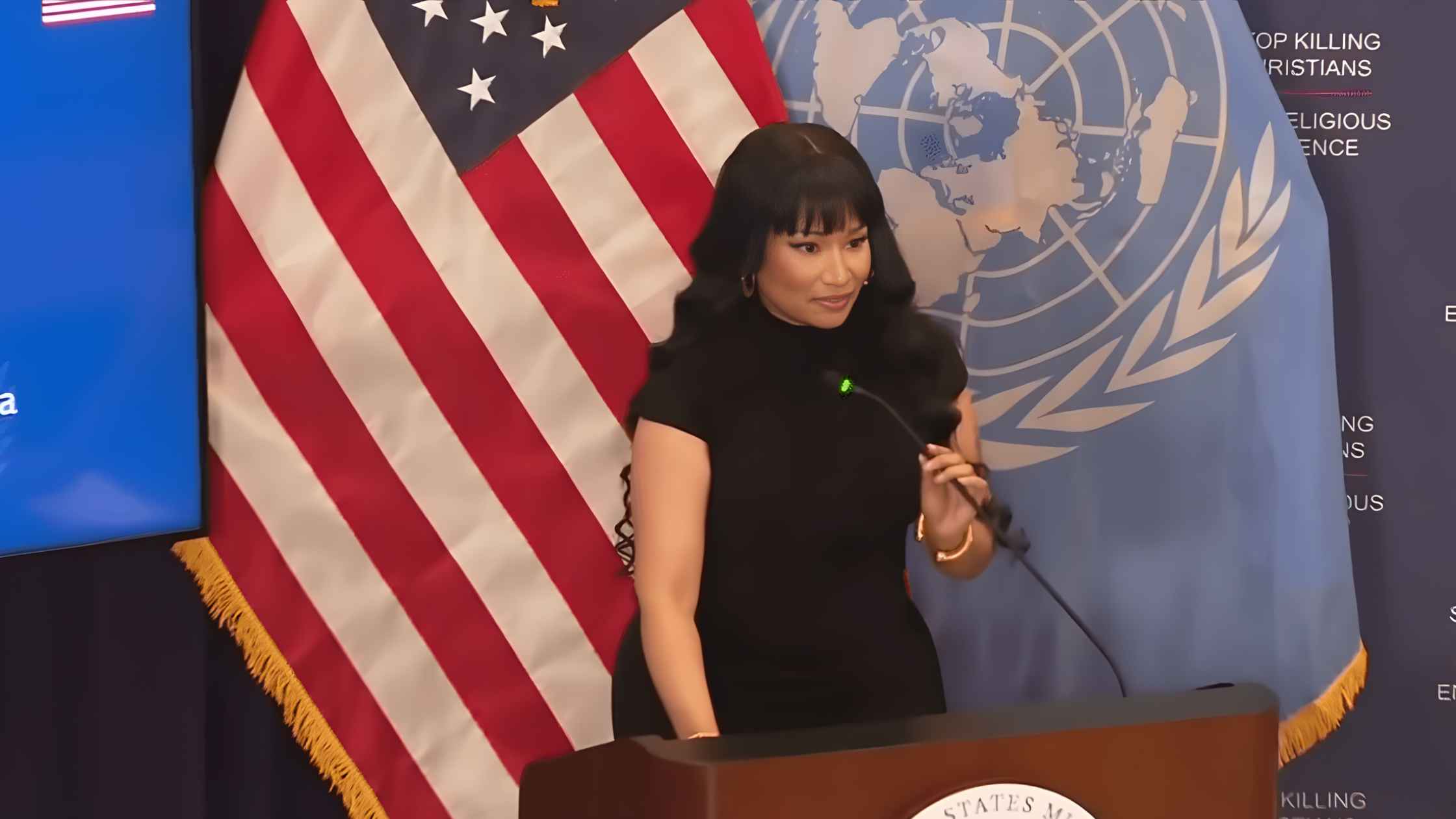
So everyone, please join me in welcoming a daughter of the Caribbean, a champion of the oppressed, and a sister in Christ, Nicki Minaj.
Nicki Minaj (12:24):
Hello, everyone. I must say I am very nervous, so please… Well, thank you, Ambassador Waltz, for this invitation. It is an honor to stand on this stage with you and the other distinguished speakers here today to shine a spotlight on the deadly threat faced by thousands of Christians in Nigeria. I would like to thank President Trump for prioritizing this issue and for his leadership on the global stage in calling for urgent action to defend Christians in Nigeria, to combat extremism, and to bring a stop to violence against those who simply want to exercise their natural right to freedom of religion or belief. I stand here as a proud New Yorker, with a deep sense of gratitude that we live in a country where we can freely and safely worship God regardless of one's creed, background, or politics.
(13:50)
No group should ever be persecuted for practicing their religion, like I recently stated on social media. And we don't have to share the same beliefs in order for us to respect each other. We are way beyond thinking or expecting or assuming for the person sitting next to you to have the exact same beliefs. We're beyond that. That's ridiculous. But that shouldn't make one person feel less safe than anyone in any room.
(14:23)
Music has taken me around the globe. I have seen how people, no matter their language, culture or religion, come alive when they hear a song that touches their soul. Religious freedom means we all can sing our faith regardless of who we are, where we live, and what we believe. But today, faith is under attack in way too many places. In Nigeria, Christians are being targeted, driven from their homes, and killed. Churches have been burned, families have been torn apart, and entire communities live in fear constantly, simply because of how they pray. Sadly, this problem is not only a growing problem in Nigeria, but also in so many other countries across the world. And it demands urgent action.
(15:24)
And I want to be clear, protecting Christians in Nigeria is not about taking sides or dividing people. It is about uniting humanity. Nigeria is a beautiful nation with deep faith traditions and lots of beautiful Barbz that I can't wait to see. When one's church, mosque, or place of worship is destroyed, everyone's heart should break just a little bit, and the foundation of the United Nations with its core mandate to ensure peace and security should shake. I'm joined here today by peace builders, by faith leaders, by those who saw violence, saw a rising intolerance, saw the threats clearly before us, and chose not to look the other way. I'm inspired by their work to build interfaith ties, to see the humanity across the lines which might divide us, and to fight for security and liberty for all those who pray.
(16:39)
I look forward to our discussion today and I hope it will encourage deepened solidarity for us to urgently work together to ensure every person can enjoy the right to believe, to worship, and to live in peace.
(16:57)
Barbz, I know you're somewhere listening.
Nicki Minaj (17:00):
… Listening. I love you so very much. You have been the ultimate light in my life and career for so long. I appreciate you and I want to make it very clear once again that this isn't about taking sides, this is about standing up in the face of injustice. It's about what I've always stood for my entire career and I will continue to stand for that for the rest of my life. I will care if anyone anywhere is being persecuted for their beliefs. Thank you.
Speaker 1 (18:03):
Please welcome our panelists for today's discussion, six-time Emmy Award-winning Fox News Anchor, Harris Faulkner. Senior Counsel for Global Religious Freedom with Alliance Defending Freedom International, Sean Nelson. Former deputy assistant to the president and senior director at The White House National Security Council, and senior advisor to the president on International Religious Freedom, Sarah Makin. And finally, joining us virtually from Obubra, Nigeria, Reverend Gabriel Makan.
Harris (18:57):
Well, thank you all for being here today. Nicki Minaj, wow, I wrote down what you said, "Religious freedom means we all can sing our faith." So beautiful. So honored to be here with all of you. Reverend and Sarah and Sean, I want to give just a few scene-setting facts if you'll grant me the gifts to do so. Nigeria is the most populated country in Africa. As of 2025, so this is really up-to-date, an estimated 237.5 million people live in Nigeria. It's the sixth most populated country on the planet and there is a lot at stake why we're here today. Half of all Nigerians are under the age of 18. Only 7% of the population is over the age of 50, and that means life is short for many. So when we talk about the systematic killing of Nigerian Christians, you must know they are mostly young girls, young boys to young parents.
(20:08)
Who will protect the Christians? That's why we're here today. Who leads Nigeria is an interesting question. The Nigerian president Bola Ahmed Tinubu is a Muslim. It is a Muslim-majority nation, about 53%. The other large religious group is Christian, about 44%, and sundry other faiths make up the smallest percentage. I note that Tinubu's wife, Remy, is a Christian and ordained pastor. We'll see if that matters. We do know that Tinubu has rejected President Trump calling out the mass deaths in Nigeria, although the president has definitely gotten Tinubu's attention. Reportedly in response to Trump, the Nigerian president has now recently promised to "fight terrorists through diplomatic engagement". And Ambassador Walsh and I were speaking earlier, there is some movement, you spoke of that today.
(21:12)
But there are more than 7,000 Christians who have died from just January to August of this year. So now in mid-November you can make that number bigger sadly. So I questioned Tinubu's timetable for those diplomatic conversations to happen, since he seems to think that diplomatic engagement can end this. There are currently now 22 radical Islamic terror groups in the country of Nigeria. Can you imagine 22 of those groups in this country? It's unbelievable. Thousands of them. Some aligned with ISIS. The stakes are high.
(21:54)
One more quick detail back to who holds the power of Nigeria. The area of North Central Nigeria is one of incredible loss right now. You heard it referenced, they call it middle belt, where most Christians are being kidnapped and executed. The images and the stories are too horrible for our hearts to bear. That is why we're here today. Let's begin with that really hard part. And Reverend Makan, I come to you. What are the religious realities on the ground for Christians right now?
Reverend Mukan (22:37):
Well, thank you for having me join this panel. Let me first of all begin by expressing deep gratitude and appreciation to the US Congress and President Trump for turning the spotlight on Nigeria at this time, as it has to do with violence against Christians. We've been experiencing this for a quarter of a century and it has been an extremely difficult experience for Christians. Jos, where I come from, is considered as the umbilical cord of Christianity in Northern Nigeria. Jos is the host of western missionaries that have had calling to come and evangelize. So Jos is the umbilical cord for missionaries.
(23:49)
And so, Jos became the first and primary target for Islamic extremism to launch their violence. And it has been a difficult experience, because whole communities, villages have been extinct as a result of this violence. I wish we have a lot of time, because just in two counties there are a whole lot, like 67 villages that have literally been wiped out because of the extremist attacks, especially by the Fulani militants. And of course, the Fulani militants are the foot soldiers for forceful advance and expansion of Islam in Nigeria. I don't know if I've said enough or I will still have the opportunity to say more.
Harris (24:48):
I'll tell you this, I want to go around the panel and then I'll come back, reverend. I want to get a good idea, and Sean, maybe you can fill us in based on what you have seen. What actually is the motive for killing particularly Christians? And I love the way that Nicki Minaj put it, because this is not about picking sides, but it is about faith and more Christians than anyone in that nation are being executed. Why?
Sean (25:13):
That's absolutely right. And much of it started from 2009 with Boko Haram. They became militant, began attacking, and as Ambassador Walton said, began kidnapping schoolgirls, that continues now even today to raise funds or to buy weapons and all sorts of things. It could have started earlier when the Sharia criminal laws were passed. We're supporting a case right now at the Supreme Court of Nigeria that's being heard right now, so this is wonderful timing, to help overturn the death penalty blasphemy laws there. There's a young Sufi man, actually, Yahaya Sheriff-Aminu who's facing the death penalty for alleged blasphemy for song lyrics. So it could have started then.
Harris (25:55):
For song lyrics?
Sean (25:55):
For song lyrics shared over WhatsApp. That's absolutely right. At the Supreme Court, September 25th, a county state lawyer said they plan to execute this young man for alleged blasphemy. So it could have started there. In the last five years though, we've seen an extreme rise in that middle belt region. Thousands of Christians killed every single year, 2020, 2021, '22, '23, and now with 7,000 just this year. And since the president's designation, at least 78 have been killed across many states. When they come into these villages, they shout, "Allahu Akbar," they attack the churches first. I visited with one of the communities, a number of the villages that had faced these attacks just south of Jos, and spoke with a new pastor there, because the previous pastor had been beheaded and his head was found behind a church, but they were still worshiping there.
(26:51)
That same morning we went to another church where they had come back from the internally displaced persons camps, which were horrible. They were so terrible. They said, " We're going to risk it being with these militants there." And I enter this church, it's empty. There's a white shining cross there and there's no roof, because it was burned off. And all of a sudden, hundreds of villages come in and begin seeing hymns praising God. You go there and we say we want to help them, but they're a witness to us as well of the power of their faith, of the power of Christ. So what they are going through is unimaginable across Plateau, Benue, Taraba, but there faith is so strong, that's great encouragement that we can actually turn the tide of this persecution.
Harris (27:35):
And Sarah, it's because of that, that so much is at stake here, I mean if we let those lights of faith go out. And I know the Pope has even addressed this issue, because Nigeria has the largest number of Catholics in all of Africa and they're killing them. And by the way, I'm one of those journalists who talks about our faith openly. So if people are wondering, now they know. But I mean, I pray about this, because covering it, it seems endless at this point. So you're looking at this, what makes a difference now?
Sarah (28:09):
Well, first of all, thank you for being here and for the voice that you so often give these issues. I'm grateful for that. I have to say to you, my sister, thank you, because your voice, and this is a direct answer to this question, we need people of faith and of courage like you who have platforms to stand up. And we're just so grateful. And I pray that you're blessed and that any persecution you face, you join a good list of those who've come before us who were persecuted for their faith. So thank you.
(28:45)
The reality is, it is an incredibly dangerous situation, not just for Christians, but for all of Nigerians. And we see the rise in the abduction of girls in particular, there's a reason for that. Boko Haram essentially means western education forbidden. And so, these young girls are in school because they are Christian and they're allowed to go to school. I've gone and seen, this happened in Iraq when ISIS committed a genocide against Christians there, and Yazidis, they went after the women and children. And the horrific situation that these women find themselves in, now we're seeing it here in Nigeria. And somebody has to say something, we have to use our voice.
(29:36)
I'm so grateful that the president continues to speak about this. And for the record, this is not the first time he has done so. In 2018, when he met with then Nigerian President Buhari at The White House, he brought it up then, both publicly and then privately, and we saw the Nigerian government turn a little bit. I think they noticed somebody is watching and that made them a little nervous. Sadly, things didn't completely change, though the president did designate Nigeria as a country of particular concern in 2020. That was unfortunately undone by the following administration, but this is not a new thing. And I think to Ambassador Waltz's comments earlier, this isn't for politics. This is the right thing to do. The CPC designation opens a lot of levers and doors for us diplomatically and otherwise, to really pressure the Nigerian government to do what it needs to do and protect its own people.
Harris (30:40):
You say it's not political, politics unfortunately are part of everything. So the politics being played here within that country, I have a lot of questions for the Nigerian president why it takes so much pressure just to acknowledge that there's a problem. He has not yet engaged his military to stop these 22 groups of terrorists, many of them aligned with ISIS. Now, we know how to deal with ISIS. It takes a military to deal with ISIS. There's no diplomatic engagement with ISIS. So I have a lot of questions around that. In the meantime, people die.
(31:14)
So in the last four or five years, four years, under the last president, Biden, the country, a particular concern, the CPC designation was wiped away. And imagine what terrorists do in that time. They build, they feast, they're like scorpions. Reverend Makan, I want to come back to you and ask you about all of the people who are dying. Because Sarah is right about this, we know historically when one group is targeted, those who would even try to help or be neutral around that group are sometimes caught and executed as well. Is that a situation that could spread beyond the borders of Nigeria?
Reverend Mukan (31:55):
Yeah, absolutely. Unfortunately, our borders are so porous and we have all sorts of people migrate into the country unchecked. We don't know where they're coming from, but from the experience in country, we know that a lot of them come with harm in their hands and on their feet. And it has been so, so dangerous for those who speak up against these yields and these massive attacks that take place, because they too become targets of these insurgents.
(32:40)
But the problem is, how do we continue to keep quiet when people are being killed day after day? Just within the last three weeks, there have been multiple attacks in Plateau, in Southern Kaduna, in Benue, with nine out of 15 attacks in Plateau State. And that simply shows that, well, they believe that if they crush Plateau, they will crush Christianity, not just in the north, but in the whole of West Africa. And so, we need help. We do need help internationally, because these radical groups are also internationally connected with other radical groups. This is why the announcement by President Trump and what the US Congress has done has rekindled hope in Christians and even moderate Muslims, who themselves have recently been victims of the attacks of the extremists. And so, we are looking forward to some definite action being taken. The statement
Reverend Mukan (34:00):
Statement of our president about the situation is unfortunate. And we have minorities like that that are in their comfort zones and they are the naysayers, and some of them benefit directly or indirectly from the misfortunes that has befallen millions in this country. So we do need international intervention, whichever way it's going to come. Millions of Nigerians are looking up to the western nations for intervention.
Harris (34:34):
Look, I know the clergy are like yourself, they're expressing gratitude for the American president who sees the suffering. Catholic Bishop Wilfred Chikpa Anagbe told Reuters, "I'm happy that my cry, my prayers were answered. And I'm particularly happy that the world has drawn the attention of Nigeria to look into the problem that is going on."
(34:57)
Sean, I read a little bit about your background and how you see this kind of playing out. Is this about a caliphate? Why do they kill Christians? Is it a religious spiritual warfare that we're seeing now waged on one side?
Sean (35:12):
I believe it absolutely is. And we talked about the IS ideology or the Al-Qaeda ideology and that since that anybody who stands in the face of a totalizing and violent extremist view shouldn't be allowed to exist. They should be stamped out and wiped out. And of course it means that you can also take their land. It means you can take their wives and their girls. You can take all those different things. But that's why you're going after it, right? Climate change doesn't cause people to behead each other, right? These different excuses. When the attackers themselves say, "We are aligned with IS," when they themselves say, "We will kill all Christians," the Christians who see that and experience that every day, they believe them because they know what's happening. And many of those communities, they feel like they're totally defenseless, that they don't have people listening when they give early warnings to local army or law enforcement and 90% of the time nothing happens, 90% of the time-
Harris (36:16):
Why do you think that is? Why isn't the military engaged? Why aren't the law enforcement? Is that the Nigerian government that's saying, "Don't …" Is that a no-go zone because they don't want to get involved?
Sean (36:29):
I think there certainly are some kinds of politics that may be involved in that. It's hard to say without being in those kinds of conversations, but the reality is that those early warnings are not being responded to and dozens after dozens get killed because nobody goes and answers those warnings.
(36:48)
Again, there's a big case, there was a Supreme Court case involving a Christian farmer named Sunday Jackson. He was attacked, slashed on his throat and on his legs by a Fulani militant on his own farm. He tried to run and escape; he couldn't. So he got in this fighting match with him and was able to kill his assailant. He got taken and convicted of first degree murder that was upheld at the Supreme Court. He's facing the death penalty for defending himself. That's how defenseless the Christian communities feel. When you go out and you see the Fulani militants that have weapons upon weapons, that they can have drone technology, all sorts of things, you wonder-
Harris (37:25):
Where's that coming from?
Sean (37:26):
It seems to be coming from the porous borders that the Reverend has mentioned, but it is something where the Christian communities, they feel besieged. And so to have the US, to have people like Ms. Minaj speak out and say, "We have to stop that," if the government is not willing to do it by themselves, then they need that pressure from the international community. It doesn't need to just be the US. It doesn't need to just be us. It should be the entire United Nations. It should be all within West Africa, all within Africa, in Europe and around the world because more Christians are killed there in Nigeria year after year than any other country, all other countries combined. And it's an atrocity. It's outrageous. It has to stop.
Harris (38:13):
Sarah, listening to all of that, and thank you for that detail on what the battle is like both legally and spiritually, I think of those young people in Nigeria, half the population under 18, most of them under 15. What happens to the future of Nigeria if you kill the children?
Sarah (38:36):
When I hear that, I think of the reasons, one of the reasons why it's important for the United States to be a leader on this. I believe Secretary Rubio said that if something doesn't make us safer, stronger, and more prosperous, we're not going to focus on it. And I see this issue certainly as something of safety and security for us. That young population of people, those that are left, if we don't step in here and say this is unacceptable, then we allow radicalization to take place and that country will be far more dangerous in the future than it even is today.
(39:17)
So from my perspective, this is an imperative for the US government that we say the right thing and that we impose sanctions, that we use the levers and the tools that the CPC designation provides the president and the administration and try to impact change here so that we don't see a worse off Nigeria in the future.
Harris (39:37):
Can you go into a detail, just a little bit, so that the CPC designation, what does that allow President Trump to do that maybe we don't know about?
Sarah (39:47):
I think there are 15 different levers that it essentially opens up. Diplomatic pressure. Again, I reference the president's comments to President Buhari back in 2018. Even him just saying the word, "What's going on with the Christians in Nigeria? I hear you're killing Christians," it made a difference. So there's that. Sanctions, that we can open new sanctions, particularly against individuals who are witnessing this violence and doing nothing about it. So we can impose new sanctions beyond those that may already exist.
(40:26)
And, Sean, help me here. My dear friend Sean was so much more eloquent than I am. I'm so grateful to be here with him too. So diplomatic pressure, sanctions, there's a number of things that can be done, but I honestly believe the Nigerian government reacts most to the pressure, the public pressure that they feel. There's a lot of industry there. They don't want to risk that-
Harris (40:50):
Oil.
Sarah (40:50):
… and lose that. Oil. There's business. Once you become on this bad list, companies don't want to go there and operate from there any longer. That'll be something they'll feel.
Sean (41:01):
Also, I think the other thing is the CPC designation is a wake-up call. And there are those things like removing different kinds of aid saying we're not going to support these on military efforts. But the US has been a long time partner with Nigeria. We want Nigeria and West Africa to be secure and prosperous, and that's a wonderful thing for both of our countries. And so I think it is an opportunity if they can stop the denials and change course and take these things seriously, get things to the middle belt, then those sanctions don't necessarily have to happen, right? And that'll improve their own economy, it'll improve their food supply, it'll improve the lives of their everyday citizens, whether Christian or Muslim, any of those things. So I think it is an opportunity that the president is offering, but he wants the denials to stop.
Harris (41:55):
Well, it's interesting because we talk about Nigerians' rich oil history and potentially future. They were fine. A lot of oil. We actually, the United States, are supplying them with some crude. So it's interesting timing to see another oil rich country, maybe the richest in the world, Saudi Arabia's Crown Prince at the White House right now. Nigeria no doubt pays attention to our politics and our diplomacy. So I look for this day to make a lot of news on a lot of different fronts and Nigeria's at the heart of it for a lot of reasons.
(42:26)
Reverend Mukan, I made a note when you were talking before, and I had written this previously when I read your bio, but then I underlined it. Talk to us about peacemakers in the Bible. And those of us who are Christians, those of us with strong faith, my husband is Jewish, we are ecumenical, we serve the same God. Talk to us about the role that we can play as the faithful in peacemaking at this moment for Nigeria.
Reverend Mukan (42:59):
Well, I am a firm believer in the sanctity of human life. Our creator assigns equal value to our lives regardless of our race or color. And so I believe that we ought to equally value humanity. I preach peace with God. I also work for peace amongst men. Have been in it the past 25 years and we haven't given up. While this violence takes place, we still preach peace. We are still open for peace, and we encourage that. Without peace there can be no development. And this is why we are crying out for intervention because the violence is reducing the integrity and nobility of our nation.
(44:08)
Let me use the opportunity to also call on the government of my country, pleading with the government of my country to humble itself and accept help that is coming from a stronger ally like the United States and hopefully other western nations too, because they have a stake in Nigeria. Like Boko Haram, like you said earlier, it's anti-Western values. So it's anti-Western values including Christianity, including democracy. And so if the west can unite to see that Nigeria is a hub of upholding western values, which also aligns with what the Bible teaches, then we can have a world that enjoys peace and we can have development and the world will be a better place for everyone.
(45:13)
No one wins when violence just takes over everywhere. There is no progress, no development. This is part of the reason why Nigerian economy is still passing through terrible challenges today because we don't have sufficient peace. Investors are very, very wary about coming to invest in the country because of the rise in violence. And so we are all for it, and I believe the Christians in Nigeria are for peace. We want peace so that there can be progress and development and everyone can go about living their lives without apprehension of the other person coming on them and taking away their lives wishfully and willfully.
Harris (46:09):
What do you say, Reverend Mukan, to young people that you see in Nigeria? How do you give them the strategy to go forward in their prayers and their hope for the future with so much happening against them?
Reverend Mukan (46:27):
I didn't quite get that.
Harris (46:31):
What do you say to young people, young Christians who know that the future could be bleak because of how they believe? How do you keep them hopeful? What is the strategy for that? What do you pray with them and for them about?
Reverend Mukan (46:47):
Yes, yes, definitely prayer is key and we haven't given up on that. Every day we pray for our nation, for God's intervention, for God to send help. We also try to engage them, engage young people, bring them together, talk about conflict and peace building and see how we can be better Christians, be better citizens and love each other. Even the Bible teaches love your enemy and pray for those who persecute you. So we want to continue to instill that truth in our young people, but there is a limit to which they would accept and go by that when the government is failing to live up to its own responsibility of protecting lives and property of citizens. We don't encourage our young people to take the laws into their hands and go about killing and destroying properties, but the government should also do its own part.
Harris (48:02):
What you said is so important because there is a line, there's a limit that people can live through and then they want to fight. And just as my mother taught me and taught all of us, to let others praise you, sometimes you have to let others help you fight. You can't always do it on your own, and it's not always the might that does it, it's what you're talking about. It's setting the parameters that give you a better future. So as you look at this, we are potentially going to lose a generation of people in one nation if they don't get a handle on this. Is that how you see it?
Sean (48:38):
I think that if the insecurity doesn't stop, you could have lots of systems collapse. If you think of the middle belt, where it's the breadbasket of the country, if you're losing 40% of your farm and then another 40% the next year on a widespread scale across the area, how do people eat that way? How do they live that way? When there's millions of people living in internally displaced-
Harris (49:01):
16 million right now.
Sean (49:01):
It's enormous.
Harris (49:01):
Displaced.
Sean (49:06):
Absolutely. And they have nothing. How do you build a life that way? How do you build a business or a family? You've already lost your home and you have nothing to look forward to, and you don't know when you're going to leave. But there's such bad conditions that people will still try to go back to their destroyed homes just to build a life. These are people who want to live, as the Reverend said, build peaceful and prosperous communities, who want to work hard, who pray and love their families, and they're unable to have the basic elements of life because of the lack of security, because of the lack of response, because of the lack of recognition of what they're going through and saying what it is, that they're facing religious persecution, they're facing targeted persecution.
(49:50)
And I think just getting to that recognition, saying, "We're going to respond when we hear that there's attacks against you. We're going to help you get back to your homes and rebuild those things." Just saying those things and beginning to move on those, prosecuting attackers, I think you could see a pretty dramatic drop in attacks. But if the impunity continues, as you mentioned earlier, what message does that give you? It means you can attack and attack and attack again, and nothing will happen to you.
Harris (50:22):
What do you say when the government argues, when the president argues, "No, no, no, they have religious freedom. It is promised in the Nigerian constitution." I don't know if you read that recently, but it was in the headlines, and so I am reading deeper on it and I'm like, well, so what do they tell the radical Islamists, that they also had the freedom to do what they do, but the Christians don't?
Sarah (50:46):
The reality is that in northern Nigeria, is it 12 states under Sharia law, that's not freedom of religion.
Harris (50:55):
And that's sanctioned by the government.
Sarah (50:57):
They are allowed to practice Sharia law there.
Sean (00:00):
Sean (51:01):
You'd be hard-pressed to find any country in the world that has a constitution that doesn't look pretty good, that has lots of nice words in it. Look at the Chinese constitution or look at the Soviet Constitution or things like that and you see all sorts of protections. But that's a piece of paper as Antonin Scalia used to say. It's whether you live up to it. It's whether you live up to it by saying, "We're not going to discriminate in favor of one community or against another community." It's when you say that you can speak freely about your faith, where you can go to a church or to a mosque and not worry about that. And there have been some wonderful Imams. There's an Imam in the North who hid 300 Christians because they were being chased by terrorists. But that's the thing. 300 Christians were being targeted by terrorists at that same time. And so that kind of example of religious harmony is what needs to be protected.
Harris (51:56):
That's amazing though. [inaudible 00:51:58]
Sean (51:57):
It is amazing.
Harris (51:59):
Right there.
Sean (51:59):
Yes, absolutely. And that can be strengthened, but you have to recognize where the problems are first.
Harris (52:05):
How do we help someone like that? I mean, this is what we saw, and I don't like to compare atrocities because everything lives its own place in history, so I'm not going to do that. What I will say is just, in the spirit of what you just showed, but there are lights in every situation. There were lights in the Holocaust. Some of that happened where people were sheltered and given God's grace because they felt the Spirit moved them to do so. So how do we find those people? Reverend, do you have any thoughts on that?
Reverend Mukan (52:37):
Those who would provide support or…
Harris (52:40):
Those who would protect Christians.
Reverend Mukan (52:43):
Oh, yeah. Well, this is where the problem is in our country. Because of the escalation of this violence and the slow or non-response of the government authorities, a lot of the Christian communities are now feeling like they have to adopt self-defense, which also the Constitution provides for. But my other panelist is a piece of paper because whenever the communities under attack find some way to want to defend themselves, then that's when the law certainly gathers some energy to go after them. But the aggressors who seem to have a reservoir of these ammunitions and weapons keep coming round to attack the communities and to destroy lives. We have mass graves literally in every community. I've been there. I've been in the trenches. I've been to these places. You see mass graves here and there. And so how does that work? There is no justice. There is no justice. And unless justice is seen to be done, there is no amount of simply just talking and we are not seeing it being done. That is going to help the situation.
Harris (54:24):
I'm going to wrap up with this. I know I mentioned the huge Catholic population in Nigeria, 35 million Catholics. Two days ago the Pope declared, and this is a quote, "Thinking of Bangladesh, Nigeria, Mozambique, Sudan, and other countries from which news often arise of attacks on communities and places of worship." It's exactly what you're talking about. This is starting to migrate now and that's putting so many more Christians under pressure. I feel like this is a tipping point for us, and I want to thank the ambassador, Mike Walsh, for bringing us all together and Nicki Minaj for being part of this worship moment for us to understand that we're on the precipice of being able to help and we can't miss our time. So thank you all for your time. Reverend, thank you. And, Sarah and Sean, a pleasure to speak with you today and take those many questions. You're very graceful. Thank you all. Appreciate you being here. Got a hug.
Sean (55:35):
Please welcome political strategist and advisor to the president, Alex Bruesewitz, who will provide closing remarks.
Alex Bruesewitz (55:49):
Thank you. What an honor to be here. Harris, what a powerful panel. That was very informative panel. Sarah and Sean and the Reverend, full of insight and knowledge, and I learned a lot. And to be honest, I'm very bad at preparation, so I didn't prepare any remarks, but your panel gave me some inspiration to follow. I did not know that the Biden administration removed the CPC designation in Nigeria and basically turning a blind eye to the terrible persecution that's been happening to Christians in that country. And as I was also sitting there thinking about, the previous administration had no ability to lecture other nations when it comes to treatment of Christians. The Biden administration also targeted Christians in our country, whether it was shutting down churches in the name of protection from a disease or if it was putting people who purchased bibles on a watch list by the FBI or if it was hijacking Easter Sunday to rename it Trans Visibility day. Do you guys remember that one?
(57:08)
So how could that administration go to another country and lecture them on how they're treating Christians when our leaders had no respect for Christians in our country? And so that's why I'm so proud of this administration. We are finally able to be respected on the world stage again, thanks to President Donald J. Trump and Vice President Vance and Marco Rubio and Pastor Walz who are unapologetic about America's founding. America is a Christian country. It was founded as a Christian country, and it will always be a Christian country. And we are not ashamed of that. We are proud of that. And President Trump is doing incredible work here in our country to defend religious liberties. And I'm very proud of him. But I'm also grateful that he uses his platform and his powerful voice to raise awareness about the atrocities that are happening to Christians all across the globe.
(58:12)
And I know today's topic was on Nigeria, but other countries are also falling short of protecting religious liberties, including Sudan and some other African nations. But it's so incredibly important to use your voice to speak out against these injustices and Ambassador, I'm grateful for you organizing this. And Nicki, what an incredible testimony it is to have you here. I think the entire country is appreciative of you stepping forward in this moment. You spoke beautifully and elegantly, and your words will resonate in the hearts and minds of millions and millions of people all across this globe. You should be very proud of yourself for having the courage to step forward in this time. I don't think other people in your industry have the courage or the brains really. You're very smart. Some of your rivals are not so smart, believe it or not. But you are very impressive and we're grateful that you use your voice to show up today. And I'm going to leave it at that. Thank you and God bless you all. Thank you.
Sean (59:34):
Please welcome back Ambassador Michael Waltz.
Michael Waltz (59:36):
Oh, thank you. Matthew, grab the rest of those bags. I just have a couple of gifts for our panelists for coming. Sarah, we've started a new look here, if you haven't seen them. Everybody knows UNGA, the UN General Assembly. Well, we've started a new acronym called MUNGA, Make the UN Great Again. I thought it was pretty funny. I guess everybody doesn't think it's as funny as we do. This is the kind of thing the UN should be focused on. This is the kind of thing the United Nations, as you said, this isn't a US issue. This isn't a president, even necessarily a President Trump issue, although thank God he has really put a spotlight on it. This is a global issue. So we have some goodies here for you guys, including the coveted MUNGA hat. I'd love for you to have that. Thank you. And importantly… Where is… Oh, there you're Reverend. There we go. You get a blue version. There we go. Thank you so much for that amazing and beautiful [inaudible 01:00:57]. Thank you.
(01:00:57)
Who else? Oh, and Alex, come up here, buddy. So this really happened because of Alex and the President put out his Truth and Tweet. And Nicki, you so amazingly responded. And then Alex said, "Why don't you invite her right here. This is a queen in New York."
Alex Bruesewitz (01:01:24):
I knew the ambassador was a Barbz, by the way.
Michael Waltz (01:01:27):
That's right. But we'd love for you to have that. And Harris, we have you. And, Nicki, if I can have you up here. I hope you guys are okay with this, but we have this one for you.
Harris (01:01:46):
Thank you.
Michael Waltz (01:01:48):
If that's okay, one better.
Nicki Minaj (01:01:54):
Thank you.
Michael Waltz (01:01:54):
So you now have a whole amazing new-end Barbz. We're now your United Nations Barbz. Thank you.
Nicki Minaj (01:02:10):
So much for having me. When I tell you guys how honored I am, I don't think you understand. My pastor is here. I love you very much, Pastor. But I just want to thank you guys for taking this seriously and to give me a platform. I never in my wildest dreams saw myself here. But, you know, I [inaudible 01:02:29]
Michael Waltz (01:02:29):
When I was confirmed as ambassador, doing this with you was not necessarily on my to-do list. But you know what? This is what the Lord does. The Lord who brings people together to protect His flock and to further His Word. And we're just honored. And we mean this and I know the President believes this. This isn't about politics. This is about humanity. This is about doing what's right and I'm just so proud. And then I have one more thing. Pastor [inaudible 01:02:58] come on up here. So I didn't realize that the pastor is a fellow army veteran. And if everyone knows this tradition, this is one of my challenge coins. Please stand here with Nicki. Wow, this is one of my challenge coins. I'm proud, as you said. We need to be proud, and as Alex said, I'm a follower of Christ, but I'm also an Episcopalian, which means I like a good drink. And so it's a bottle opener that you can have. There we go. Yeah. Thank you.
(01:03:37)
Thank you all for coming. Thank you. Thank you. And we're now, in case you didn't know, every country gives a gift to the United Nations. And so we have the United States, over there in the UN building we have a moon rock, and we also have a Norman Rockwell collage that says, "Treat others as you would have them treat you." And the other key piece is that Trinidad Tobago has a set of amazing steel drums that they have on display in there. We pulled them out so that Nicki can play them for us. No, I'm just kidding. But anyway, we're going to go with you over and tour the UN headquarters, and we're so thrilled that you joined us today. But thank you everyone. Thank you so much.