Representative Robert Garcia (00:00):
... of how he views our country and he's accused not just Democrats, but folks across this country of putting immigrants ahead of American citizens and that is a flat-out lie. We've heard testimony over and over again from American citizens, war veterans like George Retes who was arrested just going to work. Teachers like Marimar Martinez was shot five times that had seven bullets put in her that went in and out of her body by her own government. We had agents that bragged about shooting US citizens to their friends in other agencies. We've heard about testimony from Renee Good's brothers about Americans across the country who have been impacted like themselves, who lost their own sister because a DHS officer shot her dead without justification, and with her testimony today from Teyana Gibson Brown, a citizen and a healthcare worker whose home was sworn by federal agents with military equipment and without a legal warrant. We are looking out for the Constitution and the rule of law and Stephen Miller, Kristi Noem, and Donald Trump are not going to stop that work. Thank you, Senator Blumenthal, and I yield back.
Senator Richard Blumenthal (01:27):
Thank you, Congressman Garcia. I'm going to introduce the witnesses and then call on them for your testimony. Teyana Gibson Brown is a United States citizen and resident of Minneapolis. In January, federal immigration agents raided her home, her family's home, and took her husband without a judicial warrant. Eric Schwank was formerly an assistant chief counsel with ICE from September of last year until earlier this month, he served as a trainer for ICE. He dealt with recruits at the Federal Law Enforcement Training Center in Glynco, Georgia. Steve Bunnell is a former general counsel of the Department of Homeland Security and a former chief of the criminal division at the United States Attorney's Office in the District of Columbia, distinguished, longstanding prosecutor. We welcome all of you, and Ms. Gibson Brown, if you would please begin your testimony.
Teyana Gibson Brown (02:40):
I'd like to start by saying thank you for the invite to be here to tell my story. I would also like to start by saying 12/29 was the date my husband checked in with ICE. He had another appointment on January 26th. This all happened on my oldest son's birthday. My name is Teyana Gibson Brown and today I stand before you, not just to speak but to bear witness. I'm here to share a deeply personal and painful experience, how me and my family's Fourth Amendment were violated.
(03:26)
Most days when I get off of my night shifts, the mornings have a usual routine for me. I know what to expect and I expected the same routine of my morning on January 11th. I got off of work around 7:30 AM, got home, and went to sleep at around 8:30, except on this day, I was woken up to my husband Garrison William Gibson Brown at around 9:30 AM telling me that ICE was outside of our home, banging at the door.
(03:58)
The second I woke up, I could tell how terrified my husband was. This fear intensified when the constant banging at the door woke our nine-year-old daughter, [inaudible 00:04:08] up and from there the fear only intensified. Garrison went to the door and asked the officers through the closed door about why they were at our home. Followed with this, he asked them if they had a warrant. The officers at the door told Garrison that they did have a warrant and it was signed by a judge. When Garrison asked to see the warrant, the officer simply ignored his request. Although my husband and I may not be experts in the legality of some situations, we are aware of the fundamentals and understood how the Fourth Amendment shielded us from arbitrary government searches and seizures. Given this, my husband repeatedly requested to see the warrant. The circumstances outside of our home only intensified. We knew our rights though. We knew no one could just barge into our homes without a warrant because this space was ours. The officers started surrounding our property. Our neighbors and other protesters started gathering around, demanding that the officers leave. There was patent fear that filled our home. Although me and Garrison tried to calm ourselves down knowing that no matter what, our constitutional rights could not be breached by authorities that claim to be law-enforcing bodies themselves. In no time, the scene only became more violent. Officers from the truck started shooting pepper spray at the protesters amid all of this, but 10 officers approached my front door. They looked like SWAT agents, holding each other's shoulders like a barricade. One of them grabbed a protester that was in the front of my yard from the front of his neck and the back of his head and slung him in the icy ground.
(06:12)
The officers walked up to my door and started ramming the door. They hit the door three times until the door popped open. My stomach fell. I heard the door pop and I realized we were no longer protected, far away from ever experiencing anything like this, we've never known anything of the sort. The officers stood at the door and they were pointing their guns at us. 10 officers that were all armed were standing in front of me and my family. Words can never be sufficient for me to portray what sorts of horror we felt in this moment. I stood between the officers and Garrison and I asked the officers yet again to show me the warrant. Despite all of this, they did not show me anything. My daughter and my little cousin, both children were rushed in the room by my sister and were told to hide in the closet. The fear in my daughter's eyes is something you can't imagine.
Senator Richard Blumenthal (07:16):
Thank you. Thank you very much. Mr. Schwank?
Ryan Schwank (07:31):
Thank you, Senator. Thank you, Senator Blumenthal, Representative Garcia, members of the committee. My name is Ryan Schwank. I swore an oath to uphold the Constitution when I joined ICE on August 1, 2021 as an assistant chief counsel. I followed that oath for four and a half years working side by side with ICE officers and I followed it when I resigned on February 13, 2026, a little over a week ago so that I could speak to you today. I'm here because I am duty bound to report the legally required training program at the ICE Academy is deficient, defective, and broken.
(08:19)
Five months ago, I was asked to teach the law to new cadets at the ICE Academy in Glynco, Georgia where ICE's training its new inexperienced recruits. I volunteered those without law enforcement training. I volunteered to take on this assignment based on my experience in law enforcement oversight, including at the state and local level prior to my work with ICE. On my first day, I received secretive orders to teach new cadets to violate the Constitution by entering homes without a judicial warrant.
(08:55)
For the last five months, I watched ICE dismantle the training program, cutting 240 hours of vital classes from a 584-hour program, classes that teach the Constitution, our legal system, firearms training, the use of force, lawful arrests, proper detention, and the limits of officer's authority. For example, they ceased all of the legal instructions regarding use of force. This means that cadets are not taught what it means to be objectively reasonable, the very standard which the law requires them to meet when deciding whether or not to use deadly force. Our jobs as instructors are to teach them so well that they can make split-second decisions about what they can and cannot do in life or death situations. Yet in the name of churning out an endless stream of officers, DHS leadership has dismantled the academic and practical tests that we need to know if cadets can safely and lawfully perform their job all to satisfy an administration demanding they train thousands of new officers before the end of the year.
(10:11)
DHS told the public that new cadets receive all the training they need to perform their duties, that no critical material or standards have been cut. This is a lie. ICE made the program shorter and they removed so many essential parts that what remains is a dangerous husk. No reasonable person would believe a training program suddenly cut nearly in half could meet the minimum legal requirements. These aren't abstract rules. They're required in regulations such as 8 CFR 287(g)(1). Congress requires immigration officers to meet minimum standards for a reason. ICE cannot lawfully perform their duties, make arrests, carry weapons, and use force without passing appropriate training. New cadets are graduating from the academy despite widespread concerns among training staff that even in the final days of training, the cadets cannot demonstrate a solid grasp of the tactics or the law required to perform their jobs. Without reform, ICE will graduate thousands of new officers who do not know their constitutional duty, do not know the limits of their authority, and who do not have the training to recognize an unlawful order. That should scare everyone.
(11:42)
DHS assures the public these cadets can get the job training on the competency for anything missing at the academy. This is a lie. Many graduates go to their home office just long enough to get their gun, their badge, and their body armor before deploying to places like Minneapolis and other ICE operations with minimal supervision. It's shocking that anyone would think this is safe or responsible and this pattern of lies is not isolated. It extends beyond the training program to include deceiving Congress and the public about the rules followed by ICE officers once they graduate. On my first day at the academy, I was instructed to read and return a memo in my supervisor's presence, which claimed ICE officers could enter homes without a judicial warrant. The acting ICE director authorized the very conduct that DHS in its own 2025 legal training materials had called the Chief Evil against which the wording of the Fourth Amendment is directed. That is physical entry of the home without consent or a proper warrant.
(12:47)
Never in my career had I ever received such a blatantly unlawful order nor one conveyed in such a troubling manner. Incredibly, I was being shown this memo in secret by my supervisor who made sure that I understood that disobedience could cost me my job. ICE is teaching cadets to violate the Constitution and they were attempting to cloak it in secrecy by demanding that I lie about it.
(13:16)
I'm here to convey to the public the danger that is being created at the ICE Academy. I know from my conversations with many facility members, many of the faculty, that I am not alone in my fear. Law enforcement is a deadly serious business. It is not a place for shortcuts. Deficient training can and will get people killed. It can and will lead to unlawful arrests, violations of constitutional rights and a fundamental loss of public trust in law enforcement. ICE is lying to Congress and the American people about the steps it is taking to ensure its 12,000 new officers faithfully uphold the Constitution and can perform their jobs. I'm grateful for the opportunity to speak to you today and happy to answer any questions you have now or in the future. Thank you for your attention.
Senator Richard Blumenthal (14:09):
Thank you, Mr. Schwank. Mr. Bunnell?
Steve Bunnell (14:16):
Thank you, Senator Blumenthal, Representative Garcia, and the members of the committee, both for your leadership on immigration issues and for giving me an opportunity to speak with you today. My name is Steve Bunnell. I was the general counsel of the Homeland Security Department from 2013 until 2017. I previously had served 17 years as a career federal prosecutor, including several years as the chief of the criminal division in the US attorney's office here in Washington DC. I am one of six former general counsel and acting general counsel of DHS who recently co-authored a guest essay in the New York Times, disagreeing with ICE's new policy of relying on administrative arrest warrants to forcibly enter private residence to arrest someone for a civil immigration violation.
(15:11)
The six of us included top DHS lawyers from the Bush administration, the Obama administration, the first Trump administration, and the Biden administration. This is a group that doesn't agree on policy issues always, but we all agreed on this point. The judicial warrant is a requirement of the Fourth Amendment and it applies to ICE just like it applies to every other federal, state and local law enforcement agency. What also united and frankly offended all of us who signed that New York Times op-ed was the current general counsel characterizing career DHS lawyers as "deep state operatives" with some sort of hidden agenda to undermine the department's mission. This is a cheap shot and it's wrong. It's not the so-called deep state that for decades has kept ICE from entering a home using just an administrative warrant. It is the Fourth Amendment of the Constitution and the lawyers who took an oath to support and defend it.
(16:18)
During our time at DHS, the six of us worked with thousands of DHS lawyers. Those lawyers sought to ensure that DHS' actions are lawful and to protect the constitutional rights of the people DHS agents encounter during operations. To smear career lawyers as deep state operatives for giving legal advice that is faithful to the Constitution is not only offensive but also dangerous. It sends a message, if you give your best professional advice and urge the department to respect the law, you will be attacked for doing your job.
(16:55)
It is a basic principle of the Fourth Amendment that searches and seizures inside a home without a judicial warrant are presumptively unreasonable. Indeed, as Mr. Schwank just said, the Supreme Court has stated that the physical entry of the home is the chief evil against which the working of the Fourth Amendment is directed. The law is also clear as Representative Garcia pointed out that, well, the law is also clear. You can't enter someone's home without a warrant that's been issued by a neutral and detached magistrate or judge. In other words, the police can't sign their own warrants.
(17:34)
This is a basic check and balance against tyranny and also a recognition that in the competitive enterprise of law enforcement, even a good well-intentioned police officer is subject to the natural human biases that we all share and therefore needs the approval of a neutral and independent judicial law officer before taking an action as consequential, as a forced entry into a person's home. And as Representative Garcia noted, it's important to point out that in the context of immigration enforcement, the Fourth Amendment says the people have the right to be protected from unreasonable searches and seizures. It doesn't say citizens, it says the people. It's thus well established that the Fourth Amendment applies to everyone within the physical boundaries of the United States, including immigrants who are not lawfully present.
(18:27)
ICE claims that its general statutory detention authority combined with a final removal order by an immigration judge is sufficient to satisfy the Fourth Amendment, but that argument doesn't work. Immigration judges are not neutral and detached judicial officers within the meaning of the Fourth Amendment. They work for the executive branch and are subject to the control of the president and the attorney general. Immigration judges also lack the statutory authority to issue warrants either for an arrest or for a search. I'm happy to flesh out these points and others during my testimony. In closing, I urge the Homeland Security Department to adhere to the Constitution and end the un-American practice of conducting forcible entries into homes without judicial warrants. Thank you.
Senator Richard Blumenthal (19:17):
Thank you, Mr. Bunnell. We have been alternating the gavel and the questioning. I'm going to ask Congressman Garcia to go first. I will follow him and then we're going to go back and forth between the House and the Senate colleagues who have joined us here and we'll have five-minute rounds.
Representative Robert Garcia (19:41):
Thank you, Senator Blumenthal. Of course I want to thank our witnesses again for being here, really important testimony. Particularly want to thank Mr. Schwank, your courage for coming forward and your story I think is just obviously so important. I just want to thank you for pointing out how critical it is that we are following the law and the Constitution. And I want to just also make something really clear. This is also about safety in your own home. This is about ensuring that every single American feels that their home is a place for safety for themselves and for their family.
(20:13)
Now, Ms. Gibson Brown, you experienced the results of the Trump administration's new unconstitutional policy in person and it was an attack on your own home and your own family, and I want to thank you for telling your story and the American people should understand and see exactly what this looked like in practice. Now, with your permission, we have asked to show a video so that people can understand what actually happened, what the federal government actually did to you. So this video is a short minute. We're going to play it real quick on the screen.
Speaker 1 (21:06):
Hands up!
Speaker 2 (21:06):
What are you doing [inaudible 00:21:07]?
Teyana Gibson Brown (21:06):
What warrant? Wait! Wait! Wait! There's nobody in here but my babies. [inaudible 00:21:08] stay in your room and shut the door.
Speaker 1 (21:13):
Get back. Get back.
Teyana Gibson Brown (21:17):
I'm not even touching nobody. Get your hands off of me.
Speaker 3 (21:33):
Where's the warrant?
Teyana Gibson Brown (21:34):
No, no, no. Bring him back. Bring him back. All right, loosen up.
Representative Robert Garcia (21:40):
That's really, I think that's hard to watch. I think for anybody, and I'm sorry, Ms. Gibson Brown, that you had to experience that, but I think it's important for the American public to see that video that could happen to any person in this country. And some of what you said, "There are kids in this house. Show the warrant first. Where is the warrant?" Shameful, what you had to go through and your family had to go through. Now, Ms. Gibson Brown, you are an American citizen, is that correct? You asked for a warrant, is that correct?
Teyana Gibson Brown (22:12):
Yes.
Representative Robert Garcia (22:14):
And did they show you a valid warrant signed by a judge?
Teyana Gibson Brown (22:17):
No, they did not.
Representative Robert Garcia (22:18):
They did not. Now, Mr. Schwank, before this new policy that you reported about, would it have been legal for these officers to come into Ms. Gibson's home without a warrant signed by a judge?
Ryan Schwank (22:31):
Thank you, Congressman. No, the answer is it would not have been legal either before or after this memo came out for them to go into that home.
Representative Robert Garcia (22:38):
Thank you. Now, Ms. Gibson, ICE brought overwhelming military style force into your home. Is that not correct?
Teyana Gibson Brown (22:45):
Correct.
Representative Robert Garcia (22:46):
They force their way into your home with no warrant, correct?
Teyana Gibson Brown (22:49):
Correct.
Representative Robert Garcia (22:50):
They put your children in danger. Is that how you felt?
Teyana Gibson Brown (22:54):
Yes.
Representative Robert Garcia (22:55):
Can you think of any justification why this level of force, military force would be needed to forcefully enter your home?
Teyana Gibson Brown (23:07):
No, I can't think of any.
Representative Robert Garcia (23:09):
This is what happens when we disregard the Constitution, when we disregard the rights of people in this country. This is wrong, it's outrageous, and every person should be ashamed of our own government for causing this kind of terror, not just to you and to your own family and neighborhood, but to folks across this country. There's no other way to describe what they're trying to do than to terrorize communities and neighborhoods. I want to say I am sorry for what you've had to experience. I know that is not enough. This government should be not just apologizing to you, but they should try to right that wrong and the obligation of all of us here in this room and across the country to stand up to this charity. So thank you, and Senator I yield back.
Senator Richard Blumenthal (23:59):
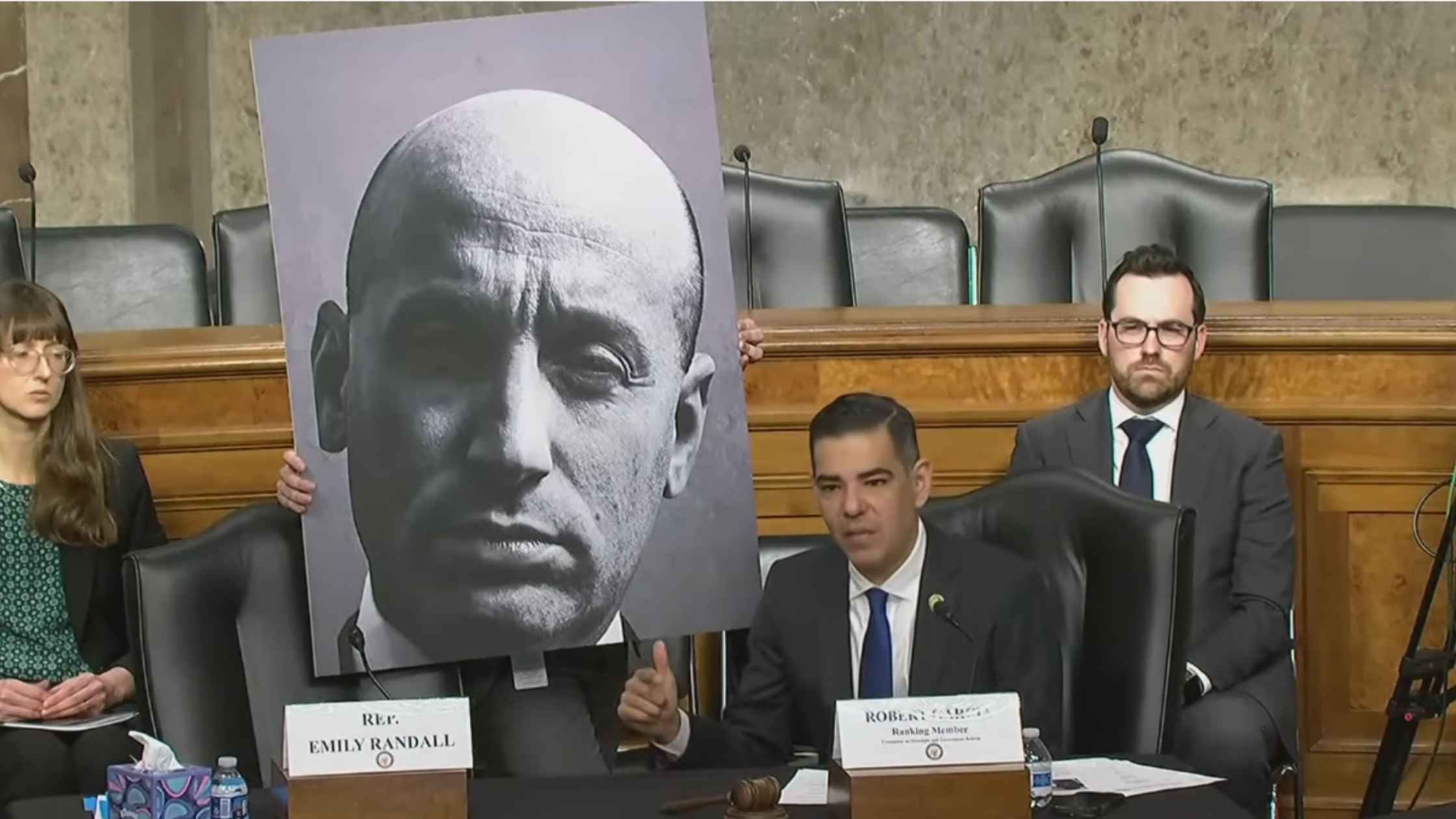
Thank you, Congressman Garcia. I'm going to hold up two posters. One of them you've just seen is what happened at your home. The other is of a memo. Mr. Schwank, I think you'll recognize this memo. It is a memo written by Acting Director Lyons. We've seen it before at this hearing. It says, in effect, ICE officers should violate the Fourth Amendment. Were you taught or told that you should train ICE agents in accordance with this memo?
Ryan Schwank (24:43):
Thank you, Senator. Yes, on the very first day I arrived at Glynco to teach, I was told that we were to instruct cadets to follow the instructions in this memo, but that we would not write down any of those instructions, that we would not keep a record that we taught it to them.
Senator Richard Blumenthal (25:02):
That's a critical point because I asked Acting Director Lyons whether this memo was distributed and he said in fact that it was with an email that so far they have failed to produce. What you're saying is that you were told not to reveal it. Correct?
Ryan Schwank (25:25):
Thank you, Senator. Yes, I was told not to discuss this memo. In fact, when it was shown to me, I was told not to take notes on it, that I was not allowed to write down any part of it. And for the record, as an attorney for ICE and someone who routinely receives memos and memoranda issued by the agency, this had never crossed my desk before I arrived at the academy.
Senator Richard Blumenthal (25:45):
So in effect, you were told as an instructor on the law that you were to train ICE agents how to break the law. I think every American should be absolutely horrified by that fact. And you were not alone. This memorandum was the basis for training ICE agents generally, hundreds, thousands of them during this fiscal year. Let me ask you about topics that there were practical exams on, and I'm going to show you another chart, which in effect, and you've seen it, it's difficult to decipher in this form, but it depicts the topics of exams that were given, practical exams and coursework. You've testified as to the reduction. Is it a fact that there was an elimination, not just a reduction in hours of training by almost
Senator Richard Blumenthal (27:00):
... just half, but also on critical substance matters topics that should have been trained.
Ryan Schwank (27:08):
Thank you, Senator. That is accurate. What you're looking at on those two charts, the shorter one is the amount of testing that's given now in practical exams. The longer one are the practical exams that were given by ICE in its training program before the current surge trainings course. Those exams that you see there, the longer list, every single one of those was designed to test whether or not cadets could apply in the real world the things they were learning in the academy. Vital lessons on things like how to use their firearms safely, how to encounter an individual they intended to detain, much like Ms. Gibson Brown's husband, classes that teach them how to do their jobs safely and lawfully were removed from testing, and what testing was left was reduced or essentially neutered by the way it was given.
(28:06)
Tests that were designed and written to be closed book where cadets were tested on what they could remember... Because again, go back to, I said this earlier, officers have a split second to decide something, so everything we do is oriented to giving them that split second to act and they have to know everything for it. We took away the ability to test whether they could.
Senator Richard Blumenthal (28:29):
But what those ICE officers did to Ms. Gibson Brown, what they did to countless people in Minneapolis, what they are continued to do across the country was not the result of split-level decisions. It was the result of a conscious, purposeful, deliberate policy carefully taught and trained. And in fact, the reduction in training, for example, on pistol use, on use of force, on other vital topics was regrettable, but the effects were truly shocking.
(29:11)
Let me ask you, because just in the time that we've released these documents, DHS has come forth with a statement. I'm going to quote it. "Under these new improvements, candidates still learn the same elements and meet the same high standards ICE has always required. No subject matter has been cut." Is that statement accurate, Mr. Schwank?
Ryan Schwank (29:38):
Senator, that statement is not accurate, not in even the slightest sense.
Senator Richard Blumenthal (29:42):
It is untrue. Would you agree?
Ryan Schwank (29:44):
Sir, I'd call it a lie.
Senator Richard Blumenthal (29:47):
Congressman Garcia, if you would call on someone from your side.
Robert Garcia (29:51):
Thank you, Senator. Representative Ansari.
Yassamin Ansari (29:54):
Thank you, Ranking Member Garcia and Senator Blumenthal, for convening both House and Senate Democrats to continue our oversight of DHS's lawlessness and brutality.
(30:04)
The Trump regime has used its paramilitary force, DHS and ICE agents, to terrorize communities and families all across the United States. These agents are told to engage in illegal and unconstitutional activity, including illegal use of administrative warrants to invade private homes and mass surveillance to collect data on millions of Americans. Here is just one example, ICE agents breaking down the door of Ms. Teyana Gibson Brown without a warrant to arrest her husband, Garrison Gibson.
(30:40)
This fascist paramilitary force, particularly Border Control agents and ICE, are completely untrained to conduct police activity in American cities, resulting in chaos and deadly harm to both members of the public, like Alex Pretti and Renee Nicole Good, as well as to officers. It is horrific, it is racist, it is fascist, and it is totally illegal. This is still America. Rules apply and the Constitution matters.
(31:13)
Under DHS use of force policies, ICE and Border Patrol agents must comply with the Fourth Amendment's restrictions on the use of force. That is that agents may only use force when "no reasonably effective, safe, and feasible alternative appears to exist." Instead, agents are engaging in a free-for-all, shooting, tasing, and pepper spraying wherever they see fit. Secretary Noem should resign in disgrace or be impeached. She will go down in history as one of the worst accomplices to this massive abuse of power. We need to rein in ICE and hold the Trump-Epstein regime accountable for its crimes.
(31:57)
Now, I want to turn to our witnesses and I want to thank all of you for being here today and bravely speaking out to shine a light on these abuses. My first question is for Mr. Bunnell. Yes or no. In the absence of an emergency, are ICE and Border Patrol agents legally allowed to knock down someone's door without a judicial warrant and probable cause?
Steve Bunnell (32:22):
They are not.
Yassamin Ansari (32:23):
And yes or no also for you. Have ICE and Border Patrol agents acted illegally in forcing entry to private homes over the past year without judicial warrants and probable cause?
Steve Bunnell (32:36):
Based on the reports that we've seen today and what we've heard about, it sounds like they are, yes.
Yassamin Ansari (32:43):
And Ms. Gibson Brown, yes or no. Did federal agents present a legal judicial warrant to you when they broke down your front door with a battering ram and entered with guns pointed at you while your daughter was home?
Teyana Gibson Brown (32:56):
No, they did not.
Yassamin Ansari (32:59):
And to Mr. Schwank, thank you so much for your testimony today. Yes or no. Are ICE agents being told they can force entry into private homes without judicial warrants?
Ryan Schwank (33:09):
Yes, they are.
Yassamin Ansari (33:11):
And you said in your introduction, "There was a secret of order to train officers to violate the Constitution." Yes or no, ICE agents are being directed to break the law and violate the Constitution with such directions.
Ryan Schwank (33:27):
Yes, they're being instructed to violate the law and enter homes using the I-205 warrant process, which is just a permission slip. It's not a real judicial warrant.
Yassamin Ansari (33:37):
Thank you.
(33:38)
What we are seeing around the country is an authoritarian police state, the kind created by a shameless authoritarian, Donald Trump, to preserve and expand his power at the expense of our Constitutional rights. I will not stop fighting against this fascist paramilitary force. And again, I want to thank the witnesses for your bravery and for your testimony and for your patriotism today.
(34:02)
Thank you. I yield back.
Senator Richard Blumenthal (34:04):
Thank you. Senator Klobuchar.
Amy Klobuchar (34:05):
Thank you, and thank my colleagues for this important hearing today. And I will say I've repeatedly challenged my Republican colleagues that if you believe in the Constitution, then you believe in the First Amendment's right to assemble if you believe in people's liberties. If you believe in the Constitution, then you don't go after people for having a legal permit to carry like they did to Alex Pretti, then you believe in the Second Amendment. If you believe in the Constitution, then you believe in the Fifth Amendment right to due process. And if you believe in the Constitution, you believe in the Fourth Amendment right against search and seizure, which is the major part of this hearing that we're talking about today.
(34:47)
And I would start with you, Mr. Bunnell. Thank you so much for coming forward. In your written testimony, you noted that the DHS legal training materials previously called physical entry into a home without consent or a judicial warrant the chief evil against which the wording of the Fourth Amendment is directed. As you know, Justice Scalia once wrote that when it comes to the Fourth Amendment, the home is first among equals. Can you explain why the home holds this special importance under the law?
Steve Bunnell (35:27):
Thank you, Senator. The Supreme Court has spoken to this numerous times over the decades and centuries. The home is the core thing that is at the heart of the Fourth Amendment protections. It's the sanctity of the home. It dates back to the traditions in England before the Declaration of Independence and the notion that a man's home is his castle, and so this is a deeply rooted principle of American jurisprudence.
Amy Klobuchar (36:01):
Thank you very much. And I note we've had it happen numerous times. It wasn't just in the sad case of Ms. Gibson Brown in front of her nine-year-old daughter, husband, sister. It also happened to a Hmong elder, who was dragged out of his house by mistake in the coldest day ever in his underwear and thrown in a car and driven around for 24 hours.
(36:24)
So Ms. Gibson Brown, you had just come back from your night shift as a nurse? Is that right?
Teyana Gibson Brown (36:29):
Yes, ma'am.
Amy Klobuchar (36:30):
And that's why you're wearing the scrubs in the video?
Teyana Gibson Brown (36:33):
Yes. I had fell asleep with my scrubs on, yes.
Amy Klobuchar (36:36):
And you work in intensive care unit? Is that right?
Teyana Gibson Brown (36:39):
A pediatric intensive care, yes.
Amy Klobuchar (36:41):
And how long have you been doing that?
Teyana Gibson Brown (36:43):
21 years.
Amy Klobuchar (36:45):
So there you are, you're home, and then suddenly your husband wakes you up and tells you that this has happened. Could you talk about how you felt at that moment?
Teyana Gibson Brown (36:56):
I just didn't understand because he had just checked in, and then he had another check-in for the 26th and it was my son's birthday that day, so I was just in shock.
Amy Klobuchar (37:09):
And is it true then that Judge Bryant, who used to, for my colleagues should know this, he was a assistant US attorney, worked as a prosecutor, and then in the last few years went through a confirmation hearing and became a federal judge. He's the judge that then issued an order that this was illegal, what happened to you. Is that correct?
Teyana Gibson Brown (37:31):
Yes.
Amy Klobuchar (37:32):
Thank you.
(37:34)
Mr. Schwank, thank you for coming forward, as my colleagues have noted. And I want you to go over again, because it was just so shocking to me, what was eliminated from the training of these ICE agents just because it's been my constituents that have been dragged out of their homes, like the Hmong elder, and it is my constituents that have seen repeatedly the racial profiling and this illegal use of force. Tell us what was omitted, taken away from this training when our colleagues in the last few years coinciding with last summer when they gave them an extra $75 billion. What was taken out of the training, Mr. Schwank?
Ryan Schwank (38:16):
Thank you, Senator. What was taken out of the training were classes on use of force, specifically classes taught by the legal department, as well as classes taught by other units. What was taken out was almost 16 hours of firearms training, classes that teach them how to use their weapons correctly and safely. What was taken out were classes on how the Constitution works, what the Constitutional requirements are for their job, and the Constitutional limits on their authority. In fact, the class where we talked to the officers and teach them about the rights of protestors was cut from a two-hour program into about 10 minutes. They got shoehorned into a lecture on what the concept of a seizure is. There are others, there are many other classes that were cut, but I think these are the most critical for your question.
Amy Klobuchar (39:02):
Thank you.
Senator Richard Blumenthal (39:02):
Thank you, Senator Klobuchar. I'm going to call on Representative Randall.
Emily Randall (39:11):
Thank you so much, Senator, and thank you to our witnesses for being here today to shed light on the blatant disregard of the rule of law that we have seen from this administration.
(39:23)
They're executing illegal warrants in violation of the Fourth Amendment, preventing members of Congress from exercising their lawful congressional oversight duty, and failing to uphold tribal sovereignty by rounding up and detaining tribal citizens. I visited the Northwest Detention Center in my district six times to ensure that immigrants are being treated with dignity, with humanity, and with care. And what I've seen on each and every visit is a stark reminder of the chaos, the pain, and the confusion at the hands of Donald Trump, Stephen Miller, and Kristi Noem.
(39:59)
And what happens when policy is developed from a place of hate and not a place of facts? I've heard report after report of the denial of basic rights within the facility in my district, and twice I've been illegally denied entry when attempting to conduct an unannounced oversight visit to further investigate these concerning reports. And we know that this is only one of the many ways in which this administration is acting illegally.
(40:26)
There are 12 tribal nations in my district, and I've heard concerns from so many of them about how ICE and CBP are racially profiling tribal citizens and detaining them. People who are indigenous to this country. I've had tribal citizens tell me they're sending their kids to school with their tribal IDs on them out of safety and fear. And when tribal members show their tribal IDs to ICE and CBP, those officers lack any understanding of tribal ID cards. Last week, Secretary Noem wrote to tribal leaders claiming that no enrolled tribal citizen has been detained and that no ICE operations have occurred on tribal lands, and this is a pure lie. She's calling every tribal citizen who has spoken out about their experience liars, and it is disgusting.
(41:17)
Mr Bunnell, how are ICE and CBP educating and training officers and agents on the United States government-to-government relationship with Indian tribes?
Steve Bunnell (41:33):
I might want to punt that one to Mr. Schwank. In terms of the training, I'm not familiar exactly with how that topic is covered. I will say, it was not an issue that percolated to the upper ranks of the department during my time there. And frankly, your description of it is quite concerning in a way that I hadn't heard before, so thank you for raising it.
Emily Randall (42:03):
Yeah, thank you so much. We've continued to hear concerns, not just in my district. When we were in Minnesota, we heard the same thing from tribal leaders there who were looking out for and advocating for the safety of constituents, of their neighbors, of tribal members who are stopped because they are brown and forced to prove that they are not only indigenous to this land, but that they are citizens. This may be a question for Mr. Schwank also. Given that some tribal leaders have encouraged our members to carry tribal IDs to show ICE and CBP in case they're detained, do you know, are ICE and CBP agents trained on how to identify a valid tribal ID?
Ryan Schwank (42:54):
I do not think of the question, but I do not have any particular information on how they're trained to identify a tribal ID. I do know there are general classes on identification documents that they take, but again, because we have eliminated practical testing, I have no idea if they're actually learning it. In the materials ITH, where I taught for the academy, the only things we discussed involving Native Americans were the possibility that some Native American tribes have the ability to cross the United States border. That was really all we ever covered on that side of it.
Emily Randall (43:24):
Thank you. What about racial profiling? Can you tell us what guidance was provided to ICE agents regarding racial profiling?
Ryan Schwank (43:33):
Yes, Representative. In the training material that we taught, the material calls for the department to follow the Department of Justice's guidelines on the use of race and other factors in law enforcement operations. But in practice, what the cadets are taught is to follow what's called the Kavanaugh stop. That is that they are allowed to use race as a factor, not the sole factor, but a factor in their operations.
Emily Randall (44:00):
Thank you. I think we've all seen the disturbing effects of that practice in our communities and across the country, and I really appreciate you for being here and sharing.
(44:08)
Thank you. I yield back.
Senator Richard Blumenthal (44:11):
Thank you, Representative Randall. Senator Welch.
Peter Welch (44:14):
Well, thank you all very, very much, each of you, and we're all horrified at what happened to you, Ms. Gibson Brown.
(44:21)
Let me just ask a question, Mr. Schwank. With respect to that attack on the home of Ms. Gibson Brown, aside from the warrant question, why in the world and in what world did we need a force with automatic rifles, combat fatigues, helmets, the whole military operation, what part of Homeland Security requires that to go to this woman's home?
Ryan Schwank (44:54):
Thank you, Senator. I can address that question to some degree. Part of that I have to defer on because I believe it might reveal tactical practices of the agency, and I don't feel comfortable disclosing that. But to what I can address is that those officers in that situation, regardless of how they show up to the scene, however they're dressed, whatever equipment they're carrying, are supposed to know their Constitutional law, their understanding of what their authority is, well enough that regardless of whatever orders they received before they showed up-
Peter Welch (45:27):
Let me interrupt for a second. I get that. I'm just shocked that you would have that level of force to show up at this woman's home. My view of that, it's intended to intimidate not just Ms. Gibson Brown and terrorize her family and her children, it's intimidating to everybody in this country to see that level of force.
(45:51)
How about you, Mr. Bunnell? Thank you so much, by the way, of the deep state... I just laughed when I heard that because my sense of what you do and your colleagues and people who've been career prosecutors suggest a commitment to the Constitution, a commitment to professionalism, a commitment to duty. If that's the deep state, that's a pretty good state to be in. I want to express my gratitude for the work you are doing and your colleagues. But what about this question of having a decision made by a superior to deploy people in combat gear, automatic rifles to go out to a citizen's home? Leave the warrant part of it alone. With or without a warrant, I'm shocked that that is what you had to arrive home to.
Steve Bunnell (46:44):
Well, I share your reaction to it as wildly over the top. Why you need to dress like you're invading Iraq in order to go apprehend somebody who is not a fugitive, I think that's the point that gets lost a little bit is, yes, there may be some probable cause that somebody is removable, but a warrant is usually something for somebody who is a fugitive. As I understand, Mr. Gibson's situation, he had removal orders. He received a removal order in 2009 and he'd been checking in regularly as he was supposed to, including right up shortly before this.
Peter Welch (47:32):
That's a discretionary decision by somebody higher up in the chain that sent these officers out in that way, right?
Steve Bunnell (47:42):
Yes. It was not a judicial officer. It was somebody, their supervisor in the field office, presumably.
Peter Welch (47:49):
Yeah, it's part of the Kristi Noem terror campaign against Americans.
Steve Bunnell (47:54):
Right. I would also just note that to the extent that ICE at least purports to want to have a strong partnership with state and locals and would like to improve their reputation in the communities that they say they're trying to protect and serve, this strikes me as an extremely, shall we say, odd way to build trust and credibility with either the people of the community or the state and locals.
Peter Welch (48:20):
[inaudible 00:48:20]. How about counterproductive?
Steve Bunnell (48:22):
There are probably much stronger words that could be at a minimum odd and counterproductive.
Peter Welch (48:27):
Let me ask both of you. Is there any justifiable reason, any justifiable law enforcement reason that the standards of training and safety and policing that apply to the Burlington, Vermont police force, to the Vermont State Police force, to police forces in all our jurisdictions in the country should not apply to ICE? Mr. Schwank.
Ryan Schwank (48:56):
Thank you, Senator. And my answer to your question is no. At a root level, all law enforcement should be trained to a minimum standard to understand when they can and cannot enter a home, when they can and cannot use force, when they can and cannot make an arrest. And this was the point I was approaching earlier, Senator, is that regardless of how they showed up at the scene, regardless of how they were told to dress when they came there or what they were told to carry, every one of those officers was supposed to know what they were allowed to do under the Constitution. And that was the point of the training program, is to teach them to know that and to know it well enough that even if they got an order that was unlawful, they would know not to follow it.
Peter Welch (49:39):
Thank you. My time is up. Thank you very much.
Robert Garcia (49:44):
Thank you. Next, I'd like to call up Representative Walkinshaw, please.
James Walkinshaw (49:47):
Thank you, Ranking Member, and thank you all for being with us. We're a nation in crisis right now. The Trump administration has turned American cities into war zones, unleashing mass, minimally trained agents and claiming, falsely claiming, that these agents have absolute immunity from prosecution. Now, DHS has embarked on a secretive campaign, as we've heard today, in disregard of the Constitution to allow warrantless entry into the homes of US citizens.
(50:15)
And I just have to say, I serve in the House of Representatives with a lot of folks who describe themselves as small government, limited government conservatives, even have a caucus called the Freedom Caucus. If the government, if the federal government can smash down your door while your children are sleeping without a warrant signed by a judge, you do not have a small or limited government. And if you allow that, if you countenance that, you do not believe in freedom. The action these agents are taking are abuses of civil liberties that stem from a central truth. Secretary Noem's Department of Homeland Security believes it is above the law. Judges across the country have documented this lawlessness, including the Honorable Patrick Schiltz, a Republican-appointed federal judge in Minnesota who identified at least 96 court orders that ICE violated across 74 cases. We have lawyers here today with DHS experience and a US citizen testifying that when the department cannot bend the legal system to accommodate its brutality, it bypasses the law entirely. In May of 2025, as we heard, ICE Director Lyons issued a memo authorizing officers to forcibly enter homes without a judicial warrant in violation of the Fourth Amendment. They were told they could rely on an, quote-unquote, administrative warrant. Nothing more than a piece of paper signed by a supervisor to use the pejorative that some of my Republican colleagues use, an unelected bureaucrat. A piece of paper signed by an unelected bureaucrat.
(51:59)
The secrecy is actually illuminating. It shows that this administration doesn't see itself as subject to our legal system. Rather, it decides to ignore the law behind closed doors and hope that no one notices. We have concrete testimony today from Mr. Schwank that DHS has knowingly jeopardized the safety of Americans by systematically dismantling the training designed to educate ICE officers on the legal limits of their authority, including the Fourth Amendment. The decision to ramp down training while simultaneously authorizing unconstitutional searches are deliberate choices in support of President Trump's lawless and inhumane campaign.
(52:46)
This is why Secretary Noem should resign, should be fired, or should be impeached, and why this Congress must ensure independent oversight of DHS's actions. That reform has to include a return to targeted enforcement that relies on lawful warrants, an end to masked officers, protections for sensitive locations, use of force standards, body cameras, and humanitarian standards for individuals in DHS custody. To quote Judge Schiltz, "ICE is not a law unto itself."
(53:21)
I want to ask Ms. Gibson, did the federal agents know that there were children inside your home when they broke down your door?
Teyana Gibson Brown (53:32):
Yes, I stated that to them.
James Walkinshaw (53:35):
Can you share with us... And I remember watching the video after the incident, and I was struck by your composure, but I could also hear the fear in your voice. I think you said, "My babies are in the house," or, "A baby's in the house." Can you share with us the impact that this incident has had on those babies, those children who were in the home?
Teyana Gibson Brown (00:00):
Teyana Gibson Brown (54:00):
My daughter is terrified of everything. Every little knock on the door, she'll scream, "Mommy, mommy." "Calm down. It's okay. She's in therapy." It just shouldn't have happened. Especially if he had an appointment to check in, they could've taken him into custody then to do all of this to traumatize her, me and my whole family. It's too much.
James Walkinshaw (54:30):
Thank you for being here. I yield back.
Senator Richard Blumenthal (54:35):
Senator Cortez Masto.
Catherine Cortez Masto (54:37):
Thank you. Thank you all for being here. And I want to follow up because I was going to ask this as well because people forget, they see the moment that it happens, then they forget what happens afterwards to the family and the children. And for your daughter and cousin and everyone else who experienced it, how are they feeling now?
Teyana Gibson Brown (54:57):
They're still in fear. Today, she called me 12 times just to make sure I was okay, make sure I was safe. She's just fear everything now. She's seen them down the street from her school and we had to go pick her up because she's full panic.
Catherine Cortez Masto (55:18):
Yeah. Can you talk a little bit about even the chilling effect that this has had, not just maybe on you and your family, but neighbors or people that find out about what happened? Have you heard from neighbors and others who are also in fear now because of what happened?
Teyana Gibson Brown (55:34):
Yeah, a lot of my neighbors don't go anywhere now. It's like we're in jail in our own homes, too fearful to leave to go to the store. Just fear.
Catherine Cortez Masto (55:48):
Right. And can I talk about... let me ask both Mr. Schwank and Bunnell. Sensitive locations. I'm curious how did ICE handle sensitive locations prior to what we are seeing now in your experience? And let me clarify, sensitive locations of schools and churches and even the courthouse and where people may be. I'm curious how that has changed.
Ryan Schwank (56:19):
Thank you, Senator. The answer to that question is that before the current administration, there were strict rules about any attempt to make an arrest at those locations. And those rules basically boiled down to don't do it.
Catherine Cortez Masto (56:31):
Why?
Ryan Schwank (56:31):
Don't enter those locations because of their sensitive nature. Because an ICE officer entering into a church, a school, a courthouse, has the effect of convincing people not to go to those places to avoid them. And when people avoid going to church, school or court, they step away from the rights and the roles they have in our civic society. It pushes them away from it and gives them less power to protect themselves.
Catherine Cortez Masto (57:00):
And wouldn't you agree somebody's home is also considered a sensitive location. That's why it requires Fourth Amendment, really constitutional protections it has and requires a Fourth Amendment judicial warrant to enter. But wouldn't you agree? Because of what we're hearing right now, the impact it's having to families because they don't even feel safe in their homes?
Ryan Schwank (57:19):
Yes, Senator. In fact, I think that's why it's not included in those original memos.
Catherine Cortez Masto (57:23):
No.
Ryan Schwank (57:23):
It's obvious to anyone who looks at the US Constitution that the home is a sacred place. It is a place where everyone should feel safe when they close their door.
Catherine Cortez Masto (57:34):
And for those that may not be steeped in legal analysis, this isn't criminal. This is civil immigration. This is civil, correct?
Ryan Schwank (57:45):
Yes, Senator.
Catherine Cortez Masto (57:49):
Could you talk a little bit about that please? And why, when we're talking about civil immigration enforcement, it does not require the level of force and it mandates against the level of force we are seeing right now under our constitution?
Steve Bunnell (58:09):
Yeah. I actually don't think it makes a difference in terms of the Fourth Amendment. Whether it's civil or criminal, you need a judicial warrant. So that's one point. I think there is some confusion, certainly in the public discourse, about what ICE is doing when they're out making these arrests. They are not enforcing criminal law. They're not going after somebody who's a suspected murderer or rapist who's out on the lam and they're not arresting them so they can be prosecuted and put into jail. They are going out to detain and remove that person out of the country. They're from Mexico, they'll go back to Mexico and they'll be set free.
Catherine Cortez Masto (58:55):
Not to be detained indefinitely?
Steve Bunnell (58:58):
I mean long enough to be removed, basically. Sometimes that is a long period of time. I mean, there are lots of people who are subject to orders of removal, like Mr. Gibson, who are not a public safety risk, who are not a flight risk and therefore are not detained. They're released into the community with conditions. In his case, he was adhering to those conditions for 17 years. In his instance, these are not the worst of the worst. These are not dangerous people, but they have civil rights, they have constitutional rights just like everybody else.
(59:45)
One of the things that gets lost here kind of dovetails with the lack of training. All of these agents and the lawyers take an oath to defend and protect the constitution. It'd be nice if they were trained on what the constitution is. The Homeland Security Act says as part of its mission, the department is supposed to protect civil liberties, protect privacy. A secure homeland is a homeland in which you have those rights secured. You have the freedoms and securities that the country promises. And so we're losing sight of the mission when we don't pay attention to the constitution, we don't pay attention to the oath and we ridicule the "deep state" for trying to follow that oath
Catherine Cortez Masto (01:00:32):
And with the Chairman's indulgence, I have one final question because, Mr. Schwank, you talked about how the training, they've eliminated some training and then shortened some of the training around use of force, 16-hour firearms training around constitutional law that you talked about was so important, and the rights of protesters has been diminished about, what, 10 minutes. Let me ask you this. Who are they hiring though? Are they police officers that already have this training so they don't have to worry about it? Or who's being hired? Is it individuals that don't have any law enforcement background or constitutional background? I'm curious what we're seeing here in this surge.
Ryan Schwank (01:01:14):
Thank you, Senator. I want to start to answer that question by saying I was genuinely surprised by two things about the cadets I saw at the academy. One was that I routinely met cadets who genuinely wanted to learn and understand what they were supposed to do, that they wanted to do their jobs correctly. I have no doubt that if given the opportunity, they would do that, but they are cadets who come from a variety of backgrounds. I've had cadets who were 18 years old. I had a cadet who we celebrated her 19th birthday in one of our classes. We have cadets who don't have college degrees. We have cadets for whom English is not their primary language. I was genuinely surprised by the sheer number of cadets we had that were first or second generation immigrants. These are all people who I think want to do well, but they don't have the background and we're not giving them the training to do this job correctly. We're not giving them the training to know when they're being asked to do something that's not supposed to do something illegal or wrong.
Catherine Cortez Masto (01:02:14):
Thank you. Thank you, all three of you, for being here.
Senator Richard Blumenthal (01:02:20):
Thank you. Representative Tlaib.
Rashida Tlaib (01:02:21):
Thank you so much. Thank you all for, of course, being here.
(01:02:24)
But I want to tell you, Ms. Gibson Brown, I didn't know your name. I saw that image immediately in front of your home. That's your home, right? I don't know if you realize how much it connected so many Americans, including myself, across the country. It's your porch, your private home. All I kept thinking about was looking at the military gear, the silencers. I don't know if you realize I watch those things, the military gear, and I start digging and I find out that ICE is primarily contracting out with two of, I think, federal immigration agencies contracted primarily to fire our manufacturers to buy guns in 2025. In the last hearing, I specifically talked about how they purchased taser launches or something, all this stuff. But now, according to some records, a report that recently came out, they've already spent about border contracted the same companies, and together, ICE and Border Patrol contracted for more than 30 million in ammunition and 25 million in what they call less lethal. But guess what? Less lethal, its pepper ball guns. That's still lethal. And pepper sprays, including tasers and other things. I say this because I feel like there's also these companies pushing and militarizing our neighborhoods and communities. They're making money off of it.
(01:03:52)
Thank you so much for your help.
(01:03:52)
I do want to enter the record. I know this is a shadow hearing, but it's important. This is an amazing report, record reports talking about private prison investors want ICE to escalate. I want American people to know this. There are people behind the scenes saying, "Go, go. Buy more. Cage up more people because we make more money off of it." Do you know what this says, Ms. Gibson Brown? In this report, it describes how even through ICE is locking up more neighbors than it ever has before, record number, 70,000 people that we know of.
(01:04:28)
Investors in these private prisons, companies CoreCivic and GEO Group are frustrated that "ICE's record immigration detention numbers aren't high enough." They're not high enough. No, no, information leaked out. The violent kidnappings, the murders, incarceration for of our loved one is fueling record profits for these companies and it's still not enough to satisfy their greed. What is scary is that CoreCivic's alone's profit spiked up 116.5 million in 2025, 70% increase, y'all, from the previous year, 70% increase. GEO Group, which has one of the largest for-profit, I call it an ICE warehouse, center in Baldwin, three hours outside of Detroit, George Zoley who called the first year of Trump's second term the most successful year for them and the company seriously, both of them, that company [inaudible 01:05:25] GEO Group made $254 million in profit last year in 2025. Both companies are projecting even larger profits this year in 2026 already, and we're not even in March yet. ICE CPP plan to cage tens and thousands of our loved ones in unsafe warehouses. They want to build a warehouse in Romulus, which is right outside, a suburb right outside of Detroit.
(01:05:47)
The companies in the administration do not view us as human beings. They view us as potential profit and shared shareholder value. That's exactly how they talk about it. They don't even care about what process is being followed. All they care is about selling more military gear and how many beds or what they call people they can have in there. I have personally three, three residents of mine who are begging, "Rashida, I said deport me since July," because they can't stand it. There's already been attempted suicide at North Lake in Baldwin, Michigan since July. "Let me go back. I have family in my native homeland. Let me go back." They will not let them go back because the longer they have them in there, the more money they make.
(01:06:35)
You know what's so disgusting? ICE Director Todd Lyons made this clear when he said we needed to start treating ICE detention and deportation "like Amazon Prime, but with human beings." I'm not done. It's not a coincidence that these two prison companies and their executives have donated millions of dollars to city members of Congress to ensure that record profits keep coming at the expense of lives and safety of our loved ones. The drive for profit will cause, of course, ICE to continue to fuel.
(01:07:02)
Ms. Gibson, I just can't thank you enough for being here and I wanted to ask you questions, but I actually get tearful hearing your story. I don't know if you know... You didn't know who I was, but just seeing this on your porch, I want to know your story. I just can't believe that you were trying to do everything right and they still took your husband and they traumatized your whole family. You were trying to do everything right.
Teyana Gibson Brown (01:07:25):
And they made me pay for my door.
Rashida Tlaib (01:07:26):
And I'm sorry to think that you are some sort of cha-ching money, let's just put it out in the community, that you are not a mother and a spouse. I'm really incredibly sorry that that is what's happening, all really for money. I can't believe how much they've already donated Trump and they've donated to US members of Congress, both Republican and Democrats. And I really am scared for our country that that's driving for many to be silent and to do nothing about what's happening. Thank you.
Senator Richard Blumenthal (01:07:58):
Thank you Representative Tlaib. We are probably not going to have any more colleagues from either side, but I have some more questions. So I'm going to go into them, not at huge length, but you've been very, very helpful and cooperative and I want to thank you in advance.
(01:08:23)
The truth is that, as we speak, literally, as you are here, the Trump administration is arming a paramilitary force, a new class of recruits, sending them out on the streets to repeat this kind of violence and brutality. It isn't an isolated or aberrant instance, it's the result of intentional institutional decisions. And we've documented here through the memo that Acting Director Lyons prepared and then concealed. It was used to instruct trainers like Mr. Schwank, beginning when he started in May, or rather in September, the memo dates from May, and it was used four hundreds of agents who now are on the streets and in our neighborhoods.
(01:09:32)
These agents now have less training than most of the police officers in our police departments throughout Connecticut and throughout the country. They have less training than the state police of Connecticut and other state police forces throughout the country. And maybe even more shockingly, they have training to break the law, which would never be tolerated in our communities. Police chiefs who wrote this kind of memo would be fired. They would be discharged and they would never find another job in policing. Advising and training members of their police force to break down doors, barge into people's home, arrest or detain them without a warrant, a systematic purposeful policy to break the law would result in firing that police chief. And yet what we have is brutal and violent tactics being used by ICE and CBP tactics with the approval and fact encouragement of the very head of ICE who said to me that this memo was distributed through an email throughout the department.
(01:11:12)
Mr. Schwank, to your knowledge, was this memo ever distributed?
Ryan Schwank (01:11:20):
Thank you, Senator. To my knowledge, this memo was never distributed to staff in general. In fact, when I came to the academy in September, I had never seen it, despite being a council for the agency. I never saw it again after it was shown to me the first time and maybe one other time it was shown to me. Other than someone physically handing me the document, I never saw it again. And right before I left, I checked the repository where the agency keeps a copy of official memo and policy guidance that is in effect, and there is no copy of it there.
(01:11:56)
Senator, I'll point out to you, if we look at this document, if we look at it, every memo issued by ICE has a control number. It has something on it that indicates that it is an official policy document and where it falls in the agency's archives, and that's not on this document, anywhere. Also, anytime we issue a memo, there is something in the document to control it's released, something that says law enforcement only or for official use only, classified, secret, something. And there's nothing on this memo that says that. Nowhere on this memo is there anything that would let you know that this is an official policy of the agency. And to my knowledge, it's never been disseminated as one. It's been handed out piecemeal to people to use when the agency thinks they need to.
Senator Richard Blumenthal (01:12:42):
Which directly undercuts the veracity of Acting Director Lyon's testimony under oath before a congressional committee. I want to go into some of the details here because I think they are so revealing, Mr. Schwank. You started your job at ICE in September of last year. This memo dates from May. How did you first see this memo?
Ryan Schwank (01:13:16):
Thank you, Senator. I've been with ICE for about four and a half years, but I was an instructor at Glencoe from September. The memo was shown to me by my supervisor at Glencoe. It was given to me in person with instructions that I could read it but not take any notes on it, that I could read it in their presence and that was it. And that I was going to teach from it, but I couldn't keep a copy of it to reference. And I couldn't document that I taught it to anyone, just that I could read it.
Senator Richard Blumenthal (01:13:46):
You were to train on it, but your supervisor didn't want you to have a copy of it for fear that it might be revealed. And in fact, it was revealed only when whistleblowers came to me, brave and strong as they were, came to me, put their professional careers and personal lives on the line and said they would reveal it.
(01:14:18)
When you were told to train on it, I believe that there was some conversation about instructing them, instructing agents who were your students to follow this memo's policies, not the other written guidance that they might be provided. Is that correct?
Ryan Schwank (01:14:44):
Thank you, Senator. Yes, that is correct. What the cadets were told to do was that they had the authority to make an arrest under this memo in someone's home, that they should knock on the door, and if the person did not open, as Ms. Gibson Brown's family did, that they could use force to enter that home, reasonable force to execute the I-205 administrative removal order. That's what we were teaching cadets at the academy. That's what we were told to teach them. And I'll tell you, when I taught my classes, I would tell the cadets that this policy existed and I would tell them that they needed to check with their local office before they did anything because there was no legal basis for this, but I did tell him this was the agency policy.
Senator Richard Blumenthal (01:15:28):
Were you apprehensive that a failure to follow this illegal policy might result in demotion or discharge?
Ryan Schwank (01:15:39):
Yes, Senator. I was. In fact, it was made very clear to me when it was shown to me that if I did not follow it, I would probably lose my job. Two other attorneys for the agency had just been removed from teaching positions at the academy. One forcibly resigned. And this way it was shown to me or told to me was that it was because they disagreed with management over this policy.
Senator Richard Blumenthal (01:16:02):
So this illegal policy was not just a suggestion, it was an order and people were disciplined as a result of failing to implement this illegal policy. Is that correct?
Ryan Schwank (01:16:17):
That is my understanding, Senator. As I said, it's my understanding that an attorney before me... In fact, the reason I was at Glencoe is because I was the alternate for the person who was forcibly resigned over their refusal to teach the memo.
Senator Richard Blumenthal (01:16:32):
And just so everyone understands, this memorandum was written by the acting director of this agency, ICE, with instructions about breaking a long-standing practice and policy of ICE itself, a well-established policy and practice of police forces going back hundreds of years, a practice and policy that embodies the core Fourth Amendment values and provisions that no person, no person, not just citizen, can have his home violated without a court saying that there's probable cause to do so. You taught ICE agents, candidates for graduation that then went on to Minneapolis. They went all around the country. We've talked about DHS contention that the standards are the same, which is belied by the documents, as well as your testimony. The numbers of courses have been drastically cut, the hours have been reduced. The physical or practical exams have been truncated. DHS may contend, "Well, we give tests to these cadets before they graduate," but my understanding is that many of the tests are paper tests, multiple choice exams rather than the practical tests on use of force and pistols and other kinds of skills that are really necessary to fairly and effectively enforce the law. Is that correct?
Ryan Schwank (01:18:40):
Yes, Senator. That's correct. What the academy does is we have two types of tests. We have multiple choice exams and we have practical exams. With the multiple choice tests, the cadets went from having to do them in a closed book format where they had to depend on what they had learned and memorized to doing them open book and open note where essentially the only thing we're really testing them on is their ability to search a document to find the answers.
(01:19:08)
But more important than that, we took away the practical testing. Under the old rules, we took everything they learned in the academy, all that they learned, and we made them apply it. We put them through a range of scenarios where we could test, do they understand when they can enter a home or not? Do they understand when they can make an arrest or not? And if they showed that they did not know that, we could failed them and send them back and make them try again and demonstrate their knowledge. And if they failed twice out of the academy, and maybe six months later, 90 days later, they could come back after they demonstrated their home office that they were ready.
(01:19:51)
But today, no matter how badly a cadet does at those practical exams, no matter how many mistakes they make, no matter how egregiously they violate the law during a practical, we graduate them.
Senator Richard Blumenthal (01:20:02):
I think people should understand, and Representative Garcia alluded to this fact, that a poorly trained officer of the law carrying a firearm or other instruments of force, actually makes our neighborhoods and communities less safe. If there were ever a demonstration of it, it has happened in Minneapolis, in California, in Chicago. We've had graphic dramatic evidence of it at that very panel table, individuals who've been shot, almost killed, relatives of Renee Good who was killed, others who were treated with brutality that is
Senator Richard Blumenthal (01:21:00):
... is unspeakable. Dragged out of cars, denied medical treatment. An untrained or poorly taught agent of the government makes our nation less safe. I'm going to ask you, have you seen cadets graduate despite using disproportionate force in practical exercises, and can you provide an example?
Ryan Schwank (01:21:30):
Yes, Senator, I have. I have seen multiple examples of that in the training program. I have seen examples of cadets who have drawn their firearms on each other by accident. I have seen cadets... And this is in the last day or two of training, so this is at the end of the program. I have seen cadets make arrests of individuals that had committed no crime and for which there was no cause to make the arrest, despite the cadet allegedly having been taught the law related to the crimes involved. I have seen officers apply excessive force in these training scenarios where they have made arrest attempts that involved drawing their firearm, using pepper spray, various events that they were not authorized to do and which were not justified by the circumstances in which no objectively reasonable police officer would have done what they did and they still graduated.
(01:22:28)
I have seen cadets... And this was a moment that stuck out to me at the academy. I saw a cadet in a scenario where we had bystanders who were allegedly filming or recording what was happening, pull out pepper spray and pepper spray a bystander. And when we asked the cadet afterwards why they did it, their answer was, "It's because I've seen what we're doing in Minneapolis." It doesn't matter what we teach them about the law if what they watch on television and on Reddit and on the internet tells them that they can get away with things. The academy can teach them till they are blue in the face, but if they see that in practice the real rules are different than what we're teaching them, they follow the rules that they see.
Senator Richard Blumenthal (01:23:10):
Thank you. I'm going to yield to Representative Tlaib, who I understand has a few more questions. I may have just a couple after.
Rashida Tlaib (01:23:21):
[inaudible 01:23:21]. Thank you so much again. Ms. Gibson Brown, after your husband was violently taken from your home, he was taken to the Whipple. Whipple Federal Building, is that correct?
Teyana Gibson Brown (01:23:33):
Yes.
Rashida Tlaib (01:23:33):
Did ICE agents take any photos of him while he was there?
Teyana Gibson Brown (01:23:38):
He said they took trophy photos.
Rashida Tlaib (01:23:40):
They were selfies on their personal cell phones.
Teyana Gibson Brown (01:23:44):
On their personal cell phones.
Rashida Tlaib (01:23:45):
With thumbs up.
Teyana Gibson Brown (01:23:46):
Yes.
Rashida Tlaib (01:23:46):
Is that correct?
Teyana Gibson Brown (01:23:47):
Yes.
Rashida Tlaib (01:23:48):
The day after your husband was illegally taken from your home, a federal judge ordered that he not be removed from Minnesota. Is that correct?
Teyana Gibson Brown (01:23:55):
Correct.
Rashida Tlaib (01:23:55):
Is that what happened?
Teyana Gibson Brown (01:23:57):
He went to Texas. They took him to Texas.
Rashida Tlaib (01:24:00):
He didn't go. They took him, kidnapped him.
Teyana Gibson Brown (01:24:01):
Yeah. They took him to Texas.
Rashida Tlaib (01:24:01):
And took him to Texas.
Teyana Gibson Brown (01:24:03):
Yes.
Rashida Tlaib (01:24:03):
Did ICE quickly realize their error on their own?
Teyana Gibson Brown (01:24:06):
No.
Rashida Tlaib (01:24:08):
No. Your attorney had to confront Homeland Security, is that correct?
Teyana Gibson Brown (01:24:12):
Absolutely.
Rashida Tlaib (01:24:13):
On January 15th, a federal judge found that ICE had violated your husband's rights by illegally breaking into your home and detaining him, and the judge ordered his release from the detention. Is that correct?
Teyana Gibson Brown (01:24:25):
Yes.
Rashida Tlaib (01:24:27):
But after your husband was released, he was re-detained for a few hours at the Whipple Federal Building, is that correct?
Teyana Gibson Brown (01:24:34):
Yes.
Rashida Tlaib (01:24:35):
Who's responsible for ordering that your husband be re-detained?
Teyana Gibson Brown (01:24:39):
They said it came from the White House.
Rashida Tlaib (01:24:42):
No. Per federal agent, we know for a fact the order came from Stephen Miller. Did you know that?
Teyana Gibson Brown (01:24:48):
Yes.
Rashida Tlaib (01:24:50):
I also think it's really important because a lot of people have been talking about this. Do you think all this would've not happened to you if they were unmasked? Do you think if they were unmasked, this would not have happened to you? Would they still show up like this but just no masks on?
Teyana Gibson Brown (01:25:07):
I think it would've happened either way.
Rashida Tlaib (01:25:08):
Yeah. Do you think it's about training or a culture?
Teyana Gibson Brown (01:25:13):
Probably a culture.
Rashida Tlaib (01:25:14):
I mean, Mr. Schwank, it's a culture. You could give all these memos because I'm telling you right now, I've seen it. We had sensitive locations policy and they still violated those I remember in my own community in southwest Detroit over and over again. So it's mind-boggling that so many of my colleagues continue to say that it's about recruitment and everything when I'm showing them over and over again, look at how they're recruiting using white supremacy music.
(01:25:43)
I don't know if you know Ms. Gibson Brown, I showed them a poster where it says, "Come join us, make home home again." What does that mean? Ms. Gibson Brown, you know this. What does that mean? Exactly. It ejects sense of some sort of white supremacy gang that's coming in and trying to... They even have a poster of Uncle Tom or something and it has an arrow saying, "Invasion." Who's invading? What are you talking about? I only say this because everything that we went over, I don't think it was about training. I think it's about Stephen Miller and everyone else that created a culture within this department, within ICE border patrol.
(01:26:26)
These folks didn't just join Border Patrol or ICE. The people that killed Alex and Renée Nicole, I don't understand how people continue to say this in committee that somehow if we just take the masks off, we'll be saved. They're going to shoot us anyways. Give them a few more trainings, give them some memos. But if the culture went from within from other presidential administrations, I've seen it, they just violate even their own policies and there's no sense of accountability. It is created on a culture of violence and fear.
(01:27:02)
And boy oh boy, are people making money from it. I don't know if there's anything else that you wanted to share, Ms. Gibson Brown, but I think it's important for people to understand just how cruel they were to you and your family, and even after they found out they violated his rights, still the White House tried to again vilify him and dehumanize him and keep him again even with the orders from judges.
Teyana Gibson Brown (01:27:28):
They kept the door broken. The door was broken and nobody paid for it. We had to pay for it and my house was open for probably almost two weeks. My door was broken. I had to put weights in front of my door to keep it locked.
Rashida Tlaib (01:27:47):
It's so shameful.
Teyana Gibson Brown (01:27:49):
Yeah.
Rashida Tlaib (01:27:49):
But you know what? GEO Group and Civics Group, all them they're making money. They don't care about your door. They just care about taking people, holding them there and billing the federal government, the American taxpayer, tons and tons of millions of dollars. And guess what? They're still not satisfied. They want us to do more. It's really sad.
Teyana Gibson Brown (01:28:06):
But when he went to Texas, he requested to call me. I hadn't talked to him for like 24 hours and they told him he's in ICE custody, he couldn't make any calls.
Rashida Tlaib (01:28:18):
Yeah. I have people that I can't find for days. They don't even put them in the system. When we say disappear, that's what we mean. And I mean I couldn't find somebody, a resident of mine for 12 days. They're not following their own processes. I don't even think that's what it's about. I think it's because it was created post-9/11 to do just what it's doing now, and it's something that I think our country needs to realize.
(01:28:45)
Now it's being turned, of course, on so many other communities across the country, but as somebody who grew up with 20 different ethnicities in my neighborhood, they've been doing it. Checkpoints, racial profiling. I don't know if you know this chairman, they even took a father from the front seat with his daughter who had leukemia in the back seat. That happened in 2010.
Teyana Gibson Brown (01:29:06):
That's crazy.
Rashida Tlaib (01:29:07):
So I just want everyone to know this is not about only who's in the White House who's enabled it and empowered it and expanded it. It's about the fact that it was created on this culture. Masks, trainings, body cams is not what's going to stop it, and that's what scares me the most.
Senator Richard Blumenthal (01:29:25):
Thank you Representative Tlaib. I'd like to ask you, Ms. Gibson Brown, your neighbors know what happened to you, correct?
Teyana Gibson Brown (01:29:35):
Yes.
Senator Richard Blumenthal (01:29:35):
Have you talked to them about it all?
Teyana Gibson Brown (01:29:37):
Yes. We've had a couple of neighbors come over.
Senator Richard Blumenthal (01:29:40):
What do they think about it?
Teyana Gibson Brown (01:29:43):
My neighbor across the street from me, she was pepper sprayed and they're just all in fear. They are very sweet, sweet people. I do love my neighborhood. Unfortunately, I have to move now because they won't renew the lease because of this. But it's just they've been very sweet bringing food, cards and they've been just absolutely wonderful, but still a lot of them are immigrants on my street. So they're in fear too, so they stay in.
Senator Richard Blumenthal (01:30:25):
They're more fearful now because they've seen what happened to you?
Teyana Gibson Brown (01:30:28):
Yeah. Yeah.
Senator Richard Blumenthal (01:30:29):
They're less likely to cooperate and help law enforcement, correct?
Teyana Gibson Brown (01:30:34):
Yeah.
Senator Richard Blumenthal (01:30:36):
So this brutality is really so self-defeating and I'd like to ask you Mr. Bunnell, you were a federal prosecutor for 17 years. I was the US attorney in Connecticut. As you were a federal prosecutor here in the District of Columbia, I was the attorney general of my state. Law enforcement really depends on citizen cooperation, doesn't it?
Steve Bunnell (01:31:08):
Absolutely.
Senator Richard Blumenthal (01:31:10):
It depends on respect for the law and the credibility of prosecutors and police. Correct?
Steve Bunnell (01:31:18):
At every stage of the process, yes.
Senator Richard Blumenthal (01:31:20):
What happens when that respect and credibility goes away?
Steve Bunnell (01:31:26):
Public safety suffers.
Senator Richard Blumenthal (01:31:28):
So all of these tactics that may be regarded as hard-nosed and tough actually undermine the credibility and respect for the law and for law enforcement and the efforts to protect the public. Correct?
Steve Bunnell (01:31:47):
Absolutely. You can't protect and serve people that don't respect and trust you.
Senator Richard Blumenthal (01:31:54):
A paramilitary force, a national police force as the Trump administration seems to be intent on establishing violates the Constitution. The founders never wanted a national police force. Its tactics of breaking into people's homes, forcible entry without a judge finding probable cause violates the Constitution. They are teaching and training purposefully illegal policy and they are making America less safe. I think that is the unmistakable takeaway from today's hearing, and I want to thank all of you and first just finally ask any of you whether you want to add anything. We may have missed stuff in our questions that you meant to bring out. Anyone who has any final thoughts or comments, I welcome that you do it. You don't have to. No pressure.
Teyana Gibson Brown (01:33:04):
I would also just like to add that my husband had stated that when he was arrested I guess at the Whipple Building, that they had someone who had scabies. And there were 40 people in one room and they wouldn't take the guy who was infected out. So they put people who probably had health issues at risk for catching something.
Senator Richard Blumenthal (01:33:31):
Thank you.
Teyana Gibson Brown (01:33:31):
It was just deplorable.
Senator Richard Blumenthal (01:33:37):
Mr. Schwank?
Ryan Schwank (01:33:39):
Thank you, Senator. I wanted to bring up a couple of things that I think are important to put on the record. One of them is a fairly important issue. There's this claim being made by the agency that ICE officers are getting essentially the same training they got before because they compressed the schedule down but kept the hours making it 12 hours a day, and that's just flat-out wrong. Cadets attend a five day a week program that's nine hours. Eight hours of lecture, one hour of lunch, and once a week they have a 10-hour session over the course of their time at the academy, those 42 days. It is not remotely close to the length of the academy before.
(01:34:23)
And the second thing I want to bring up is I want to address the Representative Tlaib's comments earlier about a culture. She's not wrong. She's not wrong that that kind of culture exists in the agency, but if the problem was that simple that we just had a bunch of people who don't like foreigners and want to remove them from our country and it was all white supremacists, it would actually be a very easy problem to solve. You would just fire them all, but that's not the root problem. The root problem, Senator, and I say this because there are hundreds if not thousands of ICE officers who are immigrants themselves or the children of immigrants. I am the child of an immigrant.
(01:35:06)
The root problem is that we have trained a federal law enforcement agency to go out and perform a job they are not equipped or trained to do. We have sent out officers who are essentially designed and trained to be civil enforcement, to do criminal enforcement, to be crowd control. To be a tool to be used by the administration, to bring fear into neighborhoods around the country, and the officers that they're recruiting now are less trained and come from less capable backgrounds than the officers who were already there. When we look at the Renée Good, or the Alex Pretti shooting, those are not inexperienced officers. Those are officers who've been there for a while, who have knowledge of how to operate and do what they need to do.
(01:35:51)
The officers who entered into Ms. Gibson Brown's home from the pictures you showed, probably experienced officers. Everything we've seen today, everything we've seen through today has been done by officers who should know better. Who should know at the end of the day that it's their personal responsibility to uphold the Constitution, that they took an oath to it. And I'm going to tell you right now, Senator, that at the academy, we took out the class that tells the officers they have an oath to the Constitution. We took out the class that tells them they have a duty to uphold the Constitution. We took out the class that tells them that they have personal responsibility. That at the end of the day, no matter what orders they get from their supervisors, it's on them to do the right thing. And that's the root problem. These cadets and these new officers don't have any firmament, any basis on which to stand. They don't know what they don't know. Thank you.
Senator Richard Blumenthal (01:36:54):
Thank you. Mr. Bunnell.
Steve Bunnell (01:36:58):
Well, let me second that very eloquent summary that Mr. Schwank just provided. I guess my parting thoughts are that whether you're a good apple or a bad apple in the organization, you still need checks and balances. You still need objective oversight. Constitutional democracy is about checks and balances and they come in various forms and elections are only one type. The Constitution is a critical check on government power, states are a critical check on federal overreach, courts enforce the rule of law. Congress passes laws and has the power of the purse. We need transparency. We need oversight. We need a merit-based professional civil service. The press and of course the people themselves, direct protest and people exercising their First Amendment rights, these are all part of a mosaic of democratic checks and balances that keep tyranny at bay and keep good people in line as well.
(01:38:03)
They're foundational elements of our political system that help make our country free and secure. They are the things that DHS should be working to protect and defend. They are the things that DHS itself should be modeling for the rest of us. Instead, it seems too often they're doing the opposite. The policy of breaking into homes without a judicial warrant is one of many signs that DHS has lost its way. DHS has forgotten its true mission. Thank you.
Senator Richard Blumenthal (01:38:35):
Thank you. You all have provided really powerful evidence that we need reform in this lawless, out-of-control agency and that our insistence on common-sense reforms is absolutely vital and well-grounded in facts. As Ronald Reagan said, " Facts are a stubborn thing." We'll hear a lot tomorrow night, I'm sure. A lot of rhetoric, but the reality is what you have told us today, the truth that you have told us about this paramilitary force that is following orders and training, that has to stop.
(01:39:26)
But right now, literally again, as we speak, agents are being trained to do illegal misconduct. Close to 4,000 during this fiscal year, a total of 12,000 according to ICE's budget eventually will be the increase in its workforce. Training, recruitment are the lifeblood of any agency, especially in law enforcement. And a law enforcement that is reckless and lawless is making America less safe. I want to thank all of you for being here today and thank everyone who has been watching. Thanks.