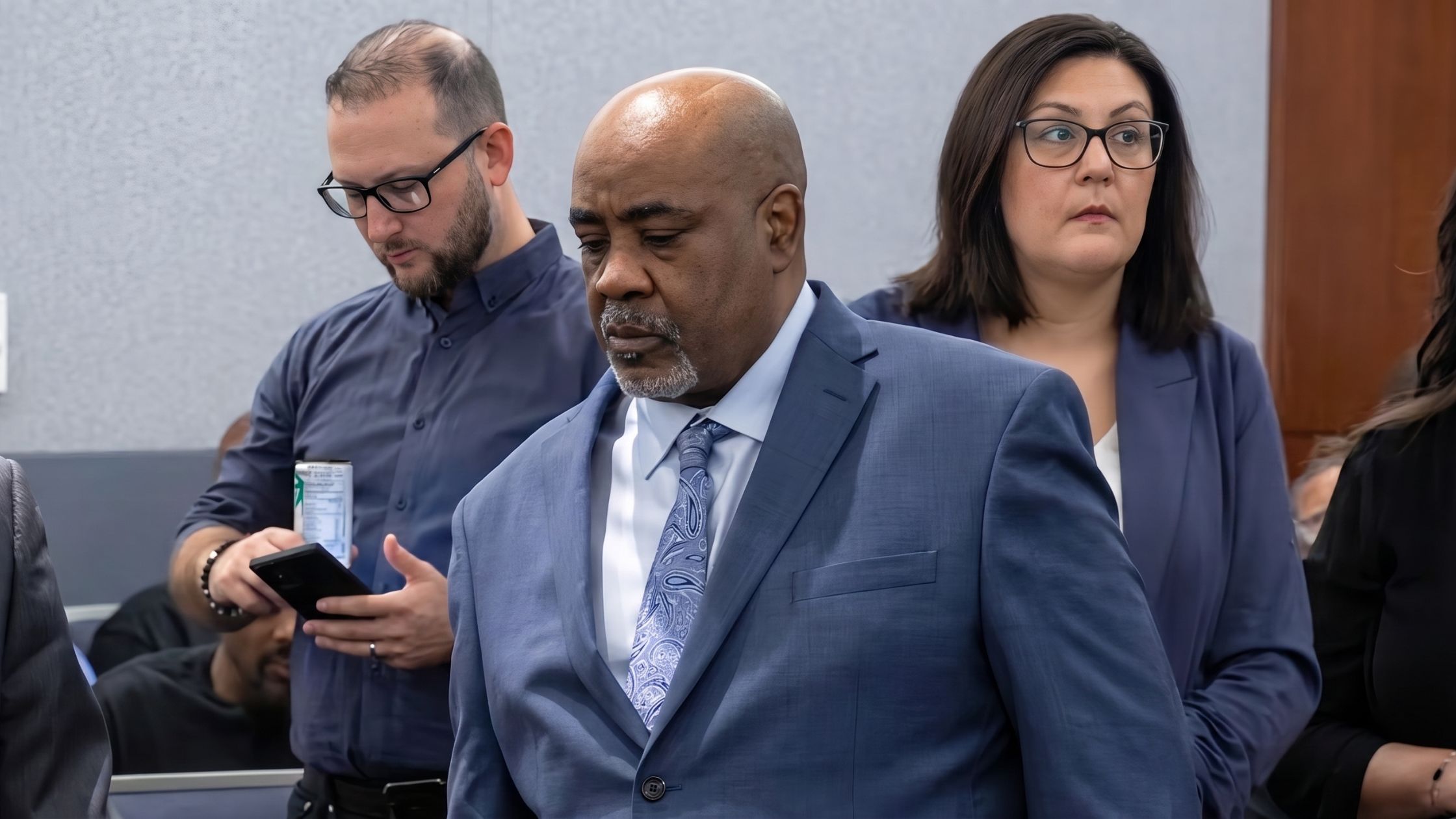
Judge (00:06):
We now have Mr. Davis. He's present in custody with Mr. Sanft. Anything we need to address outside the presence of the jury from either party?
Mr. Palal (00:13):
Nothing from the State.
Mr. Sanft (00:14):
Your Honor, I just want to make sure I have that issue with regard to the discovery commissioner. I just want to make sure, I think it's at 12:30.
Judge (00:22):
We had moved it for that, so we plan on stopping in time for you to get to that.
Mr. Sanft (00:27):
Thank you, Your Honor.
Judge (00:28):
Okay. And you were able to talk to Commissioner Ganz and get that all straightened out?
Mr. Sanft (00:31):
Not directly, but through my office, yes.
Judge (00:33):
Okay, excellent. Perfect.
Mr. Sanft (00:33):
Thank you.
Mr. Palal (00:34):
And I guess, Your Honor, I think it was mentioned during jury selection, but at this point, I think both parties would be invoking the exclusionary rule.
Judge (00:42):
Okay. So if we have anyone present in the courtroom who's on the witness list, you do need to step out at this time until you're allowed to come back in. Additionally, for everybody who's here in the audience, obviously we're in court, so I expect that there'll be no outbursts or speaking audibly that the jury can hear. Otherwise, we might have to remove you. Additionally, if you guys could all check and make sure that your cell phones are turned off or are at least on silent so that we don't have any distractions while we get going.
Mr. Sanft (01:09):
Your Honor, with regard to the exclusionary order, because of the fact that this is being broadcast, are we instructing as well witnesses to not be watching the broadcast prior to our testimony as well?
Judge (01:20):
Great point. Yes.
Mr. Sanft (01:20):
Okay.
Judge (01:20):
Anything further? All right. Let's bring in the jury.
Speaker 1 (01:20):
Did you get that [inaudible 00:03:48] for the judge after [inaudible 00:03:54]
Speaker 2 (01:20):
Stand for the jury.
Judge (01:20):
All right. You may... Do the parties stipulate to the presence of the jury?
Mr. Sanft (01:20):
Yes, Your Honor.
Judge (05:10):
You may be seated. Ladies and gentlemen, welcome back. Hopefully you were able to get everything situated over the long weekend, and we look forward to proceeding with trial. Before we get started, we do need to have you sworn. So if I could have you all stand and raise your right hand, we'll proceed with that.
Jessica (05:33):
You and each of you do solemnly swear that you will well and truly try the case at issue in a true verdict rendered according to the evidence, so help you God?
Jury (05:42):
Totally.
(05:42)
Yes.
Jessica (05:42):
Thank you. You may be seated.
Judge (05:47):
All right. Thank you, Jessica. And thank you, ladies and gentlemen. At this time, we're going to turn to opening statements. Mr. Palal, are you ready to give your opening statement at this time?
Mr. Palal (05:55):
Yes, Your Honor.
Judge (05:56):
You may proceed whenever you're ready.
Mr. Palal (05:57):
Thank you. Good morning.
Jury (06:03):
Morning.
(06:03)
Morning.
Mr. Palal (06:06):
On September 7th, 1996, Tupac Shakur came to Las Vegas to attend a Mike Tyson fight. After the fight, Tupac, along with Suge Knight, Trevon Lane, and other people that were with that group, ran into a person named Orlando Anderson. And Orlando Anderson is the defendant's nephew. And when they encountered Orlando Anderson sitting by himself, they attacked him. That attack was captured on video.
(06:50)
Then a few hours later, Tupac Shakur and Suge Knight drive down Flamingo Road to Club 662 where Tupac is scheduled to perform at a concert. Then two and a half hours later, after Tupac and Suge engaged in the beating of Orlando Anderson, Tupac is gunned down in a drive-by shooting from a white Cadillac in an act of revenge. During those two and a half hours, you will learn that the defendant was escalating and planning the retribution for the beating of his beloved nephew. Now, let's be clear. Duane Davis did not pull the trigger, but what he did do was plan the retaliation for the beating of his nephew. You will learn that Duane Davis got the gun. You will learn that he got into a white Cadillac. You will learn when the opportunity presented itself for retribution, Duane Davis made sure that the shooters were armed and ready to execute their revenge. And remarkably, you will learn that from Duane Davis himself.
(08:19)
But to understand what happened on September 7th, 1996 on the streets of Las Vegas, we need to go about 275 miles west to the city of Compton, California. What you'll learn is that Compton is about 10 square miles, but in the mid 1990s, those 10 square miles were occupied by over 30 gangs claiming its territory. And important to this case, there are two gangs, Mob Piru and the South Side Compton Crips. Let's talk a little bit about the Mob Piru. The Mob Piru's a group that associated with the color of red. And you'll hear that Suge Knight, the person who was driving Tupac Shakur that night, grew up in the neighborhood of Mob Piru. But by the mid 1990s, he had become a very successful CEO of the record label Death Row Records. But despite or maybe because of where he came from, you'll hear that Suge Knight continued to employ Mob Piru gang members as part of Death Row. They would act as unofficial security. And other times they would engage in, let's call them other acts on behalf of Suge Knight.
(09:46)
But Death Row in the mid 1990... labels around. They're artists such as Snoop Dogg, Dr. Dre, and of course, Tupac Shakur. And in 1996, Tupac Shakur was maybe the largest and biggest, most successful rapper around. He had just completed, he had just sold, released All Eyez on Me, a double album that was met with huge success. Additionally, Tupac Shakur was a movie star, having appeared in a number of movies in critically acclaimed roles. He has at times been referred to as an icon, but for the purposes of this case, what you need to know is that Tupac Shakur was not a gangster. He was a hip-hop artist associated with the Mob Piru.
(10:42)
Now, the other gang that's important to know here is the South Side Compton Crips. And when it comes to South Side, Duane Keffe D Davis was the leader of the Burris Street faction of the South Side Compton Crips. And while Suge Knight rose to prominence in his neighborhood... Duane Davis rose to prominence in his neighborhood because he was a very successful, large scale drug trafficker. And... Moves up in the world of gangs by bringing in money to the neighborhood. The other thing you'll learn is that Orlando Baby Lane Anderson was his nephew and also a highly respected member of the South Side Compton Crips.
(11:39)
Now, as part of this case, you're going to hear another name. Eric Zip Martin. Now, Eric Zip Martin is not a member of the South Side Compton Crips. In fact, he's based out of New York. He's involved in the drug trade and knows Duane Davis as a result of both their involvements in the drug trade. Duane Davis from the West Coast, Eric Zip Martin from the East Coast. And one of the connections that Duane Davis gets through his association with Zip Martin is with Sean Puffy Combs, who was then the CEO of Bad Boy Entertainment. Sean Combs wanted some security when he came out to the West Coast. He was worried about Mob Piru. He was worried about the members of Death Row Records. And so Duane Keffe D Davis agreed to be around to act as unofficial security for Sean Combs and his artists when they came out West... typically to ensure there are no problems with Mob Piru and Death Row records.
(12:50)
And this took a rivalry between Mob Piru and South Side Compton Crips and escalated it. And those tensions boiled over in the Lakewood Mall in the summer of 1996. There, you'll hear that Trevon Lane, a member of the Mob Piru Ru associated with Death Row records, was there with other members of Mab Piru in order to do some shopping. Lakewood Mall was a mall nearby Compton. You'll also hear that Baby Lane Anderson, Orlando Anderson, the defendant's nephew was there. Now, Trevon Lane that day was wearing a chain with a Death Row medallion. And there was a fight that occurs between the Mob Piru group and the South Side Compton Crips. And at one point that chain is pulled off Trevon Lane's neck. Now, what happened to that chain is an issue of much dispute. Not everybody agrees with it, but the act of disrespect of pulling the Death Row chain and the brawl that occurs further escalates this heated rivalry. And what you'll learn is that these two men, Trevon Lane and Orlando Baby Lane Anderson, they encounter each other again, this time in Las Vegas.
(14:17)
So that brings us back up to September 7th, 1996 here in Las Vegas. Again, Mike Tyson is fighting Bruce Seldon. He disposes of him in less than a round, in a round. Doesn't take a full round. And then after the fight, Tupac Shakur, Suge Knight and the people that are here with, they leave. And among his group is Trevon Lane. And that is why this fight occurs. Trevon Lane and the Death Row group sees Orlando Anderson standing by himself and they decide to attack him in retribution for what happened at the Lakewood Mall. You'll see Orlando Anderson is on the bottom of that group. You see security coming, trying to break this up. And then you'll see Tupac Shakur, Suge Knight, Trevon Lane, and that group exit the MGM Grand. Now Orlando Anderson was by himself because when Duane Davis purchased the tickets for the Bruce Seldon fight, he got it through a scalper. So everybody that came with Duane Davis were seated separately throughout the fight. And so Orlando Anderson was at that time by himself. You'll see that Mr. Shakur, Mr. Knight, and his group leave the MGM Grand and you'll see that Orlando Anderson, after being held by security, is questioned for a bit, asked if he wants to press charges. He decides he doesn't want to participate in any type of prosecution and that he doesn't need medical attention.
(16:09)
Duane Davis hears about this beating. And what you will hear is that in his world, there is no question that a response is required. And you will hear from Duane Davis what happens next. Because what happened over the next two and a half hours is something Duane Davis would later describe himself in a secret 2008 interview from his attorney's office with the federal task force. And we'll talk about that interview and the circumstances surrounding that later, but we'll hear about what the next two and a half hours was.
(16:49)
So what we learn is that Duane Davis is upset about the beating of his nephew. And frankly, no, that's not an unusual response. What's unusual is the next steps Duane Davis takes. Unusual for the normal person, maybe not unusual for in gang culture... is going to organize a retaliation that this beating cannot go unanswered. Then he runs into a person named Zip Martin. Remember the Zip Martin? That was the connection with Bad Boy Entertainment from New York. And Zip Martin tells him that he has...
Audio: Duane Davis (17:30):
I don't know.
Audio: Speaker 9 (17:30):
Okay, where do you go to? What do you tell Zip right then?
Audio: Duane Davis (17:37):
[inaudible 00:17:39].
Audio: Speaker 9 (17:39):
You tell Zip, "Hey, we're going to go handle this shit," or whatever?
Audio: Duane Davis (17:47):
Yeah, I wanted [inaudible 00:17:44] they going to get [inaudible 00:17:49].
Audio: Speaker 9 (17:48):
Who was they?
Audio: Duane Davis (17:49):
Everybody.
Audio: Speaker 9 (17:49):
Everybody?
Audio: Duane Davis (17:49):
Yeah, everybody [inaudible 00:17:55].
Audio: Speaker 9 (17:49):
How do you know that Zip had a gun? Did she tell you-
Audio: Duane Davis (17:49):
No, it was in the lobby when I met him in the lobby [inaudible 00:18:03]
Audio: Speaker 9 (17:49):
So did you ask him, "Do you have one?" Or is it he told you, "Yeah, I got one."?
Audio: Duane Davis (17:49):
Yeah, [inaudible 00:18:09] Yeah, okay, cool.
Audio: Speaker 9 (17:49):
[inaudible 00:18:13].
Audio: Duane Davis (17:49):
Yeah.
Mr. Palal (18:18):
So later, Duane Davis organizes two vehicles to go over to the 662 Club. Before that, he gets the gun from Zip Martin. He goes out to his Mercedes-Benz, gets the gun from Zip Martin. And then after some time, he assembles two cars to go to 662 to violently confront Tupac... And you'll hear that Duane Davis... and Orlando Baby Lane Anderson, they go in a white Cadillac and they go to Club 662, waiting for Tupac Shakur, waiting for Suge Knight, waiting for this violent confrontation. And what you'll learn is that Tupac Shakur and Suge Knight don't show up while they're there.
Audio: Duane Davis (19:09):
We went up to the 626 Club. They didn't show up. We waited about 15, 20 minutes. They didn't show up. So like, "Let's go get some liquor." We stopped at the liquor store. [inaudible 00:19:23] jump in the Cadillac.
Mr. Palal (19:25):
So what you hear Duane Davis say is he got... the Cadillac. And the plan at that point is to go to a liquor store, get some booze, and then go back to the Las Vegas Strip and party. What the original intention was before Orlando Anderson was beaten at the MGM Grand. But on the way back to the Las Vegas Strip, they see a caravan of cars. And that caravan included Tupac Shakur and Suge Knight. And in that white Cadillac before the shooting, before the shooting occurs, Duane Davis explains that the driver is Terrence T-Brown. In the rear driver's side is Deandre Dre or Big Dre Smith. In the rear passenger side is Orlando Baby Lane Anderson. Duane Davis himself, Keffe D, is in the front passenger side. And this is how Duane Davis explains the murder of Tupac Shakur.
Audio: Duane Davis (20:46):
Yeah. [inaudible 00:20:42] right there, then we came up on Harlem at the Long Bay Boulevard and shit... "Tupac, Tupac." I was like, "Dang, bro." And [inaudible 00:20:59] U-turn they was in the middle lane and we just we just pulled up on the side and checked every car to see where they was.
Audio: Speaker 9 (21:07):
So what direction...
Audio: Duane Davis (21:13):
"Tupac." He gave himself away. [inaudible 00:21:15] got them.
Audio: Speaker 9 (21:23):
You did a U-turn, so then you pulled alongside of it. [inaudible 00:21:28] car. Had you already handed him a gun at this point or at what point had you handed him the gun?
Audio: Duane Davis (21:28):
I thought he was going to pull on my side [inaudible 00:21:40] and pulled I upon his side.
Audio: Speaker 9 (21:43):
So you were fitting to blast if you had to, or you were just-
Audio: Duane Davis (21:46):
Yeah, if he would've been on our side, I would've.
Audio: Speaker 9 (21:50):
Okay. So you hand the gun to the back seat?
Audio: Duane Davis (21:51):
Yeah.
Audio: Speaker 9 (21:51):
[inaudible 00:21:52]
Audio: Duane Davis (21:51):
I gave it to Dre and Dre's like, "No, no, no." And...
Mr. Palal (22:04):
... admit that as they see Tupac Shakur and Suge Knight driving to Club 662, Duane Davis, along with Terrence Brown, Deandre Smith, and Orlando Anderson, decide to make a U-turn, confront Tupac Shakur, and Suge Knight. Duane Davis had the firearm. It's a firearm he got from Eric Von Zip Martin. And then he passes it to the back. Duane Davis says that if they were on his side, if Tupac Shakur and Suge Knight were on his side of the vehicle, he would've shot them himself. But because they were on the other side, he handed... Deandre Smith, according to Duane Davis, did not want to shoot at that time. So Orlando Anderson shot into that car... explains this over and over again.
Audio: Duane Davis (22:58):
... all up the street.
Audio: Speaker 9 (23:01):
Okay, Dre starts blasting. You say Suge looked over, he sees you?
Audio: Duane Davis (23:07):
Yeah.
Audio: Speaker 9 (23:09):
He looks right at you?
Audio: Duane Davis (23:20):
Yeah, he looked at me.
Audio: Speaker 9 (23:20):
[inaudible 00:23:21].
Audio: Duane Davis (23:20):
[inaudible 00:23:21] that son of a bitch [inaudible 00:23:21].
Audio: Speaker 9 (23:21):
So when he looks over at you and then Tupac's busy getting shot. Evidently, the story is Tupac's trying to either get out-
Audio: Duane Davis (23:28):
In the back seat or something.
Audio: Speaker 9 (23:30):
Yeah, what do you see happening his side there?
Audio: Duane Davis (23:30):
I see him [inaudible 00:23:35] I thought he was dead. Though he was dead [inaudible 00:23:40] something.
Audio: Speaker 9 (23:42):
A piece of glass went into his neck right here. [inaudible 00:23:45]
Audio: Duane Davis (23:44):
And [inaudible 00:23:48] I thought he was dead.
Audio: Speaker 9 (23:50):
Okay. So I'm sorry, did you guys stops, did [inaudible 00:23:55] stop the car, did anyone get out?
Audio: Duane Davis (23:50):
Yeah and [inaudible 00:23:59]
Audio: Speaker 9 (23:58):
Okay, but he stopped is what said, right?
Audio: Duane Davis (23:58):
[inaudible 00:23:59] and some broads [inaudible 00:23:59] phones. Stupid bitches [inaudible 00:23:59] they stopped.
Audio: Speaker 9 (23:58):
So Tupac's trying to jump in the back seat.
Audio: Duane Davis (23:58):
[inaudible 00:23:59] he was too big. And then...
Mr. Palal (24:25):
One other thing Duane Davis talks about during the murder of Tupac Shakur is that there is a car full of women. I think he calls them broads at one point. A car full of women who are there as well... And what she's going to tell you is that she disagrees slightly with Mr. Davis's rendition of facts. They were in fact communicating with Suge at Tupac's... And what she says is she will... what Duane Davis interprets as them chasing her. She'll tell you is them just panicking and trying to get away. But she will say they inadvertently follow Duane Davis and the other people in the white car as they are fleeing.
(25:18)
After Suge Knight and Tupac Shakur's vehicle is shot, Suge Knight makes a U-turn and heads back to the Las Vegas Strip. The car ultimately can go no further and stops. Police arrive, medical arrive. And you will hear that Suge Knight was grazed in the head and had some glass going in his neck. He ultimately survives those injuries and is released fairly quickly. You'll also hear that Tupac Shakur was shot multiple times, that he was brought to UMC, and that six days later he succumbed to those injuries. And within 24 hours... are back in Compton. They stay the night and they drive right home as though nothing happened. But a war followed them back to Compton. Because while people were afraid to come forward to police, the police knew and the streets knew that South Side Compton Crips were responsible for this murder. And the war that follows at Compton is a bloody one. You'll hear that Mob Piru and South Side Crip members start shooting at each other. Within 10 days, 3 people are killed. A number of people are shot, including an 11-year-old girl. And what you'll also learn is that none of those cases were prosecuted. Why? Because in this context, in the gang context of this, the combination of gangs and guns is scary. And in this world, silence means survival. The one person who has a hard time being silent is Duane Davis. You're going to hear from 1998 to 2023, Duane Davis has given a number of statements regarding this case. So as early as 1998, Davis spoke to the FBI. He admitted he was in Las Vegas during Tupac's murder, but he denies being responsible. Then in 1990, Davis speaks to the FBI again, and these aren't interviews that are focused on the Tupac Shakur murder. These are interviews regarding drug transactions and drug trafficking, but he does say that Tupac does come up and Duane Davis admits to being in Las Vegas for Tupac Shakur's murder. Says he wasn't involved, but he was mad about the fact that Orlando Anderson was beaten and that his plan was to handle it in Compton had Tupac survived. Then in 2008, the interview of clips we've heard today in a secret interview with the federal task force, Davis admits to his role in the murder of Tupac Shakur.
(28:37)
And we do need to talk a little bit about this 2008 federal task force because what this task force is investigating is not the murder of Tupac Shakur. What this task force is investigating is another rapper's murder. A rapper by the name of Christopher Wallace, somebody who is known as Biggie Smalls, so The Notorious B.I.G. Christopher Wallace got murdered six months after Tupac Shakur was killed. And there was some allegation that the LAPD might have been involved. So a federal task force was formed to determine what happened to Christopher Wallace. And the interesting thing about the murder of Christopher Wallace is that Christopher Wallace is killed leaving a party in LA. Also at that party, Duane Davis. Christopher Wallace, there was a suspect vehicle that involved a... and Duane Davis happened to own a Chevy SS Impala. Now as a result of that, the task force decides, "Well, let's look at Duane Davis. And the thing we know about Duane Davis is that he trafficked narcotics."
(29:49)
And so they were able through a CI and an undercover to have a drug transaction with Duane Davis. And as a result, Duane Davis now has a case, a big trafficking case. And so the federal task force approaches Duane Davis and his attorney and they say, "Hey look, we want information regarding the murder of Christopher Wallace. That is what we are trying to investigate." And what Duane Davis says is, "I don't have any information about that. But I can tell you... know about Tupac." And that's what he does. He tells a federal task force about his involvement, what you've heard, his orchestration of the murder of Tupac Shakur.
(30:38)
That secret conversation, that proffer was secretly recorded and released later. In 2009, Davis is being so helpful to federal authorities that he actually flies out to New York to try and get Zip Martin to implicate himself in the Tupac Shakur murder. Zip Martin at that time was dying of cancer, was out of the game and really did not engage with Duane Davis. In 2009 though, Duane Davis gives an interview to Las Vegas Metropolitan Police Department Detective Dan Long. Now, Duane Davis is more guarded in that interview. It is a different setting than the interview of 2008. It's not a secret proffer agreement. But Duane Davis does admit a number of things: that he was in Las Vegas, that he was mad about Orlando Anderson getting beaten, that he was the boss, that he was in the white Cadillac, and that he procured the firearm that ultimately killed Tupac Shakur.
(31:51)
Then in 2011, the landscape changes because in 2011, Greg Kading, the guy who was leading the task force in 2008, the guy who organized the secret proffer between Duane Davis and the federal task force, he leaves law enforcement and decides he's going to publish a book about his investigation into Biggie Smalls, the guy who was killed six months after Tupac, and Tupac Shakur. And what he puts in the book is that Duane Davis confessed to the murder of Tupac Shakur. The book tells the story about his admission about himself, but it also tells the story of Duane Davis telling about his nephew's involvement in the murder, about Big Dre's involvement in the murder, about Terrance Brown's involvement in the murder. And this is a problem for Duane Davis because that meeting was supposed to be secret. And now his cooperation with federal authorities is open to the world. Not only that, Greg Kading is now profiting off-
Mr. Palal (33:00):
... that Greg Kading is now profiting off Duane Davis's life story. So in 2017, Duane Davis decides to go public. He's approached by the producers of a show called Death Row Chronicles that appears on BET. And this is just a small portion of what he says is his motivation for appearing.
Video: Duane Davis (33:41):
[inaudible 00:33:31] People have been pursuing me for 20 years. Newspapers, magazines. I'm coming out now to tell the story because I got cancer. I got nothing else to lose. All I'm here about now is the truth.
Mr. Palal (33:55):
Duane Davis says, "All I want to do now is tell the truth."
(33:57)
And in the 2017 public interview, he's a little evasive, but he admits to being the boss. He admits to being in the white Cadillac. And he admits to be part of the murder of Tupac Shakur. And when he says he's the only person that can tell what happened, he's right. Because by 2017, Terrence Brown is deceased. Deandrae Smith is deceased. Orlando "Baby Lane" Anderson is deceased. Terrence Brown was murdered in unrelated incidents. Orlando Anderson was murdered in an unrelated incident. And Deandrae Smith died from [inaudible 00:34:44].
(34:46)
Remarkably, in 2019, Duane Davis then decides he's going to publish his own book. And with regards to the book, it is certainly a lot of self- aggrandizement. But again, the core remains. He was mad about the beating of Orlando Anderson, his nephew. He was in Las Vegas. He got the gun. He was in the white Cadillac and he handed the gun to the shootings.
(35:20)
And what you'll notice is a constant thing that always goes through his statements, is Duane Davis's visceral anger at Tupac Shakur for putting hands on his nephew. In the book, he says, "Them jumping on my nephew gave us the ultimate green light to do something to their ass." Then Duane Davis decides that he's going to do public interviews regarding his role in the murder of Tupac Shakur.
Video: Speaker 1 (35:53):
So you ended up getting in the car with Peggy Lane and him?
Video: Duane Davis (35:55):
I got in the car with him, yeah. [inaudible 00:35:59] we put the light on Sunset and Bingo and a dude acting like he was in a parade or something, he was in a BMW hanging out going, "Hey, it's Tupac. It's Tupac." And them bitches are... Shit. They was hollering for him. [inaudible 00:36:22] motherfucker came up on the side of him and shit...
Mr. Palal (36:30):
Davis's public admissions mirror his private ones. He admits to being a leader of South Side Crips. He admits the significance of the fight over the Death Row chain at the Lakewood Mall. He admits to being in Las Vegas the night of the fight. He admits to being angry that Tupac stomped Orlando Anderson at the MGM.
(36:47)
He admits that he was hunting down Tupac and Suge, first going to 662. He admits that he got a Glock 40 from Eric "Zip" Martin for the purposes of hunting Tupac.
(36:56)
He admits that he was in a white Cadillac with his gang members looking for Tupac. He admits to seeing Tupac in a black BMW and then changing directions, making that U-turn to confront Tupac and Suge. He admits to putting the gun he obtained that night in the backseat of the vehicle so the shooters could shoot.
(37:17)
And again, what remains? Even as late as 2020, 2021, '22 is Duane Davis's visceral anger at Tupac.
Video: Duane Davis (37:24):
[inaudible 00:37:37]. Tupac was wrong with [inaudible 00:37:46]. I mean, don't give me a wrong argument.
Video: Speaker 4 (37:24):
I mean, yeah, I think he could have reacted in a better way.
Video: Duane Davis (37:24):
You don't think that is wrong?
Video: Speaker 4 (37:24):
He could have reacted in a better way, I guess.
Video: Duane Davis (37:24):
I'll tell him, glad [inaudible 00:38:04] he admitted that that man is wrong, man.
Video: Speaker 4 (37:24):
I mean, [inaudible 00:38:11] he was wrong man, but that was only done out of [inaudible 00:38:12].
Video: Duane Davis (37:24):
Okay. Thank you. I appreciate that. My nephew didn't jump on him. He jumped on my nephew, it was a kid, man. My nephew was a fucking kid. That was a grown ass man, dude. You know what I'm saying? He was a fucking kid, and that's why he handled it [inaudible 00:38:32]. He's a fucking kid, dude. You know what I'm saying? He was wrong. My nephew never jumped over him. He jumped on my nephew.
(37:24)
My nephew's taking no punch, man. He chose the wrong, dude. Jumped on a fucking kid, dude.
Mr. Palal (38:50):
And this anger is not just demonstrated publicly, but you will hear as recently as 2024 privately in a conversation with his son, he talks about his feelings about Tupac Shakur nearly 30 years after the murder.
Video: Duane Davis (39:11):
I was born born way before that, dude. I was way out there before him, dude. I know Eazy E. And Dr. Dre and them, put them on motherfucker, on me, that little faggot, you know what I'm saying?
Video: Speaker 4 (39:30):
[inaudible 00:39:31].
Video: Duane Davis (39:30):
Put in fucking prison and get fucked in the ass. Fucking icon. And all that raping little girls, jumping on a little kid in the fucking hallway of the fucking casino, that dude is a piece of shit, you know.
Video: Speaker 4 (39:31):
Yeah, brother. They taking that shit way [inaudible 00:39:43]. Talking about he a icon [inaudible 00:39:49].
Video: Duane Davis (39:31):
Icon, icon my ass, I don't want none of my kids like that mother fucking faggot.
Mr. Palal (39:57):
28 years later, that is the visceral anger that Duane Davis had for Tupac Shakur. In two and a half hours, he took care of what he though was the proper response. And 28 years later, he still is angry about what Tupac did.
(40:21)
On September 7th, 1996, Tupac Shakur publicly on camera participated in a humiliating beating of Duane Davis's nephew, Orlando Anderson. Duane Davis knew that in his world, that required a response. And over the years in private interviews and public statements and even in private calls, Duane Davis has repeatedly told us over and over again about the anger he felt, and his own role in the revenge drive-by shooting of Tupac Shakur.
(40:53)
And now, nearly 30 years later, we're going to ask you to finally hold Duane Davis accountable. Thank you.
Judge Carli Kierny (41:08):
Thank you, Mr. Palal. Mr. Sams, do you wish to give your opening statement at this time?
Mr. Sams (41:12):
Yes, Your Honor. I'd like to set the secondary-
Judge Carli Kierny (41:14):
Of course. Whenever you're ready.
Mr. Sams (41:15):
I think this is the internal cable.
Judge Carli Kierny (41:27):
You got it or do you want IT to assist you?
Mr. Sams (41:31):
I think I got it. This is it, right?
Judge Carli Kierny (42:01):
Okay.
(42:01)
Whenever you're ready.
Mr. Sams (42:01):
Thank you, Your Honor. Good morning. We spent a lot of time, I think, when we were picking a jury to determine who would be the right jurors for a case like this. Obviously we want people who are going to reserve judgment until the end, but really look at the evidence with a critical eye.
(42:24)
Now what the state has just told you what they believe to be the evidence in this case. But really at the end of the day, you have to ask yourself if what they're saying is really truth or fiction. Fact or fiction.
(42:38)
I don't know if some of you recall, but I had asked the question specifically about what you were holding in your hands. And right now, of course, since you're all holding notepads and pens, that would be a fact, right? And in this case, for instance, I had asked before about the idea of... I can just do this, right?
(42:59)
Microphone. I'd asked some of you if that microphone was buried and dug up 30 years from now, would it still be a microphone? The answer is yes. And the reason why that's important is because in this case, what they are telling you, they're representing it to be a fact when it really is fiction.
(43:18)
And it's up to you to determine what the facts are in this case. Now I'm going to give you a timeline here for you to understand just a little bit of how this is going to work because there's so much evidence in this case that we have to sort of compartmentalize some things. And what I've done is really just sort of focused on the three detectives that work this file from beginning to now.
(43:40)
First detective you will hear about is Detective Becker. He works the file, he's the original detective on the scene.
(43:46)
Detective Long takes over the case for about 15 years or so, and then it ends with Detective Mogg who presents this to the grand jury in 2023. But why this timeline is relevant? You have to see the span of time for yourself. 30 years. And ask yourself this: what facts do they have after 30 years?
(44:10)
Now, Detective Becker does what every homicide detective does when he arrives on scene. He's assigned to the case. He starts his investigation. At that particular time though, Tupac Shakur was not dead. He was critically injured. He was at UMC. And it isn't until six days later that he passes away. But Detective Becker starts his initial investigation because it's pretty serious. And as a result, he just takes over the investigation. What he will testify to is that Flamingo and Koval on a Saturday night in the middle of a fight between Mike Tyson and Bruce Seldon, it was very busy when he arrived.
(44:50)
And he arrived at a time where he was able to determine cartridge cases, 40-caliber that was found at the scene. That's another fact for you. At some point they got to learn, he learns that potentially it was a Glock 40 that was the actual firearm that was used in this case.
(45:08)
And then when crime scene analysts arrive on scene, they document the evidence and they document the cars. That will be important, and you'll determine at some point why the cars are documented. And with regard to Detective Becker, what he'll tell you is police officers write reports. Critical. Hugely important. Why? Because at some point in the future, like in this case 30 years later, Detective Becker will not remember details like he would if he had, what? His report in front of him. And that's going to be important for you to consider in this case.
(45:43)
Now what Detective Becker does though is because of the outcry, the attention, the media focus on this case, he took his file and he secured it in his office under lock and key because he was worried about leaks in Metro, leaking information out to the public because so many people wanted to know answers to the question as to what happened and who did this to Tupac Shakur.
(46:12)
Now what you're going to find is, when Detective Becker testifies in this case, is that a lot of his reports are now missing. They're gone. Which is Metro's responsibility to hold and to pass on to the next detective and then finally to the next detective.
(46:29)
Now, Detective Becker also did not trust Compton PD. Why is that important in this case? Because there's an individual by the name of Reggie Wright Sr. He was a lieutenant working in Compton, in charge of the gangs in Compton in terms of investigations. His son is Reggie Wright Jr. He was the Head of Security for Death Row Records. The same security that was here in Las Vegas on the 9th of September 7th, 1996. Death Row Records was affiliated with Mob Piru Blood and Detectives Ladd and Brennan from Compton answered directly to Reggie Wright Sr. Becker did not trust Compton PD.
(47:17)
And the one thing that he really didn't trust is that most of their information came from confidential informants that were not reliable. And he'll tell you that. And because of his intuition, Compton PD was shut down in September of 2000 due to internal corruption. They just evaporated that police department and the sheriff's department for LA County absorbed the responsibilities for the police department in Compton because of the corruption that was there.
(47:50)
Now what facts, right? Just like the pads of paper that you have in your hand and the pens that you have in your hand, what facts can we determine from Detective Becker's efforts? First and foremost, we know that Tupac was shot multiple times. That's a fact. That can be proven. We know that it was with a 40-caliber firearm. That's a fact due to the cartridge casings. On the corner of Flamingo and Koval, that's also a fact, right?
(48:18)
We're on board so far? We know the date, September 7th, 1996. That is a fact. At 11:17 PM, we know that to be a fact as well. And then finally that he was in a vehicle during [inaudible 00:48:34] at night and that Tupac died six days later.
(48:37)
Those are facts that will not be refuted by anybody in this courtroom during the time that we spend together. But here's the one thing. There are no facts to point to Keefe, not one. And you're going to hear about this over and over and over again.
(48:56)
No facts, like the microphone in your hand or the pad of paper that you have that you write on. Detective Long takes over the case in 2002 and he has it from 2002 to 2017. He was, interestingly enough, on the gang unit and at the time of the shooting, he was in gangs and he had been one of the first to arrive on scene.
(49:17)
He will testify and tell you that every time he did something on this file, he wrote a report because that's important. That's what we do as a police officer. And he conducted follow-up interviews and he made some travel to Compton.
(49:32)
He will tell you those things. That's his role in all of this. But here's the thing. Detective Long also encountered some challenges in this case. They had to hide the case file with Metro because people were still accessing the file in Metro and they weren't authorized to do so.
(49:51)
So they changed the case number so that people couldn't find the file. In addition to that, what you're going to learn is LAPD reached out to him, called them up and said, "Hey, Detective Long, we have the gun and we've tested it and it matches back to what you're looking for in terms of the weapon that killed Tupac Shakur." Detective Long goes to LAPD, gets the gun, transports it back, gets tested, and it comes out as not a match to a big gun, to test you out.
(50:23)
This is the level of, I don't know how to put it, that was going on during this time period between Metro, LAPD and Compton. This is what's happening during this time period. Leads, according to Detective Long, became very scarce and stale, meaning that it was just taking a long time for him to follow up with people. Witnesses became unavailable. Why do you think that is?
(50:48)
Because of time. So as a result, memories started failing because of that time. So Detective Long had these challenges. But here's what Detective Long does. He interviews Keefe in 2009. Sits him down, has an interview with Keefe, just like the state said. And guess what happens? Detective Long doesn't even know that Keefe had actually spoken to a task force the year before. How is that possible? Metro is the agency responsible for the investigation to Tupac Shakur's murder and they don't even know about this.
(51:27)
No one in that room in 2008 told Detective Long or Metro what was going on. And you know who was in the room in 2008? You had FBI in the room. You had DEA in the room. You had LAPD in the room. You had the United States Attorney for the Central District of California in that room.
(51:54)
And Detective Long does not know about any of that. What you also learned is, out of all those people in that room, not one person verifies what Keefe D tells them. That the FBI, the gold standard of investigation in our country, did not go out and follow up on what was said.
(52:16)
Now one of the things the state showed you was a picture of a car and indicated there was four individuals in that car. And he'd tell you that at some point three of those individuals are dead and Keefe's the only one that's remaining.
(52:32)
But at the time that he gives his statement to the task force in 2008, there's another individual that's still alive. They never interviewed that individual to verify if that information was true. Why not? Because the FBI just fell asleep, that the LAPD just didn't care.
(52:55)
Keefe was never charged for any of what he said during that time period. And it's because they knew he was full of crap, otherwise they would've. Why wouldn't they? When Detective Long comes back to Las Vegas, he goes and he talks it over with the Clark County District Attorney's Office. And you know what happened then? They didn't charge the case either in 2009. Ask yourself the reason why that is. It's because they just didn't care about Tupac Shakur or his life, or it's because they looked into it and realized, we can't verify this information. We don't believe this to be true. Why would the Clark County District Attorney's Office not charge it in 2009? Now what facts do we get out of Detective Long based upon what he did for those 15 years?
(53:58)
We don't have any facts. Outside of statements made allegedly by Keefe D and other people, we don't have anything to verify any of that information. Not one single thing to corroborate the statements made by that man in 2008 or 2009. Not only by Metro, but by the FBI, by LAPD, by the DEA, by the United States Attorney's Office. No one corroborates any of this. So 2017 comes along and an entity called the Center of Investigative Reporting, they file what's called a FOIA request with Metro. And what that means is, FOIA is the Freedom Information Act that allows or requires government agencies to give up information if you ask for it.
(54:51)
That's the goal, it's to be transparent. And people wanted to know what was going on with the murder files. This is 2017. This is years after any of the statements that were made and anything else.
(55:04)
Where's the investigation? What's going on? Well, Metro said, "No, we're not going to give it to you." So in 2018, the Senate turns around and files a lawsuit against Metro to force them to give them the file, to show them what work had you been doing over at that particular point, I don't know, what's that? 20 years?
(55:29)
That's when Detective Mogg enters the picture. What you will learn is that Detective Mogg basically says, "I'm here just to close out the case." He's not here to solve the mystery of who killed Tupac. So with everything you have in front of you that you're now hearing for the first time in terms of the statements that were made in 2008, 1998, 1990, whatever, Detective Mogg moves on and says, "I'm just here to close out the case." That's his role. And what you're going to learn is Detective Mogg received a copy of what's called the Death Row Chronicles in 2018.
(56:05)
It's not a deposition. It's not a testimony under oath. It's edited and it's done for [inaudible 00:56:12] purposes. He receives a copy of it. You know what happens when he receives that copy... Showing you in this case? No charges filed. Why?
(56:25)
Well, Keefe writes a book, allegedly. Allegedly he writes this book called Compton Street Legend in 2019. You know what happened with the book, right? Even he confesses to it. What you find is no charges filed. What is going on? District attorney's office doesn't want to charge the case. No charges filed.
(56:51)
When the interview happens, no charges are filed when the book is written. What is going on? Five years goes by and nothing is going on with the case. But Detective Mogg says he's closing it out. Detective Mogg turns around and applies for what's called a search warrant.
(57:09)
Now what a search warrant is, is that in July of 2023, around that time period, a search warrant requires a police officer to get permission from a judge to basically violate the sanctity and privacy of your home, right? There's got to be legal reasons for it. He's got to go through that process and he's got to ask permission from a judge in order for him to get that. And what he does in that search warrant application is he assures the judge, "Hey, what we are looking for is in the home. The thing that's going to help us solve this crime, who killed Tupac, is in the home." And he signs an affidavit, and that's important. I want you to remember this. He signs an affidavit attesting to what he's saying to this judge to be true and correct. What he says is, "I think we have evidence in Keefe D's home that will solve the murder of Tupac."
(58:04)
So up until this point, they've got all these statements that can't be corroborated. So now they're saying, "We have evidence of this home that we think probably is in the home." And as a result, we're going to find this evidence that's going to help us solve this case.
(58:20)
What I want to tell you right now is that he don't find it. And in the meantime, Detective Mogg retires. He now becomes Mr. Mogg. And Mr. Mogg goes to the grand jury. And in the grand jury, it's a secret proceeding. We're not there. The defense isn't sitting like we are here. It's just the prosecutors. There's a panel of people called the grand jurors and you have people come up and they testify under oath. And there's really no way for the defense to challenge any of it because it's done in secret. We don't really know about it. But in this particular case, Mr. Mogg is sworn to testify truthfully. And you know what Mr. Mogg does? He just reads pages of the book into the record.
(59:05)
He doesn't do any more in terms of an investigation than read pages of a book into the record. He never documents in any of his efforts any verification of the book before he reads it into the record. He walks up, gets on the stand and reads the book as if it's the gospel truth. And that's what he does. He treats that book like it's fact.
(59:40)
Now, what you're going to find out about Mr. Mogg is that he never wrote a report. So when he took over the case in 2017, all the way up until when he retired in 2023 and was in front of the grand jury, he never wrote a report. Not one time. Not like Detective Becker and not like Detective Long. And not like any other police officer who does their job. This man never writes a report. In fact, what happens is he transitions, right?
(01:00:13)
He's Metro detective, he retires, and then he gets a job working as an independent contractor for the district attorney's office as an investigator. And as an investigator, he doesn't have any police power. He continues to work as a lead detective on this case. Even though the procedure is, you hand your file and your officer's report to the next detective in line. That's how this works.
(01:00:39)
But he keeps the file for himself and he starts billing against the file after he retires as a detective at Metro. Because now he's an independent contractor. That's important to know. Why is that important? Because what the evidence is going to show you is that he backloaded his work. And when he finally writes a report, it's not an officer's report, it's a investigative report that stands from 2018 to current. And we just received it about five weeks ago.
(01:01:15)
The importance of capturing everything you do, the accuracy that you would need to be able to be in court on a murder case, not some type of college paper that you forgot to do and then the last second just put something together and get it out the door, Mr. Mogg does not do any of that. That's going to be important later for you to consider, because according to that report that he submitted five weeks ago or so, he never verified the book.
(01:01:51)
According to that report, he never investigated any of the alternate theories that were out there. And you're going to hear about those alternate theories. There are people who have developed over time answers to the question. Who did this and why? He never looked into any of it. Which I think, at the end of the day, don't you want to see what's out there to help your investigation?
(01:02:13)
And according to his work, his report, he did more on the case after he became an investigator than he did before when he was a detective.
(01:02:23)
What I'm going to tell you right now is what you're going to find when you listen to all the evidence that his work was biased, sloppy, and incomplete. Those are the three things you're going to determine for Mr. Mogg.
(01:02:36)
Now, because of the fact that in terms of the evidence itself, he doesn't have much, the state's going to lean pretty heavily on their witnesses. I want to give you a sampling of the type of people you're going to run across in this trial based upon their witness list in this case.
(01:02:52)
First person is this guy named Reggie Wright Jr. He's the... Remember? The security company for... Thank you, for Death Row Records. And what he is, is a felon. Second of all, you're also notified that he's a former Compton police officer. He worked for Compton PD for about five years and apparently he got disabled.
(01:03:19)
At some point he becomes a felon. You're going to learn about that. And his father, like I said before earlier, Reggie Wright Sr. was the head of the Compton PD gang unit. What you're also going to learn about Reggie is that, once again, he was supposed to be protecting Suge Knight. Where was he the night of the shooting? In addition to that, he orders his security team to not carry firearms the night of the shooting before the shooting took place.
(01:03:47)
What you're also going to learn is he wasn't even around when the shooting occurred. So the principal, meaning the person he should have been protecting the most, would have been Suge Knight, the head of Death Row Records, this man was nowhere to be found. He was sitting at a club called 662 down the street waiting for Suge to show up while he left his people that were working for him unarmed in the vehicles behind Suge Knight.
(01:04:14)
And when the push comes to shove, he orders his people to lie to police during their investigation. That's going to be called by them. That guy's going to be called by them. In addition to that, when everything was said and done, Suge Knight went to prison because he was not supposed to be in a fight in Las Vegas. He violates his release. Guess who takes over Death Row Records? Reggie Wright Jr.
(01:04:43)
Now the State is also going to bring in other people with unreliable positions, including criminal histories, financial motivations, and inconsistent statements. That are the people and the quality of the evidence that you're going to listen to in this case. Just to give you another example, there's going to be an individual by the name of Devonta "Dirt Rock" Lee. Who is he? He's been a paid informant for years.
(01:05:09)
You're going to hear that they have paid him to be an informant. He will of course say whatever he needs to say to avoid his own criminal actions, but his testimony will be inconsistent. And that's what you have to really rely on, is what exactly is he going to say and can you even believe it? In addition to that, you're also going to learn about a disgraced LAPD detective by the name of Greg Kading.
(01:05:35)
The State told you about him. He wrote a book. He benefited off of what was happening with regards to Keefe. Now Greg Kading, he stole the file. What you're going to learn is he actually stole the file. He took the Tupac and the Biggie case files and walked out the door. This is an LAPD detective that they are using, or one of the people that they're going to be focusing on to establish their case. He writes the book, then he holds himself out as...
Michael Sanft (01:06:00):
... case. He writes the book, then he holds himself out as the person who solves the murder. That's Greg Kading. That's the LAPD detective. Now, what you're also going to learn is Greg Kading, when he was a detective with LAPD, was basically caught manipulating witnesses. And because he was caught manipulating witnesses, it led to cases being overturned as a result. There was a court finding on this issue. A judge determined that, and there we go. That's Greg Kading. That's a witness in this case from that. Now, your challenge is, right? I mean, gosh, we're sitting here, there's cameras in the room. I mean, there's things going on, but it's really time. How do you, as jurors, try to figure out time on this case? There's been so much time. Delays. By who though?
(01:06:57)
And there's corruption. How do you look at your information that you're receiving with anything more than just skepticism? Like you're going to look at the stuff and you're like, well, I mean, you have a motive to lie. You have a motive to tell or deceive. And it's because at the end of the day, there's not actual facts. When you get past all the talk and me talking, talking, talking, just look at the actual facts. What facts do you have to support any of what Keffe D said on any of these interviews are in the book? When you look at the relevant timeline again and you see the length of time, ask yourself what facts do they have to even put Keffe D in a car in Las Vegas on September 7th, 1996? Facts. When you look at the video that happened at the MGM, look for him. Try to find him in there. Try to find any of the other individuals. Remember he said there's three individuals in the car with him and Orlando Anderson. Orlando's in the video because he's getting beat up. Find any of those other individuals on the videos of the MGM. Look for evidence that shows that Keffe D was even in Las Vegas on the night of the fight. Receipts, credit cards, a picture of him standing next to somebody else, maybe watching the fight from another casino. Something. Give me something.
(01:08:33)
In the book, you're going to learn that Keffe says that he was at the fight. He was sitting on the second row. He was sitting with all the celebrities and he dressed in his finest gear. There's not one iota of proof that he was ever at that fight. But you know who does show an iota of proof that he was at the fight? Suge Knight. Suge Knight was raided and at some point, there is a ticket stub to that fight, the Tyson versus Seldon fight with Suge Knight's possession because he went to the fight. And you would think a fight like this, you want to show everyone that you were at the fight. There's no evidence at all that man was even at the fight.
(01:09:16)
When we take fact versus fiction, really at the end of the day, what you're going to hear from witnesses that will testify to this is that Keffe D was known to do this. That's the testimony you're going to hear in this case. That's what you're going to hear about that man right there until you have to ask yourself a question. If I just say things, is that going to end up being one of those things where I'm going to be hemmed up for a murder if I just keep repeating that fiction? I keep repeating that? The answer is no. You have to corroborate everything I say in order for it to be true. Otherwise, it's just that, [inaudible 01:09:58]. And at the end of all of the time we spend together, what you're going to find is that the State cannot prove to you beyond reasonable doubt the claim that Keffe had anything to do with a first degree murder with use of deadly weapon. There's no facts to that matter. Thank you.
Judge Carli Kierny (01:10:17):
Thank you, Mr. Sanft. State, at this time, are you prepared to proceed on with your case in chief or did you need a brief break? I
Marc DiGiacomo (01:10:23):
Just need a break to bring the evidence in, so maybe give the jury a few minutes.
Judge Carli Kierny (01:10:26):
Sure. We can do that. All right, ladies and gentlemen, at this time, we are going to take a 15- minute break. During this recess, you are admonished on the talk or converse amongst yourselves or with anyone else on any subject connected to the trial or read, watch or listen to any report of or commentary on the trial of any person connected with this case by any media of information, including without limitation, newspaper, television, internet, and radio, or form or express any opinion on any subject connected with the trial until the case is finally submitted to you. We'll have you guys back here at 11:00 AM. Please rise for the jury. For the record, the jury has exited the room. Is there anything we need to address outside the presence?
Marc DiGiacomo (01:11:33):
No, Your Honor.
Michael Sanft (01:11:36):
No, Your Honor.
Judge Carli Kierny (01:11:36):
Okay. You guys are just going to work on marking those exhibits so it goes a little smoother?
Marc DiGiacomo (01:11:39):
I'm just going to bring the box in. We've already given our list and it's marked. And then I just need to grab the exhibits for the witnesses today.
Judge Carli Kierny (01:11:47):
Okay. Sounds good. All right. And then we'll give you about an hour or only return about an hour and 15 before we have the break.
Clerk (01:11:52):
[inaudible 01:11:53]. We're still on the record. So everybody still needs to remain quiet.
Judge Carli Kierny (01:11:52):
I have to stop at 12:15 [inaudible 01:12:00].
Marc DiGiacomo (01:11:52):
No, I'm just saying we need to be done before 12:15.
Judge Carli Kierny (01:11:52):
Oh, got it.
Clerk (01:11:52):
[inaudible 01:12:06].
Judge Carli Kierny (01:13:47):
... on record in State versus Davis, anything we need to address before bringing the jury in?
Michael Sanft (01:13:50):
No, Your Honor.
Judge Carli Kierny (01:13:51):
All right. Let's bring him in.
Michael Sanft (01:13:51):
It actually looks a lot better than mine. [inaudible 01:13:52].
Marc DiGiacomo (01:13:51):
This one?
Michael Sanft (01:13:51):
Yeah.
Marc DiGiacomo (01:13:52):
Okay. Thank you. [inaudible 01:14:21].
Michael Sanft (01:13:52):
Gotcha. The same person [inaudible 01:14:21].
Marc DiGiacomo (01:13:52):
No, Safina was in court. [inaudible 01:14:21].
Michael Sanft (01:13:52):
Okay. Different guy. The handwriting [inaudible 01:14:21].
Marc DiGiacomo (01:13:52):
I guess maybe they get taught how to do that.
Michael Sanft (01:13:52):
Yeah. It looks like [inaudible 01:14:21].
Marc DiGiacomo (01:13:52):
[inaudible 01:14:21].
Michael Sanft (01:13:52):
All right.
Marc DiGiacomo (01:13:52):
[inaudible 01:14:21] the stolen Dodge Caravan.
Michael Sanft (01:14:21):
I see. Thank you.
Marc DiGiacomo (01:14:56):
Hey, 30 years later, we'll figure out the facts are no more.
Michael Sanft (01:15:14):
We'll get there. [inaudible 01:15:17].
Speaker X (01:15:14):
[inaudible 01:15:20].
Court Officer (01:15:24):
Stand for the jury.
Judge Carli Kierny (01:15:59):
Do the parties stipulate to the presence of the jury?
Michael Sanft (01:16:07):
Yes, Your Honor.
Marc DiGiacomo (01:16:08):
Yes, Your Honor.
Judge Carli Kierny (01:16:08):
You may be seated. All right. State, you may call your first witness.
Marc DiGiacomo (01:16:10):
Garry Dale.
Court Officer (01:16:10):
[inaudible 01:16:34].
Clerk (01:16:36):
You do solemnly swear the testimony you're about to give in this action shall be the truth, the whole truth, and nothing but the truth, so help you God?
Garry Dale (01:16:46):
Yes, I do.
Clerk (01:16:46):
You may be seated.
Garry Dale (01:16:46):
Thank you.
Judge Carli Kierny (01:16:46):
May I please have you state and spell your first and last name for the record?
Garry Dale (01:16:49):
First name is Garry, G-A-R-R-Y. Last name is Dale, D-A-L-E.
Judge Carli Kierny (01:16:57):
Thank you, sir. Whenever you're ready, Mr. DiGiacomo, you may proceed.
Marc DiGiacomo (01:16:58):
Thank you. Sir, back in September of 1996, how were you employed?
Garry Dale (01:17:02):
I was working for the Las Vegas Metropolitan Police Department at that time.
Marc DiGiacomo (01:17:05):
And how long did you wind up working for Metro?
Garry Dale (01:17:09):
25 years total.
Marc DiGiacomo (01:17:11):
On September 7th of 1996, what was your assignment?
Garry Dale (01:17:15):
I was assigned to a bike team on bicycles on The Strip, Las Vegas Strip area.
Marc DiGiacomo (01:17:21):
Is the uniform similar to the ones they have today where you're wearing the yellow shirts or were you wearing something different?
Garry Dale (01:17:26):
Yellow shirts and black pants.
Marc DiGiacomo (01:17:28):
I want to direct your attention to right around 11:00 PM. What part of The Strip were you working?
Garry Dale (01:17:36):
I was working the little bit further south end, south of Flamingo.
Marc DiGiacomo (01:17:41):
Did you have a partner?
Garry Dale (01:17:43):
Yes, I did.
Marc DiGiacomo (01:17:44):
What was his name?
Garry Dale (01:17:45):
Richard Golgart.
Marc DiGiacomo (01:17:48):
While you were working on that area of The Strip, did you cause there to be some sort of car stop of a vehicle?
Garry Dale (01:17:58):
Yes, sir. I did.
Marc DiGiacomo (01:17:58):
And what was the purpose of stopping this vehicle?
Garry Dale (01:18:01):
I initiated a car stop on a black BMW that had no license plates.
Marc DiGiacomo (01:18:07):
May I approach, Judge?
Judge Carli Kierny (01:18:08):
You may.
Marc DiGiacomo (01:18:11):
First, I'm going to show you what's been marked as State's Proposed Exhibits 1 and 2. Now, there's some obvious markings on here, but these appear to be two aerials of the Las Vegas Valley from generally around the time period of the 2000s, '96 area.
Garry Dale (01:18:26):
Yes, sir.
Marc DiGiacomo (01:18:28):
Accurately reflect kind of the locations that they're describing on there? Flamingo, Harmon?
Garry Dale (01:18:33):
Yes.
Marc DiGiacomo (01:18:35):
Move to admit 1 and 2, Judge.
Judge Carli Kierny (01:18:36):
Any objection?
Michael Sanft (01:18:37):
No objection, Your Honor.
Judge Carli Kierny (01:18:38):
So admitted. You may publish.
Marc DiGiacomo (01:18:41):
I'm going to start with Exhibit number 1. And right next to you, don't click it, but there is a mouse that you can roll around with a pointer. Can you generally tell me where this car stop occurred?
Judge Carli Kierny (01:19:04):
It won't work because you're doing it off of your computer.
Marc DiGiacomo (01:19:06):
I have I had it plugged in. It works.
Judge Carli Kierny (01:19:08):
There it goes.
Marc DiGiacomo (01:19:08):
Little bit lower.
Garry Dale (01:19:11):
I'm just trying to wrap around the Boulevard here.
Marc DiGiacomo (01:19:17):
So if I told you that red dot's Harmon and Flamingo, I'm sorry, Harmon and Las Vegas Boulevard...
Garry Dale (01:19:22):
Yes, sir. A car stop was right around, I believe it was right around this area.
Marc DiGiacomo (01:19:30):
So just south of Flamingo on Las Vegas Boulevard?
Garry Dale (01:19:33):
Yes.
Marc DiGiacomo (01:19:34):
When you approached the vehicle, did you recognize the occupants?
Garry Dale (01:19:42):
No, I did not.
Marc DiGiacomo (01:19:45):
Why did you stop this vehicle?
Garry Dale (01:19:47):
It had no license plate on the back.
Marc DiGiacomo (01:19:50):
When you approached the vehicle, did the occupants communicate with you?
Garry Dale (01:19:53):
Yes.
Marc DiGiacomo (01:19:54):
And at that point, did you learn their identity?
Garry Dale (01:19:58):
They told me who they were, but just as identifying them, not.
Marc DiGiacomo (01:20:03):
Did you know them-
Garry Dale (01:20:04):
No, I did not.
Marc DiGiacomo (01:20:05):
... when they told you their names?
Garry Dale (01:20:06):
They told us their names because we asked them their names, but I didn't know them. I had no knowledge of them before that. We ID'd them.
Marc DiGiacomo (01:20:15):
As you sit here today, do you recall who they were?
Garry Dale (01:20:18):
Yeah. Tupac Shakur and Marion Knight.
Marc DiGiacomo (01:20:23):
May I approach?
Judge Carli Kierny (01:20:23):
You may.
Marc DiGiacomo (01:20:25):
Showing you grand jury Exhibit number 3. Is that how the two of them appeared to look that evening when you approached them?
Garry Dale (01:20:36):
Yes.
Marc DiGiacomo (01:20:38):
In particular, Mr. Shakur is wearing or has on a very large gold necklace.
Garry Dale (01:20:46):
Yes.
Marc DiGiacomo (01:20:47):
Did you talk to him about that necklace?
Garry Dale (01:20:50):
Yeah, we talked to him for a few minutes out there and just remarked to him, "Wow, man, that's a huge piece of gold," or something like that, that he had around his neck.
Marc DiGiacomo (01:21:03):
Would you describe your interaction with them as congenial?
Garry Dale (01:21:06):
Yes.
Marc DiGiacomo (01:21:06):
Okay. Did you ask them about the license plate, why their vehicle had no license plate?
Garry Dale (01:21:12):
Yes, I did.
Marc DiGiacomo (01:21:13):
And what was the response?
Garry Dale (01:21:15):
They stated that they were filming a video. So they had taken the license plate off because they were filming a video going up and down The Strip.
Marc DiGiacomo (01:21:22):
Move to admit 3, Judge.
Judge Carli Kierny (01:21:25):
Any objection?
Michael Sanft (01:21:29):
I'm sorry. No objection, Your Honor.
Judge Carli Kierny (01:21:32):
So admitted. You may publish.
Marc DiGiacomo (01:21:37):
And this large gold medallion is what we're talking about, correct?
Garry Dale (01:21:41):
Yes, sir.
Marc DiGiacomo (01:21:43):
How did that interaction with Mr. Knight and Mr. Shakur end?
Garry Dale (01:21:50):
We told them that they were going to have to put the plate back on their car, and we warned them and released them.
Marc DiGiacomo (01:21:58):
Did you remain down in The Strip area after they left that car stop?
Garry Dale (01:22:03):
Yes, sir.
Marc DiGiacomo (01:22:04):
Well, fast-forward about, let's say 10 minutes later, something unusual happened. What happened?
Garry Dale (01:22:13):
We were continuing riding on The Strip area. We were heading southbound on the Boulevard, and we heard some calls come out about a vehicle. Can't remember exactly what was said, but heading up towards Harmon, we saw the vehicle that had been described in the median of the road. It looked like it had ran up on the median and was stopped there in the middle of the boulevard.
Marc DiGiacomo (01:22:38):
What do you do when you see that?
Garry Dale (01:22:40):
We approached the vehicle.
Marc DiGiacomo (01:22:42):
Is it you and Mr. Goldberg or Officer Golgart?
Garry Dale (01:22:44):
Yes, Officer Golgart and I.
Marc DiGiacomo (01:22:46):
And do you see either of the two people that you saw earlier in the vehicle?
Garry Dale (01:22:52):
Yes.
Marc DiGiacomo (01:22:55):
And who is that?
Garry Dale (01:22:55):
Marion Knight was outside of the vehicle, walking around, talking. And Tupac Shakur was being removed by EMS people.
Marc DiGiacomo (01:23:08):
As Marion Knight is talking, do you recall anything he's saying?
Garry Dale (01:23:15):
He was telling us to take care of Tupac Shakur. Marion Knight had a chunk of shrapnel or something in his head. He was bleeding. And when I wanted to talk to him, he was adamant that we needed to go and care for Mr. Shakur.
Marc DiGiacomo (01:23:30):
Did you then go to Mr. Shakur?
Garry Dale (01:23:33):
Yes, I did.
Marc DiGiacomo (01:23:34):
And then what do you do? What's your responsibility as it relates to Mr. Shakur as the EMTs working on him?
Garry Dale (01:23:40):
I was trying to talk to him to find out what had happened. Excuse me. Gather information to see who had fired at them.
Marc DiGiacomo (01:23:48):
Did you wind up riding anywhere with Mr. Shakur?
Garry Dale (01:23:52):
Yes, I rode to the hospital in the ambulance with him.
Marc DiGiacomo (01:23:55):
During that time period, between the time you get to Mr. Shakur and the time period he gets taken into the hospital, are you able to have any sort of communication with Mr. Shakur?
Garry Dale (01:24:05):
He was still talking and I was trying to convince him to tell me the name of whoever his assailants were.
Marc DiGiacomo (01:24:14):
And did he ever respond?
Garry Dale (01:24:16):
Yes. He responded, "No, we'll take care of it." Something like that.
Marc DiGiacomo (01:24:19):
Said, "No, we'll take care of it. We'll take care of it."
Garry Dale (01:24:25):
"We'll take care of it." Something like that.
Marc DiGiacomo (01:24:26):
And that's the only thing you were able to gather from Mr. Shakur?
Garry Dale (01:24:30):
Yeah. I couldn't get him to talk to me any further than that. That was repeated a couple of times.
Marc DiGiacomo (01:24:35):
I'm going to approach with a few photographs. Well, let me back up. When an incident like this happens, there's first responders, but then there is detectives, crime scene analysts, everybody who's called out. Is that correct?
Garry Dale (01:24:50):
Yes, sir.
Marc DiGiacomo (01:24:53):
Showing you what's been marked as grand jury Exhibit number 4. Do you recognize the individual who appears to be inside of that vehicle at that time?
Garry Dale (01:25:06):
Dan Ford.
Marc DiGiacomo (01:25:08):
Do you know what he did for Metro?
Garry Dale (01:25:11):
At the time, he was a detective. I was not there when that photograph was taken, but at the time, he was a detective. I'm not sure what he was. Homicide or general assignment or...
Marc DiGiacomo (01:25:23):
Could he be a crime scene?
Garry Dale (01:25:24):
Crime scene analyst. CSI.
Marc DiGiacomo (01:25:28):
Okay. And then I'm just going to show you a few other pictures of the vehicle itself. Showing you State's proposed Exhibits 5 through 8. Just flip through those.
Garry Dale (01:25:43):
Okay.
Marc DiGiacomo (01:26:01):
Is that how the vehicle appeared to you when you first arrived on scene? Obviously without people in it.
Garry Dale (01:26:06):
Right. On the scene of where it stopped in the middle of Harmon Boulevard.
Marc DiGiacomo (01:26:11):
Move to admit 5 through 8.
Judge Carli Kierny (01:26:16):
Any objection, Mr. Sanft?
Michael Sanft (01:26:17):
No objection, Your Honor.
Judge Carli Kierny (01:26:17):
So admitted. You may publish.
Marc DiGiacomo (01:26:20):
And then finally, while you were at UMC, did you collect some personal items off Mr. Shakur?
Garry Dale (01:26:27):
Yes.
Marc DiGiacomo (01:26:28):
I'm showing you what's been marked as State's proposed Exhibit number 33. Do you recognize that?
Garry Dale (01:26:33):
Yes.
Marc DiGiacomo (01:26:34):
What is it?
Garry Dale (01:26:35):
That's the objects I removed from Tupac Shakur. I impounded those into evidence. There should be a property report for those.
Marc DiGiacomo (01:26:45):
Let's talk about that large gold chain we see in that photograph right there. The second time you came across Mr. Shakur, was he wearing that gold chain that's around his neck?
Garry Dale (01:26:57):
No.
Marc DiGiacomo (01:26:58):
And so you weren't able to recover that from him at the hospital?
Garry Dale (01:27:04):
No.
Marc DiGiacomo (01:27:04):
Judge, I'm just going to put up a few of these photographs.
Judge Carli Kierny (01:27:18):
Okay. My clerk's letting me know that 4 was not admitted.
Marc DiGiacomo (01:27:19):
Move to admit 4.
Judge Carli Kierny (01:27:21):
Any objection, Mr. Sanft?
Michael Sanft (01:27:22):
No objection, Your Honor.
Judge Carli Kierny (01:27:23):
So admitted.
Marc DiGiacomo (01:27:24):
Showing you 4. That's Mr. Ford appearing like he's inside that vehicle.
Garry Dale (01:27:33):
Okay.
Marc DiGiacomo (01:27:36):
5. That's the front of the vehicle, yes?
Garry Dale (01:27:49):
Yes.
Marc DiGiacomo (01:27:50):
Sorry. She's typing down everything, so you got to answer yes or no.
Garry Dale (01:27:52):
Apologies.
Marc DiGiacomo (01:27:58):
That's the rear of the vehicle without the license plate still?
Garry Dale (01:28:00):
Yes.
Marc DiGiacomo (01:28:07):
Number 8 is the driver's side of the vehicle.
Garry Dale (01:28:11):
Yes.
Marc DiGiacomo (01:28:12):
And oops.
Judge Carli Kierny (01:28:19):
Mr. DiGiacomo, 43 [inaudible 01:28:19] also noted [inaudible 01:28:19]. Okay. Which one?
Marc DiGiacomo (01:28:24):
There you go. 7. That is what the passenger side of that vehicle looked like?
Garry Dale (01:28:32):
Yes.
Marc DiGiacomo (01:28:46):
Finally, from you, 33, those are the items you had collected off Mr. Shakur at the hospital?
Garry Dale (01:28:50):
Yes.
Marc DiGiacomo (01:28:54):
Judge, Mr. Sanft has requested and I have agreed to also offer Dan Ford's CSA report as Mr. Ford is not physically capable of coming to court to testify.
Judge Carli Kierny (01:29:06):
So that'll be admitted via stipulation?
Marc DiGiacomo (01:29:07):
Yes.
Judge Carli Kierny (01:29:08):
What exhibit did you want it to?
Marc DiGiacomo (01:29:10):
I guess we could just make it next in order, which I believe is 143.
Judge Carli Kierny (01:29:12):
Yes. All right. That'll be admitted via stipulation as 143.
Michael Sanft (01:29:19):
Thank you, Your Honor.
Judge Carli Kierny (01:29:19):
No problem. I think 33 has been withdrawn. [inaudible 01:29:26].
Marc DiGiacomo (01:29:27):
And based upon that agreement-
Judge Carli Kierny (01:29:28):
This is 33? 33 is also not admitted.
Marc DiGiacomo (01:29:33):
Move to admit 33.
Judge Carli Kierny (01:29:34):
Any objection?
Michael Sanft (01:29:35):
No objection here.
Judge Carli Kierny (01:29:35):
So admitted.
Marc DiGiacomo (01:29:37):
And based on that agreement that we've reached with Mr. Sanft, I believe he has no objection to the rest of Mr. Ford's crime scene photographs at this particular scene, which is State's proposed Exhibits 9 through 32.
Michael Sanft (01:29:54):
That is correct, Your Honor.
Judge Carli Kierny (01:29:56):
All right. 9 through 32 will be admitted via stipulation. You may publish.
Marc DiGiacomo (01:30:00):
I'll pass the witness, Judge.
Judge Carli Kierny (01:30:00):
Okay.
Michael Sanft (01:30:00):
[inaudible 01:30:18].
Clerk (01:30:00):
Yeah. [inaudible 01:30:20].
Michael Sanft (01:30:00):
Old school.
Clerk (01:30:00):
[inaudible 01:30:25].
Michael Sanft (01:30:40):
And you are Mr. Dale?
Garry Dale (01:30:42):
Yes.
Michael Sanft (01:30:47):
Welcome back to the courtroom.
Garry Dale (01:30:49):
Thanks.
Michael Sanft (01:30:51):
So let me ask you this. So how long had you been working for Metro until you retired basically?
Garry Dale (01:30:58):
Like 13 years.
Michael Sanft (01:31:01):
I see. And at the time when you were on the bicycle on September 7th, 1996, how long had you been working for Metro at that point?
Garry Dale (01:31:12):
Yeah, I'm sorry. I thought that's what you asked to begin with. I started in '83, so it would've been right around 13 years.
Michael Sanft (01:31:20):
I see. And obviously, when you are first a police officer, you go through an academy before you become an actual police officer?
Garry Dale (01:31:29):
Yes, sir.
Michael Sanft (01:31:30):
And you learn skills and techniques and things to help you become a successful police officer?
Garry Dale (01:31:35):
Yes.
Michael Sanft (01:31:35):
One of those things I would imagine would be writing reports.
Garry Dale (01:31:39):
Yes.
Michael Sanft (01:31:39):
Now, fair to say though, in this particular case, what you had seen or what you had done was basically you saw a license plate that wasn't on a vehicle and you stopped them, you asked for their ID, and at some point, you just allowed them to continue on their way?
Garry Dale (01:31:52):
Yes.
Michael Sanft (01:31:52):
So there was no need to write a report about that?
Garry Dale (01:31:54):
No.
Michael Sanft (01:31:55):
Okay. Did you write a report with regards to that stop?
Garry Dale (01:31:59):
No.
Michael Sanft (01:31:59):
Okay. Now, when you were present at the scene and you saw the vehicle stop, do you know if any other vehicles were behind it?
Garry Dale (01:32:09):
No, I did not see any other vehicles behind it, so I don't know.
Michael Sanft (01:32:12):
So there wasn't like a caravan or a line of vehicles behind the black BMW when you stopped the BMW?
Garry Dale (01:32:19):
No.
Michael Sanft (01:32:20):
Can you describe for us a little bit about what the area was like on the night of September 7th, 1996?
Garry Dale (01:32:30):
It was pretty average night for The Strip as far as the amount of traffic flowing and things like that. Not particularly crowded or packed or anything like that. The area we stopped in had some lighting, but it wasn't like right in front of a hotel or something that cast a lot of lighting on the area or anything like that.
Michael Sanft (01:32:51):
I see.
Garry Dale (01:32:53):
Nothing out of the ordinary.
Michael Sanft (01:32:54):
So there was nothing out of the ordinary as to that particular date and time in terms of any special events going on in Las Vegas at that particular time?
Garry Dale (01:33:03):
I'm sorry. There was always something going on on The Strip. So I heard that things were going on that night, but I wasn't really aware of them.
Michael Sanft (01:33:17):
Were you ever aware that on that particular night, there was a championship boxing match between Mike Tyson and Bruce Seldon that was being held at the MGM?
Garry Dale (01:33:24):
Yes.
Michael Sanft (01:33:26):
All right. And I would venture to say that that would be something that would've been briefed to all the police officers prior to you going on your shift for that night.
Garry Dale (01:33:35):
No, we didn't really talk about it.
Michael Sanft (01:33:38):
All right. And then with regards to the amount of traffic, you're saying that even though this championship fight had taken place, in your opinion, there wasn't a lot of traffic on The Strip?
Garry Dale (01:33:48):
Not more than ordinary.
Michael Sanft (01:33:50):
Okay. And when you say not more than ordinary, can you describe for us what that means exactly?
Garry Dale (01:33:56):
Well, The Strip is always pretty crowded or was at that time. So that's why they had us out there on bicycles was because we could get in between in and out of cars. So I guess when we conducted the car stop, there was enough traffic that we felt comfortable that he was going to have to stop and pull over. They wouldn't be able to just take off on us. And that's the best description I have. That's why we rode bikes out there. But there was always traffic in that area. It's always congested over there.
Michael Sanft (01:34:25):
Okay. And that's probably the best way to put it, right? It's still congested for Las Vegas?
Garry Dale (01:34:30):
Yes.
Michael Sanft (01:34:30):
But it's normal for Las Vegas to be congested?
Garry Dale (01:34:32):
Yes, sir.
Michael Sanft (01:34:33):
Okay. So it wasn't like, for instance, I don't know if you were around Las Vegas in 2020 when you could just take your bicycle and just ride down Las Vegas Boulevard with no one around, right? It's not that kind of-
Garry Dale (01:34:43):
Right. It's not like that.
Michael Sanft (01:34:45):
All right. And when you say congested, meaning that cars could not go very fast because there was always cars around in that area?
Garry Dale (01:34:50):
Yes.
Michael Sanft (01:34:50):
Okay. Now, in addition to that, your testimony was that you had arrived on scene and then at some point, you're actually in the ambulance with Mr. Shakur, being transported to the hospital?
Garry Dale (01:35:04):
Yes.
Michael Sanft (01:35:05):
And the hospital you were going to was UMC?
Garry Dale (01:35:06):
It was UMC.
Michael Sanft (01:35:07):
Okay. Now, when a police officer first arrives on scene, is that police officer considered to be the primary officer until such time as they're relieved of that duty?
Garry Dale (01:35:21):
Ordinarily, yes.
Michael Sanft (01:35:22):
Were you the primary officer at that particular scene? Were you the first officer on arrival?
Garry Dale (01:35:30):
I don't really remember. There were so many of us that showed up at right around the same time. There's just a lot of officers showed up there pretty quickly.
Michael Sanft (01:35:40):
Right. Now, I mean, you have a pretty clear memory of this. Did you review any records or have any meetings with the district attorney's office prior to your testimony here today?
Garry Dale (01:35:51):
Yes, I did. I reviewed the records.
Michael Sanft (01:35:54):
Okay. And once again, you do that, so it'll help you refresh your recollection as to what occurred 30 years ago.
Garry Dale (01:35:59):
Yes.
Michael Sanft (01:36:00):
Okay. Even though this might be something that's unusual, right? You have a celebrity who's shot on The Strip, you still have to refresh your recollection in order for you to remember things?
Garry Dale (01:36:11):
Some of it, yes.
Michael Sanft (01:36:12):
Yeah. And once again, you're doing that so you make sure for this jury that you're accurate about what you recall 30 years ago?
Garry Dale (01:36:18):
Yes.
Michael Sanft (01:36:19):
Okay. Now, in addition to that, you were shown a map, and I'm going to show you again here, this is State's Exhibit number 1. See this?
Garry Dale (01:36:27):
Yes.
Michael Sanft (01:36:29):
Okay. Can you tell me, this map, do you know if this map was the actual map in 1996 of the Las Vegas area?
Garry Dale (01:36:39):
No.
Michael Sanft (01:36:41):
You're smiling.
Garry Dale (01:36:42):
It's a long time ago. It changes so much down there.
Michael Sanft (01:36:46):
Yeah. So we know that this is a map of Las Vegas.
Garry Dale (01:36:50):
Yes.
Michael Sanft (01:36:50):
But you cannot tell us, for instance, if this is 1996?
Garry Dale (01:36:54):
No, I cannot tell you that.
Michael Sanft (01:36:55):
Okay. So for instance, on the top over here, this doesn't look like The Sphere, does it?
Garry Dale (01:37:00):
No.
Michael Sanft (01:37:01):
Does it?
Garry Dale (01:37:03):
No.
Michael Sanft (01:37:03):
Okay. I'm sorry. And then down over here, does this look like T-Mobile or anything like that as far as you can tell?
Garry Dale (01:37:12):
No.
Michael Sanft (01:37:13):
Okay. Now, and once again, I just want to make sure I'm clear for the jury. This particular map, as it sits here right now, as it's here, for instance, we have what looks like down here at the bottom. I'm pointing where the MGM label is right here. Do these look like bridges or walk bridges over the streets?
Garry Dale (01:37:37):
I can't really tell.
Michael Sanft (01:37:39):
Let me just scroll here real quick. Does that help you?
Garry Dale (01:37:46):
Yeah, they do look like walkways.
Michael Sanft (01:37:48):
And fair to say that those walk bridges in 1996, people were still walking on the streets crossing like pedestrian crosswalks, right?
Garry Dale (01:38:01):
I'm trying to recall. I couldn't honestly recall. I remember them taking the crosswalks out and putting those walkways in. I remember when they did that, but I don't remember the year they did it.
Michael Sanft (01:38:12):
And once again, I'm nor trying to... It's not a catch a moment.
Garry Dale (01:38:15):
No, I understand what you're saying. I don't want to say something that I can't be sure of, but I remember when I was down there working, they no longer allowed traffic to cross on foot across The Strip because of all of the accidents that we had. So they put those walkways in when I was still working.
Michael Sanft (01:38:31):
Right. Okay. Now, just finally here, with regards to when you're riding on The Strip and you're riding with the other person that's with you, you said at some point you were made aware that there was a shooting that had occurred and the radio traffic indicated that the vehicle you had stopped was potentially the vehicle that was being involved. Remember that line of questioning?
Garry Dale (01:39:01):
Yes.
Michael Sanft (01:39:02):
Okay. Can you tell us just really quickly...
Mr. Paul (01:39:00):
... questioning?
Mr. Dale (01:39:01):
Yes.
Mr. Paul (01:39:02):
Okay. Can you tell us just really quickly here, based upon State's exhibit number one... And once again, we're not looking at it in terms of an accurate 1996 view, but just in terms of the streets, can you tell us where you were at when you took off to wherever the vehicle was? And I'll just pull that here real quick so you can...
Mr. Dale (01:39:24):
Thank you.
Mr. Paul (01:39:25):
Sure.
Mr. Dale (01:39:28):
I couldn't really tell you where we were, because I... If my memory serves me, it was called out right around the same time as we were rolling up on that vehicle.
Mr. Paul (01:39:38):
Okay.
Mr. Dale (01:39:40):
There was shots fired call and vehicles involved, and then we rolled up and saw that vehicle in the middle of Harmon, in the boulevard.
Mr. Paul (01:39:50):
Okay. And when you rolled up and you saw the vehicle, can you tell us other vehicles that were behind that vehicle? Were there any other vehicles in an entourage behind the black vehicle?
Mr. Dale (01:40:04):
There were several vehicles stopped all over the strip, it was cluttered with cars, so I couldn't tell you if they were with them or not.
Mr. Paul (01:40:13):
Sure. Did other police officers aid in terms of securing the scene and making sure that anything of evidentiary value was going to be kept in that area?
Mr. Dale (01:40:22):
Yes.
Mr. Paul (01:40:23):
Because I would imagine it wasn't just you by yourself-
Mr. Dale (01:40:25):
Right.
Mr. Paul (01:40:25):
Your partner, other officers arriving on scene would've started to help as a team.
Mr. Dale (01:40:29):
Yes, sir.
Mr. Paul (01:40:33):
Okay. I have no further questions. Thank you.
Judge (01:40:36):
Any redirect examination, Mr. DiGiacomo?
Mr. DiGiacomo (01:40:39):
No, Your Honor.
Judge (01:40:40):
Ladies and gentlemen of the jury, do you have any questions for this witness? If you do, please raise your hand, and I'll walk you through the process. Seeing no hands, thank you so much for being with us, Mr. Dale. You are excused.
Mr. Dale (01:40:50):
Thank you.
Judge (01:40:50):
The State may call their next witness.
Mr. Paul (01:40:56):
Yes, Your Honor. The State calls Ingrid Stokes.
Speaker 3 (01:40:58):
Are you going back to your computer?
Mr. Paul (01:41:30):
Yes.
Speaker 4 (01:41:30):
You do solemnly swear that the testimony you're about to give in this action shall be the truth, the whole truth, and nothing but the truth, so help you God?
Ingrid Stokes (01:41:33):
Yes.
Speaker 4 (01:41:36):
You may be seated.
Judge (01:41:36):
May I please have you state and spell your first and last name for the record?
Ingrid Stokes (01:41:42):
Ingrid Stokes. I-N-G-R-I-D, S-T-O-K-E-S.
Judge (01:41:48):
Thank you, ma'am. Whenever you're ready, Mr. Paul, you may proceed.
Mr. Paul (01:41:50):
Thank you, Your Honor. Good morning, Ms. Stokes.
Ingrid Stokes (01:41:52):
Good morning.
Mr. Paul (01:41:54):
Back in 1996, did you have a different last name?
Ingrid Stokes (01:41:57):
It was Johnson.
Mr. Paul (01:41:58):
Okay. So you went by Ingrid Johnson back then?
Ingrid Stokes (01:42:00):
Mm-hmm.
Mr. Paul (01:42:01):
Is that a yes?
Ingrid Stokes (01:42:01):
Yes. Sorry.
Mr. Paul (01:42:03):
Did you come to Las Vegas on the weekend of September 7th, 1996?
Ingrid Stokes (01:42:07):
Yes.
Mr. Paul (01:42:08):
Who'd you come with?
Ingrid Stokes (01:42:09):
My best friend and some girlfriends.
Mr. Paul (01:42:13):
And can you tell me who they were?
Ingrid Stokes (01:42:14):
Shalane, Tanisha, and Lauren.
Mr. Paul (01:42:15):
And why'd you come to Las Vegas that weekend?
Ingrid Stokes (01:42:17):
Well, when you live in LA, you go to Vegas all the time. It's just a party city. So we decided to go for the weekend. We were all off work. And so we went to come hang out, have fun.
Mr. Paul (01:42:28):
And were you aware... Well, first, let me take a step back. So you guys were living in LA at the time?
Ingrid Stokes (01:42:33):
Yes.
Mr. Paul (01:42:33):
What part of LA?
Ingrid Stokes (01:42:36):
I may have been living at my dad's, which is Carson.
Mr. Paul (01:42:37):
Okay. And you came out for the purposes to party. Were you aware that there was a Mike Tyson fight that weekend?
Ingrid Stokes (01:42:46):
Yes. That's one of the reasons. There was always a Mike Tyson fight. But we were coming because my friend knew one of the managers, or coaches, I forget what they're called, and we had planned on going to the fight.
Mr. Paul (01:42:58):
Did you end up going to the fight?
Ingrid Stokes (01:43:00):
No.
Mr. Paul (01:43:00):
What happened?
Ingrid Stokes (01:43:03):
Four women in a bathroom did not work. We took too long.
Mr. Paul (01:43:05):
Yep.
Ingrid Stokes (01:43:05):
We missed the fight completely.
Mr. Paul (01:43:08):
And so where were you staying that night?
Ingrid Stokes (01:43:10):
I believe we were at the Lexor or the Rio, but I think it was a Lexor.
Mr. Paul (01:43:16):
Okay. And then, did you ever actually make it to the MGM where the fight was?
Ingrid Stokes (01:43:18):
We made it to the let-out is what I call it, because the fight was already over, so everyone was kind of hanging out. So we went to see what was going on for the night.
Mr. Paul (01:43:28):
And did you hang out there for a while?
Ingrid Stokes (01:43:31):
I don't remember. But it would've been enough time to run into a few friends and say hello and hang out, maybe a drink or two, maybe.
Mr. Paul (01:43:39):
So what did you do after hanging out at the MGM Grand?
Ingrid Stokes (01:43:43):
Well, we had met one of my friends, and they had mentioned there was somewhere they were going to go, so we decided, okay, we'll go there first and see what's happening before we decide where we're going to end the night. So we all got back in our car, the rental car we took from LA and drove.
Mr. Paul (01:43:59):
And do you recall what kind of car that was?
Ingrid Stokes (01:44:01):
It was a convertible Sebring.
Mr. Paul (01:44:04):
And did all four of you go in the car?
Ingrid Stokes (01:44:07):
Yes. All four of us were in the car.
Mr. Paul (01:44:10):
And what happened once you guys started driving?
Ingrid Stokes (01:44:13):
That's a loaded question. A lot happened. We got in the car. I believe we left the MGM parking lot, and then we went to the main street, Las Vegas Boulevard, I guess, and we were driving. And I believe we were, I don't know, about 15, 10 minutes after leaving the parking lot, and then we ran into Suge and Tupac in the car.
Mr. Paul (01:44:47):
And when you say you ran into them, what'd that look like?
Ingrid Stokes (01:44:52):
Well, we were driving, hanging out in the convertible. And my girlfriend, Lauren, at the time, she knew Suge, and she told us, " Hey, there's Suge. Pull up next to them. I'm going to ask them what they're doing." And so Shalal was the driver, and she slowed up close to them.
Mr. Paul (01:45:07):
And so you said Shalane was the driver?
Ingrid Stokes (01:45:09):
Yes.
Mr. Paul (01:45:11):
Where were you seated?
Ingrid Stokes (01:45:12):
I was the passenger in front.
Mr. Paul (01:45:14):
In the front passenger?
Ingrid Stokes (01:45:14):
Yes.
Mr. Paul (01:45:16):
So Shalane's driving, you're the front passenger, and the other two women are in the back seat?
Ingrid Stokes (01:45:19):
Yeah. Tanisha's behind me, and then Lauren is behind the driver.
Mr. Paul (01:45:23):
After all these years, you still remember that, huh?
Ingrid Stokes (01:45:25):
Well, yeah. Some things, you don't forget. That's one of them.
Mr. Paul (01:45:29):
And so then, when you start driving, when you see Suge and your friend starts talking to Suge, what happens?
Ingrid Stokes (01:45:37):
They were talking, and she was like, "What's going on? What's happening?" We look over and we pull up to the car, and we kind of nod or say hello, that kind of thing, but we were in our own little world. While she was talking to them, he said, "Hey, we're all going to the club. Why don't you follow us? Get behind us. You can go with us." And so that was decided, we'll go there first and see what's happening before we go anywhere else.
Mr. Paul (01:45:57):
So do you follow... Well, do you remember who's driving and who's in the passenger side?
Ingrid Stokes (01:46:01):
Suge was driving and Tupac was in the passenger seat.
Mr. Paul (01:46:04):
All right. I believe State's exhibit three has already been admitted. We're going to publish that. Is this kind of the way they looked that night?
Ingrid Stokes (01:46:12):
Yeah, that was just like [inaudible 01:46:14].
Mr. Paul (01:46:18):
And so you decided to follow Suge and Tupac to the club?
Ingrid Stokes (01:46:21):
Mm-hmm.
Mr. Paul (01:46:21):
Is that a yes?
Ingrid Stokes (01:46:22):
Yes. I'm sorry. Yes.
Mr. Paul (01:46:23):
That's okay. And so do you recall the name of that club?
Ingrid Stokes (01:46:28):
It was the area code, so I remember it was 662 or 702, but now I know it's 662.
Mr. Paul (01:46:32):
Okay. And then, what did you do? Did you guys start driving over to Club 662?
Ingrid Stokes (01:46:38):
We got behind them and we start driving down the Las Vegas strip. And it was weird because there was a car behind us and they kept going around us, trying to get in front of us. It happened quite often. It was really annoying. We didn't understand what was going on. And then, at one point, we were getting ready to turn to go on the main street, I guess Flamingo was on, or Flamingo, I think is what it was called. When we turned that way, I was like, "What the heck's going on? People keep getting in front of us. I know how to get to the club. Let's figure out our own way. I can drive and we can meet them up there." And so our plan was to get out from behind them.
Mr. Paul (01:47:16):
So you were confused about the way the cars were moving?
Ingrid Stokes (01:47:19):
Yeah. I didn't understand what... In hindsight, I know now. But I didn't understand there was an entourage. I just thought they were going to the club. We didn't think about it.
Mr. Paul (01:47:28):
And then, at some point on Flamingo, do you stop at a light?
Ingrid Stokes (01:47:31):
Yeah. So when we get close to the light, I tell Shalane, "Pull over. I'll drive. I know where I'm going. I've been there before." So we pull from around them, and then we stop at the light, and-
Mr. Paul (01:47:44):
And before...
Ingrid Stokes (01:47:45):
I'm sorry.
Mr. Paul (01:47:45):
Oh, that's not [inaudible 01:47:48] when you guys are stopped at the light, where is your car relative to Suge Knight's and Tupac Shakur's car?
Ingrid Stokes (01:47:56):
So I believe there was four lanes, a turning lane, the lane next to it, the middle, and then there was one for the outside lane. So they were on the third lane, I believe. And when we got out the lane behind them, we got out and we went past, and I think we were car two on the second lane from the light.
Mr. Paul (01:48:17):
Okay. And so were you behind or in front of Suge Knight's car?
Ingrid Stokes (01:48:20):
We were in front.
Mr. Paul (01:48:24):
So you're in the lane next over, a car or maybe two in front?
Ingrid Stokes (01:48:29):
Yeah, exactly.
Mr. Paul (01:48:30):
Then while you're waiting at that light, does anything happen?
Ingrid Stokes (01:48:34):
Well, me and Shalane were going to change seats. I was going to drive. I'm the more aggressive driver. She was nervous with them coming back in front of us so much. So me and Shalane were literally head down, taking our seatbelts off when we heard the gunshots, when all hell broke loose.
Mr. Paul (01:48:54):
And to be fair, you didn't see those gunshots?
Ingrid Stokes (01:48:55):
No, not at all.
Mr. Paul (01:48:56):
And then, what do you do when you hear the gunshots?
Ingrid Stokes (01:48:58):
I freak out and I scream, " What the heck?" Heck. Hell. I said, "What the hell?" And then, Shalane is kind of half up, half down, and so I grab her head to bring her down. And I was like, "What the hell is going on?" And then, she has her hand on the wheel, but she's frozen. And so I don't remember how many gunshots there were, honestly, but I know I put the car in drive and I told her, "Get the hell out of there and drive." And so I may have even grabbed the wheel. Like I said, I'm very aggressive. And from that, she tried to drive off.
Mr. Paul (01:49:36):
And then, did you see the color of the vehicle?
Ingrid Stokes (01:49:39):
Yeah. So we almost hit the car when we were trying to drive off. There was a car in that last lane that was the turning lane, and it was a white four-door. I can't tell you what car, but I just know it was white-ish. And we almost hit it when we were trying to get away.
Mr. Paul (01:49:54):
Were you trying to pursue the white car?
Ingrid Stokes (01:49:55):
Hell no. No. Just wanted to get away.
Mr. Paul (01:50:00):
And then, where did you guys go? Did you turn off? Did you follow them turning off?
Ingrid Stokes (01:50:02):
We turned off. We turned the only way you could turn, because it was a light, a red light, which was down that first street past. And then, when we turned right, we were just driving fast. There still might have been gunshots. I can't speak for anyone else in the car. But there was a lot going on, there was a lot of adrenaline. And then, the first street we saw that was on the left, I was like, "Turn left," and we just turned down a random street that had apartments on it.
Mr. Paul (01:50:29):
Now, it's fair to say you didn't see who was in the car, right?
Ingrid Stokes (01:50:32):
No, didn't look.
Mr. Paul (01:50:34):
But did you go back to where the shooting occurred?
Ingrid Stokes (01:50:38):
Yes, I did.
Mr. Paul (01:50:40):
Were you nervous about talking about what happened?
Ingrid Stokes (01:50:45):
I didn't think I had anything valuable to say, to be honest, so I wasn't nervous initially, because I just was like... We came back because just we wanted to know what happened, because we left, so we didn't know. We didn't look around, we didn't see anything, we just left. And so when we came back, we saw there were a lot of police presence, and I wasn't a big fan of the police at the time, so it wasn't like I wanted to stop and talk to them and offer my help, but I also wanted to make sure if I could help, I would help.
(01:51:11)
So when we went back, we told the officers we had been there when something happened, what happened when we left. And so he made us stop the car and get out the car. The police officer made us sit on the ground on the sidewalk in front of every body. Cars are still, I think, may have been passing, so it was kind of an odd situation, where they were kind of rude to us and then they're treating us like we're suspects. We really didn't know what happened though. And so they said, "Well, we need you guys, eyewitnesses, we need you guys to come downtown, and we're ordering a van for you guys to come," and had us sit there. I kept asking a lot of questions, but no answers.
Mr. Paul (01:51:47):
Now, I noticed some of your friends aren't going to be here. Is there this fear about talking in this kind of case?
Ingrid Stokes (01:51:55):
Absolutely, yes.
Mr. Paul (01:51:56):
Why is that?
Ingrid Stokes (01:51:57):
Snitches get stitches. I don't know. It's a saying. Not the coolest. But yeah, talking to police is not a thing we do in our culture anyway in LA, it's not a normal thing, so there was that, especially in the '90s and '80s. There was multiple reasons why. But I didn't see anything, so I was kind of limbo. I didn't see anything, I didn't think I'd be beneficial. And then... I don't know. I was going to offer some assistance, what I could, because I may have had more memory back then. I may have heard the number of gunshots. I may have had more. But the police treated us so bad that we started shutting down, because we're like, if someone did it, they could come by and see us sitting on the ground. They could see we're sitting here telling people, even though we're not saying anything. So it just was a really bad situation.
Mr. Paul (01:52:43):
And is it fair to say that that was something that also would scare you, is that if somebody was seeing you talking?
Ingrid Stokes (01:52:49):
Absolutely.
Michael Sanft (01:52:49):
Objection, Your Honor. It's leading.
Judge (01:52:51):
What's your response, Mr. Paul?
Mr. Paul (01:52:53):
I'm just following up on her question that she's already laid a foundation to.
Judge (01:52:56):
I'll sustain if you could rephrase.
Mr. Paul (01:53:01):
Okay. Is it fair or unfair to say that you were concerned about people seeing you talking to police?
Ingrid Stokes (01:53:05):
Yes.
Mr. Paul (01:53:05):
All right. No further questions from the State, Your Honor.
Judge (01:53:05):
Cross-examination, Mr. Sanft?
Michael Sanft (01:53:12):
Thank you, Your Honor. Hi, Ms. Stokes.
Ingrid Stokes (01:53:13):
Hello.
Michael Sanft (01:53:24):
Obviously, I would imagine you've never testified before about this particular situation?
Ingrid Stokes (01:53:28):
No, other than the grand jury.
Michael Sanft (01:53:30):
Okay. So you were at the grand jury. And with regards to your testimony when you were in front of the grand jury, did you meet with the district attorney's office prior to giving that testimony to the grand jury?
Ingrid Stokes (01:53:40):
Not except outside the door when I got to the courthouse.
Michael Sanft (01:53:43):
Okay.
Ingrid Stokes (01:53:43):
I mean, the door of the grand jury.
Michael Sanft (01:53:45):
I see. And with regards to that testimony, did you review any documents, records, anything like that in preparation for your testimony in front of the grand jury?
Ingrid Stokes (01:53:55):
No.
Michael Sanft (01:53:56):
All right. Now, asking you again for today, did you review any documents in preparation for your testimony here in front of this jury?
Ingrid Stokes (01:54:02):
I looked at the grand jury testimony that I said, but other than that, no.
Michael Sanft (01:54:07):
Okay. Now, when this thing had occurred, I would imagine it would've been a very traumatic experience for you?
Ingrid Stokes (01:54:13):
Yes.
Michael Sanft (01:54:15):
And at some point, you go back to LA?
Ingrid Stokes (01:54:17):
Mm-hmm. Yes.
Michael Sanft (01:54:17):
Is that a yes?
Ingrid Stokes (01:54:18):
Yes. Sorry. Yes.
Michael Sanft (01:54:19):
That's all right. It's just for the record. When you go back to LA, did you ever just keep on top of it, in terms of articles that would come out in magazines, anything like that at all?
Ingrid Stokes (01:54:30):
No. We didn't talk about that night for decades. We just didn't talk about it.
Michael Sanft (01:54:34):
Okay. Now, did you ever at any point capture what you had remembered in a journal or anything like that?
Ingrid Stokes (01:54:43):
I did a documentary, a couple of documentaries, yes, like 20 years later.
Michael Sanft (01:54:49):
I see. And in preparation for those documentaries, what did you use to refresh your recollection back then?
Ingrid Stokes (01:54:56):
Talked to my girlfriend. I mean, more talk and try to remember pieces that I could.
Michael Sanft (01:55:01):
Right. And your girlfriend was also present in the Sebring when it happened as well?
Ingrid Stokes (01:55:06):
Yes, she was driving.
Michael Sanft (01:55:06):
I see.
Ingrid Stokes (01:55:06):
My best friend.
Michael Sanft (01:55:07):
Now, just to describe us a little bit that night, you were driving in a convertible Sebring?
Ingrid Stokes (01:55:12):
Yes.
Michael Sanft (01:55:13):
And I'd assume that the top was far down?
Ingrid Stokes (01:55:15):
The top was down, yes.
Michael Sanft (01:55:17):
Okay. And the weather that night, was it raining?
Ingrid Stokes (01:55:19):
No.
Michael Sanft (01:55:20):
Can you describe for the jury what the weather was like that night?
Ingrid Stokes (01:55:24):
It was Vegas in September. It probably... I mean, I'd be guessing, but I know what it wasn't. It wasn't raining. It could have been a cloud in the sky, but I wouldn't remember that.
Michael Sanft (01:55:34):
Was it cold?
Ingrid Stokes (01:55:34):
I just know it wasn't bad.
Michael Sanft (01:55:35):
Yeah.
Ingrid Stokes (01:55:36):
No, we didn't have any jackets. We had designer clothes. That's why I was mad I had to sit on the curb. But no, it was a nice, cool evening. So I would probably say in the 80s, 70s, 80s. I have no idea.
Michael Sanft (01:55:50):
All right. But obviously, among the four girls, no jackets or anything that would indicate that it was cold that night?
Ingrid Stokes (01:55:57):
Yes. No.
Michael Sanft (01:56:00):
Okay. Now, in addition to that, your testimony was that you had pulled up alongside Suge Knight's vehicle at some point?
Ingrid Stokes (01:56:07):
Yes.
Michael Sanft (01:56:07):
Now, I noticed that you weren't given a map. Did you ever have an opportunity to envision exactly where this had occurred?
Ingrid Stokes (01:56:15):
I didn't forget that part.
Michael Sanft (01:56:17):
Okay. If I were to show you a map, would you be able to point out for us exactly?
Ingrid Stokes (01:56:21):
As much as I can, yes, absolutely.
Michael Sanft (01:56:22):
Sure. I'm going to show you what's been marked and admitted as State's exhibit number one. And just for the record, I'm showing you State's exhibit number one. It's just an overview of Las Vegas. Does that help you at all?
Ingrid Stokes (01:56:53):
No, not really, but I see the streets. It's what I thought. I'm assuming the red dot is Vegas Boulevard.
Michael Sanft (01:57:03):
And when you say red dot, there's a mouse that's right there in front of you. You could use that to move that mouse over to where... No, it doesn't do that.
Ingrid Stokes (01:57:10):
I can point, but...
Michael Sanft (01:57:11):
Now, let me do this.
Mr. DiGiacomo (01:57:12):
[inaudible 01:57:12] on our computer, can you do that [inaudible 01:57:16].
Ingrid Stokes (01:57:16):
You can point it out.
Michael Sanft (01:57:18):
All right. So would this be-
Ingrid Stokes (01:57:19):
Yes.
Michael Sanft (01:57:20):
I'm using my Sharpie. That's the dot?
Ingrid Stokes (01:57:20):
Yes. Yes.
Michael Sanft (01:57:21):
Okay. So yes, that would be Las Vegas Boulevard. Now, I'm going to point over here. Do you recognize this particular area?
Ingrid Stokes (01:57:27):
Yeah, that's where it happened.
Michael Sanft (01:57:28):
Okay. And this, I'm pointing now, once again for the record, Flamingo, and it looks like this would be Koval?
Ingrid Stokes (01:57:34):
Koval, that sounds about right.
Michael Sanft (01:57:36):
Now, you were describing for us a little bit about where the cars were. If I were to give you a piece of paper, can you draw for us just a little bit better so we can have a better view?
Ingrid Stokes (01:57:44):
I can try.
Michael Sanft (01:57:45):
Okay. Your Honor, may I approach?
Judge (01:57:48):
Yes, you may.
Ingrid Stokes (01:58:01):
Okay. And what am I drawing exactly again?
Michael Sanft (01:58:02):
If you can draw for us where on that night where Koval was. And just for the record, you're writing Koval. Is it for the horizontal line or the vertical line?
Ingrid Stokes (01:58:17):
It is the horizontal line.
Michael Sanft (01:58:19):
Okay. So that's Koval. And then, can you draw for us where Suge's vehicle was when you pulled up to it?
Ingrid Stokes (01:58:26):
Well, we were behind it.
Michael Sanft (01:58:27):
Okay.
Ingrid Stokes (01:58:28):
So it would've been... I'm just going to make lanes. And don't quote me. I could be off by one, of course. So I'll say this was Suge, and we were behind. So this was... I'm going to put I for me. And then, we moved and went right here. So this is where we end up parking, or not parking, but stopping at the red light.
Michael Sanft (01:58:47):
That's fine. And just for the record, you have made a mark that looks like an S, and I would assume that would be for Suge's vehicle?
Ingrid Stokes (01:58:54):
Yes.
Michael Sanft (01:58:55):
And then, there's another I, it looks like, right there, and that would be for your vehicle?
Ingrid Stokes (01:59:01):
Yes.
Michael Sanft (01:59:02):
And then, you have an arrow pointing to the next lane over where the I is now at?
Ingrid Stokes (01:59:06):
Yes. That's where it ended.
Michael Sanft (01:59:08):
Okay. Great. And then, when you were, I guess, trying to change seats, can you tell us where you were at that particular point?
Ingrid Stokes (01:59:18):
You mean in the car?
Michael Sanft (01:59:19):
Well, not in the car, but where the car was.
Ingrid Stokes (01:59:21):
It was here when the shots happened.
Michael Sanft (01:59:22):
Okay.
Ingrid Stokes (01:59:24):
And when we were trying to flee, we were trying to get in this lane to go around to get to the turn.
Michael Sanft (01:59:25):
I see.
Ingrid Stokes (01:59:29):
And that's what we ended up doing eventually.
Michael Sanft (01:59:30):
I see. So when the shots were fired, you were still in that I?
Ingrid Stokes (01:59:35):
The I, yes.
Michael Sanft (01:59:35):
And then, you pulled off onto Koval?
Ingrid Stokes (01:59:37):
Yes.
Michael Sanft (01:59:38):
Okay. Now, this area right here, what is this? What street is that?
Ingrid Stokes (01:59:44):
What do you mean? This Flamingo? This is Flamingo, I'm assuming. I'm guessing. Like I said, I'm bad at direction on places I still go today.
Michael Sanft (01:59:52):
That's right.
Ingrid Stokes (01:59:53):
And then, here was a gas station or something right there. And then, here was where we turned off right, which is where that first left was. So I don't know the name of the streets or anything.
Michael Sanft (02:00:05):
No problem. I'm going to show this to the jury. Thank you so much, ma'am. I appreciate it. All right. Your Honor, if I could have this marked as Opposing Defense exhibit A.
Judge (02:00:16):
Any objection?
Mr. Paul (02:00:16):
No, Your Honor.
Michael Sanft (02:00:16):
I move for admission.
Judge (02:00:16):
Any objection to its admission?
Mr. Paul (02:00:17):
No, Your Honor.
Judge (02:00:21):
All right. So admitted. Did you want to publish?
Michael Sanft (02:00:26):
I would like to publish, Your Honor.
Judge (02:00:26):
Okay. Feel free.
Michael Sanft (02:00:33):
Thank you. Now, I've shown you what's been marked and admitted now as Defense exhibit A. All right. And I will just explain this for the jury again. So where you have Koval is actually the street Koval. Is that right?
Ingrid Stokes (02:00:55):
Yes.
Michael Sanft (02:00:55):
And you have Flamingo, which would be the other street that's going vertical down the Defense exhibit A?
Ingrid Stokes (02:01:03):
Yes.
Michael Sanft (02:01:03):
And then, on the corner, one of the corners, there's a gas station.
Ingrid Stokes (02:01:10):
Yes.
Michael Sanft (02:01:11):
Now, over here, this S, that would be what you recall as Suge Knight's vehicle?
Ingrid Stokes (02:01:15):
Yes.
Michael Sanft (02:01:15):
And you were directly behind that vehicle at some point?
Ingrid Stokes (02:01:18):
Yes.
Michael Sanft (02:01:19):
And you pulled up, and that's the arrow pointing up to the next lane over, and that's where you were at right next to Suge's vehicle?
Ingrid Stokes (02:01:25):
In front of, not next to. That's why it's a little above.
Michael Sanft (02:01:29):
I see. So you're slightly in front of Suge's vehicle. Was there another vehicle over here in front of Suge's vehicle?
Ingrid Stokes (02:01:35):
I'm assuming, yes, because we weren't at the front of the line. So yes, maybe two.
Michael Sanft (02:01:40):
I see. Maybe two vehicles, but presuming that there would be at least a vehicle in front of Suge's vehicle?
Ingrid Stokes (02:01:45):
At least two, I'd say, because there was one in front of me.
Michael Sanft (02:01:47):
Okay. And then, this lane over here, what lane is that?
Ingrid Stokes (02:01:52):
That's a small lane that you could turn off.
Michael Sanft (02:01:56):
A turning lane?
Ingrid Stokes (02:01:57):
Yeah. It didn't say, but yes.
Michael Sanft (02:01:59):
Yeah. And so at some point when the shots were ringing out, you just immediately just gassed the car and made a right-hand turn on Koval?
Ingrid Stokes (02:02:09):
Yeah, into the turning lane.
Michael Sanft (02:02:11):
Okay. And your testimony here right now, for instance, is that the top was down, but you didn't see-
Ingrid Stokes (02:02:15):
No, I was looking down because I was initially changing my seat. So thank God, I was all face down.
Michael Sanft (02:02:22):
Okay. And when you pulled off and you made that right-hand turn, did anyone shoot at you?
Ingrid Stokes (02:02:28):
Probably. I honestly don't know. There was a lot of gunshots.
Michael Sanft (02:02:31):
Sure. After the event had occurred, did you ever observe any bullet holes in your vehicle?
Ingrid Stokes (02:02:39):
There was no bullet holes in my vehicle.
Michael Sanft (02:02:40):
Was there any shattered windshield as a result of anything happening on the scene?
Ingrid Stokes (02:02:45):
No. No.
Michael Sanft (02:02:45):
Okay. And then, with regards to where you were at, your testimony was that you were talking to Suge. Suge was saying, "Hey, come to 662." Is that what was happening?
Ingrid Stokes (02:02:57):
Yes.
Michael Sanft (02:02:58):
And during that time period, you said, and I want to make sure I'm clear, that while there was a conversation about going over to Suge's place, but it seemed like everyone was sort of talking. The girls in the backseat maybe were having a conversation or something like that.
Ingrid Stokes (02:03:16):
No, no. Lauren was the only one talking to Suge because she was the only one who knew him.
Michael Sanft (02:03:19):
I see.
Ingrid Stokes (02:03:20):
So nobody... We were just like, "Oh, okay," looking, because it wasn't our conversation.
Michael Sanft (02:03:24):
Right. And when that was happening, did any of your people in your vehicle yell out, " Tupac, Tupac," anything like that?
Ingrid Stokes (02:03:32):
No, absolutely not.
Michael Sanft (02:03:33):
"Oh my gosh, it's Tupac"?
Ingrid Stokes (02:03:34):
No.
Michael Sanft (02:03:35):
Okay. Now, during that time period, as you're over here behind Suge's vehicle, or next to it, did you ever see... Can you describe for me what Tupac was doing in the vehicle?
Ingrid Stokes (02:03:46):
When we pulled up on the side of him and she was talking to Suge, he was relaxed sitting in the chair, sitting in the passenger seat, and Suge was relaxed talking to Lauren. There was no engagement.
Michael Sanft (02:04:02):
Okay. So as you're sitting there and you pull up, Tupac was not hanging out the window and doing something out of the window?
Ingrid Stokes (02:04:09):
Absolutely not, no.
Michael Sanft (02:04:10):
Okay.
Ingrid Stokes (02:04:10):
No.
Michael Sanft (02:04:11):
His torso was not sitting on top of the window yelling to his fans, "Tupac, Tupac," anything like that?
Ingrid Stokes (02:04:17):
No. There was no fans around. They were just driving in the car, listening to music, like we were.
Michael Sanft (02:04:21):
All right. And during that time period, when you were here during this time period, there's a red light?
Ingrid Stokes (02:04:27):
Yes.
Michael Sanft (02:04:27):
Preventing you from moving forward. And once again, going back to Defense exhibit A, there's no green light allowing traffic to move in the direction of Koval?
Ingrid Stokes (02:04:36):
No.
Michael Sanft (02:04:37):
Okay. So everyone was stopped at that particular point?
Ingrid Stokes (02:04:39):
Everyone was stopped.
Michael Sanft (02:04:46):
I have no further questions, Your Honor. Thank you.
Judge (02:04:47):
Okay.
Michael Sanft (02:04:48):
Thank you, ma'am.
Judge (02:04:50):
Any redirect?
Mr. Paul (02:04:51):
No, Your Honor.
Judge (02:04:52):
Ladies and gentlemen of the jury, any questions for this witness? We do have one. Okay. So what I'll need you to do is write your juror number on the question, and then write the question on a full sheet of paper, and then hand it to my marshal when you're done. Any questions from anyone else? Okay, perfect. Can I have the parties approach? All right. One question from a juror. Could you gauge what direction the shots were coming from?
Ingrid Stokes (02:07:09):
No.
Judge (02:07:09):
No? Any follow-up... Oh, go ahead.
Ingrid Stokes (02:07:09):
Sorry. I was going to say, it was just too chaotic-
Judge (02:07:09):
You're okay.
Ingrid Stokes (02:07:10):
It was too chaotic and you're not thinking about that, but no.
Judge (02:07:15):
Okay. State, any follow up based on that question?
Mr. Paul (02:07:16):
No, Your Honor.
Judge (02:07:17):
Defense, any follow up based on that question?
Michael Sanft (02:07:20):
No, Your Honor.
Judge (02:07:20):
All right. Thank you. You are excused. State, any quick witnesses, or are we prepared to take a lunch break at this time?
Mr. Paul (02:07:30):
Lunch break, Judge.
Judge (02:07:32):
Okay. Sounds good. Ladies and gentlemen, we'll take our lunch break at this time. During the recess, you are admonished not to talk or converse amongst yourselves or with anyone else on any subject connected to the trial, or read, watch, or listen to any report of or commentary on the trial of any person connected with this case by any medium of information, including without limitation newspaper, television, internet, and radio, or form or express any opinion on any subject connected with the trial until the case is submitted to you. We'll have everyone back here, let's say, 1:15, so that everybody has enough time to get everything done over the lunch break. We'll see you guys back at that time. Please rise for the jury. For the record, the jury has exited the room. Anything we need to address outside their presence?
Mr. Paul (02:08:45):
Nothing from the state.
Michael Sanft (02:08:45):
No, Your Honor.
Judge (02:08:47):
Okay. We'll be in recess. I'll see you guys back right around 1:15.
Michael Sanft (02:08:50):
Thank you.
Judge (02:08:50):
If you need any more time, just let us know.
Michael Sanft (02:08:53):
It should be...
Judge (02:08:54):
He did indicate that you could go over whenever.
Michael Sanft (02:08:57):
Okay.
Judge (02:08:57):
And so if you want to go over now, you can get...
Speaker 5 (02:08:57):
[inaudible 02:14:45].
Judge (02:12:00):
Okay.
Judge Carli Kierny (02:12:18):
Okay. [inaudible 02:14:50]. And now I'm trying to mute. And now I'm trying to [inaudible 02:14:49]. And now I'm trying to mute.
Judge (02:12:18):
Any difference?
Speaker 5 (02:12:18):
[inaudible 02:14:59]. Was there a difference?
Judge Carli Kierny (02:15:06):
I though I did. Okay, I'm talking and now I'm muting. I'm keeping it on mute. Can you hear me?
Speaker 5 (02:15:07):
I can still hear you. I don't know they can.
Speaker 7 (02:15:07):
[inaudible 02:15:10].
Judge Carli Kierny (02:15:09):
I'm on mute. I'm pressing the mute button.
Speaker 7 (02:15:10):
So you're still [inaudible 02:15:18].
Judge Carli Kierny (02:15:10):
I'm sure the [inaudible 02:15:59] is working on all of that side now.
Speaker 8 (02:15:10):
While I left, everything was fine [inaudible 02:16:03].
Judge (02:16:19):
Okay. We're on record in the State versus Davis, C337407. We've gotten through some of our technical issues. Anything else we need to address before bringing in the jury?
Marc DiGiacomo (02:16:27):
No, Your Honor.
Judge (02:16:27):
Okay. Let's bring him in.
Speaker 6 (02:16:27):
Stand for the jury.
Judge (02:17:18):
Do the parties stipulate [inaudible 02:17:19] the jury?
Speaker 9 (02:17:20):
Yes, Your Honor.
Marc DiGiacomo (02:17:20):
We do. We do.
Judge (02:17:20):
Okay. You may all be seated. At this time, the State may call their next witness.
Marc DiGiacomo (02:17:25):
Brent Becker.
Judge (02:17:29):
All right. Mr. Becker, can you hear me?
Brent Becker (02:17:32):
Yes, ma'am.
Judge (02:17:33):
I'm going to have my clerk swear you.
Clerk (02:17:35):
Please raise your right hand.
Brent Becker (02:17:35):
Yes, ma'am.
Clerk (02:17:37):
You do solemnly swear the testimony you're about to give in this action shall be the truth, the whole truth, and nothing but the truth, so help you God?
Brent Becker (02:17:44):
Yes, I do.
Judge (02:17:44):
May I please have you state and spell your first and last name for the record?
Brent Becker (02:17:49):
Brent Becker. B-R-E-N-T B-E-C-K-E-R.
Judge (02:17:55):
Thank you.
Marc DiGiacomo (02:17:56):
Sir-
Judge (02:17:56):
[inaudible 02:17:57]. I'm sorry. Go ahead.
Marc DiGiacomo (02:17:59):
Thank you. Sir, you're retired these days. Is that correct?
Brent Becker (02:18:03):
Yes, sir.
Marc DiGiacomo (02:18:04):
And what'd you do for a living before you retired?
Brent Becker (02:18:09):
I was a police officer for the Las Vegas Metropolitan Police Department.
Marc DiGiacomo (02:18:14):
And what years were you with Metro?
Brent Becker (02:18:20):
I was there from 1984 to 2011.
Marc DiGiacomo (02:18:24):
And in September of 1996, what was your assignment?
Brent Becker (02:18:29):
I was a detective with the Homicide Section.
Marc DiGiacomo (02:18:33):
Do you recall how long you'd been with Homicide in 1996?
Brent Becker (02:18:41):
I got into Homicide, I think it was November of 1994.
Marc DiGiacomo (02:18:48):
Did you have a partner in '96?
Brent Becker (02:18:51):
Yes, it was Mike Franks.
Marc DiGiacomo (02:18:53):
And who was your sergeant?
Brent Becker (02:18:55):
Kevin Manning.
Judge Carli Kierny (02:18:59):
Sorry. Sorry.
Marc DiGiacomo (02:19:03):
Hold on a second. He's going to work on the echo. Can you still hear me?
Brent Becker (02:19:15):
Yes, sir.
Marc DiGiacomo (02:19:16):
Okay. On September 7th or into, I guess, technically into September 8th of 1996, did you get called out for a shooting that happened, well, ultimately determined to be happened at Flamingo and Koval?
Brent Becker (02:19:39):
Yes. Sergeant Manning called me. It was about 12:30 in the morning and I was asleep, so it would've been September 8th. And so it was around 12:30. So by the time I had got up, got dressed and got there, it was probably about 1:00 in the morning on the 8th.
Marc DiGiacomo (02:19:59):
And when you say you got there, what scene did you go to?
Brent Becker (02:20:04):
Initially, from what I recall, I went to Harmon in the Boulevard because that's where General Assignment and everybody was at to get debriefed on things and get some of the notes.
(02:20:20)
And then from what I recall, I went over to Flamingo and Koval to look at the scene, but they had some witnesses from the car that supposedly was directly behind Suge Knight and Tupac Shakur back at Harmon and the Boulevard that I needed to interview.
Marc DiGiacomo (02:20:47):
Can we talk a little bit? First of all, Tupac Shakur is still alive on September 8th of 1996, correct?
Brent Becker (02:20:54):
That's what I was told. He had already been transported. He was not at the scene when I got there.
Marc DiGiacomo (02:21:01):
Is it somewhat unusual for Homicide to be involved in a situation where there isn't a deceased victim yet?
Brent Becker (02:21:08):
That was very unusual. Normally, we don't get called out, at least at that time, we didn't get called out unless there was a deceased victim. So it was unusual. I think when we arrived at the scene, we were told that because of the nature of who the victim was, General Assignment wanted us to come out to it.
Marc DiGiacomo (02:21:38):
Let me ask you, we've heard from a first responder today. Back in those days, what was General Assignment? What does that mean?
Brent Becker (02:21:48):
General Assignment was the, in essence, the night detectives. They worked swing shift and graveyard shift. So they were the night detectives, that if something needed a detective to respond, they were the ones that got called out to the scene.
Marc DiGiacomo (02:22:06):
So they would've been at the scene before you, and then they made a determination along with, I assume the command staff, that Homicide should be called out to this investigation?
Brent Becker (02:22:19):
Correct. Actually, uniformed officers would've been the first people called to the scene of anything. And General Simon, I'm sure, was monitoring the traffic. So if they'd have heard the call, they may have been responding, but they would've gone out, assessed the scene, and eventually determined the type of scene it was and if someone needed to come out to it. And in this case, I guess someone must have called Sergeant Manning because he's the one that called us.
Marc DiGiacomo (02:22:53):
And your partner, Detective Franks, do you recall where he responded to?
Brent Becker (02:23:00):
I believe he got sent directly to the University Medical Center, the hospital, which is where Shakur, and I believe, Suge Knight got sent to.
Marc DiGiacomo (02:23:14):
And your responsibility, was there also crime scene analysts that were called up to the scene?
Brent Becker (02:23:22):
Yeah. My initial response was to the scene to start handling things directly at the crime scene. Yes.
Marc DiGiacomo (02:23:32):
And then does at some point crime scene analyst, Dan Ford, show up and document the scene while you're present?
Brent Becker (02:23:39):
Dan Ford was already there, from what I recall. They were called CSAs back then, I believe. Yeah, Dan Ford would've already been there. Usually, CSAs, 'cause they were already... CSAs were assigned to each shift, so I'm pretty sure he was that particular shift CSA. He would've already been out there doing whatever he did for the scene, marking it, taking photographs and such.
Marc DiGiacomo (02:24:14):
At the end of both the two scene investigations, so the Harmon and Las Vegas Boulevard, as well as the Flamingo and Koval investigation, essentially what was the facts you were dealing with?
Brent Becker (02:24:35):
Well, according to the witnesses that I had interviewed, Frank Alexander, Malcolm Greenidge, Katari Cox, and Yafeu Fula, and I'm just doing what I remember the pronunciation was, they were in the car behind Suge Knight and Tupac Shakur.
(02:25:05)
And from what I recall, they described a white Cadillac pulling up alongside Knight's car, and someone inside that white Cadillac opening fire or shooting into the car that Knight and Shakur were at.
(02:25:25)
Their descriptions varied a little bit, but from what I recall, I believe they all said it was a white car, and more or less agreed it was a Cadillac. And there might have been a little bit of a variance between two and four occupants.
Marc DiGiacomo (02:25:45):
And what direction after the shooting did the vehicle head?
Brent Becker (02:25:51):
After the shooting, it would've turned south on Koval. That was at Flamingo and Koval, 'cause the Knight group was heading eastbound on Flamingo. And the Cadillac would've originally been heading eastbound, but then it turned southbound on Koval.
Marc DiGiacomo (02:26:12):
And the nature of the bullet holes that are in the BMW that's located at Harmon and Las Vegas Boulevard, all those bullets appear to be coming in from the passenger side of the BMW?
Brent Becker (02:26:29):
The impact strikes that I saw were all on the right rear passenger door, the right front door, or the right front passenger door. I believe there was some sort of a mark or impact on the windshield. Those were the strikes that you could see. You couldn't tell if anything had been astray of any kind.
Marc DiGiacomo (02:27:02):
So at your scene, you have bullets being shot from south to north into the passenger side of Suge and Tupac's car, but you have no idea how many actual bullets are fired 'cause you can only see the strikes which are in the car?
Brent Becker (02:27:20):
Correct. All I can see is what the actual impacts are. That doesn't mean that's how many shots were fired. That's just how many struck the vehicle.
Marc DiGiacomo (02:27:33):
And I think we have another witness who's going to testify to this later, but there are a number of casings or cartridge cases, expended cartridge cases that ultimately get collected from the southbound lanes of Flamingo right before Koval. Is that correct?
Brent Becker (02:27:49):
Yes. Without seeing the report, I know that there were fired cartridge cases recovered from the street. I do recall that the number of fired cartridge cases recovered from the street did not match the number of impact strikes on the vehicle, which wouldn't have been surprising considering what traffic probably was on Flamingo on a Saturday night, and probably the delay of anybody arriving there, at least from law enforcement.
Marc DiGiacomo (02:28:23):
What happens when, in your experience, as a detective, there's a bunch of cartridge cases laying in a busy street and cars driving through? What can happen to those cartridge cases?
Brent Becker (02:28:34):
Well, especially prior to the uniform officers getting there, cars are driving over them. They're either getting caught within the tread of the tires or they're getting thrown down the street, or thrown into a rain gutter. I mean, they could go a lot of different places.
(02:28:54)
We've investigated numerous shootings within streets where you've had fired cartridge cases scattered all over the place. And you never know for sure if you've got all of them, because if something gets caught within a tread of a tire and it doesn't get ejected, unless someone tells you about it later or it gets ejected somewhere else, who knows where it ends up.
Marc DiGiacomo (02:29:20):
In addition to that, when you have your shooter inside a vehicle, are there times that you found casings have gone into the vehicle that the shooter's shooting from?
Brent Becker (02:29:33):
Yeah, that would depend on if the shots were fired with the handgun inside the window of the car or if the handgun was outside of the window. Obviously, if the handgun is outside of the window, there's a higher probability... If it's a semi-automatic pistol, there's a higher probability that all those fired cartridge cases ended up outside.
(02:29:57)
If the handgun is on the inside of the vehicle, you have a higher probability of some fired cartridge cases ended up staying inside the car. If it's a revolver, then everything is going to stay within the handgun.
Marc DiGiacomo (02:30:13):
Eventually, I'm kind of jumping forward here, do you have those casings forensically tested?
Brent Becker (02:30:21):
The firearms examiner ends up testing them. I believe they were able to determine that they thought a Glock. It was going to be a .40-caliber. They were able to determine the caliber.
(02:30:37)
And I believe, because I guess I'm not the expert, the firearms people are, but that a Glock has a particular marking that shows up. And I believe they determined that they thought it was a Glock that fired the weapon, that fired the cartridge cases.
Marc DiGiacomo (02:30:57):
So now, you're looking for a white Cadillac occupied somewhere between 2 and 4 times heading south on Koval, and a Glock .40-caliber firearm?
Brent Becker (02:31:09):
That was the information we had eventually at the time. Yes.
Marc DiGiacomo (02:31:13):
After speaking to the witnesses, did you have any suspect information?
Brent Becker (02:31:22):
The only thing we had was two to four people, probably already all Black males. The shooter, all we had was a Black arm. There was a question of whether it was out the driver's door window or out the back window. There was a lot of questions.
(02:31:46)
And this was strictly coming from the four gentlemen, Alexander, Greenidge, Cox, and Fula, from the car that was behind them. You got to realize, as I learned later, there was an entire convoy or entourage, whatever you want to call it, that had been behind them. And none of those people were around. Everybody had skedaddled before we got there, or at least by the time I got there.
(02:32:16)
And so, the only information we had was what General Assignment had acquired from, I believe, a couple of witnesses that they had talked to and some of the people at the scene. I think Detective Franks talked to some girls later on that had been at the scene.
Marc DiGiacomo (02:32:41):
Now, during the course of this, you've mentioned Frank Alexander. Do you know what Frank Alexander's responsibility was that night in the car behind Suge and Tupac?
Brent Becker (02:32:54):
Frank Alexander said he was Tupac Shakur's bodyguard.
Marc DiGiacomo (02:32:59):
And Yafeu Fula? I'm not even going to say his name right either.
Brent Becker (02:33:05):
Fula and Greenidge and Katari Cox were supposed to be part of the Outlawz. I guess it's like the group. I don't know if you call them the band, but the part of the group that performed with Tupac Shakur.
Marc DiGiacomo (02:33:20):
And those are the only four that stuck around by the time you got there and you were able to take statements from?
Brent Becker (02:33:28):
I believe they were the only four, plus I know there were a couple other guys that are mentioned in the report. I think Kevin Woods was one of them. And I think they must have got stopped by a General Assignment or somebody. When Suge Knight had made the U-turn to flee or drive away and ended up at Harmon and the Boulevard, everybody else was gone.
Marc DiGiacomo (02:33:52):
I want to fast-forward a little bit. Did you learn of an incident that occurred at the MGM Casino shortly after the Tyson-Seldon fight?
Brent Becker (02:34:10):
We eventually learned that. No one claimed that that night, but yes, there was a videotape that came about and information about a fight that was caught on videotape where a person was kicked, beaten down by Suge Knight and a bunch of other people in that group. Tupac Shakur was in the group and Frank Alexander was off in the side.
Marc DiGiacomo (02:34:48):
When you learned about that, initially, did Metro initially know the identity of the victim of that beating?
Brent Becker (02:34:58):
The only thing we had, I believe, was the first name of Orlando. One of the officers that was at the fight that night, I think they were working off-duty, because we also saw some video where they had talked to the person.
(02:35:16)
He was wearing a football jersey. And I don't believe there was a written down ID where the ID was obtained, but the first name of Orlando was on there. That was all we had at that time.
Marc DiGiacomo (02:35:33):
Did you make efforts to talk to Suge Knight?
Brent Becker (02:35:38):
I know that night at the hospital, Detective Franks attempted to, he said. And then I know that for two to three days after that, we attempted to and finally were able to get him in and conduct an interview with him.
Marc DiGiacomo (02:35:57):
How did that come about? How does Shook Knight wind up at Metro?
Brent Becker (02:36:03):
Well, the first couple of attempts weren't very successful, put it this way. He didn't come in. In fact, I think the one time he was supposed to come in, he didn't show up. And then the night he did, I think it was three nights after, it would be in the report.
(02:36:23)
When he did arrive, he showed up with David Kenner, David Chesnoff, and George Kelesis, who were all three attorneys who were his representatives, which we thought was weird 'cause Suge Knight was a victim. I think Reggie Wright Jr. might've been out in the lobby waiting. And then that's when we were finally able to conduct a taped interview of Suge Knight with his three attorneys present.
Marc DiGiacomo (02:36:53):
And what were your impressions from that interview?
Brent Becker (02:36:59):
Suge Knight, it was not the Suge Knight I expected. We had done a lot of research in the short time we had been involved, and Suge Knight was not a very timid person in the previous interviews we had seen of him. He was a very boisterous, in charge kind of guy. He was very timid. And to us, his interview was very practiced and he was very timid, and I thought he lied to us. He just didn't know anything.
Marc DiGiacomo (02:37:40):
Your impression was he was withholding information about what happened?
Brent Becker (02:37:45):
He just basically said he didn't know anything. He couldn't recognize anybody.
Marc DiGiacomo (02:37:52):
A few days, or maybe a week even, does there come a point in time when you get contacted by law enforcement in Los Angeles area, whether it be LAPD, LASO, or Compton PD that assists you in your investigation?
Brent Becker (02:38:20):
Tupac Shakur passed away on September 13th. We attended the autopsy and we were later contacted... Well, I think there was probably some contact with other people within the Homicide section. You got to realize there are people higher up than us.
(02:38:46)
But eventually, Tim Brennan from Compton PD, I think a Mike Coet, and I don't know, something like that from Los Angeles County Sheriff's came down to exchange information. And that's when we showed them the videotape from the MGM.
Marc DiGiacomo (02:39:13):
And once you showed them the videotape from the MGM, were they able to identify for you, first of all, who Orlando was?
Brent Becker (02:39:24):
They immediately recognized Orlando Anderson. They told us, 'That's Orlando Anderson."
Marc DiGiacomo (02:39:30):
And do they also identify some of the people that are with Suge that you didn't know might've been with Suge?
Brent Becker (02:39:37):
They recognized Suge Knight. I think they did by monikers, if I remember right. There might've been names. I think Buntry was in the picture, a guy named Buntry. There may have been some others. Again, it would be on the report 'cause we did document all this.
Marc DiGiacomo (02:40:03):
Does Trevon Lane sound familiar to you?
Brent Becker (02:40:06):
Yes. Trevon Lane does sound familiar.
Marc DiGiacomo (02:40:11):
What about [inaudible 02:40:12]?
Brent Becker (02:40:13):
They ended up identifying a bunch of people because we ended up getting a substantial amount of information from them.
Marc DiGiacomo (02:40:23):
Does there come a point in time when they let you know that basically there's something happening in Compton that might be really indicative of who may have killed Tupac?
Brent Becker (02:40:38):
Well, we learned that they had had a series of shootings occurring in Compton and were getting a lot of information from informants that was interesting to us. The problem was it was all from informants.
(02:41:01)
We didn't have any actual people that would come forward and testify. So, it was information we could use, but we didn't have any witnesses that would be willing to talk to us. It was all hearsay for us.
Marc DiGiacomo (02:41:17):
And before I get too far into the time you go to Compton the first time, were you able to identify that Suge Knight, Tupac Shakur, and their entourage was staying at the Luxor?
Brent Becker (02:41:35):
Oh, yeah. We knew that after the beat down at the MGM, they had all gone because the MGM security had videotaped or filmed the group going through the casino and exiting.
(02:41:50)
And we got information that they went over to the Luxor where they had rooms, because we observed or saw some video videotape down in the valet area after they had changed clothes and were meeting down there for some vehicles where they had left to go to Suge Knight's house there in Las Vegas.
Marc DiGiacomo (02:42:13):
Judge, I have in my hand a certified record from Luxor of the reservations as 124 I'd offer it.
Speaker 9 (02:42:22):
No objection, Your Honor.
Judge (02:42:22):
So admitted.
Marc DiGiacomo (02:42:31):
So you mentioned something that I guess I should get to. Suge and Tupac's group leave the MGM, go to the Luxor. And then did you have law enforcement outside, not for this purpose, but did you have law enforcement working security near Suge Knight's house here in Las Vegas?
Brent Becker (02:42:55):
We did not. Homicide did not. Apparently there was an off- duty assignment at Suge Knight's community. I guess it's a gated community is where his house was at. And they were working off duty because of whatever the event was.
Marc DiGiacomo (02:43:14):
And so, did you learn that after the Luxor, they went over to Suge's house?
Brent Becker (02:43:21):
Yes. We learned that they went over there. There was, I think, a gate log or something, and we learned that several people had gone over there, gone inside, and we eventually acquired that gate log. And then sometime after they had arrived at the house there, they departed and-
Marc DiGiacomo (02:43:51):
That's when the incident occurs?
Brent Becker (02:43:52):
That's not long after that is when the incident occurred.
Marc DiGiacomo (02:43:58):
All right. Let me get back to Compton. At some point, do you get told that the Compton Police Department is going to execute search warrants on all of the Mob Piru and Southside Crip residences that they could identify as part of their investigation into the ongoing war now that's happening between Mob Piru and the Southside Crips?
Brent Becker (02:44:26):
It was kind of twofold. We were told that they were serving search warrants on all these locations for these different groups or gangs, but that there was also at least one murder warrant for Orlando Anderson that they had there in Compton. So, it was our understanding that they were going to be arresting him on an outstanding murder warrant there in Compton.
Marc DiGiacomo (02:44:53):
Were you present in Compton when those warrants were executed?
Brent Becker (02:44:57):
Mike Franks and I did travel down and were present to witness the search...
Brent Becker (02:45:00):
... and were present to witness the search warrants being served by Compton. And I believe the Los Angeles... I don't know if the Los Angeles County Sheriffs participated, the actual deputies. I know that their jail facility people were there.
Marc DiGiacomo (02:45:20):
And you talked about this before, that warrant, had you seen a copy of the affidavit for that warrant?
Brent Becker (02:45:32):
Yes. I saw one way back in '96, and I think I've seen one here recently that you showed me that kind of refreshed my memory.
Marc DiGiacomo (02:45:44):
And within that, all of the witness are identified as CRIs. Do you know what they were calling CRIs?
Brent Becker (02:45:56):
What I was told is that it was called a confidential reliable informant. I don't recall any person being named as a testifying witness to anything. It was all based on confidential reliable informants that the search warrant was being based on, which I guess in some cases that's not unusual. I know narcotics cases do that quite often, but eventually if you're going to successfully prosecute a case, you need to have somebody willing to testify.
Marc DiGiacomo (02:46:34):
So on October 2nd of 1996, were you present on Burris Ave when Orlando Anderson's residence was... When the police hit it and searched that residence?
Brent Becker (02:46:47):
I can't tell you if it was Burris Avenue. I remember being somewhere where Orlando Anderson was arrested, yes.
Marc DiGiacomo (02:46:55):
And during that, did you find out information as to where Orlando Anderson was staying when he was in Las Vegas?
Brent Becker (02:47:07):
Well, yeah, we kind of had an idea before that, but then when he was arrested, we kind of confirmed it that he had been staying at the Excalibur Hotel. We knew he'd been in Vegas because we had him on videotape, but yes.
Marc DiGiacomo (02:47:23):
Judge, I have in my hand state's proposed exhibit number 125, which is a certified copy of, or it's a certified record of the Excalibur. I offer it at this time.
Speaker 10 (02:47:40):
Your Honor, may we approach?
Judge Carli Kierny (02:47:41):
Yes. That will be admitted.
Marc DiGiacomo (02:48:16):
Okay. Now, I'm going to try my best here to share my screen with you and see if we can... I want to show you just one little portion of this particular record. All right, share screen. I guess I should have it up. All right. Are you seeing my screen at all?
Brent Becker (02:49:08):
I see you. I don't see the document. Oh, wait a minute. It just flipped.
Marc DiGiacomo (02:49:13):
You see that document now?
Brent Becker (02:49:14):
Yeah, I do see a document. It's a Affidavit of Custodian of Records.
Marc DiGiacomo (02:49:21):
Okay. I'm going to roll down here to page two.
Brent Becker (02:49:25):
Okay. It's a receipt from Excalibur.
Marc DiGiacomo (02:49:28):
And then I'm going to zoom in here, maybe. Oh, that's the search button. Is this going to let me zoom in here? There we go.
Brent Becker (02:49:42):
I see some writing down there, yeah. Okay, it zoomed.
Marc DiGiacomo (02:49:47):
Yeah. I'm just going to get to that writing now that I've zoomed in. So on page two here, there's some handwriting on there.
Brent Becker (02:49:55):
That's the Stardust and Monte Carlo.
Marc DiGiacomo (02:49:58):
Do you recognize that handwriting?
Brent Becker (02:50:00):
That's my handwriting.
Marc DiGiacomo (02:50:02):
So how does that handwriting wind up on this record? What do you do?
Brent Becker (02:50:08):
Well, without seeing a report, I wrote it on there. There's no doubt that I wrote it on there. The question is why I wrote it on there. It's dated September 8th. It says they're local calls. And I put Stardust for one phone number, and then the Monte Carlo for the other phone number.
Marc DiGiacomo (02:50:40):
Does that suggest to you you were looking to see who Orlando Anderson, what other hotels he was calling?
Brent Becker (02:50:47):
I'm wanting to see what the phone calls are, and the Stardust call is at 9:41. If it's correct, 09:41 is 9:41 AM, and then Monte Carlo is at 09:46. And then right after that is the Stardust again at 09:47 again.
Marc DiGiacomo (02:51:11):
Now, there's been some discussions, and I guess we'll get to that when we get a little bit farther, but why don't we address some of that now? Was there a problem at the Las Vegas Metropolitan Police Department of information related to your investigation being leaked publicly?
Brent Becker (02:51:35):
Well, I became aware that there may have been some information being leaked. I couldn't say who specifically was doing it, but I was becoming concerned to the point that in our office we had shelves behind... Not behind my desk, but there were some shelves where a lot of the case files were stored. And once this case continued and the nature of who the victim was, especially when he passed away, there seemed to be a lot of interest in it, outside interest, especially with the media, and I became concerned about it. So I started locking my case files in my desk because I didn't want them to be available. Because I had left things on my desk and a couple times I had found things different than when I left them and it just bothered me. So that's why I locked them up.
Marc DiGiacomo (02:52:52):
Did there come a point in time when you started saving your reports to a different type of medium than just the computer?
Brent Becker (02:53:01):
Well, yes. There were some reports that I ended up not sending off the records because I was putting them on what we had then was called a floppy disk. I guess today they've got a lot different technology, but back then we had a thing called a floppy disk. Because we actually did some reports early on that I still don't know where they are. We did a pen register early on that I guess nobody can find. We went looking for a vehicle on another guy that nobody can find. There's just a lot of things that disappeared. And some of them are reports that were before I even put them on floppy disk. So yes, I had some concerns.
Marc DiGiacomo (02:53:54):
Were you aware that some Metro employees sold a Polaroid of Tupac on the autopsy table to the Daily Mail?
Brent Becker (02:54:10):
After we did the autopsy I was outside the autopsy room. I cannot say that I saw a person take the Polaroid photo of Tupac Shakur's body. I saw somebody walk into the autopsy room where his body was at with a Polaroid, and then I don't remember how long after that a book was published by a Kathy Scott that had... It was a Polaroid photo of his body. It wasn't one of our photos of his body from the autopsy. It was quite obvious it was a Polaroid photo afterwards because it was not a photograph that we took. We didn't take those kind of photographs at an autopsy. We had no reason to.
Marc DiGiacomo (02:55:09):
But needless to say, you yourself had concerns about the security of the information as it relates to the investigation?
Brent Becker (02:55:19):
Yes.
Marc DiGiacomo (02:55:21):
Now going back to exhibit number 125, it says on September 8th at 9:46 AM, it appears the Monte Carlo was called, correct?
Brent Becker (02:55:35):
Correct.
Marc DiGiacomo (02:55:37):
And Judge, I have marked state's proposed exhibit number 126, which is a certified copy of a record from the Monte Carlo I'd offer.
Judge Carli Kierny (02:55:49):
Any objection?
Speaker 10 (02:55:50):
If I can have a moment, please?
Judge Carli Kierny (02:55:53):
Yeah. Okay, they'll be admitted.
Marc DiGiacomo (02:56:25):
All right, Detective, I'm going to try and do this, change the screen for you and now put 126 up on the screen. Apparently screen sharing has stopped. Let me put it up first and then... Now I got to go back to you and hit share. Can you see that now?
Brent Becker (02:57:11):
Now I do. There's a little delay, but it's an Affidavit of Custodial Records again.
Marc DiGiacomo (02:57:20):
Now this is the Monte Carlo, and I'm going to jump down to the first page. There's a name, Corey Edwards at-
Brent Becker (02:57:28):
Corey Edwards.
Marc DiGiacomo (02:57:30):
1301 East Sloan.
Brent Becker (02:57:31):
Okay.
Marc DiGiacomo (02:57:35):
And it looks like he arrived and departed the Friday night before, the Friday the 6th into Saturday the 7th of September of '96. You see that on the right side?
Brent Becker (02:57:49):
I see that.
Marc DiGiacomo (02:57:52):
And I'm going to roll down here a few pages in. Let's see, I could zoom in a little bit here for you.
Brent Becker (02:58:07):
No, I can see the writing. Excalibur... Well, go back.
Marc DiGiacomo (02:58:12):
Yeah, I got to go back.
Brent Becker (02:58:13):
Yeah, it zoomed too much.
Marc DiGiacomo (02:58:14):
There you go.
Brent Becker (02:58:17):
Okay, Excalibur, Sahara, and Luxor. No, that's my handwriting.
Marc DiGiacomo (02:58:24):
So does that suggest to you that you took this record and checked to see-
Brent Becker (02:58:29):
Where those phone numbers-
Marc DiGiacomo (02:58:30):
The local phone numbers that are being called on it? I'm going to roll down.
Brent Becker (02:58:34):
Yes, so the Excalibur was September 7th at 10:01 AM, Sahara, September 7th at 10:26, and Luxor was at September 7th at 10:32 AM.
Marc DiGiacomo (02:58:52):
Now, initially, did you have any idea who Corey Edwards was?
Brent Becker (02:59:03):
I did not have Corey Edwards' name until Compton gave us that name.
Marc DiGiacomo (02:59:12):
So now you're in Compton. You've executed search warrants. You learn about the Excalibur, you learn about the Monte Carlo and Corey Edwards. I want to fast forward now. Well, you mentioned something about a pen register. Does there come a point in time when you guys learn about an individual by the name of David Keith that might've worked at the MGM?
Brent Becker (02:59:43):
Yes, we learned about him... Well, it would've been related to the pen register because it goes back to, I want to say Yafeu Fula's description when I took his statement. He gave a description that I recall... He described the driver of the Cadillac having a bitch face. That's the term he used. And I may have misunderstood the terminology at the time. I might have thought bitch face, meaning the younger looking face at the time, because there were some names coming up and we had developed a name of Davion Brooks, who apparently was a Southside Compton Crip, and he was a fair skinned black male. I don't know. We thought he kind of was a bitch face. And he was the person that the pen register was related to in a place... It was south. I can't tell you the address right off the bat. It was south of Tropicana between the Boulevard and Coval.
(03:01:14)
Because all we had, I think, was a cell phone or something, and we did the pen register, but David Keith's name came up somehow in that as a worker in Las Vegas. And for some reason, I'm going off the top of my head without the report, he had, I thought, a full size Blazer because I used to own a full size Blazer. And there was an address in Las Vegas that... And I know we went out and checked that address, but it turned out nothing was there. We couldn't determine anything. But that's how that all came about, David Keith.
(03:01:53)
And I know that we ended up... Because we couldn't find Davion Brooks that we, at the time, I don't know what they got now, we had a thing called Scope, which the people would get their sheriff's cards or criminal history would go in there and we could flag a person. So if they were stopped by officers or arrested, that we could be notified. And so we had flagged Davion Brooks. And I believe eventually we must have been down because I was out of town, but Mike Franks and Kevin Manning went and interviewed him.
Marc DiGiacomo (03:02:34):
So at this point, we have the names of Orlando Anderson, you have the name of Corey Edwards, you have the name of Davion Brooks, you have the name of Davion Keith. Kind of fast forward, but in November of '96... Well, let me ask you this, of all the people you interviewed in that car behind, was there anybody who said he thought he could make an identification?
Brent Becker (03:03:04):
Yafeu Fula, from what I remember, thought he could ID someone possibly... I thought it was the driver, but I'd have to look at the report. He's the only person that thought they could possibly identify someone. I don't recall anybody saying they could ID the shooter. Frank Alexander, Malcolm Greenage, and Qatari Cox were more or less more of the dark arm kind of thing.
Marc DiGiacomo (03:03:38):
In November of '96 in New Jersey, did something happen to Yafeu Fula?
Brent Becker (03:03:44):
Unfortunately, Yafeu Fula was murdered. We were notified, I want to say it was Orange, New Jersey, somewhere in that area we learned that Yafeu Fula had been murdered. This was after we had made several attempts, because Death Row Records, David Kenner, who was the attorney, they had told us that if we needed to talk to anybody from the Outlawz or anybody, that we needed to contact them to make arrangements. And somewhere in the reports there's several attempts were made to try to get ahold of Yafeu Fula, and we got the runaround on that.
Marc DiGiacomo (03:04:35):
I want to fast forward to March 9th of 1997. Did you become aware that another famous rapper by the name of Christopher Wallace, also known as Biggie Smalls, also known as Notorious BIG, was killed outside the Peterson Automotive Museum in Los Angeles?
Brent Becker (03:05:00):
Yes.
Marc DiGiacomo (03:05:01):
And LAPD was responsible for that investigation?
Brent Becker (03:05:06):
Correct.
Marc DiGiacomo (03:05:07):
At some point, do you have contact with Fred Miller, one of the lead detectives from LAPD?
Brent Becker (03:05:16):
Yes.
Marc DiGiacomo (03:05:18):
And then shortly thereafter, March 17th or so, did you attempt to contact... Well, let me ask you this. Did you contact Frank Alexander to do photo lineups?
Brent Becker (03:05:34):
Yes. Mike Franks and I went down and we met Frank Alexander, if that's what the report said, it was around March 17th, down in Orange County somewhere, California. And I had taken probably, I think it was 10 photo lineups that we had prepared, because since the shooting and all, Frank had kind of turned around, I think he had gone cross with Death Row Records and things turned around and he was willing to meet with us. And that's when I showed him the photo lineups.
Marc DiGiacomo (03:06:21):
Judge, and I talked to Mr. Stamp about not having to lay the foundation with each one of these with Mr. Sam, but I have in my hand those 10 photo lineups, which are marked 76 through 85.
Speaker 10 (03:06:34):
No objection, your honor.
Judge Carli Kierny (03:06:35):
No objection to admission?
Speaker 10 (03:06:36):
Yes.
Judge Carli Kierny (03:06:37):
All right. They'll be admitted then.
Marc DiGiacomo (03:06:40):
I'm going to start with number 10, which is 85. Oops. I have to go in and out here a few times. But each of these photo lineups that you have done here, did you have a reason why you had these particular people in photo lineups?
Brent Becker (03:07:11):
Main players that were in these photo lineups were... Well, obviously Orlando Anderson was in there because of the beat down at the MGM, and because of the information we'd acquired from Compton. Then the other people, I think Darnell Brim might've been in one of those because his name had come up. Dwayne Davis's name was in there. Terrence Brown, DeAndre Smith. There's another Davis, I think it's Dwayne Davis's brother, or he's related to him somehow. Is it Kevin? Kevin Davis, I think.
Marc DiGiacomo (03:08:07):
Let me just share my screen and we'll go through each one one by one, okay?
Brent Becker (03:08:11):
I just remember there were 10 of them and each person that was in the lineup, there was a reason for them being in there. Just to cover our bases. We had particular people we were looking at, but we wanted to cover the bases of everybody that had come up.
Marc DiGiacomo (03:08:29):
So on these lineups, this is page one, page two, and then on the bottom, page three has the names of the people that are in each of those positions. Is that fair?
Brent Becker (03:08:42):
Those are the lineup records, yes.
Marc DiGiacomo (03:08:45):
So it shows on March 17th of 1997, you would've created the photo lineup record. That's your name down there?
Brent Becker (03:08:55):
Yes.
Marc DiGiacomo (03:08:56):
And this one, the suspect is number six, Dwayne Davis.
Brent Becker (03:09:01):
Yeah. And I guess I probably spelled his name wrong.
Marc DiGiacomo (03:09:06):
And if we go to picture number six.
Brent Becker (03:09:09):
That's Dwayne Davis. He's younger. I mean, obviously it's been a long time.
Marc DiGiacomo (03:09:16):
30 years, right?
Brent Becker (03:09:17):
Yeah, it's been a long time.
Marc DiGiacomo (03:09:20):
Now, at this point in time, when you're showing these photo lineups, did you have a theory as to who was in this vehicle?
Brent Becker (03:09:30):
We had an idea from information. We didn't have anybody stepping forward to say anything in particular.
Marc DiGiacomo (03:09:40):
Okay. And who was it? Who'd you think was in the car?
Brent Becker (03:09:44):
Well, the four names that we were leaning on was Dwayne Davis, Terrence Brown, DeAndre Smith, and Orlando Anderson. Those were the names that we'd been leaning on. But again, those are just the names we had.
Marc DiGiacomo (03:10:04):
Right. You had no live witness to tell you?
Brent Becker (03:10:07):
No.
Marc DiGiacomo (03:10:09):
You all had confidential, reliable... The CRI that-
Brent Becker (03:10:15):
We personally didn't even have that. I mean, I guess everybody else did, but we didn't have a name that would step forward to say anything. And I believe the CRIs were even throwing out Darnell Brim and other people.
Marc DiGiacomo (03:10:36):
I'm going to kind of go through each one of these, but there's one I want to show you, and you've looked at these 10 photo lineups recently, right?
Brent Becker (03:10:46):
Correct.
Marc DiGiacomo (03:10:47):
And then there's another six photo lineups that you have where there's just a handwritten log that goes with them, right?
Brent Becker (03:10:54):
Yeah. And after looking at those, I'm wondering if those are photo lineups that I did later, because the four girls that I think Mike interviewed that night at the shooting scene, I had attempted to get in touch with them and I think I talked to a couple of them. And one or two of them lived in the LA area. And either, I think it was LAPD, we had sent some lineups to them to look at. Those might've been the lineups we sent to them, actually, because it was, what, '97 or '98. And I think technology might've got a little better by then.
Marc DiGiacomo (03:11:39):
So let me click out here. Judge, I have in my hand the log in 86 and then state's proposed exhibits 87 through 91, which are the other six lineups. Five lineups, excuse me.
Speaker 10 (03:11:58):
No objection. I'm sorry, Your Honor, no objection.
Judge Carli Kierny (03:12:00):
They'll be admitted.
Marc DiGiacomo (03:12:01):
Thank you. So let me start with the log for you. And then we're going to go back to the other ones for just a minute, but let me pull up the log first. I'm sure there's more technologically advanced if you were younger. If I were younger, we could figure out how to do this easier.
Brent Becker (03:12:28):
You're doing better than me.
Marc DiGiacomo (03:12:30):
These are the logs, this is the logs you wrote for each one of those lineups, right? So you had Orlando Anderson in one, Darnell Brim in another, Roger-
Brent Becker (03:12:41):
Yeah. These are probably notes that I wrote down because we were just trying to put something together to send off because I'm seeing... Well, Roger Williams wasn't a Southside Crip from what I remember. He was a mob guy or something. He was the opposite of everybody else.
Marc DiGiacomo (03:13:01):
Roger Williams, do you recall his nickname being Neck Bone?
Brent Becker (03:13:06):
Yes, because I think we got to talk to him briefly down in Compton.
Marc DiGiacomo (03:13:13):
The name Jerry Bonds was the name that was coming up?
Brent Becker (03:13:17):
Jerry Bonds was a name that came up very, very early on, and I think Compton had it. And as time went on, Jerry Bond's name kind of was fading out. I think he's a Southside Compton Crip, but as things went on, his name just started disappearing even from the reliable, the informants.
Marc DiGiacomo (03:13:51):
And then the last one on there is Big Dre or DeAndre Smith?
Brent Becker (03:13:56):
DeAndre Smith, who is the guy that we think was in the back seat with Orlando Anderson.
Marc DiGiacomo (03:14:03):
Now I'm going to go to the DeAndre Smith photo lineup, and that's 91. And he'd be in position number three, correct? Oh wait, you can't see it. I didn't share it with you yet.
Brent Becker (03:14:31):
Nothing's popped up yet.
Marc DiGiacomo (03:14:33):
Let me share it with you. But if your log has him in position number three, that'd be him in number three, correct?
Brent Becker (03:14:50):
Looking at it. Yeah, that face kind of looks familiar. And that number 15 would be my writing. So this is one of the later photos. Yes. Yeah, this is definitely one of the later photos. This is one we had early on.
Marc DiGiacomo (03:15:07):
So now I want to go to photo lineup that you wrote as number one, which is state's exhibit number 76. Can't believe I have to stop to share every time, but... I'm going to zoom in here on number two and then share it with you here. Maybe. The person there in number two, that appears to be DeAndre Smith, correct?
Brent Becker (03:15:56):
Yes. That's probably an early photo because what I'm looking at I think is probably... I don't know if those were California DMV photos or what, because from what I recall, we had to cut the pictures out because the backgrounds were all different colors and we were trying not to make different colors on the photo lineup so we didn't come into conflict down the road with anybody. I think Mr. Samford agreed, if you have a yellow, red, blue, that causes issues. So that's why we did this. And this is all we had that was available at the time.
Marc DiGiacomo (03:16:38):
So I want to roll down here. The weird thing about this record is-
Brent Becker (03:16:44):
Number six didn't have a name.
Marc DiGiacomo (03:16:47):
Well, number six didn't have a name, but also number two, even though it's a picture of DeAndre Smith, the record you have written is Andre Norton. Is that possibly an AKA for Mr. Smith?
Brent Becker (03:16:59):
Probably. We're talking what, '97? Yeah. Andre Norton. I'd have to look at his rap sheet. I don't know. But because there's no ID number over there, that's probably what it is because usually if there's an ID number, that's a Metro thing. And DeAndre Smith, whatever, wouldn't have had anything because I don't think he had a history with Las Vegas.
Marc DiGiacomo (03:17:34):
Now as I go through each of these photo lineups that you have, let's go to number two, which is state's exhibit number 77. And we roll down here. Oh, I guess I should share it for you so you know what I'm talking about.
Marc DiGiacomo (03:18:00):
... talking about. We roll down here and position number three is Orlando Anderson. Is that right?
Brent Becker (03:18:27):
Okay. You're right.
Marc DiGiacomo (03:18:31):
And position number three is Orlando?
Brent Becker (03:18:32):
Yes, that's Orlando. He had a pretty recognizable face. And again, that would've been a similar deal where the backgrounds were all different colors, so that's why we had to cut him out.
Marc DiGiacomo (03:19:01):
I'm going to share with you 78 and then show you down at the bottom, Darnell Brim's in position number one.
Brent Becker (03:19:25):
Yeah. When I saw the picture, it looked like him up in the... Something about the faces that kind of remember.
Marc DiGiacomo (03:19:34):
But that's Darnell Brim?
Brent Becker (03:19:36):
That would be Darnell Brim.
Marc DiGiacomo (03:19:40):
All right. Let's go to number four. And if we roll down here, position number five would be Jerry Bonds. And if we roll up here, in position number five, we have Jerry Bonds.
Brent Becker (03:20:22):
Correct. Yes. Okay.
Marc DiGiacomo (03:20:28):
Number five. Number five, we roll down to the bottom, which is State's Exhibit number 80.
Brent Becker (03:20:56):
That's Davion Brooks. Yeah.
Marc DiGiacomo (03:20:58):
Davion Brooks in position number five. And if we roll up here, that's Davion Brooks in position number five.
Brent Becker (03:21:05):
Yeah.
Marc DiGiacomo (03:21:07):
And that's the potentially young kid based upon what Yefula said that caused you guys to do the pen and all those other things.
Brent Becker (03:21:16):
He's the guy we did the pen register on, yes.
Marc DiGiacomo (03:21:23):
Number six. Oops. And this will be state's exhibit number 81. I got to share it with you. We roll down here. David Keith is in position number one. And so that would be David Keith?
Brent Becker (03:21:57):
Yes. And the reason we put the tape on there is I think those were probably ID numbers or something. So we were again, trying not to create problems with the different booking photos or something. I don't know if this was a booking thing or a sheriff's card, but we just covered them up to lessen the conflict.
Marc DiGiacomo (03:22:24):
You learned during the course of your investigation that Mr. Keith worked at the MGM, which meant he must have a work card. Ergo, he must have a photo.
Brent Becker (03:22:32):
At a minimum, he had to have a work card. Yes.
Marc DiGiacomo (03:22:41):
Pull the next one. Oops. Number 82. Here we go. We roll down to 82. And spot number five is Kevin Davis.
Brent Becker (03:23:10):
Kevin Davis. Yeah.
Marc DiGiacomo (03:23:13):
And number five is a photograph of Kevin Davis.
Brent Becker (03:23:17):
Okay. Yes.
Marc DiGiacomo (03:23:20):
And your understanding was is that Kevin Davis is Duane Davis's brother?
Brent Becker (03:23:28):
I think that's what it was. I knew he was a relative. For some reason, I thought they were brothers.
Marc DiGiacomo (03:23:34):
Do you recall a point in time when a 40 caliber Glock was found on Mr. Davis?
Brent Becker (03:23:41):
I don't remember if it was on him. There's two firearms that I can recall. I know that Mike Collett from the LA County Sheriff's Office had a firearm. If that was on him, then that would be it. He mentioned a Glock 40 and I had him enter those cartridges into what we had was Drugfire then. I don't know if they still have it. And then I had our firearms people do the comparison on that.
Marc DiGiacomo (03:24:24):
And ultimately that wasn't your murder weapon?
Brent Becker (03:24:27):
The firearms' examiner said it was not the weapon.
Marc DiGiacomo (03:24:37):
And so Drugfire, which is, I think the jury will hear later, is now called NIBIN, but Drugfire was a way for photographs of casings to be put into a computer. And then somebody somewhere else could check casings that were found and see if they matched the same gun, casing to casing.
Brent Becker (03:24:56):
Yeah. The forensics guys that do all those firearms things, they know how to do all that stuff. All I know is if I get the information, I ask the people to enter it in to Drugfire at the time and then those firearms people know what to do. I depended on them.
Marc DiGiacomo (03:25:19):
So we only got two more here. Let's do your number eight, which is going to be my 83. In position number two is Terry Brown.
Brent Becker (03:25:57):
Terry Brown...
Marc DiGiacomo (03:26:02):
You see that right there? It says Terry Brown.
Brent Becker (03:26:05):
I don't see the photo lineup yet. I just see the lineup record.
Marc DiGiacomo (03:26:10):
Terry Brown would be in position number two, correct?
Brent Becker (03:26:14):
Yeah. He's going to be in number two. Okay. Oh, there he is. Yeah.
Marc DiGiacomo (03:26:21):
Photo number two is Terrence Brown?
Brent Becker (03:26:23):
That's the old photo, yes.
Marc DiGiacomo (03:26:27):
And then the last record I have for you, Detective. Well, I have to share my screen with you. Excuse me a second. State's Exhibit number 84. You have Corey Edwards in position three.
Brent Becker (03:27:04):
Corey Edwards. Correct.
Marc DiGiacomo (03:27:09):
And when we roll up here to position number three, that'd be Corey Edwards.
Brent Becker (03:27:20):
Yeah. Does he always have that beard? I don't remember. It's been so long, but yeah.
Marc DiGiacomo (03:27:32):
Now, when you showed Mr. Alexander these photo lineups, was he able to pick anybody out?
Brent Becker (03:27:45):
He said he could not.
Marc DiGiacomo (03:27:48):
And do you know where Mr. Alexander is today?
Brent Becker (03:27:54):
From what I was told, he committed suicide, so he's deceased.
Marc DiGiacomo (03:28:00):
Did you attempt to show those photo lineups to Malcolm Greenidge?
Brent Becker (03:28:06):
I think it was the next day, because what started this was a newspaper article. So we went and met Malcolm with Reggie Wright Jr. And I think I learned later, because there's a report that some other guy came with him. We met them at the Compton Police Department and we sat down with Malcolm and asked, we offered to show him these photo lineups. And Malcolm said he never wanted to see the lineups because he said he could never identify anybody. So basically he declined to look at the photo lineups.
Marc DiGiacomo (03:28:46):
You mentioned a news story. What was in the news story that caused you to think you should go probably talk to Mr. Greenidge?
Brent Becker (03:28:56):
There was a reporter named Chuck Philips that was working for the LA Times at the time that was... well, that's my opinion. Anyhow, Chuck Philips was writing an article claiming that there were two witnesses that the Metropolitan Police Department were refusing to talk to, Frank Alexander and Malcolm Greenidge. When we got ahold of Frank Alexander and Malcolm Greenidge, they both stated that the words that Chuck Philips used were not their words, that they had never said those words. And that Malcolm Greenidge, he said he could never identify anybody, so he had no reason to look at the photo lineups. Frank Alexander basically said the same thing, that the story was not the way he had told it.
Marc DiGiacomo (03:29:48):
Now you were a homicide detective in Las Vegas, Nevada, Clark County, right?
Brent Becker (03:29:56):
Correct.
Marc DiGiacomo (03:29:57):
This crime appears to have come from Compton and returned shortly thereafter to Compton, right? All the witnesses, everything is there, correct?
Brent Becker (03:30:08):
Everybody that is related to this crime that we know of is coming from California. Yes.
Marc DiGiacomo (03:30:16):
And so are you a peace officer in California? You got the same power as you have here in Las Vegas?
Brent Becker (03:30:24):
No.
Marc DiGiacomo (03:30:25):
And how many times did you trip to California generally in an effort to talk to people about this particular case?
Brent Becker (03:30:38):
We made 10 to 12 trips to California. Not all of those trips were with law enforcement because it came a time where we weren't necessarily wanting to deal with law enforcement. So we went down there that many times to try and to contact different people. In fact, every time we went to California, we tried to contact Death Row Records, but got the run around.
Marc DiGiacomo (03:31:06):
So ultimately, were you left with any avenue to further your investigation?
Brent Becker (03:31:18):
The only thing we ever got was the... Well, the revocation hearing for Suge Knight where I ended up providing a videotape from the MGM for the DA's office down there. The one time-
Marc DiGiacomo (03:31:39):
Let me ask you about that. So Suge Knight, at the time that he is involved in this fight with Orlando Anderson at the MGM, he is on probation, both federal and state probation in California, correct?
Brent Becker (03:31:54):
That's the way it was presented to us, yes.
Marc DiGiacomo (03:31:58):
And at that particular hearing, did he call a witness in his defense to claim he was trying to stop the fight?
Brent Becker (03:32:07):
Orlando Anderson was subpoenaed as a witness for Suge Knight. Yes.
Marc DiGiacomo (03:32:16):
And did he testify that Suge Knight was trying to help him, not hurt him?
Brent Becker (03:32:24):
I wasn't allowed in the courtroom, but apparently Orlando Anderson testified in court that day that Suge Knight was trying to help him.
Marc DiGiacomo (03:32:34):
And then were you the witness that laid the foundation for the videotape that disputed that testimony at that revocation hearing?
Brent Becker (03:32:41):
Because I had talked to Orlando Anderson in Compton the day of the search warrants and he told me differently, I was there as an impeachment witness in case Orlando decided to tell the story that he did tell. And I testified that Orlando told me otherwise, that Suge Knight and Tupac had basically beat him down pretty good.
Marc DiGiacomo (03:33:08):
Thank you, sir. Judge, I'd pass the witness.
Judge Carli Kierny (03:33:11):
All right. Cross-examination, Mr. Sanft.
Mr. Sanft (03:33:18):
Detective Becker, can you hear me?
Brent Becker (03:33:20):
Yes, sir.
Mr. Sanft (03:33:23):
I just need to follow up with a couple things. Let me start off with this. So you talked a little bit about your powers as a police officer in Nevada. And you had mentioned that those police powers end at the border of Nevada. Is that what I heard before?
Brent Becker (03:33:44):
Yeah. Our basic law enforcement powers are within Nevada.
Mr. Sanft (03:33:51):
And as a result, what that means is when you enter into another state, you're technically not a police officer per se. I mean, you are a police officer, but you don't have a jurisdiction. Is that how you would frame it?
Brent Becker (03:34:05):
Correct. If we were, say, to want to arrest someone in another state, I mean, you could have someone arrest them, but you'd have to go through an extradition proceeding to bring someone over to Nevada. And that takes time. It's not like you can just go grab a guy and bring him back to Nevada.
Mr. Sanft (03:34:22):
Right. Now, in terms of your work here on this case, I just wanted to make sure that I was clear on a couple things. We went through a lot of photo lineups, right?
Brent Becker (03:34:34):
Correct.
Mr. Sanft (03:34:34):
And you had referenced to me a little bit about the photo lineups. And fair to say, of course, as a defense attorney, you want to make sure that each photo lineup does not suggest the answer to the question, right?
Brent Becker (03:34:47):
Correct.
Mr. Sanft (03:34:48):
So back in those days, you're cutting pictures, you're actually cutting photographs out and just pasting them in such a way to try to eliminate backgrounds and so forth so that the person that's looking at the photo lineup won't be suggested as to what the answer is.
Brent Becker (03:35:04):
That's what our attempt was. Yes, sir.
Mr. Sanft (03:35:06):
Now, just for the jury's edification, when someone is being shown a photo lineup, they're in a room, they see the photo lineup. And then at that point, you wait for them to respond and see which one of the six people in there they recognize, right?
Brent Becker (03:35:26):
Well, you'd show the lineup and ask them if they recognize anybody in the lineup. You don't say, who in this lineup do you recognize? You just say, do you recognize anybody in the lineup?
Mr. Sanft (03:35:41):
Right. And the reason why you ask that question that way is you do not want to suggest an answer to your question.
Brent Becker (03:35:47):
Correct. You don't want to try and make them lean towards anybody in particular.
Mr. Sanft (03:35:52):
Right. Because there are instructions that are part of those photo lineups that say there may not be a person at all that we're interested in the six people that we present to you, right? You could have a photo lineup with nobody in it that you would have as a target. Fair?
Brent Becker (03:36:07):
That's a fair statement. Yes, sir.
Mr. Sanft (03:36:10):
Now, in this particular regard, once a person sees who that person believes to be somebody associated with whatever investigation you're looking at, they typically would circle the picture and maybe put down a percentage of how sure they are of that person being the person that's involved in something. Is that how that works?
Brent Becker (03:36:33):
Yeah. Typically, what I would do anyhow is I'd have them initial the back of the photograph, the particular photograph of the person. And if there was a percentage, yeah, I would have them put that on there, say at 80%, 60, whatever that is, or 100%, whichever.
Mr. Sanft (03:36:54):
Now, of course, during this time period, as you are putting together these photo lineups, the majority of the individuals that the state identified in each photo lineup are people that are associated with Southside Crips. Would that be an accurate description?
Brent Becker (03:37:11):
I believe everybody was. I don't remember. Was Roger Williams one of them? Because he's not a Crip. He's a Piru or Mob guy. So he's a Blood.
Mr. Sanft (03:37:21):
I think they're-
Brent Becker (03:37:23):
But everybody else was a Crip, yes.
Mr. Sanft (03:37:24):
Right. And so because you were under the premise that there was a gang war that the Southside Crips had actually shot at Tupac and Suge Knight because they were Piru Blood. And so you were identifying just the Southside Crips and putting them into photo lineups. Is that how that worked?
Brent Becker (03:37:44):
Yeah. We were using Crips because that was the information. Again, we were basing a lot of things off the information we were getting from Compton.
Mr. Sanft (03:37:53):
Right. And so even as you're receiving this information from Compton, even as you sit here right now, sir, you weren't comfortable necessarily with all of the information you were receiving from Compton, right?
Brent Becker (03:38:08):
We weren't comfortable with certain things in Compton, yes.
Mr. Sanft (03:38:13):
For instance, the way they were conducting their business as law enforcement in Compton was not the way you would recommend or know that Metro would do here in Las Vegas. Fair?
Brent Becker (03:38:25):
We witnessed a couple of interview techniques that we weren't comfortable with. Yes.
Mr. Sanft (03:38:31):
Yes, sir. Now, in addition, as you are having these photo lineups, did these photo lineups ever go to anyone back in Las Vegas? For instance, we've heard some testimony from some females that were in a vehicle, some other people maybe that would've been at the scene. Were those photo lineups ever shown to anyone that was like the girls in the Sebring or anything like that?
Brent Becker (03:39:00):
That's where I'm wondering. I think there was five photos later on that are shown. Not the original 10. I don't remember the exact number, but there are five later photos. And I think I mentioned it during my earlier testimony that we sent to, I believe, someone in LAPD. And I know that of the four girls in the Sebring, I only think one or two said they were willing to look at the photo lineups. And I think photo lineups were sent to LA so they could show them to those one or two girls.
Mr. Sanft (03:39:42):
Do you recall what the results were of those photo lineups being sent to the girls in LA?
Brent Becker (03:39:48):
I don't believe they identified anybody.
Mr. Sanft (03:39:51):
And fair to say that in this particular regard, the photo lineup that shows Terrence Brown, as far as you know, no one identified Terrence Brown as being in a vehicle even in Las Vegas on September 7th, 1996?
Brent Becker (03:40:07):
If Terrence Brown was in one of those photo lineups, then he wasn't identified. Correct.
Mr. Sanft (03:40:15):
How about DeAndre Smith? Was he ever identified by anybody and his photo lineup as being present in Las Vegas, Nevada on September 7th, 1996?
Brent Becker (03:40:26):
I don't recall anybody being identified in a photo lineup.
Mr. Sanft (03:40:32):
Okay. Now, in addition to that, sir, your testimony was that you were the primary detective on this case originally?
Brent Becker (03:40:41):
Of myself and Mike Franks, we didn't really have a lead, but yeah.
Mr. Sanft (03:40:45):
All right. You drew the short straw basically on this one, right?
Brent Becker (03:40:50):
Well, I guess I'm the guy that's name is all over everything, but yes.
Mr. Sanft (03:40:58):
Well, congratulations. Let me ask you this question though. As a police officer, did you write reports of all of your activity that you did during the course of this investigation?
Brent Becker (03:41:12):
Anytime we did something, I did an officer's report. I know Mike Franks did several reports too. Yes.
Mr. Sanft (03:41:20):
And would there ever be a time during the time that you were handling this investigation that you would've chosen not to have written an officer's report?
Brent Becker (03:41:30):
Not that I can think of.
Mr. Sanft (03:41:35):
Okay.
Brent Becker (03:41:35):
No. If we'd have had a trip, especially any trip we did out of state, anything where we went out and did anything, I'd have done an officer's report. Back in the day, apparently they do things a little different. Even if it was a one paragraph, we did officer's reports.
Mr. Sanft (03:41:55):
And as far as you know, based upon your knowledge of what happened to your file after you left, is the file complete in terms of your reports and what you did in this case?
Brent Becker (03:42:04):
When I left, it was, yes.
Mr. Sanft (03:42:07):
Isn't now?
Brent Becker (03:42:09):
I don't know. I have never seen the case file, so I don't know what it looks like now. I've heard rumors.
Mr. Sanft (03:42:16):
Now, the district attorney's office had forwarded over to you some documents to help you with your preparation for testimony here today, right?
Brent Becker (03:42:24):
Correct.
Mr. Sanft (03:42:26):
Were those documents all of the officer's reports that you wrote while you were on this investigation?
Brent Becker (03:42:34):
No.
Mr. Sanft (03:42:36):
Now, in addition to that, sir, you had testified a little bit about the Luxor, I think. You had mentioned something about there was some information that Tupac and Suge Knight both had rooms at the Luxor. Is that correct?
Brent Becker (03:42:57):
That's the information we had. Yes, sir.
Mr. Sanft (03:42:59):
Okay. In addition to that, was there any video that was captured of the vehicles that had gone to the Luxor to pick up Tupac while he was at the Luxor?
Brent Becker (03:43:12):
I don't remember a specific video of the vehicles. I mean, there was hearsay of vehicles, but I don't remember specific videos. Off the top of my head, I don't. No.
Mr. Sanft (03:43:30):
Right. And because you were the lead detective, of course, you're accumulating all of the information that's being gathered sometimes from other police officers in furtherance of your investigation, right?
Brent Becker (03:43:43):
Yeah. If it's given to me, yes. And it's put into the case file. Yes.
Mr. Sanft (03:43:47):
Right. And so with regards to the Luxor incident, you learned and you had put into your officer's report that Tupac Shakur was picked up with some people, looks like around 10 o'clock at the valet. Do you recall that?
Brent Becker (03:44:07):
I don't think I did an officer's report reference the valet. No.
Mr. Sanft (03:44:16):
I have a document here. Looks like your signature is at the bottom as the officer.
Brent Becker (03:44:23):
Yeah. If you could show it to me. Like I said, I've seen some documents from this that I don't recall, but if you have it, show it to me. I'd be happy.
Mr. Sanft (03:44:34):
You want me to run it right over for you right now?
Brent Becker (03:44:37):
Yeah, if you could show it to me.
Mr. Sanft (03:44:38):
I'm kidding. I'm kidding. Let me do it this-
Brent Becker (03:44:38):
I just don't recall it.
Mr. Sanft (03:44:42):
Now, I believe that we had submitted some documents for your review as well. Do you recall the documents that we reviewed?
Brent Becker (03:44:50):
Because I remember you showing me a document from LA that I didn't remember too. But it's been a while.
Mr. Sanft (03:44:58):
This would be titled the Murder or Attempt Murder Supplement. Do you recall that document?
Brent Becker (03:45:05):
Okay. Wait a minute. Is this the report with Beard on it?
Mr. Sanft (03:45:12):
Correct. That's right.
Brent Becker (03:45:14):
Oh, okay. That report. Now I remember that report. Yes.
Mr. Sanft (03:45:18):
And I apologize if I wasn't clear enough.
Brent Becker (03:45:20):
Okay. I remember that report. Yes.
Mr. Sanft (03:45:23):
And in that report, for instance, there was a discussion about the number of vehicles that had pulled up to pick up Tupac. And one of the vehicles that was there was a Cadillac that was white with four Black males in it. Do you recall that?
Brent Becker (03:45:37):
Correct.
Mr. Sanft (03:45:37):
Okay. So the way we're looking at it right now is Tupac comes out of the Luxor, he gets picked up in a long caravan of cars, and the last car is a white Cadillac with four Black males in it, right?
Brent Becker (03:45:54):
Correct.
Mr. Sanft (03:45:56):
Okay. And that's based upon your investigation?
Brent Becker (03:45:59):
Correct.
Mr. Sanft (03:46:00):
Now, in addition to that, we talked a little bit about the pen registers. Can you explain to the jury what a pen register is?
Brent Becker (03:46:09):
A pen register isn't the same as a... A pen register is more or less you're getting a number and you're more or less recording those numbers. It's not quite the same as you're recording phone calls and listening to them. Where in that particular case, you actually have people in a room and they're actually listening to calls. And if the call is not pertaining to your investigation, you're supposed to turn it off and not listen to it. It's something that's not pertaining to it. A pen register is more or less information to record calls. It's a tool to assist you in your investigation if it turns out to be something that's valuable. That was the intent.
Mr. Sanft (03:47:06):
Right.
Brent Becker (03:47:07):
When we did the pen register, we never got to do it because we did the pen register. You have to file it with the county. And lo and behold, the next day it was in the newspaper. So basically it was a waste of time.
Mr. Sanft (03:47:25):
Well, I mean, for instance, the pen register would be you would target someone's phone number, right?
Brent Becker (03:47:31):
Correct. That was the intent.
Mr. Sanft (03:47:35):
And the pen register would record the numbers that were either going to that phone number or that phone number making phone calls out of that to other folks?
Brent Becker (03:47:44):
That was the intent.
Mr. Sanft (03:47:47):
Now in this case, can you tell us, for instance, what Keffe D's phone number was at that particular time?
Brent Becker (03:47:56):
I couldn't tell you. No.
Mr. Sanft (03:47:59):
And with regards to the phone records that we had received, there were some numbers that were either from the Monte Carlo, and I don't know if it was from the Luxor, but do any of those phone numbers register back to a pager, because this is 1996, right? So it's got to be a pager or maybe, I don't know. I don't know what was around in 1996 besides the pager.
Brent Becker (03:48:23):
I believe those phone numbers were actually the phone numbers to the hotels themselves.
Mr. Sanft (03:48:28):
Right. And so outside of that, we don't have any fact that Keffe D's pager or phone number was either dialed to or received in from either Luxor or the Monte Carlos, what's been shared here today, right?
Brent Becker (03:48:47):
Not on those calls, sir.
Mr. Sanft (03:48:49):
Now, in addition to that, you had mentioned as well the search warrants that occurred in Compton. Now these search warrants that occurred, fair to say that they also, they were doing these search warrants to try to retrieve firearms to help quell or to suppress any potential violence in Compton. Is that the reason or purpose for those search warrants?
Brent Becker (03:49:18):
I don't know. It was their search warrant. I can't tell you what the purpose, other than my understanding was there was an arrest warrant for Orlando Anderson. All that other stuff, that's Compton's thing. It was their search warrant.
Mr. Sanft (03:49:36):
And in terms of that search warrant, did you ever see the results or was Keffe D's house or residence in Compton searched as well?
Brent Becker (03:49:45):
I don't remember. The return had so much information on there. I'd have to sit there and look at it again. I just don't remember right off the top of my head if Keffe D's house was on that return or not.
Mr. Sanft (03:50:04):
No worries, sir. And in terms of your investigation, did you ever have to deal directly with Reggie Wright Jr.?
Brent Becker (03:50:16):
The only face-to-face, and it would've been brief, would've been at Compton when he brought Malcolm Greenidge in, but I don't think there was any talk. And the reason we probably didn't talk to him was because his dad was a lieutenant at Compton.
Mr. Sanft (03:50:37):
And what did that mean to you as to why you wouldn't talk to him because his dad was a lieutenant?
Brent Becker (03:50:44):
Right, wrong, or indifferent. Our feeling was, well, if your dad's a Compton lieutenant and you're the head of Death Row Records security, I just have a problem with the communications line there. Maybe I'm-
Brent Becker (03:51:00):
... communications line there. Maybe I'm being distrustful on that. I just worry about what's being said between the two parties.
Mr. Sanft (03:51:11):
Were you aware during the course of your investigation that Reggie Wright Jr. instructed his people to lie to you?
Brent Becker (03:51:23):
I was told later on by Frank Alexander that he said that, yes.
Mr. Sanft (03:51:28):
In addition to that, we had talked a little bit about the video footage that was captured at the MGM. Did you at any point when you looked at that video footage, observe or see Duane Davis Keffe D in that surveillance video?
Brent Becker (03:51:48):
No.
Mr. Sanft (03:51:55):
And then finally, your recollection is, so you wake up in the morning, you get the call, you arrive on scene, and when you get there, you had said, and this might be an old Nevada scene, "but everyone's skedaddled before I got there." You remember saying something like that?
Brent Becker (03:52:12):
Yeah.
Mr. Sanft (03:52:15):
Did you, during that time period, ever observe a white Cadillac sitting there waiting for somebody inside to talk to either yourself or any other police officers about what happened at the scene?
Brent Becker (03:52:27):
No.
Mr. Sanft (03:52:34):
Okay. And then finally, you had mentioned a little bit about Suge Knight, and you had said that you believed that he was timid or afraid when he showed up with three attorneys to talk to you.
Brent Becker (03:52:43):
Yeah, I think he was rather timid, yes.
Mr. Sanft (03:52:46):
Sure. And it would be fair to say, of course, that you don't know why he was timid, right? I mean, he's walking in with three attorneys. I mean, is he worried that he's going to get caught doing something wrong or is he there because he's worried about something else? You don't know, right?
Brent Becker (03:52:59):
I don't know why he was. It's just I'm sitting here thinking, one, why is a victim showing up with three attorneys? That was just an odd thing to me.
Mr. Sanft (03:53:09):
Right. Thank you, sir. I have no further questions.
Judge (03:53:16):
Any redirect, Mr. DiGiacomo?
Marc DiGiacomo (03:53:16):
Briefly.
Judge (03:53:16):
Okay.
Speaker 11 (03:53:16):
And the first recording.
Judge (03:53:36):
Of course.
Marc DiGiacomo (03:54:15):
All right, Detective, I'm going to jump in here just a little bit with you. Hold on one second while I get ready so that we can share some screens here. Now I can't get the thing to come up so I can share the screen because it is in the way. Where the hell is my cell? There it is. I found it. Here we go. I want to start with an aerial that's been admitted as State's exhibit number one. I'm going to put it up big for you here. Can you see that?
Brent Becker (03:55:20):
Just a minute. Okay. Yeah, now I do.
Marc DiGiacomo (03:55:29):
Okay. So your understanding is that Suge and the entourage were coming down this way, westbound on Flamingo towards the 662 Club?
Brent Becker (03:55:41):
Yeah. Flamingo towards Koval. Yes.
Marc DiGiacomo (03:55:45):
And after the shooting, what's your understanding of what Mr. Suge-
Brent Becker (03:55:48):
Did you say westbound or eastbound?
Marc DiGiacomo (03:55:50):
I'm sorry.
Brent Becker (03:55:50):
I'm sorry.
Marc DiGiacomo (03:55:51):
Eastbound towards the 662, correct?
Brent Becker (03:55:54):
Correct.
Marc DiGiacomo (03:55:56):
What's your understanding as to what Suge and the majority of that entourage do after the shooting?
Brent Becker (03:56:06):
My understanding is once the shooting happened, they made a U-turn, went westbound on Flamingo, southbound on the Boulevard, Las Vegas Boulevard, and came to a stop. If that red dot is at Las Vegas Boulevard in Harmon, that's where they came to a stop.
Marc DiGiacomo (03:56:26):
And it wasn't just Mr. Knight's vehicle that was stopped at that location. There were a number of other cars that were part of that entourage that remained at the scene for photographing. Is that correct?
Brent Becker (03:56:44):
My understanding, because obviously Frank Alexander and the other three gentlemen were there, so their car must have been there. If Kevin Woods got talked to, and I think there was somebody else, so I'm guessing their car was there. If there were other cars there, no one said anything about it. So I don't know how many. I remember the car that Suge Knight and Tupac Shakur were in that was there in the intersection.
Marc DiGiacomo (03:57:21):
Right. And two of the wheels had been blown out from hitting a curb?
Brent Becker (03:57:24):
The rims were banged up from going over the median there in the middle of the Flamingo.
Marc DiGiacomo (03:57:33):
And then the entire crime scene would've been taped off by initial patrol officers, correct?
Brent Becker (03:57:40):
Yeah. I remember the street was pretty well taped off from what I recall.
Marc DiGiacomo (03:57:47):
And when they put crime scene tape up, they put crime scene tape up around the entire area they're trying to protect. Whether or not the people that were in those vehicles stayed at that location, there are more than one vehicle that's taped off in this scene. Would you agree with that?
Brent Becker (03:58:09):
They should be. It should be taping off a wider area than a smaller area. It's easier to bring, come in than to go out.
Marc DiGiacomo (03:58:19):
So this is going to make me kick me back in and out every time, but let's go through this.
Brent Becker (03:58:24):
Well, what I'm saying is if you're going to tape off an area, you'd rather make it bigger than start smaller because it's easier to start bigger and enclose it than to start small and make it wider. 'Cause once you've made it small, you got lookie-loos, everybody coming in. It's tough to get people out then.
Marc DiGiacomo (03:58:48):
So now I'm going to share this photograph. That's the rear of Mr. Shakur and Suge Knight's vehicle, or at least appears to be, correct?
Brent Becker (03:59:01):
This is at the scene, right?
Marc DiGiacomo (03:59:02):
Yes.
Brent Becker (03:59:03):
Yeah. Okay. I see the tape and the distance. Okay. And then ...
Marc DiGiacomo (03:59:07):
That's exhibit number six.
Brent Becker (03:59:11):
Okay. And is this on the Boulevard?
Marc DiGiacomo (03:59:16):
I believe the testimony is that this vehicle is Las Vegas Boulevard in Harmon.
Brent Becker (03:59:20):
Okay. I see the black and white up ahead just 'cause I see the reflective from the door.
Marc DiGiacomo (03:59:27):
I'm going to go through exhibit number-
Brent Becker (03:59:30):
What's that white car?
Marc DiGiacomo (03:59:31):
Well, we're going to go through all of these for you in a second.
Brent Becker (03:59:35):
Okay.
Marc DiGiacomo (03:59:38):
Of course, I got to do this the hard way. So now I'm going to show you number 20. Give me a second. I don't know why this thing won't roll up for me when it's photographs. There's obviously a different black BMW that's inside. If you look real close on the right side, the crime scene.
Brent Becker (04:00:23):
Okay. Okay.
Marc DiGiacomo (04:00:30):
There is 22. I got to click out of this.
Brent Becker (04:00:36):
I'm guessing that license plate number is on the report.
Marc DiGiacomo (04:00:39):
Darn it.
(04:00:39)
Let me just click through. That's 23. Now we're looking at 24. Share my screen. There's a black Lexus within the crime scene tape.
Brent Becker (04:01:05):
Okay.
Marc DiGiacomo (04:01:10):
Stop sharing.
Brent Becker (04:01:11):
So all those cars that are in that line to the side is just regular traffic being going by, I take it.
Marc DiGiacomo (04:01:21):
Then within the tape, this is state's exhibit number 24. There's a silverish Mercedes.
Brent Becker (04:01:37):
Okay. So Kevin Woods is probably in at least one of these.
Marc DiGiacomo (04:01:49):
And then 26. Up here 26. Also in the tape, there's white. I think you zoom in really close down here, which I don't know if I could do on here.
Brent Becker (04:02:12):
Yeah.
Marc DiGiacomo (04:02:12):
Oh, I can do this. There you go.
Brent Becker (04:02:15):
And it's probably the license. Oh, it's a ...
Marc DiGiacomo (04:02:17):
A Dodge Avenger.
Brent Becker (04:02:19):
Okay. A Dodge Avenger. Okay. And the license plate number. Because I remember on the original crime report, there are license plate numbers on vehicles and I'd have to look at it to see what they match up to.
Marc DiGiacomo (04:02:33):
And then Mr. Sanft asked you questions about going to the Luxor.
Brent Becker (04:02:41):
Okay.
Marc DiGiacomo (04:02:44):
Do you recall those questions?
Brent Becker (04:02:46):
Yes.
Marc DiGiacomo (04:02:46):
Would it refresh your memory as to exactly what you found out at the Luxor to review that report that you generated?
Brent Becker (04:02:52):
Uh-huh.
Marc DiGiacomo (04:02:52):
Okay.
(04:02:52)
There we go. Why is it not coming up? Share this one more time. Let's see if this works. There we go. All right. All right. Here we go.
Brent Becker (04:03:34):
Brian Beard. Yeah. Okay.
Marc DiGiacomo (04:03:37):
So the beginning is just sort of a little paragraph that you wrote about what the investigation is about.
Brent Becker (04:03:50):
It's just a very brief synopsis about what happened the night of the shooting. Yes.
Marc DiGiacomo (04:03:58):
Now you indicated you talked to Brian Beard, who was working security at the Luxor.
Brent Becker (04:04:03):
Correct.
Marc DiGiacomo (04:04:06):
At about 10:00 PM, he saw Mr. Shakur with a large group of people at the valet. Shakur and his group entered numerous vehicles and drove onto Las Vegas Boulevard around 10:30.
Brent Becker (04:04:17):
Right.
Marc DiGiacomo (04:04:18):
Beard recalls a black two-door Mercedes, a dark-colored Hummer, a two-toned van, and a black four-door Mercedes or BMW in the entourage.
Brent Becker (04:04:30):
Yeah. And the Hummer was supposed to be MC Hammer. I remember that.
Marc DiGiacomo (04:04:37):
Okay. And then you also talked to Angel Zavalza.
Brent Becker (04:04:38):
Right.
Marc DiGiacomo (04:04:39):
Zavalla. He was working as well. His recollection of the vehicles were there was a white Dodge Caravan, a black BMW, a Mercedes, and two other black vehicles. Two white vehicles were also behind the group. Zavalza said he thought the last car was a Cadillac or Buick for four black males, was what he reported.
Brent Becker (04:05:07):
Right. Correct.
Marc DiGiacomo (04:05:11):
Thank you, Judge. I have nothing further.
Judge (04:05:12):
Okay. Any recross?
Mr. Sanft (04:05:16):
Just real quick, Detective Becker, with regards to that last line, the last line is that the last white vehicle was either a Cadillac or a Buick, right? So the Cadillac was a white Cadillac.
Brent Becker (04:05:31):
Correct. That's the way that's worded. Yes.
Mr. Sanft (04:05:33):
All right.
Brent Becker (04:05:34):
Either a white Cadillac or Buick. Yes.
Mr. Sanft (04:05:36):
All right. No further questions. Thank you.
Judge (04:05:38):
Anything else?
Mr. Sanft (04:05:39):
No.
Judge (04:05:40):
Ladies and gentlemen of the jury, any questions for this witness? Seeing no hands, thank you, you are excused. Have a good day.
Brent Becker (04:05:48):
Thank you, ma'am.
Judge (04:05:51):
All right. State, any additional witnesses for today?
Mr. Sanft (04:05:54):
May we approach, Judge?
Judge (04:07:03):
Come on. All right. We're going to take another 15 minute break while we try to get some Zoom things going. During this recess, you are admonished not to talk or converse amongst yourselves or with anyone else on any subject connected to the trial, or read, watch, or listen to any report of or commentary on the trial of any person connected with this case by any mean of information, including without limitation, newspaper, television, internet and radio, or form or express any opinion on any subject connected to the trial until it is submitted to you. We'll see you guys back 3:30. Please rise for the jury.
(04:07:37)
All right.
Marc DiGiacomo (04:07:38):
Apparently the media can hear me, so.
Judge (04:07:40):
Yes. Go ahead.
Marc DiGiacomo (04:07:44):
Oh, he's frozen now. Can you hear me, sir?
Fred Miller (04:07:48):
You're very faint. Yes.
Marc DiGiacomo (04:07:50):
If I get closer to this microphone, is that any better?
Fred Miller (04:07:56):
There we go. I got you now.
Marc DiGiacomo (04:07:56):
Okay.
Judge (04:07:57):
If you wanted to question him sitting, I have no problem with that. That'll help with the microphone issue.
Marc DiGiacomo (04:08:04):
I'm just going to speak up because I'm capable of asking questions in my chair.
Judge (04:08:08):
Okay. Just offering some suggestions.
Marc DiGiacomo (04:08:11):
No, I appreciate the suggestion.
Judge (04:08:13):
All right. Mr. Sanft, are we ready?
Mr. Sanft (04:08:16):
Yes, Your Honor.
Judge (04:08:17):
Okay. We have everybody. Anything we need to address before we bring the jury back in?
Mr. Sanft (04:08:21):
Not from the state. No, Your Honor.
Judge (04:08:22):
All right. Let's bring him in.
Speaker 12 (04:08:22):
Staff for the jury.
Judge (04:09:00):
Do the parties stipulate to the presence of the jury?
Marc DiGiacomo (04:09:02):
Yes, Your Honor.
Mr. Sanft (04:09:04):
Yes, Your Honor.
Judge (04:09:09):
You may be seated.
(04:09:09)
All right. The state may call their next witness at this time.
Marc DiGiacomo (04:09:12):
Fred Miller.
Judge (04:09:13):
Hi, Mr. Miller. Can you hear me or are you frozen?
Fred Miller (04:09:26):
I can hear, Your Honor.
Judge (04:09:27):
Okay, great. I'm going to have my clerk swear you and then-
Fred Miller (04:09:29):
There seems to be a ...
Speaker 12 (04:09:33):
Please raise your right hand to be sworn. Do you solemnly swear or affirm the testimony you're about to give in this action shall be the truth, the whole truth, and nothing but the truth, so help you God?
Fred Miller (04:09:44):
I do.
Speaker 12 (04:09:45):
If you please state your full name and then spell it for the record.
Fred Miller (04:09:49):
Fred Miller. F-R-E-D M-I-L-L-E-R.
Judge (04:09:54):
Thank you, Mr. Miller. Mr. DiGiacomo, you may proceed.
Marc DiGiacomo (04:09:58):
Thank you. Sir, how did you used to be employed?
Fred Miller (04:10:03):
I used to be employed with the Los Angeles Police Department.
Marc DiGiacomo (04:10:05):
How long you were with LAPD?
Fred Miller (04:10:08):
Almost 30 years.
Marc DiGiacomo (04:10:11):
On March 9th of 1997, what was your assignment? What section were you in?
Fred Miller (04:10:20):
I've been assigned to Robbery Homicide Division or Homicide Special.
Marc DiGiacomo (04:10:26):
Were you one of the two detectives assigned initially the investigation into an individual identified as Christopher Wallace, also known as Biggie Smalls, also known as the Notorious BIG?
Fred Miller (04:10:40):
No, I did not receive the responsibility for the case until approximately 60 days later. We received it from the Wilshire Division, and then we took over the responsibility for the investigation.
Marc DiGiacomo (04:10:54):
Why would a case be transferred from Wilshire to RHD?
Fred Miller (04:10:59):
I'm sorry?
Marc DiGiacomo (04:11:00):
Why would a case at LAPD be transferred out of the Wilshire Division to the Robbery Homicide Division?
Fred Miller (04:11:09):
Because of the magnitude of the investigation that it looked like it was going to entail. They did not have the manpower that we had at Robbery Homicide to work a case of this magnitude.
Marc DiGiacomo (04:11:24):
During the course of your investigation, did you learn how Mr. Wallace died?
Fred Miller (04:11:30):
Yes, sir.
Marc DiGiacomo (04:11:31):
And can you describe that for us?
Fred Miller (04:11:33):
Yes. He received, I believe, four nine millimeter projectiles to his body that caused his demise.
Marc DiGiacomo (04:11:42):
And where was he when he got shot?
Fred Miller (04:11:45):
He was sitting in the right passenger seat of his limousine ... Museum.
Marc DiGiacomo (04:11:54):
And was that the Petersen Automotive Museum in LA?
Fred Miller (04:12:00):
Yes, sir. It is.
Marc DiGiacomo (04:12:05):
And was there a Vibe actor party after some awards showed that he was in attendance before he was shot?
Fred Miller (04:12:15):
That's correct.
Marc DiGiacomo (04:12:17):
And the fire marshals, did they shut down that party and that's why everyone was leaving?
Fred Miller (04:12:23):
That's my understanding. Yes, sir.
Marc DiGiacomo (04:12:25):
Did you have information as to a suspect vehicle that you originally received?
Fred Miller (04:12:35):
That's correct. We received ... black or dark, newer Chevrolet SF four door. It had very fancy rims on it. It was last seen going north on Fairfax and then eastbound on Wilshire Boulevard.
Marc DiGiacomo (04:13:04):
So I think what you just said was it was a newer model Chevy Impala SS that was dark in color. Is that correct?
Fred Miller (04:13:13):
Correct. That's correct.
Marc DiGiacomo (04:13:16):
And the race of your potential suspect, how was that identified to you?
Fred Miller (04:13:22):
Yes. It's a male Black.
Marc DiGiacomo (04:13:26):
During the course of your investigation, did you receive information that a person by the name of Duane Davis might be a suspect in this homicide?
Fred Miller (04:13:39):
Yes, we did.
Marc DiGiacomo (04:13:54):
I think he's frozen just a ...
(04:13:54)
Okay. And in addition to that, did you learn that Duane Davis was present at the Petersen Automotive Museum during the party?
Fred Miller (04:14:09):
Yes, he was.
Marc DiGiacomo (04:14:15):
Did you also receive information that he potentially had a motive to harm Mr. Smalls because of some sort of monetary dispute?
Mr. Sanft (04:14:27):
Objection, Your Honor as to leading.
Judge (04:14:30):
What's your response?
Marc DiGiacomo (04:14:32):
I'm just trying to lay a foundation through video.
Judge (04:14:40):
Overruled. I'll allow it given the circumstances. You can answer, Mr. Miller.
Marc DiGiacomo (04:14:44):
He's now frozen.
(04:14:45)
I don't think we caught your answer.
Fred Miller (04:15:12):
I'm sorry. I didn't hear the question.
Marc DiGiacomo (04:15:14):
Did you receive information that he potentially had a motive over money owed to him?
Fred Miller (04:15:25):
Yes. From several sources, we'd heard that there was a dispute between Mr. Davis and Tupac's organization.
Marc DiGiacomo (04:15:36):
All right.
(04:15:39)
And ultimately, did you learn that Mr. Davis lived at a residence at 1524 California?
Fred Miller (04:15:50):
Yes.
Marc DiGiacomo (04:15:52):
Did you also learn that he had driven or received a citation driving a black Chevy Impala SS?
Mr. Sanft (04:16:01):
Objection, Your Honor. Leading.
Judge (04:16:02):
Can I have the parties approach real quick?
Speaker 11 (04:16:12):
Can we just redo this tomorrow?
Fred Miller (04:16:14):
Yes.
Speaker 11 (04:16:15):
Damn it.
Judge (04:16:15):
We're going to take a 10- minute recess to see if we can fix the feed a little bit. During this recess, you are admonished not to talk or converse amongst yourselves or if anyone else on any subject connected to the trial, or read, watch or listen to any report of or commentary on the trial of any person connected with this case by any medium of information, including without limitation, newspaper, television, internet, and radio, or form or express any opinion on any subject connected with the trial until the case is submitted to you. I apologize for the constant in and out, but we do need to try to fix this. All right, please rise for the jury.
Speaker 12 (04:17:53):
Nailed it.
Speaker 13 (04:17:53):
Yeah, yeah.
Marc DiGiacomo (04:18:10):
Yeah. Now it's working perfect.
Judge (04:18:13):
For the record, the jury has exited the room. I don't know what you wanted to do.
Marc DiGiacomo (04:18:18):
So Jacob's going to call him and see if we can get him closer to his Wi-Fi.
Judge (04:18:28):
Okay.
(04:18:28)
Okay. If you guys want to try to play around with it, see if it works and let me know what you've decided. Okay. All right. We'll be in recess. The jury's [inaudible 04:18:38]
Mr. Sanft (04:19:00):
We have one record to make outside the presence of the jury.
Judge (04:19:00):
Sure. Let's do that.
Mr. Sanft (04:19:04):
Just with regards to this witness's testimony earlier.
Speaker 14 (04:19:15):
We can hear you. I mean, we have to turn it off [inaudible 04:19:16] you know, he can hear you.
Judge (04:19:15):
Okay.
Mr. Sanft (04:19:17):
Okay. I don't think it's going to hurt his feelings.
Speaker 13 (04:19:17):
Okay.
Mr. Sanft (04:19:21):
The information that was garnered by the State specifically, I think, just goes towards a other bad act issue. And that is the testimony is that he's a suspect in a murder of Biggie Smalls. And there's some implication at this particular point. I know how the story ends. The problem is though is that it still infers a bad act in terms of him being the suspect in this case. So as a result, we just ...
Marc DiGiacomo (04:19:50):
I have no problem. The court's already admitted this by way of our motion in limine. I have no problem with the court instructing the jury that neither the state nor LAPD believes, now believes that Mr. Davis is involved in the murder of Christopher Wallace. I have no problem with that instruction.
Judge (04:20:11):
Did you want a contemporaneous instruction or do you want that to be included in the jury instruction packet, Mr. Sanft?
Mr. Sanft (04:20:17):
I think it should be something of an impression right now. So if you need a contemporaneous instruction, Your Honor.
Judge (04:20:22):
So the suggestion was neither the court nor LAPD believe ...
Marc DiGiacomo (04:20:28):
Believe at this point.
Judge (04:20:30):
At this point that Mr. Davis was involved in any way in the death of Mr. Wallace?
Mr. Sanft (04:20:39):
Sure.
Judge (04:20:40):
Does that work?
Mr. Sanft (04:20:41):
That's fine, Your Honor.
Judge (04:20:41):
Okay.
Speaker 15 (04:20:41):
[inaudible 04:20:48] LAPD.
Judge (04:20:50):
Okay. Let's bring in the jury.
Speaker 16 (04:20:51):
Stand for the jury.
Judge (04:20:51):
All right. Do the parties stipulate to the premise of the jury?
Mr. Sanft (04:20:56):
Yes, Your Honor.
Marc DiGiacomo (04:20:56):
Yes, Your Honor.
Judge (04:21:00):
Okay. Before we go back to Mr. Miller's testimony, I did want to admonish you as follows. Neither the court nor the LAPD believe at this point that Mr. Davis was involved in the death of Mr. Wallace. I want that to be clear. Going back to you, Mr. DiGiacomo, you may proceed with Mr. Miller.
Marc DiGiacomo (04:21:48):
Thank you.
(04:21:48)
Mr. Miller, can you hear me now?
Fred Miller (04:21:51):
Yes, I can.
Marc DiGiacomo (04:21:51):
Okay. So you received information that Duane Davis could potentially be your suspect. Is that accurate? I think that's where we left off.
Fred Miller (04:22:00):
That's correct.
Marc DiGiacomo (04:22:03):
And you also received information that potentially Mr. Davis feels like he's owed money by either Mr. Wallace or Puffy Combs Bad Boy Records. Is that correct?
Fred Miller (04:22:17):
That's correct. That's correct.
Marc DiGiacomo (04:22:19):
You also learned that he was driving or ticketed on March 8th, 1997, a black 1996 Chevy Impala SS. Is that correct?
Fred Miller (04:22:30):
That is correct.
Marc DiGiacomo (04:22:32):
And so based upon all of that, do you, along with ... Well, on May 27th of 1997, Compton PD executes a search warrant at 1524 California. And then on the 28th, you get a warrant to search the vehicle, the 1996 Chevy Impala, correct?
Fred Miller (04:23:01):
Correct.
Marc DiGiacomo (04:23:02):
And the vehicle was actually registered to a Patrick Parker. Is that correct?
Fred Miller (04:23:09):
That is correct.
Marc DiGiacomo (04:23:12):
Eventually, fast-forward to June 20th, 1997, do you and your partner, Detective Poole, wind up having a conversation with Mr. Davis at his lawyer's office, Edie Fall?
Fred Miller (04:23:31):
That's correct.
Marc DiGiacomo (04:23:32):
Judge, I've had marked as 116 as well as it's old school, so it's two sides of a statement, 108 and 109, which is transcripts. It's the audio and the transcripts. I'd offer them at this point.
Judge (04:23:46):
Any objection?
Mr. Sanft (04:23:47):
No objection, Your Honor.
Judge (04:23:48):
All right. Those will be admitted. And further, pursuant to your stipulation, we're going to play those after Mr. Miller's done testifying, correct?
Marc DiGiacomo (04:23:55):
Correct.
Judge (04:23:56):
Okay.
Marc DiGiacomo (04:23:57):
Sir, during the execution of that search warrant that you did, in the trunk of the vehicle ...
Mr. DiGiacomo (04:24:00):
... That you did. In the trunk of the vehicle, did you collect a Polaroid photograph?
Mr. Miller (04:24:09):
Yes, I did.
Mr. DiGiacomo (04:24:11):
And I'm going to share my screen with you. Can you see that Polaroid?
Mr. Miller (04:24:22):
Yes, I can.
Mr. DiGiacomo (04:24:23):
And is that the Polaroid that you collected out of the vehicle?
Mr. Miller (04:24:27):
That's correct.
Mr. DiGiacomo (04:24:29):
I move to admit 66.
Speaker 17 (04:24:30):
Any objection?
Mr. Sanft (04:24:32):
No objection, Your Honor.
Speaker 17 (04:24:33):
So admitted.
Mr. DiGiacomo (04:24:35):
I pass the witness.
Speaker 17 (04:24:35):
Okay. Mr. Sanft, cross?
Mr. Sanft (04:24:41):
Mr. Miller, can you hear me?
Mr. Miller (04:24:43):
Yes, sir.
Mr. Sanft (04:24:44):
This Polaroid that's on screen right now, which is State 66 that you see in front of you.
Mr. Miller (04:24:49):
I'm sorry, I didn't understand your question. I can't hear you very well. You're breaking out just a little bit.
Mr. Sanft (04:24:56):
I apologize. So, this exhibit that you see in front of you right now, do you see the Polaroid still, which is State's Exhibit 66, for the record?
Mr. Miller (04:25:04):
Yes, I see it.
Mr. Sanft (04:25:05):
Okay. Can you tell the jury what this means?
Mr. Miller (04:25:10):
What it means?
Mr. Sanft (04:25:11):
Yeah. I mean, it's a Polaroid, is there anything about this particular photograph that means anything?
Mr. Miller (04:25:19):
I really don't get your question. It just means there's a group of guys together who enjoyed themselves, apparently.
Mr. Sanft (04:25:25):
Right, can you tell us when that photograph was taken?
Mr. Miller (04:25:29):
No, I can't.
Mr. Sanft (04:25:30):
Can you tell us where that photograph was taken?
Mr. Miller (04:25:33):
No.
Mr. Sanft (04:25:35):
In terms of the clothing that everyone's wearing at this particular point, do you know if that was how Mr. Davis dressed normally?
Mr. Miller (04:25:46):
I have no idea how Mr. Davis dresses normally.
Mr. Sanft (04:25:50):
Now, this photograph that was taken from the '96 Chevy Impala, that was pursuant to your search warrant, correct?
Mr. Miller (04:26:01):
Yes, sir.
Mr. Sanft (04:26:02):
And you were looking for evidence that would help you substantiate as to who was responsible for the murder of Biggie Smalls, right?
Mr. Miller (04:26:10):
Yes.
Mr. Sanft (04:26:11):
So, can you tell us how this photograph helps you learn any more information as to who killed Biggie Smalls?
Mr. Miller (04:26:19):
It may not be the actual person who pulled the trigger, but it may be one of the people that lead us to who did pull that trigger.
Mr. Sanft (04:26:26):
All right. So, who are the other people that are in the photograph?
Mr. Miller (04:26:31):
I don't recall the names. Orlando Anderson was one, and I don't recall the others.
Mr. Sanft (04:26:35):
Okay. But fair to say, of course, if there was a Polaroid with these people in there, it would've been part of your job as the detective at the time, to look into and identify who those other individuals are, correct?
Mr. Miller (04:26:47):
Yes.
Mr. Sanft (04:26:48):
And that didn't happen in this case?
Mr. Miller (04:26:51):
I believe we did find out there was three or four more.
Mr. Sanft (04:26:57):
All right. And once again, did it help you solve the murder of Biggie Smalls?
Mr. Miller (04:27:05):
No.
Mr. Sanft (04:27:06):
And fair to say though, even though we've been talking about Mr. Dwayne Davis as somebody that was a potential target for your investigation, ultimate, at the end of the day, he was never charged with the murder of Biggie Smalls, right?
Mr. Miller (04:27:19):
That's correct.
Mr. Sanft (04:27:20):
Now, in addition to that, fair to say that in your course and scope as a detective, when you do your investigations, you would've ran Mr. Davis's criminal history as part of your investigation, right?
Mr. Miller (04:27:33):
Yes, sir.
Mr. Sanft (04:27:34):
Was there any indication on any of his criminal history that he had ever been arrested or charged or convicted of any violent felony?
Mr. Miller (04:27:43):
I don't recall.
Mr. Sanft (04:27:45):
Now, in addition to that, sir, your testimony here is that you did an investigation on Mr. Davis. Did you ever, at any point, look into the actual Impala itself? You said it was owned by somebody else, a Patrick Parker, is that correct?
Mr. Miller (04:28:07):
It was owned by someone other than Mr. Davis, yes.
Mr. Sanft (04:28:08):
And with regard to that, did you ever interview Mr. Parker?
Mr. Miller (04:28:13):
I do not recall.
Mr. Sanft (04:28:15):
And when you went to 1524, what was the purpose of going to that particular address?
Mr. Miller (04:28:22):
I'm sorry, what?
Mr. Sanft (04:28:23):
You said you went to 1524 California... I apologize. That was my bad. But you went to 1524 California, why to that address?
Mr. Miller (04:28:35):
Because that's where we had heard that Mr. Davis lived, and that we had had air units go by and check the location and they observed a black Chevy Impala parked in the back, that's why.
Mr. Sanft (04:28:49):
Did you ever search the 1524 California residence in furtherance of your investigation?
Mr. Miller (04:28:57):
I didn't. It was searched by the Compton Police Department.
Mr. Sanft (04:28:59):
Okay. And in their search of the 1524 California residence, fair to say that there was no evidence that was located that would've been helpful for your investigation?
Mr. Miller (04:29:11):
Not at this point, that's correct.
Mr. Sanft (04:29:12):
Okay. What about anything to do with a potential issue with Tupac Shakur's murder, any evidence found at the 1524 California residence?
Mr. Miller (04:29:22):
I'm not sure. That was not my case.
Mr. Sanft (04:29:32):
Now, at some point, your testimony is that there was a meeting between yourself, Mr. Davis, as well as Edi Faal, his attorney?
Mr. Miller (04:29:41):
Yes, sir.
Mr. Sanft (04:29:42):
And in that meeting, it was recorded?
Mr. Miller (04:29:45):
Yes.
Mr. Sanft (04:29:46):
And was that recorded surreptitiously, meaning it was done without their knowledge, or was it done with their knowledge?
Mr. Miller (04:29:52):
I don't recall whether they were informed or not.
Mr. Sanft (04:29:57):
And just for our edification, where was the location of that meeting and recording?
Mr. Miller (04:30:03):
Wow. I don't recall. I want to say it was at Parker Center, but I don't actually remember.
Mr. Sanft (04:30:11):
Would that have been LAPD headquarters or are you talking about some other location?
Mr. Miller (04:30:15):
That would be 150 North Los Angeles Street.
Mr. Sanft (04:30:19):
I don't know where that's at. Is that a-
Mr. Miller (04:30:20):
It no longer exists. It was the old Parker Center, yes.
Mr. Sanft (04:30:24):
Okay.
Mr. Miller (04:30:24):
The Old Police Administration Building.
Mr. Sanft (04:30:29):
Thank you, sir. I have no further questions.
Speaker 17 (04:30:31):
Any redirect, Mr. DiGiacomo?
Mr. DiGiacomo (04:30:32):
No, Your Honor.
Speaker 17 (04:30:34):
Any questions for this witness by the jurors? We do have at least one, so hang on with us, Mr. Miller, while we go through the question process.
Mr. Miller (04:30:42):
Thank you.
Speaker 17 (04:30:43):
Can I have the parties approach?
(04:30:50)
All right.
Speaker 19 (04:30:50):
We're unmuted.
Speaker 17 (04:30:54):
Okay. Mr. Miller, can you still hear me?
Mr. Miller (04:31:26):
I'm sorry, what, Your Honor?
Speaker 17 (04:31:27):
Excellent. A question from one of our jurors, " If the car was owned by someone else, why weren't they questioned?"
Mr. Miller (04:31:38):
I don't understand. I mean, I'm not hearing you correctly, Your Honor.
Speaker 17 (04:31:41):
If the car was owned by someone else, why were they not questioned?
Mr. Miller (04:31:50):
More than likely, he was. Like I said, I do not recall whether he was interviewed or not. He was not by me, that I remember.
Speaker 17 (04:31:57):
Okay. Any follow up, Mr. DiGiacomo?
Mr. DiGiacomo (04:31:59):
No.
Speaker 17 (04:32:01):
Any follow up, Mr. Sanft?
Mr. Sanft (04:32:06):
I do have one further question, Your Honor.
Speaker 17 (04:32:09):
About that or about something else?
Mr. Sanft (04:32:12):
Sure, about this.
Speaker 17 (04:32:13):
Any objection to him reopening questioning?
Mr. DiGiacomo (04:32:15):
No.
Speaker 17 (04:32:16):
Okay. Mr. Sanft, you may proceed with a different question.
Mr. Sanft (04:32:18):
Thank you, Your Honor. I apologize. Thank you to the state as well. Sir, you had told us earlier that there was some indication that you believed that either Biggie or Sean "Puffy" Combs had owed my client money. Do you recall that line of questioning?
Mr. Miller (04:32:38):
I remember that question, yes.
Mr. Sanft (04:32:43):
Was there any evidence that he actually was owed money by either one of those two individuals?
Mr. Miller (04:32:51):
Not that I'm aware of.
Mr. Sanft (04:32:53):
No further questions, Your Honor.
Speaker 17 (04:32:54):
Any questions based on that, State?
Mr. DiGiacomo (04:32:56):
No.
Speaker 17 (04:32:58):
All right. Any questions based on that by the jurors? Seeing nothing at this time, Mr. Miller, you are excused. Thank you so much for being with us.
Mr. Miller (04:33:07):
Thank you, Your Honor.
Speaker 17 (04:33:09):
I think this is our last witness for the day. Is that correct, State?
Mr. DiGiacomo (04:33:12):
Yes, although we can play that 1997 recording.
Speaker 17 (04:33:15):
Okay.
Mr. DiGiacomo (04:33:15):
It's part of it.
Speaker 17 (04:33:16):
I think we do have time. You said it was about 40 minutes?
Mr. DiGiacomo (04:33:21):
I think part A is 40 minutes, and then there's a little bit that we may have to finish in the morning, but we can at least do part of it.
Speaker 17 (04:33:25):
Okay, sounds good. Let's get started.
Mr. DiGiacomo (04:33:25):
We got to switch over to the-
Speaker 19 (04:33:26):
Okay.
Detective Miller (04:33:26):
How you doing?
Mr. Davis (04:33:26):
All right.
Detective Miller (04:33:26):
[inaudible 04:34:14].
(04:33:26)
Would you like a coffee or soda?
Mr. Davis (04:33:26):
Do you have soda?
Detective Miller (04:33:26):
Yeah, yeah. What would you like?
Mr. Davis (04:33:26):
Orange soda.
Detective Miller (04:33:26):
Regular or diet?
Mr. Davis (04:33:26):
Regular.
Detective Miller (04:33:26):
Regular?
Mr. Davis (04:33:26):
Coke.
Detective Miller (04:33:26):
Coke.
Mr. Davis (04:33:26):
It's kind of warm today.
Detective Miller (04:34:43):
Oh, yeah. Yeah, we were out in the valley earlier, it's really hot on there.
Detective Poole (04:34:43):
Diet Pepsi okay?
Mr. Davis (04:34:43):
It's fine. Thank you.
Detective Miller (04:35:14):
Okay. Mr. Davis, I'm Detective Miller, this is my partner, Detective Poole. Mr. Davis here with Attorney Faal. The easiest way to do this is tell you why we're here and what we're all about. We are working the Christopher Wallace murder, and Christopher Wallace is the Notorious B.I.G. During the course of the investigation, as you know, you've been through plenty of these, as I have, many police come in, anonymous calls, [inaudible 04:35:47] the investigation is to try and run down. People say "I was at a party, may have seen something," whatever. There were 1,700 people at that party.
Mr. Davis (04:35:57):
That's right.
Detective Miller (04:36:00):
So, what we're trying to do is contact as many of those people as we can, find out if they saw anything. That's where we're coming from. I'm aware of your traffic warrants, I could care less about those. I'm not a traffic cop, okay? I got Mr. Faal aware of that.
(04:36:22)
So, during the timeframe when he got killed, Christopher got killed, until today, I said we received lots of calls. Originally, when this murder went down, there was a description given of a dark possible four-door car, okay? Some of the witnesses said it was a Chrysler, some said it's a Chevy SS. That's part of our investigation. To this day, I can't be positive. I can't tell you if I'm positive one or not, so that's where we're at, and that's why you're here, to find out. We heard you were at the party. You own an SS, a dark one, just like about the 85 other people we talked to that had dark Chryslers or Chevys. So let me ask this, were you at the, I guess let's call it the after party, Soul Train Award party?
Mr. Davis (04:37:20):
I was at the party.
Detective Miller (04:37:21):
Okay. And were you alone? Did you ride there with somebody else?
Mr. Davis (04:37:29):
Okay. I was riding with a few friends, but-
Detective Miller (04:37:32):
No, that's fine. If you're good at it. Mr. Faal explained that to me, and I'm sure he's already advised you. My thing is to you, all I want to know if you saw anything, what happened there? Did you see anything unusual?
Mr. Davis (04:37:48):
I didn't see anything unusual. When he got shot, I was up under the parking garage waiting on the valet man with my car. The whole crowd just started running up under the parking garage, you know, talking about "Biggie got shot. Biggie got shot." So about three, four minutes later, the man pulled up with my car. An officer in the middle of the thing waving us out of it. You know, waving the cars off. Get up out of here, you know?
Detective Miller (04:38:19):
From the parking truck, you mean?
Mr. Davis (04:38:20):
From the parking structure.
Detective Miller (04:38:21):
Okay. It may be advantageous, to his point, sometimes if one of these witnesses were there just to verify. And like I said, right now, I'm not going to ask the names. I'm sure that if we need them-
Mr. Davis (04:38:33):
Yeah, sure.
Speaker 20 (04:38:36):
At this point, his main interest is to tell you where he was, what car he was in, to exclude any suspicion that his car was involved or that he wasn't involved.
Mr. Davis (04:38:52):
I was in a green Cutlass.
Detective Miller (04:38:54):
Okay.
Mr. Davis (04:38:55):
Green.
Detective Miller (04:38:55):
Newer, older?
Mr. Davis (04:38:56):
It was a '95 Cutlass.
Detective Miller (04:39:04):
Okay. And how many people were with you?
Mr. Davis (04:39:05):
It was three of us. It was me, Wendell Prince, and Shawn. That's all.
Detective Miller (04:39:05):
Okay.
Mr. Davis (04:39:19):
His name Wonder Mike, I don't know his last name.
Detective Poole (04:39:21):
Wonder Mike?
Mr. Davis (04:39:23):
Yes.
Detective Poole (04:39:23):
Wonder, W-O-N-D-E-R?
Mr. Davis (04:39:30):
Yeah.
Detective Poole (04:39:30):
Okay.
Detective Miller (04:39:30):
Let me back up. Let's start, what time did you arrive at the party, do you recall?
Mr. Davis (04:39:32):
Maybe about 11:30, 11:00. Around 11:00.
Detective Miller (04:39:32):
11:00, 11:30?
Mr. Davis (04:39:32):
Yeah.
Detective Miller (04:39:44):
Okay. And when you arrived there, there were two entrances to the location there, that little street you pull on?
Mr. Davis (04:39:51):
Yeah.
Detective Miller (04:39:52):
With the park structure on one side and the museum's on the other?
Mr. Davis (04:39:56):
Yeah.
Detective Miller (04:39:56):
Okay. You remember, did you come down Fairfax or down Orange to get there?
Mr. Davis (04:39:59):
I came down... What's that side street?
Detective Miller (04:40:05):
Orange, Orange Drive.
Detective Poole (04:40:05):
Orange Grove.
Detective Miller (04:40:06):
Orange Grove, I'm sorry.
Mr. Davis (04:40:07):
No, on the vehicle... Fairfax.
Detective Miller (04:40:08):
Fairfax.
Mr. Davis (04:40:08):
Fairfax, yeah.
Detective Miller (04:40:12):
Okay. And then pulled into the lot there?
Mr. Davis (04:40:14):
I pulled in, yeah, got my car valeted. No, I didn't get the car valeted. I pulled up in the corner. It was parked right up here in the corner.
Detective Miller (04:40:24):
Okay. There were three levels of that parking structure.
Mr. Davis (04:40:27):
Yeah.
Detective Miller (04:40:27):
Do you remember which level you were on?
Mr. Davis (04:40:30):
I think I was on the first.
Detective Miller (04:40:31):
First level?
Mr. Davis (04:40:32):
Mm-hmm, in the corner.
Detective Miller (04:40:34):
Okay. Up front, towards here, or on the back side?
Mr. Davis (04:40:35):
I was on the back side. When he pulled... No, I was valeted. He pulled the car up and I just... The man told us, he waved us up out of there, a big tall cop. He was going like this.
Detective Miller (04:40:51):
Okay. When you pulled out, did you pull out on Fairfax or did he make you go out the other way?
Mr. Davis (04:40:55):
I pulled out on Fairfax.
Detective Miller (04:40:57):
Okay. When you pulled out on Fairfax, what did you see? Did you see anything?
Mr. Davis (04:41:06):
I didn't see nothing.
Detective Miller (04:41:06):
Where there car's parked in the middle of the street?
Mr. Davis (04:41:08):
A lot of limos right there, to the right.
Detective Miller (04:41:11):
Along the curb there, on Fairfax?
Mr. Davis (04:41:12):
Yeah.
Detective Miller (04:41:22):
Okay. Did you see the car that Biggie was in?
Mr. Davis (04:41:22):
I seen it when he was up under the parking garage.
Detective Miller (04:41:23):
Okay. Did you see that car in the street when you left?
Mr. Davis (04:41:29):
The crowd just came running up under the parking garage. Everybody was running, saying "Biggie got shot. Biggie got shot." I was like, Lord, have mercy." And then we went to our [inaudible 04:41:49] airport hotel. It was a gang shooting up in the air in a hotel room, and all that.
Detective Miller (04:42:08):
But what kind of business are you in? Are you in entertainment business? I don't know.
Mr. Davis (04:42:11):
No, I'm not involved.
Detective Miller (04:42:11):
Okay.
Mr. Davis (04:42:13):
I do hydraulic cars.
Detective Miller (04:42:15):
I'm sorry?
Mr. Davis (04:42:15):
Hydraulic cars.
Detective Miller (04:42:16):
Oh, okay.
Detective Poole (04:42:18):
You have your own business?
Mr. Davis (04:42:28):
It's like a co-business. 1524 California.
Detective Miller (04:42:28):
South California, okay. And the phone number?
Mr. Davis (04:42:28):
638.
Detective Miller (04:42:28):
638.
Mr. Davis (04:42:28):
9042.
Detective Miller (04:42:28):
32, okay. And the business address?
Mr. Davis (04:42:28):
520 Long Beach Boulevard.
Detective Miller (04:42:28):
520 Long Beach.
Detective Poole (04:42:28):
Do you have a phone number there?
Mr. Davis (04:43:02):
It's seasonal with the hydraulics, you know? In the winter, there ain't really no work. So when it get hot, that's when-
Detective Miller (04:43:10):
What's the name of the business?
Mr. Davis (04:43:10):
Compton Hydraulics.
Detective Miller (04:43:27):
So, you arrived there between 11:00, 11:30. How long were you there at the party before you left?
Mr. Davis (04:43:31):
It was about an hour.
Detective Miller (04:43:36):
While you were there, I'm sure you were roaming around, did you see [inaudible 04:43:44]?
Mr. Davis (04:43:44):
No.
Detective Miller (04:43:45):
No?
Mr. Davis (04:43:47):
There was a lot of stars there, football players, basketball players.
Detective Miller (04:43:59):
... People there at one time.
Mr. Davis (04:44:04):
The fire department closed it down, because I think it was all crowded, or something.
Detective Miller (04:44:08):
Right. Okay. Did you see Biggie there or Puffy there? Do you know who Puffy Combs is?
Mr. Davis (04:44:11):
Yeah, I know who Puffy Combs is.
Detective Miller (04:44:11):
Did you see them at the party?
Mr. Davis (04:44:19):
Yeah, I seen both of them there.
Detective Miller (04:44:19):
Okay. Do you know them?
Mr. Davis (04:44:20):
Do I know them?
Detective Miller (04:44:20):
Yeah. I mean, were you sitting with them or drinking with them, or anything?
Mr. Davis (04:44:20):
I wasn't sitting with them, they were on the other side.
Detective Miller (04:44:29):
Okay. Do you recall who was with them when you saw him?
Mr. Davis (04:44:33):
Him, and Little Caesar, and it was his entourage. You know, his bodyguard and stuff.
Detective Miller (04:44:33):
Okay. And Little Caesar, do you know what his name is? Was he a rapper?
Mr. Davis (04:44:52):
Rapper, yeah. He's a rapper.
Detective Miller (04:44:52):
How old is he?
Mr. Davis (04:44:52):
Bad Boy.
Detective Miller (04:44:52):
Bad Boy?
Mr. Davis (04:44:52):
Yeah, Little Caesar.
Detective Miller (04:45:36):
... At the table, or anybody he was talking to? No, okay. Did you go up and talk to him or did you sit at the table?
Mr. Davis (04:45:47):
No, I didn't sit at the table.
Detective Miller (04:45:49):
Did you talk to him?
Mr. Davis (04:45:50):
He came by and spoke, "How you doing?" Gave me some Dom Perignon.
Detective Miller (04:45:59):
Who'd you talk to?
Mr. Davis (04:46:00):
Him.
Detective Miller (04:46:08):
Oh, okay, Combs. Okay. Do you know Combs?
Mr. Davis (04:46:08):
I know him a little bit.
Detective Miller (04:46:08):
I mean, enough associate with him, or-
Mr. Davis (04:46:08):
No, I really didn't--
Speaker 18 (04:46:08):
Basically, he wants to talk about where he was and what he was doing.
Detective Miller (04:46:30):
Okay.
Speaker 18 (04:46:31):
As opposed to his relationship with any individual.
Detective Miller (04:46:35):
Okay, that's fine. Do you mind telling us where you were prior to the party?
Mr. Davis (04:46:37):
I was in Compton.
Detective Miller (04:46:40):
In Compton?
Mr. Davis (04:46:40):
Yeah.
Detective Miller (04:46:44):
And you came from Compton up to the party?
Mr. Davis (04:46:46):
No. We went to a state basketball championship.
Detective Poole (04:46:52):
Where was that at?
Mr. Davis (04:46:54):
That was at the park.
Detective Miller (04:46:59):
Okay. I got to say, you got to have a ticket to get in. Did you have a guest pass to get in?
Mr. Davis (04:47:04):
Yes. Yeah, we had one.
Detective Miller (04:47:05):
And mind if I ask who you got that from?
Speaker 18 (04:47:05):
No, I didn't think it was [inaudible 04:47:06].
Detective Miller (04:47:06):
Okay. When you pull out of the parking lot onto Fairfax, did you turn left or right, do you remember, after the party?
Mr. Davis (04:47:37):
I think we made a left. No, they was making sure everybody goes right.
Detective Miller (04:47:45):
Right?
Mr. Davis (04:47:46):
Yeah, they was making sure. He was right there. The officer, big tall officer, he was waving everybody.
Detective Miller (04:47:51):
Was everybody northbound, I mean, right on Fairfax?
Mr. Davis (04:47:53):
Right, yeah.
Detective Miller (04:47:53):
Okay.
Mr. Davis (04:47:56):
He was pushing everybody other way. I guess he didn't know what happened, or nothing. I don't know, he was just waving everybody out. Cars was coming out and I just followed the cars.
Detective Miller (04:48:06):
Okay. When you were leaving the party, you said you saw Mr. Wallace in the parking stretch, or I mean the parking area?
Mr. Davis (04:48:19):
He was on the stairs. He came down, got in that truck.
Detective Miller (04:48:27):
Where was the truck at?
Mr. Davis (04:48:29):
It was right in front of the parking area. You know, as you come down the stairs?
Detective Miller (04:48:29):
Right.
Mr. Davis (04:48:30):
It was right there, parked right there.
Detective Miller (04:48:35):
Okay. Did you see any problems or anything unusual out there, when you're walking down there?
Mr. Davis (04:48:39):
I didn't see anything.
Detective Miller (04:48:47):
Okay. And you came downstairs, went to the first level, got your car, and pulled in there?
Mr. Davis (04:48:52):
No, everybody was out there talking, talking, boom. They left out, then about five minutes later, everybody just started running. I didn't even hear the shots, or nothing like that. I didn't even hear the shots.
Detective Miller (04:49:13):
Were you in your car? I'm sorry. Were you in the car when people came rushing back?
Mr. Davis (04:49:16):
No, I was outside.
Detective Miller (04:49:17):
You're still standing outside?
Mr. Davis (04:49:17):
I was still standing outside, yeah. Got it on surveillance cameras too. You can just check him out, got on a blue jumpsuit, blue Michael Jordan's.
Detective Miller (04:49:32):
That's what you were asking?
Mr. Davis (04:49:35):
That's what I had on. Check the surveillance camera, I was right up under the parking garage.
Detective Miller (04:49:43):
And you said that Mr. Prince was with you?
Mr. Davis (04:49:48):
Yes.
Detective Miller (04:49:48):
What was he dressed in, do you remember?
Mr. Davis (04:49:54):
I don't remember. All I know, I had on Michael Jordan's that came out a couple of days beforehand.
Detective Miller (04:50:02):
They were blue?
Mr. Davis (04:50:06):
Huh? They was blue, yeah. I brought the blue jumpsuit and the blue shoes, tennis shoes and the blue jumpsuit, and over to the basketball game. My little friend, he plays basketball for [inaudible 04:50:16].
Detective Miller (04:50:13):
Okay. Your friend, what's your friend's name?
Mr. Davis (04:50:23):
His name's Tayshaun Prince.
Detective Miller (04:50:23):
Tayshaun?
Mr. Davis (04:50:23):
Tayshaun Prince.
Detective Miller (04:50:33):
Is he a senior?
Mr. Davis (04:50:36):
He was a junior last year.
Detective Miller (04:50:40):
At the time this thing happened, he was a junior?
Mr. Davis (04:50:48):
Yeah.
(04:50:48)
The crowd just got to running. You know how people run?
Detective Miller (04:50:49):
Oh, yeah.
Mr. Davis (04:50:56):
Yeah, they was running, and he just pulled the cars up. I just got in my car when he pulled up, and the officer was leading people out like this. Then I just made a right, went onto the freeway. Went to Jerry's Deli out there in the Marina.
Detective Miller (04:51:24):
What time did you think it was when you got to Jerry's, do you have any idea?
Mr. Davis (04:51:38):
I don't remember.
Detective Miller (04:51:38):
Okay. When you say it was a police officer, was that a LAPD police officer?
Mr. Davis (04:51:40):
LAPD. I know you already heard it before, he waved everybody up out of there.
Detective Miller (04:51:48):
That's why I'm trying to get the time, because the police didn't get there until about six minutes after the shooting, but you were sitting there. That's why I asked.
Mr. Davis (04:51:53):
Yeah.
Detective Miller (04:51:58):
There's just so many people there that trying to... People had time, because you know, it's difficult when it was a small period of time to try and put everything together.
Mr. Davis (04:52:08):
Yeah.
Detective Miller (04:52:14):
Was it your car, the one you drove there?
Mr. Davis (04:52:18):
No, it was a rental car.
Detective Miller (04:52:18):
Okay. A two-door green-
Detective Poole (04:52:24):
The green Olds is a rental car?
Mr. Davis (04:52:25):
The Cutlass, yeah. It was green.
Detective Miller (04:52:25):
Two door, four door?
Mr. Davis (04:52:25):
It was a four-door.
Detective Miller (04:52:25):
Do you remember what model?
Mr. Davis (04:52:33):
The little bitty one, a SAL, or something like that. I don't know.
Detective Poole (04:52:41):
Who rented it?
Mr. Davis (04:52:41):
My mother.
Detective Poole (04:52:44):
What's your mother's name?
Detective Miller (04:52:48):
Oh, we have it on paper.
Mr. Davis (04:52:49):
Bernie Davis, that's my stepmom. Bernie Davis.
Detective Miller (04:53:10):
Is anything unusual or fancy thing about that car? I mean, just so we can figure out the videotape, the security camera.
Mr. Davis (04:53:16):
No, it's a rental car.
Detective Miller (04:53:16):
Yeah.
Mr. Davis (04:53:16):
'96.
Detective Miller (04:53:16):
Okay.
Mr. Davis (04:53:16):
'95, '96 green rental car.
Detective Miller (04:53:16):
Dark green?
Mr. Davis (04:53:16):
Dark green.
Detective Miller (04:53:29):
And you said there was three of you in that car?
Mr. Davis (04:53:29):
Three, yeah.
Detective Miller (04:53:29):
Okay. Was there any particular reason that you left the party after being there an hour?
Mr. Davis (04:53:43):
Because they closed the party down.
Detective Miller (04:53:45):
Okay. Who closed it down?
Mr. Davis (04:53:46):
I think the fire department. That's what they said on the thing, turned on lights and said the party's over. They said the fire department closed it down, or something, for overcrowding, or something.
Detective Miller (04:54:07):
Did you see any of your friends there, at this party?
Mr. Davis (04:54:09):
My friends?
Detective Miller (04:54:13):
Yeah. I mean, you went with two other friends, did you see some more friends, say from your neighborhood, where you live?
Speaker 18 (04:54:18):
You mean other people he knew?
Detective Miller (04:54:20):
Yeah, friends.
Speaker 18 (04:54:21):
Yeah, I don't know if he wants to get into that. Again, he wants to limit himself to what he did or what he did not do.
Detective Miller (04:54:29):
Okay. The reason why I ask, we're trying to identify everybody who was there so we can interview and see if we can't find out some more information about this.
Mr. Davis (04:54:37):
Well, you want me to tell you a truthful opinion.
Detective Miller (04:54:38):
Okay.
Mr. Davis (04:54:40):
Y'all barking up the wrong tree. You know what I'm saying? You're wasting a lot of taxpayers' money. Every time something happened, y'all displaying that little neighborhood over there. The guy from Compton Police, Brenton, he got y'all on a wild goose chase.
Detective Miller (04:54:57):
Well, as your attorney... We get hundreds and hundreds of criminals.
Mr. Davis (04:55:05):
Okay.
Detective Miller (04:55:05):
If we don't do something they'll do something to me in court.
Mr. Davis (04:55:06):
The next day, after it happened, next day after Biggie got killed, he pulled over one of my nephews, saying, "We know you did it." That's ridiculous.
Detective Miller (04:55:25):
Okay. I understand your problem with him. That's why you'll find-
Mr. Davis (04:55:29):
I know you guys always say, you know, take these guys out.
Detective Miller (04:55:35):
No. I didn't meet him until here, probably three weeks ago.
Mr. Davis (04:55:40):
Yeah. When he pulls you over, he probably just... He's so obsessed with bringing somebody to jail, I don't know what's his problem. He done sent me to the pen three times.
Detective Miller (04:55:47):
Well, see, that's the problem I'm trying to explain to you-
Mr. Davis (04:55:54):
I'm 34 years old, I'm not going to piss on cops, man. I've been had three strikes before the law came out, straight out. I'm not going to piss on cops.
Detective Miller (04:56:02):
Okay. I just want you to know, we haven't picked you up from anybody.
Mr. Davis (04:56:03):
[inaudible 04:56:09].
Detective Miller (04:56:11):
If we though you were involved, we would have been a long time ago.
Mr. Davis (04:56:12):
Yeah, you would have put me on TV.
Detective Miller (04:56:12):
We went through your attorney to have you come down here just because somebody gave us a clue that you were at the party. That's the only reason why you're here.
Mr. Davis (04:57:02):
Okay.
Speaker 18 (04:57:02):
Let me tell you his concerns. You're hearing some type of anger or frustration from him. The reason being, we're talking about something very dangerous. Once word gets out, that you associate it with certain crimes [inaudible 04:57:02].
Detective Miller (04:57:02):
I know. I understand. That's why we try... because I understand what you're saying.
Mr. Davis (04:57:02):
I'm riding down the street-
Detective Miller (04:57:02):
Here's the situation, you understand, the reason we're doing this is not just because-
Detective Miller (04:57:00):
[inaudible 04:57:00]. Do you understand? The reason we're doing this is not just because I've heard, because so many people have put the connection, supposedly, between Tupac's messages. Well, I don't ... [inaudible 04:57:16].
Mr. Faal (04:57:15):
And then he wants to come here, because we know you're not Compton PD.
Detective Miller (04:57:20):
No.
Mr. Faal (04:57:20):
We know you're not Brennan. Okay? And we don't have to hide anything. You probably heard everything about Brennan and his family.
Detective Miller (04:57:22):
Yeah.
Mr. Faal (04:57:22):
The thing is, he thought if it comes to LAPD, answer your questions as to where he was, what he was doing. Hopefully, that will quell the rumor that was out there.
Detective Miller (04:57:38):
That's what-
Mr. Faal (04:57:38):
We believe, because nothing that he believes-
Detective Miller (04:57:45):
[inaudible 04:57:42] just ran [inaudible 04:57:43]. That's what that ... you know. I knew you had warrants. We could have come down to your house and drug you out and all this. I'm too busy to play silly little games. I got, believe me, lots of people to talk to. And because of the anonymous calls, people call in and say, "Hey, check on this, check on that." And then your car, I had to eliminate ... I have to talk to you. And that's why I just went through your attorney. And I said, we could have done this, zoomed down there, but the appointment schedule works great, because everybody has a busy schedule, okay? If you're my target, you'd have been booked by now. Okay?
Keffe D (04:58:20):
Yeah. Well, I [inaudible 04:58:21]-
Detective Miller (04:58:20):
Guess what? We've talked to lots of people prior to you and they said, "Hey, we saw Keffe D there." We're just trying to confirm this and find out what people saw. Okay?
Keffe D (04:58:28):
Yeah. Yeah. He seen me up under the parking garage.
Detective Miller (04:58:30):
Well, see, we learned something new. We now know where you were at.
Keffe D (04:58:36):
You got me on surveillance camera, man. I'm in a blue jump suit, North Carolina hat on, and some JUMP Mans, I mean, Jordan's.
Detective Miller (04:58:45):
That's what I'm [inaudible 04:58:45]. As much as you can tell us, it makes it easier for us to try and eliminate people or put them in spots so we can see that. That's all I'm trying to do.
Keffe D (04:58:52):
Well ...
Detective Miller (04:58:52):
Okay? So that's what ... just relax.
Detective Poole (04:59:00):
Okay, the last thing you said was that we're barking up the tree.
Keffe D (04:59:00):
The wrong tree.
Detective Poole (04:59:01):
Is there a direction that you can lead us in to help us out? I mean.
Keffe D (04:59:10):
You guys know. You know what I'm saying? I ain't ... you know.
Detective Miller (04:59:14):
You talking about Suge Knight?
Keffe D (04:59:14):
I ain't saying nothing, but y'all know.
Detective Miller (04:59:19):
Well, that's why I'm asking.
Mr. Faal (04:59:20):
No, no, no. Let me ... everyone may have their own theories, theories [inaudible 04:59:25]. Here, you should just limit yourself to facts. Things you know, things you don't know. Don't get into what you think, because I don't want you to get into what you think. That's-
Detective Miller (04:59:35):
That's what ... yeah. That's ... yeah.
Keffe D (04:59:41):
Well I was in here. I was up in this parking garage. The car ain't been moved for six months, because GM been looking for the car since January, December. You can call and check with them too.
Detective Miller (04:59:54):
Let me go back now to that. When you were in the parking structure and when you hear these people coming back or-
Keffe D (05:00:01):
Running. Running in there.
Detective Miller (05:00:03):
Where were they coming from? Did you recognize anybody or ... I mean-
Keffe D (05:00:05):
They were just running, just-
Detective Miller (05:00:08):
[inaudible 05:00:08] possibly anybody that came running on Fairfax, in that parking structure, that you knew, that may have been out there [inaudible 05:00:14]. Somebody may have seen it. Did you recognize any stars or anybody that was running around from there?
Keffe D (05:00:20):
No.
Detective Miller (05:00:20):
Or anybody? Okay. Did you hear any conversations with anybody that may have seen a suspect, a car or anything while you were there in the parking lot waiting to get out?
Keffe D (05:00:35):
No.
Detective Poole (05:00:41):
Okay. When you left, you made the right turn. Where did you go then after that?
Keffe D (05:00:47):
[inaudible 05:00:49].
Detective Poole (05:00:50):
I mean, what was your destination after you left the party?
Keffe D (05:00:57):
We went to eat, then I went and dropped Wonder Mike off.
Detective Poole (05:00:57):
Where'd you eat at?
Keffe D (05:00:57):
Jerry's.
Detective Poole (05:00:57):
Jerry's? In the Marina.
Keffe D (05:00:57):
Yeah.
Detective Poole (05:00:57):
Okay. And then where'd you go from there?
Keffe D (05:00:57):
Went to drop Wonder Mike off. Then we drove in a ...
Detective Miller (05:01:00):
Did they live in Compton or that area? I'm just ... we're trying to direction of travel.
Keffe D (05:01:00):
Yeah. Wonder Mike's in jail. In jail.
Detective Miller (05:01:00):
I mean, where are you dropping you off?
Keffe D (05:01:03):
He's in jail, yeah.
Detective Miller (05:01:07):
Where did you dropping off [inaudible 05:01:16]? Was it Los Angeles? Compton?
Keffe D (05:01:37):
Compton.
Detective Miller (05:01:39):
Okay. So you left Jerry's and went towards Compton?
Keffe D (05:01:40):
Yeah.
Detective Miller (05:01:40):
Okay.
Detective Poole (05:01:40):
Okay. Then next?
Keffe D (05:01:40):
Then I dropped Wendell Prince off.
Detective Poole (05:01:51):
Okay. Same area?
Keffe D (05:01:52):
Yeah.
Detective Poole (05:01:52):
Okay. Then what?
Keffe D (05:01:52):
Went home and went to bed.
Detective Poole (05:01:52):
Which address?
Keffe D (05:02:05):
1514.
Detective Poole (05:02:18):
You didn't talk to anybody else at all after? Just went straight home?
Keffe D (05:02:23):
Yeah.
Detective Poole (05:02:28):
About what time was that?
Keffe D (05:02:29):
What time was that? Maybe about two o'clock. Two or three o'clock.
Detective Miller (05:02:30):
[inaudible 05:02:40].
Keffe D (05:02:42):
Two or three o'clock.
Detective Miller (05:02:44):
Went to bed between two and three?
Keffe D (05:02:53):
Yeah, between two and three. And I was-
Detective Poole (05:02:53):
That's AM, right?
Keffe D (05:02:54):
Yeah.
Mr. Faal (05:03:02):
Now, at some point, I guess I'm going to have to talk to both of you about his car, because I understand it goes picked up and [inaudible 05:03:09] investigation. At some point I would expect that you would either rule the car in and then keep it for evidence or rule it out and have to ... you know.
Detective Miller (05:03:19):
You [inaudible 05:03:20] made a claim against the car.
Mr. Faal (05:03:20):
They have to make a claim.
Keffe D (05:03:20):
Yeah, they pay and got it.
Detective Miller (05:03:23):
Okay.
Mr. Faal (05:03:24):
Okay. They want [inaudible 05:03:25].
Detective Poole (05:03:26):
Whose car is it?
Keffe D (05:03:26):
It's GM's car right now.
Detective Poole (05:03:32):
Okay. GM's car, but did ... did you purchase the car?
Keffe D (05:03:33):
No, I did not.
Detective Miller (05:03:36):
Can you get those pictures for us? Just make sure [inaudible 05:03:38] car. We've been trying to keep the car [inaudible 05:03:43]. Is this the car that's yours?
Mr. Faal (05:03:37):
Looks like it.
Keffe D (05:03:37):
Yeah, that's the plate.
Detective Miller (05:04:01):
Okay. So they'll be willing to tell us the license plate. Three, Nora, Mary, Robert, 071. Is it on it?
Keffe D (05:04:09):
Yeah, he got [inaudible 05:04:10].
Detective Poole (05:04:10):
Okay. Who purchased the car?
Keffe D (05:04:14):
You know-
Mr. Faal (05:04:14):
Just, you don't want to get into ...
Detective Poole (05:04:17):
Well, I need to find ... what's a history behind it? Is it registered to you?
Keffe D (05:04:19):
No, it's not.
Detective Poole (05:04:19):
Who's it registered to?
Mr. Faal (05:04:19):
I think the registration is a public record.
Detective Poole (05:04:19):
[inaudible 05:04:26].
Mr. Faal (05:04:19):
It's a public record.
Detective Poole (05:04:28):
That's the thing. What makes it your car? That's what I'm trying to find out here.
Mr. Faal (05:04:34):
He had possession. He had control over that car. Now, if GMAC, who is the lien holder, is making the claim, of course, he's going to respect that claim.
Detective Miller (05:04:46):
That's between you and him.
Mr. Faal (05:04:47):
Yeah, yeah, right. So we don't want to get into that now. But the car was registered, that's a matter of public record.
Detective Poole (05:04:56):
The question is is, he didn't purchase the car, he's in possession of the car-
Detective Miller (05:05:02):
How does that make [inaudible 05:05:03].
Detective Poole (05:05:02):
That's what I'm trying to find out.
Detective Miller (05:05:03):
How does it make it your car? Did you buy it from somebody?
Mr. Faal (05:05:07):
Again, that car was parked in a garage or backyard.
Keffe D (05:05:16):
In the backyard.
Mr. Faal (05:05:17):
In the backyard, and he parked it there. He had use of that car before this incident.
Detective Poole (05:05:31):
You seem ... you know. And a simple question.
Detective Miller (05:05:35):
How long have you had possession of the car? Or how long has the car been in your possession?
Keffe D (05:05:36):
About July last year.
Detective Miller (05:05:50):
July [inaudible 05:05:49]? Has it been involved in any accidents or anything like that since you've had it?
Keffe D (05:05:54):
Since I had it?
Detective Miller (05:05:54):
Yeah.
Keffe D (05:05:54):
That I can remember.
Mr. Faal (05:06:12):
And again, Detective Poole, our concern in terms of my not allowing him to answer more questions regarding how he got control of the car, and so forth, has nothing to do with your criminal investigation. These are certain civil aspects of certain transactions that I don't want you to comment on. It's entirely civil. It has nothing to do with your criminal investigation.
Detective Poole (05:06:36):
Well, Mr. Faal, we're here just to get the truth. Okay? And it's strange to me something as simple as the possession of a car, it appears to me that some ... what's here to hide? If it's your car, tell us how you got the car. That's what I'm saying.
Mr. Faal (05:06:51):
But the point is he has already informed you. He was there. He said he had control of that car-
Detective Poole (05:06:57):
Correct.
Mr. Faal (05:06:57):
... around this time period. So if he was trying to run away from anything, he would say, "I have nothing to do with that car. It's not in my name. It's not my statement. I have nothing to do." But he's telling you that he had some control over that car. So that means he's not trying to hide anything from the point of view of your investigation.
Detective Poole (05:07:18):
I'll make the determination whether it's [inaudible 05:07:23] the investgation.
Mr. Faal (05:07:22):
That is fine. That is fine. But he's here voluntarily talking to you. But in terms of any contract between GMAC and him and someone else, and so forth, that's a question of contract between him, and he just doesn't want to get into it.
Detective Miller (05:07:36):
Okay. Well, we want to know the [inaudible 05:07:39]. How many sets of keys are there to the car?
Mr. Faal (05:07:46):
That you know of?
Detective Miller (05:07:46):
Yeah, that you're aware of, yeah.
Keffe D (05:07:46):
Just one. Just one set.
Detective Miller (05:07:48):
Okay. Who has that key?
Keffe D (05:07:51):
I have the key. Y'all got it now.
Detective Miller (05:07:51):
Okay. That's the key that ... what is her name?
Detective Poole (05:07:51):
Paula.
Detective Miller (05:07:51):
Paula.
Detective Poole (05:07:51):
Is Paula your girlfriend?
Keffe D (05:07:51):
Yes.
Detective Poole (05:08:02):
Okay. What's her last name?
Keffe D (05:08:02):
Clemons.
Detective Miller (05:08:03):
We talk to thousands of people, and [inaudible 05:08:03] ridiculous. When was the last time you drove the car?
Keffe D (05:08:19):
I pulled it out about two weeks before y'all came over here. My niece drove it to the prom.
Detective Miller (05:08:26):
Okay, that's what somebody said. Paula said that, actually. Went to the prom or something.
Keffe D (05:08:32):
Yeah. And that was the only time the car being used.
Detective Miller (05:08:35):
How long is it parked back there, would you say?
Keffe D (05:08:40):
[inaudible 05:08:41] tell you the truth?
Detective Miller (05:08:40):
Yeah.
Keffe D (05:08:40):
It was up under the thing since August.
Detective Miller (05:08:47):
August of '96?
Keffe D (05:08:48):
Yeah. Up under the thing. What do you call that?
Detective Poole (05:08:52):
The awning there on the side of the house.
Keffe D (05:08:56):
Yeah, yeah, yeah. It was up under there. Then GMAC came around the corner at my parents' address, knocked on the door and said they came looking for the car with the repossessors. So I pulled it in the back and shut the gate in the lock it, and they then pulled up out of there, period.
Detective Miller (05:09:14):
Did you cover the car up with something when it was back there?
Keffe D (05:09:22):
When they first got there, it got covered over. It got covered up, but I didn't have a long enough ...
Detective Miller (05:09:23):
Oh, scratch ... the cover?
Keffe D (05:09:23):
Yeah, I didn't have a long enough cover so the car was dirty anyway, I just kept it off.
Detective Miller (05:09:32):
And to your knowledge, who else had driven that car other than you? That you're aware of, that you remember, who else was driving that? Other than Patrick, I know who he drove.
Keffe D (05:09:44):
Yeah, okay. Just me and him.
Detective Miller (05:09:50):
Okay. I mean, did you ever loan it out to anybody for a couple days or anything like that?
Keffe D (05:09:52):
Never.
Detective Miller (05:09:52):
[inaudible 05:10:10].
Detective Poole (05:09:52):
I have a lot of questions.
Detective Miller (05:10:24):
I was going to ask you something about the ... if you know, when the car was purchased, did it come with the sunroof?
Keffe D (05:10:30):
No.
Detective Miller (05:10:31):
Okay. And then this side ... [inaudible 05:10:39] this side. I was just [inaudible 05:10:46] about that, if that came with it or not. On the side on the, it would be the driver's side and rear, it says Impala SS. Oh, here's a better picture. I'm sorry. Did that come stock or? Because I've seen it both ways, I was just [inaudible 05:11:04]-
Keffe D (05:11:03):
Yeah. You got the [inaudible 05:11:05].
Detective Miller (05:11:06):
Oh, you do? Okay. When you bought it, this, the ones I've seen that are on the cars are black. So this didn't come with it or?
Keffe D (05:11:14):
It was black. Yeah, that didn't come with it.
Detective Miller (05:11:17):
Okay. So you put this ... you had them ... okay.
Keffe D (05:11:17):
And the car did get wrecked though before too.
Detective Miller (05:11:21):
Okay. What damage? Do you know what part of the car was damaged or ... well, there's no damage to now. It's fixed apparently.
Keffe D (05:11:30):
Yeah, yeah. The driver's side.
Detective Miller (05:11:30):
Okay.
Keffe D (05:11:32):
The man just backed up and came down the street, and [inaudible 05:11:37].
Detective Miller (05:11:39):
I got to ask you, how much did you pay for those tires? That's got an expensive. Did you see those? Those are beautiful [inaudible 05:11:45].
Mr. Faal (05:11:45):
It's a show car.
Detective Miller (05:11:46):
Yeah. No, it was very pretty. Anything else [inaudible 05:11:54]?
Detective Poole (05:11:55):
Yeah, just the comment that such a beautiful car sitting in the backyard, collecting dust, why is it-
Keffe D (05:12:04):
I got a low rider. I got a low rider. Got chrome, everything, everywhere. And it don't be moving either. You know what I'm saying? Okay. My daddy truck I was in one day, driving down the street, gets shot up, you know what I'm saying? My daddy truck. So I just-
Detective Poole (05:12:23):
What kind of truck is that?
Detective Miller (05:12:28):
Like a new truck?
Detective Poole (05:12:28):
Contractor?
Keffe D (05:12:28):
Dead. Dead. And it got shot up. They talked to police though, and I ain't been in no car where nobody know where I will be in at all, because I ain't, you know, forget my ... all this press, all that, man, that just put my life in danger.
Detective Poole (05:12:48):
Well, what cars are registered to you [inaudible 05:12:51]? Do you have any cars that are registered to you at all?
Keffe D (05:12:55):
No.
Detective Poole (05:12:55):
Do you just rent cars or do you own any cars?
Keffe D (05:12:59):
I don't own no cars.
Detective Poole (05:13:05):
Okay. Do you drive other people's car? Does your girlfriend Paula have a car?
Keffe D (05:13:11):
Yes.
Detective Poole (05:13:11):
Do you drive her car?
Keffe D (05:13:14):
Sometimes.
Detective Poole (05:13:15):
Which car is that?
Keffe D (05:13:17):
A 240, sometimes.
Detective Poole (05:13:20):
240 what?
Keffe D (05:13:23):
The little 240 Nissan. A little 240 Nissan.
Detective Poole (05:13:23):
240 Nissan?
Keffe D (05:13:23):
Yeah.
Detective Poole (05:13:23):
240Z?
Keffe D (05:13:29):
No, that other little car. [inaudible 05:13:31]. SE or something.
Detective Poole (05:13:35):
Okay. When we were over there was a, what, a Toyota Land Cruiser or something. Whose car is that?
Keffe D (05:13:39):
That's her mother's car.
Detective Poole (05:13:42):
Her mother?
Keffe D (05:13:46):
Yeah.
Detective Poole (05:13:46):
And this Nissan 240 is Paula's?
Keffe D (05:13:49):
Yes.
Detective Poole (05:13:53):
Land Cruiser is her mom's.
Keffe D (05:14:14):
Right. Okay.
Detective Poole (05:14:15):
Were you at any time involved in the purchase of this car at all?
Keffe D (05:14:19):
What car?
Detective Poole (05:14:21):
This Impala.
Mr. Faal (05:14:24):
I think it's the same question that I told you where to get the info.
Detective Miller (05:14:37):
[inaudible 05:14:30]. If you could just think about what [inaudible 05:14:36], what I'm trying to get at from you is you recall anybody in that parking structure area, when you first heard that he was shot or whatever, I mean, entertainers, anything, do you recall anybody, that might have been in that area where you were at? It might be sort of being ... they may have seen something.
Mr. Faal (05:15:02):
I'm sorry, the question-
Detective Miller (05:15:09):
Okay. When he was walking there towards his car and he saw the people come running back around, my question is, did he recognize anybody? Stars, whoever, might have been running there, so I can talk to them and see if they can be a witness. Because if they're coming back toward that parking structure, they may have been walking at the sidewalk on the east side of Fairfax towards the Wilshire where the cars were parked, they might help as well.
Detective Poole (05:15:32):
We might find somebody that may have witnessed something. [inaudible 05:15:37].
Detective Miller (05:15:38):
We've identified a lot of people, and we talked to a lot of people already, but they said they didn't see everybody, they only knew a few people. It's like, you know, because you may know one or two people, you won't know everybody was there. So we have to ask everybody same thing to see if maybe they can get us to another possible witness. Is that fair?
Keffe D (05:15:54):
Yeah.
Detective Miller (05:15:58):
Do you have something to say? I know it's-
Mr. Faal (05:16:00):
That's beyond the scope of what we had in mind. What we had in mind was I will come and tell you what he was, when he was, why he did, everything about him. But he made it better play. He doesn't want to be involved with other people. That question is about other people.
Detective Poole (05:16:21):
Okay. We're here to try to clear up some questions here. And there's several questions that, up to now, have been unanswered, that I'm not satisfied with. I'd like to just interview him one time, because we still got many other people to talk to. And I got many questions to ask. And I mean, we're here all to get the truth. If he's not involved in anything, I don't see any reason-
Keffe D (05:16:57):
I'm not involved in nothing.
Detective Poole (05:16:59):
Well, that's why I'm saying, well, why not answer some of these very simple questions?
Mr. Faal (05:17:04):
Because I think you know the reason, Detective. You know the reason. He does want to be involved. He doesn't want to get involved. He does not want to get involved. He believes that he was ... he knows he was there, he was not involved in this crime, and he doesn't want to be dragged into it in any-
Detective Miller (05:17:29):
So we should just drop all investigations.
Mr. Faal (05:17:30):
No, no, no. Of course not.
Detective Miller (05:17:30):
And say, "Hey, to hell with."
Mr. Faal (05:17:33):
No, no, no. You're doing the right thing.
Detective Miller (05:17:34):
Well, thank you.
Mr. Faal (05:17:34):
You're doing your job.
Detective Miller (05:17:37):
That's what-
Mr. Faal (05:17:37):
I'm not faulting you at all. You're doing your job. You're going out, locating people, talking to them, and I hope you continue to do. I don't have a problem with that.
Detective Miller (05:17:46):
But I'm saying ... I'm just saying, I didn't ... like I said, my concern is just to talk to these people [inaudible 05:17:51] us what they're into. Most of them we know were entertainers or something. My concern is did they see stuff?
Mr. Faal (05:17:56):
He doesn't want to be in a situation where word gets around that he said this.
Detective Poole (05:18:02):
You think we told you where we got his name or who told us about it. We don't do that.
Mr. Faal (05:18:07):
The impression I have, this is my first time meeting you, and I do have-
Detective Poole (05:18:15):
No, it's the second time.
Mr. Faal (05:18:15):
And I do have a good impression of you, and I have no reason to question either of you. But he's had very bad problems with the Compton Police Department where things have been leaked out, putting him in a bad light, and he's very concerned about-
Detective Miller (05:18:35):
No, I understand that. That's why-
Mr. Faal (05:18:36):
It has nothing to do with LAPD.
Detective Miller (05:18:36):
That's why we took that time in [inaudible 05:18:40] and went through you. Because like I said, if he was a suspect, you know where he'd be right now. Okay? He'd been in jail. And all I'm trying to do is ... I do the same thing if it was your brother or your cousin, whoever got killed. And you can imagine some Blood wouldn't drop shit to me if they stood right there in front and saw it. Well, people got to get out of this fucking mentality and start realizing a human life was destroyed.
Keffe D (05:19:05):
Yeah, that's right.
Detective Miller (05:19:05):
Okay? And that's all my concern is is this could be just a kid or any other guy, it doesn't have to be somebody who is famous. It doesn't make my job any different [inaudible 05:19:15] a human being.
Mr. Faal (05:19:19):
Let me suggest something. Let me walk out and have a chat with him, and we'll come back.
Detective Miller (05:19:21):
Sure, go ahead. It's fine.
Mr. Faal (05:19:23):
Because I have not discussed this with him. And one thing, the condition he made clear to me-
Detective Miller (05:19:29):
Oh no, I understand. That's why I said that so that you two could talk.
Mr. Faal (05:19:32):
He did not want to do anything that goes beyond talking about himself. Now I understand what you're doing and, again, I have no problem with it, but let me take a moment to chat with him, and then we'll see.
Detective Miller (05:19:38):
Oh, man. Give me a chance to remember.
Detective Poole (05:19:38):
You can go right the next room where you can sit out here, wherever it's comfortable. [inaudible 05:20:06].
Judge Carli Kierny (05:20:13):
Okay. Four minutes is fair. All right. We're going to take a recess for the evening. We're having everyone back at 9:00 AM tomorrow. During this recess, you are admonished not to talk or converse amongst yourselves or with anyone else on any subject connected to the trial or read, watch or listen to any report of or commentary on the trial of any person connected with this case by any means of information, including without limitation, newspaper, television, the internet and radio or form or express any opinion on any subject connected with the trial until the case is submitted to you. We'll see you guys back here 9:00 AM tomorrow. Please call a marshal. [inaudible 05:20:42]. For the record, the jury has exited the room or through the back. Hi. Okay.
Speaker 21 (05:21:25):
Your Honor, can we approach?
Judge Carli Kierny (05:23:08):
Sure. Come on up. You're not in trouble. Don't worry. Come on up.
Speaker 22 (05:23:09):
[inaudible 05:27:12] until tomorrow.
Judge Carli Kierny (05:27:12):
Oh, we're starting at nine. All right. Anything else we need to address outside the presence?
Speaker 21 (05:27:16):
No, Your Honor.
Speaker 23 (05:27:17):
No, Your Honor.
Judge Carli Kierny (05:27:18):
We'll have a check tomorrow on what is visible, what we can hear, things like that. I'm going to contact IT to have them here as well. So [inaudible 05:27:26].
Speaker 23 (05:27:25):
You have no calendar.
Judge Carli Kierny (05:27:27):
I have no calendar until Wednesday.