


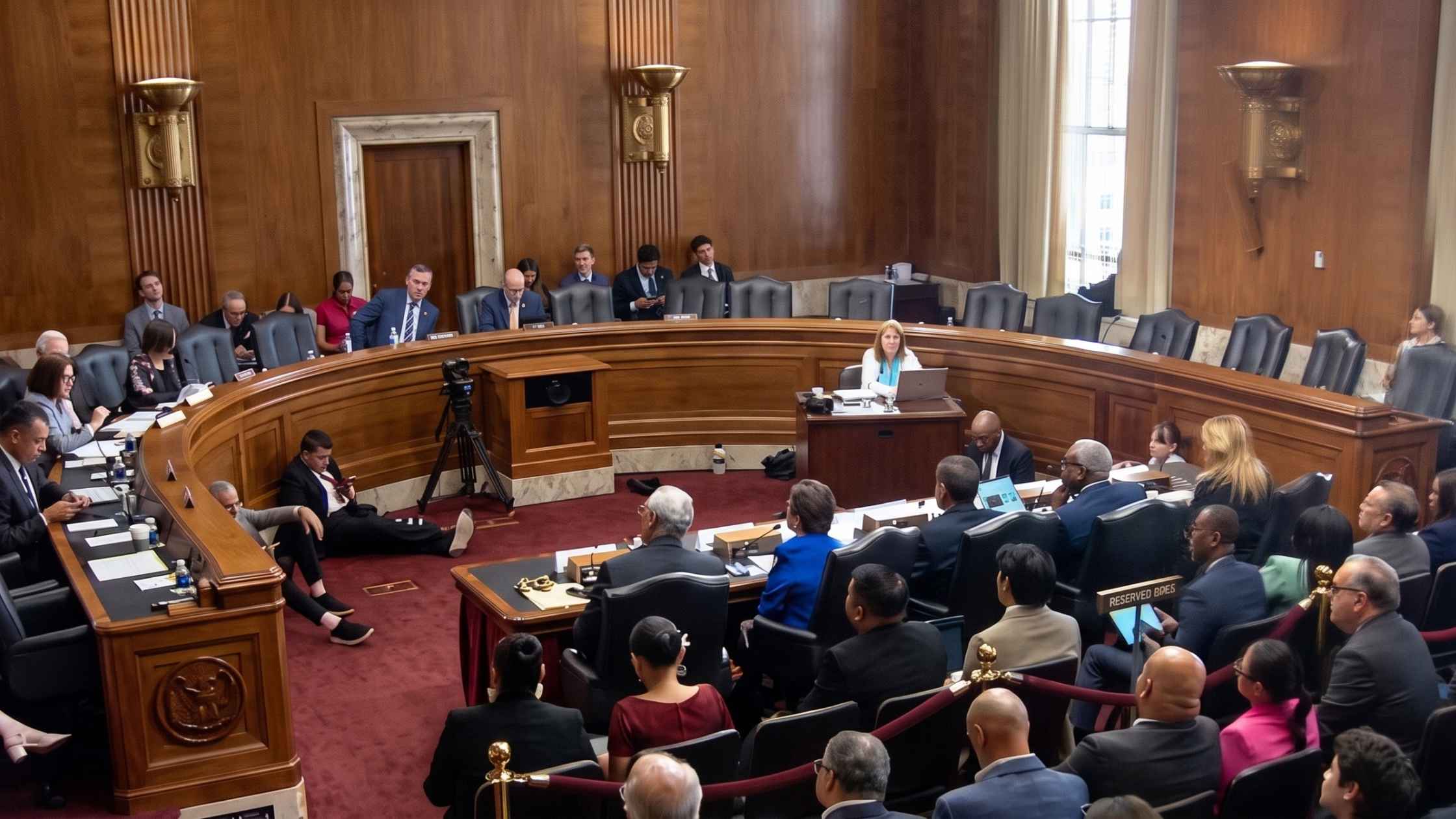
Chairman Lee (00:00):
... business meeting before our hearing today, so we'll start with that. In today's business meeting, the Senate will take up S.1547, reauthorizing the National Parks and the Public Land Legacy Restoration Fund sponsored by Senator Daines. First, let me ask if any Senator wishes to offer an amendment. Okay. Yes. Senator Padilla.
Senator Padilla (00:26):
Thank you, Mr. Chairman. First, I want to note that reauthorizing the Legacy Restoration Fund is a priority for me as it is for many of us on this committee. In California alone, we have nearly a $5 billion deferred maintenance backlog on our federally managed public lands, and this reauthorization could provide nearly a billion dollars to address that over five years. It's why I co-sponsored the America the Beautiful Act, which I thank Senator Daines and Senator King for all their hard work on. However, the substitute amendment before us today would change the bill significantly from the one I chose and agreed to co-sponsor. Specifically, I'm concerned about the amendment's approach towards non-resident visitor fees. In January, the Park Service implemented a whopping $100 per person surcharge for non-resident visitors at 11 national parks, including Yosemite, Kings Canyon, and Sequoia National Parks in California, some of the most heavily visited parks in the country. I'm concerned that this bill would codify this surcharge and apply it to all Park Service units that collect fees. I'm also particularly concerned about how the Park Service determines who is required to pay these extra fees. Our national parks are significant contributors to local economies and should be welcoming to all who visit our country. Under the current practice, these fees have been collected on the honor system. However, if we codify this, I fear that parks could become de facto immigration checkpoints where hardworking Park Service staff will be required to check passports or birth certificates, and that's not their job. It's not something they're trained to do and that's not what I signed up for.
(02:13)
Now, as to the amendments, I have a couple quick ones. It's my understanding that the goal of the non-resident fee is to apply to foreign tourists. However, the definition of non-resident has been left very vague in the text before us. That's why I filed a second degree amendment with Senator Hickenlooper that would only apply these surcharges to foreign visitors on tourist visas, which I believe was the original intention. The language in our amendment would bring the bill in line with the bipartisan House version led by Chairman Westerman and Ranking Member Huffman on the House side. This is amendment 1A2.
(02:55)
But Mr. Chairman, I understand that our staffs are having encouraging and productive conversation to resolve this drafting issue. So I certainly like to see these issues addressed in the bill before its final passage, but I believe since members of both sides want to address this, I won't bring up the Padilla-Hickenlooper amendment 1A2. But I have another critical issue that we need to address, which is how revenue from non-resident visitor surcharges would be shared across the Park Service system. Colleagues, currently, at least 80% of their fee revenue collected at a Park Service unit stays in the unit where it was collected while 20% benefits other parks around the country. But the bill before us does not keep any of the surcharge revenue in the park where the fee was collected. Instead, it would redirect all of the additional revenue into the broader legacy restoration fund.
(03:55)
I strongly believe that parks that are heavily visited and experience additional strain on their natural resources and infrastructure should be proportionately supported based on these surcharges. So second amendment Padilla-Hickenlooper 1A1 has been filed that would require at least 80% of these foreign tourist surcharges be dedicated to addressing the maintenance in the park where it was collected. Now, I understand that this surcharge was added as a pay-for and that we still do not have a CBO score for the bill, but in good faith, I will not bring up this second degree amendment for a vote today knowing that we're continuing to work on this issue and maintaining the spirit that the parks that collect high levels of revenue receive their proportionate share of support for deferred maintenance.
(04:57)
And lastly, Mr. Chairman, my third amendment that I want to bring up, I believe it's critical that gateway communities and the public be able to have a say in these foreign tourist surcharges. When the Department of Interior created these non-resident visitor fees in January, they did not consult with the public in any way despite consultation being a legal requirement of the Federal Lands Recreation Enhancement Act. There was no public consultation on how expensive these fees should be. There were no studies on the potential impacts on visitation levels, and no analysis on the impacts to gateway communities and local businesses. I sent a letter to the Department of Interior in December with several of my colleagues on this committee requesting information on what public consultation occurred and how these fees would be implemented, and we have yet to receive a response. Now, as written, the bill would strive to, quote, "maximize revenue," while, quote, "retaining non-resident visitation" when deciding the amount of the surcharge. It only seems appropriate that the gateway communities and local stakeholders should be consulted given the impacts to the local economies and the bottom line for many businesses and families.
(06:13)
Mr. Chairman, I appreciate you working with my staff to include the language in your substitute amendment to provide public participation opportunities to gateway communities and local stakeholders in accordance with existing law, and given these surcharges with no doubt impact local communities, I appreciate you supporting us and allowing all of our constituents to have a voice in this process and I appreciate that the Manager's Amendment includes language to address this third concern. Thank you, Mr. Chairman.
Chairman Lee (06:40):
Thank you so much, Senator Padilla. I look forward to continue to work with you on these matters. I appreciate that. Senator Hirono.
Senator Hirono (06:48):
Thank you, Mr. Chairman. I share the concerns that Senator Padilla has expressed and the amended bill would expand the authority of the National Park Service to charge international visitors higher fees at all fee collecting parks. And since January of this year, 11 fee-collecting parks have charged higher fees for non-residents. We don't yet have data on what revenue that has generated or the impacts that those higher fees have had on visitations to gateway communities, which is why, as Senator Padilla noted, it is important for community input and consultation regarding these higher fees. We should have that information before we expand that to all fee-collecting parks and codifying it into law. Another change to the underlying bill is that an entire provision has been included giving the Department of the Interior the authority to license intellectual property. The amendment would give the Department of the Interior Authority similar to that given to the Department of Defense and the Department of Homeland Security, but without requiring similar governing regulations.
(08:02)
I think that is an important aspect to giving this kind of authority to the Interior Department that the other two departments that have this kind of authority, they did have to undergo rulemaking to implement that authority. So I'm a co-sponsor of the underlying bill, which has brought bipartisan support. So I'm glad that we are moving the bill. And I do support the basic purpose of this bill even in the amended form and the concerns that I have and the underlying purposes to extend the authority for the Department of the Interior to address deferred maintenance needs on our public lands. And we know that it's in the billions of dollars of deferred maintenance and it's something that I very much support. So I would again associate myself with Senator Padilla's remarks and hope that we can improve this bill before the full Senate considers that. Thank you, Mr. Chairman.
Chairman Lee (08:56):
Thanks so much, Senator Hirono. I'm going to defer my opening statement and my remarks on the bill until after we vote, and we'll allow everybody else to speak afterwards if they'd like. I'd like to turn now to my amendment that I've offered jointly with Senator Heinrich, and I want to thank Senator Heinrich and his team and all the others who have participated in this, including Senator King. Our teams have worked very hard on this and grateful for it. This will be amendment 1A, the Lee-Heinrich Amendment, and this will be a voice vote. All those in favor of the Lee-Heinrich amendment, number 1A, all those in favor of that amendment say aye.
Speaker 1 (09:39):
Aye.
Chairman Lee (09:40):
All those opposed, say nay. The ayes appear to have it. The ayes do have it. The amendment is agreed to. We'll now go to the bill S.1547 as amended, and the question is on the bill. All those in favor of the bill signify it by saying aye.
Speaker 1 (10:01):
Aye.
Chairman Lee (10:01):
Opposed nay. The ayes appear to have it. The ayes do have it, and the bill S.1547 as amended will be reported favorably to the Senate. I'll now recognize any speaker who wants to be heard on this legislation. I see hands up from Senator Daines and Senator Murkowski on this side, Senator King and Senator Heinrich on the side.
Senator Daines (10:27):
Mr. Chairman, we just witnessed something that looked very easy but was very hard. This was a very profound moment to have a voice vote on what we just accomplished, and it's nice to have some good news in Washington DC for a change of bipartisan cooperation, compromise, and a great outcome. The teams were up literally until about 6:30 this morning working to get to this point and I want to commend them. Chairman Lee, Ranking Member Heinrich, thank you for your leadership, and thanks to all the staff who are bleary-eyed and bushed this morning for working very late nights and long hours to get to where we're at here today. This is a big step forward. The Great American Outdoors Act was viewed as one of the greatest conservation wins in 50 years. I think similarly now we extend the work that was done with that bill by reauthorizing this tremendous investment in addressing the maintenance backlog in our National Parks and National Forests.
(11:32)
This amendment and the bill we're sending to the full Senate represents a bipartisan and bicameral collaborative output. We've been working with the administration, [inaudible 00:11:45] here in the Senate, as well as keeping our House colleagues in the loop, Chairman Westerman and Ranking Member Huffman, so that we can move it not only out of the Senate, but get it through the House into the president's desk. We've taken priorities from the House, the Senate, the administration, many members on this committee, and there were reforms made. The reforms we did make strengthen the Legacy Restoration Fund, help us tackle that growing maintenance backlog on our parks and public lands. It's a great down payment to help fix the aging infrastructure and bolster our recreation economy. This is supported by over 100 groups. It has 64 Senate bipartisan co-sponsors, and I want to thank my co-chair, Senator King, his staff, as many of you know on the National Park Subcommittee, we don't have a chairman and ranking member.
(12:40)
Senator King and I have always agreed on a handshake. We are co-chairs. No matter which way the gavel falls in majority minority position, Senator King and I are co-chairs, but a wonderful partner on that subcommittee and we have an outcome here today. I also want to thank Senator Murkowski and her staff. Secretary Burgum and his staff, I can't tell you how many text messages I have on my phone right now in the last 72 hours with the secretary working together with the administration to get to this point here today and this morning. I know their teams work all night with many of the staff that are sitting behind us here on this dais today. I look forward to working with Chairman Westerman. They had a big hearing. Even had Kevin Costner in Hot Springs, Arkansas on Friday to have a hearing about this bill as well as ranking member Huffman.
(13:33)
We want to thank them for the work already done. And now, once we have done the work here, to toss it to the House and get it through there as quickly as possible. So I urge my colleagues here and my friends in the House, let's get this bill on President Trump's desk before the 4th of July. I can think of no better present for the president and the country on the America's 250th birthday than supporting our national parks and our public lands. Chairman Lee, thank you.
Chairman Lee (14:01):
Thank you, Senator Daines. And a minute ago I thanked Senator Heinrich and Senator King and their teams and neglected to mention others, including Senator Murkowski, you, Senator Daines, for your great work on this and I know you and your teams have also been working really hard on it and burned the midnight oil along with Senator Merkley-
Senator Daines (14:23):
And Chairman Lee, if I may say-
Chairman Lee (14:24):
Yep.
Senator Daines (14:24):
... you are the chairman, you have the gavel. Were it not for your cooperation on this bill, we wouldn't be here today as well-
Chairman Lee (14:29):
Thank you.
Senator Daines (14:29):
... Mr. Chairman. And I thank you for that because you hold the gavel, and without your cooperation leadership, we wouldn't have had this outcome. So thank you.
Chairman Lee (14:36):
Thank you. Senator Murkowski.
Senator Murkowski (14:39):
Thank you, Mr. Chairman. And Senator Daines, I'm pleased to be able to follow your comments. You have been a leader in this space with the Great American Outdoors Act from the very beginning. You have had a passion and a purpose I think towards this, and it's reflected in the working relationship that you have with your vice chair, Senator King. I too want to acknowledge the extraordinary hard work that so many people put into this. And I was somewhat amused by your statement, Senator Daines, that we made this look easy this morning, and it was anything but. But I think that that is reflective of the hard work to get to yes instead of people who were coming to the table dead set to oppose it just to be able to oppose something. And in fairness, that's the political climate that we are operating in.
(15:35)
And so I think it says much about what we're talking about here this morning, which is our great American outdoors. Something that whether you are from Montana, Alaska, Hawaii, California, Mississippi, doesn't make any difference where you are. There is a deep love for our national treasures and for those areas that we find very personally connected and attached to. And so when we look at the list of deferred maintenance around the country for these treasured spaces and places, we should all be worried about it. And so what was put in place with the Legacy Restoration Fund was significantly important. We need to be aggressive in how we are handling our deferred maintenance, and so this reauthorization was very important.
(16:31)
What was equally important in this, and I think the role that I and really my staff on the Appropriations Committee worked aggressively around the clock with Senator Merkley's team, I chair the Interior Appropriation Subcommittee along with Senator Merkley, and so our role here is to make sure that Congress's role in understanding how we're going to implement these priorities is maintained. And so ensuring that there was a list that is presented from the president to the legislative branch as outlined in GAOA was important to maintain that, and how we are able then to not only receive a list, but to be able to ensure that there is accountability on both sides, that we are not establishing a venue for the administration, any administration going forward, to pick and choose and inject layers of politics into what should not be political, but again, really caring for our treasures.
(17:47)
So I'm very appreciative, Mr. Chairman, of your leadership in this, and Senator Heinrich, your willingness to work with all of us, not only on this committee, but outside the committee as well. Truly very appreciative.
Chairman Lee (18:03):
Thanks so much. Senator Heinrich, and then we'll go to Senator King.
Senator Heinrich (18:07):
I want to thank you, Mr. Chairman, for marking up this legislation. This is a good model for how we can get things done on this committee. When I go home, left, right, and center, people make their family memories on our public lands, and so reinvesting in that infrastructure is incredibly important. I also want to thank Senator Daines, Senator King, all of the co-sponsors, the appropriation staff who worked all night to land this deal, and we got it done with minutes to spare. So I don't think... It may look easy this morning, but this was a big lift, and I want to thank everybody who worked so hard to make it happen.
Chairman Lee (18:58):
Thank you. Senator King.
Senator King (19:01):
Well, I want to provide my thanks just as all of us have, particularly to the staff who often don't get the recognition, who are working as Senator Heinrich said, all night literally to finalize this document. Steve, Senator Daines, great to work with you and this is the way this place is supposed to work. Bipartisan work together on a common cause important to the American people. Mr. Chairman, I appreciate your accepting my amendment that this money will be allocated alphabetically by park starting with Acadia. Actually, there's no such thing, but it's a good idea.
Senator Daines (19:43):
This is a strong objection from the guy who loves Yellowstone, which I know Senator Barrasso would associate himself with those remarks.
Senator King (19:51):
And he's got Zion.
Senator Daines (19:53):
I guess Zion is not going to fare well on that one. We're going to have the Y caucus rebel here, but go ahead, Angus. Proceed at great risk.
Senator King (20:01):
No, seriously. And I do want to inject one note of frustration, not with this bill, but for the necessity of the bill. Through multiple administrations, I had great problems with the last administration on not providing adequate maintenance in the regular budget. We're doing a bill on deferred maintenance because we haven't adequately done maintenance which should have been done every year as part of the base budget of the interior department of the National Park Service. So this is a major accomplishment, but I think we should also work with the current administration, the next administration to be sure that we don't have to do this every five years because not doing maintenance is a kind of debt. It's incurring a debt and we're now going to pay that debt. But going forward, I hope that whoever's in charge of the Department of the Interior and the National Park Service budget will take the maintenance responsibility as seriously as they do the other portion.
(21:05)
But with that note, this is an extraordinary achievement and it's being done exactly the right way with a lot of work, a lot of compromises, a lot of... But as I think Senator Murkowskisaid, a lot, the impulse was to get to yes and we made that happen. And we're not there yet. We've got to work with the House. We've got to continue to refine the bill, get through on the Senate floor, but this is an important step forward for America and for our national parks. And I want to thank the chairman and Ranking Member Heinrich for their leadership on this. We wouldn't be here without you. Thank you.
Chairman Lee (21:43):
Thank you. Okay. What we're going to do now, we'll go ahead and conclude the business meeting and then I'll give my opening statement for the hearing and in which I'll also give my brief remarks on this bill, put those into the record. Our national parks are... Yeah. Our national parks are among the most popular features of the US government. Not everything we do in this town necessarily brings about absolute popularity, but people like their national parks. The national parks are iconic. They're among the most recognizable places in America. Millions of people travel from across America and from throughout the world to witness their beauty. And we as Americans have a responsibility to make sure that they're well maintained and that they're going to be there for generations to come as beautiful as ever.
(22:41)
By 2020, however, there was some broad agreement that the federal government had fallen short of that responsibility. Roads, trails, visitor centers, campgrounds, water systems, and other critical infrastructure at many of our national parks and on other federal lands were piling up. They were piling up these huge deferred maintenance backlog lists faster than the agencies responsible for managing them were able to address them. The Great American Outdoors Act, often pronounced as GAOA, was Congress's answer to that challenge. But when GAOA first came before Congress during the first Trump administration, I had serious concerns about how the program was structured and whether it would actually solve the problems that it was set up to solve. Specifically, the drafters included a permanent extension of the Land and Water Conservation Fund in GAOA, which allowed the government to continue permanently growing a federal estate that it's proven not to be able to manage, as evidenced by its massive and growing deferred maintenance backlog, increasing costs and restricting many communities, especially in the Western United States where a lot of these lands are found, and ultimately adding to the deferred maintenance backlog.
(24:04)
At the time of passage of GAOA, the deferred maintenance backlog across federal land management agencies clocked in at about $26 billion. Today, after six years and roughly 10 billion taxpayer dollars, that maintenance backlog has skyrocketed up to $43 billion. Reasonable people can disagree as to why the backlog has increased instead of decreased, but whatever explanation one prefers, the fact remains that Congress should not reauthorize programs on autopilot. We ought to stop from time to time and ask whether they're achieving their intended purpose. And if the intended purpose of GAOA was to reduce the backlog, and six years later the backlog is larger than when the program began, significantly larger, I would add, then what should Congress do? Well, one of the things that I appreciate about this committee is that members can disagree and then keep talking and work forward toward a stronger product and a better outcome.
(25:09)
I'm very proud of that. And as I mentioned earlier, together with Senator Daines, Senator King, Ranking Member Heinrich, Senator Murkowski, and so many others and the Trump administration, we've done just that. I'm also very grateful for Secretary Burgum at the Department of the Interior for his help and encouragement. And I also, again, want to thank the staff who worked literally all night, and given that we recently experienced another all night vote-a-rama, I know that that can be very taxing, and so I thank them and all those involved. But the amendment that we adopted today along with this bill to pass it on to the Senate floor represents a real compromise. And while I've got concerns that language added at the behest of my colleagues on the Appropriations Committee could slow down the issuance of 2027 funding to our states and the legislation does not include needed reforms to the Land and Water Conservation Fund.
(26:20)
The improvements reflected in the legislation demonstrate what can be accomplished when members are willing to engage in good faith negotiations and work through legitimate concerns to figure out what can pass. So I hope that we can carry the same approach into conversations that lie ahead because there's still a lot of work to be done. We had to continue examining how federal agencies prioritize maintenance and in what order projects are selected for maintenance, whether the current policies are encouraging the federal government to acquire land faster than it can maintain the land, the vast acreage that it already owns. Look forward to continuing those talks with my colleagues in the months ahead. The drafters that the original GAOA made... There wasn't an adequately serious attempt to offset spending within the bill, even though many of the ideas were proposed. The late Senator Enzi proposed a solution, include a modest surcharge on foreign visitors to our national parks.
(27:26)
This is done in other countries when Americans visit foreign destinations and it makes sense to codify President Trump's executive order on this point. That said, the bill before us is already partially offset. This is a positive step, but we all have a responsibility to ensure that legislation of this size is fully paid for before it reaches the president's desk. And I also believe that will be crucial to its passage in the House if not also the Senate. And I hope we can continue working together to identify additional offsets as the bill moves through the Senate process and advances to and through the floor. America's national parks are a source of great national pride. It's my hope that if we can continue working together as we have today and in the days leading up to it, we can pass them onto the next generation in a condition that will make us all proud.
(28:28)
Anyone else want to speak on this bill before we proceed to the separate hearing on the Great American Outdoors Act? Yeah. All right. The business meeting is now adjourned and we'll begin the hearing. Yeah, gotcha. Thanks.
Chairman Lee (32:04):
Okay. We'll now open the hearing portion of our meeting today. Today we're pleased to be joined by the governors, or representatives of five U.S. territories. These territories are beautiful, and distinctive regions of America, and I look forward to hearing from each of these governors and representatives as to the state of affairs of the U.S. territories, and what, if anything, they would ask of Congress. These governors, or their senior representatives are as follows, the Honor for... Jenniffer Gonzalez-Colon of Governor of Puerto Rico. Welcome. The Honorable Albert Bryan Jr., The Governor of the U.S. Virgin Islands. Welcome, sir. Mr. Henry Hofschneider, Chief of Staff to Governor David Apatang, the Commonwealth of the Northern Mariana Islands, or CNMI, here today because the governor is dealing with the impact of a major typhoon that is in his territory. Welcome. Also, the Honorable Lourdes Aflague Leon Querrero, Governor of Guam. Welcome. And the Honorable Nik Pula, the Governor of American Samoa. I wish to welcome each of you to this committee. America's territories occupy some of the most strategically important ground under the American flag. They strengthen American national security, and support our economy, extend America's presence into regions that will play a defining role well into the 21st century. In the Pacific, Guam and the Northern Mariana Islands, we see lands that are key to America's ability to deter aggression, and maintain stability in the region, increasingly threatened by China's growing military ambitions, and its potential designs with regard to Taiwan. Further south, American Samoa expands our presence in the region, providing valuable logistical support for U.S. operations, while strengthening our relationships with Pacific Island nations. In the Caribbean, Puerto Rico and the U. S. Virgin Islands anchor America's security and economic interests in that region. Their location gives the United States a strategic foothold. Those stride some of the hemisphere's most important shipping lanes, while Puerto Rico has become a hub of America's pharmaceutical manufacturing capacity.
(34:48)
These territories have been part of the American family for generations. They've contributed greatly to our country, and they'll continue to play a really important role in its future. Their importance to our country is undeniable, so too are the challenges they face. In Puerto Rico, the island continues to struggle with energy reliability, aging infrastructure, and concerns about the management of public resources. Millions of citizens still live with an electric power grid that too often experiences devastating rolling blackouts. The Virgin Islands face similar challenges. Public debt, high energy costs, and aging infrastructure continue to place pressure on residents and on businesses. Residents of the Virgin Islands pay some of the highest electricity rates anywhere under the American flag. Rates that are roughly three times the U.S. national average, while continuing to endure service disruptions, and aging infrastructure. The Northern Mariana Islands' economic concerns increasingly intersect with and affect national security concerns. The CNMI, it's just 60 miles from Guam, which houses some of America's most important military installations.
(36:04)
Earlier this year, my colleagues and I called on the Department of Homeland Security, and the Department of the Interior to terminate the CNMI Economic Vitality & Security Travel Authorization Program, a Biden era policy that allows nationals from the People's Republic of China to enter the Northern Mariana Islands for up to 14 days without a visa. This policy is threatened to create, and in some cases created serious problems. Chinese nationals have been convicted of trafficking methamphetamine into the CNMI. The program has facilitated birth tourism, and created additional travel avenues to Guam. At a time when the Chinese Communist Party is actively seeking to expand its influence in that region, and seemingly everywhere, we shouldn't be providing special access to a U.S. territory for PRC nationals. I continue to urge the Department of Homeland Security, along with the Department of the Interior to terminate the CNMI Economic Vitality & Security Travel Authorization Program, and to end Hong Kong's participation in the broader Guam-CNMI Visa Waiver Program. Guam remains indispensable to America's security posture in the Indo-Pacific. As tensions in the region grow, Guam's importance will only increase, making it all the more important that we take seriously the challenges that we face in that region as a whole. The circumstances facing each territory are very unique, but a common theme runs through them all. Strong infrastructure, sound governance, economic opportunity, and national security are deeply connected. Our territories are not peripheral to America's future. As competition in the Pacific intensifies, as economic pressures continue in the Caribbean, and as these communities confront challenges of their own, Congress has a responsibility to pay attention. Their future matters, not only to the people who live there in those territories, but to the United States of America as a whole. Chairs, happy now to recognize our ranking member, Senator Heinrich.
Senator Heinrich (38:24):
Thank you, Chairman Lee. And I want to thank all of our governors and witnesses for being with us here today. This hearing reflects an important duty of this committee to invite and provide a platform for leaders from the United States territories to address Congress, and speak directly about the issues affecting their communities. And what we as senators and members of this committee are doing here today is simple but important, we are listening to you. We can review reports and data, but there is frankly no substitute to hearing directly from all of you about the experiences, the challenges, and the future plans of your communities. Taken together, you represent roughly 3.5 million Americans living in Puerto Rico, and Guam, in the Northern Mariana Islands, American Samoa, and the U.S. Virgin Islands. The people you represent serve in our military. They strengthen this nation. They live under the policies passed by Congress, and yet too often, their voices reach this chamber only when Congress chooses to make space to hear them.
(39:32)
As our nation prepares to mark 250 years since the Declaration of Independence, I also recognize that more than 125 years ago, the United States established the governing framework for the territories that still shape these relationships today. These relationships are deeply important to our nation, but they have also created a reality where millions of Americans continue to experience a very different relationship with the federal government than those of us living on the mainland. That reality makes hearings like this one even more important. This morning, we will hear from these representatives about energy costs, about disaster recovery, healthcare access, food security, and economic development in their communities. We will hear what it takes to build resilience in places that have experienced extraordinary hardship.
(40:26)
One challenge facing every territory represented here today is the rising cost of energy. Families, small businesses, schools, hospitals, and local government are all feeling the impact of high electricity and fuel prices. And while we are seeing energy costs skyrocket across the country, island communities often feel those impacts first and more severely, because much of their energy supply depends on imported fuel. I know you all are working with your communities to modernize aging energy infrastructure, strength and grid reliability, but I also know that these efforts take time, resources, and sustained commitment from the federal government as well. And many of your communities are also still recovering from devastating natural disasters from the hurricanes that reshaped Puerto Rico and the Virgin Islands, to recent typhoons in the Northern Mariana Islands and Guam that have once again demonstrated how important it is that we invest in durable infrastructure in island communities. And climate change is making all of these challenges harder, from increasing the frequency and severity of extreme weather events, to placing even greater strain on already fragile infrastructure agriculture and critical services. Energy resilience is not a luxury for island communities. It is the foundation for everything else. When electricity prices run 2 or 3, even 4 times higher than the national average, that is not simply an inconvenience, it is every part of daily life, and every corner of the economy. The issue is not a lack of local leadership, or willingness to do the work. The question is whether the federal government is following through on the commitments that have already been made. Funds already appropriated. Projects already underway. Too often, implementation moves far slower than communities can afford to wait, but these challenges extend far beyond energy and disaster recovery.
(42:31)
For many families, unequal access to basic federal programs remains part of that same story. I have long supported greater parity for the territories in federal nutrition and health programs, and I believe that this committee should continue using every tool within its jurisdiction to help communities build resilience against storms, against habitat loss, and invasive species, against rising energy costs, and against the kind of slow federal response that can turn a disaster into a decade-long crisis. At a time when families are already paying more for electricity, for fuel, groceries, and other daily necessities, Congress has a responsibility to understand whether federal policies are helping communities build resilience, or making those challenges harder to overcome. To our witnesses, thank you for making this trip. The Senate does not always come to you, but you are here, and we are listening. Thank you.
Chairman Lee (43:32):
Thanks so much. And he makes an excellent point, a lot of our witnesses come from across the country. You've traveled much farther distances than many of them have to travel, and we're grateful for that. I'll now invite each of you to give your opening statements, and your full written statements will also be made part of the record. We'll begin today with Governor Gonzalez-Colon, who has been serving as the 15th Governor of Puerto Rico since the ratification of the Puerto Rico constitution in 1952. She formerly served in the Puerto Rico House of Representatives from 2002 to 2017, and as Resident Commissioner of Puerto Rico from 2017 to 2025. Governor Gonzalez-Colon, you may proceed.
Jenniffer Gonzalez-Colon (44:21):
Thank you, Chairman Lee, Ranking Member Heinrich, and all members of this committee. Thank you for the opportunity to bring the state of Puerto Rico today. I think it's important to have in the territories today. As governor, I made a commitment to restore fiscal responsibility, accelerated reconstruction of our energy grid, and critical infrastructure, and strengthen Puerto Rico's contribution to national and economic security. And we are delivering some results. In 2016, Puerto Rico faced bankruptcy, and Congress enacted PROMESA. Last year, I signed our first certified balanced budget since that law, and now, for the first time in a decade, the government of Puerto Rico led the budget development process. Once approved by 13 days, we expect this will become our second certified balanced budget.
(45:12)
We have cut contract spending by over $900 million in just one year, and repeal nearly 400 regulations, and 13 pages of obsolete regulatory text, and we are advancing reforms to improve the ease of doing business, and attract investment on the island. As a result, total employment reached 1.1 million in March of this year, the highest level since 2008. In one year, our trade surplus expanded by 30%. Exports increased by 3.6%, reaching $64.2 billion, and construction employment increased by 5% adding 1,900 jobs. When I took office, Puerto Rico was facing a power generation shortfall, and projections indicated that we will experience widespread blackouts last summer. Thanks to God, and working with the Trump administration, and with emergency orders from the Department of Energy, we restored more than 1,600 megawatts of generation capacity, and have not experienced an island-wide blackout in over a year.
(46:20)
With DOE support, we are investing $368 million in grid improvement, scheduled for completion by the end of this year. With EPA permitting assisting, we are converting power plants from oil to cleaner and more affordable natural gas, a transition expected to reduce energy costs by approximately 180 million annually. We are also pursuing 3,000 megawatts of new permanent baseload generation through public/private partnerships. Throughout strong oversight of utility operators, we have Accelerated FEMA-funded energy reconstruction projects, increasing construction by more than 25%. FEMA- funded permanent works projects in execution have increased by more than 37%. During the past week, over 1,100 customers lacked water to decades of underinvestment in our water utility system. We're still restoring that service, and to permanently resolve it, we have committed over $7.5 billion in 351 active capital improvement projects.
(47:26)
We're helping bring manufacturing back to America through an aggressive reshoring strategy. After all, made in Puerto Rico is made in the USA. To date, 23 manufacturing companies such as Eli Lilly, Amgen, Stryker have committed to invest more than $2.6 billion, and create more than 5,700 jobs, supporting our economy while reducing U.S. dependence on foreign adversaries for pharmaceuticals and other critical products. With the renewed attention on the Western hemisphere, Puerto Rico is also playing a leading role supporting the counter narcotics operations in the Caribbean, and helping keeping the homeland safe.
(48:07)
Looking ahead, one of our most pressing priorities is securing long-term Medicaid funding for Puerto Rico after the current five-year agreement I achieved while I was serving in Congress expired in September 2027. More than 1.3 million Americans on the island rely on this program. As I have outlined, we are balancing budgets, rebuilding on infrastructure, and strengthen American supply chain, and created new opportunities. As United States approaches its 250 anniversary, Puerto Rico stands ready to continue contributing as an equal, full-fledged member of the Union. Since 2012, Puerto Rico voters chosen statehood in four plebiscites. I look forward to working with Congress to respect that democratic mandate, and secure equal rights, responsibilities, and representation for the 3.2 million Americans who call Puerto Rico home. Thank you, and I look forward to your questions.
Chairman Lee (49:06):
Thanks so much, Governor. We'll now turn to Governor Bryan of the U.S. Virgin Islands. Governor Bryan is serving as the ninth governor of the U.S. Virgin Islands, a role that he has held since January 7th, 2019. Governor Bryan, you're recognized and you may proceed.
Albert Bryan Jr. (49:22):
Chairman Lee, Ranking Member Heinrich, distinguished members of the committee, thank you for the opportunity to appear before you today. I am honored to be here on behalf of the more than 87,000 American citizens, and other residents who call the United States Virgin Islands their home. As I prepare to conclude the service as governor, I do so with great pride. I've had the privilege and the test of serving through some of the most difficult chapters in our history. I've watched our people recover from two Category 5 hurricanes, and endure a global pandemic that temporarily brought our tourism economy to a standstill. But despite this, we have come out of the other side with a tourism industry, and a community that is stronger than before. And through it all, I have watched Virgin Islanders rebuild with the resilience, determination, and patriotism that have always defined our community.
(50:21)
We are proud Americans. Our sons and daughters serve in uniform. Our students pledge allegiance to the same flag that flies over this capitol, but throughout my years as governor, I have come to understand the difficult truth, despite our American citizenship, Virgin Islanders are asked to overcome barriers that Americans elsewhere never have to face simply, because where in this great nation we call home. That is not simply unfair to the people of the Virgin Islands, it is also a missed opportunity for the Union. We occupy one of the most strategic locations in the Caribbean. We can strengthen America's maritime presence, support energy security, expand regional commerce, and serve as a gateway to the hemisphere. Yet our ability to contribute is too often constrained by outdated federal policies, and foreign actions beyond our control.
(51:13)
In over the past seven years, I have learned that these issues are not faced only by our territory. The American territories have increasingly come together to identify shared challenges, and speak with a common voice. That cooperation has shown that these are not isolated concerns. They are common American challenges that can and should be addressed through partnership. So my message today is simple, the people of the Virgin Islands are not asking for special treatment, we are asking Congress to remove these barriers to guarantee that we have the same opportunities, the same tools, and the same chance to succeed that every American community on the mainland enjoys. One of the clearest examples of these barriers is healthcare. More than 24% of our population is over the age of 65, and thousands of Virgin Islanders rely on Medicaid, Medicare, and disability benefits.
(52:07)
Congress has already taken important steps to improve the healthcare funding for the territories, such as a permanent adjustment to the territory's Medicaid matching rate. And I thank the members of both parties who help make that progress possible, but the work remains unfinished. While the Medicaid funding in The States automatically expands whenever enrollment or economic needs rise, the Virgin Islands continues to operate under a permanent federal funding cap. Our hospitals face similar challenges. Even when Virgin Islanders can access care, the institutions serving them must operate under a reimbursement system, TEFRA, that is not kept pace with the realities of modern medicine.
(52:49)
Similar disparities exist with Supplemental Security Income, or SSI. An elderly American citizen living in a state may qualify for SSI benefit, but that same American citizen with the same disability and the same financial need may lose access to those benefits simply by moving to the Virgin Islands. Their citizenship has not changed, their circumstances have not changed, only their address. The promises and benefits of American citizenship should not depend on the geography as the Supreme Court recognized in United States versus Vaello-Madero. Only Congress can address these disparities.
(53:27)
And the same principle applies to economic opportunity. For generations, the refinery on [inaudible 00:53:33] was an economic engine for our territory, created jobs and strengthened families, but it remains closed due to the heavy-handed application of environmental rules that is not only a loss for Virgin Islanders, it is a missed opportunity for the United States. We need the kind of future at home that federal policies help. Today, under the Net CFC Tested Income regime, federal tax rules can treat investment in the Virgin Islands as much like the investment in foreign jurisdiction, discouraging companies from investing in an American community. But the Virgin Islands is not a foreign country, we opened under a miracle tax system established by Congress itself, yet we are treated disparately by the European Union as we are a black listed entity, even though our taxes are controlled by the U.S.
(54:28)
I want to conclude by saying, as I see my time is running out, that I really want to thank the Congress. Over the last eight years, we have made tremendous progress. We have fixed our retirement system. By the end of the year, over 50% of our grid will be renewable. We have recovered over $25 billion for our recovery. Of that, 11 billion of that has already created opportunities in contracts. Our tourism product is on fire. All we need now is to get the same treatment as everybody else. And yes, our power woes are becoming less and less, but we still need some help there as well. So I'd like to thank the committee for their work that they have done, for listening to us over the years, and for the tremendous support of the Bipartisan Budget Act, which has really set us on a course that is anchored in progress. Thank you.
Chairman Lee (55:22):
Thank you, Governor Bryan. The Chair now recognizes Mr. Hofschneider, testifying on behalf of the governor of the Northern Mariana Islands. Mr. Hofschneider serves as Chief of Staff to Governor Apatang, who, again, unfortunately was not able to join us today as CNMI continues to recover from the effects of Typhoon Sinlaku, which made landfill in April, but has caused significant destruction to CNMI, necessitating his ongoing presence there to dig out from that mess. Mr. Hofschneider, thanks for joining us. You're now recognized.
Henry Hofschneider (55:56):
Thank you. [foreign language 00:56:00] Chairman Lee, Ranking Member Heinrich, and members of the committee. Thank you for the opportunity to appear before you. I am Henry Hofschneider, and I serve as the Chief of Staff to David M. Apatang, Governor of the Commonwealth of the Northern Mariana Islands. I am honored to provide these remarks on behalf of Governor Apatang and the people of the Commonwealth. The governor sends his regrets that he's unable to appear in-person today. Conditions in the CNMI, and the current demands of disaster recovery require his presence at home, as our government, our communities, our federal partners continue the work of recovery following Super Typhoon Sinlaku. The governor has asked me to convey his deep appreciation to this committee for its undistracted attention to the needs of the CNMI, and for the federal partnership that remains essential to our recovery, stability, and long-term future.
(56:57)
When the governor was last in Washington D.C. in February of this year, the Commonwealth participated in Section 902 consultation and the senior meeting of the interagency on insular group areas. At that time, we discussed many of the same long-term challenges that continued to shape our future, economic recovery, infrastructure, energy, labor, healthcare, and federal partnership. In February, these challenges were already severe. The Commonwealth was facing a deep fiscal and economic crisis caused by the failure of our primary economic sector, tourism, to recover from the collapse of international travel after the COVID-19 pandemic.
(57:41)
Historically, important visitor markets had deteriorated. Government revenue had declined sharply, and federal pandemic resources had expired. Since then, these challenges have deepened. Nine weeks ago, Super Typhoon Sinlaku struck our islands. It tested our people, our infrastructure, public services, and our economy. It damaged homes, disrupted power and water systems, affected businesses, public facilities, roads, ports, schools, and healthcare services. It placed a new pressure on the government already operating under austerity.
(58:17)
Governor has asked me to be clear with the committee. The CNMI is still recovering. It is recovering from Super Typhoon Sinlaku. It is recovering from economic collapse. It is recovering from the pandemic. That is why federal assistance at this moment in the Commonwealth's history is so important. Commonwealth has limited means to resolve its fiscal challenges on its own. We have a small revenue base, a narrow private sector economy, high fixed costs, and limited access to outside financing. We must still fund schools, healthcare, public safety, utilities, corrections, medical referrals, employee and retiree health coverage and pension obligations. Those responsibilities do not disappear because revenues decline. Post-disaster revenue data show that the Commonwealth's fiscal 2026 revenue forecast had been revised downward by approximately 9%, or $12.3 million. In April 2026, revenues fell approximately $6.7 million, or 32% below the established baseline. We have also incurred more than $2.6 million in obligated unbudgeted disaster related costs. These are major losses for a government of our size.
(59:40)
The largest recurring weaknesses in our economy here, revenue base is the condition of the CNMI's tourism industry. Tourism remains our primary private sector economic engine. It supports hotels, restaurants, transportation, retail tours, cultural activities, airport revenues, jobs, and government collections. But visitors' arrivals are projected at approximately 404,511 in fiscal year 2026, more than 500,000 fewer than the 607,000 arrivals recorded in fiscal year 2018. Airline seats capacity has fallen from approximately 762,000 seats in fiscal year 2018, to approximately 167,500 seats in fiscal year 2026, a 78% decline. For the CNMI, air service is the foundation of our tourism recovery. Visitors cannot drive to the Commonwealth. They cannot take a train. Every visitor must arrive by air. When airline seats disappear, the ceiling for recovery drops with them.
(01:00:57)
This has created a difficult cycle. Fewer flights mean fewer visitors. Fewer visitors mean lower hotel occupancy, and lower hotel occupancy tax collection. Lower collections mean fewer resources for marketing and air service development. The Marianas Visitors Authority's share of hotel occupancy tax revenues has declined from $14.2 million in fiscal year 2018, to approximately $1.4 million in fiscal year 2026. We are trying to rebuild to resume for approximately 22% of airline seats, 17% of the visitors, and 10% of the NVA occupancy tax funding that existed when the industry was healthy. This is why the Economic Vitality & Security Travel Authorization Program, EVS-TAP, and secure travel pathways are so important. The CNMI takes national security seriously. We do not ask the federal government to ignore security. We ask that security be balanced with the economic reality of our islands. EVS-TAP must be secure, accountable, and supported by strong screening. But removing it without a workable replacement would harm our economy at a time when we are still recovering from the disaster and years of decline.
(01:02:24)
We ask for serious consideration of secure travel pathways for the Philippines and other appropriate visitor markets. The Philippines is the close ally of the United States, and has strong family ties to our community. A Philippines waiver or travel authorization could strengthen tourism, support air service, and reduce dependence on any one market. Energy cost is another major pressure. The CNMI relies heavily on imported fuel for power generation. In May 2026, the Commonwealth Utilities Corporation fuel adjustment charge increased from approximately 24 cents per kilowatt-hour, to approximately 44 cents per kilowatt-hour, an increase of approximately 81.6%.
(01:03:11)
The Commonwealth government has historically spent approximately 12 million to $14 million per year on utilities. Under the higher fuel adjustment charge, annual utility costs could rise to approximately $21.8 million, to $25.4 million. That could mean nearly $10 million to $11 million in additional annual costs for government operations. Schools need power. Healthcare facilities need power. Public safety buildings, water systems, wastewater systems, ports, public facilities all depend on reliable electricity. The CNMI needs reliable baseload power, a modern generation plan, stronger grid infrastructure, energy efficiency, and continued support for the Commonwealth Utilities Corporation. Clean energy is important, but we must be practical. Our hospital cannot run on promises...
Henry Hofschneider (01:04:00):
... it's important, but we must be practical. Our hospital cannot run on promises. Our economy cannot recover on promises. We need power that works every day, including after storms. We are grateful for FEMA and SBA and all federal agencies working with us after Super Typhon Sinlaku. Their assistant helps families repair homes, helps small businesses keep workers employed, restores public services, and brings confidence back to our community.
(01:04:28)
But I ask the committee to understand that the financial impact of a disaster and CNMI goes beyond damaged buildings, includes lost business, lost wages, interrupted tourism, higher construction costs, energy power costs, and the strained placed on a small government with limited resources.
(01:04:49)
For that reason, I respectfully ask Congress and the administration to support and increase federal cost share for FEMA public systems categories C through G. The CNMI must repair roads, public buildings, utilities, waterways, and other permanent infrastructure. We cannot fully recover if the local share for that workforces deeper cuts to essential services. The labor impacts are also serious. As of May 2026, the CNMI Department of Labor had received 19 workforce ... I'm sorry.
Speaker 2 (01:05:25):
You're out of time.
Henry Hofschneider (01:05:27):
Mr. Chair`man, can I continue or ...
Chairman Lee (01:05:29):
Yeah, if you could wrap it up in the next 30 seconds or so, we'll move on. You're about four minutes over, but you can have another 30 seconds to wrap up.
Henry Hofschneider (01:05:38):
I'll just wrap up. I still have more to read from Governor Apatang, but thank you for this opportunity.
Chairman Lee (01:05:45):
Thank you so much. I really appreciate it, Mr. Hofschneider. Okay. We will now turn to the Honorable Governor Guerrero from Guam. She's currently serving as Guam's ninth governor. This is a position she's held since January 7th, 2019. Governor Guerrero, you're recognized.
Honorable Governor Guerrero (01:06:08):
Mr. Chairman Lee.
Chairman Lee (01:06:11):
They hit the microphone button, if you will. Thank you.
Honorable Governor Guerrero (01:06:13):
Sorry. Mr. Chairman Lee, Ranking Member Heinrich and members of this committee. Håfa Adai, and thank you for the opportunity to testify on behalf of the people of Guam. Guam sits at the Center of America's Indo-Pacific Defense Posture. From Guam, the United States projects power, sustains logistics, supports humanitarian operations, and maintains deterrence across the region. Today, that strategic goal is expanding through one of the largest military realignments in the Pacific since World War II. This buildup is unfolding on a small island community with finite land, aging infrastructure, and civilian systems already under pressure. Guam is the tip of the spear, but that spear is only as sharp as the community behind it. Our resilience as a community is the foundation underpinning America's defense readiness in the Pacific. It is the basis for DOD's call for a whole of government, one Guam approach to strengthening our Indo-PACOM force posture dating back to 2006. It is what not only justifies the reconvening of the Economic Adjusting Committee but demands it. Healthcare is the clearest example. Guam is nearly seven hours from advanced care on US soil. In the Pacific, distance creates risk. The Department of Defense has recognized Guam's role in medical surge capacity and civilian military interoperability in the Indo-Pacific. But our healthcare infrastructure was not built for the growth and mission demand now arriving. A modern Guam medical complex will strengthen civilian care, military readiness, and regional response capacity in a theater where time and distance shape outcomes. The same challenge exists with power resilience. The military mission on Guam runs in a civilian grid vulnerable to typhoons, aging infrastructure, and above ground transmission failures. Our recent brush with [inaudible 01:08:23] Super Typhoon Sinlaku reminded us that Guam remains one major storm away from becoming a critical defense community unable to fully function operationally.
(01:08:35)
Hardening and undergrounding critical power systems would strengthen operational continuity, emergency response, communications, healthcare delivery, and military readiness throughout the region. Cybersecurity must also be treated as part of the national defense picture. Cyber attacks, supply chain disruption, and gray zone operations now target the civilian systems that sustain military power. Guam's hospitals, utilities, public agencies, communication systems, and infrastructure networks are part of the resilience architecture that supports America specific posture. That same principle should guide the federal government's approach to deep sea mining. Guam understands the national security interests of critical minerals as well as supply chain resilience, but decisions involving the Pacific Ocean cannot be made without the Pacific communities most directly affected by them. BOEM current process concerns potential mineral leasing across a vast offshore are near Guam and the cinema that is one regional marine ecosystem. And any environmental impacts to this ecosystem will disrupt our economy, our culture and social integrity lasting for generations.
(01:09:59)
For that reason, Congress must invest in the infrastructure that underpins both Guam's resilience and America's defense readiness, including a modern Guam medical complex and the hardening of our power system. And Guam is already doing its part, we're not sitting on the sidelines waiting to be rescued. We've eliminated our structural deficit, rebuilt our rainy day fund and reduced debt obligations for the first time in generations. Now we ask the federal government to match the scale of the mission with the scale of the partnership. Convene the EAC, adopt a [inaudible 01:10:38] Guam approach, align resources with reality.
(01:10:41)
As we join the nation in celebrating 250 years of independence, I ask that you remember this. Guam has given the lives of its sons and daughters the best of its land and a share of its treasure to keep this nation safe and free. We have done so without a vote in Congress, a vote for president or a meaningful voice in our own future, yet our commitment to America has never been measured by what we receive but by what we are willing to give. Today we ask only to be equal. I also would officially invite you to come visit our island because you will see how beautiful it is where America's day begins. [foreign language 01:11:25].
Chairman Lee (01:11:27):
Thank you so much, Governor Guerrero. And finally, last but not least, the chair recognizes Governor Pula from American Samoa. Governor Pula is serving as the ninth governor of American Samoa. He's previously held a number of roles in the United States government, including a nearly 30 year stint at the US Department of the Interior. Governor Pula, you may proceed.
Governor Pula (01:11:50):
Thank you. As a cultural chief of the people of American Samoa, I remove my traditional lei as a sign of respect as I speak to this esteemed body of the United States Senate. Chairman Lee, Ranking Member Heinrich, distinguished members of the committee, talo falava and warm greetings from the people of American Samoan. Thank you for the opportunity to appear before you today on behalf of the nearly 50,000 American citizens and nationals who call American Samoa home. At the outset, I would like to thank this committee for its continued support of the US Territories. I also extend my compliment to Uifa'atali Radewagen on behalf of American Samoa and the territories on the US House side. In addition, I'm grateful to the Interagency Group on the Insular Areas, IGIA, for its role in coordinating federal engagement and helping advance critical infrastructure and economic development priorities across our islands.
(01:13:01)
American Samoa has proudly been part of the American family for 126 years. As America's only permanent sovereign presence south of the Equator, American Samoa occupies a unique place in the Indo-Pacific region, yet our greatest contribution to this nation is not our location, it is our people. For generations, American Samoa likened to its sister territories has maintained one of the highest per capita military enlistment rates in our country. Our sons and daughters have proudly served this nation in times of peace and war, demonstrating an unwavering commitment to the United States. Despite that commitment, American Samoa continues to face longstanding challenges. Our per capita income remains below that of every US state. Geographic isolation, high transportation costs, and limited economic scale continue to challenge our ability to grow and diversify our economy.
(01:14:04)
Yet we have demonstrated that federal investments can produce meaningful results. For example, American Samoa obligated its full American Rescue Plan Act, ARPA, allocation ahead of the federal deadline. Some of those funds are now supporting significant healthcare modernization efforts at our only hospital, the LBJ Tropical Medical Center. We are constructing a new emergency unit, an ICU and the territory's first MRI facility. These projects demonstrate that federal investments when paired with responsible stewardship deliver measurable results.
(01:14:44)
However, significant barriers remain. Through the IGIA, American Samoa has identified 59 priority infrastructure projects totaling approximately 2.6 billion across energy, transportation, healthcare, telecommunications, and so forth. These are foundational investments required to maintain essential services and support long-term economic viability. I would like to highlight six priority requests.
(01:15:14)
First, energy security. We request continued investment in renewable generation, battery storage, great modernization and water infrastructure projects. Our grid is small, isolated, and fully exposed to global fuel price volatility, reducing diesel dependence is the fastest path to lowering costs. American Samoa Power Authority, ASPA, requested five projects totaling 23.3 million.
(01:15:44)
Second, the Port of Pago Pago. We seek federal partnership to modernize our sole maritime gateway with an estimated cost exceeding 200 million. The territory has already committed 10 million for stabilization. We are also looking at using the port as a trench shipment hub for critical minerals mined in the Cook Islands, facilitating transport to the US for processing. Modernization is urgent, current cargo handling capacity lacks regional ports that process more than twice the containers per hour. This investment will lower freight costs, strengthen supply chains, and protect a strategic US asset in the Pacific.
(01:16:28)
Third, healthcare modernization. We seek continued support to modernize our hospital and expand clinical capacity. Today, patients requiring specialized care must travel to Hawaii or New Zealand. We request relief from the territorial Medicaid match requirement and inclusion in future rural health transformation funding. Current statutory structures do not reflect the fiscal realities of insular systems. Fourth, air traffic control. Our air traffic is controlled by a control tower in independent Samoa, 80 miles away. We request funding for a US operated air traffic control tower at the Pago Pago International Airport to improve aviation safety, emergency coordination, and operational control.
(01:17:22)
Fifth, deep sea mining policy. American Samoa maintains opposition to deep sea mining in its waters at this time. Should federal policy advance, we request rigorous science-based review, full consultation with Pacific jurisdictions, environmental safeguards, and equitable benefit sharing.
(01:17:45)
Sixth, ARPA extension. We respectfully request an extension of the December 31st, 2026 deadline for ARPA funds to ensure full and responsible deployment of remaining recovery resources. The story of American Samoa is not of dependence. It is one of partnership. Continued partnership will help American Samoa become resilient, economically viable, and capable of supporting both local priorities and broader national interests in the Pacific. Thank you for this opportunity. God bless the United States and God bless American Samoa. Thank you.
Chairman Lee (01:18:25):
Thanks so much, Governor. Appreciate your opening statements. We'll now proceed with five minute rounds of questions. In order of seniority, I'll go first followed by Ranking Member Heinrich. Then after that, in order of seniority subject to the early bird rule followed by this committee. Governor González-Colón, I'd like to start with you. Your former Secretary of Economic Development resigned after stating publicly that interventions by your office following contracting investigations, "Made it impossible to continue performing the duties of the position with the integrity and autonomy that the role requires and that every secretary owes to the public." Now, his resignation was followed by 10 other senior officials resignations at the resignation of the director of COR3, the Disaster Recovery Terminal. Now, did you or anyone in your office encourage, direct or request the disciplinary actions related to these investigations be reversed?
Jenniffer Gonzalez-Colon (01:19:31):
No, sir. And first they're separate things. The first, the allegations all false. The second, the COR3 director did resign and he told me about that in April of this year because he got a family issue and he will continue to work with me in other assets. So it's completely false the allegation the former secretary is making. Second, he did ask about that contract and I instructed him about canceling because he prompted the problem with the contract and he was worried about the situation. So I told him to, if he was distracted, to cancel and redo the contract. No contract was awarded whatsoever. So those are false allegations and they're investigated at this time by the Department of Justice in Puerto Rico.
Chairman Lee (01:20:26):
Okay. So you've ordered an independent review of the allegations that were raised and you're categorically denying the allegations-
Jenniffer Gonzalez-Colon (01:20:32):
All of them. All of them.
Chairman Lee (01:20:34):
... of the former director of economic development. Now, how can Congress be assured that federal funds sent to Puerto Rico aren't being misused or misplaced?
Jenniffer Gonzalez-Colon (01:20:44):
First of all, there are many federal funding on the island. We've been increasing the participation with the federal IG office, the federal FEMA with the FBI and all the federal liaisons in many of the areas. We're increasing the reports in all of the agencies, not federal funding at this time during the last year are being misused. As a matter of fact, we are increasing the use of federal funding and we are imposing more regulations to oversight and approving and presenting more local laws to review and do oversight on local and federal budgeting and review and corrupt probes as well.
Chairman Lee (01:21:32):
Okay. So if the allegations raised by the former Secretary of Economic Development are emphatically entirely false, any idea why he would say those things if they were untrue? It seems like the kind of accusation that he would know if it were not true that that could be figured out. Any ideas on that?
Jenniffer Gonzalez-Colon (01:21:48):
I don't know what political motivations he may have. I don't have an idea. He submitted an allegation of one of his employees that has been submitted to investigation that is part of the Department of Justice and he was referred to further investigation by the Secretary of Justice in Puerto Rico and is right now under current investigation and that's the allegation. Saying that my office, myself or my chief of staff is involved is completely false and creating the narrative of any kind of involvement on this issue is completely false again. There is no evidence. There's no evidence of that, sir. And I will tell you more. The facts are there. There is no sworn deposition at this time and the employee that he's referring is fighting that allegation as well.
Chairman Lee (01:22:45):
Thank you. Now, Mr. Hofschneider, do you think it makes sense for the citizens of one of America's biggest most menacing adversaries, that is the People's Republic of China, should be allowed to enter a US territory without a visa?
Henry Hofschneider (01:23:03):
That's a good question. The answer to that, as we look at it from the CNMI point of view, they shouldn't, but there are other ways for other nationals to enter the CNMI without a visa.
Chairman Lee (01:23:19):
Okay. So you agree that Secretary Mullin should close that program with respect to the PRC?
Henry Hofschneider (01:23:26):
Chairman Lee, that's a very difficult question to answer because our economy depends on tourism and around us in the CNMI, the closest island is Guam. Some people go to vacation or relax in the CNMI and they're US citizens. Some of them are maybe not US citizens, but they enter the CNMI.
Chairman Lee (01:23:49):
But you would agree, wouldn't you, that we shouldn't sacrifice American national security for tourism dollars-, wouldn't you?
Henry Hofschneider (01:23:57):
Of course not, but there's got to be a way to make them both work at the same time. We take national security very seriously. We live with it. We breathe with it. The military comes and visits our governor once a month, or regular meetings happen and we talk to them about their activities, what's going on on the island of Tinian. As you all know, there's a big military project going on there, Guam as well. And it's very serious, but to just cut it off and look at tourists from other market source would be very, very detrimental to the CNMI economy.
Chairman Lee (01:24:44):
Okay. My time's expired, but I'm confused by your answer. I thought you were saying a few minutes ago that you agreed that people from China should not be able to enter your territory without a visa, but your last statement seemed to contradict that. Help me understand which way you're going.
Henry Hofschneider (01:24:59):
What I'm saying is we need to work on a system that would protect national security and protect the CNMI's economy as well. That's our life.
Chairman Lee (01:25:08):
Understood.
Henry Hofschneider (01:25:09):
That's our life.
Chairman Lee (01:25:10):
Talking about tourism generally, not necessarily supporting ongoing visa-free entry by PRC nationals into your territory.
Henry Hofschneider (01:25:20):
Right. Let's work on that.
Chairman Lee (01:25:21):
Understood. Thank you. Senator Heinrich.
Senator Heinrich (01:25:25):
Governor Colón, Puerto Rico residents continue to face all too frequent outages and reliability concerns, that's despite billions of dollars in federal investments intended to modernize the grid. And I understand that you've raised concerns regarding Luma's performance and in fact are actively moving to challenge their legal contract in court. If Luma's out of the picture, who steps up to manage Puerto Rico's grid and generation assets?
Jenniffer Gonzalez-Colon (01:25:59):
Since the last year, we've been trying to resolve the lack of commitment of Luma with the government of Puerto Rico. I inherited that contract. So what we've been doing is first trying to coordinate those differences with the contract. The contract says that when you have a difference with the contractor, in this case, the operator, you manage those difference negotiating with them and having that difference being resolved by the courts. And we try to do that. And that's the reason we filed a first motion to the courts that's still pending. They tried to remand that to the federal case. Judge Swain at the federal level said that that should be resolved by the local courts, so that's still in that court. The second we filed after not being resolved, we filed a second motion to cancel the contract, that is still pending to be reviewed. One of the issues is that we are asking the court to make a transition process to allow-
Senator Heinrich (01:27:05):
Right. No, I understand that. But if you are successful, who steps in and manages the grid in the generation access?
Jenniffer Gonzalez-Colon (01:27:11):
We want to have a private company as well with experience in the United States. So we are not looking to get into public hands.
Senator Heinrich (01:27:20):
So that would require an immediate transition. It would require a-
Jenniffer Gonzalez-Colon (01:27:23):
At least for a year.
Senator Heinrich (01:27:24):
... commitment from some private entity?
Jenniffer Gonzalez-Colon (01:27:26):
Yes.
Senator Heinrich (01:27:27):
I want to understand that transition. I don't want there to be a gap.
Jenniffer Gonzalez-Colon (01:27:31):
Of course.
Senator Heinrich (01:27:31):
The people of Puerto Rico-
Jenniffer Gonzalez-Colon (01:27:33):
There should not be any gap.
Senator Heinrich (01:27:34):
... need more reliability in their power than they have now. So who would fill that gap?
Jenniffer Gonzalez-Colon (01:27:41):
The question that we are asking to the court in that case is to allow a transition process at least to a year to allow the government of Puerto Rico to begin a formal process, to ask for companies that are interested, and they are, to begin that process of formal request for proposals and begin that transition process. But as we are-
Senator Heinrich (01:28:05):
So would Luma still retain management through that year or would someone else?
Jenniffer Gonzalez-Colon (01:28:13):
That will be part of the decision that the court needs to make, because as we are binding-
Senator Heinrich (01:28:17):
What incentive would Luma have to manage for a full year if they're out?
Jenniffer Gonzalez-Colon (01:28:23):
We need the court to decide how that transition process will go, because the government Puerto Rico is not looking to go back to government operating the system-
Senator Heinrich (01:28:36):
I appreciate that.
Jenniffer Gonzalez-Colon (01:28:37):
And I want to make that clear.
Senator Heinrich (01:28:39):
PREPA had huge challenges.
Jenniffer Gonzalez-Colon (01:28:40):
Exactly. We already got a bankruptcy in PREPA, so we are not looking at the government to take back that operation. So we want to have a private operator like we do have Luma right now and a transition to another private operator. So to make that transition process, we should have companies with experience in the United States. So we want companies that got experience in the United States in transmission and distribution to make that happen. In order to get that ready, we need the court to allow us that period of one year to make that open process. We cannot begin that process with the proper instruction of the court.
Senator Heinrich (01:29:18):
You referenced 1,300 megawatts of restored generation capacity. Can you walk through what specific projects make up that 1300 megawatt figure?
Jenniffer Gonzalez-Colon (01:29:32):
Yes. During the last year we saw many reports of what was going on. We've got a very old system and many people know from '70s and '60s.
Senator Heinrich (01:29:43):
Yeah, I recognize that.
Jenniffer Gonzalez-Colon (01:29:44):
So we went with the Department of Energy and PREPA and even Genera, which is the other operator, to try to switch oil and [inaudible 01:29:55], all installations to convert them to LNG and most of them, and just combined cycle. So we're talking about plants like San Juan and Palo Seco that were transitioning. Even last week we were transitioning all turbines that were invested more than $58 million from the Department of Energy and they were revamping in a few months and giving now more energy. Pickers, new unit pickers that are being converted on the island that were using oil and now are using gas. They're going to be installed from FEMA money, Tesla units from batteries across the island as well, six units that are going to be installed to the end of this year. So what we've been doing is changing the complete use of oil to diversify baskets of energy. Combined cycle, of course, LNG and batteries as an opportunity to increase energy based load and all that.
Senator Heinrich (01:31:03):
Chairman, I apologize for going over my time before as I wrap here, I just want to ask unanimous consent to enter a letter from Governor Guerrero and Governor Apatang regarding deep seabed mining into the record.
Chairman Lee (01:31:18):
That'll be admitted without objection. Senator Widen.
US Senator Ron Wyden (01:31:22):
Thank you, Mr. Chairman. Governor, I think we need a little bit of an update on Medicaid and a number of members here on our side have worked hard to try to provide stability to Puerto Rico's Medicaid program over the last few years, but the temporary fixes are about to expire as you know. If Congress fails to act, Puerto Rico plunges into a multi-billion dollar Medicaid funding cliff. Nearly half of your population relies on this program. I mean, this is life-saving healthcare. Can you just paint a clear picture for the committee of what this funding stability means for Puerto Rico?
Jenniffer Gonzalez-Colon (01:32:02):
It will be catastrophic not having that appointment of resources in September of 2027. First of all, I want to say thank you, Senator, because you've been always a leader helping us to the government of Puerto Rico to achieve the last deal of making the huge amount that was done during my time serving in Congress.
(01:32:25)
I will give you a clear example. Puerto Rico's Medicaid money is always capped at 55% FMAP. That means that we cannot receive more than $500 million, it's capped by law. Different from the rest of the states that depends on a formula based on the poverty rate. We don't have that as territories. So that means that Congress needs to intervene. As the hurricanes hit us in 2017, we received 100% FMAP for two years. And after that, because of the pandemic, we received 86% FMAP, which is the cost share of federal money that was assigned to the territories.
(01:33:11)
At this time, it's 76%. It covers 1.3 million Americans at least in Puerto Rico. Even with that money, and we're talking about $3.6 billion a year on the island, that never covers all the mandatory programs for Medicaid on the island because we cannot afford the rest of the programs. That means we don't cover long-term care for elderly citizens in Puerto Rico. That's the reason you see a lot of Puerto Ricans moving to Florida, moving to Texas and moving to the rest of the states because there they can receive all the mandatory programs. [inaudible 01:33:53]-
US Senator Ron Wyden (01:33:53):
I want to get in one other question that I know you care about. I just want you to know that those of us that have been working with you, we're going to pull out all the stops to handle the situation that's coming up at the end of the year and I share your view that the pain would be devastating. The other question I just wanted to get into very quickly with you is the question of the statehood matter. The Department of Justice and State and Congresses have made clear again and again that the alternatives to the current unincorporated territory status under the Constitution are essentially statehood, nationhood is a purely independent nation or nationhood freely associated with the United States. But certainly there are people in politics here who are floating ideas of a commonwealth that isn't governed by Congress and can even make its own treaties, but is still part of the United States.
(01:34:47)
What do you think about these, I call them unconstitutional fantasies? They seem to me to be a distraction and the status question needs to stay focused on if Puerto Rico should become a state or an independent nation. And I would be interested in your thoughts.
Jenniffer Gonzalez-Colon (01:35:02):
First of all, even Republican and Democratic Department of Justice and any administration of both parties has declared that unconstitutional. Non-territory can declare what federal laws applies to a territory. That cannot happen. And a plebiscite proposed by the resident commissioner of Puerto Rico saying that you can have a territory saying what federal laws applies and whatnot and they can have which country they want to do a treaty or not has been banned by the Supreme Court of this land and the Department of Justice by both departments, by the Department of Justice of the Republican Administration and Democratic Administration, both. And the people of Puerto Rico have rejected not once, not twice, four times in a row, and the last one in 2024, but more than 60% of the vote against the current territorial status. So that is denied ...
Jenniffer Gonzalez-Colon (01:36:00):
... the current territorial status. So that is denying the consensus of the island of more than 60% that they want statehood. So Senator, I believe that the only options that people of Puerto Rico got are we're independents remain in as a territory or statehood, which is the preferred option of the people of the island. And you know what? More than 230,000 people on our island have served the United States uniform. And as we are celebrating the 250 anniversary of America, it is time to solve our issue.
Speaker 3 (01:36:34):
Well said and I particularly appreciate your salute to the people who wear our uniform.
Jenniffer Gonzalez-Colon (01:36:40):
Thank you, sir.
Speaker 3 (01:36:40):
Incredibly important. Thank you, Mr. Chairman.
Chairman (01:36:42):
Thank you. Senator King.
Senator King (01:36:43):