Bronwen Maddox (00:12):
Great, would you like to…
(00:12)
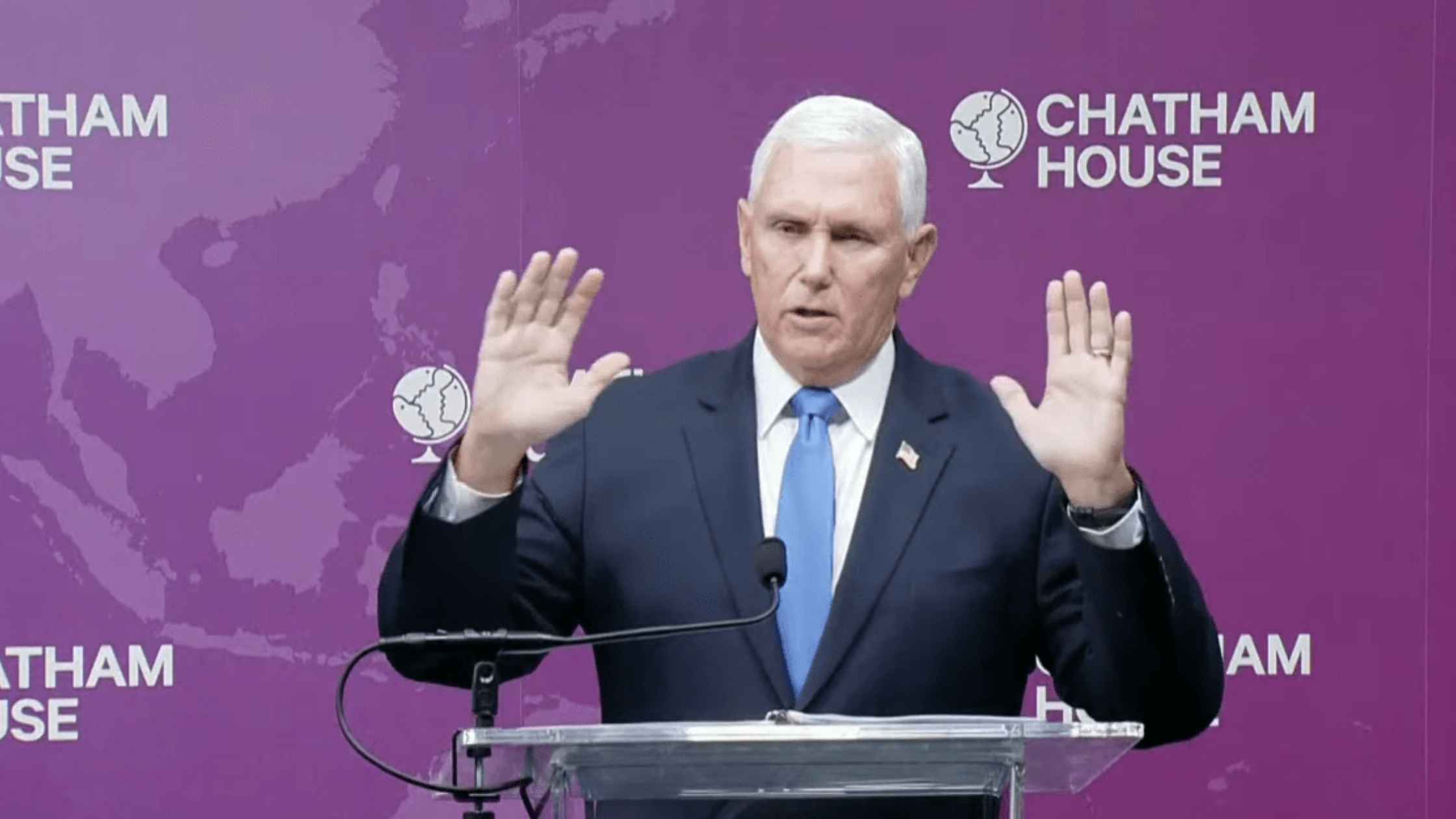
We are delighted to have here today… Thank you for the warm-up that I've got, but I don't need a warm-up. Thank you for joining us for this conversation we are delighted to be having with Mike Pence, the 48th Vice President of the United States. Let me say at the beginning, just in case you're in any doubt, this is on the record and live-streamed. We are not under the Chatham House rule. And thank you all for coming here. Thank you to the many online. I was saying to Mike Pence upstairs that we had so many people register interest for this, it's broken our records, at least for the past few years.
(01:16)
Let me give the briefest of introductions not to cut into our time. Mike Pence, as I said, the 48th vice president, holding that office from 2017 to 2021 in President Trump's first administration. From Indiana, born there, long political career there, starting off with a law degree, and time in law practice. Served as a congressman for six terms, and was governor of Indiana. And through that arguing for the things that he has become known for, tax cuts, fiscal responsibility, job creation, education reform, investment and infrastructure.
(01:53)
He affirmed the integrity of the 2020 elections that took Joe Biden to the White House, disagreeing with Donald Trump on that point, and defending the constitutional transfer of power on January 6th, 2021. He has also diverged from President Trump's second administration somewhat on the question of support for Ukraine, which I expect we will discuss.
(02:15)
He's here in the UK to talk about his book, So Help Me God, to be published next year. I gather you have finished writing it, which is not always true of people who come to talk about their books, so congratulations on that. This is something then of a warm-up tour. He's going to begin with some opening remarks. I will then ask him a few questions, and then over to your questions. I'm sure there will be many of them. With that, welcome to Chatham House.
Mike Pence (02:41):
Thank you so much.
(02:46)
Well, thank you for that introduction. You read it just the way I wrote it. But it genuinely is an honor, for my wife Karen and I, to be back in Great Britain. We are rounding out a week of travel that's taken us from Newcastle to the north and then Oxford and Cambridge, but I was very much looking forward to the opportunity to walk in these historic halls, and speak into this moment here at Chatham House. An institution, that for more than a century, has stood as one of the world's leading forums for thoughtful debate and principled dialogue on international affairs.
(03:34)
While it wasn't in my introduction, I hail from a heartland state, but I spent more than a decade on the International Relations Committee in the House of Representatives. As a governor, I traveled the world, because in Indiana we do two things well, we make things and we grow things and we sell them to the world. And then as vice president of the United States, I had the privilege of representing our country in many venues with many world leaders. And so I cherish the great tradition here at the Chatham House and I'm humbled by the invitation. Truth is Chatham House has helped nations turn the lessons of war into the practice of peace. And in every generation, your work has reminded us that ideas shape destiny and the future of freedom. Join me in thanking the leadership here at the Chatham House for the work that you continue to do.
(04:31)
Now, while I no longer speak on behalf of the United States, I do speak with confidence as an everyday American who travels our country continuously. And I came here to speak with confidence on behalf of millions of Americans who cherish the enduring friendship between the United States of America and the United Kingdom.
(04:56)
As I learned in my 20 years in public office, our bond is like no other. The special relationship, as Winston Churchill called it, was not declared by a treaty or born of convenience, it was forged in the fires of World War I and World War II. Together we faced the great trials of the last century. The eyes of the world turned to us when the hopes and prayers of liberty-loving people everywhere. We fought side by side to defeat Nazi Germany when American and British troops landed on the beaches of Normandy. In the years that follow, we stood united to vanquish communism and build alliances that anchored the world with stability.
(05:43)
And just as America came to Britain's aid in the Second World War, I was in Washington, DC on September the 11th, 2001 as a new member of Congress, and I witnessed Britain come to our aid after 9/11. The only time Article 5 has ever been initiated under the NATO treaty. Thousands of British troops fought and bled besides ours in Afghanistan and in Iraq and in the global war on terror. Many never came home.
(06:18)
As I said in my visit to the territorial military base in Newcastle last Friday, meeting with men and women in uniform, I said during all my years in Congress, I made a point to visit our troops down range every year for 10 years following the launch of hostilities in Afghanistan and Iraq. And as I told those British soldiers just last week, I never visited a forward-deployed base without seeing the Union Jack flying beside Old Glory.
(06:56)
The Bible says if you owe debts, pay debts, if honor, then honor, if respect, then respect. So allow me to join voices of remembrance that gathered in this great country just last week. The American people will never forget or fail to honor your heroic fallen who came to our aid these past 20 years.
(07:21)
Now, today we also stand shoulder to shoulder in defense of Ukraine, following the brutal and unprovoked Russian invasion three years ago. Since the outbreak of the war, you Brits have done your part leading the Coalition of the Willing, 22 billion pounds to Ukraine's enduring fight for freedom, training 58,000 Ukrainian military personnel, and committing to maintain the peace if and when peace comes.
(07:52)
And truth is, ours is not merely an alliance of interest or random chance, it is an alliance of ideals. We are connected by those ideals. Our country will celebrate those ideals at the 250th anniversary of the American founding. And while we were separated by war for a time, the simple truth is that it was the institutions, the traditions of democracy in the West that were born here and carried there, as Churchill also said. And the American people know that Great Britain is Greece to America's Rome, and we'll never see it otherwise.
(08:40)
But the truth is, those ideals, those shared principles in this still young century, are once again being tested. We're living in an age of rapid change and rising peril. Authoritarianism is on the march. A fallen empire labors to rise from the grave in Eastern Europe. China continues its military provocations in the Asia Pacific. And at home, both in the United States and here in Britain, we are confronted with a rising chorus of voices urging retreat from the world.
(09:13)
On the populist right in America, some argue that we should turn inward, abandon our allies, trade in isolation, trade leadership for isolation. They argue that America can't take care of our domestic issues while remaining leader of the free world. Well, to them I say, anyone who thinks that America cannot solve our problems at home and be leader of the free world has a pretty small view of the greatest nation on earth. We have done both for more than 75 years and we will continue to do both in the days ahead.
(09:56)
On the progressive left in my country, we hear similar calls to withdraw from the world under the banner of pacifism, as if Beijing, Moscow, and Tehran's tyranny will be disarmed by good intentions, handshakes and smiles. The truth is, both are deeply wrong and both are dangerous. And both, if followed, I believe would invite catastrophe not just for the American people, but for the world. For weakness arouses evil. And history is not kind to nations that abandon their friends or their principles. Peace is not preserved with empty wishes and catchy slogans. Peace is preserved by strength and vigilance and sacrifice.
(10:45)
As Margaret Thatcher once reminded this very institution, history teaches us that wars tend to break out not when there is an equal balance of military strength between potential adversaries, but rather when there is an imbalance. It's military weakness that tempts the tyrant and leads to war. The Iron Lady's words ring as true today as they did in her time in this place. I believe when America leads, the world grows safer. When America falters, chaos advances. And the same is true for Britain, whose moral authority and clarity have long given courage to free peoples everywhere. And it goes without saying, when our NATO allies live up to their obligation to provide for our common defense, our nations in the free world are safer still.
(11:45)
Despite the criticisms by some, our transatlantic alliance is not an artifact of the past. It's a foundation of today and a cornerstone of the future. The values we share, faith, family freedom, democracy, and the rule of law are not relics of a fading age, they are the very fruits of ordered liberty and the foundations of Western civilization that must be defended in an ever turbulent world.
(12:12)
Now, gathering here today, as Karen and I prepare to return home later to pay our respects and attend the funeral of a predecessor, Vice President Dick Cheney, I'd be less than candid if I didn't acknowledge that in recent days the special relationship between our countries has begun to feel at times like a specially difficult relationship.
(12:36)
Now, I acknowledge that some of our president's recent actions, imposing unilateral tariffs on friend and foe alike, have strained relations with the UK, at least for a time. But some of the choices, I say with great respect, made in London have given ammunition to angry voices in my country, that argue our allies no longer share our values and no longer deserve our trust. When British courts imprison citizens for what they say or pray or where they pray; when your government announces plans to withhold intelligence because it distrusts American actions against narco-terrorists; or when it embraces the same open border policies that are undermining sovereignty across the West, those decisions echo far beyond these shores. They're noticed across America, not just in Washington, DC, and they are exploited by those who would say that the UK is not our friend. Who would like nothing more than to see the Atlantic Alliance crumble.
(13:50)
But let me assure you, the American people know that the United Kingdom is our friend, and the United States will always be a friend to the United Kingdom. So I say as a friend, the surest way to strengthen our alliance is to live out the freedoms that made it possible: free speech, secure borders, moral courage to call evil by its name. These are not uniquely American virtues, they're the shared inheritance of freed people. We do well to repair to them. So I came to say today, now more than ever the United States and the United Kingdom must stand together as the twin pillars of the free world. And nowhere is that calling clearer than in the war raging in Eastern Europe. My wife and I have traveled into Ukraine since Russia's brutal and unprovoked invasion three years ago. Just a few short months
Mike Pence (15:00):
After the initial invasion, we crossed the border of Poland to a relief center and saw a sight I never thought I'd see outside of black and white films from World War II, literally throngs of women and children of every age carrying all the possessions they could on their backs into a relief center, fleeing from the onslaught of the Russian invasion. And in 2023, I traveled to the very sites just outside Kyiv, where Ukrainian troops turned back the initial invasion on that capital city bravely in the woods at great cost. Vladimir Putin's unprovoked invasion of Ukraine is the most blatant act of aggression in Europe since 1939.
(15:55)
But it's not merely an attack on one nation. It's a very assault on the right of free people to determine their own destiny. And it's assault on the principle that we will not allow powers to redraw international lines by force. And the truth is, I have no doubt that if Vladimir Putin, who I have met and spoken to and told things that he didn't want to hear, I have no doubt that if Vladimir Putin overruns Ukraine, it's only a matter of time before he crosses a border where our men and women in uniform will have to deal with him. Now, I want to commend the United Kingdom for its steadfast leadership, sending weapons, training troops, rallying Europe, but we must do more.
(16:50)
Putin will not stop until he's stopped. That's why in my country, I have called on our administration and on the Congress of the United States to pass strong secondary sanctions against any nation that is propping up Russia's war machine through the purchase of its energy. Russia's war efforts is being maintained and sustained by oil money from the rest of the world, and much of it comes from nations who claim to share our values. More than a trillion dollars worth of Russian oil and gas has been purchased on world markets funding Putin's brutal war machine.
(17:32)
The passage of strong secondary sanctions by the United States and our allies, I believe, will bring enormous economic pressure on Russia. Any nation that heats its homes with Russian oil fuels Putin's war machine. Any nation that helps Putin should share in his isolation. And in point of fact, I'm happy to report the United States has lots of oil and natural gas. And by the way, the United Kingdom has significant undeveloped reserves in the North Sea. I submit to you that it's time for America and the UK to fuel freedom like never before.
(18:18)
Beyond Europe lies what I think is the greatest challenge to our securities and economies in the free world in the 21st century. And that is the rise of communist China. While continuing to engage in trade abuses, military provocations, and human rights violations, Beijing inches closer to Taiwan each passing day. And of late, President Xi has continued a communist long-running war on Christianity. Just a few weeks ago, they arrested the pastor of one of the largest underground churches in China, Pastor Ezra Jin Mingri, along with dozens of other church leaders. I would submit to you that in support of our shared commitment to religious freedom, our nations must continue to call on the CCP to immediately release the detained church leaders. And in support of our commitment to democracy and free press, the time has come for Hong to free Jimmy Lai. What China doesn't know is that communism will never defeat Christianity. People who know me well know the introduction I prefer is I'm a Christian, a conservative, and a Republican in that order. The truth is, you can pay 10 pounds and visit the grave of Karl Marx here in London.
(19:54)
But if you try to visit the grave of Jesus of Nazareth, He isn't there. He's risen, and His church is on the move. Beijing makes no secret of its desire, not just to expand its influence in the Asia Pacific, but to remake the world in its own image. More totalitarian, less prosperous, more antagonistic, less concerned with human rights, and a world in which we're all less free. Xi Jinping, who I've also met and spoken with, believes history is bending in China's favor, that the West is decadent, divided too exhausted to defend our interests. And sadly, America's rising isolationists agree.
(20:47)
But I say with confidence, President Xi is wrong. And together we will meet China's challenge with unity, defending freedom, navigation in the Pacific. Standing with free people of Taiwan, securing our critical supply lines, and ensuring the technologies of tomorrow are shaped by liberty, not by tyranny. The future does not belong to the Chinese Communist Party. The future belongs to freedom. That's the dividing line of our time. More than ever before in my lifetime free nations on one side and those hostile freedom on the other in Europe, Asia, and especially in the Middle East.
(21:37)
I'm proud to reflect on the shared deep historical bond that the United States and the United Kingdom share with Israel. Here in Britain, the tradition of Christian Zionism helped inspire the Balfour Declaration, which in turn paved the way for the rebirth of the Jewish state of Israel. And America was proud to be the first nation on earth to recognize that nation in 1948. It is a legacy worth defending and preserving in our time, fulfilling the hopes of generations on both of our countries, and of the proud Jewish people through the millennia.
(22:22)
And make no mistake about it, Israel's survival has never depended on charity. It's depended on partnership. That partnership has made the world safer. As America's B-2 bombers buried the Iranian nuclear program under tons of rubble, it was the Israeli Air Force that cleared the way to a safer world. And as we stand with our cherished ally Israel, I submit to you with great respect that we must also, with renewed vigilance, confront a growing evil that has re-emerged in the West. Old hatreds dressed up in new rhetoric on the right and on the left represent a vile and dangerous trend in the Western world.
(23:16)
And whether it is whispered in the back rooms or shouted on social media, anti-Semitism has no place in a free society anywhere in the world and must be universally condemned. So those then are our challenges. And I look forward to our conversation and your impressions. And I know there are some who say that America is weary and losing interest in the world. We've lost our appetite for leadership, but that's not the America I know. Outside of social media echo chambers, I can assure you the American people still believe in the ideals of our founding and still embrace America's unique role as leader of the free world.
(24:11)
The Ronald Reagan Presidential Library in 2024 did a national survey, found that 57% of Americans, a record high, believed, "The US should be more engaged and take the lead in international affairs." Even a majority of those who identified themselves as MAGA Republicans embrace that principle and I believe they still do. The American people are rejecting the siren song of populism, and I believe they always will. Because America's core character does not change with one leader, one season in our history, our nation has weathered populists and progressives, isolationists and realists, every shade in between. And our country may get off message from time to time, but America will always be defined not so much by our government as by the enduring and indomitable spirit of the American people, a belief in freedom, free markets, and government of, by, and for the people. So, as I close, let me say to all who are gathered here straight from the heart, now don't give up on these principles or the important relationship between our two free nations, on the alliances that make us strong. Don't give in to pessimism. Don't lose faith in your countrymen.
(25:45)
And never, never doubt the goodness, decency, resolve of the American people. And I know with God's help, America will continue to lead the free world. And as the United Kingdom and our allies stand with us, we will stand firm for freedom against this rising tide of tyria… tyranny and aggression. And we will forge a future of liberty, security, and prosperity for all mankind. So help us God.
Bronwen Maddox (26:32):
Mr. Vice President, thank you very much indeed. With those final remarks about America's core character does not change, you've taken us right to the heart of one of the questions the world is asking about whether the United States has indeed changed. And I wanted to pick up 1 point, one central point in what you are saying, which is whether the United States still respects the rule of law.
(26:59)
I'm thinking of, among many other things, of the remarks that President Trump made about perhaps taking over Canada or Greenland or some of the things which he has said in the context of Ukraine, which seem to allow President Putin a degree of success or reward for what, as you say, is a hostile invasion of another country. So does the United States still respect the rule of law? What can you say to other countries looking at this?
Mike Pence (27:37):
Well, gee, look at the time. I…
Bronwen Maddox (27:39):
Yes or no will do.
Mike Pence (27:46):
I say emphatically yes. The people of the United States of America and our leaders not only respect the rule of law, but cherish it, cherish freedom. I'm very proud of the record of the Trump-Pence administration. It didn't end the way I wanted it to, but I'll always believe by God's grace I did my duty that day in January of 2021, the seat of the peaceful transfer of power. But up until that time, I can tell you that President Trump and I had a close working relationship.
(28:25)
Some people think we're a little bit different, but I witnessed the President's words, his ability to garner attention, to initiate engagement with leaders around the world, friend and foe alike. But along the way, I also saw our administration rebuild our military. We unleashed our armed forces. With British support, we took down the ISIS caliphate and took down their leader without an American casualty, and also removed the leader, the Iranian Revolutionary Guard, Qasem Soleimani. We stood without apology for Israel, moved our embassy to Jerusalem.
(29:17)
So I would maintain to you that even as the President's rhetorical style can get the attention of the world, like very few leaders I've ever known, that watching what America did in our years, watching where the administration has gotten to after some stops and starts with Ukraine, should give evidence of the fact of what the expectation of the American people is, what the expectation of our leadership is in Washington, DC. I think we will… we're going to continue to be a nation standing for freedom.
Mike Pence (30:01):
… And President Trump will not change in the way he speaks, but I believe in my heart of hearts that America's going to stay on that strong course of leader, the free world, the issues. One last thought. There's a lot of talk about isolationism. I brought it up today. The president I serve with is not an isolationist. In fact, he has a bias for leadership. He has a bias for being in front of the debate. And so I remain hopeful that the United States, whether it be Eastern Europe, the Asia Pacific, and certainly with progress we've made in the Middle East toward peace, that you'll continue to see America lead on that principle.
Bronwen Maddox (30:44):
Okay, so thank you for that. Let me ask you then one detailed point on that about Ukraine. Whereas you said you and your wife have spent some time. Should Europe now assume Ukraine and that conflict is its own to solve, that it won't be getting much more help from the United States?
Mike Pence (31:04):
Well, I don't think that. In fact, it was just a couple of days ago that I was encouraged in a piece in the Wall Street Journal last summer. I reflected on my time as vice president when we negotiated a ceasefire with President Erdoğan as his troops surged into Syria. And we were able to accomplish that in large part, which you can read about in the essay because we made it clear that we were going to impose, President Trump was going to impose punitive sanctions on members of Erdoğan's government the next morning if they didn't give the opportunity for our Kurdish allies to evacuate from the northern border of Syria. I urged the administration and members of the Senate to move those strong secondary sanctions.
(31:53)
I've continued to do that publicly and just two days ago I was heartened that President Trump essentially said that he was, in his words, okay with the Senate passing the strong secondary sanctions. I said in my first trip to Europe as vice president, it was always my impression. America first doesn't mean America alone, but it does mean that our allies would live up to their word to do their part and $140 billion more of investments by our NATO allies after our first four years was evidence that our allies across Europe here in the UK did the same. So I don't think you should have the view other than we should all take the view that this is a real moment of testing of the West, but I think you'll continue to see American leadership.
Bronwen Maddox (32:52):
Okay, thank you. Let me ask you about it, you introduced yourself after my introduction. Dwelling on what it means to come from a state that makes a lot of things and exports them to the world. Do you think the tariffs that President Trump has brought in will outlast his administration?
Mike Pence (33:14):
Well, I hope not. In fact, the Supreme Court of the United States is now currently evaluating whether or not the statute the president has used to impose unilateral tariffs against friend and foe alike is even constitutional.
Bronwen Maddox (33:29):
That is claiming that it is an emergency using that as the basis for these tariffs.
Mike Pence (33:36):
Claiming is an emergency statute that there's a global emergency. But under our constitution, Article I, Section 8, it provides that taxes and tariffs, which were called imposes back in the day can only be enacted by the Congress. The small foundation that I started a few years ago in Washington, D.C. has filed briefs, one of which was cited in the Court of Appeals case that we don't believe the president's use of that statute is consistent with the constitution. My hope is that a majority of the Supreme Court will conclude the same. I mean the simple truth is that at the American founding taxes on tea were kind of an issue. Those were tariffs. And so by the time they got around to that second draft of an American government in 1787 that we call the Constitution of the United States, the one thing they wanted to make clear was that no one person could impose import tariffs and taxes on the American people, that it would be done by the elected representatives of the American people.
(34:53)
I'm hopeful that our Supreme Court will draw the same conclusion because as we've argued and as people in the UK understand whether it's your tariffs here on our goods coming in or our tariffs on exports from the UK to the United States, I've made it clear that with the exception of maybe a small impact of the margin that American businesses and American consumers pay American tariffs. I think the concession by our administration just in the last few days that they were lifting tariffs on coffee and beef through lower prices at their grocery store kind of made my point. So I think the American people are sensing this. I think we're seeing inflation, we're seeing impacts in our economy and my hope is that whether it's the Supreme Court or whether the administration continues to tack and adjust, that we will return to using tariffs the way we did in our administration.
(35:56)
Which was we used tariffs in the threat of tariffs to negotiate down tariffs and trade barriers and non-tariff subsidies. I mean, President Trump threatened to do away with NAFTA and impose harsh tariffs on Canada and Mexico. It set the stage for us to negotiate the largest trade deal in American history, the USMCA. I was sent to give a major speech to the City of London to say that when Brexit was done, we were already putting together working groups to begin to negotiate a free trade agreement with the UK. I mean, it seems to me tariffs have their use as a means of facilitating negotiations. But an economic policy, I believe with the exception of China, because honestly after decades of trade abuses, intellectual property theft, and I think we've got to stand firm on China. But other than that, I believe in free trade with free nations and it's one of the ways the free world will prosper and prevail.
Bronwen Maddox (37:07):
Thank you very much for that. You mentioned the Supreme Court and I wanted to ask you about the quality of democracy in the US itself. We've got quite a lot of questions online on that, including one from Haida Iqbal. Thank you. I'm thinking both of the January 6th challenge, but even of a remark by the president in the White House last night at a press conference where he asked a question by ABC News uncomfortable to his guests, the Crown Prince of Saudi Arabia and suggested that ABC's license, one of the main broadcasters of the US should be taken away. What about the quality of democracy in the US? What should the rest of the world make of it?
Mike Pence (38:00):
I'm very confident about American democracy. The American people cherish our representative government. They cherish, and I believe you'll see celebrations next year all across the country in big cities and small towns, remembering the signing of a Declaration of Independence, the ideals enshrined there. And my confidence really comes from having not only served in the Congress and as a governor and as vice president traveled across our country continuously, but Karen and I, after we left the White House, we moved home to Indiana. We bought five acres and a pond, a riding mower, pickup truck. So we spent a lot of time traveling around the country as well as just living in the heartland.
(38:50)
And I have to tell you, there has not a day gone traveling anywhere across the United States that I haven't been deeply humbled by having people come up to me on the right, on left, everywhere in between and express appreciation for our service, particularly on that fateful day. And it has reiterated to me the deep love the American people have for our constitution. We've had a few elections since then. There have been reforms at the state level for elections. 2022 elections went off without a hitch. '24 elections worked out just fine for the president. We just had midterm elections less so, but without controversy. And I think you can be confident the American people are going to continue to demand that we live up to that ideal and that principle of representative democracy.
Bronwen Maddox (39:53):
I know there are going to be a lot of questions, so let me just ask you one more. You mentioned some points where you thought the UK was going wrong. We have the budget next week where the Chancellor is expected to bring in a lot of tax rises and is grappling with the rising size of the state here. These are principles you've argued against all your life. Is this somewhere where you think the UK is going wrong?
Mike Pence (40:21):
Well, I would just caution friends about ignoring the real threat to the long-term security and prosperity of both of our countries. And that's public debt. And let me before I-
Bronwen Maddox (40:38):
I have to say the US is in a worse position than the UK on that.
Mike Pence (40:41):
I was about to say before I criticize my friends. When I arrived in Congress, our national debt was three or $4 trillion. It's $38 trillion today and rising. When I ran for president back in 2023, not so where you'd notice, but it was a rich experience. But I think only of the eight candidates in that primary, not counting the one that won, only two of us were talking about the national debt. Only two of us were talking about the only real way to solve the national debt is with compassionate reforms of the entitlement programs that consume more than 80% of federal spending. Now, why did I open that up by saying the greatest threat to our security and prosperity? And the reason is, I think it was back in 2005, the chairman of the Joint Chiefs of staff was testifying before a committee I served on in Congress and he asked, "What's the greatest threat to America's national security?"
(41:56)
And then 20 years ago, he said, "The national debt." Two years ago was the first time in American history that we spent more money on interest on our national debt than we did on our national defense. I would say to you, don't look to us as a good example, but I would urge friends across the pond here, maybe lead like Great Britain has done before. A lot of times I say the good ideas sometimes follow the sun across the Atlantic. And I'm not just talking about the Beatles, but policies that echo and they come to the West and the impact, I would love to see the people of Great Britain call upon their leadership to lead on the kind of fiscal reforms that'll put us back on a sustainable path. I'll continue to be a voice for that in our country, but I think we have a moral obligation to lift this mountain range of debt off our children and grandchildren for our security and our prosperity. And I'll continue to champion it.
Bronwen Maddox (43:13):
Thank you very much. Let's go to questions. Lots of hands up. Right. Let me come here first in the front row.
Sam Kiley (43:26):
Thank yoU. Mr. Vice President, could you elucidate-
Bronwen Maddox (43:28):
Could you possibly say who you are.
Sam Kiley (43:29):
I beg your pardon. Sam Kiley from the Independent. Mr. Vice President, could you elucidate a little bit more on the perception we certainly have here in United Kingdom in Europe, that internal democracy in the United States really is under threat. There's been attacks on the judiciary, the media, the Pentagon, the armed forces have been eviscerated of potential critics. And certainly as I come from the African continent, the kind of incipient coup is pretty obvious to some of us.
Mike Pence (44:07):
I understand the perception and I understand the way actions get written about, but I just speak with confidence about the expectations of the American people. The American people cherish our democracy. They cherish our republic. And I actually believe, I've said many times, January 6th was a day of tragedy. But thanks to the heroes in uniform, the riot was quelled. And you witnessed Republican and Democrat members of the House and Senate reconvene the very same day to complete our work under the Constitution. So that day of tragedy became a triumph of freedom. And as I said, I still have my critics
Mike Pence (45:00):
Even in my own party on my actions that day, I believe the overwhelming majority of people in my party and across the country looked to that day and are grateful to all of us.
(45:16)
Now, the only heroes I saw that day were wearing uniforms, but the fact was that every member of the House and Senate, Republican and Democrat alike, reconvened the very same day and did their duty and did their work. It should be a source of great confidence.
(45:34)
With changing administrations, there's always cross currents and perceptions can vary, but I have great confidence in the expectations of the American people, and you should too.
Bronwen Maddox (45:49):
Okay, thank you.
(45:50)
Woman right here towards the back, two in from the aisle.
Speaker 1 (45:56):
Thank you very much, Mr. Vice President. [inaudible 00:45:59] from the Leadership International Program at Chatham House.
(46:02)
We're all witnessing the Crown Prince of Saudi Arabia's visit right now to the White House, and we're hearing about a potential defense pact and new AI agreements. We're hearing also that this partnership will evolve beyond the traditional. What will that look like in the short term and in the long term?
Mike Pence (46:22):
Well, I saw a lot of the press coverage yesterday and people seemed surprised at the engagement with Saudi Arabia, for a variety of reasons. But it's important to remember that the first international trip that the president took under our administration was to Riyadh. We engaged Arab nations directly and immediately even while we stood without apology with our most cherished ally, Israel; we, as I said, moved the American embassy to Jerusalem, we recognized the Golan Heights.
(46:59)
We were told by many sincere voices in international relations that that would result in harvesting the whirlwind, that war would break out in the region. In fact, what broke out was the Abraham Accords. In 2020, while the world was wrestling with the worst pandemic in a hundred years, we still nevertheless were able to gather on the south lawn of the White House and have two Arab nations normalize relations with Israel.
(47:31)
And while I've expressed concerns here during my trip in the UK about the sale of F-35 aircraft to Saudi Arabia, given that's the most advanced aircraft platform that we have, stealth technology, and I am hopeful the administration will carefully consider the transfer of that technology to Saudi Arabia and take steps to ensure that that technology does not fall into China's hands-
Bronwen Maddox (48:07):
Forgive me. Is that your main concern, that China gets access to it, as opposed to changing the balance of power?
Mike Pence (48:13):
It is a very real concern because I'm very aware of our military superiority, our technologies, and the F-35 platform is chief among them.
(48:29)
But the other part of that is, I hope what comes from it is I hope Saudi Arabia will find its way onto the Abraham Accords. That would be a colossal development in the region. And it may well signal after the horrors of October 7th and the tragedy of the war, the necessary war that Israel prosecuted in Gaza in a sense, it might well herald a completely new season for peace in the region.
Bronwen Maddox (49:02):
Okay, thank you.
(49:02)
Here, second up.
Nishan Chilkuri (49:03):
My name is Nishan Chilkuri, Chatham House member, and I work for the Daily Mail.
(49:13)
Mr. Vice President, you've obviously paid a big price for your commitment to upholding the constitution. Going into the next election, do you expect to see actions that will challenge it yet again? What are your biggest fears?
Mike Pence (49:32):
Well, let me say, I don't know about paying a price. Last Tuesday in our country, on November 11th, we remember the people that really pay a price.
(49:54)
But I can honestly tell you that I don't have those concerns. I mean, there always are going to be voices on the fringes of the right and the left. It seems particularly with social media that they find megaphones on the right these days more than they found them before. But I just have to tell you that the American people that I know just won't have it. They just won't have it.
(50:24)
It was one of the reasons why on that day, I remember as I was witnessing … With my wife at my side, we had been escorted off of the Senate floor. The Secret Service wanted me to leave the building, but I was determined to stay at my post and finish our work. And by God's grace, we did. But I remember looking at that small television set, seeing people smashing windows and assaulting police officers, and I just found myself thinking, "Not this, not here, not America." And particularly not the people of our movement.
(51:01)
I will maintain to you that the people that engaged in violence and vandalism on that day did not represent even much more than a fraction of the people of our movement, people that I was among for 20 years, and four and a half years as a candidate and as a vice president. Those people love our institutions. The American people, I think are the most generous, most patriotic, most God-fearing, innovative people the world's ever known, and they're going to hold our country to account in the days ahead.
Bronwen Maddox (51:40):
Thank you. I'm going to take another one here. Front row.
Jonathan Rugman (51:47):
Jonathan Rugman from Channel 4. I wanted to ask a question about a former resident of Indiana actually, the journalist Jamal Khashoggi, who was a student there. Yesterday the president said that the Saudi Crown Prince knew nothing about the killing of Jamal Khashoggi. Do you believe that? And did you see evidence to the contrary when you were in the White House given that the subsequent intelligence assessment which was published said otherwise?
Mike Pence (52:21):
I would not have said that.
Jonathan Rugman (52:22):
You would not have said what?
Mike Pence (52:25):
Beyond that I would not … I think the President also praised his record on human rights.
(52:33)
Look, there's …
Bronwen Maddox (52:35):
Just to be clear, you would not have said that the Crown Prince knew nothing about it.
Mike Pence (52:42):
Well, I really can't speak to intelligence that I was exposed to, but-
Jonathan Rugman (52:47):
But President Biden published the assessment.
Mike Pence (52:49):
Well, what I can tell you is that I would've not have made that statement and …
(52:56)
I think part of foreign policy, you've talked about it here for a hundred years at Chatham House, you've got to take the world that you find them and you got to make relationships with sovereigns as you find them. And so I do think the relationship with Saudi Arabia is one that we need to find a way forward on. But I think it's very important that we never cast aside our deep commitment to freedom, to the freedom of the press, to …
(53:42)
And I can tell you, I just simply would've … Had I been given the opportunity to be sitting in that right-hand chair in front of the fireplace, that meeting would've gone a little different.
Bronwen Maddox (54:01):
Right at the back near the door. Olivia.
Olivia O'Sullivan (54:06):
Thank you. Olivia O'Sullivan, Chatham House. And thank you for speaking to us today, Mr. Vice President.
(54:11)
I have a question about immigration. In your remarks, you said when the UK makes certain choices, including around open borders policies, it raises questions among some in the US about the relationship and the alliance. In the past year, this UK government has significantly tightened immigration rules on skilled workers, on family reunification for students, and most recently on refugee status. So when you say open border policies, can you say specifically what you mean? And in your view, what immigration policies should countries pursue in order to be assured the US will remain their ally?
(54:46)
Thank you.
Mike Pence (54:49):
Well, I speak more about perceptions in our country about the UK. And I don't believe in foreign interference in elections or policy, so I'll leave you to that. But there has been a perception of open borders, not only in the UK but among other European nations.
(55:13)
And the Biden administration essentially undid all the policies that we had put into effect that secured our southern border and ended asylum abuse almost overnight with what actually I negotiated that came to be known as the Remain in Mexico Policy. We required people, if they applied for asylum in the United States, that we would process their application, but we would require them to wait in Mexico as opposed to disappearing into the United States as literally millions were able to do in years before and after. The new administration has put all those policies back into effect, and essentially illegal immigration and asylum abuse has virtually disappeared. A nation without borders is not a nation. And I think it's absolutely essential that our nations not only secure our borders, but I will also say to you, I think our immigration system in America is broken, and I can't speak to it here in the UK, but it looks like you might have the same problem. I mean, immigration ought to be an invitation for people to come into your country. I think it was Adam Smith that said, "No nation grows but by population." So you want positive immigration into your country, but you also want people to come to the UK to be British. We want people to come to the United States to be Americans.
(56:47)
My grandfather got on a boat in Ireland in 1923, sailed across the Atlantic, stepped onto Ellis Island; never lost that Irish brogue. Michael Richard Pence was named after Richard Michael Colley, the proudest man I ever knew. And he was a proud American. He never forgot his home across the pond in what he used to call the old country, and I've been to that house he grew up in, but he came to be an American, to embrace American ideals. And I don't think we have … In our country, I'll just say, I don't think we have an orderly system of immigration that really ought to open the doors based on merit into the country in ways that will benefit people who aspire to live the American dream, but also meet the needs of our country; and to the extent that the UK faces the same challenges …
(57:47)
But to me, first order of business is secure the border and stop the flow of illegal immigration and illicit drugs coming into our country claiming hundreds of thousands of American lives. The second step is the one we're waiting to do, and that is to reform a broken immigration system. And I hope we will.
Bronwen Maddox (58:08):
Thank you for that.
(58:09)
There are so many hands up and I am so sorry that we are going to have to stop right there. There are terrific questions online as well, everything from rare earths to fossil fuels. Someone has said in Trumpian capitals, "Welcome, dear VP. Thank you for your service to the world, sir," as well. And we have lots, lots more; the Taliban and Jeffrey Epstein. Not normally entities you get in successive paragraphs of text, I have to say.
(58:36)
There are so many questions and we could do justice to only a few of them, but I wonder if you could join me in thanking Mike Pemce.