




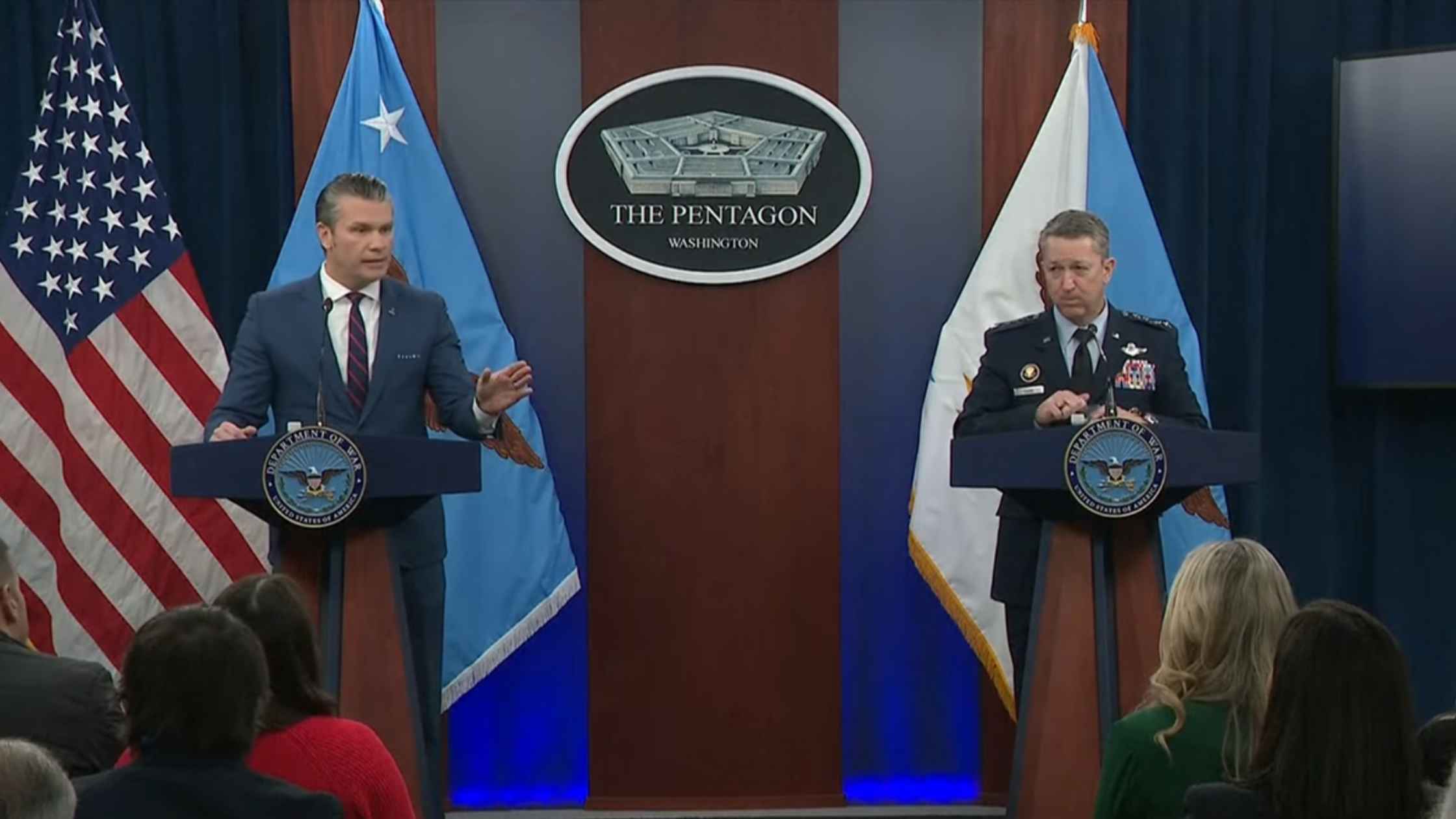


Speaker 1 (00:00):
You need to silence your cell phones. If you have a cell phone, if you could silence or turn it off. Check one, two. This is a final mic check. Check one, two. Audio check. This is the chairman's mic. Please turn off your cell phone or put it in mute. Check one, two. Check one, two. This is the chairman's mic. Check one, two. Check one, two. Audio check, one, two. We're doing a final mic check for the pool, as well as DMA, as well as a cell phone announcement. Please silence all cell phones. Check one, two. Check one, two. Got about four minutes. One more? Audio check, one, two. We're doing a final mic check. This is the secretary's mic. Check one, two. Check one, two. Again, please turn off all cell phones or silence them. Thank you.
Pete Hegseth (14:20):
Well, good morning. We just finished an update with Admiral Brad Cooper, the CENTCOM commander, across the CENTCOM AOR, our leadership and troops, as you would expect, doing a fantastic job. Two days ago, under the direction and direct orders of President Donald J. Trump, the Department of War launched Operation Epic Fury, the most lethal, most complex, and most precise aerial operation in history. For 47 long years, the expansionist and Islamist regime in Tehran has waged a savage one-sided war against America. They didn't always declare it openly, except for their constant chants of death to America.
Pete Hegseth (15:00):
... they did it through the blood of our people. Car bombs in Beirut, rocket attacks on our ships, murders at our embassies, roadside bombs in Iraq and Afghanistan, funded and armed by Iranian Quds Force and IRGC killers. My generation of veterans carried the names of brothers who never came home. Brothers butchered by Iranian-backed roadside bombs and well-armed militias, thousands of our own. We didn't start this war, but under President Trump, we are finishing it. Their war on Americans has become our retribution against their Ayatollah and his death cult. It took the 47th president, a fighter who always puts America first, to finally draw the line after 47 years of Iranian belligerence. He reminded the world, as he has time and time again, being an American means something unbreakable. If you kill Americans, if you threaten Americans anywhere on earth, we will hunt you down without apology and without hesitation, and we will kill you.
(16:14)
President Trump has also been very consistent. Crazy regimes like Iran, hell-bent on prophetic Islamist delusions, cannot have nuclear weapons. It's common sense. Many have said it, but it takes guts to actually enforce it, and our president has guts. Iran's stubborn and self-evident nuclear pursuits, their targeting of global shipping lanes, and their swelling arsenal of ballistic missiles and killer drones are no longer tolerable risks. Iran was building powerful missiles and drones to create a conventional shield for their nuclear blackmail ambitions. Let me say that again. A conventional shield for their nuclear blackmail ambitions. Our bases, our people, our allies, all in their crosshairs. Iran had a conventional gun to our head as they tried to lie their way to a nuclear bomb. It almost worked under Obama and his terrible deal, but not under this president. Turns out the regime who chanted death to America and death to Israel was gifted death from America and death from Israel.
(17:33)
This is not a so called regime change war, but the regime sure did change, and the world is better off for it. Today, in their desperation, the enemy is unmasked. As Iranian missiles and drones reign down indiscriminately on the hotels, airports, apartments, and other civilian targets of their neighbors. Cowardly terrorist tactics from a regime that for decades has trafficked in cowardly terrorist tactics, lies, death, and destruction to this day. The Iranian leadership has built nothing, except proxies, and missiles, and drones, and deeply buried nuclear factories and facilities. Peaceful nuclear ambitions do not need to be buried underneath mountains. Last June, Operation Midnight Hammer obliterated their nuclear program to rubble. Afterward, we told them plainly, "That's it, now make a deal." They arrogantly refused. We said, "Rebuild it, and we'll stop you again this time, far worse." Well, President Trump, Secretary Rubio, Steve Witkoff, Jared Kushner, they bent over backwards for real diplomacy, offering pathway after pathway to peace.
(18:53)
I watched it. I was there. They tried over and over and over again, earnest attempts at peace. The former regime had every chance to make a peaceful and sensible deal. But Tehran was not negotiating. They were stalling. Buying time to reload their missile stockpiles and restart their nuclear ambitions. Their goal: hold us hostage, threatening to strike our forces. Well, President Trump doesn't play those games. And as Secretary Rubio said, after the Maduro raid, "If you don't know, now you know." President Trump puts America and Americans first. He doesn't hesitate, and neither do our troops. The mission of Operation Epic Fury is laser-focused. Destroy Iranian offensive missiles, destroy Iranian missile production, destroy their Navy and other security infrastructure, and they will never have nuclear weapons. We're hitting them surgically, overwhelmingly, and unapologetically. With every passing day, our capabilities get stronger, and Iran's get weaker. We set the terms of this war from start to finish. Our ambitions are not utopian. They are realistic, scoped to our interests and the defense of our people and our allies. Speaking of people, we hope the Iranian people take advantage of this incredible opportunity. President Trump has been clear: now is your time. To Iranian security forces, choose wisely. President Trump has also been clear about your fate in either direction. To the media outlets and political left screaming, "Endless wars." Stop. This is not Iraq. This is not endless. I was there for both. Our generation knows better, and so does this president. He called the last 20 years of nation building wars dumb, and he's right. This is the opposite. This operation is a clear, devastating, decisive mission. Destroy the missile threat, destroy the Navy, no nukes.
(21:19)
Israel has clear missions as well for which we are grateful. Capable partners. As we've said since the beginning, capable partners are good partners. Unlike so many of our traditional allies who wring their hands and clutch their pearls, hemming and hawing about the use of force. America, regardless of what so-called international institutions say, is unleashing the most lethal and precise air power campaign in history. B2s, fighters, drones, missiles, and of course, classified effects. All on our terms with maximum authorities. No stupid rules of engagement, no nation-building quagmire, no democracy building exercise, no politically correct wars. We fight to win, and we don't waste time or lives. As the president warned, an effort of this scope will include casualties. War is hell and always will be. A grateful nation honors the four Americans we have lost thus far and those injured. The absolute best of America.
(22:33)
May we prosecute the remainder of this operation in a manner that honors them. No apologies, no hesitation, epic, fury. For them and the thousands of Americans before them, taken too soon by Iranian radicals. Before I turn it over to General Caine for the operational update, let me speak straight to you, the joint force, our warriors on the front lines. This is your moment. This is the generational turning point America has waited for since 1979 and since the rudderless wars of hubris, my generation, our generation, endured. Don't listen to the noise. Just stay focused. Our commander-in-chief is steady at the wheel. We face a determined enemy, but you are better, but we must prove it every single day. History doesn't care if we're tired, if we're scared, or if the fight feels big, it demands warriors who rise anyway. Peace through strength, the warrior ethos, lethality, unity of purpose, those are not slogans.
(23:44)
They're the beating heart of what it means to wear the uniform, that uniform. You think clearly under fire, you act decisively in chaos. You uphold the Constitution, and you uphold our country without hesitation. We are not defenders anymore. We are warriors. Trained to kill the enemy and break their will. History is watching. Be the force you swore an oath to be: focused, disciplined, lethal, and unbreakable. We will finish this on America First conditions of President Trump's choosing, nobody else's. As it should be. And know this above all, President Trump and I have your back always. Through fire, through criticism, through fake news, through everything. We unleash you because you are the best, most powerful, most lethal fighting force the world has ever seen. May Almighty God watch over you and his providential arms of protection extend over you. Godspeed warriors and keep going. General Caine, over to you.
Dan Caine (25:02):
Thank you, Mr. Secretary. And good morning, everyone. The purpose of my portion of the briefing today is to update you and the American people on the actions taken thus far. The briefing will discuss the preparation, the planning, setting the force, the early operations, and how we're assessing the progress thus far. So let's get started. On Saturday, 28th February at 01:15 Eastern Standard Time, 9:45 AM local Tehran time. On the orders of the President of the United States, US Central Command, under the command of United States Navy Admiral Brad Cooper, commenced Operation Epic Fury. As I said, I'm going to walk you through the initial phases of the operation, but first, I want to express my deep condolences and the condolences of the Joint Force to the Department of War personnel killed and wounded in actions thus far. As the secretary said, they're heroes and represent the best of our nation has to offer.
(26:02)
They're true examples of what selfless service means. Our deepest and heartfelt condolences are with their families, their friends, and their units. We grieve with you, and we will never forget you. Additionally, I stand here before you today grateful for each service member, planner, logistician, operator across our Joint Force. For our Department of War civilians, our intelligence community teammates, our inter-agency teammates who continue to stand in harm's way alongside us. I am proud of all of you as you take the fight to the enemy, and we are the best in the world at integrating. I want to extend my personal gratitude to the dedicated commanders and senior enlisted leaders and the enlisted members of the Joint Force who are fighting this fight across the CENTCOM AOR. In addition to Admiral Cooper and Fleet Master Chief Compton, I want to highlight a few today. US Army Central Command Commander Lieutenant General Pat Frank, who, along with his team are fighting the counter missile and counter drone fight.
(27:09)
United States Navy Central Command Commander Vice Admiral Curt Renshaw and his team, who are engaged with the Iranian Navy and projecting American Naval combat power from the seas, and United States Air Force Central Command Commander Lieutenant General Derek France and his leadership team, who are crushing Iranian targets from the air. I want to highlight the support to the CENTCOM fight from other combatant commands who are directly involved with this effort, to include US Space Com, USCYBERCOM, and USEUCOM. I also want to specifically call out United States Transportation Command and USSTRATCOM for their contributions to this fight. We cannot project American combat power at the time and place of our choosing without both. And finally, I want to express how deeply thankful I am for the continued service and sacrifice of the entire Joint Force and their families. Their unwavering commitment and dedication are the cornerstones of this effort.
(28:17)
So let me start with a few details. First, to be clear, as the secretary said, this is not a single overnight operation. The military objectives that CENTCOM and the Joint Force have been tasked with will take some time to achieve, and in some cases, will be difficult and gritty work. We expect to take additional losses, and as always, we will work to minimize US losses, but as the secretary said, this is major combat operations. So let me talk about the preparation and the planning. On February 28th, the full strength of America's Armed Forces came together in a unified purpose against a capable and determined adversary. The United States Army, Navy, Marine Corps, Air Force, Space Force, Coast Guard, and our reserve components integrated our cross, our combatant commands, and began coordinated operations with the Israeli Armed Forces of an unprecedented scale. As the secretary laid out, our military objectives are clear.
(29:22)
Our mission is to protect and defend ourselves and, together with our regional partners, prevent Iran from the ability to project power outside of its borders and be ready for follow-on actions as appropriate. Across every domain, land, air, sea, cyber, the US Joint Force delivered synchronized and layered effects designed to disrupt, degrade, deny, and destroy Iran's ability to conduct and sustain combat operations. On the US side, this marked the culmination of months and in some cases, years
Dan Caine (30:00):
... years of deliberate planning and refinement against this particular target set. From precision strikes against key military infrastructure to persistent intelligence and targeting integration to the close coordination of the components across vast distances, this operation again demonstrated America's reach, readiness and professionalism and that of our joint united force. It was historic not only in the operational scope, but in the level of joint integration displayed across every element of the joint force. And as I said earlier, this work is just beginning and will continue.
(30:41)
So now to talk a little bit about setting the force and setting the theater. On the order of the Secretary of War over the last 30 days to reinforce deterrence and provide the president with credible options should action be required, the joint force began to systematically reposition assets and personnel across the region. These movements ensured that US forces remained postured, protected, and ready to respond decisively for any emerging threat.
(31:14)
This deployment included thousands of service members from all branches, hundreds of advanced fourth and fifth generation fighters, dozens of refueling tankers. The Lincoln and Ford Carrier Strike Group and their embarked air wings, sustained flow of munitions, fuel, supplies, all supported with command and control, intelligence, surveillance, and reconnaissance network. And the flow of forces continues today. In fact, Admiral Cooper will receive additional forces even today.
(31:44)
This rapid buildup of forces demonstrated the joint force's ability to adapt and project power at the time and place of our nation's choosing. I want to highlight a couple specific cases for you. The Gerald R. Ford Carrier Strike Group, which many of you know was down in the Western hemisphere, redeployed across the Atlantic to set the theater. The ship, her crew, their families, and the entire strike group took a deep breath and as they always do, began planning to conduct combat operations.
(32:19)
The integrated reserve and National Guard forces have continued to demonstrate the value of America's reserve forces, including the Wisconsin Army National Guard operating in Kuwait and Iraq and Air National Guard units from a variety of states to include Vermont and Virginia. In the case of the Vermont Air National Guard and the 158th fighter wing, they were mobilized for operation absolute resolve and then were tasked to take their F-35As across the Atlantic instead of going home to be prepared to support this operation. The same is with our Air National Guard and Air Force Reserve Command tanker and mobility forces who stepped right out of their civilian jobs to deploy and to protect the region.
(33:05)
Lastly, I want to highlight the unsung heroes of warfare, our American logisticians and sustainment force, those who quietly work every day behind the scenes to project and sustain America's combat power. Our leaders from World War II were right when they said, "Professionals do logistics." As regional tensions rose, the joint force elevated our force protection measures on the order of the secretary and repositioned discreetly civilians and non-essential personnel designed to ensure the safety and security of our joint force. By the time operations began, only essential forces remained on our bases and in theater already, capable to respond.
(33:52)
So now let me move to H-hour. At 15:38, 3:38 PM on Friday, February 27th, the United States Central Command through the Secretary of War received the final go order from President Trump. The president directed and I quote, "Operation Epic Fury is approved. No aborts. Good luck." In the region, every element of the joint force made their final preparations. Air defense batteries ready themselves, checking their systems to respond to Iranian attacks. Pilots and crews rehearsed their strike packages for the final time. Air crews began loading their final weapons and two carrier strike groups began to move towards their launching points.
(34:38)
Across the globe, our operation centers came alive in Tampa, Florida here at the Pentagon, and of course forward in the central command AOR. As always, operational security was paramount as we sought to maintain and sustain the element of surprise. This operation was highly classified so that at H-hour, the enemy would see one thing, speed, surprise, and violence of action. The first movers were US Cybercom and US Space Com, layering non-kinetic effects, disrupting and degrading and blinding Iran's ability to see, communicate, and respond.
(35:18)
At H-hour, the beginning of major combat operations, 01:15 local Eastern Daylight Time, 9:45 local AM Tehran time, as dawn crept up across the central command AOR, the skies surged to life. More than 100 aircraft launched from land, sea, fighters, tankers, airborne early warning, electronic attack, bombers from the states and unmanned platforms forming a single synchronized wave.
(35:50)
This was a daylight strike based on their trigger event conducted by the Israeli defense forces enabled by the US intelligence community. The first shooters at sea were tomahawks unleashed by the United States Navy, closed in on Iranian naval forces and began to conduct strikes across the southern flank in Iran. On the ground, forces fired precision, standoff weapons, measured, deliberate, precise, and lethal. This was a massive overwhelming attack across all domains of warfare, striking more than 1,000 targets in the first 24 hours.
(36:29)
We are now roughly 57 hours into the operation. In the initial phase, CENTCOM's focus was systematic targeting of Iranians command and control, infrastructure, naval forces, ballistic missile sites, and intelligence infrastructure designed to daze and confuse them. Coordinated space and cyber operations effectively disrupted communications and sensor networks across the area of responsibility, leaving the adversary without the ability to see, coordinate, or respond effectively.
(37:06)
The combined impact of these strikes, swift, precise and overwhelming has resulted in the establishment of local air superiority. This air superiority will not only enhance the protection of our forces, but also allow them to continue the work over Iran. Over the course of the last two days, the joint force has launched hundreds of missions from land and sea and delivered tens of thousands of pieces of ordinance. The effort continues to scale. This included American B-2 bombers, which again, similar to Midnight Hammer, flew a 37-hour round trip sortie from the continental United States, dropping precision, penetrating munitions on Iranian underground facilities across the southern flank and slightly deeper. Additionally, Israel has separately executed hundreds of sorties against hundreds of targets.
(38:01)
Beyond Air Force and Navy, aircraft strike packages, coordinated salvos of precision standoff weapons from across the region have neutralized hundreds of preplanned targets. As I mentioned earlier, in support of these kinetic operations, US Cybercomm and Space Com have continuously layered effects to disrupt, disorient, and confuse the enemy. I will note that this operation had several combat firsts, which I'll allow at some point in the future Admiral Cooper to talk about since he owns the AOR.
(38:38)
While we've prosecuted a relentless offensive campaign, our defense has been equally important. Across the theater, operations have remained steady and disciplined. Once again, our integrated air and missile defense network is performing exactly as it's intended. US Patriot and Thad batteries, along with ballistic missile defense capable Navy destroyers, continue to coordinate and execute intercepts with precision and consistency.
(39:11)
I wish that every American could hear the voice communications like I have as these joint operation centers remain calm, focused, and cool while executing under fire over and over again. Collectively, these systems have intercepted hundreds of ballistic missiles targeting US forces, our partners, and regional stability. The threat from one way attack UAVs has remained persistent. Our systems have proven effective encountering these platforms, engaging targets rapidly. Each intercept represents hundreds of hours of training, readiness, and technology all coming together to work as designed. We remain vigilant in the counter-UAV fight.
(40:03)
And the defense of the region is not ours alone. As the threat grew, our partners surged in beside us. Air defense batteries in Qatar, the UAE, Kuwait, Jordan, and Saudi Arabia joined the fight, proof positive that years of training, trust, and harder and integration pay off. I am aware of the loss of three US Air Force F-15Es overnight in the region. I am grateful for the safety of the crews. And we know that this was not from hostile enemy fire. As this matter is under investigation, I'll not comment further on this.
(40:44)
Let me close. Operations will remain active across the theater and across the globe. The US forces are postured not only to maintain pressure, but to respond and adapt as required. Operation Epic Fury stands as a reminder of what the United States military uniquely delivers, the ability to project power on a global scale with speed, surprise, precision, and overwhelming force when and where our nation requires it. What we've demonstrated over the past several days reflects years of investment in readiness, joint integration, and professionalism of the joint force. As major combat operations continue across CENTCOM, we remain engaged globally. America's joint force retains a credibility, capacity, and flexibility to respond to any contingency anywhere in the world at any time. To those who would test our resolve or threaten the United States, our allies, or our interests, understand clearly we can reach you, we can sustain the fight, and we can scale the fight, and we will prevail.
(42:05)
To the American people, your joint force remains steady, frosty, calm, and focused. Your service members are trained, disciplined, and determined. We understand the risks of this mission and the weight of the responsibility that we carry. We also recognize that our families also shoulder the burden at home. You are a part of this too.
(42:34)
I am proud today, as I am every day, to stand as a member of America's joint force. There is no mission too complex, no distance too great, and no adversary to determined for the men and women who wear our nation's uniform. We mourn our fallen, we honor their families, and we continue our mission with focus, unity, and strength. And now I'm happy to take any questions.
Pete Hegseth (43:03):
Thank you, Mr. Chairman. Right here. Go ahead.
Speaker 2 (43:06):
Thank you for your time. What percentage of Iranian long straight capabilities are still in the fight and what is our exit strategy here and when will it be deployed?
Pete Hegseth (43:17):
Well, they have long range strike capabilities, which we are hyper focused on. The brief we got just this morning, Admiral Cooper knows exactly and precisely what kind of threat matrix he's looking at, the way they might change their techniques and how we adapt to that. So we're making sure the theater commander has absolutely everything he needs.
(43:35)
I mean, one of the things the chairman mentioned is for months and months, even before we built up, we ensured that we had maximum defensive capabilities in theater to allow the president the decision space in the future. So even before this buildup in the last 30 days, we discreetly brought defensive assets in to make ... Understanding that there are Iranian capabilities.
(43:55)
As far as timeframe, I would never hang a timeframe from our perspective. The commander-in-chief sets the op tempo in terms of this fight. As I said, it's on his terms. And we'll make sure that Admiral Cooper and his team have everything they need, not just to defend. I mean, the best defense is good offense.
(44:10)
And so we're aggressively pushing into that airspace over that southern flank to ensure that we control it and we destroy anything that moves that would attempt to shoot us. Think of it as shooting the archer instead of the arrows. That's where we want to be. And we have the kind of exquisite intelligence to get over the top, find that and destroy it.
(44:28)
It won't happen overnight. This is a big battle space with a lot of capabilities. That's part of the reason why it's such a threat to us. That's why I talk about conventional umbrella to blackmail nuclear ambitions. They were building up this conventional arsenal in order to ensure that no one would ever block them from their ability to get nuclear weapons. So we're very clear-eyed about the nature of this Iranian threat and we are going to get after it. I don't know if you have anything to add to that, Mr. Chairman.
Dan Caine (44:56):
Thank you for the question. The only thing I'll add is unlike an operation,
Dan Caine (45:00):
... a single operation like Midnight Hammer or Absolute Resolve. It'll take some time for us to conduct battle damage assessment and the targeting cycle that CENTCOM will run will take those things into effect. Admiral Cooper will adjust his plan and fires accordingly to ensure that we're attributing that. He's focused on long range strike capability coming out of the enemy, and that's a key and essential part of it.
Speaker 3 (45:24):
Of the capabilities that still exist from the enemy front?
Dan Caine (45:27):
Yeah, that's what I mean when I say we're still doing BDA. Normally we'd be able to see a singular thing and we'd assess pretty quickly. He's doing offense and assessment simultaneously, so it'll take longer for us to assess than it would in a single operation.
Reagan Reese (45:43):
Secretary Hegseth, thank you, Reagan Reese with the Daily Caller. Two questions for you. The president said yesterday in his video message that we will leave Iran when we complete all of our objectives. What are our objectives? And can you share more information on how the soldiers who were killed were killed?
Pete Hegseth (46:02):
Well, I laid out the objectives as did the chairman. They're completely nested. I mean, Iran has an ability to project power against us and our allies in a ways that we can't tolerate. So whether that's ballistic missiles and drones, so offensive capabilities, effectively their Navy, which would attempt to set other terms and impose different costs, drone capabilities, which we laid out there. And ultimately, though this tying it back to Midnight Hammer, the president has been willing to make a deal. You can't have a nuclear bomb.
(46:33)
Radical Islamists can't have a nuclear bomb that they wield against the world. He gave them every single opportunity. Then we precisely took it away. And even then after that, they didn't have that. They didn't come to the table with the willingness to give it away. So ultimately, those nuclear ambitions, which never ceased, are something that had to be addressed as well.
(46:54)
So that's a discrete sense of what's being addressed here to ensure that they can't use that conventional umbrella to continue a pursuit of nuclear ambitions. And then as it pertains to the US casualties, that particular incident was ... You have air defenses and a lot's coming in and you hit most of it. And we absolutely do, we have incredible air defenders. Every once in a while you might have one, unfortunately we call it a squirter that makes its way through. And in that particular case, it happened to hit a tactical operation center that was fortified, but these are powerful weapons. So we certainly will do, as I said, moments like that as we remember them and we take care of them and take care of their families, only stiffen our resolve to ensure that we do this properly.
Reagan Reese (47:43):
Thank you.
Pete Hegseth (47:44):
Yep. Right here.
Speaker 4 (47:45):
Thank you, Secretary Hegseth. I had two questions for you. First, are there currently any American boots on the ground in Iran?
Pete Hegseth (47:55):
No, but we're not going to go into the exercise of what we will or will not do. I think it's one of those fallacies for a long time that this department or presidents or others should tell the American people ... and our enemies, by the way, "Here's exactly what we'll do. Here's exactly how long we'll go. Here's exactly how far we'll go. Here's what we're willing to do and not do." It's foolishness. And so President Trump ensures that our enemies understand we'll go as far as we need to go to advanced American interests, but we're not dumb about it. You don't have to roll 200,000 people in there and stay for 20 years.
(48:27)
We've proven that you can achieve objectives that advance American interests without being foolish about it. Now, will we be bold about it? Are we willing to be decisive about it? Do we put months and months of planning into what kind of effects we want to achieve? Absolutely. But going forward, why in the world would we tell you, you, the enemy, anybody, what we will or will not do in pursuit of an objective? We fight to win. We fight to achieve the objectives the president of the United States has laid out, and we will do so unapologetically. Thank you.
Speaker 4 (48:59):
Is there any significance to Israel carrying out this strike to kill the Ayatollah? And I wanted to know, what was your immediate reaction to finding out about his killing?
Pete Hegseth (49:08):
I think Israel did a great job in the conduct of that operation.
Speaker 5 (49:11):
President Trump put a four-week timeline on it, are you saying that's wrong?
Pete Hegseth (49:13):
[inaudible 00:49:14] right here, please.
Speaker 6 (49:16):
Yeah, thank you. You mentioned during the briefing, General Caine, that there would be additional troops sent to the region. Could you say how many troops currently are involved in this operation and how many additional troops are planned to go in this next phase?
Dan Caine (49:34):
I don't want to talk specifics because that would tip the enemy off. We have more tactical aviation flowing into theater just based on the time it took to get it out there. I think we're just about where we want to be in terms of total combat capacity and total combat power for Admiral Cooper. One of the things, though, that a commander, he'll consistently assess the trajectory of the campaign, is he on or off trajectory, and then make an ask of the joint force, which will then develop options for consideration by the secretary and the president to either increase or in some cases decrease the amount of combat capability that we have over there.
Pete Hegseth (50:14):
I heard the question about four weeks. It's the typical NBC sort of gotcha type question. President Trump has all the latitude in the world to talk about how long it may or may not take. Four weeks, two weeks, six weeks. It could move up. It could move back. We're going to execute at his command the objectives we've set out to achieve. And what he has shown ability to do that other presidents can't quite seem to have the aperture to do, well, I mean, Joe Biden didn't even know what he was doing, is to look for opportunities and off ramps and escalations for the United States that creates new opportunities to execute what we need on our own timeline.
(50:49)
So you can play games about four weeks, five weeks. He has all the latitude. And I'm glad he does, because there's no better communicator than our president expressing those things-
Speaker 5 (50:57):
[inaudible 00:50:58] to The Daily Mail-
Pete Hegseth (50:58):
I've been in meetings with the president for the last two and a half days. We know exactly where his head space is, and he will communicate as he should exactly what he would like, and we will follow those orders. And I think everything he said on that is right down the middle.
Speaker 5 (51:12):
Mr. Chairman, did you have evidence that Iran was going to strike first?
Pete Hegseth (51:14):
Yes, right there. Yes, sir.
Speaker 7 (51:16):
Thank you. Thank you very much, Secretary. I left my hometown of Saqqez in Iranian Kurdistan in 1996. Can you promise that I will be able to return home safely this year? And I have a following question too, please.
Pete Hegseth (51:33):
I appreciate the question. I'm not here to place guarantees on that, but I think the message the president has given has been clear. To the people of Iran, this is your moment. The world was seized by these crowds, and then seized by the reality of this regime killing tens of thousands of innocent protestors. So we saw the nature of the regime yet again exposed. We saw many, many of the Iranian people seek a change there. This is their moment to take advantage of it for sure.
Speaker 7 (52:01):
Secretary, you serve in Iraq, and know that no American soldiers were killed in Kurdistan. The Kurdish people are very pro-American. Will you continue protect Kurdistan and Peshmerga as loyal ally of the United States? Why I'm asking this question, because now Kurdistan is under attack by Iranian drones and by proxies in Iraq and in the region.
Pete Hegseth (52:31):
I think I can speak to allies generally in the region who we've been in constant communication with. We have been standing shoulder to shoulder with them and we appreciate their capabilities. Absolutely. Yes, right here.
Cameron Arcand (52:42):
Hi, thank you. Cameron Arcand with The Daily Wire. My question is about some of the domestic threats, if any, regarding this right now. Have there being any concerns about Iranian sleeper cells and kind of what has the Trump administration been doing to kind of monitor these levels? Well,
Pete Hegseth (52:56):
Across the inner agency in full coordination, of course we're paying attention to any potentialities there. This is a former regime, a regime that seeks to export that ideology and try to sow terror. We're ready for that. We've seen these types of folks before and the American people can rest assured that we're vigilant on that. Right here.
Cameron Arcand (53:19):
Kind of follow up on that last question. There was just this, what appears to be a terrorist attack in Austin yesterday. Does that change the operation at all? What effect does that have? And I have a follow up.
Pete Hegseth (53:31):
It doesn't change the operation at all, and I know the authorities are executing exactly the way they should.
Speaker 8 (53:34):
Secretary Hegseth, and one for Chairman Caine as well. I understand to your point here that you don't want to broadcast everything for our adversaries to hear, but the American people also want to know what they're sending their men and women to war for. Is there a concern of this spiraling into a longer war and then one for the chairman when you're done?
Pete Hegseth (53:56):
Did you not hear my remarks? I mean, we're ensuring the mission gets accomplished, but we are very clear-eyed as the president has been, unlike other presidents about the foolish policies of the past that recklessly pulled us in, the things that were not tethered to actual clear objectives. So we know we have plans, we have generals, we have chairmans, we have commanders, CENTCOM commanders, Admiral Cooper, who's executing very deliberately to ensure outcomes that I laid out are accomplished. But we would never, in front of a press pool lay out how long that may take. The mission for our war fighters, which is what matters to us, is very, very clear and they're executing it right now, violently.
Speaker 8 (54:39):
And just for the chairman quickly, I have one for just for the chairman. You said this is not a one night operation. It will take time to achieve the goals. What would be the goal line here for you?
Dan Caine (54:51):
I think the secretary laid out the military objectives and that's what we execute against is the military objectives.
Pete Hegseth (54:57):
Last one right here.
Speaker 9 (54:57):
Do you know [inaudible 00:54:58] uranium is?
Speaker 10 (54:59):
Thank you, sir. As you've said, there are a large amount of US service members that are in harm's way right now. What is your prayer for them?
Pete Hegseth (55:08):
First of all, my prayer for them is that I do pray for them. My wife prays for them. Our family prays for them. Our cabinet prays for them. None of this is done on a whim. Having been in their boots, having been in their shoes, having been in their flight suits, I mean, I know we think about them with every decision that we make and every recommendation that we make to the president of the United States.
(55:34)
Those recommendations are made prayerfully. And when I pray every day for them and for this mission, I pray simply for the biblical wisdom to see what is right and the courage to do it. It's going to take courage to follow through on this. There's going to be a lot of noise and we pray for that, and we hope all of you do as well. Thank you very much. Appreciate it. Thank you.
Speaker 11 (55:58):
Going to strike first.
Speaker 12 (55:58):
[inaudible 00:56:02]