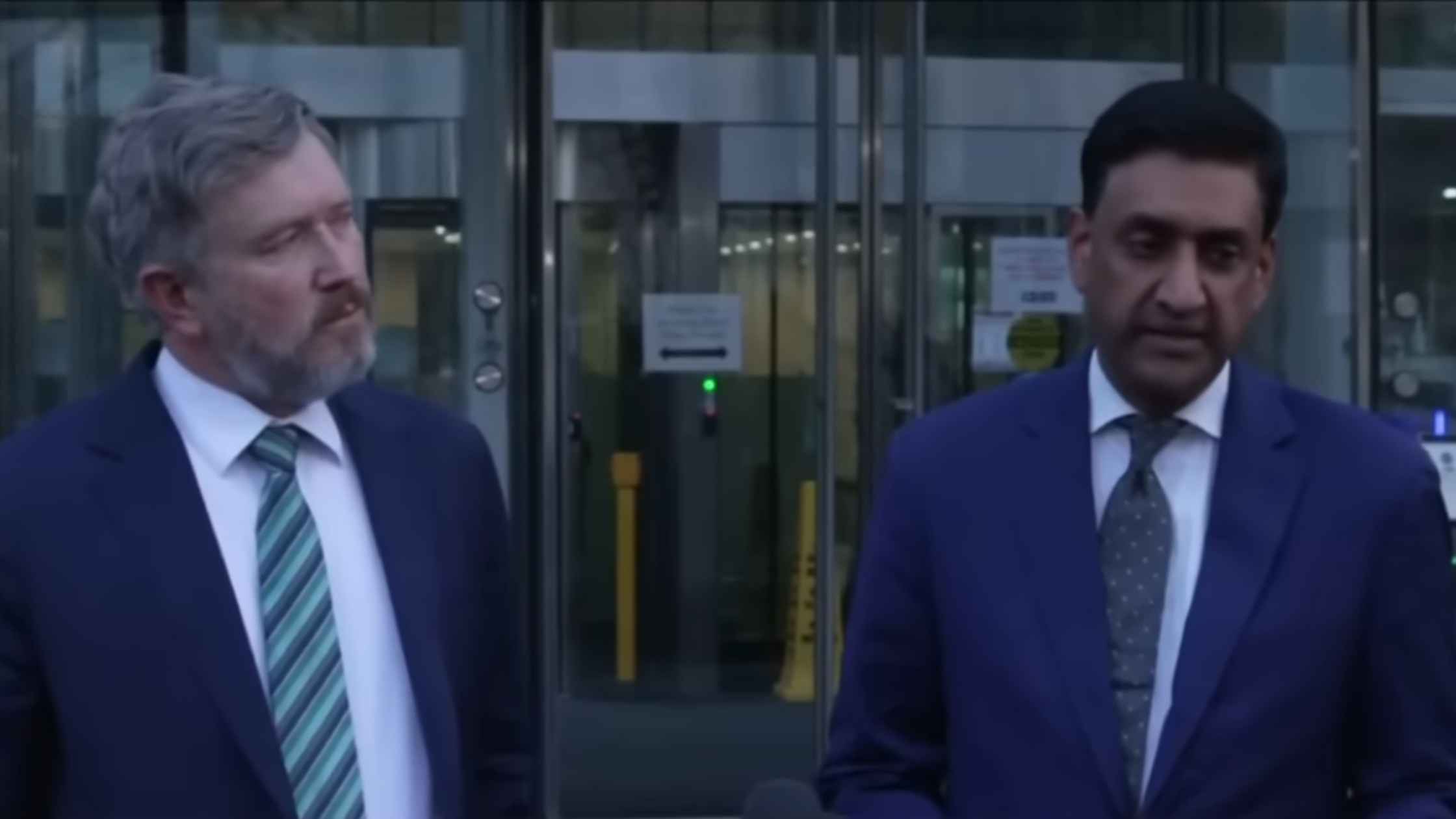
Speaker 1 (00:00):
Welcome to the cold.
Ro Khanna (00:02):
Yeah, sorry to keep you guys out here that long.
Thomas Massie (00:05):
Well, that was an interesting experience.
Ro Khanna (00:07):
It was.
Thomas Massie (00:08):
The user interface is a little clunky at first, but what I saw that bothered me were the names of at least six men that have been redacted that are likely incriminated by their inclusion in these files. So that's the first thing that I saw. It took some digging to find them. Then I'll let you talk about what you saw.
Ro Khanna (00:29):
Well, and we discussed that. I mean, there are six men, some of them with their photographs that have been redacted, and there's no explanation why those people were redacted. And Thomas discovered it through his MIT logic on some of the searches, but that's really concerning. I think there are two other points. One is some of the internet concern about some of the more sensational emails. I mean, I do think it's important to recognize that some of the senders on that are women. And so some of the redactions may be appropriate, some may not be appropriate. We need to look at that. But just because there's an email out there, it doesn't mean that there's necessarily an improper redaction. The bigger concern is these six individuals. I will say that the staff was very professional in allowing us to do the searches. Our bigger concern is that there's still a lot that's redacted.
(01:27)
Even in what we're seeing, we're seeing redacted versions. I thought we were supposed to see the unredacted versions. And that's because the documents produced to justice from the FBI, from the grand jury was redacted when they got it. So we kept doing the searches for the unredacted information. It's the identical redactions that they have. Now, I don't think that's nefarious on the career attorneys that were reviewing it, but they obviously haven't gotten the production because our law says that the FBI and the original grand jury needs to be unredacted.
Thomas Massie (02:03):
Right. The US attorneys and the FBI are compelled as well as the DOJ. And the DOJ was responsible for this document production. And they just produced documents that have been given to them from the FBI, the 302 forms, for instance, which need to be unredacted. There was one other thing that definitely needs to be addressed. Some of these files have been taken down, like the DOJ produced them, and for some reason they took them down. Maybe they decided that victim's names were in there and that they needed further redactions. But those documents not only haven't been put back up on the site with the appropriate redactions, they were not available to us to search. As far as I could tell, we couldn't search the documents that had been taken off the internet.
Speaker 4 (02:49):
Can you share with us the names of the six men that you identified?
Thomas Massie (02:53):
I probably should do that from the floor or in a committee hearing.
Ro Khanna (02:59):
And look, they should be releasing these documents. We have many avenues where we can compel that legally. Maybe they've done it out of oversight. I don't know. I don't believe that, but they should be releasing those documents, and our hope is to get them to do that. And then in some of the redactions, they need to be very careful on whether that was a survivor or not. Just because, for example, someone is female doesn't necessarily mean they're survivors. And it seemed like they blanket redacted anyone who was a female from my review.
Thomas Massie (03:34):
Yeah. I would like to give the DOJ a chance to say they made a mistake and over-redacted and let them unredact those men's names. That would probably be the best way to do it.
Speaker 4 (03:46):
So how much of the redactions... You said that the documents, some of what you saw in there, had redactions. How much new information, then, did you see that was unredacted, or did it look pretty similar to what we've seen publicly?
Thomas Massie (04:03):
I mean, what we're after is the men who Jeffrey Epstein trafficked, women too. We want those names published. We're not out to embarrass people. And the problem is we went in there hoping to see that in 302 forms. What we found out is those 302 forms were redacted before they got to the DOJ. But our legislation directs the FBI, which is the agency that produced those 302 forms, to also produce these documents. The Attorney General is ultimately responsible for that production. So that's why we're here at the DOJ to view these files, but there needs to be more information given in those 302s. So I was disappointed we didn't find that. But it's also clear, just sort of as a check, checking their homework, that they need to do a little more homework. There are six men; we went in there for two hours. There's millions of files, right? And in a couple of hours, we found six men whose names have been redacted, who are implicated in the way that the files are presented.
Speaker 5 (05:10):
What's your message to Pam Bondi after what you saw today?
Thomas Massie (05:15):
They need to do a little more work. And I would like... I mean, we'll see her at the judiciary committee here in a couple of days.
Ro Khanna (05:23):
At the very least, these six men, maybe she can make public. I mean, we're happy to provide the information to them, and they should do that. Look, there's some of the effort... Because there were a lot of career attorneys on that. There's some redactions that were appropriate, some to protect the survivors. And some of the most sensational things out on the internet, there may have been appropriate redactions. So for Thomas and me, it's always been about the facts. And our biggest concern is what was redacted before it even came to the Justice Department. I mean, the reality is that the most important things, the 302 files and some of the information on the prosecution memos, it's unclear that those redactions happened here. We saw a lot of files that already were redacted. And then, of course, they have been protecting some of these men. Maybe it was not intentionally, but the law is very clear. They need to comply with the law.
Thomas Massie (06:21):
And finally, the documents that they put up and decided for one reason or another, they had to take back down. I was hoping to see those here. They didn't appear to be in the database that we were able to search. Those ostensibly are wholly redacted files now. We know they exist. They published them for a brief period of time and pulled them back. They need to answer to us as to do they intend to redact those files and put them back up and put them in the database so that we can search them and see if it was appropriate to take them back down from the website.
Speaker 5 (06:54):
Are these men US citizens? What fields do they work in? Is it finance? Is it political?
Thomas Massie (07:00):
At least one is a US citizen. At least one is a foreigner, and the other three or four have names. I'm not sure if they're foreign or US.
Speaker 5 (07:11):
And which field do they work in? Is it finance, banking, political?
Thomas Massie (07:16):
One is pretty high up in a foreign government.
Ro Khanna (07:18):
And some are... One of the others is a pretty prominent individual. But I think that the point is that these six are just what we found in two hours of a review of the files that aren't redacted. The broader issue is why so many of the files they're getting are redacted in the first place. And until that becomes unredacted, the main things that they're sending to the career attorneys to review, I don't think we're going to have full compliance with the law to get to the question that most Americans want to know. Who were the rich and powerful people who went to this island? Did they rape underage girls? Did they know that underage girls were being paraded around? And after seeing this, I don't blame the US attorneys, the assistant US attorneys reviewing it. If they're reviewing redacted material, what are they supposed to do? But they're getting, it seems like, material that's already been redacted.
Speaker 4 (08:10):
Congressman Raskin also viewed these materials earlier. He said that he saw President Trump's name redacted. He saw Les Wexner's name redacted. Did you see President Trump's name redacted and Les Wexner's name redacted? Can you share anything about that?
Thomas Massie (08:23):
I didn't put Donald Trump in the search engine, so I couldn't tell you.
Speaker 4 (08:26):
Why not?
Speaker 6 (08:28):
Did you see who wrote the email about the little girl who was "a little naughty"?
Thomas Massie (08:34):
I did, and that was a woman that wrote that, and so it may be proper to redact it, and it may not be. I don't know. It seems like part of their algorithm for redaction was just to redact every woman in there, pretty much.
Ro Khanna (08:48):
Yeah.
Thomas Massie (08:48):
So we can't parse if the person who sent that was a victim or not.
Ro Khanna (08:55):
None of this is designed to be a witch hunt. Just because someone may be in the files doesn't mean that they're guilty, but there are very powerful people who raped these underage girls. It wasn't just Epstein and Maxwell, or showed up to the island or showed up to the ranch or showed up to the home knowing underage girls were being paraded around. And some of the sickening stuff in there about the violence. And what we want to do is have the investigation to get to those people to answer those questions. And not to say that every internet rumor about some email is going to be true. And like I said, in some of the cases, the redactions may have been appropriate. But for Thomas and me, it's never been about getting Donald Trump or getting Bill Clinton or scoring political points or trying to destroy people's reputations. It's about actually getting justice for these survivors.
Speaker 7 (09:51):
Do you plan to read the six names on the house floor?
Thomas Massie (09:54):
I think we need to give the DOJ a chance to go back through and correct their mistakes.
Speaker 8 (10:01):
How long do they have to unredact these files?
Thomas Massie (10:04):
They're already breaking the law. Look, they're way past the deadline. And the reason they gave for taking so much time is so they wouldn't release victims' information, but in fact, they've released all kinds of victims' information. So the problem here is not the deadline. The problem is they need to go back; they need to themselves check their own homework or have somebody else check it. And as Ro said, they need to go to the US attorneys and the FBI, who are compelled by the legislation directly to produce that material to them unredacted.
Ro Khanna (10:37):
And I think, look, we could have brought contempt or impeachment weeks ago, but our interest isn't actually getting the information out. And as a result of the strategy we've been pursuing, this is the largest release of the Epstein files in history. Now, it's not enough, but it has exposed people in the highest levels in technology, in finance, in real estate. It has exposed the establishment and monarchies in other countries. So our push is how do we expose this and have accountability, not how do we score political points or have retribution?
Speaker 9 (11:16):
What questions are you going to ask him on [inaudible 00:11:19]?
Ro Khanna (11:18):
Well, he's on the committee.
Thomas Massie (11:20):
We'll see Wednesday.
Speaker 10 (11:23):
You said a lot of the redactions were already made before the files were [inaudible 00:11:26]. Who do you suspect who made those developments?
Ro Khanna (11:29):
It seems that they were made by the FBI or they were made by attorneys and the grand jury, but the Justice Department, it seems, got some of these documents already redacted. Our law was very clear: unless something was classified, it required it to be unredacted, and they have not complied with that law. And that law needs to be complied with because that's where a lot of the information is, especially about the powerful people in this country and what their involvement was. And their involvement could have been that they were showing up at this island, knowing that there was pedophilia taking place. Their involvement could have been that they were actually engaged in raping underage girls or knowing that underage girls were being raped. We won't know until we see those files.
Speaker 11 (12:22):
What information does Ghislaine Maxwell and her lawyer, Steven, say?
Speaker 12 (12:25):
-Six men were implicated in Epstein's crimes?
Thomas Massie (12:32):
It's a list of 20. You can go... You can actually; I'll direct you to the unredacted or the redacted file. It's a list of 20 individuals, three or four. Maxwell and Epstein are on the list, and maybe one or two other people. And everybody else is redacted, and their names are redacted, but it also includes 20 pictures, 20 photographs. And they're sort of mugshots. They're not the best pictures. I'm not sure if they were mugshots or not, but there are at least three or four males in the photographs. I couldn't verify by looking at their names because they have foreign names. I couldn't verify by looking at their names that they were male until I went and looked at the photographs. By the way, in the document I'm directing you to, the photographs are redacted and their names are redacted. There is no reason in our legislation that allows them to redact the names of those men, as far as I can tell.
Ro Khanna (13:34):
Unless there are any male survivors, which seems hard to believe given this issue. But in all the women that are redacted, it's unclear if they were just actual survivors, in which case they did the appropriate thing, or whether they just, as Thomas said, had an algorithm to take out any woman's name.
Speaker 4 (13:52):
Can you confirm that Donald Trump is not on that list?
Thomas Massie (13:54):
Hold on a second. There's also an FBI form that lists people who are conspirators, and one of those is a male. It's like on an FBI form.
Ro Khanna (14:08):
Right.
Thomas Massie (14:08):
They've redacted his picture and his name on that form where they were, I guess, considering an indictment or indicting or something. I could also; I don't have the number in front of me, but I could direct you. It's a three-page EFTA file.
Speaker 13 (14:23):
[inaudible 00:14:26].
Thomas Massie (14:25):
I'm not sure if they're mugshots.
Speaker 13 (14:30):
Were authorities investigating these individuals or?
Thomas Massie (14:34):
In one instance, it was. And in the other instance, it seemed to be.
Ro Khanna (14:39):
I've got to go. I'll let Thomas...
Thomas Massie (14:41):
No, I got to go too.
Ro Khanna (14:41):
All right.
Speaker 14 (14:43):
One last question for you, Congressman Khanna. Congressman Massie has called for Commerce Secretary Howard Lutnick to face, potentially, some accountability for the connection that he has in these files. Do you support that call?
Ro Khanna (14:54):
Absolutely. Look at what's happening in Britain. You have a left government. Actually, I know Keir Starmer. I was excited when he won, and yet I believe he needs to be held accountable with what's happened with Mandelson. You have the British monarchy having to answer questions. I mean, the King of England is putting out statements, and yet in our country, we have not had that reckoning. People in power, whether they're in government, whether they're in finance, whether they're in technology, if they have been implicated in the files in morally embarrassing ways and in ways that shock the conscience, should be held accountable, and it should be regardless of party.
Speaker 14 (15:32):
So you're calling for Howard Lutnick to resign?
Ro Khanna (15:34):
I believe that Lutnick, at the very least, needs to be brought before Congress. I think, based on the evidence, he should be out of the cabinet, but I mean, people say, "Oh, you're just a Democrat saying that." No. I mean, look at how much influence he had with Epstein, and he wasn't transparent about it. But again, it's not about Lutnick, and it's not about any particular person. In this country, we have to make a decision. Are we going to allow rich and powerful people who were friends and had no problem doing business and showing up with a pedophile who was raping underage girls? Are we just going to allow them to skate? Or, like other countries, are we going to have elite accountability and have accountability for the people who did that? Most Americans believe we need accountability. Thanks.
Thomas Massie (16:21):
Thanks.
Speaker 4 (16:21):
Can you confirm that President Trump wasn't on this list?
Thomas Massie (16:23):
No, I didn't see him on that.
Speaker 15 (16:24):
Congressman Massie, in the last week, you were called on by President Trump to...