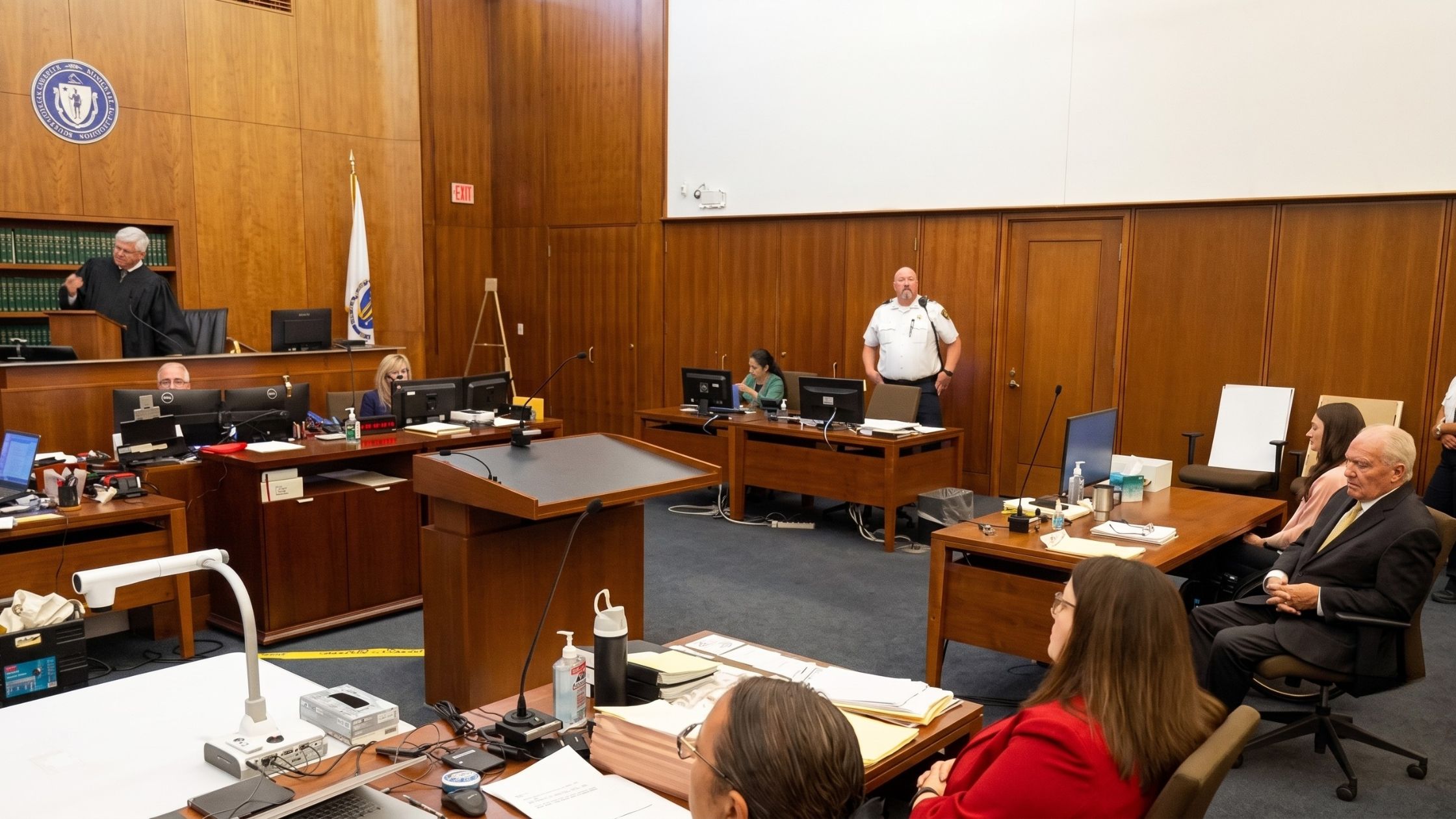
Kevin Reddington (00:00):
[inaudible 00:08:29].
Speaker 1 (00:00):
All right, counsel.
Kevin Reddington (00:00):
Yeah, yeah.
Speaker 2 (16:55):
Court, all rise. Hear ye, hear ye, hear ye. All persons having anything to do before the Honorable William Sullivan, Justice of the Superior Court now sitting in Plymouth, within and for the Commonwealth. Draw near, give your attention and you shall be heard. God save the Commonwealth of Massachusetts. This court is now in session. Please be seated.
Madam Clerk (17:13):
Good morning, Your Honor. May I proceed?
Honorable William Sullivan (17:15):
Yes, please.
Madam Clerk (17:16):
Your Honor, before the court today, we have a jury trial in the matter of Commonwealth versus Lindsay Clancy. Ms. Clancy is present. She is represented by Attorney Kevin Reddington and the Commonwealth is represented by Assistant District Attorney Jennifer Sprague and Assistant District Attorney Shannon Buckingham. Your Honor.
Kevin Reddington (18:15):
All right.
Honorable William Sullivan (18:18):
Thanks. All right. Thank you, everyone. I'm sorry that's the technology that we have here, I apologize. Before we get going, I want to ask you just a couple of questions to make sure that everyone was able to follow my instructions from last week. And so the first question would be, has any member of the jury read, seen or heard or overheard anything about any aspect of this case that would affect your ability to be fair and impartial as a juror? All right. All answered no in the negative. Number three, the last question I just want to ask, is there any other serious matter or concern bearing on your service as a juror in this case that anybody needs to bring to my attention? All right, very good. Thank you again for following those instructions. And Madam Clerk?
Madam Clerk (19:06):
Ladies and gentlemen of the jury, please stand and raise your right hand. Do each of you solemnly swear that you shall well and truly try the issues between the Commonwealth and the defendant at the bar, according to your evidence, so help you God?
Jury (19:21):
I do.
(19:21)
I do.
Madam Clerk (19:22):
Thank you. You may be seated. Members of the jury, harken to these indictments. On Docket Number 2383CR00198, Offense 001 on the charge of murder, the jurors for the Commonwealth of Massachusetts on their oath present that Lindsay M. Clancy of Duxbury in the county of Plymouth on or about January 24th, 2023 at Duxbury in the county of Plymouth did assault and beat Cora Clancy, intend to murder her and by such assault and beating did kill and murder said Cora Clancy. On Docket Number 2383CR00198, Offense 002 on the charge of murder, the jurors for the Commonwealth of Massachusetts on their oath present that Lindsay M. Clancy of Duxbury in the county of Plymouth on or about January 24th, 2023 at Duxbury in the county of Plymouth did assault and beat Dawson Clancy with intent to murder him, and by such assault and beating, did kill and murder that said Dawson Clancy.
(20:39)
On Docket Number 2383CR0019 [inaudible 00:20:41] Offense 003 on the charge of murder, the jurors for the Commonwealth of Massachusetts on their oath present that Lindsay M. Clancy of Duxbury in the county of Plymouth on or about January 24th, 2023 at Duxbury in the county of Plymouth did assault and beat Callan Clancy, intend to murder him, and by such assault and beating, did kill and murder the said Callan Clancy. To these indictments, the defendant at the bar pleads not guilty and for trial places herself upon the country, which country you are. You were sworn to try the issues. If she is guilty, you shall say so. If she is not guilty, you shall say so and no more. Members of the jury, hearken to your evidence.
Honorable William Sullivan (21:32):
All right. Thank you, Madam Clerk. Now, members of the jury, and really this is the first time I can technically call you members of the jury because you don't become the jury in this case. So you take that great oath that was just given. And that's an oath that has been given to jurors for hundreds of years here in the Commonwealth of Massachusetts where you've sworn to well and truly try this case. We have confidence that you're going to be able to do that. And so what I'm going to do at this point is I'm going to give what we call a pre-charge, right? And all that really is an orientation to you to the procedures that we're going to have as the case goes forward and go over some of the terminology that you might hear to give you a little bit of an idea what some of the principles of the law are that you'll have to apply to the facts as you find them.
(22:24)
So as we go through this, just again, I'm going to explain it, and then after that, we're then going to go right into the opening statements of counsel, all right? So first, as you know, this is a criminal case and the defendant was charged by the way of an indictment on three counts, right? Now, you have to understand that an indictment is not itself any evidence of the defendant's guilt, whatsoever. It's merely the formal way of accusing a person of a crime in order to bring her here to this courtroom for trial. You are not to draw any inference of guilt from the indictments or from the fact that she was indicted and formally charged.
(23:07)
Now, in every criminal case, the defendant is presumed to be innocent unless and until she's proven guilty beyond a reasonable doubt. The law requires the Commonwealth, that is the prosecution, to prove that the defendant is guilty beyond a reasonable doubt. The law does not require the defendant to prove her innocence or to produce any evidence. At the end of this trial, you must find the defendant not guilty unless the Commonwealth has proved to you beyond a reasonable doubt that the defendant has committed each or any of the offenses with which she's charged.
(23:42)
Now, I'll more formally instruct you on what reasonable doubt is later. But a charge is proved beyond a reasonable doubt, if after you've compared and considered all the evidence, you have in your minds an abiding conviction to a moral certainty that the charge is true. It's going to be your duty, the duty of the jury, to determine whether the Commonwealth has proved its case against the defendant beyond a reasonable doubt. And that decision has to be based only on the evidence and the law that's presented here in the courtroom during the trial of this case.
(24:15)
Now, the defendant has been charged in three counts of murder. There are two different degrees of murder. There's murder in the first degree and murder in the second degree. If you find the defendant guilty of murder, you shall decide the degree of murder. The Commonwealth alleges that the defendant committed murder in the first degree on the following theories. Murder with deliberate premeditation and/or murder with extreme atrocity or cruelty. Now, to prove the defendant guilty of any crime, the Commonwealth must prove beyond a reasonable doubt that the defendant was criminally responsible at the time the alleged crime was committed.
(24:57)
The Commonwealth bears the burden of proving beyond a reasonable doubt that the defendant committed the crime with which she's charged and also that the defendant is criminally responsible for her conduct. The defendant has no burden to prove a lack of criminal responsibility. Criminal responsibility is a legal term. A person is not criminally responsible for her conduct if she has a mental disease or defect, and as a result of that mental disease or defect, lacks the substantial capacity either to appreciate the criminality or the wrongfulness of her conduct or to conform her conduct to the requirements of the law.
(25:38)
Now, just so you know, at the end of this trial, I will go over all of those legal principles in much greater detail, all right? So I just wanted to give you a little bit of an outline of what the law is on these charges. Now, I want to go over how the trial is going to proceed. So that, as soon as I'm done giving you this pre-charge, the attorneys for the Commonwealth and the defendant will have an opportunity to present their opening statements. The Commonwealth goes first. The Assistant District Attorney will make her opening for the Commonwealth. And after that, the defense may choose to make an opening statement at that time.
(26:18)
They could defer to give it later in the trial or they could just not give an opening at all, because you remember, the burden of proof is not on the defendant, all right? After the opening statements ... One thing I did want to tell you, the opening statements are very important, but they are not evidence, all right? They're really, at least to call it when I was a lawyer, just roadmaps. So you could see where the case is going. So you can see what each party's position is, all right? But they're not evidence and it's important for you to keep that in mind. After the opening statements, the Commonwealth will then have their opportunity to introduce evidence in support of the charges.
(27:01)
After that, the defendant may present evidence in her behalf if she wishes to, but she's not obligated to do so at all. Remember, the government, the Commonwealth, has the burden of proof and the defendant doesn't have to produce any evidence, whatsoever. Now, there also in this case may be some rebuttal evidence. And we'll go over that, how that works in regards to the case when we get to that point, all right. Now, what is the evidence? Well, the evidence is generally from testimony. This is where the witnesses will testify from generally here. There may be some documents. There may be some videos. There may be some audios.
(27:45)
And in addition to the evidence, we're going to take what we call a view. And a view, and I'll go over that again also a little bit later, but a view is we're just going to go to a number of spots and sites that may be relevant in this case. We're going to do that probably sometime either later this week or sometime next week. And I'll keep you advised as to that, so you can check the weather and how we're going to go. So that would be generally the evidence. After the evidence is done, we'll go into what they call the closing arguments of the attorneys. Again very important, but not evidence, all right?
(28:23)
And then after the closing arguments, I get to come talk to you again. And at that point, I give what they call the judge's charge or just the instructions. And really what it means, I'm just going to explain to you what the law is. And you're going to have to take the facts that you find during the course of this trial and apply the law that I give to you to arrive at the verdict. And I'll explain what the law is. Believe me, much more detailed at the end of this trial, okay? Now, I just wanted to go over everybody's function in this trial as we go forward. My function is pretty simple, all right?
(29:01)
My function is to see that the case is tried in a way that's orderly, fair and efficient. It's also my function to decide on questions of law that might come up during the trial, and as I said, to instruct you what the law is that you have to apply. And it's your duty as jurors to accept the law, as I stated to you, all right? Well, what's your function? Well, your function is to determine the facts in this case. You are the sole and exclusive judges of the facts. You alone will determine what evidence to believe, how important any evidence is that you do believe, and what conclusions all the believable evidence leads you to.
(29:41)
You are going to have to consider and weigh the testimony of each and all the witnesses who will appear before you and you alone will determine whether to believe any witness and what extent to which you do believe that witness. It's going to be your responsibility to resolve any conflicts and testimony that might arise during the course of the trial and it's your duty to determine where the truth lies, all right? That's your function. Now, you should ... I want to comment. I'm going to sometimes be making rulings on objections and evidence issues. I'll be talking to the attorneys and talking sometimes to witnesses.
(30:21)
Don't try to read into what I'm doing. In other words, I have no opinion as to what your verdict should be, all right? So if you think you are, you're trying to read between the lines, don't, all right? I have no opinion. Now, also during the course of the trial, you may hear either the three lawyers objecting, all right? Don't hold that against the attorneys. That's their job, all right? And generally, the objections go towards the admissibility of some of the evidence or the questioning. It might be a different form that's needed and that's what they're supposed to do. So don't hold it against either side if they're making objections.
(31:05)
And what'll happen is sometimes I'll just rule right from here where I'm sitting. It may be an objection. If I say, "Well, that's sustained," that means I agree with the objection. And a lot of times the question is just asked a different way. If I say overruled, just means I disagree with the objection and the question can go forward and the answer can be given, all right? So that's just the shorthand we use. There's going to be times during the course of a trial that I have to talk to counsel over at sidebar. When I say sidebar at this point, that's going to be over here, all right?
(31:38)
In this courtroom, this is the sidebar. And so a lot of times I'll have to talk to counsel over here because the law requires me sometimes to make decisions outside of your hearing, all right? So we do that over here. It can be annoying. I know that. But we do it over here because it's actually quicker than if we ask you to leave the courtroom because you've now seen, you'd have to stand up, file out one by one, all the way down to the jury room. The court officer then says, "They're all in the jury room." Then I talk to the lawyers, then we resolve that. You have to then file all the way back. So we found it's quicker. And so a lot of times those things really move a case along.
(32:18)
So I apologize if we're doing them, but that's the reason we do it. And that's the reason why we do it in the courtroom. If we're doing a sidebar conference, if anybody needs to stand up, stretch, you have a bad back, those are pretty comfortable chairs, but maybe sitting there for a while, by all means, do that. But when we're over here at sidebar, don't discuss with any of the other jurors what's going on or what you think's going on over here, all right? So if you just want to stretch, you can. Now, if during the course of this trial, anybody needs to communicate with me about anything, just let the court officer know and they'll let me know and I'll talk to the attorneys and we'll deal with any of your concerns or any issues.
(33:02)
Now, until this case is submitted to you after my final instructions, you must not discuss it with anyone, even your fellow jurors or your family, friends, employees, all right? So it's important that you keep an open mind and not decide this case in any way until the entire case has been submitted to you, all right? And that sounds easy at this point because you haven't heard anything, but as the case gets going, it gets harder and harder sometimes, even in the jury room. You can't start deliberating until you hear all the evidence. You can't start talking about until you hear all the evidence, until you know the law that you got to apply, all right?
(33:41)
We're going to allow you as the case goes forward to take notes, all right? And so anybody who wants to take notes, you can. You don't have to. Some people find it helpful to remember. Some people find it distracting. So it's up to you. That's your option, all right? You should know that those notes are your notes. By that, we can't let you take them home, but at the end of each day, they're collected. They're put in a secure place. Nobody reads them. I don't read them. The attorneys don't read them. Nobody reads them. At the end of the trial, they're destroyed, okay? But just some people, if you want to do it, we'll hand those out in a couple of minutes.
(34:23)
Now, I want to just kind of go over just some cautions as we're getting ready to start this trial, all right? First is, as I said already, please keep an open mind. Don't form any judgments or conclusions or views as to any aspect of this case. You haven't heard all the evidence and you must keep an open mind throughout this case and until the case is given to you in your deliberations. Two, as I said, don't talk about this case, about any aspect of the case with family, friends, acquaintances or anybody like that. Three, don't talk to any of the witnesses or parties or attorneys involved in this case. They-
Honorable William Sullivan (35:00):
Any of the witnesses or parties or attorneys involved in this case, they've been instructed not to talk to you. We really want you to be comfortable. All right. And so, if you do pass by one of the people involved in the case, if they go by you and don't say anything to you, don't hold it against them. Don't think they're not being respectful. They're following my instructions. We just want you to be comfortable throughout the course of this trial.
(35:25)
Now, another caution is during the time that you serve on this jury, there may be reports about this case in newspapers or social media or on the television. You may be tempted to look or listen. Don't do it. All right. My instruction to you is do not read anything about this case. Don't listen to anything about this case. If something comes on, turn it off. Or if somebody starts talking about it, just say you can't talk about it and you can blame me. That's my instruction. All right.
(35:57)
Now, sometimes during the course of a trial, evidence is presented that produces an emotional reaction, and that might happen in this case. But as jurors who have taken the oath to follow the law, I'm instructing you that the law says you must separate any emotional reaction on your part from the informational value and weight of the evidence. You must find the facts in this case based only on the evidence. All right. I may go into that a little bit later, but I just wanted to remind you of that in regards to that.
(36:36)
Don't do any research on this case. All right. If you have any questions about things as you go forward, you're not to do any independent research. As I said before, we've got three very, very experienced lawyers. They'll get you the information that you're going to need to come to the right verdict. All right. You can't do any research. The other thing is don't visit the scene of any place that's described during the course of the testimony. So, no field trips. All right.
(37:12)
As I said, we very well may be taking a view or to go see some of these places later on in the trial, but that's the only time you should be there, because at that point you'll be under the supervision of the court officers, the court, the attorneys will be there. So, that's the only time you're going to be allowed to do that. Now, I think the reason for all of these cautions is probably pretty clear, but it's just we need to ensure that a fair and just trial is given to all the parties in this case. So, if you follow those instructions, you'll be able to do that.
(37:49)
In regards to the schedule, as I told you, what we're generally going to do is go start at 9:00. We're going to go to 11:00. We might be off kilter a little bit today, because of this part of the procedures. Go to 11:00, then we'll go till 1:00. There'll be a break from 1:00 to 2:00. And we'll generally go 2:00 to 3:30 or 4:00. All right. Now, after saying that, as I told you, I think everybody, this is a case that we may not be sitting every day. All right. And we may have to break early on certain days.
(38:25)
So, what I'm going to try and do, as best I can, is give you as much notice and explain to you where we are as we go through the case. So, that being said, we're not sitting tomorrow. All right. Something's come up that has nothing to do with any of the participants, but we can't sit. So, the thought would be we'll hopefully go most of the day today, and then Wednesday, Thursday, Friday. All right. As the week goes on, then I'll address you about how it looks for the next week. All right. And we'll try as best we can to keep you up to date in regards to the schedule and also the progress that we're making on this case. All right.
(39:08)
So, that's pretty much what I wanted to address you in this pre-charge. These instructions are very preliminary. They're intended, as I said, just to acquaint you with the procedure and the framework of how this case is going to go forward. I'm going to talk to you later on in the trial in a much more detailed explanation of what the law is and what your obligations are. But I know, I know that you're going to try this case according to the oath that we talked about, that you took as jurors where you promise you would well and truly try the issues between the defendant and the Commonwealth according to the evidence and the law.
(39:50)
If you follow that oath and try this case without fear or prejudice or bias or sympathy, you'll arrive at a true and just verdict. I'm confident of that. And also have confidence in yourself. All right. You can do this. The lawyers and I asked a number of questions and we all decided and chose that you would be the people who could make this decision. So, everyone has confidence in you. You should have confidence in yourself in regards to sitting on this jury and delivering the just verdict on this.
(40:25)
So, at this point, I'm going to now see if the Commonwealth is prepared to give their opening statements. Commonwealth. Ms. Buckingham? Sorry.
Madam Clerk (40:34):
Thank you, Your Honor. Morning, ladies and gentlemen. Cora, she had just turned five. She was sweet, silly, smart. She loved sparkly dresses and wearing bows in her hair. She loved princesses and baby dolls. She even tried to convince her preschool teachers at the beginning that her name was Sophia because she loved the Disney character, Sophia the First, so very much. Dawson, he was three. A boy's boy. He was a bit rambunctious, but funny, full of energy. He loved trucks, construction trucks, fire trucks, and he spoke with a raspy little voice. Callan, Callan was just eight months old. Always smiling with chunky cheeks. A sweet little baby.
(41:47)
We are here, ladies and gentlemen, because they are not. They were strangled, deliberately and meticulously killed by this defendant on January 24th of 2023. One by one, she wrapped exercise bands around each one of the kids' necks and pulled until their little bodies were limp and lifeless. First Dawson, then Cora, and finally Callan. Your job, ladies and gentlemen, is not easy in this case. The evidence will be difficult to see, to hear, to process. Testimony of witnesses, family, friends, teachers, people who knew the Clancy family, people who saw them regularly, people who saw them on the day in which this defendant killed them. They're all going to come before you. And it may be heartbreaking to hear what they have to say.
(42:56)
You'll see photographs of the crime scene. You'll hear testimony from first responders. They're going to tell you about what they discovered when they came into the Clancy home at 47 Summer Street in Duxbury on January 24th. You'll hear evidence about the defendant during that time period, observations of her physical appearance, her demeanor. You'll hear testimony about what she was reporting to her friends and family and doctors during this time period. The list of witnesses is quite long. Law enforcement, firefighters, friends, family, teachers, crime scene investigators, forensic scientists, toxicologists, medical examiners, experts.
(43:44)
We expect over the next few weeks that you'll be able to or will be able to present to you a clear picture of what was occurring in the Clancy household on January 24th of 2023. We ask that you keep an open mind when you're hearing this evidence. And during the course of the trial, don't forget that you use your common sense and your life experience. Those are things that you bring as jurors to the courtroom every day, and it's what's going to take you into the deliberation room at the end of this trial.
(44:15)
So, what happened? On January 24th, 2023, it had recently snowed. It was in fact a Tuesday. Tuesdays were days that Cora and Dawson usually went to preschool. They attended the Learning Sprouts Preschool in Duxbury, but they didn't attend on Tuesdays. So, on this day, they were home. On this particular day, Cora, who had just turned five, had an appointment at the doctor's, an annual checkup. And so, the defendant brought her first thing in the morning to the doctor's.
(44:53)
Defendant's husband, Patrick Clancy, was home and he was caring for Callan and Dawson while defendant took Cora to the doctor. Pretty normal. You'll hear and see that Patrick and the defendant exchanged text messages that morning. Patrick sends a photo of Dawson who had just dressed himself that day and he was jumping for joy. And he sends that text to the defendant while she's at the doctor. And while at the doctor, the defendant sends a text of Cora and her little Johnny and mask to Patrick.
(45:27)
When the defendant and Cora returned home that morning, Patrick went downstairs to his basement office to do work. They made it as he had normally done on any other day since returning from paternity leave. And then the defendant was charged caring for the kids for the rest of the day. She put Callan down for a nap, bundled up Cora and Dawson, took them outside to the backyard and played in the snow. They built a snowman. The defendant sent pictures of the snowman and the kids in the snow to Patrick when he's working in the basement and her mom who was living in Connecticut, who had just been there that weekend, but had gone home. The day proceeds as normal.
(46:11)
You'll hear Patrick describe it as a good day, actually. In the late afternoon around 4:00 p.m., the defendant searched on her phone for kids' MiraLAX. She searched Takeout ThreeV and she opened the Apple Maps on her phone and searched the route that it would take to get from their house to the ThreeV Restaurant in Plymouth. She searched how much time and how far it was. Now, this restaurant had been a place that the family had eaten before, but wasn't their normal takeout spot.
(46:47)
She also called CVS and asked them about the kids' Pedia-Lax or MiraLAX. And that's because at the doctor earlier that day, the doctor had recommended a laxative for Cora, because she had some stomach issues. She had complained of an upset tummy at school the day before. You'll hear she had some issues where she didn't like to go to the bathroom at school, a little bit embarrassed. So, they suggested the Pedia-Lax. So, she calls CVS and she confirms that they actually have it at their local CVS in Kingston.
(47:21)
Then she sends a text to Patrick and asks if he wants to get takeout, if ThreeV is okay. She didn't feel like cooking dinner. It was a long day. He says, "Sure." She calls in the order. When Patrick leaves the house around 5:15 that evening, everything is normal. Seems normal. He sees Dawson eating chicken nuggets and green beans on the couch before he walks out the door. Patrick leaves to go to ThreeV and he's going to stop at CVS on the way there. That's when the clock starts, ladies and gentlemen.
(48:02)
The defendant knows that Patrick has to stop at CVS, go to ThreeV. She knows that it's about five miles from their house to get to the restaurant. She knows it's approximately how much time she has for him to go there and come back. She then takes the children down into the basement. She separates Dawson from Cora and Callan. And then she proceeds to wrap exercise bands around each child's neck and pull until they're dead. He leaves the bands wrapped around each child's neck and goes back upstairs.
(48:39)
In the kitchen, she gets a knife and then she proceeds to the second floor of the home. In the middle of this, she misses a call from Patrick. He's at CVS. He misses the call. She calls him right back and they talk for 14 seconds. Nothing that she does or says in that phone call is of concern to Patrick. He proceeds on his task and she proceeds with hers. She goes to the second floor master bedroom, locks the door, crushes up some pills and attempts to take her own life. She uses the knife she got in the kitchen to slash her wrists and her neck. She moves the bed away from the wall, away from the window. She opens that window and goes out. She lands on the cold, hard ground.
(49:34)
Shortly thereafter, around 6:00 p.m., Patrick comes home. He's got the takeout bag and the CVS bag with the medicine. He enters into the house through the mudroom door into the kitchen area, places the bags down. Eerily quiet. He calls to the kids. No answer. He calls to the defendant. No answer. He takes out his phone and dials the number for Lindsay's phone, defendant's phone. No answer. He then goes upstairs and finds the master bedroom door locked. He opens it and enters the room, sees blood and the window open.
(50:16)
He then goes to the backyard and that's where he finds the defendant. He's on the ground outside that window moaning and mumbling. At 6:11 p.m., he calls 911 for help. First responders arrive to the home almost immediately. He's still on the phone with 911 when the responders arrive and they go right to the backyard and tend immediately to the defendant. While they're with the defendant, Patrick tells the first responders, "I need to find my kids."
(50:49)
He had asked the defendant where the kids were and she told them they were in the basement. So, when he went in the house, that's the first place he went, down into the basement. He's still on the phone with 911 when he finds each child with an exercise band still wrapped around their neck. He screams for help. And he says, "She killed the kids." Efforts made to resuscitate Cora and Dawson were futile, but first responders from Duxbury and the surrounding communities were persistent and they kept trying to resuscitate them all the way to the hospital. But when they arrived at the hospital, there was nothing more that medical staff could do for Cora and Dawson.
(51:36)
The staff at Beth Israel were able to get a heartbeat on Callan, but he never started breathing on his own. He never regained consciousness. He had no brain activity. Nonetheless, he was transferred to Boston Children's Hospital where he died three days later on January 27th. The defendant was taken to South Shore Hospital and then transported subsequently to Brigham and Women's in Boston. She had multiple traumas, including spinal injuries, as well as superficial injuries to both her wrists and her neck. She is paralyzed.
(52:16)
We expect during the course of this trial that you'll hear that the defendant made claims that either right after Patrick left the house or after he called her from the CVS, depending on which version of the events she's telling, she heard a voice. A male voice. A voice that she had never heard before, a voice that she never heard again. And that voice told her that it was her last chance that she had to kill the kids so that she could kill herself. She immediately took action when she heard the voice with no direction or details from the so-called voice. And she killed the children. Once she killed the children, the voice stopped.
(53:06)
When you consider this information in the course of the trial, ladies and gentlemen, I ask that you consider the source, the timing, the substance of her statements about this voice. You're also going to hear from, or you may hear from forensic psychologists and psychiatrists who talk about what's called command hallucinations and voices that people hear before they do something. And when you hear that testimony, I ask that you keep in mind the details of what she's saying the voice told her and the details of when this voice spoke to her.
(53:42)
Another important thing to remember throughout the course of this trial is that this is not a case about the Lindsay Clancy that sits before you today. This case is about the Lindsay Clancy on January 24th, 2023 at the time of the crimes. This was not a woman in the throes of psychosis on January 24th, 2023. This was a woman who acted intentionally, rationally, and swiftly to accomplish a very specific goal, to kill.
(54:18)
You'll see and hear evidence about all the things that she did that day, what she did in the days leading up to this incident, leading to the murders. You'll hear her spending time with her family and friends. You'll hear her appearing to be in good spirits and doing better for all intents and purposes. On that very day, you'll hear she interacted with people at the doctor's office. She came home and took care of the kids. She talked to people on the phone via text message. The evidence will show you she was not psychotic that day.
(54:56)
Throughout the evidence in this trial, you will learn about the defendant being the classic overachiever in school, in her personal life, in her nursing career. She was someone who liked to control every little detail of her life, of her family's life. In contrast to pictures you'll see of the doting mother, the dedicated nurse, you'll also see a side of Lindsay Clancy that's different. Somebody extremely controlling, meticulous and manipulative.
(55:34)
The days were laid out with specificity. Strict schedules were expected to be maintained. Food was planned carefully. Sleep was scheduled to the minute. And in the time after Callan was born, her last baby, the family had to adjust. And by all sources that I expect you're going to hear at that trial, that summer was great. But after Patrick had finished his paternity leave and was back to work full-time, when she no longer had a nanny to watch the baby do laundry, tidy up the house, follow her schedule, when she was responsible for it all, it was hard. It was hard for her to maintain that control. It was hard for her to bond with her kids.
(56:21)
And in efforts to maintain control, she withheld information from her husband, from her doctors. She reported serious symptoms that were inconsistent with her daily activities you'll hear. And ultimately, on January 24th, 2023, the defendant made a calculated decision. This was a woman who no longer liked the life she thought she wanted. It was getting harder and harder to control. And when she saw the opportunity to escape, she made the selfish choice to take it, and to take Cora, Dawson and Callan first before attempting to take her own life.
(57:06)
Ladies and gentlemen, this is not a public debate about women's mental health and how the medical system treats women. This case is about this defendant, Lindsay Clancy. There is no dispute that she was dealing with mental health issues during this time period prior to the murders. There'll be medical records, medical doctors, mental health professionals that will talk about treatment, prescriptions, hospital visits. All that's going to be before you.
(57:37)
The evidence will show that this defendant had a means and access to mental health that most people don't. And she chose to deal with her mental health issues in the worst way. She chose to manipulate her providers, seek out the quick and easy fix when she was feeling depressed and anxious. And when she didn't get what she expected, she chose an alternate route. She sought a different doctor. She changed medications after days. She disengaged from treatment when she didn't like the plan.
(58:15)
After only four months in treatment, she made a choice, a deliberate and intentional decision that she did not want to try anymore. And because no one could take care of her kids the way she wanted them to, she had to take them with her. Despite all the precision that she exhibited that day, you'll hear the timing of it all, the swiftness of the killings, overcoming the interruption of Patrick's phone call. What she did not anticipate was that she would not be able to complete the act by killing herself.
(58:55)
Ladies and gentlemen, people with mental illness commit crimes every day and are responsible for them. The fact that someone may suffer or have a mental illness, a mental disease or defect is not the end of the inquiry when it comes to guilt or innocence. It is whether a person can appreciate the wrongfulness or criminality of the conduct and conform their conduct to the law. Do they know what they were doing? And can they control their actions?
(59:26)
The evidence in this case will prove beyond a reasonable doubt that this defendant coldly and efficiently executed, first, Dawson, then Cora, and finally Callan. One by one, she strangled the life out of each one of them. She did so with no hesitation, with deliberate premeditation and extreme atrocity and cruelty. She is criminally responsible for the murders, because the evidence will prove to you that she knew exactly what she was doing. She drew her husband out of the house, their father, so that she had the opportunity and the time to carry out these murders. She maintained the ability to control her conduct, conform her conduct when she attempted to kill herself to escape the consequences.
(01:00:18)
At the conclusion of this case, we're going to come back and we're going to ask that you return guilty of the murders of Cora Clancy, Dawson Clancy and Callan Clancy, because the defendant committed those crimes.
Honorable William Sullivan (01:00:36):
All right. Thank you, Counsel. Mr. Reddington, do you wish to give an opening?
Mr. Reddington (01:00:40):
I do. Your Honor, I might use the easel. May I be placed in front of the TV screen so that the jurors are able to [inaudible 01:01:37]. Normally, we thank jurors for time away from your life, jobs, your family. Coming to court, listening to a trial certainly is a service that's provided by you as citizens. But in this case, God bless you, you people are going to have to listen to some of the most horrific things. Look at some of the most horrific things.
(01:02:15)
In jurors, it's a beautiful system. You pass between, as you've heard [inaudible 01:02:24] say, you probably don't remember it, but it's all language goes back to old England. Says that you as jurors pass between the government, them. And she places herself on her country, which country you are. You owe allegiance to nothing, but your oath, your consideration and your time, your common sense. You bring your life experience to this trial. You render a verdict.
(01:03:04)
And as jurors, experiences, take the job very, very, very seriously. You people will never forget this case. And thank you for that service. Government says that this is a situation, it's not a referendum on women's having babies and having postpartum psychosis, postpartum depression, but it sure as hell is. Because you're going to hear consistent with what his Honor told you in the instructions, consistent with the obligation that the government has when they brought this charge. They brought this charge. Him, Cruz, the DA right in the front row brought this charge.
(01:03:59)
He knew, as did his office, the facts of this case. And he knew when he brought this charge that it was going to kill the soul of this young woman. And they would bring their evidence in front of a jury that she knows that she killed these children. We'll sit here and listen to their evidence, but I suggest to you that the issue of consideration is what was going on in that woman's mind. You're going to hear evidence that, as the government said, Lindsay was a kind of a parent-pleaser. She was a person that in school had a lot of friends, still has friends. You'll hear evidence to this day from the sixth grade, high school, college, nursing school.
(01:04:54)
You're going to hear evidence that Lindsay in the course of being in high school. She was a high-achiever gymnastics, stopped doing gymnastics because she hurt herself and didn't like to do the back flips and stuff you do in gymnastics, but she was very athletic. You can hear evidence that right after she had the birth, the last child within four or five days, she ran a 5K. She was very, very, very physically fit. Her life was such that she watched what she ate, watched what she did in her life as far as activities, and was one heck of a mother. She loved her children.
(01:05:39)
All the things that the DA said to you about those little kids and their life and what they liked, she knows 1,000 times more than what they know. And in that capacity, as a mother, daily, you'll see evidence that she would decorate rooms, that she and Patrick did have that achievement of a wonderful life. They had it all. They met in Boston. She was a young nurse out of school. He was working in his industry. They ended up falling in love. They got married, bought a nice house. People say they're living in this mansion. No. They're living in a very, very humble house in Duxbury that they had to struggle to pay for.
(01:06:35)
That house, you will see, not from the view, because it's not enough that we have photographs. On top of the photographs, we have to have a video. And on top of the photographs in the video, we have to have an auto-computerized animated display. And on top of the photographs, the video, the animated display, we have to get on a bus and go take a ride and look at the house where some guy and his wife are now living that it doesn't look at all like what it looked like when Lindsay and Patrick were living there with their three kids.
(01:07:08)
But there are videos that show what that home looked like that day, prior to that. You'll see in every room, there are things hanging on the walls, alphabets, colors, numbers, pictures of different cartoon characters. And I'm too old to even remember what they are. Movies, all sorts of toys, erector sets, trucks all over the living room. There was no dining room. It was a large thing for the baby to be in and then surrounded by toys. Every single room had toys in it.
(01:07:43)
These children were loved and nurtured and cared for by her. She didn't want to get rid of her kids because of her selfish life as the government indicates. She loved those children right up to the time of their death. You're going to see that there's photographs in this case that you will be able to evaluate that show that. Some of them might even be in the videos that the state police took. This case is a massive production by the district attorney's office.
(01:08:11)
You have the district attorneys, the assistant district attorneys, the assistants to the assistant district attorneys. You have the state police crime laboratory. You have the detectives. You have the state police, the armed men that will go out and interview witnesses and will investigate this case. You have the victim witness advocate, very nice lady by the way, that deals with witnesses and people in a case such as this. It's a massive operation. And that's great. We should have that.
(01:08:41)
But when you're considering the evidence, you consider the fact that you have two young people that were living this life, that were working. And Patrick, not because of COVID, not because of he just didn't want to work in an office anymore. He worked out of his basement. He worked in an office in the basement. He was there, because of what Lindsay was going through. He was there. He lived it. And he will testify to it. He doesn't have to testify, quite frankly, and identify clothing and be distraught and placed in a position of horror in this courtroom. But he will testify to what they went through as a husband and a wife, the wife being pregnant. They had three kids.
(01:09:36)
After the second child, she had postpartum. You're going to hear evidence that that's one of the issues that is important because that could lead to bipolar. One of the things that you don't do, which is taboo, is if you have somebody that's bipolar, you don't put them on an antidepressant, you don't put them on Zoloft, you don't put them on what's called an SSRI, selective serotonin re-uptake inhibitors. It messes with your brain. You don't do that, but it was done in this case. The reason ...
Mr. Reddington (01:10:00):
... don't do that, but it was done in this case. The reason that Lindsay went to the doctors was in September 2022. July and August of 2022, they were very happy, lovely little family. September, things went sideways. And you heard the government saying, and remember what they say in their opening, and remember that when they prepare a case and remember how they can point at different aspects of the case to show guilt, to show that somebody's conniving. In this case, how many times we heard she faked the suicide? Faked the suicide. Little cuts, dinky little cuts, scratches you'll hear stated in the opening statement or time of the arraignment that she asked for a lawyer. That's rich. You're going to hear evidence that she was in her bedroom after the horrific act in the basement and that she was up in the bedroom, that she stood in front of a full length mirror, that she took the knife, the knife that was in the kitchen, that she had taken. And when she took the knife, she cut her throat in front of the mirror. This is no fake suicide. This is her when she was brought to the hospital. When she was in the hospital, that's what her appearance was at the South Shore Hospital. When she's at the South Shore Hospital, she had wonderful care and treatment that was able against her will to save her life. Fake suicide, little scratches, dinky little scratches. This is photograph that was taken at the South Shore Hospital of her neck. Photograph taken of her wrist showing the split in the skin. Photograph showing the, you'll see evidence of this, bedroom floor next to the bed with the blood.
(01:12:33)
The knife next to the cup. Sadly, a gift saying because kids, you see the white residue inside the cup, that's where the pills were crushed up with leftover lemonade from the night before when she consumed that. That's the knife. This here you'll see is sleep aids. See this here, deep sleep pillow spray. She couldn't sleep. She couldn't sleep for months. More photographs of the injuries to her neck. And then in the course of the fake suicide speculation by the police, you'll see the evidence that she hung on the window ledge and like Spider-Man, I guess, slid down the wall of the house. You're going to hear evidence that she flung and threw herself out the window, striking her head on the ground, full ground, causing what's known as a Jefferson fracture of her neck. She shattered, exploded her thoracic spine.
(01:14:13)
Shattered her cervical spine, the first disc, broke every rib. And the Jefferson fracture, you'll hear evidence, is not consistent with a fake suicide by any means. Jefferson fracture is consistent with Superman when he get thrown off the horse. It's consistent with people that have the tragedy where they dive into a swimming pool as a result of which they get that fracture in their neck and they're paralyzed. She's paralyzed. She's not going to get up miraculously and walk out of this courtroom. Paralyzed and will be paralyzed for the rest of her life. She's living her own hell. She knows what happened with those kids. And she wanted to die. When she was in the hospital, you're going to see evidence of Brigham and Women's Hospital.
(01:15:03)
When they transferred her from South Shore Hospital, air flight into Brigham and Women's Hospital. And she was then given the emergency room with the emergency treatment at the Brigham and Women's Hospital. You couldn't move in that room. There was so much equipment, so many wires, so many breathing tubes, so many machines, humming, banging, clicking, and she's spread out like she's crucified on the bed while she's being treated in that room, surrounded by armed police officers. Out in the hallway, guarding the hallway against what? Anyone could guess. Guarding the hallway, guarding the room, guiding the bed, standing there. She's handcuffed to the bed. She goes to the South Shore Hospital.
(01:15:48)
Government speculates that, again, you see how the government is able to create what they want for facts. That she is so cold and calculating that she said that she heard voices after I brought a psychologist, Dr. Zeisel, into that room to see her. I had to move heaven and earth. You'll hear evidence that they wouldn't even let her have visitors. She couldn't even see her family for over a week. The cops wouldn't let anybody near her. That room was an armed camp. I had to move heaven and earth and practically get a court order to be able to get in there and see her while she's laying in the bed. And they suggest and will suggest that she said, "I heard voices. I heard command hallucinations telling me to kill the kids and then kill myself." After she talked to Paul Zeisel as if he was telling her what to say because I'm the lawyer and I brought him into that hospital. You're going to hear evidence that Paul Zeisel is one of the most respected psychologists. You're going to hear evidence that he was embedded with the military in Afghanistan for years. You're going to hear evidence that he works for the government when there's a shooting involving the FBI, the CIA, or any of those alphabet soup cops. He's involved out interviewing these people for post-traumatic stress. I knew that he was a man to talk to this young woman in the hospital. When I finally was able to get into that room, into that hospital, he was with me. He did not tell her command voices. He as a human being gave her a cell phone so she could call Patrick. But you know what? You're going to hear evidence from a woman who works at Bergen Women's Hospital who saw Lindsay as soon as she came out of her coma.
(01:17:51)
She is a woman that works with the religious services in that hospital. And the first thing that Lindsay wanted to know is where's my family? And then she told her about what happened and told her about the command voices. And this is well before she ever met me, but Paul Zeisel. So you have to keep focused on the evidence because it's so easy to manipulate. There's no fake suicide. And there was no plan to fake her sickness. This is a young woman that with her husband tried very hard to get the help she needed. She went and saw a doctor by the name of... By the way, remember in the opening, the government says she shopped around for doctors, I guess, that she wanted to get doctors to, I don't know, give her drugs or something. You're going to hear evidence that she went online and she looked for someone that was into neonatal or post-baby delivery because she knew that she was in trouble.
(01:19:00)
She couldn't sleep. She had insomnia. It wasn't just when you get up in the middle of the night because your phone's on. She couldn't sleep. She could only get two hours a night, three hours a night if she's lucky as time went on. In September she went to see Dr. Tufts. Jennifer Tufts is the name of the doctor. Jennifer Tufts then gave her a prescription for Zoloft, which is a antidepressant. It's one of those SSRIs. She didn't take the Zoloft for a couple of weeks because she was breastfeeding. She was afraid to have the baby have anything to do with drugs, but ultimately couldn't do it any longer. Took the Zoloft and was spun out of control. Well, you're going to hear evidence because she was bipolar. You don't give a bipolar person Zoloft, but she got it. You're going to see what the effect was that it had on her as that week went on, as that month drove on, and she couldn't sleep.
(01:19:55)
And she was unable to emote, had no emotions, had no feelings, was unable to really react to anything, but had to take care of the kids. And as the government says, "Well, she was able to talk to people. She was able to talk to neighbors." Sure, you're going to do it because they don't call them. We're going to call them. People that knew Lindsay as a mother, people that knew Lindsay, teachers of those kids will indicate what kind of a mother she was, as will neighbors, as will friends, as will people that saw her during that period of time. You're going to hear evidence from Patrick as to the effect that this sickness had on her. She was looking into it. You're going to see her Google searches. You're going to see her Google searches go on and on and on about how to take care of postpartum.
(01:20:49)
What type of drugs? Can you become addicted to benzodiazepines? What about, is it possible to have a ketamine treatment? What do I do as far as insomnia? What do I do about my thoughts to kill myself? Ways to kill. How do you kill? What do you do to kill? Government lashes onto that. Oh my God. She's looking up ways to kill. Let's make that a basis of our prosecution on this case. This is not a righteous prosecution. They're looking for every single piece of evidence that they can to show some ridiculous concept that she wanted to kill her beautiful kids because she didn't want to be a mother anymore. This is a woman that was a nurse. She worked for one of the best hospitals in the country. She was in a labor delivery. You're going to hear from labor and delivery nurses that will tell you how dedicated she was.
(01:21:36)
Cora was named after the very, very first baby that she delivered as a nurse in the hospital. That's where the name Cora came from. Cora was named after her first delivery. This is a woman who did nothing in her life but dedicated her life to helping people and be a good person and a good nurse and a great mom. And as time went on, looking like anyone else would, please help me. That's what it's all about. Give me help. And consider the government will say, "God, she was able to talk to people. She wasn't drooling. She wasn't putting tin foil inside of a hat when she was going to the schools. No, she was able to talk to people." We actually have, we meaning the government, we have video of her and Patrick and the kids at the Museum of Science. And they were actually having a good time.
(01:22:31)
We also have video that shows them down at the Cape Codder, down the Cape with the kids and they're in bathing suits. I guess she was fine. She put on a pretty good face. So what does she do? September 12th of '22, she looked for a psychiatrist. That's when she hooks up, if you will, with Dr. Jennifer Tufts. Early October of '22, initial appointment. October 20th of '22, reports the adverse reaction that she was having to the selective serotonin reuptake inhibitor, Zoloft. November 16th, she goes to the South Shore Hospital emergency room because she was so depressed and so maxed out from lack of sleep and so unable to emote. She couldn't laugh. She couldn't cry. She couldn't have any feeling. She was a robot. She went to South Shore Hospital. She was referred and engaged with South Shore Perinatal Behavioral Health.
(01:23:39)
This was Patrick's mother. This is Patrick's mother, Mrs. Clancy, who's a nurse. Well respected nurse, wonderful woman. She works at the South Shore Hospital, labor and delivery as well. She knows Lindsay. And she told Lindsay, "You got to go to this outfit here," which was the South Shore Perinatal Behavioral Health. She didn't look them up because she wanted to get drugs. She was referred by her mother-in-law, who's a nurse. She went to see these people. November 21st of '22. When she was engaged at the South Shore Perinatal Behavioral Health, she's going on one drug to the next, to the next. The drugs that she was prescribed, you see here and you'll hear evidence that first off, Jennifer Tufts, September 15th, '22, Sertraline, that's the Zoloft. Then Lorazepam, October 21st, Jennifer Tufts. Then hydroxyzine, Jennifer Tufts. Lorazepam, Jennifer Tufts. Buspirone, Jennifer Tufts. Lorazepam increased, Jennifer Tufts.
(01:24:45)
Buspirone increased from one milligram to five milligrams, Jennifer Tuft. Trazodone from another individual. Fluoxetine, 10 milligrams from another person named Julie Paul. Julie Paul worked at the South Shore Hospital when she went there to go to try to get some help from South Shore Perinatal Behavioral Health. More medications, spiraling, continuing on, down. Pat lived this and he will testify to what they went through. At this point, at the end of November, around Thanksgiving, she's reporting disassociation and confusion. They put her on Remeron. This is around Thanksgiving. Things were so bad at this point that her mother and father came up from Connecticut and lived with them to take care of the kids to help because she was walking around absolutely a zombie. She would rock on the sofa, crying hysterically, banging her head into the pillow of the sofa. Patrick will tell you what he observed with her.
(01:25:51)
She dealt with her parents. Her parents were there to try to help. Is this someone that's faking because she doesn't want to be a mother anymore? The parents were there. Mother and father, wonderful people. Mother's retired. Dad took pictures of high school kids for yearbooks. They did what they could. Coming into December after Thanksgiving. And they went, by the way, during the holidays down to Connecticut at one point to visit with the family. But December 4th, she calls a suicide hotline seeking help. December 5th, she's evaluated by what's known as the Aspire Crisis Team. You'll hear evidence about that. December 6th, the next day, they have an appointment with Nurse Gelada. Now, Nurse Gelada comes into this action because again, not looking for more doctors. Paul retired or left or went to another job. So all of a sudden, Nurse Paul, who was treating her and prescribing meds, leaves.
(01:26:51)
Here's Nurse Gelada. She's now going to be your person you deal with. That's all. She wasn't looking for some other doctors to get additional medication. She now is dealing with Gelada. They have an appointment with Nurse Gelada and Pat goes with her because he was so upset and says to Gelada, you hear evidence. Do you think possibly that she's over-medicated? Do you think somebody screwed up? And she says it's possible. And then she puts her on more medication. She puts her on, okay, December of 2022, you're going to see that Nurse Gelada, who is now on this chart, is in blue. Nurse Gelada puts her on quetiapine 25 milligrams. November 30th, December 6th, diazepam five. December 7th, diazepam. December 7th, quetiapine. December 9th, diazepam five. December 13th, diazepam.
(01:27:43)
And then she goes back to Jennifer Tufts because they just couldn't handle dealing with Rebecca Gelada because she wanted to wean off the drugs. Gelada told her to stay the course. She ends up going through December 19th, 21st, 22nd, dealing with quetiapine, 300 milligrams of quetiapine. Now, what happens is they then suggest that what she has to do is go to Mass General Hospital. She goes to Mass General Hospital. At Mass General, they say, "Well, you can do like a day program or you can go to this fantastic program down in Rhode Island called Women and Infants Programs." She goes to Women and Infants Program. She goes down for a day. She sits there in a group with other mothers and they talk. And they look at her medication and they say, you're going to see it in the medical records, "We can't really help you as postpartum." And that's what they specialize in because you get medications that you're going to have to clear because the medications can be affecting you. She was there for a day. One day. They never said anything. You're not suffering from postpartum. Postpartum, every one of these doctors and nurses knew that she was suffering from postpartum. And now it's turning into psychosis. Now as she goes through the period of time in January five, Aliyah Goodhart from McLean Hospital puts her on Trazodone, 50 milligrams. Lorazepam, one milligram leaving the hospital. She goes to that hospital on New Year's Eve. She and Patrick decide this is it. And two of them get in their car. Family takes care of the kids. She goes to the hospital.
(01:29:25)
Now it's locked wards. She goes into the hospital. She's there for five days, four days. During that period of time that she's there, she's in group. She doesn't see a doctor but once. There's no discussion of medications till the very end. You'll see the medical records. You can look at the medical records, you'll see that her daughter's birthday was coming up and she wanted to leave rather than the fifth on the fourth. This is not a discharge against medical advice. They cleared her. They said, "Yeah, fine, you're okay. Good. Good luck. Go home." She went home and she went to the birthday party. The government will have witnesses apparently to show that she was able to socialize like, "Hi, how are you?" At the trampoline where they had the birthday party for Cora. She's still living in her nightmare. During this period of time, January 9th, back to Jennifer Tufts, puts her on diazepam.
(01:30:19)
Jennifer Tufts kicks up the Trazodone to 150 milligrams. January 13th, you've got Rebecca Gelada puts her on diazepam. And by the way, when she was down at Rhode Island and the nurse and babies hospital, not a hospital, it was like a service. The people that were treating her for that one day reached out to Gelada to find out what's up with the medication. Gelada never called them back. You're going to hear evidence, and it's in the medical records that when she and Patrick called Gelada to say, "I got to wean off this." She didn't want more drugs. She wanted off the drugs. Julia says, "Stay the course. She's going on vacation. I'll see you in a week." Comes back in a week. You're going to see that now Jennifer Tufts puts her on diazepam two milligrams on January 16th. Amitriptyline, 10 milligrams. January 16th, diazepam and diazepam between Tufts and Gelada. And the last script is diazepam, two milligrams January 23rd.
(01:31:27)
During that period of time, you can see that on December 20th and 22nd, she was evaluated at the woman's infants partial hospitalization program in Rhode Island. December 30th, she returned to Mass General Hospital emergency room. December 31st, that's after Mass General told her to go to the hospital, you can go to McLean. New Year's Eve, December 20th of '22, they were admitted to McLean Hospital for psychiatric treatment. January 6th of '23 was post-discharge follow-up appointment with Dr. Tufts. January 10, 16 and 23, appointment at Dr. Tufts, Dr. Tufts, Dr. Tufts. The day before the killings, Dr. Tufts. These are the medications that she was on, that she had filled, that she took, that she didn't take and apparently, according to the opening statement by the government, was manipulating the doctors, not telling the doctor. She told them that she was suicidal. She told them that she had suicidal ideation.
(01:32:25)
And in December, to his and her ever dying regret, told Patrick in the presence of her mother that she was having psychosis thoughts of hurting the children. This is a woman that did not get the medication, did not get the medical treatment that she so deserved. This is a woman that was suffering from psychosis at the time that she went down to that basement. She had no motive. She loves her children. She intended to kill herself. She didn't fake that. Threw herself out the window. Goes to the hospital, you're going to see that when she's in the hospital, they said to her, what do you call it? A DNR? Do not resuscitate or whatever. Absolutely. Did not want any DNR. Didn't want to be resuscitated, wanted to die. To this day, wants to die. That's what we're dealing with on this prosecution. So you're going to hear from witnesses. It's going to be emotional. And thank you for your service. Thank you, Judge.
Honorable William Sullivan (01:34:02):
All right. Members of the jury, we're going to take the morning recess at this time. All right. I'm going to ask you to go out. Again, don't discuss the case. We'll be back here probably about 15, 20 minutes and we'll begin with the Commonwealth's case. All right. So we'll be in recess at this time.
Speaker 3 (01:34:20):
Court, all rise. Jurors, this way please.
Honorable William Sullivan (01:34:50):
All right. Counsel, we need to discuss anything at this time?
Speaker 4 (01:34:53):
No, your Honor.
Honorable William Sullivan (01:34:54):
So we'll be in recess for about 20 minutes. Thank you.
Speaker 4 (01:34:57):
Thank you.
Speaker 3 (01:34:58):
Clear the full room, please. Thank you.
Speaker 5 (01:34:58):
The court's in session. Please be seated.
Honorable William Sullivan (02:13:17):
Counsel, are we ready for the jury?
Madam Clerk (02:13:18):
Yes, Your Honor.
Speaker 6 (02:14:42):
Court, all rise. Jurors enter.
(02:14:42)
This court's now in session. Please be seated.
Madam Clerk (02:14:44):
Your Honor, for the purpose of the record, we return back to the trial of Commonwealth versus Lindsay Clancy. All parties are present, including the defendant.
Honorable William Sullivan (02:14:50):
All right. Well, members of the jury, thank you for your patience with us. We're now going to begin the presentation of evidence. Commonwealth, if you'd call your first witness, please.
Madam Clerk (02:14:59):
Thank you, Your Honor, the Commonwealth calls Patrick Clancy.
Speaker 6 (02:15:21):
Good morning, sir. Can you stop right here? Raise your right hand for the clerk, please.
Clerk (02:15:28):
Good morning. Do you solemnly swear that the testimony and the evidence you shall give to the court and the jury in the matter now pending between the Commonwealth and the defendant shall be the truth, the whole truth, and nothing but the truth, so help you God?
Patrick Clancy (02:15:37):
Yes.
Clerk (02:15:37):
Thank you. You may have a seat [inaudible 02:15:40].
Honorable William Sullivan (02:15:42):
All right. Good morning, sir. I'm going to ask you to speak into that microphone. Again, be seated if you'd like, if you're more comfortable. Okay. All right. Commonwealth, please.
Madam Clerk (02:15:53):
Thank you, Your Honor. Good morning. Can you please state and spell your name for the record?
Patrick Clancy (02:15:58):
Yeah, my name's Patrick Clancy. It's P-A-T- R-I-C-K C-L-A-N-C-Y.
Madam Clerk (02:16:03):
And what is your date of birth?
Patrick Clancy (02:16:05):
June 15th, 1988.
Madam Clerk (02:16:07):
What city do you live in now?
Patrick Clancy (02:16:09):
New York.
Madam Clerk (02:16:10):
And what do you do for a living?
Patrick Clancy (02:16:12):
I work in tech.
Madam Clerk (02:16:13):
How long have you worked in tech?
Patrick Clancy (02:16:18):
14 years.
Madam Clerk (02:16:21):
And were you previously married to a person named Lindsay Clancy?
Patrick Clancy (02:16:25):
Yes.
Madam Clerk (02:16:25):
And you're divorced now, is that correct?
Patrick Clancy (02:16:27):
Correct.
Madam Clerk (02:16:28):
Do you see that person in the courtroom today? Yes. Could you point to them and describe something they're wearing?
Patrick Clancy (02:16:34):
She's wearing a pink shirt.
Honorable William Sullivan (02:16:36):
Record will reflect the identification of the defendant.
Madam Clerk (02:16:40):
Thank you. Where did you meet the defendant?
Patrick Clancy (02:16:44):
In South Boston.
Madam Clerk (02:16:46):
And when was that?
Patrick Clancy (02:16:48):
I think it was May 2013.
Madam Clerk (02:16:52):
And how did you meet her?
Patrick Clancy (02:16:55):
Through my cousin.
Madam Clerk (02:16:57):
And would it be accurate to state that your cousin had been college roommates of the defendant?
Patrick Clancy (02:17:02):
Yes.
Madam Clerk (02:17:05):
And at some point in time, did you start dating?
Patrick Clancy (02:17:08):
Yes.
Madam Clerk (02:17:08):
And around what time was that?
Patrick Clancy (02:17:11):
July 2013.
Madam Clerk (02:17:14):
Did you eventually move in together?
Patrick Clancy (02:17:16):
Yes.
Madam Clerk (02:17:17):
Do you remember when that was?
Patrick Clancy (02:17:19):
September 2015.
Madam Clerk (02:17:21):
And where did you live?
Patrick Clancy (02:17:23):
In Quincy.
Madam Clerk (02:17:26):
How long did you live in Quincy?
Patrick Clancy (02:17:28):
One year.
Madam Clerk (02:17:30):
And where did you go after that?
Patrick Clancy (02:17:31):
We bought a house in Weymouth.
Madam Clerk (02:17:34):
And how long did you live in Weymouth?
Patrick Clancy (02:17:36):
Two years.
Madam Clerk (02:17:38):
Did you eventually get married?
Patrick Clancy (02:17:40):
Yes.
Madam Clerk (02:17:40):
And when was that?
Patrick Clancy (02:17:43):
December 2016.
Madam Clerk (02:17:45):
And was that while you were living in Weymouth?
Patrick Clancy (02:17:48):
Yes.
Madam Clerk (02:17:51):
Did you have your first child when you were living in Weymouth?
Patrick Clancy (02:17:54):
Yes.
Madam Clerk (02:17:54):
And what was her name?
Patrick Clancy (02:17:55):
Cora.
Madam Clerk (02:17:57):
And what was her date of birth?
Patrick Clancy (02:17:59):
December 24th, 2017.
Madam Clerk (02:18:07):
Prior to getting married, did the defendant ever tell you she had taken psychiatric medication while in nursing school?
Patrick Clancy (02:18:14):
Not that I recall.
Madam Clerk (02:18:18):
After having Cora, did the three of you move somewhere else?
Patrick Clancy (02:18:22):
Yeah, we moved to Duxbury.
Madam Clerk (02:18:24):
And what was your address in Duxbury?
Patrick Clancy (02:18:26):
47 Summer Street.
Madam Clerk (02:18:30):
And do you recall when you moved there?
Patrick Clancy (02:18:33):
I believe it was July 2018.
Madam Clerk (02:18:37):
And where were you working at that time?
Patrick Clancy (02:18:41):
I was working for a startup called Automation Anywhere.
Madam Clerk (02:18:44):
At some point in time, did you start working for Microsoft?
Patrick Clancy (02:18:47):
Yes.
Madam Clerk (02:18:48):
And when was that?
Patrick Clancy (02:18:51):
May 2020.
Madam Clerk (02:18:53):
And when you worked for Microsoft, did you go to an office or did you work from home?
Patrick Clancy (02:18:57):
I worked from home.
Madam Clerk (02:18:59):
And was that from 2020 onward that you worked from home?
Patrick Clancy (02:19:04):
No, I started working from home in 2018.
Madam Clerk (02:19:06):
2018? Okay. So from 2018 up until, let's say 2023, you were working from home. Is that correct?
Patrick Clancy (02:19:14):
Yes.
Madam Clerk (02:19:18):
And did you have an office in your home which you worked out of?
Patrick Clancy (02:19:21):
Eventually, yeah.
Madam Clerk (02:19:22):
Okay. And where was that located?
Patrick Clancy (02:19:24):
In the basement.
Madam Clerk (02:19:25):
And was that a finished basement?
Patrick Clancy (02:19:27):
Yes.
Madam Clerk (02:19:34):
Going back to after Cora was born, do you recall the defendant having any physical issues after the birth?
Patrick Clancy (02:19:42):
Yeah.
Madam Clerk (02:19:42):
And what were those?
Patrick Clancy (02:19:46):
I think there was a lot of tearing and she bled a lot.
Madam Clerk (02:19:51):
Did it take her a while to recover physically?
Patrick Clancy (02:19:53):
I would say so, yeah.
Madam Clerk (02:19:57):
Did she have maternity leave at that time?
Patrick Clancy (02:20:01):
Yes.
Madam Clerk (02:20:02):
Where was she working?
Patrick Clancy (02:20:01):
Yes.
Madam Clerk (02:20:02):
Where was she working?
Patrick Clancy (02:20:04):
Mass General Hospital.
Madam Clerk (02:20:06):
And what was she doing there?
Patrick Clancy (02:20:07):
She's a labor and delivery nurse.
Madam Clerk (02:20:10):
At that point in time when she had Cora in 2017, how long had she been a nurse?
Patrick Clancy (02:20:20):
Three years maybe.
Madam Clerk (02:20:22):
And do you recall how long her maternity leave was with Cora?
Patrick Clancy (02:20:29):
That was the shortest of the three. I want to say it was 10 or 11 weeks.
Madam Clerk (02:20:35):
And did you have paternity leave at that time?
Patrick Clancy (02:20:39):
Yeah, I had two weeks.
Madam Clerk (02:20:43):
Two weeks. Okay. When you went back after the two weeks back to work in the home, were there any issues that you noticed the defendant having?
Patrick Clancy (02:20:55):
Yeah. I'm sorry. I just want to correct an earlier statement. I was working for Pegasystems when Cora was born.
Madam Clerk (02:21:00):
Okay. And then eventually you worked for Microsoft?
Patrick Clancy (02:21:03):
Yeah.
Madam Clerk (02:21:04):
Okay. And so after the two weeks of your paternity leave, the defendant was still on maternity leave, correct?
Patrick Clancy (02:21:10):
Yes.
Madam Clerk (02:21:10):
Okay. And did she have to take any psychiatric medications at that time?
Patrick Clancy (02:21:18):
Not that I know of. She had a lot of anxiety, but...
Madam Clerk (02:21:21):
Okay. So you're saying that she had some anxiety at that time. Is that correct?
Patrick Clancy (02:21:25):
Yeah.
Madam Clerk (02:21:26):
How did that manifest or how did you know that?
Patrick Clancy (02:21:29):
She just really struggled with the date of going back to work.
Madam Clerk (02:21:35):
So immediately after having Cora, as she healed physically, what was her mood like when you're both on leave?
Patrick Clancy (02:21:45):
It was great. It was good.
Madam Clerk (02:21:46):
Good? Okay.
Patrick Clancy (02:21:47):
I mean, relatively, yeah.
Madam Clerk (02:21:48):
And so did the anxiety start as it became closer in time to when she had to go back to work?
Patrick Clancy (02:21:54):
Yes.
Madam Clerk (02:21:55):
How many shifts was she working at that time?
Patrick Clancy (02:22:00):
Before Cora was born, she was working at least 40 hours, maybe more. After she went back to work, it was I think initially just one.
Madam Clerk (02:22:13):
One shift?
Patrick Clancy (02:22:13):
Yeah.
Madam Clerk (02:22:14):
And was that a 12-hour shift?
Patrick Clancy (02:22:17):
It was per diem.
Madam Clerk (02:22:17):
Per diem.
Patrick Clancy (02:22:18):
And then she eventually did two shifts.
Madam Clerk (02:22:21):
Okay.
Patrick Clancy (02:22:21):
I think it was 20 weeks.
Madam Clerk (02:22:23):
After 20 weeks, she moved to two shifts?
Patrick Clancy (02:22:27):
I'm sorry. It was 20 hours a week.
Madam Clerk (02:22:29):
20 hours a week. Okay. And so from the time she worked her way back up to 20 hours a week at work until she had your next child, did it remain that 20 hours per week that she worked?
Patrick Clancy (02:22:43):
Pretty much, yeah.
Madam Clerk (02:22:43):
Okay. And did you have any assistance in the home during that time after she went back to work? A nanny or a babysitter?
Patrick Clancy (02:22:53):
Yeah, we had babysitters. We had a babysitter who came probably 12 hours a week.
Madam Clerk (02:23:02):
And did that typically happen after your wife had a shift that the nanny or the babysitter would be there?
Patrick Clancy (02:23:08):
Yeah, so she could sleep.
Madam Clerk (02:23:10):
Did the defendant work overnights?
Patrick Clancy (02:23:12):
Yeah.
Madam Clerk (02:23:16):
And how long did you have that nanny or babysitter for?
Patrick Clancy (02:23:21):
Several years.
Madam Clerk (02:23:23):
Do you remember her name?
Patrick Clancy (02:23:25):
We called her Ms. Jen.
Madam Clerk (02:23:26):
Ms. Jen? Do you remember her last name?
Patrick Clancy (02:23:28):
Shanahan.
Madam Clerk (02:23:31):
And then you had a second child. Is that correct?
Patrick Clancy (02:23:34):
Yes.
Madam Clerk (02:23:34):
And what was their name?
Patrick Clancy (02:23:36):
Dawson.
Madam Clerk (02:23:37):
And what was Dawson's date of birth?
Patrick Clancy (02:23:39):
September 30th, 2019.
Madam Clerk (02:23:42):
And was Ms. Jen still helping out in the home at that time?
Patrick Clancy (02:23:47):
Yeah.
Madam Clerk (02:23:48):
And what was Dawson's delivery like?
Patrick Clancy (02:23:53):
Pretty traumatic.
Madam Clerk (02:23:54):
How so?
Patrick Clancy (02:23:55):
He was in, I think, a breach position. So he came out in a... I guess, I don't know much about it, but not an ideal way. And it caused just significant bruising and tearing.
Madam Clerk (02:24:12):
So again, did the defendant, with this second pregnancy, have some pain and difficulty physically healing from the birth?
Patrick Clancy (02:24:20):
Yeah, much more so than Cora.
Madam Clerk (02:24:24):
Okay. And was she on maternity leave at that time?
Patrick Clancy (02:24:27):
Yes.
Madam Clerk (02:24:28):
How many weeks leave did she have at that time?
Patrick Clancy (02:24:31):
I don't recall, but I think it was more than the traditional 12. I want to say it was 13 or 14, maybe more.
Madam Clerk (02:25:02):
Page 13? If I may approach.
Patrick Clancy (02:25:04):
You may.
Honorable William Sullivan (02:25:06):
You don't have to keep telling me the pages. That's okay.
Madam Clerk (02:25:08):
Okay.
(02:25:08)
If I could have you look at page 13 and just read yourselves lines six through 10, and then just look up when you're finished.
Patrick Clancy (02:25:21):
Okay.
Madam Clerk (02:25:21):
Thank you. Does that refresh your memory as to how much maternity leave the defendant had after Dawson's birth?
Patrick Clancy (02:25:37):
Yeah.
Madam Clerk (02:25:37):
And what was it?
Patrick Clancy (02:25:38):
18.
Madam Clerk (02:25:39):
18 weeks.
Patrick Clancy (02:25:40):
Mm-hmm.
Madam Clerk (02:25:40):
Is that correct?
Patrick Clancy (02:25:42):
I believe so.
Madam Clerk (02:25:43):
Okay. And after dealing with the physical pain of birth and starting to heal, how was her demeanor and experience during that maternity leave?
Patrick Clancy (02:25:57):
I think it was fine at first. It was always when she had to go back to work, that's when she struggled.
Madam Clerk (02:26:08):
Okay. So that was a pattern that you saw --
Patrick Clancy (02:26:09):
Yeah.
Madam Clerk (02:26:09):
... after the baby, maternity leave was good and then she'd struggle going back to work?
Patrick Clancy (02:26:15):
She just had a really hard time being separated from them.
Madam Clerk (02:26:21):
Okay. What was the plan for how many shifts she would work or how many hours she would work after Dawson was born?
Patrick Clancy (02:26:28):
I believe it was the same thing.
Madam Clerk (02:26:33):
And in terms of Ms. Shanahan, the babysitter, you had mentioned before that she was there about 12 hours a week. Did that stay consistent after Dawson's birth or was it more or less?
Patrick Clancy (02:26:47):
Probably consistent.
Madam Clerk (02:26:54):
After Dawson's birth, did the defendant ever tell you whether she was on any psychiatric medication after Dawson's birth?
Patrick Clancy (02:27:01):
No.
Madam Clerk (02:27:02):
Did she seek treatment or tell you she sought treatment after Dawson's birth?
Patrick Clancy (02:27:08):
Yeah. She got a therapist for a short period of time, but it didn't last very long.
Madam Clerk (02:27:14):
Did she tell you that at the time or later?
Patrick Clancy (02:27:17):
At the time.
Madam Clerk (02:27:17):
Okay. And did she have any psychiatric hospitalizations or commitments at that time?
Patrick Clancy (02:27:22):
No.
Madam Clerk (02:27:24):
What about after Cora's birth? Any psychiatric hospitalizations or treatments?
Patrick Clancy (02:27:28):
No.
Madam Clerk (02:27:34):
Was there a time after Dawson's birth where she wanted to declutter your garage?
Patrick Clancy (02:27:44):
Maybe at some point. Yeah.
Madam Clerk (02:27:46):
Okay. And did you assist her with that?
Patrick Clancy (02:27:48):
Yeah.
Madam Clerk (02:27:50):
And how was that done?
Patrick Clancy (02:27:52):
We had a lot of stuff to throw away. And I think we sold some stuff on Facebook Marketplace. We just had a lot of stuff.
Madam Clerk (02:28:00):
So did the two of you go through the items in the garage and organize it into what you would keep, what you would throw away, and what you would sell?
Patrick Clancy (02:28:08):
Yes.
Madam Clerk (02:28:08):
Okay. And so it was very organized?
Patrick Clancy (02:28:12):
I would say so, yeah.
Madam Clerk (02:28:13):
Okay. And you finished the project. Is that correct?
Patrick Clancy (02:28:20):
It was always ongoing.
Madam Clerk (02:28:26):
Now, eventually you had your third child, correct?
Patrick Clancy (02:28:28):
Yeah.
Madam Clerk (02:28:29):
And what was their name?
Patrick Clancy (02:28:31):
Callan.
Madam Clerk (02:28:31):
And what was his date of birth?
Patrick Clancy (02:28:34):
May 26th, 2022.
Madam Clerk (02:28:39):
Can you describe that delivery for us?
Patrick Clancy (02:28:43):
It was great from what I could tell. It was relatively quick. It was during the day. We were both smiling after and I don't think there was as much physical trauma.
Madam Clerk (02:28:59):
Nothing compared to what happened with Cora or Dawson. Is that correct?
Patrick Clancy (02:29:02):
Correct.
Madam Clerk (02:29:05):
Did the defendant have maternity leave after Callan's birth?
Patrick Clancy (02:29:11):
Yeah.
Madam Clerk (02:29:12):
And how long was that leave?
Patrick Clancy (02:29:14):
She never went back.
Madam Clerk (02:29:16):
How long was it planned for initially?
Patrick Clancy (02:29:17):
I want to say 18 weeks.
Madam Clerk (02:29:18):
Okay. And were you on paternity leave as well?
Patrick Clancy (02:29:24):
Yes.
Madam Clerk (02:29:25):
And how long was your paternity leave?
Patrick Clancy (02:29:27):
12 weeks.
Madam Clerk (02:29:30):
So with Callan being born on May 26th, 2022, the two of you were home with the children that summer on leave. Is that correct?
Patrick Clancy (02:29:39):
Yeah.
Madam Clerk (02:29:44):
What was family life like during that time period, those summer months?
Patrick Clancy (02:29:51):
It was great. We had a lot of time off. I was able to spend a lot of time with... I spent a lot of time with Cora and Dawson. So I would take them around the playgrounds and birthday parties and stuff like that.
Madam Clerk (02:30:06):
And what would Lindsay be doing while you were with Cora and Dawson?
Patrick Clancy (02:30:10):
Sometimes she'd come with us with Callan, but oftentimes we did kind of like a divide and conquer. So she'd be home with Callan and I'd be out with the older kids.
Madam Clerk (02:30:20):
And what types of family activities did you all do during those summer months?
Patrick Clancy (02:30:26):
We went on a couple vacations. We went to the beach. We went out on our boat and went to friends' houses.
Madam Clerk (02:30:37):
During those months when you're going to the beach and out on the boat and visiting with friends, were there any signs of anxiety in the defendant during those months?
Patrick Clancy (02:30:50):
I would say starting in September, yes. But in the previous months, not so much.
Madam Clerk (02:30:55):
When had she been scheduled to go back to work?
Patrick Clancy (02:30:59):
I don't remember the exact date, but I think it was October.
Madam Clerk (02:31:01):
Okay. So again, it was that pattern of as it became closer in time to go back to work, she started to struggle?
Patrick Clancy (02:31:15):
Yeah.
Madam Clerk (02:31:17):
During the times when she would get anxious, when it was time to go back to work and she would start being anxious, did you ever have any difficulty understanding her when she spoke?
Patrick Clancy (02:31:29):
No.
Madam Clerk (02:31:30):
And did she ever exhibit any behavior that made you concerned enough to call a doctor or want to commit her?
Patrick Clancy (02:31:42):
No.
Madam Clerk (02:31:45):
When she was showing this anxiety, what were you seeing in her behavior?
Patrick Clancy (02:31:52):
Just a lot of stress. There were days where she had all three kids and there's different nap schedules and different needs. So it was just really stressful.
Madam Clerk (02:32:05):
Okay. And you're still working in the basement office at this point after Callan's born, correct?
Patrick Clancy (02:32:15):
I went back to work late August.
Madam Clerk (02:32:18):
Okay. And when you worked downstairs, how often would you come upstairs during the day?
Patrick Clancy (02:32:24):
All the time, for lunch or just to say hi.
Madam Clerk (02:32:29):
Okay. Were there times when Lindsay would ask you to hold the baby in the office while she was doing something?
Patrick Clancy (02:32:39):
So, yeah.
Madam Clerk (02:32:39):
Okay. And were there times when you would watch one or more of the children while she took another to a doctor's appointment or to an errand or something like that?
Patrick Clancy (02:32:50):
Yeah. If it worked out with a schedule, yeah.
Madam Clerk (02:32:58):
Okay. What was the plan in terms of how many shifts or hours she was going to work after Callan?
Patrick Clancy (02:33:07):
I believe the plan was two shifts per week, but there was a lot of flexibility. She could have done really anything.
Madam Clerk (02:33:16):
Do you recall saying previously that you were going to start off with one shift and hopefully move to two?
Patrick Clancy (02:33:22):
I could imagine, yeah.
Madam Clerk (02:33:26):
Okay. And you said there was some options, correct? What were those options if that didn't work out?
Patrick Clancy (02:33:31):
Well, I always put money aside in basically our own maternity account, just so that if she needed more flexibility. We planned for that, so.
Madam Clerk (02:33:43):
So if she needed more time off more than what her work would provide for her, you were financially secure enough to afford that at that time?
Patrick Clancy (02:33:52):
Yes.
Madam Clerk (02:33:57):
During this time in the fall of 2022, were Cora and Dawson attending preschool?
Patrick Clancy (02:34:05):
Yes.
Madam Clerk (02:34:06):
And where was that?
Patrick Clancy (02:34:07):
Learning Sprouts.
Madam Clerk (02:34:09):
And where is the Learning Sprouts located?
Patrick Clancy (02:34:11):
Duxbury.
Madam Clerk (02:34:14):
How often were they attending Learning Sprouts?
Patrick Clancy (02:34:19):
Full days, Monday, Wednesday, Friday, and a half day on Thursday.
Madam Clerk (02:34:23):
And what was a full day? What hours?
Patrick Clancy (02:34:26):
I think it was 9:00 to 4:00.
Madam Clerk (02:34:27):
9:00 a.m to 4:0 p.m?
Patrick Clancy (02:34:28):
I think so, yeah.
Madam Clerk (02:34:30):
And what was a half day?
Patrick Clancy (02:34:32):
9:00 to 12:30. I think they might've had some days where they started early. I can't remember.
Madam Clerk (02:34:39):
But basically all day, working hours all day, Monday, Wednesday, Friday, and then the mornings on Thursday. Is that right?
Patrick Clancy (02:34:46):
Right.
Madam Clerk (02:34:52):
And who would do drop-offs for school?
Patrick Clancy (02:34:55):
We both would.
Madam Clerk (02:34:57):
And what about pickups?
Patrick Clancy (02:34:58):
Both of us.
Madam Clerk (02:35:00):
Together or take turns?
Patrick Clancy (02:35:01):
Usually we would take turns.
Madam Clerk (02:35:05):
Now, at some point in time after Callan was born, did you hire a nanny?
Patrick Clancy (02:35:11):
Yes.
Madam Clerk (02:35:12):
And when was that?
Patrick Clancy (02:35:18):
I think it was in August or September.
Madam Clerk (02:35:22):
Of 2022?
Patrick Clancy (02:35:23):
Yeah.
Madam Clerk (02:35:24):
And who was that nanny?
Patrick Clancy (02:35:28):
Lainey. I don't remember her last name.
Madam Clerk (02:35:31):
Does Elaine Rossi sound familiar?
Patrick Clancy (02:35:32):
Yeah.
Madam Clerk (02:35:34):
And do you recall how many days per week Elaine was going to work when you hired her?
Patrick Clancy (02:35:44):
I think it was 12 hours.
Madam Clerk (02:35:47):
But it wouldn't be 12 hours altogether? It would be spread out over the week. Is that right?
Patrick Clancy (02:35:51):
Correct.
Madam Clerk (02:35:51):
Okay. And who was she hired to take care of?
Patrick Clancy (02:35:59):
Everyone, but mainly it was going to be Callan.
Madam Clerk (02:36:03):
Okay. Because Cora and Dawson would be at school?
Patrick Clancy (02:36:06):
For the most part, yeah.
Madam Clerk (02:36:09):
And what was the plan for when Elaine would work? Was it that same type of after Lindsay worked shifts or something different?
Patrick Clancy (02:36:19):
Yeah, the goal was after Lindsay would work shifts... I mean, she never went back to work, but I think we wanted to get her just oriented with our house and the kids. So we had her start before, and then... She was amazing. She was an amazing caregiver, but eventually we decided to let her go because Lindsay was home anyways.
Madam Clerk (02:36:51):
So when you initially hired her in August or September, you said Lindsay was going back to work in October. So is that what you're talking about, that give Elaine that month or so to get situated and acclimated to the house?
Patrick Clancy (02:37:05):
Yeah.
Madam Clerk (02:37:05):
Okay. Have the kids get used to her. Is that right?
Patrick Clancy (02:37:07):
Yep.
Madam Clerk (02:37:10):
Okay. Elaine, did she also do some cleaning, laundry, and food prep?
Patrick Clancy (02:37:19):
Yeah. Yeah, she was amazing.
Madam Clerk (02:37:19):
Now, during this timeframe, again in the end of summer, fall period of 2022, what types of activities were Cora and Dawson doing?
Patrick Clancy (02:37:30):
Gymnastics. Are you talking about organized activities or just in general?
Madam Clerk (02:37:40):
Organized.
Patrick Clancy (02:37:43):
I only remember gymnastics.
Madam Clerk (02:37:44):
Did they both do the gymnastics?
Patrick Clancy (02:37:46):
Yeah.
Madam Clerk (02:37:47):
And then were they also participating, maybe not in organized situations, but in swimming, soccer, skiing, things like that?
Patrick Clancy (02:37:53):
Yeah. They were doing swimming. And yeah, Cora and Dawson did skiing. Yeah, Cora started doing soccer. She didn't really like it, but did a little bit.
Madam Clerk (02:38:02):
And who took them skiing?
Patrick Clancy (02:38:04):
I did.
Madam Clerk (02:38:04):
Okay. And in terms of the swimming, where would you do that?
Patrick Clancy (02:38:10):
We did it at Goldfish in Rockland, I think. And then Lindsay took them somewhere in, I think, Plymouth. I don't remember where it was.
Madam Clerk (02:38:21):
So you would each take them swimming at various times?
Patrick Clancy (02:38:24):
Yeah.
Madam Clerk (02:38:25):
Okay. Did you also do some swimming at the Kingsbury Club?
Patrick Clancy (02:38:29):
Yes.
Madam Clerk (02:38:30):
And what is the Kingsbury Club?
Patrick Clancy (02:38:32):
It's like a gym with a pool. And they had childcare, so sometimes they would hang out in the kids' room and we would go work out.
Madam Clerk (02:38:41):
And is that in Duxbury?
Patrick Clancy (02:38:45):
It's on the Kings and Duxbury line. I'm not entirely sure, but yeah.
Madam Clerk (02:38:49):
Okay. And so you could drop the kids off at the daycare portion and go work out or swim or something like that?
Patrick Clancy (02:38:55):
Yeah, or we could go with them and go swimming.
Madam Clerk (02:38:57):
Okay. Did Lindsay work out?
Patrick Clancy (02:39:01):
Yes.
Madam Clerk (02:39:02):
She was very health conscious?
Patrick Clancy (02:39:04):
I think so.
Madam Clerk (02:39:06):
And were you aware that she had been an athlete in both high school and college?
Patrick Clancy (02:39:11):
Yes.
Madam Clerk (02:39:13):
Do you recall what she did?
Patrick Clancy (02:39:15):
Competitive cheerleading.
Madam Clerk (02:39:19):
Now, when you were together, what type of exercise would she do or did she prefer?
Patrick Clancy (02:39:26):
She did a lot of running. She did the Peloton and she did... There was some program called Beachbody, I think.
Madam Clerk (02:39:34):
Do you recall when she started Beachbody?
Patrick Clancy (02:39:39):
Maybe in the spring of 2022. I'm not sure.
Madam Clerk (02:39:42):
So right before having Callan, would that be accurate?
Patrick Clancy (02:39:46):
Probably, yeah.
Madam Clerk (02:39:56):
When you returned to work... And you said that was in August, correct?
Patrick Clancy (02:40:01):
Yes.
Madam Clerk (02:40:03):
What was the defendant's demeanor when you returned to work?
Patrick Clancy (02:40:08):
Increased anxiety and definitely stressed out.
Madam Clerk (02:40:17):
Do you recall describing her as slightly stressed, but in good spirits?
Patrick Clancy (02:40:22):
Yeah.
Madam Clerk (02:40:25):
And when she was stressed out, when she was showing some anxiety, how did that manifest?
Patrick Clancy (02:40:34):
I don't really know how to describe it. I guess it's just any way you can tell that somebody's stressed out. I don't know. She would say, "I'm not looking forward to going back to work." I remember once she said, "It's just so unnatural to be separated from your newborn." Stuff like that.
Madam Clerk (02:40:55):
So she didn't want to go back to work? Is that what you're saying?
Patrick Clancy (02:40:58):
I think she did. It was just a really difficult transition for her.
Madam Clerk (02:41:06):
And do you recall attending a wedding on September 17th, 2022?
Patrick Clancy (02:41:12):
Yeah.
Madam Clerk (02:41:13):
And where was that wedding?
Patrick Clancy (02:41:14):
New Hampshire.
Madam Clerk (02:41:16):
Was it just you and Lindsay that went or did the whole family go?
Patrick Clancy (02:41:19):
We brought Callan.
Madam Clerk (02:41:20):
And when you were at that wedding, do you recall having a conversation with Lindsay about medication?
Patrick Clancy (02:41:29):
Yes.
Madam Clerk (02:41:29):
What did she say to you?
Patrick Clancy (02:41:32):
We were walking downtown and she said, "I think I'm going to start taking Zoloft."
Madam Clerk (02:41:38):
And did she tell you why she wanted to start taking Zoloft?
Patrick Clancy (02:41:41):
She said, "I think it's really going to help with my anxiety and with going back to work."
Madam Clerk (02:41:46):
And did she tell you how she was going to go about getting Zoloft?
Patrick Clancy (02:41:52):
Yeah. I asked her, "How are you going to get Zoloft? It's a prescription." And she said, " Usually just ask the doctor and they'll give it to you."
Madam Clerk (02:42:04):
And did she tell you that she was going to see a psychiatrist?
Patrick Clancy (02:42:09):
Yeah, I believe so.
Madam Clerk (02:42:11):
And when she did that, did she tell you who she was going to see?
Patrick Clancy (02:42:17):
No.
Madam Clerk (02:42:17):
Okay. Did you eventually learn the name of the person who she went to see?
Patrick Clancy (02:42:23):
Months later, yeah.
Madam Clerk (02:42:24):
Okay. And who was that?
Patrick Clancy (02:42:26):
Jennifer Tufts.
Madam Clerk (02:42:27):
Okay. And did Lindsay tell you when she started seeing Dr. Jennifer Tufts?
Patrick Clancy (02:42:34):
No.
Madam Clerk (02:42:36):
Did you learn... or strike that.
(02:42:39)
Did Lindsay tell you when she received the medication and when she started it?
Patrick Clancy (02:42:44):
No. I should correct that. It's not exactly.
Madam Clerk (02:42:53):
Well, let me just ask a question first.
Patrick Clancy (02:42:54):
Sure.
Madam Clerk (02:42:57):
Did you have a conversation with Lindsay about the medication she was on?
Patrick Clancy (02:43:02):
Eventually, yeah, but I didn't know the start date.
Madam Clerk (02:43:04):
Okay. And so when did this conversation take place, this eventual conversation?
Patrick Clancy (02:43:11):
Probably the end of October.
Madam Clerk (02:43:13):
Okay. And at that point, what did Lindsay tell you about the medication and how she was taking it?
Patrick Clancy (02:43:22):
I don't remember exactly, but I learned that she was taking the Zoloft. I don't remember really too much about it after that. She was just taking it and we were seeing how it went.
Madam Clerk (02:43:40):
And did you notice any changes in her physically during that timeframe that she was on it and you weren't aware she was on it?
Patrick Clancy (02:43:52):
At the time, no, I don't think I did.
Madam Clerk (02:43:54):
Okay. And did you notice any changes in her emotionally during that time when she was on it, but you weren't aware she was on it?
Patrick Clancy (02:44:04):
Yeah. She wasn't really improving. She just kind of seemed to be gradually becoming more in a depressed state.
Madam Clerk (02:44:15):
And how was that manifesting? What were you noticing?
Patrick Clancy (02:44:18):
It was just small things. I was planning a trip with Cora to San Francisco and she was nervous about us going. And I remember we went to a Halloween event. And just leading up to it, I remember it just kind of seemed like she didn't want to go for some reason.
Madam Clerk (02:44:41):
Okay. Now, do you recall learning that she had actually obtained the prescription the day before she told you she was going to ask for the prescription?
Patrick Clancy (02:44:54):
I did later learn that, yeah.
Madam Clerk (02:44:56):
So she's telling you at the wedding that she is going to ask to take this medication and going to see a psychiatrist to get on that medication, but she actually already had the prescription. Is that correct?
Patrick Clancy (02:45:07):
Correct. I don't think she started taking it yet, but she already had it.
Madam Clerk (02:45:23):
Okay. And did Lindsay tell you how long she took the medication for?
Patrick Clancy (02:45:28):
She may have. I don't remember the exact timeframe. I just remember she took it for a period of time and then her sleep started to suffer, so she stopped taking it.
Madam Clerk (02:45:40):
And did she tell you whether or not she spoke to her provider, her doctor, about the troubles she was having?
Patrick Clancy (02:45:49):
I believe so, yeah.
Madam Clerk (02:45:50):
Okay. And did she tell you, did Lindsay tell you that she was advised to double the dose of the Zoloft?
Patrick Clancy (02:46:00):
She may have. I don't remember.
Madam Clerk (02:46:04):
Page 31. If I may approach?
(02:46:05)
If you could look at lines 20 to 22. And then just look up when you're finished.
Patrick Clancy (02:46:13):
Sure. Okay. Yeah, apparently she did.
Madam Clerk (02:46:13):
Does that refresh your memory?
Patrick Clancy (02:46:13):
Yeah.
Madam Clerk (02:46:23):
And so did Lindsay tell you that she was supposed to double the dose?
Patrick Clancy (02:46:28):
I guess she did, yeah.
Madam Clerk (02:46:43):
Did you notice any changes in her sleep during that time when she was on the medication, but you weren't aware she was on it?
Patrick Clancy (02:46:52):
Eventually, yeah.
Madam Clerk (02:46:54):
When was that?
Patrick Clancy (02:46:56):
I don't remember the exact dates, but she just... One night she said, "Do you mind..." She started it by saying, "I'm not mad or anything, but do you mind sleeping in the basement and letting me just sleep in our room with Callan? And then you can take the monitors down in the basement and if Cora and Dawson get up, you can get up with them." She said, "I've just been having a lot of trouble sleeping, and I'm hoping that if there's less in and out, then there'll be less disruption."
Madam Clerk (02:47:30):
Okay. Had you noticed prior to her telling you this, that she was up a lot or having trouble sleeping, like physically seeing her awake?
Patrick Clancy (02:47:38):
No. Not that I recall.
Madam Clerk (02:47:40):
And did you in fact start sleeping in the basement for a period of time?
Patrick Clancy (02:47:44):
I think I did it for like two nights and then she actually went down in the basement.
Madam Clerk (02:47:48):
Okay. So then you went back up to your bedroom to sleep. Is that correct?
Patrick Clancy (02:47:50):
Yeah.
Madam Clerk (02:47:51):
And how long did Lindsay sleep in the basement for after that?
Patrick Clancy (02:47:57):
Maybe a couple of weeks.
Madam Clerk (02:47:59):
And so during that timeframe, was she telling you that she was still having trouble sleeping?
Patrick Clancy (02:48:04):
Yes.
Madam Clerk (02:48:05):
But you weren't actually down there watching her sleep, you're getting this information from her, correct?
Patrick Clancy (02:48:10):
Correct.
Madam Clerk (02:48:10):
Were you aware that out of the Zoloft prescription she was given, she only took seven pills?
Patrick Clancy (02:48:25):
No.
Madam Clerk (02:48:32):
After you had the conversation with Lindsay where she said she was going to double the dose of Zoloft, did you notice any difference in her demeanor or behavior?
Patrick Clancy (02:48:42):
I would say yes. I don't know if I connected it with the doubling of her Zoloft, but over that period of time, she just kept getting worse and worse.
Madam Clerk (02:48:55):
And what period of time was that? What month are we in?
Patrick Clancy (02:48:58):
Mid-October to the end of December.
Madam Clerk (02:49:01):
Okay. So she got the prescription in September, started taking it in October, took seven pills, but was having difficulty in December. Is that what you're saying?
Patrick Clancy (02:49:13):
Yes.
Madam Clerk (02:49:13):
From this medication?
Patrick Clancy (02:49:14):
Yep. Well, I don't know which medication it was from, but yeah.
Madam Clerk (02:49:17):
Okay. At some point in time, did Lindsay switch providers?
Patrick Clancy (02:49:25):
Yes.
Madam Clerk (02:49:26):
And why did she do that?
Patrick Clancy (02:49:29):
Because whatever she was doing with Jennifer Tufts, it wasn't working. She was only getting worse. And she thought that it would be better if she worked with, I guess, more of like a perinatal psychiatrist.
Madam Clerk (02:49:47):
And did she get a referral or a recommendation of where to go?
Patrick Clancy (02:49:51):
I think so, yeah.
Madam Clerk (02:49:52):
Do you know who gave her that recommendation?
Patrick Clancy (02:49:54):
It might've been my mother.
Madam Clerk (02:49:56):
Okay. And your mother's a nurse at South Shore Hospital, correct?
Patrick Clancy (02:49:58):
Yeah.
Madam Clerk (02:49:59):
And does she also do labor and delivery work?
Patrick Clancy (02:50:01):
Yes.
Madam Clerk (02:50:02):
Okay. And so do you know which provider or which office she recommended?
Patrick Clancy (02:50:10):
Yeah. Her name is Julie Paul.
Madam Clerk (02:50:13):
And was she at the South Shore Perinatal Clinic?
Patrick Clancy (02:50:16):
Something like that, yeah.
Madam Clerk (02:50:17):
Okay. And do you know when that was?
Patrick Clancy (02:50:21):
I don't know the dates on that.
Madam Clerk (02:50:28):
Do you recall saying previously that it was towards the end of November?
Patrick Clancy (02:50:33):
Yeah, that sounds accurate. Yeah.
Madam Clerk (02:50:36):
Okay. And you said she initially saw someone named Julie Paul. Is that correct?
Patrick Clancy (02:50:43):
Correct.
Madam Clerk (02:50:44):
Okay. And do you know how long she saw Julie Paul at that facility?
Patrick Clancy (02:50:51):
I think it was only four or five days.
Madam Clerk (02:50:54):
And were you aware that Julie Paul left that office?
Patrick Clancy (02:50:58):
Yes.
Madam Clerk (02:50:59):
Okay. And do you know who Lindsay saw after Julie Paul?
Patrick Clancy (02:51:03):
Rebecca Jolotta.
Madam Clerk (02:51:05):
And was Rebecca Jolotta a nurse practitioner?
Patrick Clancy (02:51:07):
Yes.
Madam Clerk (02:51:10):
Were you aware that she also saw a licensed social worker therapist named Leticia Dukes while she was at the South Shore Perinatal Clinic?
Patrick Clancy (02:51:22):
I don't recall Leticia Dukes, but it's possible.
Madam Clerk (02:51:26):
So Lindsay never told you that she had therapy sessions with a person named Leticia Dukes during that timeframe?
Patrick Clancy (02:51:33):
I don't remember any therapy sessions, no.
Madam Clerk (02:51:35):
Okay. After switching to Julie Paul and then Rebecca Jolotta, did Lindsay start coming home with different prescription bottles?
Patrick Clancy (02:51:51):
Yes.
Madam Clerk (02:51:51):
Okay. And were some of these medications that she came home with, were some of them during the time she was with Dr. Tufts?
Patrick Clancy (02:52:03):
I think some of them were, yep.
Madam Clerk (02:52:05):
And some of them were while she was with Julie Paul. Is that correct?
Patrick Clancy (02:52:08):
Correct.
Madam Clerk (02:52:08):
And then some while she was with Nurse Practitioner Jolotta. Is that correct?
Patrick Clancy (02:52:12):
Yes.
Madam Clerk (02:52:13):
Okay. And would it be accurate to state that you provided the District Attorney's Office with a printout from CVS Pharmacy of all the prescriptions that were filled for Lindsay from September through January, September 2022 through January of 2023?
Patrick Clancy (02:52:45):
Yes.
Honorable William Sullivan (02:52:49):
Any objection?
Honorable William Sullivan (02:52:50):
No, of course not.
Madam Clerk (02:52:51):
I'd ask for it to be admitted as one.
Honorable William Sullivan (02:52:52):
Sure. Yeah.
Honorable William Sullivan (02:52:58):
And members of the jury, one of the things I forgot to tell you is anything that's entered as an exhibit, you'll have with you in the deliberating room when you're deliberating. So you'll have a chance to go over that as well. So you'll have anything that's marked as an exhibit, okay?
Madam Clerk (02:53:11):
[inaudible 02:53:14].
Honorable William Sullivan (02:53:14):
Thank you.
Madam Clerk (02:53:18):
Now, while she was taking these medications, the various pills, were you always with her watching and monitoring exactly what she took?
Patrick Clancy (02:53:27):
Not always. No.
Madam Clerk (02:53:29):
Sometimes you'd see it, sometimes you wouldn't?
Patrick Clancy (02:53:31):
Yeah.
Madam Clerk (02:53:35):
Directing your attention to February 6th, 2023, did you go to the District Attorney's Office or have your attorney go there and provide a bag of prescription medication that had belonged to Lindsay?
Patrick Clancy (02:53:50):
Yeah. I think the police took a bag of prescription medications that night, the night my kids passed away. And then there was a bag that I had in my truck that I was supposed to... Nurse Practitioner Jolotta said, "You can bring them to a police station. They get rid of them for you." But I never got around to it.
Madam Clerk (02:54:18):
And where had you stored those in your truck?
Patrick Clancy (02:54:22):
In the center console. It's underneath the center console that opens.
Madam Clerk (02:54:28):
You have one of those center consoles that open up, but then there's another larger compartment below it?
Patrick Clancy (02:54:33):
Correct. Yeah.
Madam Clerk (02:54:33):
So was it your plan to bring these to a location where they could be properly disposed?
Patrick Clancy (02:54:41):
Yeah. I didn't want to just throw them in the trash.
Madam Clerk (02:54:43):
And these were all medications that had been prescribed in the past to Lindsay, but she was no longer taking, correct?
Patrick Clancy (02:54:50):
Right.
Honorable William Sullivan (02:54:58):
Your Honor, I don't think I have any objection to any of their exhibits.
Honorable William Sullivan (02:55:02):
Okay.
Honorable William Sullivan (02:55:02):
So she doesn't have to keep showing it to me.
Honorable William Sullivan (02:55:00):
Any objection to any of their exhibits, so she doesn't have to keep showing it to me. That's fine.
Speaker 7 (02:55:04):
So, I'll assume if you do have an objection, just-
Honorable William Sullivan (02:55:07):
Sure.
Speaker 7 (02:55:08):
... rise, let me know. Okay. Thank you.
Madam Clerk (02:55:11):
So, for the record, a bag here with nine pill bottles as exhibit two, please. These are marked.
Speaker 7 (02:55:22):
Thank you.
Madam Clerk (02:55:32):
And so, looking in exhibit two, we have the Zoloft that was prescribed by Dr. Tufts and filled on September 15th, 2022. And I think I asked you earlier, you weren't aware that only seven pills were taken out of this, correct?
Patrick Clancy (02:55:52):
That's correct.
Madam Clerk (02:55:54):
Okay. And then there's another prescription in here for Ativan that was filled on October 26th, 2022. Were you aware that only six pills were taken out of that bottle?
Patrick Clancy (02:56:07):
Can you say the date again?
Madam Clerk (02:56:08):
October 26th, 2022.
Patrick Clancy (02:56:11):
And how many did it start with?
Madam Clerk (02:56:13):
Let's see. 30 pills.
Patrick Clancy (02:56:41):
Okay. I mean, I don't have those exact numbers on how many she took, but there were adjustments made on the dosage of the Ativan. So, that aligns with that.
Madam Clerk (02:56:55):
But the question was, were you aware that only six pills were taken out of this prescription?
Patrick Clancy (02:57:02):
No, but I think the context is important.
Madam Clerk (02:57:04):
Okay. Were you aware that there was a prescription for Buspirone or BuSpar filled on October 26th, 2022 in which only two pills were taken out of the 30 that were prescribed?
Patrick Clancy (02:57:21):
I found out about the BuSpar later and I didn't know about the number of pills taken.
Madam Clerk (02:57:28):
And then were you aware that there was a prescription for hydroxyzine, a prescription filled on October 26th, 2022 for 30 pills and that only three pills were taken out of this bottle?
Patrick Clancy (02:57:43):
Which-
Madam Clerk (02:57:44):
Hydroxyzine.
Patrick Clancy (02:57:45):
Yeah. What is that?
Madam Clerk (02:57:46):
I believe it's in some type of, similar to an antihistamine, like Benadryl or something like that.
Patrick Clancy (02:57:52):
Oh, okay. I don't really recall much about that drug.
Madam Clerk (02:58:05):
Okay. And were you aware in this bag there was another prescription for BuSpar that was filled on November 9th, 2022, 30 pills prescribed, and no pills were taken out of this bottle. Were you aware of that?
Patrick Clancy (02:58:23):
I wasn't keeping track of the number of pills taken out of each bottle.
Madam Clerk (02:58:28):
And then just ask you about one more. The Trazodone prescribed on November 16th, 2022 by a doctor from South Shore Hospital, 30 pills. Were you aware that only seven and a half pills were taken out of this prescription?
Patrick Clancy (02:58:47):
No.
Madam Clerk (02:58:50):
So, there were a lot of pills prescribed, but not a lot of pills taken, correct?
Patrick Clancy (02:58:57):
That comprehensive of all the pills that were prescribed?
Madam Clerk (02:59:00):
These are the pills that you brought into the police station, so out of these.
Patrick Clancy (02:59:04):
Out of those, yeah, it's possible that not a lot were taken.
Madam Clerk (02:59:22):
Do you recall what was the most amount of pills prescribed? I guess I could ask this better. What was the maximum number of medications she was on at any one time?
Patrick Clancy (02:59:40):
I want to say three or four.
Madam Clerk (02:59:41):
Okay. Would it surprise you to know that she, at any given time, the most she was prescribed was three, but most of the time it was two medications that she was prescribed at any given time?
Patrick Clancy (02:59:58):
It wouldn't be terribly surprising, no.
Madam Clerk (03:00:01):
Now, on November 16th, 2022, did Lindsay visit South Shore Hospital?
Patrick Clancy (03:00:10):
Yes.
Madam Clerk (03:00:11):
Okay. And why did she go to the South Shore Hospital that day?
Patrick Clancy (03:00:17):
I believe that day it was because she basically went 48 hours without sleeping.
Madam Clerk (03:00:23):
And was she having heart palpitations?
Patrick Clancy (03:00:26):
I think so, yeah.
Madam Clerk (03:00:29):
Were you aware that she had taken a weed gummy that day?
Patrick Clancy (03:00:36):
I don't recall.
Madam Clerk (03:00:38):
And are you aware that she didn't tell medical staff at the hospital when describing her symptoms and her medication that she left out that she had used marijuana?
Patrick Clancy (03:00:50):
I wasn't with her, so I don't know what she talked about at the hospital.
Madam Clerk (03:00:52):
So, she drove herself to the hospital?
Patrick Clancy (03:00:54):
She did.
Madam Clerk (03:00:56):
Okay. And she drove herself home from the hospital then? Is that correct? Now, during this timeframe between September and November of 2022, are you still participating in activities as a family?
Patrick Clancy (03:01:13):
Between November and December?
Madam Clerk (03:01:15):
Between September and November.
Patrick Clancy (03:01:16):
Yeah.
Madam Clerk (03:01:16):
Okay. And what types of things were you doing?
Patrick Clancy (03:01:24):
We celebrated Halloween. I don't really remember what else, but I think we were doing things regularly.
Madam Clerk (03:01:36):
Do you recall going to an event with food trucks?
Patrick Clancy (03:01:49):
Yeah.
Madam Clerk (03:01:51):
And do you recall going to an event in November where there were trains to ride with the kids?
Patrick Clancy (03:01:59):
Yeah.
Madam Clerk (03:02:04):
So, we have the photo from the food truck event admitted as Exhibit three. And the photo from the train event is Exhibit four. Three and four somewhere. If I may publish?
Honorable William Sullivan (03:02:28):
You may.
Madam Clerk (03:02:29):
So, exhibit three, is this Lindsay, Cora, and Callan at that event?
Patrick Clancy (03:02:34):
Yeah.
Madam Clerk (03:02:34):
And Exhibit four, is this Lindsay with all three kids at that event in November?
Patrick Clancy (03:02:41):
Yeah.
Madam Clerk (03:02:55):
Did you have plans for Thanksgiving that year?
Patrick Clancy (03:02:58):
Yeah.
Madam Clerk (03:02:58):
What were your plans?
Patrick Clancy (03:03:01):
I believe the order was we went to Wallingford where her parents lived in the week before, and then the week after we went to my sister's house.
Madam Clerk (03:03:14):
And where did your sister live? What town?
Patrick Clancy (03:03:17):
South Hamilton.
Madam Clerk (03:03:18):
And that was a week after Thanksgiving, is that correct?
Patrick Clancy (03:03:22):
Yeah, I think so. Yeah. Yeah, it was.
Madam Clerk (03:03:32):
And is this a photo from Thanksgiving at your sister's house?
Patrick Clancy (03:03:38):
Yes.
Madam Clerk (03:03:40):
I could have this photo marked as Exhibit five, I believe.
Honorable William Sullivan (03:03:43):
All right. That may be marked.
Madam Clerk (03:03:44):
Five. Showing you what's been marked Exhibit five. Is this Lindsay here on the left?
Patrick Clancy (03:03:59):
Yes.
Madam Clerk (03:04:00):
And are those your sisters in the photo with her?
Patrick Clancy (03:04:04):
That's one of my sisters and my sister-in-law.
Madam Clerk (03:04:07):
Okay. And have they coordinated outfits for the day? The shirts?
Patrick Clancy (03:04:12):
Yeah, I think my sister did.
Madam Clerk (03:04:13):
What was Lindsay's demeanor that day?
Patrick Clancy (03:04:22):
She was in rough shape.
Madam Clerk (03:04:24):
Rough shape?
Patrick Clancy (03:04:25):
Yeah.
Madam Clerk (03:04:25):
How so?
Patrick Clancy (03:04:27):
She wasn't talking much. She had low energy. She was really depressed. I just remember when she showed up, my sister-in-law gave her a big hug.
Madam Clerk (03:04:37):
And she was able to get through dinner, eat dinner with everyone?
Patrick Clancy (03:04:41):
Yeah.
Madam Clerk (03:04:42):
Okay. She interacted with people, is that correct?
Patrick Clancy (03:04:47):
I would say very little, but to some degree, sure.
Madam Clerk (03:04:50):
And she took care of the kids with you while she was there?
Patrick Clancy (03:04:54):
We both took care of the kids together.
Madam Clerk (03:05:01):
Okay. You mentioned earlier that your wedding anniversary is in December. Is that correct?
Patrick Clancy (03:05:05):
Yeah.
Madam Clerk (03:05:05):
Okay. Do you recall going out for your anniversary on December 3rd, 2022, going into Boston?
Patrick Clancy (03:05:14):
No, we didn't go out.
Madam Clerk (03:05:16):
You don't recall arranging for a massage for Lindsay and then going to the Omni Parker house and going out to dinner that night?
Patrick Clancy (03:05:26):
No. December 3rd, 2022, we stayed home.
Madam Clerk (03:05:28):
You stayed home. Okay. Showing you a photo of you and Lindsay. Do you recognize this photo?
Patrick Clancy (03:05:59):
Yeah.
Madam Clerk (03:05:59):
And when was that taken?
Patrick Clancy (03:06:04):
I'm not really sure.
Madam Clerk (03:06:05):
It wasn't taken on December 3rd when you were out celebrating your anniversary?
Patrick Clancy (03:06:09):
In 2022?
Madam Clerk (03:06:10):
Yes.
Patrick Clancy (03:06:11):
No. No, we wanted to go out, but we canceled because she wasn't feeling well. So, we stayed home. We got take out.
Madam Clerk (03:06:22):
Okay. Did you also, on November 26th, 2022, go out as a family to get a Christmas tree?
Patrick Clancy (03:06:36):
Yes. Well, probably. I don't know. But yeah, around that time, yes. Okay.
Madam Clerk (03:06:50):
Showing you two photos. Are these from that day when you got the Christmas tree?
Patrick Clancy (03:06:56):
Yeah, that looks accurate.
Madam Clerk (03:06:56):
If you have the first photo of all five. Six. And then the second one is Exhibit seven. Exhibit seven. Showing you Exhibit six. This is all of you at the tree farm?
Patrick Clancy (03:07:32):
Yeah.
Madam Clerk (03:07:36):
And Exhibit seven, those are the kids?
Patrick Clancy (03:07:39):
Yes.
Madam Clerk (03:07:52):
Around December 6th, 2022, did Lindsay tell you she was starting a new medication?
Patrick Clancy (03:08:03):
I don't remember specifically.
Madam Clerk (03:08:06):
Is it that you don't remember the date or you don't remember her starting a new medication?
Patrick Clancy (03:08:11):
I'm not sure.
Madam Clerk (03:08:13):
Do you remember Lindsay telling you at some point she was starting the medication Seroquel?
Patrick Clancy (03:08:18):
Yes.
Madam Clerk (03:08:19):
Do you remember around what timeframe that was?
Patrick Clancy (03:08:22):
I though it was before December 6th.
Madam Clerk (03:08:25):
Okay. And do you recall how she was physically after starting the Seroquel?
Patrick Clancy (03:08:42):
Awful.
Madam Clerk (03:08:43):
How so?
Patrick Clancy (03:08:46):
That was really where her big spiral started. She started to lose a lot of weight and she became very depressed and she was having a really hard time.
Madam Clerk (03:08:59):
Okay. And did she describe to you some thoughts or feelings that she was having at that time?
Patrick Clancy (03:09:08):
Yeah, she started to say she was suicidal.
Madam Clerk (03:09:11):
And was that in December of 2022?
Patrick Clancy (03:09:14):
I think so, yeah.
Madam Clerk (03:09:14):
Okay. And when she told you she was suicidal, did you ask her if she had a plan on how to kill herself?
Patrick Clancy (03:09:22):
Yes.
Madam Clerk (03:09:23):
And what was her response?
Patrick Clancy (03:09:25):
She said no.
Madam Clerk (03:09:27):
Okay. And did she ever mention a specific way or plan she had to kill herself to you?
Patrick Clancy (03:09:33):
No.
Madam Clerk (03:09:36):
And at some point in time, did she tell you that this was the first time she had had suicidal thoughts?
Patrick Clancy (03:09:49):
I don't know if she mentioned it was the first time or not. I just remember her saying she had them.
Madam Clerk (03:09:53):
Had you ever heard her say that to you before that she was having suicidal thoughts?
Patrick Clancy (03:09:58):
No.
Madam Clerk (03:10:02):
Did you own at that time a Surface Pro, a type of tablet that works as a laptop?
Patrick Clancy (03:10:08):
Yeah.
Madam Clerk (03:10:08):
And who had access to that laptop?
Patrick Clancy (03:10:11):
We both did.
Madam Clerk (03:10:13):
Okay. You and Lindsay?
Patrick Clancy (03:10:14):
Yeah.
Madam Clerk (03:10:15):
And going back to August 22nd, 2022, did you click on a link on that Surface Pro that was titled Methods of Suicide?
Patrick Clancy (03:10:25):
Not that I recall.
Madam Clerk (03:10:26):
Okay. And August 22nd, 2022, that was before Lindsay had been on any medications as far as you know, correct?
Patrick Clancy (03:10:35):
Correct.
Madam Clerk (03:10:41):
Going back to December, she's told you that she's having these thoughts. What's your reaction when she tells you that she's having these suicidal thoughts?
Patrick Clancy (03:10:56):
I just wanted to support her. I asked those questions back to her and her mother was coming up pretty regularly anyways, so we let them know and we just tried to be supportive.
Madam Clerk (03:11:12):
Did she also tell you at that time, at the beginning of December, that she was having some other intrusive thoughts?
Patrick Clancy (03:11:17):
Yeah.
Madam Clerk (03:11:19):
Is that how she described them or how you described them, intrusive thoughts?
Patrick Clancy (03:11:23):
I would say both.
Madam Clerk (03:11:25):
Okay. And when she told you that she was having intrusive thoughts, did you ask her what they were?
Patrick Clancy (03:11:32):
Yeah.
Madam Clerk (03:11:33):
And what was her response?
Patrick Clancy (03:11:35):
She described thoughts of hurting the kids or them having some sort of ailment. So, she was very worried that Cora had, whenever she had a stomach ache, she became overly worried that she had like a liver problem or something much more dramatic than it was.
Madam Clerk (03:11:57):
Okay. But going back to that first part, she said she had thoughts of harming the kids. Is that correct?
Patrick Clancy (03:12:03):
Yeah.
Madam Clerk (03:12:04):
And did she tell you whether or not she had specific thoughts of how she would harm the kids?
Patrick Clancy (03:12:10):
No.
Madam Clerk (03:12:12):
And she didn't describe that as hearing this external voice telling her to harm the kids, correct?
Patrick Clancy (03:12:17):
Correct.
Madam Clerk (03:12:18):
She told you she was having intrusive thoughts herself of harming the children, correct?
Patrick Clancy (03:12:25):
Correct.
Madam Clerk (03:12:27):
And did you ask her how she was going to harm the kids?
Patrick Clancy (03:12:33):
I didn't ask it in that way. It was the same thing. I said, "Do you have a plan and is it disturbing to you?" And she said no. And then she said yes. And-
Madam Clerk (03:12:42):
Let me go back for a minute there. You said, "Do you have a plan?" And she said no. What was the second question? Second part of the question?
Patrick Clancy (03:12:51):
I said, "Do you find it disturbing?" And she said yes. And she described it as really the way she was describing it as something that might happen to the kids.
Madam Clerk (03:13:01):
So, it was more something might happen than she might do something. Is that correct?
Patrick Clancy (03:13:06):
Yeah.
Madam Clerk (03:13:08):
And did she tell you how long she had those thoughts for?
Patrick Clancy (03:13:16):
She didn't give a duration.
Madam Clerk (03:13:18):
And how many times did she tell you this, that she had thoughts of harming the kids?
Patrick Clancy (03:13:26):
A couple times.
Madam Clerk (03:13:28):
And was that a couple times over the course of a night or two in December?
Patrick Clancy (03:13:32):
Yeah. Okay.
Madam Clerk (03:13:33):
And as a result of her telling you this, that she had thoughts of harming the kids, what did you do?
Patrick Clancy (03:13:41):
Her parents came up and I think I asked her at some point, "Do you feel like you need to be kept away from them?" And she said no. And then it was very confusing because a minute later she was making them lunch or playing with them or getting ready for bed or whatever it was.
Madam Clerk (03:13:59):
So, it was confusing in that she wasn't physically harming them at the time, but had had these thoughts. Is that what you're saying?
Patrick Clancy (03:14:10):
Right. I never saw Lindsay harm the kids.
Madam Clerk (03:14:13):
And did you also, as a result of these statements, suggest an appointment with nurse practitioner Dilauda?
Patrick Clancy (03:14:23):
It wasn't as a result of these statements. That appointment was set up because we were at her parents' house in Wallingford for Thanksgiving. And she just described how she was feeling on the medication and she felt that she was addicted to them.
Madam Clerk (03:14:45):
Was that the benzodiazepines that she thought she was addicted to?
Patrick Clancy (03:14:49):
Primarily. And then she was taking Seroquel at the same time and she might've been taking Trazodone or Remeron. I'm not sure.
Madam Clerk (03:14:57):
Okay. Do you recall testifying previously that, "I called her parents to come up to stay with us and I told her that we needed. I asked her who her doctor was because I was very concerned at this point. She was prescribed 10 different medications in just over two months, so it didn't make sense to me." And then you said, so after her parents came up, she said, "I have a remote meeting with Rebecca Dilauda." And you said, "No, it has to be in person."
Patrick Clancy (03:15:23):
Yeah. I felt like it had to be in person because I just felt like there was a disconnect. I felt like we could figure it out, whatever was going on. So, it seemed like most of her telehealth appointments were pretty quick and there just wasn't a lot of attention.
Madam Clerk (03:15:44):
Were you present for these telehealth visits?
Patrick Clancy (03:15:48):
Only a few of them. And they were after that meeting with Dilauda.
Madam Clerk (03:15:52):
Okay. And that appointment in person with Dilauda was December 6th, 2022. Is that correct?
Patrick Clancy (03:15:56):
That sounds correct.
Madam Clerk (03:16:00):
So, the thought of harming the kids was after Thanksgiving, but before December 6th. Is that correct?
Patrick Clancy (03:16:08):
That sounds correct.
Madam Clerk (03:16:11):
Were you concerned for the kids' safety at that time?
Patrick Clancy (03:16:14):
No, I wasn't.
Madam Clerk (03:16:15):
And why not?
Patrick Clancy (03:16:17):
Because she wasn't showing any intention of harming the kids.
Madam Clerk (03:16:20):
And she told you she didn't have a plan. Is that correct?
Patrick Clancy (03:16:23):
Correct.
Madam Clerk (03:16:32):
Now, directing your attention to December 15th, 2022, did Lindsay go to Mass General Hospital to the emergency department that day?
Patrick Clancy (03:16:46):
Yeah.
Madam Clerk (03:16:47):
Okay. And why was that?
Patrick Clancy (03:16:49):
I remember the reasoning being she told her dad that she wanted to commit suicide. And then she said to me, "I told my dad I want to die and it didn't bother me at all."
Madam Clerk (03:17:04):
And as a result of those statements, you brought her or did she bring herself to Mass General?
Patrick Clancy (03:17:22):
I think I brought her that time.
Madam Clerk (03:17:24):
And at Mass General, she saw medical staff, correct?
Patrick Clancy (03:17:29):
Yeah.
Madam Clerk (03:17:32):
Okay. And did they recommend to her some type of admission to McLean Hospital?
Patrick Clancy (03:17:39):
I remember there was one doctor who was in favor of that, and there were two others who were more in favor of a day program.
Madam Clerk (03:17:47):
And did they give you information about a specific day program? Yeah,
Patrick Clancy (03:17:51):
It was Women and Infants in Providence.
Madam Clerk (03:17:54):
And at that time when Lindsay was saying that she was suicidal, was she asked if she had a plan?
Patrick Clancy (03:18:03):
By the doctors?
Madam Clerk (03:18:04):
Or by you?
Patrick Clancy (03:18:07):
I was always checking in with her and she never told me that she had a plan. I'm not sure what the doctors asked her.
Madam Clerk (03:18:12):
Okay. And after being at Mass General on December 15th, did she go to Women and Infants Hospital in Rhode Island to attempt to get into their postpartum program?
Patrick Clancy (03:18:32):
She was already in. She went in as scheduled.
Madam Clerk (03:18:34):
Okay. But she didn't remain in, correct? She was just there for a day?
Patrick Clancy (03:18:38):
Correct.
Madam Clerk (03:18:38):
Okay. And did she go by herself? Did you go with her?
Patrick Clancy (03:18:44):
I dropped her off and then I took Dawson skiing.
Madam Clerk (03:18:46):
Okay. And at some point in time, did Lindsay reach out to you to say she wasn't staying at the program and to come pick her up?
Patrick Clancy (03:18:56):
She actually said that the providers at that program suggested to her that she call me and have her come get picked up, and then that I should go in and meet with the providers.
Madam Clerk (03:19:07):
Okay. And then after you picked her up, she was no longer in the program at that point, correct? At Rhode Island Women and Children's, right?
Patrick Clancy (03:19:20):
Well, we discussed it with the doctors and their recommendation was that the program wasn't right for her.
Madam Clerk (03:19:25):
Right. And so, you guys returned home. Is that correct?
Patrick Clancy (03:19:28):
Yes.
Madam Clerk (03:19:28):
Okay. And during this timeframe in December, Lindsay's still working out at the Kingsbury Club, correct?
Patrick Clancy (03:19:46):
That might be true. I don't recall exactly, but yeah.
Madam Clerk (03:19:56):
Do you recall her going to the Kingsbury Club on December 6th, 13th, 16th, 17th, or 18th?
Patrick Clancy (03:20:04):
I mean, I believe that can be true. Yeah. I don't recall those exact dates, but yeah.
Madam Clerk (03:20:13):
At this time when she's saying that she's feeling suicidal, she's telling you she doesn't have a plan, correct. She's no longer saying she has any thoughts of harming the children, correct?
Patrick Clancy (03:20:29):
Correct.
Madam Clerk (03:20:31):
She's still bringing the children to doctor's appointments during that time, right?
Patrick Clancy (03:20:36):
Yeah.
Madam Clerk (03:20:37):
Do you recall her bringing Callan and Dawson to the doctor's on December 2nd when they weren't feeling well?
Patrick Clancy (03:20:46):
Yeah.
Madam Clerk (03:20:47):
And then she was able to call the doctor's office on December 27th and make an appointment for Callan and Cora when they weren't feeling well. Do you remember that?
Patrick Clancy (03:20:57):
Yeah.
Madam Clerk (03:20:58):
And take them to the doctor, I believe with you, correct?
Patrick Clancy (03:21:04):
Maybe. I don't know.
Madam Clerk (03:21:07):
And then on December 30th, she was able to take Callan to the doctor that day as well and interact with the staff. Is that correct?
Patrick Clancy (03:21:16):
Probably.
Madam Clerk (03:21:20):
Then you returned to Mass General Hospital, the emergency department on December 31st. Is that correct?
Patrick Clancy (03:21:29):
Yes.
Madam Clerk (03:21:29):
And why did you go back on the 31st?
Patrick Clancy (03:21:33):
Because she was still talking about thoughts of suicide and I was exhausted. I said, "I think it's time to go to McLean." And we didn't have a diagnosis, so we just didn't really know what was wrong. And I think for me, I was hoping that McLane could really evaluate her and try to figure out the best path forward.
Madam Clerk (03:22:01):
Okay. So, the path to getting to McLane was to go to the emergency department at Mass General and be referred to McLane. Is that correct?
Patrick Clancy (03:22:08):
Yes.
Madam Clerk (03:22:13):
Were you aware that that night while at the hospital, Lindsay was taking selfies?
Patrick Clancy (03:22:24):
No.
Madam Clerk (03:22:37):
Move to submit these two photos as the exhibit.
Honorable William Sullivan (03:22:37):
Right. That may be admitted or they may be admitted.
Madam Clerk (03:22:56):
Showing you exhibit eight. Taking a selfie at the hospital. Is that correct?
Patrick Clancy (03:22:57):
Are you asking me?
Madam Clerk (03:23:01):
Yes.
Patrick Clancy (03:23:02):
Yeah, I can see that. Yeah.
Madam Clerk (03:23:04):
And then the second page is just her legs in the doorway. Is that correct?
Patrick Clancy (03:23:09):
Yep.
Madam Clerk (03:23:22):
As a result of going to Mass General and telling them about her suicidal thoughts, was she transferred to McLean Hospital?
Patrick Clancy (03:23:30):
Yeah.
Madam Clerk (03:23:34):
Okay. And did you stay with her throughout that transfer process or were you able to?
Patrick Clancy (03:23:37):
I was not able to. For some reason, they transferred. I don't know if they do this with all patients, but she was transferred at three in the morning.
Madam Clerk (03:23:47):
Okay. And so, she reached McLean in the early morning hours of January 1st then of 2023. Is that correct?
Patrick Clancy (03:23:55):
Yeah.
Madam Clerk (03:23:56):
Okay. And did you visit her at McLean Hospital?
Patrick Clancy (03:23:59):
Yeah.
Madam Clerk (03:24:00):
How often did you see her there?
Patrick Clancy (03:24:02):
I think I was able to go twice or maybe three times.
Madam Clerk (03:24:06):
Okay. And do you remember what visiting hours were or what hours you visited?
Patrick Clancy (03:24:15):
I don't remember exactly, but it was something like two to six. And I think there were morning hours, but you couldn't just go anytime.
Madam Clerk (03:24:18):
You couldn't or could?
Patrick Clancy (03:24:20):
You could not.
Madam Clerk (03:24:20):
Okay. And so, out of the few days that she was there, what five days she was there, you visited two or three times. Is that correct?
Patrick Clancy (03:24:28):
Yeah.
Madam Clerk (03:24:29):
And while you were there with her, did Lindsay talk to you about the treatment that she was receiving at McLean Hospital?
Patrick Clancy (03:24:41):
She told me about her experience. It didn't really seem like she was getting any treatment.
Madam Clerk (03:24:45):
Okay. Did she tell you that she wasn't really getting any treatment or wasn't getting as much care or treatment as she wanted?
Patrick Clancy (03:24:54):
Well, I think by the third day I said, "What have the doctors said?" And she said, "I haven't met with the doctor The challenge was she arrived on a Saturday and then I think Monday was an observed holiday, so she didn't see a doctor until Tuesday. So, until then she was coloring and playing with clay and going for walks.
Madam Clerk (03:25:16):
Were you aware that she was seen by a resident, a doctor, the first two days she was there and then an attending on the third day that she was there?
Patrick Clancy (03:25:27):
No.
Madam Clerk (03:25:28):
Were you aware that she was seen by a licensed social worker, group therapist, and other mental health workers every day while she was there?
Patrick Clancy (03:25:37):
Yeah, I didn't get any updates.
Madam Clerk (03:25:38):
Okay. Were you aware that she was offered one-on-one therapy by unit staff every day that she was there?
Patrick Clancy (03:25:45):
No.
Madam Clerk (03:25:46):
Did you know that she participated in group therapy on January 1st for 45 minutes, a session about illness and symptom management?
Patrick Clancy (03:25:56):
I was aware of some group activities. I didn't know the details of it. Okay.
Madam Clerk (03:26:00):
And were you aware that she participated in two group therapy sessions, one for 45 minutes and one for 50 minutes, one on self-compassion and one on illness and symptom management on January 3rd?
Patrick Clancy (03:26:12):
I wasn't aware of the subject of any of the meetings, no. Were
Madam Clerk (03:26:15):
You aware that she declined further group therapy and treatment in the afternoon of January 3rd?
Patrick Clancy (03:26:22):
No.
Madam Clerk (03:26:24):
Were you aware that on January 4th she participated in a group for 40 minutes called medication management?
Patrick Clancy (03:26:30):
No.
Madam Clerk (03:26:32):
Were you aware that she participated in a group on January 5th on expressive therapy for 45 minutes?
Patrick Clancy (03:26:37):
No.
Madam Clerk (03:26:38):
And were you aware that she declined further treatment two times on January 5th, one to attend a group therapy and one to attend a session on cognitive behavioral processes?
Patrick Clancy (03:26:50):
No.
Madam Clerk (03:26:53):
Were you aware that Lindsay asked the doctors to be discharged on the 6th, Friday the 6th, because she wanted to go to Cory's birthday party on the 7th?
Patrick Clancy (03:27:05):
Not that I recall.
Madam Clerk (03:27:07):
Were you aware or did Lindsay tell you that she then asked the doctors to discharge her on January 5th because she wanted to go home and get ready for the party?
Patrick Clancy (03:27:19):
I wasn't aware of Lindsay asking the doctors to be discharged.
Madam Clerk (03:27:27):
Okay. Were there any insurance issues in terms of insurance refusing to pay for her stay at McLean Hospital?
Patrick Clancy (03:27:34):
We didn't really get to that point.
Madam Clerk (03:27:36):
You weren't advised by the social worker or any staff there that there were any issues with your insurance, is that correct?
Patrick Clancy (03:27:45):
Yeah, that's correct. But I wouldn't have cared either.
Madam Clerk (03:27:48):
Would you have just paid for it if needed?
Patrick Clancy (03:27:49):
I would've paid anything. Yeah.
Honorable William Sullivan (03:27:56):
Ms. Brigg, is this a good time to break?
Madam Clerk (03:27:58):
Yes.
Honorable William Sullivan (03:27:59):
All right. So, members of the jury, we're going to break for the afternoon recess and we'll see you back here about 2:00. Okay?
Madam Clerk (03:28:09):
Court all rise. [inaudible 03:28:11] on your chest. All good.
Honorable William Sullivan (03:28:53):
All right. Counsel, anything we need to address before the break?
Madam Clerk (03:28:56):
No, Your Honor.
Honorable William Sullivan (03:28:57):
All right. So, we'll see everybody about 2:00. Thank you.
Speaker 8 (03:30:00):
(silence)
Speaker 9 (04:05:00):
(silence)
Bailiff (04:41:41):
This court is back in session. You may be seated.
Judge (04:41:50):
All right. Anything we need to talk about before we bring the jury in?
The Court (04:41:52):
No, Your Honor. Did you want the witness on the stand now or after?
Judge (04:41:56):
Well, we've got a couple seconds. The jurors are coming in right now. If you want to have them take the stand, that's fine.
Bailiff (04:42:10):
Right this way, sir.
Patrick Clancy (04:42:22):
I do appreciate you are still under oath.
Judge (04:42:23):
Be seated.
Bailiff (04:43:09):
Court. All rise. This court's now in session. Please be seated.
Madam Clerk (04:43:13):
Your Honor, for the purpose of the record, we return back to the trial in the matter of Commonwealth versus Lindsay Clancy. All parties are present, including the defendant.
Judge (04:43:19):
All right. Thank you. Thank you, members of the jury. [inaudible 04:43:23]?
The Court (04:43:22):
Thank you, Your Honor. Sir, before the break, we were talking about Lindsay's stay at McLean Hospital, correct?
Patrick Clancy (04:43:31):
Correct.
The Court (04:43:32):
Were you aware that she was discharged on January 5th, 2023?
Patrick Clancy (04:43:38):
Yes.
The Court (04:43:39):
And did you in fact bring her home that day?
Patrick Clancy (04:43:41):
I picked her up, yeah.
The Court (04:43:45):
Okay. Were you aware that she had a follow-up appointment with Dr. Jennifer Tufts the following day?
Patrick Clancy (04:43:57):
Yes.
The Court (04:44:01):
I want to show you some photos here of the children and just ask if this is a fair and accurate depiction of how they looked in January of 2023.
Patrick Clancy (04:44:19):
Yes.
The Court (04:44:21):
Thank you. We could have them marked as the next four exhibits.
Judge (04:44:29):
All right. They may be marked.
The Court (04:44:29):
9 to 12. Thank you. Sir, showing you exhibit 9. This is Cora, correct?
Judge (04:44:55):
Yes.
The Court (04:44:56):
Can you tell us a little bit about what Cora was like in January of 2023, what her interests were?
Speaker 10 (04:45:00):
Your Honor, I'm going to object at this point.
Judge (04:45:00):
Counsel, can I see you in sidebar?
The Court (04:46:09):
So sir, if you could just tell us a little bit about Cora's interest at that time.
Patrick Clancy (04:46:16):
Cora was into princesses and she had a lot of friends and she just liked taking care of people.
The Court (04:46:34):
And showing you Exhibit 10. That's Dawson, correct?
Patrick Clancy (04:46:40):
Yes.
The Court (04:46:42):
What kind of things was Dawson interested in in 2023?
Patrick Clancy (04:46:47):
He was into firefighters and trucks. And he liked Paw Patrol.
The Court (04:47:01):
Exhibit 11, Callan, he's only eight months old, correct?
Patrick Clancy (04:47:08):
Correct.
The Court (04:47:10):
Did he have any interest or...
Patrick Clancy (04:47:13):
He was just a happy baby.
The Court (04:47:13):
Happy baby. And then just showing you exhibit 12. Does this picture fairly indicate their sizes in relation to each other in January, 2023?
Patrick Clancy (04:47:35):
Yes.
The Court (04:47:40):
After Lindsay was released from McLean Hospital, was there a birthday party for Cora on January 7th, 2023?
Patrick Clancy (04:47:51):
Yes.
The Court (04:47:51):
And who had organized that birthday party?
Patrick Clancy (04:47:56):
I think we both did.
The Court (04:47:58):
And where was it?
Patrick Clancy (04:48:00):
It was at Nova in Plymouth.
The Court (04:48:04):
And was Lindsay present for the party?
Patrick Clancy (04:48:07):
Yes.
The Court (04:48:11):
And do you recall who got all the supplies and everything for the party?
Patrick Clancy (04:48:16):
I think Lindsay did.
The Court (04:48:21):
If we could play a video. I'm going to ask you to look at a video and just tell me if you recognize this as a video from the party. Sir, was that from the party?
Patrick Clancy (04:48:43):
Yeah.
The Court (04:48:45):
And was that Cora seated in front of Lindsay while singing happy birthday?
Patrick Clancy (04:48:51):
Yeah. Okay.
The Court (04:48:51):
And there's a second clip. Again, was that Cora and Lindsay?
Patrick Clancy (04:48:58):
Yeah.
The Court (04:49:00):
Move to have the birthday videos as the next exhibit.
Judge (04:49:06):
That may be admitted.
The Court (04:49:09):
13 so far. From Cora's birthday party until January 23rd, 2023, did you check on and check in with Lindsay?
Patrick Clancy (04:49:30):
Every day.
The Court (04:49:31):
And how did you do that?
Patrick Clancy (04:49:33):
I would ask her in the morning how she's feeling, how she slept.
The Court (04:49:38):
And did she tell you that she was sleeping better?
Patrick Clancy (04:49:42):
Maybe a little bit better, but she was still struggling.
The Court (04:49:52):
And did you ask her during that time if she had suicidal thoughts?
Patrick Clancy (04:49:58):
Yeah.
The Court (04:49:58):
And what was her response?
Patrick Clancy (04:50:00):
She told me no.
The Court (04:50:01):
She told you what?
Patrick Clancy (04:50:02):
She said no.
The Court (04:50:03):
No? Did she ever tell you during that time period that she was having thoughts of harming the children?
Patrick Clancy (04:50:11):
No.
The Court (04:50:15):
Did you as a family go to the Museum of Science on January 8th, 2023?
Patrick Clancy (04:50:20):
Yes.
The Court (04:50:22):
Was the defendant able to participate in activities with the children while at the museum on January 8th?
Patrick Clancy (04:50:28):
Yes.
The Court (04:50:29):
I'm going to pull up some photographs. Just ask you to ID or identify everyone in the photograph so that the jurors can follow their movements through the video footage and the video. So if I may, down here in the maroon colored shirt-
Patrick Clancy (04:50:56):
That's Dawson.
The Court (04:50:57):
Dawson. And in the red skirt?
Patrick Clancy (04:50:59):
Cora.
The Court (04:51:01):
And in the gray jacket?
Patrick Clancy (04:51:03):
Lindsay.
The Court (04:51:04):
And here pushing the carriage?
Patrick Clancy (04:51:07):
That's me.
The Court (04:51:07):
Okay. And is Callan in the carriage at that time?
Patrick Clancy (04:51:10):
Yeah.
The Court (04:51:17):
And permission to play the video, Your Honor?
Judge (04:51:19):
That's okay, see you in sidebar.
The Court (04:58:41):
Your Honor, at this time, we've moved to submit the still photograph and the video pursuant to the discussion at sidebar. I'd move to submit the full video in as one exhibit for identification and the timeline video as the exhibit.
Judge (04:59:02):
Timeline. You submit a copy of that later?
The Court (04:59:09):
No, there's a full video that was provided by the Museum of Science, and then there's a timeline that was created following the family through the museum. And we could get snippets from this video.
Judge (04:59:16):
Okay, that's fine.
The Court (04:59:17):
So for identification. Museum of Science video.
Madam Clerk (04:59:23):
Exhibit C, so marked.
The Court (04:59:35):
And the museum timeline for the next exhibit.
Madam Clerk (04:59:36):
Exhibit 14, so marked.
The Court (04:59:50):
Sir, after going to the Museum of Science... Well, let me go back to that for a moment. At the Museum of Science, do you recall the defendant being able to interact with the children at exhibits that required manipulating knobs and materials and showing the children how to do those exhibits and interacting with them at those exhibits?
Patrick Clancy (05:00:15):
Yeah. Lindsay was always able to interact with our kids, including at the Museum of Science.
The Court (05:00:21):
Okay. And then after your trip to the Museum of Science, do you remember going to the Charlie Horse Restaurant with the kids and Lindsay?
Patrick Clancy (05:00:30):
Yes.
The Court (05:00:31):
And how soon after the Museum of Science was that? Do you recall?
Patrick Clancy (05:00:37):
I don't recall the exact dates.
The Court (05:00:38):
Okay. And what type of place is the Charlie Horse Restaurant?
Patrick Clancy (05:00:42):
It's like a family restaurant with games.
The Court (05:00:44):
And how was the defendant's demeanor at the restaurant?
Patrick Clancy (05:00:51):
It was good. I was hopeful.
The Court (05:00:53):
Why were you hopeful?
Patrick Clancy (05:00:54):
Because she seemed much better.
The Court (05:00:59):
And then on January 14th, 2023, were you able to go to brunch with your friends while the defendant was home with the children?
Patrick Clancy (05:01:10):
Yeah.
The Court (05:01:11):
And about how long were you gone?
Patrick Clancy (05:01:15):
About two hours.
The Court (05:01:17):
Were there any issues or problems that you were aware of while you were gone?
Patrick Clancy (05:01:21):
No. She encouraged me to go. She said, "You've just been inside a lot. You should go out." And it was fine.
The Court (05:01:30):
And while you were there at brunch, did she send you photos of the kids and text messages?
Patrick Clancy (05:01:35):
I think so, yeah.
The Court (05:01:41):
Directing your attention to January 15th, 2023. Did you and Lindsay and the kids go to the Cape Codder in Hyannis?
Patrick Clancy (05:01:49):
Yeah.
The Court (05:01:50):
And was there a water park there?
Patrick Clancy (05:01:52):
Yeah.
The Court (05:01:53):
And how was Lindsay's demeanor that day?
Patrick Clancy (05:01:57):
It seemed pretty good.
The Court (05:01:58):
Was she able to interact with the children and participate in the activities?
Patrick Clancy (05:02:03):
Yes.
The Court (05:02:04):
If we could bring up the photos again, I would just like you to look at the photos to point out who the individuals are in the photo. So here in the dark short with the white band on the top.
Patrick Clancy (05:02:22):
It's me.
The Court (05:02:24):
And then in the bathing suit here with the pony tail?
Patrick Clancy (05:02:27):
It's Cora.
The Court (05:02:29):
And then in the striped swimsuit at the bottom?
Patrick Clancy (05:02:32):
It's Dawson.
The Court (05:02:38):
And then here in the black bathing suit without shoulder straps?
Patrick Clancy (05:02:43):
Lindsay.
The Court (05:02:44):
Lindsay? And that was Cora with her?
Patrick Clancy (05:02:48):
Yes.
The Court (05:02:51):
And in this third photo, is that Lindsay with Callan in her arms?
Patrick Clancy (05:02:55):
Yeah.
The Court (05:03:02):
And that photo there, is that Dawson with the striped bathing suit?
Patrick Clancy (05:03:06):
Yep.
The Court (05:03:06):
Okay. We can go to the video with the court's permission.
Judge (05:03:11):
How long?
The Court (05:03:12):
I'm just going to go to certain clips. If we could start with from the beginning to 40 seconds in and play. Sir, if you could tell us who... Well, can you confirm that that's you and the children and Lindsay arriving now?
Patrick Clancy (05:03:34):
Yes.
The Court (05:03:48):
Would that be Cora in the purple jacket with the pink boots?
Patrick Clancy (05:03:51):
Yes.
The Court (05:03:52):
And Lindsay in the gray coat with the backpack?
Patrick Clancy (05:03:55):
Yes.
The Court (05:04:01):
And then if we could go to 1:39. And during this time, are you waiting to check in and get your wristbands and all of that?
Patrick Clancy (05:04:55):
Yeah.
The Court (05:05:30):
If you could go to 6: 47. Do you recognize this play area?
Patrick Clancy (05:05:42):
Yes.
The Court (05:05:43):
And did you and Lindsay and the children go over to this pirate ship area?
Patrick Clancy (05:05:48):
Yep.
The Court (05:05:49):
Showing you here, is that Cora that just went down the slide?
Patrick Clancy (05:05:54):
Yeah.
The Court (05:06:10):
And is that you there by the slide?
Patrick Clancy (05:06:12):
Yeah.
The Court (05:08:04):
We can go to 11:22. Bless you. We could go to 14:06. 16:25. Start here at 16:25. Is that Cora and then Lindsay that go down the slide together.
Patrick Clancy (05:08:53):
Yeah.
The Court (05:08:54):
If we can go to 17:45. Is that the same thing here?
Patrick Clancy (05:09:20):
Yeah.
The Court (05:09:22):
So she's able to interact with Cora and the others, participate in the activities?
Patrick Clancy (05:09:28):
Yeah.
The Court (05:09:28):
If we could go to 47:53, please. You're up in the corner here. Is this you and Dawson and Cora entering the pool area?
Patrick Clancy (05:09:54):
Yeah.
The Court (05:09:56):
Lindsay was with Callan at that time, correct?
Patrick Clancy (05:09:59):
Yes.
The Court (05:10:00):
So you were comfortable with her being off and in a separate area with Callan while you were with Cora and Dawson that day?
Patrick Clancy (05:10:11):
Yeah.
The Court (05:10:11):
Okay. That's all, thank you. I move to submit the Cape Cod photos and timeline.
Judge (05:10:17):
Again, let me just see you over here just briefly, just so I have that straight.
The Court (05:13:34):
Move to admit the exhibit with the guidelines at sidebar.
Judge (05:13:37):
All right. Pursuant to our discussion, that portion may be admitted.
The Court (05:13:41):
15 somewhere.
Judge (05:13:45):
What's it? 15? Okay, thank you.
The Court (05:13:51):
Sir, directing your attention now to January 16th, 2023. Did you go skiing that day?
Patrick Clancy (05:14:00):
Yeah.
The Court (05:14:01):
And who did you go skiing with?
Patrick Clancy (05:14:03):
Cora.
The Court (05:14:04):
And was it just the two of you?
Patrick Clancy (05:14:06):
No, we went with another dad and his son.
The Court (05:14:09):
Okay. And who was that dad?
Patrick Clancy (05:14:10):
Adam Schwabak.
The Court (05:14:13):
And was Lindsay home with Callan and Dawson that day when you went skiing with Cora?
Patrick Clancy (05:14:21):
Yeah.
The Court (05:14:22):
Were there any issues or problems that you're aware of when she was home alone with the kids all day?
Patrick Clancy (05:14:28):
No.
The Court (05:14:29):
And was she able to communicate with you throughout the day?
Patrick Clancy (05:14:33):
Yeah.
The Court (05:14:34):
And how was that communication done?
Patrick Clancy (05:14:38):
Text. I might've called her. I'm not sure.
The Court (05:14:41):
And do you recall texting each other back and forth photos of you with Cora and the boys at home and what they were doing?
Patrick Clancy (05:14:50):
Yeah.
The Court (05:14:51):
So she was able to take those photographs and send them to you without any apparent problem, correct?
Patrick Clancy (05:14:56):
Correct.
Madam Clerk (05:15:05):
... show you the three text messages with the attached photos if we can, Your Honor. Thank you.
(05:15:31)
And sir, are these accurate copies of the text messages with the photos that were sent between yourself and the defendant on January 16th, 2023?
Patrick Clancy (05:15:44):
Yes.
Madam Clerk (05:15:45):
I'd like to move to have these marked as the next three exhibits, Your Honor.
The Court (05:15:49):
They may be admitted.
Madam Clerk (05:16:15):
Exhibit 16, 17 and 18 are marked.
(05:16:15)
And so sir, showing you the first photo which was marked Exhibit 16, did you start off the conversation by sending the photo of you and Cora skiing?
Patrick Clancy (05:16:28):
Yeah.
Madam Clerk (05:16:32):
And showing you Exhibit 17, did Lindsay respond by taking and sending this photo of Dawson?
Patrick Clancy (05:16:38):
Yeah.
Madam Clerk (05:16:41):
And then did she respond again sending you selfies she took of herself and Callan?
Patrick Clancy (05:16:48):
Yeah.
Madam Clerk (05:16:59):
And you felt comfortable leaving Callan and Dawson home with her that day?
Patrick Clancy (05:17:03):
Yeah.
Madam Clerk (05:17:04):
And why is that?
Patrick Clancy (05:17:05):
She seemed to be doing a lot better.
Madam Clerk (05:17:07):
In what ways did she seem to be doing better?
Patrick Clancy (05:17:12):
Her mood seemed better. She was more active and she was able to partake in more things.
Madam Clerk (05:17:21):
She was also going to the gym during that time as well, correct? The Kingsbury Club?
Patrick Clancy (05:17:25):
That sounds right. Yeah.
Madam Clerk (05:17:25):
Okay. Were you hopeful at that time that things were getting better?
Patrick Clancy (05:17:36):
Yeah.
Madam Clerk (05:17:39):
Did Lindsay's parents visit you the weekend of January 21st through the 22nd?
Patrick Clancy (05:17:43):
Yeah.
Madam Clerk (05:17:44):
And whose idea was that? Do you recall?
Patrick Clancy (05:17:47):
I think it was theirs. I think they were just coming to visit to say hi.
Madam Clerk (05:17:53):
Okay. And what did you guys do that weekend?
Patrick Clancy (05:17:57):
We just hung out and went to her friend's house on Sunday. They left after we got back from there.
Madam Clerk (05:18:05):
And whose friend's house did you go to that Sunday?
Patrick Clancy (05:18:10):
The Carneys.
Madam Clerk (05:18:11):
Carneys? Okay. And who went to the Carneys?
Patrick Clancy (05:18:16):
Lindsay, myself, Dawson and Cora.
Madam Clerk (05:18:19):
And what did you do there?
Patrick Clancy (05:18:23):
There was a fire and I think we roasted marshmallows or something like that.
Madam Clerk (05:18:28):
Okay. And how was Lindsay's demeanor that day?
Patrick Clancy (05:18:32):
She was quieter that day. So I mean, that was the extent of it.
Madam Clerk (05:18:37):
Was she able to interact with the Carneys?
Patrick Clancy (05:18:41):
Yeah, but she's quiet.
Madam Clerk (05:18:42):
Okay. And you said you returned home and then her parents left?
Patrick Clancy (05:18:48):
Yeah.
Madam Clerk (05:19:03):
Okay. Do you recall Lindsay and her mom taking a picture together that weekend?
Patrick Clancy (05:19:08):
Yeah.
Madam Clerk (05:19:12):
This that photo?
Patrick Clancy (05:19:12):
Yeah, that's it.
Madam Clerk (05:19:12):
If we could have this marked as the next exhibit?
The Court (05:19:15):
It may be admitted.
Madam Clerk (05:19:19):
Exhibit 19. And Lindsay seemed to be doing better that weekend, correct?
Patrick Clancy (05:19:30):
Overall, yeah.
Madam Clerk (05:19:32):
Were you aware that her mother had sent her a text saying something to the effect of, "I'm glad you're doing so much better"?
Patrick Clancy (05:19:37):
I became aware of that later, yeah.
Madam Clerk (05:19:40):
And just showing Exhibit 19.
(05:19:53)
And I'm sorry, Your Honor, I didn't mark the still photo from the Museum of Science. If we could have that as the next exhibit?
The Court (05:19:58):
Sure.
Madam Clerk (05:19:58):
Exhibit 20. Thank you. That Monday after her parents had gone home to Connecticut, so Monday the 23rd of January, did Cora and Dawson go to school?
Patrick Clancy (05:20:30):
Yeah.
Madam Clerk (05:20:30):
And do you recall Lindsay picking them up that afternoon?
Patrick Clancy (05:20:35):
Yeah.
Madam Clerk (05:20:36):
When Lindsay returned home with Cora and Dawson, did she discuss with you that Cora was having some stomach issues at school?
Patrick Clancy (05:20:45):
Yeah.
Madam Clerk (05:20:45):
And were you familiar with the stomach issues that Cora had been having?
Patrick Clancy (05:20:50):
Yeah.
Madam Clerk (05:20:50):
And did you have an idea of what was causing those stomach issues?
Patrick Clancy (05:20:57):
Yeah, it wasn't unusual. She was embarrassed to go to the bathroom at school, so she just held it all day.
Madam Clerk (05:21:03):
Okay. And so this was a common occurrence?
Patrick Clancy (05:21:06):
Yeah.
Madam Clerk (05:21:07):
And were you aware that Cora had her five-year physical scheduled for the next day, Tuesday the 24th?
Patrick Clancy (05:21:16):
No, I didn't know that was already scheduled. I thought she called it in and set it up. So yeah, it's news to me.
Madam Clerk (05:21:25):
Okay. So would it have been Lindsay who would make those kinds of appointments, the physicals and all of that?
Patrick Clancy (05:21:32):
She usually handled that, yeah.
Madam Clerk (05:21:34):
Okay. And going to Tuesday, January 24th, 2023, were you working that day?
Patrick Clancy (05:21:45):
I'm sorry, you said on the 24th?
Madam Clerk (05:21:46):
Yes. Tuesday the 24th.
Patrick Clancy (05:21:48):
Yeah.
Madam Clerk (05:21:49):
That morning, was Cora's doctor's appointment at 8:00 AM?
Patrick Clancy (05:21:53):
Yeah.
Madam Clerk (05:21:54):
And who took her to the doctor's appointment?
Patrick Clancy (05:21:56):
Lindsay.
Madam Clerk (05:21:58):
And did anyone have to go with her or did she drive herself and Cora there?
Patrick Clancy (05:22:02):
It was just Lindsay and Cora.
Madam Clerk (05:22:04):
And you were home with the boys, is that right?
Patrick Clancy (05:22:06):
Yeah.
Madam Clerk (05:22:07):
And while you're with the boys and Lindsay's with Cora at the doctor's, are you sending text messages and photos back and forth?
Patrick Clancy (05:22:18):
Yeah.
Madam Clerk (05:22:19):
And why did you send a photo of Dawson to Lindsay that morning?
Patrick Clancy (05:22:25):
Because he dressed himself completely for the first time.
Madam Clerk (05:22:30):
And he was excited about that?
Patrick Clancy (05:22:33):
Yeah.
Madam Clerk (05:22:38):
And did she respond back with a photo of Cora?
Patrick Clancy (05:22:41):
Yeah.
Madam Clerk (05:22:49):
Are these the photos you sent back and forth?
Patrick Clancy (05:22:51):
Yeah.
Madam Clerk (05:22:51):
If I could have the photo of Dawson as the next exhibit and the photo of Cora as the following.
The Court (05:22:57):
All right. They may be admitted.
Madam Clerk (05:23:09):
Exhibit 21 and 22 somewhere? Publishing these. Exhibit 21 and Exhibit 22.
(05:23:28)
And while you were texting with Lindsay back and forth, were you able to understand her text messages?
Patrick Clancy (05:23:34):
Yeah.
Madam Clerk (05:23:36):
Did she seem to understand yours in response?
Patrick Clancy (05:23:39):
Yes.
Madam Clerk (05:23:43):
Okay. Did she return home?
Patrick Clancy (05:23:46):
Yes.
Madam Clerk (05:23:47):
And do you recall around what time she got home that morning?
Patrick Clancy (05:23:53):
8:30.
Madam Clerk (05:23:54):
And once she got home, what did you do?
Patrick Clancy (05:23:57):
I think I got ready for work.
Madam Clerk (05:24:01):
And while you were downstairs working in your office, do you know what Lindsay and the kids were doing?
Patrick Clancy (05:24:13):
They built a snowman and they did some art projects.
Madam Clerk (05:24:16):
And how did you know this was happening?
Patrick Clancy (05:24:18):
She texted me a picture.
Madam Clerk (05:24:20):
So Lindsay was continuing to text you and send you photographs throughout that day?
Patrick Clancy (05:24:25):
Yeah. And I went up to say hi at one point.
Madam Clerk (05:24:40):
Okay. First, I just want to show you the text messages back and forth. The texts being on the right-hand side. If you want to look through there and just see if you recognize the messages going back and forth between you and Lindsay that morning that day.
Patrick Clancy (05:25:05):
It says activity sensor.
Madam Clerk (05:25:08):
Excuse me?
Patrick Clancy (05:25:09):
I think this is something else.
Madam Clerk (05:25:10):
Let's see. So starting at 7:00 AM on the 24th and we go to 8:17 AM. Is this the photo you sent of Dawson?
Patrick Clancy (05:25:23):
Yeah.
Madam Clerk (05:25:25):
And then the replies going to 8: 18 AM. Is this the reply from Lindsay?
Patrick Clancy (05:25:34):
Yeah.
Madam Clerk (05:25:35):
And then throughout the day, just messages back and forth up to the point, page 940 where Lindsay sending you the photos of the kids in the snow. Is that correct?
Patrick Clancy (05:25:56):
Yeah. Yeah.
Madam Clerk (05:25:57):
Okay. If we could have the text messages marked as the next exhibit?
The Court (05:26:03):
All right. It may be admitted.
Madam Clerk (05:26:08):
Exhibit 23. And just look at one photo. Is this one of the photos you sent?
Patrick Clancy (05:26:18):
Yeah.
Madam Clerk (05:26:22):
If we could have the photograph marked as the next exhibit?
The Court (05:26:24):
That may be admitted.
Madam Clerk (05:26:36):
Exhibit 24. How often do you think you... Or do you remember going upstairs that day to interact with Lindsay and the kids?
Patrick Clancy (05:26:43):
Once or twice. It was a busier day than usual.
Madam Clerk (05:26:50):
And when you did come up to interact with them, how was Lindsay's mood?
Patrick Clancy (05:26:59):
She seemed happy.
Madam Clerk (05:27:00):
Happy? And how could you tell that? What was she doing?
Patrick Clancy (05:27:05):
She was playing with the kids and she seemed in a good mood.
Madam Clerk (05:27:11):
At any point during that day when you came up or while she's texting you, did she tell you she was having suicidal thoughts?
Patrick Clancy (05:27:18):
No.
Madam Clerk (05:27:18):
Did she tell you she was having thoughts of harming the kids?
Patrick Clancy (05:27:22):
No.
Madam Clerk (05:27:23):
Did she ask for help or anything that caused concern?
Patrick Clancy (05:27:27):
No, she was having one of her best days.
Madam Clerk (05:27:29):
One of her best days?
Patrick Clancy (05:27:30):
Yeah.
Madam Clerk (05:27:37):
I want to direct your attention to 4:53 PM that day. Did you receive a text from Lindsay about dinner?
Patrick Clancy (05:27:45):
Yeah.
Madam Clerk (05:27:46):
And do you recall what it said?
Patrick Clancy (05:27:49):
Something along the lines of, "Do you want to get takeout? I haven't planned anything."
Madam Clerk (05:27:55):
Do you recall it saying, "Any chance you want to do takeout from ThreeV? I didn't cook anything. It's been a long day."
Patrick Clancy (05:28:01):
Yep.
Madam Clerk (05:28:03):
Had you been to ThreeV restaurant previously?
Patrick Clancy (05:28:07):
Yep.
Madam Clerk (05:28:08):
Alone or with the family?
Patrick Clancy (05:28:10):
With the family.
Madam Clerk (05:28:12):
And approximately how many times had you been there to eat?
Patrick Clancy (05:28:15):
Probably three times.
Madam Clerk (05:28:16):
And so you had all gotten in the car and driven from your home to ThreeV restaurant in Plymouth approximately three times?
Patrick Clancy (05:28:27):
Yeah. Sometimes we were already out somewhere, but yeah.
Madam Clerk (05:28:29):
Okay. But been there three times. Had you ever done takeout from there before?
Patrick Clancy (05:28:34):
No.
Madam Clerk (05:28:35):
Where would you typically do takeout when you were going to do takeout at home?
Patrick Clancy (05:28:40):
The Chestnut Grill. I think another one was West End Grill.
Madam Clerk (05:28:46):
Were those closer than ThreeV to your home?
Patrick Clancy (05:28:48):
Yeah.
Madam Clerk (05:28:56):
So Lindsay suggested ThreeV and you agreed. Is that correct?
Patrick Clancy (05:29:00):
Yep.
Madam Clerk (05:29:01):
Okay. Did she send you another text at 4:56 PM asking you to take a look at the menu?
Patrick Clancy (05:29:08):
Yeah.
Madam Clerk (05:29:11):
And did you send a text at 5:06 PM about Callan?
Patrick Clancy (05:29:18):
Yeah. I asked if he had taken a nap.
Madam Clerk (05:29:20):
And did she respond?
Patrick Clancy (05:29:22):
Yeah.
Madam Clerk (05:29:22):
And what was her response?
Patrick Clancy (05:29:25):
That it was a shorter nap and he was awake.
Madam Clerk (05:29:27):
Okay. And at that time, did you also send a separate text asking what she was getting at ThreeV?
Patrick Clancy (05:29:34):
Yeah.
Madam Clerk (05:29:35):
And what was her response?
Patrick Clancy (05:29:38):
I don't remember what she ordered.
Madam Clerk (05:29:42):
Do you recall a Mediterranean power bowl?
Patrick Clancy (05:29:45):
Yeah, that sounds right.
Madam Clerk (05:29:50):
And did she ask you what you were getting?
Patrick Clancy (05:29:54):
Yeah.
Madam Clerk (05:29:55):
And at 5:08 PM, did you respond?
Patrick Clancy (05:29:58):
Yeah.
Madam Clerk (05:29:58):
And what did you tell her?
Patrick Clancy (05:30:02):
I forget what it was.
Madam Clerk (05:30:03):
Do you recall scallop and pork belly risotto?
Patrick Clancy (05:30:07):
Yeah.
Madam Clerk (05:30:07):
That was it?
Patrick Clancy (05:30:08):
Yep.
Madam Clerk (05:30:11):
Who called in the order to ThreeV?
Patrick Clancy (05:30:13):
Lindsay.
Madam Clerk (05:30:15):
Once the order was placed, what did you do?
Patrick Clancy (05:30:19):
I came upstairs, I took Callan for a minute and I rocked him by my knees, kissed Cora on the head, and I said, " I'll be right back."
Madam Clerk (05:30:31):
And what was Dawson doing when you were leaving?
Patrick Clancy (05:30:34):
He was eating chicken nuggets on the couch.
Madam Clerk (05:30:37):
And do you recall if he was using a bowl or a plate?
Patrick Clancy (05:30:39):
It was a bowl.
Madam Clerk (05:31:29):
Do you remember what the defendant's... Well, first of all, where was the defendant seated when you left the house or was she seated?
Patrick Clancy (05:31:41):
She was standing in the doorway.
Madam Clerk (05:31:41):
And where was she?
Patrick Clancy (05:31:41):
In the doorway of the living room.
Madam Clerk (05:31:47):
And was that the doorway by the front door or the doorway by the basement door?
Patrick Clancy (05:31:51):
It was the doorway by the basement door.
Madam Clerk (05:31:55):
Okay. And did she have Callan or where was Callan?
Patrick Clancy (05:31:56):
She had Callan.
Madam Clerk (05:31:57):
Okay. And what was her demeanor?
Patrick Clancy (05:32:01):
Normal.
The Court (05:32:06):
Counsel, can I see both sidebar here?
(05:32:07)
All right. Members of the jury, we're going to break at this point for the day. All right? So what we're going to do is I'm going to excuse you till Wednesday morning. All right? So you don't have to come in here tomorrow. Just remind you, I'm going to ask those same questions I asked you this morning, whether or not you did any research or you saw anything that would affect your ability to remain fair and impartial. You have to still keep an open mind. So don't do any research, don't talk about this case with anyone, don't go online, look at anything. Don't take any road trips.
(05:33:54)
And we will see you on Wednesday morning. Same instructions that you got from the officers in regards to that. So again, thank you so much for your time and your effort, and I'll see you on Wednesday. Okay?
The Bailiff (05:34:12):
Court. All rise. [inaudible 05:34:13].
The Court (05:34:14):
You're all set, sir. All right.
The Bailiff (05:34:47):
In session, please be seated.
The Court (05:34:49):
Counsel, anything else we need to address before Wednesday?
Madam Clerk (05:34:53):
I'm not sure if you want to discuss the view?
The Court (05:34:55):
Oh, yeah. Let me see counsel over here.
(05:34:56)
All right. I want to thank everyone. And so we're going to be... Recess on this matter until Wednesday at 9:00 AM. All right. So we'll be in recess.
The Bailiff (05:37:51):
Court, all rise.