


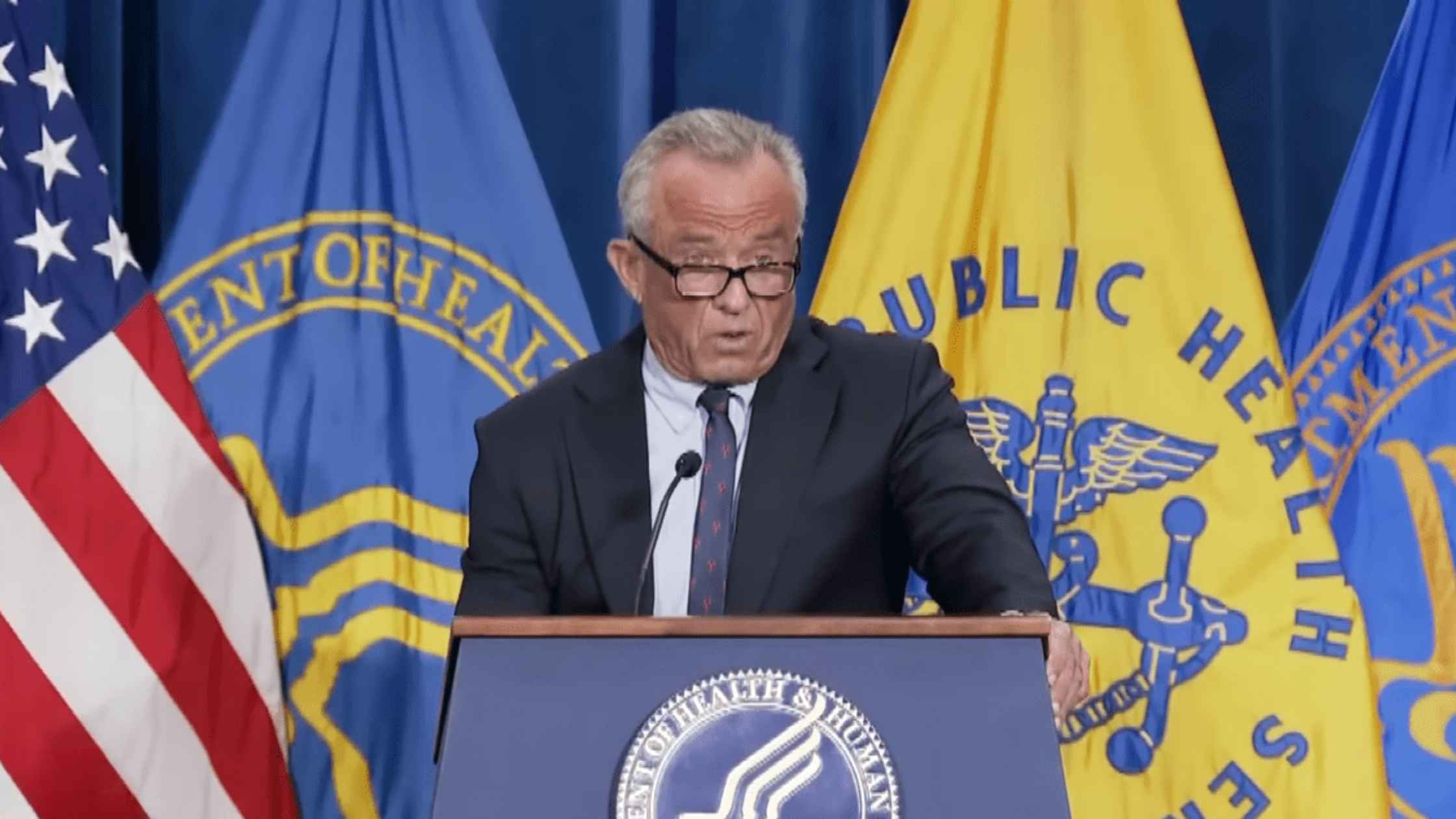
Speaker 1 (00:17):
Good afternoon. Thank you for being with us today. We are thrilled to have more than 200 people with us to celebrate a huge announcement in women's health. It is my pleasure to welcome to the stage, Health and Human Services, Secretary Robert F. Kennedy Jr.
Speaker 2 (00:40):
Good morning, everybody. I want to begin by acknowledging the second lady of the United States, Usha Vance, who's here today to celebrate a new era in women's health. And we're grateful for your presence and for the attention that you're bringing to this historic announcement. I also want to recognize secretary of labor, Lori Chavez-DeRemer, and thank you again for standing with us and a big hello to my friend, first lady of West Virginia, Denise Morrissey, and thank you for being with us today. I also want to recognize my wife, Cheryl Hines, and my daughters Kat and Kick, who are here.
(01:23)
For more than two decades, the American medical establishment turned its back on women. Millions of women were told to fear the very therapy that could have given them strength, peace and dignity through one of life's most difficult transitions, menopause. That ends today. The FDA is initiating the removal of broad black-box warnings from hormone replacement therapy products for menopause. We're challenging outdated thinking and recommitting to evidence-based medicine that empowers, rather than restricts.
(02:03)
When prescribed responsibly and started early, hormone replacement therapy transforms the lives of women. Hormone replacement therapy has been found to reduce the risks of cardiovascular disease and mortality by as much as 50%, Alzheimer's disease by 35%, bone fractures by 50% to 60%, as well as reducing cognitive decline and all-cause mortality. In other words, extending the lives for as much as 10 years. It helps women sleep better, think more clearly, and live fuller, longer and healthier lives. In short, it restores balance not just hormonally, but emotionally and physically. That's why in 1999, approximately 27% of post-menopausal women took hormone replacement therapy. Then, in 2002, a study called the Woman's Health Initiative found that women taking hormone replacement therapy may have an increased risk of breast cancer diagnosis. Not mortality, but diagnosis.
(03:17)
The study was not statistically significant, but it triggered a media frenzy and led to the FDA applying unscientific black-box warnings to all hormone replacement therapy products in 2003. The label was designed to frighten women and to silence doctors. It warned of diseases and dangers that the data simply did not support. Bureaucrats at the FDA reacted out of fear, not gold standard science. And instead of correcting the record, the medical establishment doubled down in groupthink, the consequences have been devastating.
(03:59)
Since that decision, more than 50 million American women have been scared away from treatments that could have eased their suffering and extended their lives. Before the panic, one in four women used hormone replacement therapy. Today, it's fewer than one in 20. That's not progress. That's neglect, that's malpractice. We can no longer accept a culture of fear that blocks innovation and keeps patients from proven therapies. But today, thanks to President Trump's bold leadership and unwavering commitment to restoring trust in public health, and the courage of Commissioner Marty Makary, the FDA is correcting that mistake.
(04:43)
After a thorough evidence-based review of decades of scientific data, an expert panel and public testimony, the FDA is announcing today that it will remove the misleading black-box warnings from all HRT products. For the first time in a generation, the FDA is standing with science and standing with women. The era of ignoring women's health is over. The era of patronizing women is over. The FDA will follow the science, and America's women will finally get the care, the respect, and the honesty that they deserve.
(05:24)
Today, we are restoring integrity to medicine, restoring faith in public health, and we are restoring balance to the lives of millions of women who have been ignored for too long, and that's what it means to make America healthy again.
(05:40)
And now, it's my honor to introduce my friend doctor and commissioner, Dr. Marty Makary, who will share some more about this landmark decision and the steps that the FDA is taking to improve the lives of millions of women.
Speaker 3 (05:56):
Thanks so much. Thank you, Mr. Secretary, always an honor. Secretary Chavez-DeRemer, thank you for being here. Madam Second Lady, Mrs. Vance, thank you for supporting this endeavor. All my colleagues at the FDA, my colleagues at HHS, this is a historic day for women in the United States.
(06:22)
The Women's Health Initiative study was the largest study ever done in US history, a $1 billion study at the time. And you just heard how that study was misrepresented and created a fear machine that lingers to this day. Ask your doctor. But what you may not know is that there was an incredible back story. The headline that hormone replacement therapy causes breast cancer was released to the media before the scientific data was released to the public. A week later, once the data was published, some of us looked at it and said, "This is interesting. There's no statistical significance in the increase in breast cancer." If we don't have statistics, then we don't have science. All of a sudden, snake oil cures diseases and science goes out out the window.
(07:14)
Women who took estrogen alone had a 24% reduction in breast cancer, and no clinical trial has ever shown that HRT increases the risk of breast cancer mortality. In talking to some of the scientists involved in my curiosity as a cancer surgeon and public health researcher at Johns Hopkins, before I came into this role, I reached out to some of the scientists and asked them about this controversy. I learned that before the study was released, the researchers got together in a hotel in Chicago and a shouting match erupted. One of the scientists said, "If you put this out there," quote, "if you stir baseless fear around something so sensitive," that is breast cancer, "you can't put that genie back in the bottle." Those words were so prophetic. Look at where we are today.
(08:17)
What he predicted is exactly what happened. The fear machine took on a life of its own. Medical groupthink took seed, just like the medical group think that told us opioids were not addictive for 15 years. Like the medical group think that said, "Kids should avoid peanut butter until they're age three to prevent peanut allergies." It turns out it increases the risk of peanut allergies with avoidance in the first three years. They got it perfectly backwards. Like the groupthink that saturated fat causes heart disease directly. For 50 years we got that wrong, ignoring the role of refined carbohydrates.
(08:55)
Tragically for women, 50 million women since that study 23 years ago have been denied or never offered or talked out of the life-changing, life-saving benefits of hormone replacement therapy, including my mom. Many people know about the short-term benefits alleviating the short-term symptoms of menopause, which can last 8 to 10 years. They can be severe, not like we were taught in medical school, that some women experience menopausal symptoms, but they last a couple of years and they're usually mild. No, that was misinformation. The symptoms occur in over 80% of women. They last on average eight years, and for many women they are severe, even debilitating. Mood swings, night sweats, weight gain, hot flashes, divorce.
(09:48)
By a large body of evidence, there are now recognized to be profound long-term health benefits that few people, even physicians know about.
Speaker 3 (10:00):
… out. A large body of evidence. The reduction in risk of Alzheimer's that's been suggested in one study, but let's just talk about the risk of bone fractures going down 50 to 60%. This is New England Journal level of Medicine evidence. A woman who makes it to age 80 has a one in three chance of having a hip fracture, it is avoidable with a risk reduction of 50 to 60%, and so we're hammering rods in a woman's hip as a part of an operation for a condition that may have been avoidable.
(10:34)
We don't talk about this issue as much as we should. Let's just cite the data on heart disease. In the Journal of Cancer, I'm going to hold it up right here, in the Journal of Cancer, three years ago, they concluded that more than 40 observational studies show a consistent 30 to 50% reduction in coronary heart disease in HRT users compared to non-users. A 30 to 50% reduction in heart disease, what are we doing? The number one cause of death in women is heart disease. The power of dogma.
(11:10)
In the journal, Circulation, again, massive, massive, highly respected studies, 30% reduction in all-cause mortality, and a 48% reduction in heart attack deaths. Okay? We talk about statins all the time. We never talk about HRT. Statins have up to a 35% reduction and these studies are showing up to a 50% reduction. What are we doing not offering women this potentially powerful treatment? With few exceptions, there may be no other medication in the modern era that can improve the health outcomes of women on a population level than hormone replacement therapy.
(11:55)
After 23 years of dogma, the FDA today is announcing that we are going to stop the fear machine steering women away from this life-changing, even life saving treatment. The FDA is taking action to remove the black box warnings from estrogen related products. This is based on a robust review of the latest scientific evidence. Our expert panel at the FDA, we conducted a few months ago. Some of those doctors and experts are here with us today.
(12:23)
We are also approving two new drugs for the treatment of menopausal symptoms. We are listening to doctors who have been waving the flag in the air saying, "Hey, we have this wrong." We are listening to women who have been challenging the paternalism of medicine. We are listening to female medical students that have demanded more menopause education in the curricula. This administration hears your voice and is not afraid to challenge the medical status quo.
(12:57)
If you listen to people, and I've seen this at the bedside, if you listen to the patients, you learn a lot. HRT has saved marriages, rescued women from depression, prevented children from going without a mother. A male-dominated medical profession, let's be honest, has minimized the symptoms of menopause, and as a result, women's health issues have not received the attention that they deserve. But more than 80% of women have notable severe symptoms lasting up to eight years. How could the medical establishment get it so wrong for so long? That's the power of groupthink.
(13:40)
Women deserve the same rigorous science as is used for men. We don't believe in medical dogma, we believe in evidence, science, patient choices, and restoring the doctor-patient relationship. And the way we do that, and we talk about this all the time in the secretary's office, the way that we restore the damaged public trust is by showing some humility.
(14:10)
So with that, I want to thank everyone who's here, including the FDA scientists, Christine Nguyen, Janet Maynard, and so many others. Sara Brenner, my deputy commissioner is now going to come up and give some comments. Thank you very much.
Speaker 4 (14:21):
Excellent. Thank you, Dr. Makary.
(14:29)
So we have come a long way since our roundtable earlier this year at FDA. I would like to consider today our arrival at the start line, not the finish line, on this issue. The start of a new era in promoting, protecting, and preserving women's health across the entire lifecycle. For decades in medicine, understanding and addressing the differences between women's and men's bodies has been deprioritized. The unique physiological changes and needs of women have either been steamrolled or ignored.
(15:03)
Menopause is not just a medical term. It's a deeply human and vulnerable experience. Like puberty, menarche, the phases of the menstrual cycle, pregnancy, postpartum, and lactation, menopause touches every part of a woman's being. Her body is literally changing through each phase of life. This is markedly different than the reproductive lifecycle of men who experience puberty, adulthood, and aging differently than women, both physiologically and culturally.
(15:36)
Regarding menopausal treatment, for years, women were told that HRT could cause breast cancer. Black box warnings on HRT products discouraged doctors from prescribing and patients from inquiring about these products. Those fears shaped decades of medical guidance, family decisions, and FDA policy. Realigning beliefs with new and emerging data and scientific findings takes time and effort and courage, but it's worth it. We must encourage ourselves and others to be open-minded and seek an honest evaluation of where conclusions from the past may have been wrong and how we can evolve our understanding and practices moving forward. As women, we are caretakers, mothers, daughters, aunts, sisters, and leaders. We give so much of ourselves to others.
(16:27)
Today, with this action, we affirm that women's health matters. This milestone would not have been possible without the bold leadership of President Trump, Secretary Kennedy and Commissioner Makary. Through the MAHA movement, we are tackling outdated assumptions and groupthink head-on, and returning to the simple truth that when science evolves, policy must evolve too. Today is a meaningful day for women's health in America. Thank you for joining us in making America healthy again for women of all ages.
(16:59)
And now I'd like to invite Dr. Jackson to come up.
Speaker 5 (17:09):
Today, we have the opportunity to add up to a decade of healthy years to the life of every woman that you love. The science is clear, hormone therapy is safe and effective, and it is hugely beneficial to the vast majority of women when properly timed. When a woman goes through menopause, she becomes two to three times more likely to develop Alzheimer's than a man. Cardiovascular disease becomes her number one killer, taking eight times more lives than breast cancer. She's more likely to suffer from debilitating bone fractures, muscle loss, depression, and metabolic disease. Menopause shortens women's lives. Today, that changes.
(18:02)
The black box warning on estrogen, a label based on the flawed overgeneralized and misinterpreted WHI study, kept tens of millions of women from accessing this essential hormone. Women have endured sleepless nights, derailed careers, painful sex, broken bones, and a loss of wellbeing, all because the science was misread.
(18:26)
Estrogen isn't just about ovaries, it is just as much about the brain and its impacts on every organ in a woman's body. When estrogen vanishes, a cascade of disease and aging begins. A preponderance of data now shows that estrogen, when started early, acts as a protective shield for the brain, lowering risks of memory loss, mental health decline, and neurodegenerative, even Alzheimer's. It improves metabolic and immune function, reduces cardiovascular disease, diabetes, and fracture risk. Estrogen is one of the most effective longevity interventions for women, and yet we have told women and their doctors the exact opposite. Tens of millions of women have suffered. They will never get those years back.
(19:23)
But we can transform the future. It is time for American healthcare to catch up to American science. Secretary Kennedy, Dr. Makary, thank you for your leadership and your courage. And to the researchers, clinicians, and advocates who have worked relentlessly for this day, this is your win. Today is your day. Thank you.
(19:55)
I'd now like to introduce Dr. Rachel Rubin.
Dr. Rachel Rubin (20:06):
Wow. Those of us who see the impact of urinary tract infections on women's lives are thrilled with these long overdue label changes. You see, when hormone levels decrease, it can lead to urinary frequency, urgency, pain with sex, and recurrent urinary tract infections. We call these symptoms the genitourinary syndrome of menopause or GSM. Urinary tract infections are not just uncomfortable. They also cost our healthcare system billions of dollars and cause serious health consequences to the people we love, like sepsis and death.
(20:49)
But there's a simple treatment, vaginal hormones. They are safe for all ages, and they're proven to get at the root cause of GSM. So why aren't more doctors prescribing this life-saving medication? Because until today, the warning label on the box falsely says that vaginal estrogen causes cancer, stroke, blood clots, heart attacks, and probable dementia. Yet, not a single scientific study shows this. Because of that warning label placed in 2003, an entire generation of clinicians were never taught the details, and the details matter here. You see, estrogen, progesterone, and testosterone are all different, which matters when talking to patients about the risks and benefits of hormone therapy. Pills that are swallowed and metabolized through the liver carry different risks than those that go through the skin, like a patch gel or when used vaginally at low doses.
(21:53)
For the medical community, we wanted to make this as easy as possible. So this year, the American Urological Association published guidelines endorsed by many other medical specialties that explains how to diagnose and treat the genitourinary syndrome of menopause, including how to prescribe vaginal estrogen because patients need their surgeons to know that vaginal estrogen should not be stopped before surgery. It doesn't increase blood clots, but it does prevent urocepsis readmissions. They need their oncologists to know that women with breast cancer who use it may actually live longer. They need their primary doctors to know how to write the prescription, recommend it for life, and use it even if you're using systemic hormone therapy for hot flashes and osteoporosis prevention.
(22:47)
Today's announcement is the culmination of decades of medical research, education, and advocacy pioneered by the many people in this room and watching today. But it's also just the beginning. It will take more education and more advocacy to ensure this change benefits the tens of millions of women who are currently not getting the care that they deserve. Thank you so much. I'd like to welcome another urologist, my friend, Dr. Kelly Caspersen.
Dr. Kelly Caspersen (23:24):
Distinguished guests, colleagues, and leaders, today marks a monumental shift in women's health. The FDA has finally acted to correct decades of misleading guidance. As a surgeon and advocate, I stand here for the 80 million American women over 40 whose health has been shaped by misinformation instead of fact.
(23:53)
When I was in residency, I was told women were too complex, as if their health needs were unknowable. Years later, a bladder cancer survivor in tears reminded me how wrong that was. She wasn't complicated. She was in pain, and no one had treated it. That moment shifted everything. I started asking, "Who is taking care of the people who are supposed to be partnered with the people that urologists like me are giving testosterone and Viagra to?" Because here's the truth, women's care has been an afterthought. He gets treated. She gets dismissed. Families fracture. It doesn't have to be this way.
(24:54)
Estrogen is FDA-approved for osteoporosis prevention, premature menopause, and several symptoms of menopause. While 80% will experience symptoms, only 5% receive treatment. If a patient does get a prescription from her doctor and brings it home, nearly one in three will never use it because of the fear created by the incorrect warning label. Today, there is hope. Evidence now outweighs inaction. The FDA's decision to remove the boxed warning is not just regulatory. It's revolutionary. What happens here will be followed in other countries, too. Worldwide women spend more years in ill health than men, despite having safe, effective, even preventative treatment that until now has been held back by fear. To the researchers who refused to back down, thank you; to the clinicians who pushed past outdated protocols, teach our peers; and to the women who spoke up, you moved the line. Let today be the day we stop treating women's health as a footnote and started treating it as the standard. Thank you.
Speaker 6 (26:35):
We'll have the secretary and Marty here and then you guys right [inaudible 00:26:48] other side [inaudible 00:26:48].
Marty Makary (26:47):
Great.
Speaker 6 (26:47):
You guys come on up. Then we're going to get a picture. Then we'll take some questions from the press.
Marty Makary (27:11):
Great.
Speaker 8 (27:11):
[inaudible 00:27:12].
Speaker 6 (27:11):
[inaudible 00:27:12] step up.
Speaker 7 (27:12):
[inaudible 00:27:12].
Speaker 8 (27:16):
Just a little bit more. Big smile, one, two, three. Thank you.
Speaker 6 (27:20):
You guys [inaudible 00:27:18] and you guys on the other side. We're ready to take some questions from the press, yes? There's a mic. Then also if you can say your outlet, first name and last name.
Zach Brennan (27:35):
Zach Brennan, Endpoints News. I guess I'm curious as to how you can assess the extent to which women weren't able to access HRT because of the black box warning and how removing this warning is going to increase the uptake of the therapy.
Marty Makary (27:55):
[inaudible 00:27:54] first and then we're not [inaudible 00:27:57].
Dr. Kelly Caspersen (27:58):
The statistic of nearly 30% of women don't use it because of the boxed warning came from a published paper by Dr. Una Lee. I believe it was in the Urology Journal. That was a survey asking women, how many people are able to, this was a vaginal estrogen questionnaire, access that with their physician, and then once they got it home, how many people still didn't use it because of the label? That's published paper.
Sarah Owermohle (28:26):
Sarah Owermohle from CNN. I'm curious your guidance for women in perimenopause and how they should be thinking about this, and also the direction you would take with compounded, sorry, hormone replacement therapies because there's a lot of people using this as well.
Marty Makary (28:43):
We are sticking with our philosophy that the government is not your doctor, so having a doctor evaluate your estrogen levels to figure out when is the right time to start. Sometimes it's micro-dosing followed by a half dose followed by a full dose as your intrinsic estrogen level decreases. You will not really see much medroxyprogesterone acetate, which is the form of progesterone used in the WHI study. Some have attributed that the slight increase in breast cancer risk to that form. That is not a form in common use today for hormone replacement therapy. So we want people to talk to their doctors, and we want doctors to have the right information. Part of that means removing these scary black box warnings and putting the nuanced discussion in the package insert of the medications. Thank you.
Harrison Watters (29:40):
Harrison Watters, World News Group. Will there be any difference in handling bioidenticals to the synthetics for HRT?
Marty Makary (29:52):
All are on the market, and so there's a view that the bioidenticals may be more representative of the intrinsic
Marty Makary (30:00):
Estrogen produced by the ovaries. Again, we'll leave that up to individual doctors. I just remember you asked about compounding and I didn't answer that question. So there are legal criteria for compounding, and we're going to continue to respect those boundaries. Thank you.
Speaker 9 (30:13):
Go ahead.
Speaker 10 (30:23):
Hi, Vera Young for Medscape. Have the companies agreed to do this yet? Have you worked with them? Do they have control of the label in the end? What have those discussions been like?
Marty Makary (30:32):
The companies are generally speaking, very excited when the FDA tells them, you can remove a scary warning on your product. So the process, just so you know, is that we had an expert panel. This is something I had an interest in from previous research. We let the experts express their opinion, some of whom are on stage today, and then we have our subject matter experts at the FDA do an incredible comprehensive review of the literature. The conclusion of that review was a recommendation to remove certain black box warnings. That recommendation was presented to me, I accepted it, and that makes it final. So we are letting the public know now the companies will reprint and accept those label changes.
Speaker 9 (31:20):
Over here. Do we have a second mic?
Tiffany Ryder (31:26):
Hi. Tiffany Ryder, Red Flag Media. I practiced in emergency medicine and it is insane how much dogma there is and how long it actually takes for recommendations to get down to the clinician level where clinicians are actually comfortable prescribing things as we should. Is there a campaign to encourage clinicians to move away from the dogma even though the science has been clear for, as you stated, many years now?
Marty Makary (31:56):
Yeah. Rachel, do you want to say something about that?
Dr. Rachel Rubin (31:59):
So this is so important because in 2019, the American Urologic Association has recurrent urinary tract infection guidelines that say, give vaginal estrogen. It prevents UTIs. And I found that no one did. No one read them, no one started writing prescriptions. So you can see, I got onto Twitter and social media and I got loud, and we have really inundated social media with a campaign of why this is important. And even a published paper just came out recently that showed prescription rates are increasing, Google searches are increasing for these vaginal hormones, which your great-grandmother in the nursing home can take to prevent UTIs. And we are seeing, we've published in the emergency medicine literature and we both advocate, we publish, we research, and that's what's moving the needle. And so it is taking time, but people are getting loud, the public is getting loud, and I actually think there's a lot of hope here.
Tiffany Ryder (32:53):
Awesome. Thank you.
Speaker 9 (32:57):
Right up here.
Arthur Jones II (33:04):
Thank you. Arthur Jones II, ABC News. Commissioner Makary, you talked about how this is a medical breakthrough for women, but why is this a medical breakthrough and not just the updating of guidance today? And also, you also talked about two new drugs for menopause. Can you expound on them a bit?
Marty Makary (33:23):
Sure. So we have a generic form of Premarin, which is a combination therapy that the FDA just approved. And one of the giant goals of President Trump and this administration is lowering drug prices for everyday Americans. It is a health reform. It's not packaged with a bow from Capitol Hill, but it is a meaningful health reform that actually addresses the two root causes of our affordability crisis, the cost, the price of goods and services, and the health of the population, something we're focused on. And the other medication is a medication that is specific to the treatment of a menopausal symptom. There's already one out called Veozah. This is another product that also directly treats menopausal symptoms. And that's important for women who can't take estrogen because there are contraindications. I do think to your first point, it is both a medical breakthrough and a guidance change, and we want to see the community talk about the evidence at the level of the evidence. So, thank you.
Speaker 9 (34:30):
Right there.
Matt Perrone (34:34):
Hi, Matt Perrone, AP. Thanks for taking questions. Commissioner Makary has been passionate about this issue for a long time. I think the first chapter of his most recent book was about this topic, if I recall. But to what extent does this reflect FDA scientists and consensus among the rank and file? Was there a process reconsidering the label before you arrived there?
Marty Makary (34:58):
It wasn't the first chapter, but I have written on this topic. But, thank you. Look, people have felt demoralized in this field. We've made almost no progress in assessing the evidence for years. And so, they did an independent review and were enthusiastic to recommend label changes. And those are the individuals I mentioned. We'll have an article with those scientists in the Journal of the American Medical Association, our top number one circulating medical publication in the world. I think there's a couple other pieces coming out. We want to get the word out there that there is a nuanced message here. Most women are great candidates and there are profound long-term health benefits. It's not just to treat night sweats and difficulty sleeping. Thank you.
Speaker 9 (35:47):
Okay, one more question right there.
Luke Zarzecki (35:51):
Hi, Luke Zarzecki with Inside Health Policy. Going off of that question, why did FDA choose to have an expert panel instead of an ADCOM meeting, which is usually the procedure?
Marty Makary (36:00):
Because ADCOMS are bureaucratic, long, often conflicted, and very expensive. So we can have an active, robust discussion as a group of medical experts spontaneously. And so, we're doing more of that. We're doing both advisory committees following the long FACA process of the government. And we are also convening experts to say, speak your mind passionately. State your conflicts of interest, if you have any. Speak your mind passionately about an important topic in medicine that is not being talked about, that needs to be talked about. And this was one of those panels. As you know, we also had a similar forum on SSRIs in pregnancy. We had one on gene cell and gene therapy. So we're going to continue to have those. It allows us to have a robust debate without all the bureaucratic barriers. Thank you.
Speaker 9 (36:53):
Thank you so much for coming today.