Steve Gregorian (00:01):
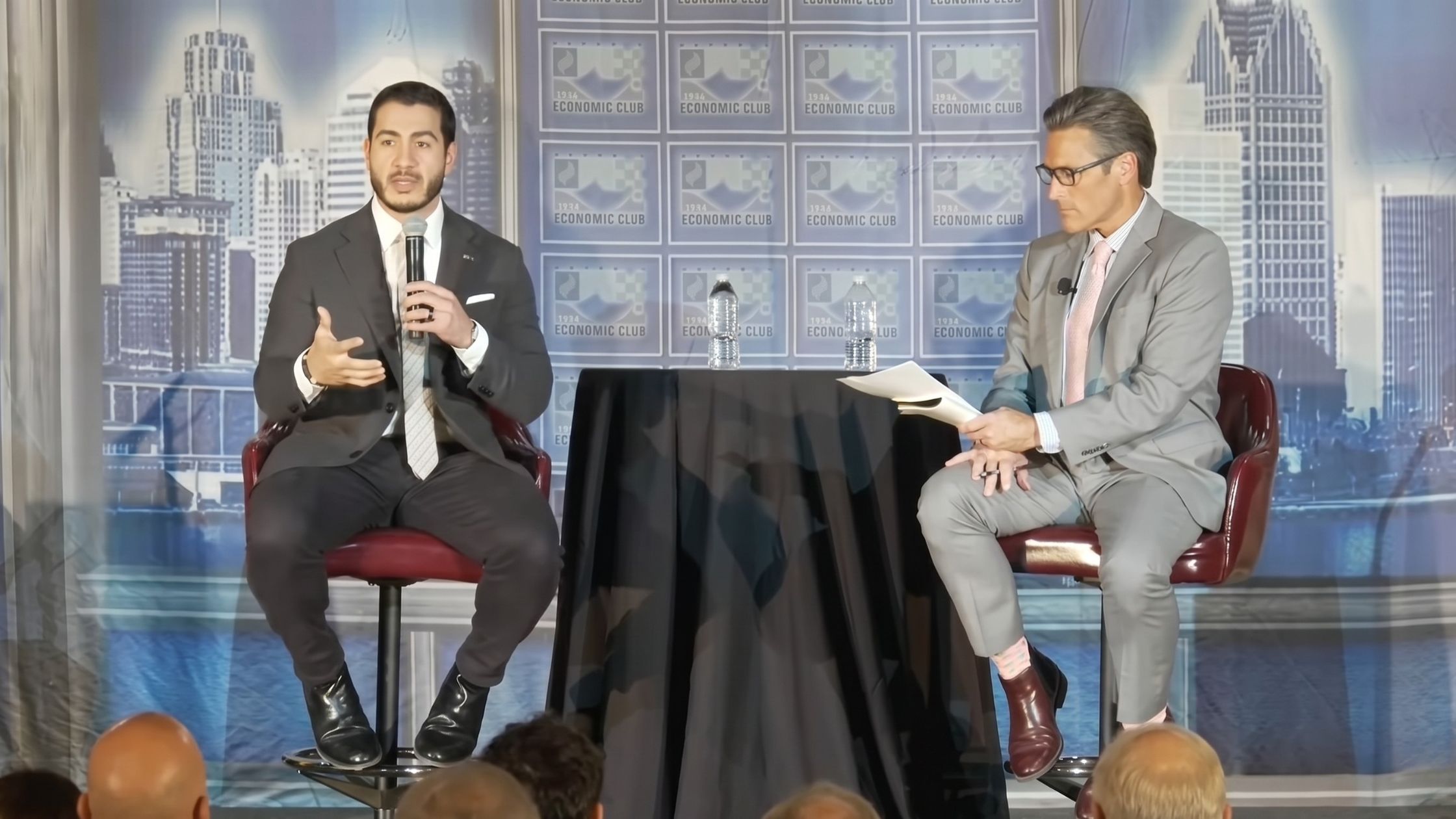
Good afternoon, ladies and gentlemen. Good afternoon. My name is Steve Gregorian. I'm the president and CEO of the Detroit Economic Club. Welcome to today's very special meeting, 93 years of incredible speakers and networking, and that tradition continues today. I do want to especially welcome our DEC members. And if you're not a DEC member yet, give me two seconds to convince you. Your next prospect, client, job, maybe best friend, is right in this room. If you want to build your network and learn from thought leaders on our stage, we invite you to invest in yourself and join today. As we get started, I would ask you just to please take a moment and silence your cell phone so we don't disturb today's program, and we've got a tradition of always starting with a pledge of allegiance, so please stand and join me as we honor our country. The flag is to my right.
(00:56)
I pledge allegiance to the flag of the United States of America, to the Republic for which it stands, one nation, under God, indivisible, with liberty and justice for all. You may be seated. Normally, if you've been with us, you know we have an invocation, but I checked with our clergy and they said you are all perfect and need no blessings today, so congratulations. All right, a couple of thank yous. I want to say thank you to WJR, who's doing their focus show live. You'll see them during lunch. Thank you to WDIV Local 4, Lawrence Technological University, and Detroit PBS for live streaming today's meeting. And a special thank you to my fellow members of the Michigan Debate Commission who are here with us today. This program is a result of those efforts and we will continue to do more.
(01:49)
I do want to take a minute to recognize our sponsors and partners. Make no mistake, they are the reason that we can bring you programs like today. So thank you if you're part of the corporate sponsors. If you'd like to become one, see me at lunch. Happy to talk to you about the benefits. And the other thing I was going to mention is our fall season continues to be red hot. Next up in November, we will host Delta Airlines CEO, Ed Bastian, right here at the Masonic, and we want to welcome Ed with a really large crowd because Delta is so important to our region. So please get your tickets. Plenty more to come, get your tickets before they sell out. All right, we always say hello to our students. They're here today courtesy of our generous corporate sponsors. They just finished a private reception with both of our candidates, which is really cool. I would ask you to hold your applause while I tell you what schools are here today.
(02:43)
We've got Catholic Central High School, thanks to MBC Loans, Frontier International Academy, thanks to Detroit Zoological Society, Loyola High School, thanks to Accenture, University of Michigan Dearborn, thanks to Albert Kahn Associates, and the best looking group of all, the AGBU Alex & Marie Manoogian School, the Armenian students are with us today as well. So how about a round of applause to thank the students and their sponsors.
(03:16)
All right, some DEC election history I think it's really important I want to share. Today is the DEC 16th Senate election focused programs. In fact, we've hosted Michigan's US senatorial candidates in 10 of the last 11 elections. And this is what the DEC does. We bring you voices of people who want to lead our state. And just a few weeks ago, you might remember, we had both gubernatorial candidates on our stage. For today, though, I do want to thank both candidates, Abdul El-Sayed and Mike Rogers, for choosing the DEC, and here's why. You see many organizations fought for this opportunity to host the candidates and they recognize the importance of all of you to the future of our state. So I am going to ask you for a favor. Please help the DEC maintain high standards of decorum by offering the candidates a respectful audience. And by doing so, future candidates will choose the DEC once again.
(04:19)
And the last thing I do want you to know, since we are the Detroit Economic Club, the topics you'll hear today will focus on matters important to the business community, Michigan's economy, and business issues and policies. Other issues, yes, they're important, but we will not include those today. All right, the most important person today is our timekeeper. On time every time, that's the DEC. Please welcome the best timekeeper and the best in the land, longtime DEC member, JR Hasano. Thank you JR. And now it's my pleasure to turn this over to our moderator. You know him because you're up at 4:30 AM doing your emails and watching him anchor WDIV Local 4 Morning Show, and he is the host of Flashpoint on Sunday mornings. Please welcome the DEC's and my good friend, Jason Colthorp.
Jason Colthorp (05:18):
Thank you, sir. Thank you and hi to everybody. Speaking of the governor's forum a couple weeks ago, just a few more people than that one, I will say. And I was informed a little while ago, a little bit more media, 28 media outlets, including from seven countries that are here today. So obviously this is a big one. I know we have at least one collegiate outlet, the Oakland Post is in the house. They made themselves. So thanks to all the media that's here today. I think this one's going to be unique today and I think we're in a good spot because we all know this race. We've seen how nasty it's been both on TV in the first debate. They have another debate tomorrow. And while I'm sure my colleagues at XYZ are excited about that, I think we get an opportunity today to put all of that aside and focus on some serious issues and talk to them one-on-one and get their answers straightforward about policy, hopefully without those attacks on one another.
(06:22)
So you guys ready to get rolling here? There was an invocation that Steve didn't know about. I think somebody said a prayer for no blood drawn, and hopefully that comes through. They're not going to be out here at the same time, one, and then another one, so one at a time. And the first one that I'd like to introduce today, give me a nice warm welcome, your Republican nominee for US Senate here in Michigan, Mike Rogers. Mike, how you doing? Good to see you.
Mike Rogers (06:56):
Good to see you.
Jason Colthorp (06:57):
You can take this one right here.
Mike Rogers (06:57):
Right.
Jason Colthorp (07:03):
So the candidates are going to get the same eight questions. And as we go, each question, you'll get two and a half minutes for your answer. If you run to that two and a half minutes, you will hear this.
Mike Rogers (07:18):
It sounds like you missed.
Jason Colthorp (07:19):
Yeah. I didn't want to make a Michigan State football joke there, but I think we missed the kick on that one. I'm a Michigan Stater, it's okay. We can hammer our own. And then you get a two minute closing statement. There's a second chime, right? What's the second chime for?
JR Hasano (07:38):
So two minutes.
Jason Colthorp (07:40):
Two minutes. Two and a half minutes for the answer.
JR Hasano (07:43):
Two and a half minute answer. Two minutes in, I'll chime once.
Jason Colthorp (07:46):
Oh yeah, that's it.
JR Hasano (07:47):
And I'll chime twice.
Jason Colthorp (07:48):
I just did this a couple weeks ago. So you get one chime at two minutes, two chimes when your time is up at two and a half minutes.
Mike Rogers (07:55):
Can you play the Michigan fight song?
Jason Colthorp (07:59):
We can. We'll play it every time for every touchdown they score this weekend. What? They're going to score a ton. I always have to do this. One daughter went to Michigan, I went to Michigan State. I'm good on both sides. All right, let's get rolling. Mike, first topic, we're going to start with Michigan's economic competitiveness. Michigan needs to get more competitive and attract new businesses and help the businesses already here and help them flourish. What is the single most important federal policy you'll pursue to strengthen Michigan's economy and how can we measure that success?
Mike Rogers (08:32):
So two things, and one of the reasons my wife and I got into this race was for exactly that. Over the last quarter century we've lost 200,000 manufacturing jobs, our median wage is now $10,000 less than the median average. That never used to happen because we built things here. I draw a direct line to those loss in manufacturing jobs. Highest utility rates in the Midwest, highest auto insurance rates in the nation. The first time homeowner now is 40 years old in our state, 40 years old. We have huge challenges. Adding more cost, adding more expensive utility bills is not going to solve our answer. I think we got to go the other way. So the things that we can do is make sure we have American energy so that it puts pressure on prices. We think we can do that, number one.
(09:20)
Two, we have to keep taxes low. There's folks that want to increase taxes generally, number one, increase taxes on healthcare, number two, which I think is a disaster for our economy and your healthcare. Then you have the problem that they want to undo taxes on overtime or no tax on overtime, no tax on tips, no tax on social security. Those are powerful tools to keep the economy humming. I think we'll go back and make sure we do those. Here's the most important thing we can do, which is the only reason my wife and I got in this race other than a good business climate and trying to turn this thing around. Two thirds of our fourth graders can't read in the fourth grade. Two thirds. You have a 70% chance of going to prison or being on welfare.
(10:06)
Let that sink in for a second. Two thirds of our fourth graders can't read in the fourth grade. If we don't fix this literacy problem, we are all doomed. I'm telling you, doomed. We have a plan that goes in with phonics kind of interdiction to get kids reading at grade level. We've seen it work. It's a powerful thing. My wife and I have been part of a group here around Detroit called Beyond Basics that's getting kids back up to reading level, fundamentally changing their lives.
Jason Colthorp (10:36):
Let me talk about tariffs here. They're hitting Michigan harder than any other state and especially the auto industry, which is going through a major transformation as global competitors now challenge US automakers and EVs and batteries, software, advanced manufacturing. And you just talked about this a little bit, but when, if ever, should the United States impose tariffs, and why are you better suited than your opponent to protect Michigan manufacturers from those tariffs and ensure that US automakers remain competitive?
Mike Rogers (11:07):
Yeah. So I've come out and said we got to end this Canadian tariff war. I don't think it's helpful to us. It's certainly not helpful to our automotive industry. But there are tariffs that have helped. The very fact that cars are coming back to the United States, including Michigan, from Mexico and China are because of the tariffs that were applied to help us, I think, correct about 40 years of bad trade policy. So you see that the Silverados come into the Orient plant, that's huge. It'll be a multi-billion dollar investment. General Motors is actually bringing about 500,000 new cars to be built in the United States, and we'll have some of that up here in Michigan. Those tariffs are good. If it's good for Michigan, I'm going to be for it. If it's bad for Michigan, I'm going to be against it.
(11:53)
Excuse me, the Cherokee goes across that bridge something like 16 times between us and Canada before it goes onto an assembly lot, or a for sale lot or dealer lot. When they oppose these tariffs, I don't know if they didn't understand that or weren't concerned about it. If we don't fix that part, we're going to be in trouble. It just really is disruptive to the automotive guys. My thing is this, send somebody back that can actually go and get a meeting and fix it and advocate for the things that work and be against the things that don't so we can get them fixed. Sending somebody else back that all they want to do is gouge the president's eyes out is not going to help us. We don't have a lot of time to get our very low metrics up.
Jason Colthorp (12:37):
Quick follow up here, take 30 seconds. You mentioned how this was to offset the original trade deficit, but analysts at the time when the president said this said it's going to blow tariffs or it's going to increase inflation. We've now seen it rise to 3.7%. Does that mean Trump was wrong on his tariff plan?
Mike Rogers (12:56):
Well, I just think they over... When they went to Canada, I thought that was not the right direction and mainly because they didn't account for how integrated we are in the automotive business. And we sell, content providers here sell into Canada for cars that actually come back to be finalized in an American plant. I just don't think they factored all of that. So having that conversation to me is important, but think of this. I mean, Detroit Diesel's adding a third shift. They haven't done that in decades. We talked to small fabrication shops. They haven't added second shifts in decades. They're adding second shifts. That's good for us in the long run. We just got to get this thing right.
Jason Colthorp (13:36):
Let's talk workforce and skilled trades. Employers are struggling to find qualified workers and many Michigan residents and college grads are leaving for better opportunities, and state labor data is now showing that the workforce shrank by 158,000 people in just this past year. What can you do from the Senate to close the skills gap and connect more workers to good paying jobs here in Michigan?
Mike Rogers (14:00):
So we've been doing the tours around the state where these small fabricators, they used to have a question when you get interviewed and it was a measuring tape question. They had to take the measuring tape question off. I've talked to at least five. All of them took the measuring tape question off because they couldn't find a high school graduate that could do fractions. Think of that. My dad who's a shop teacher would be rolling over in his grave on this. We have a huge education problem we have to fix. I think that's why we should put shop back in every high school or at least be accessible to every high school so that you can get connected to the skilled trades. It's a job China can't steal and it's a job AI can't replace. And it's huge opportunity.
(14:42)
And wages, if you look at wages for new college graduates versus wages for the skilled trades, man, skilled trades is winning that fight all day long. So we have to A, give kids an opportunity to be exposed to it in shop. I took shop, my math scores went up. I finally figured out, "Oh, that's what math is all about." It's an applied math skill and we just don't have it. Again, fix reading in the fourth grade, let's get math right. Why this is such a big problem, think of this, in eighth grade here in Detroit, only 15% can read at the eighth grade level and 12% can do math at the eighth grade level. This is a crisis like I have never seen. We all ought to be bothered by this. Any student that gets the eighth grade and can't read is shame on us. I think it's criminal. We have to change it.
(15:31)
If we're going to help with how kids get connected, you got to do it in stages, give shop class, do apprenticeships. By the way, we talked to both unions and non-union shops about how they would use apprentice from high school to get them connected earlier in skill sets. I love this idea, we ought to do it. Get them reading, get them doing math. We can fix this. And this is the good news. It is fixable. We've seen it through this Beyond Basics technique. We put that in every school. People get back to phonics. We're going to have our kids reading again.
Jason Colthorp (16:01):
I also took shop, but I only got in trouble because I was always-
Mike Rogers (16:00):
... kids reading again.
Jason Colthorp (16:01):
I also took a shot, but I only got in trouble because I was always breaking the wood, acting like I was...
Mike Rogers (16:06):
Karate chop.
Jason Colthorp (16:06):
Karate Kid, yeah.
Mike Rogers (16:07):
I've seen that kid in [inaudible 00:16:09].
Jason Colthorp (16:08):
Yeah, that was me. I got in trouble. My dad didn't like it either. All right. Healthcare. We touched on this a little bit. Let's dive into this a little bit more. Healthcare costs are weighing heavily on both employers and employees. What's the most important change that you can make to reduce healthcare costs without compromising access to quality care?
Mike Rogers (16:26):
Yeah, I think transparency. One thing, a woman was telling me the other day, she went into the hospital, she had a whole series of tests, and on the way out, one of the physician assistants came in and said, "Hey, do you want another one of these tests?" It was a scan. And she said, "Okay, they're asking me. I must need it." They billed her for that. It was like $1,700. She had no idea. My argument is we need transparency. You need to know what they're charging when you show up. I think transparency is the number one thing we can do to start putting pressure on prices. And let me just say this about how we're not going to distort the system. Right now, Medicare pays about a flat rate, meaning maybe you break even, sometimes you don't break even. The way we subsidize Medicare in this country is private insurers will pay about 200% of the cost. You take all of that away, think of the costs we will have to add for these medical shops to stay open, for doctor's offices, for hospitals, for everything else. This is a huge problem if we do this because people haven't thought about the consequences.
(17:33)
So let's do something different. Before we break the whole thing and ask you to stand in the back of the line, take Medicare away from seniors, which you're going to do, that they've paid for since they were 18 years old, we have got to find ways to put pressure on prices. You do it through prescription drugs, making sure Canada doesn't get a better deal than we do. You make sure that there's transparency in hospital billing, and you make sure insurance companies are open about their denial rates. You start doing those things, we're going to start putting pressure on prices.
Jason Colthorp (18:03):
Going back to the transparency example, another quick follow-up, if that woman needs that test and she can't afford it, what do we do then?
Mike Rogers (18:11):
Well, that's different if she absolutely needs it. But here's the problem. Why did they ask her to do the test that they later learned she really didn't need? That's a cost into the system because somebody's trying to make sure their numbers add up at the end of the month. Transparency, like any other business, puts pressure on those unnecessary medical requirements. We want them to get everything they need. We don't want no doctor at the insurance company who reviews it and says, "I'm not paying for that. We don't need any of that. We got to get rid of that." This is the way you get back at those high costs.
Jason Colthorp (18:45):
Artificial intelligence could boost productivity. It could disrupt jobs and entire industries at the same time. President Trump says it's larger than the industrial revolution and needs no real oversight. What should the federal government do to help American businesses lead in AI while preparing workers for the changes that it'll bring?
Mike Rogers (19:06):
Well, we definitely need guardrails on AI. I've seen it personally when I was chairman of the House Intelligence Committee. There was a test of a missile system that was told, and this was very early AI concepts, we want you to measure everything that hits the tip of that missile while you're flying, get there fast and get there accurate, but don't use the power in the back, we need those to ditch the missile if something goes wrong. And it was a test. There was no ordinance on it. And what happened was in flight, the thing decided all on its own, go around, get use of the batteries because if my primary mission is faster and more accurate, I need that extra power. It gave you a little bead of sweat on your forehead. This was back, I left Congress in 2014. You think about what happened and how fast this stuff has advanced. We must have guardrails. There is a national security framework, it's something I'll support when I get there. I need to go through the details of the bill, see if it can't be improved. But the other one, and this is for the business crowd here, the antitrust provisions prevent these AI companies from cooperating on safety. I think we ought to tailor a very narrowly crafted exemption so that you can cooperate on safety. One of these companies is going to see something that they know is not going to work, if the other company doesn't see it, they plow through it. My argument is let's have that narrowly crafted antitrust exemption so you can talk to each other on safety, not on anything else in the business, but on safety. Those are two reasons or two ways I think we can help put guardrails on AI.
Jason Colthorp (20:40):
Michigan's per capita income, it's fallen to 40th in the nation and it used to be 16th, just 25 years ago, at least in 1999, which raises concerns about the state's long-term economic prosperity. If Michigan was just average, people would have an extra $9,500 a year in per capita income. What sort of legislation can you target to help Michiganders raise their income?
Mike Rogers (21:02):
So we lost 200,000 manufacturing jobs since 2000, 200,000. Those are all middle class families. Those are all higher wage jobs. We just have to stop the bleeding. We used to build a lot of things in this state, submarine components, under 700-foot ships, airplanes, the main battle tank in Warren, that's all gone. Now still happens in the United States, just doesn't happen here anymore. So one of the things that I've already had conversations with people about, you know what the Navy needs now? Under 700-foot ships. Guess what we can do right here in Michigan up in the Bay City area? We can build under 700-foot ships. We have talent, we have people. Guess what? Those wages are really good. Welders now are making over a hundred grand a year. Welders, not too many years out of school, you're clocking in at 100,000 bucks. Those are real jobs.
(21:51)
I'm going to get Michigan back in the defense industrial base work. We should be doing it. Think of all drones. Even for drones, you got to bend metal to make these things. Who better to do that than the great state of Michigan? We know that these contracts are coming. We ought to help Michiganders be a part of the arsenal of democracy again. That's how our wages got up. And it also spurs civilian use. Manufacturing always follows these guys everywhere they go. We want to be a part of that for our future. That's the one way we have to get jobs up. Advanced manufacturing is pretty spectacular.
(22:26)
We ought to be the leaders right here in Michigan. I think we can, it just takes a US senator who cares about it, who shows up, who knows how to put the right people in the right room to get those things done so we can build ships and submarine components. We can build drone activity. I'd love to get back in the airplane business. We have a huge aerospace industry here. Most people don't know it. We even have a company here that builds for SpaceX. Nobody even knows they exist. It's not because they don't want to, they're just real quiet about it. And my argument is we have the technology, we have the people, we have the know-how, it just takes somebody to put the right people in the room to get it done. That's what I'm going to do. That'll get our wages up.
Jason Colthorp (23:03):
A quick follow-up, if you have to work with a Democratic Michigan governor, big if, nothing's decided, but you confident in how you could do that?
Mike Rogers (23:09):
I don't care who it is, honestly. If you care about building the state and retaining manufacturing, put me in, coach. I mean, think about it. We have a housing plan. We're going to make sure that young people have an opportunity to get into houses earlier. If you go on rogersforsenate.com, you can see that plan. It's very exciting. People in Detroit love it. It's going to be popular. We're going to do that. It has to be bipartisan. Getting kids reading in the fourth grade, it's going to have to be bipartisan. When I was in Congress, I'm the only guy in the race that actually had put bipartisan legislation together to get these things done. I don't care who's the president, I don't care who is the governor, we're going to get this done for the future of our state.
Jason Colthorp (23:50):
We'll dive more into housing in a hot second. Let me first ask you about taxes. How would you change the federal tax policy to encourage economic growth while also addressing the national debt, which is exploding? What trade-off would you be willing to make to achieve both of those goals?
Mike Rogers (24:06):
So we just saw a figure the other day, $500 billion in fraud payments. Now, I'm a tech guy, I've been in the cybersecurity business despite what you see on TV, I've been in the cybersecurity business for the last decade. There are great mechanisms to make sure you can reduce fraudulent payments by using a little bit of technology. It doesn't even have to be a lot. Problem is with the federal government, they're back 20 years, they still have fax machines. Think of that. And so what we've got to do is make sure that we get after that $500 billion of fraud. I would try to eke every dollar out of that.
(24:44)
On taxes, we need to make sure we have a lower tax rate that businesses can invest and some certainty on it. This whole up and down and up and down is not good for a business owner. We need a little certainty so they know how to invest. I'm big in research and development opportunities and tax relief for companies that are investing in the future of those companies, and that means the future jobs in those companies for Michiganders. All of that we have to do and we need to make sure that we don't have the largest tax increase in the history of the country, which is...
(25:16)
I mean, that's what the other team is talking about doing. That Green New Deal, if you like your utility bill and the folks who are talking about this Green New Deal, since we did a mini one in the state in 2023, this is a Democrat-led operation, they've raised our utility rates nine times because the mandates on our companies are not doable. So they're trying to figure out how they meet the law, and guess who's paying for that? We are all paying for that. If you want a company here, give them cheaper rates, make sure their insurance rates, their auto insurance rates aren't the highest in the country, their tax rates are low. We need to open up a sign and say Michigan is open for business again. Let's be the work belt of the Midwest again.
Jason Colthorp (26:02):
Just quickly, what about accountability on the jobs they promised? The Detroit News did a recent study saying they're only delivering on 9% of those.
Mike Rogers (26:10):
I'm always skeptical of an MEDC type investment, I'll be candid with you, because they never can quite promise what they can fulfill. What if we just took a step back and say we're going to have the best utility rates in the nation? Remember, we're competing with Ohio and Indiana. We're higher than Ohio and Indiana. Our state income tax rate is almost twice as much as it is in Ohio and Indiana. Wonder why Ohio and Indiana are getting these manufacturing companies. Remember in the last eight years we lost 27,000 manufacturing jobs, the rest of the country gained a hundred thousand jobs in manufacturing. That's what we've got to fix.
Jason Colthorp (26:50):
Let's finish with housing affordability and attracting talent here to the state. I mentioned inflation up to 3.7% now, which was the biggest jump last month since May, and rent is now one of the more concerning costs for people, and of course that factors in to finding workers who are willing to live here. Mortgage rates up to 7.25%, which you touched on, for a 30-year fixed mortgage, which makes the American dream out of touch for people under 40. What do you plan to do in the Senate to make those housing costs more affordable for Michiganders? And I know you touched on this, but maybe dive a little deeper.
Mike Rogers (27:22):
Yeah. I mean, I'd love to talk about our housing plan. Think about Detroit. We have 122,000 vacant lots in this city. We pride ourselves in how many houses we tear down in the city of Detroit. That's a metric they use every year. My argument is stop that, let's start talking about how many houses we build in the city of Detroit. How do we get them to do that? In my plan, you put all of those lots in a land bank, you allow builders to bid on those lots. Let's get it pre-approved for the city council. I've already been talking with city council members here in the city of Detroit about, "Hey, would you work with me on this if we could get it done?" " Yes." So that you have a much cleaner, less regulatory burden to build that house.
(28:06)
And why you give them... When they build and they sell it to a family here in Detroit, it's 100% tax-free. Whatever you make on that, federally tax-free, I'd like the state to join in too. Why you do that is because builders tell you they won't build because they can't get the valuation to get their credit lines right. So that house doesn't kind of value it where they can get the loan for it. We're going to try to flip the math on that. I think this is really very exciting. So we've already got land that we think we can do it, and we're also going to expand it by eliminating in Detroit food deserts. I've already had conversations with some commercial enterprise folks who, if we get this right, we can have houses being built, we have students from the high school participating in the apprenticeship of building these homes and giving them a skill set.
(28:54)
They don't have to travel outside of the city. So many Detroit seniors have to travel outside the city to go to the grocery store. We can do this. We just got a little creative. That's how we start this thing. Once you get one, you get two. And by the way, this works in Flint, it works in Saginaw, works in Grand Rapids. I mean, any city that wanted to participate, you can do this because you're incentivizing...
(29:15)
And here's another thing. We have two of the largest financial lenders in the country. Guess who's going to help us participate in making sure these folks get their qualified for a loan? Well, guess what? I think we're going to get them both. One has expressed an interest. We're going to get this done. So it's a one shop deal, people moving in, we're building, we're going to have a new grocery store. I'm pretty excited about it. And here's the thing, I know Detroiters are well. We've had this conversation with a lot of them.
Jason Colthorp (29:42):
Take two minutes for a closing statement.
Mike Rogers (29:43):
Well, thank you. Listen, it just happens to... When I first ran, I talked about the issues that got us in, the jobs, the education, the fact that we're 46 in economic opportunity now in Michigan. We have to change all of that. I do believe something else is on the ballot here. This really isn't left or right anymore. We have built coalitions that really are very untraditional for a Republican candidate. We've spent a lot of time here in Detroit, Flint, Pontiac, I think if we're going to get our state right, we have to have everybody included in this forward progress. Can't do it without education. We can't do it without the right kind of framework to encourage building and other things, get our kids interested in the skilled trades, which I think we can. All of that I think is on the ballot.
(30:29)
There are two very different visions. I had a elected Democrat tell me the other day, she was very helpful to me, and I said, "Why are you doing this?" And she said, "I'll tell you. Somebody knocked on my door on the weekend and handed me a Democrat Socialist of America and said, "Would you help us make Detroit a Democrat socialist city?" And I'll just use her language, excuse it, "I'll be damned if I'm going to let Detroit become a Democrat socialist city. It doesn't work." That's what's on the ballot. They're talking about big government, government control, more rules, more regulation, another Green New Deal. If you do that, guess what? We are going to continue to ride this thing out to number 50.
(31:12)
I have plans to get us to where we're the envy of the country again, but it's going to take a little work, a little innovation, and it's going to have to take lots of conversations with people of all stripes in this state. We've done that. If you look at Democrats for Rogers, it's our fastest growing coalition. Jewish Democrats obviously have lots and lots of concerns about the direction that would happen if I didn't win this race. So you start thinking about those things being really anti-business or somebody who's going to use business to solve our problems, I think that's the difference. I hope I earn your vote in November. Thank you.
Jason Colthorp (31:50):
The Republican nominee for Senate, Mike Rogers. Thanks, Mike. Good to see you.
Mike Rogers (31:54):
Appreciate it. Why do you look younger every time [inaudible 00:31:59].
Jason Colthorp (31:58):
That's my wife.
Mike Rogers (32:00):
Oops, I think I'm going this way.
Jason Colthorp (32:02):
Go ahead. Thank you.
Mike Rogers (32:00):
Oops, I think I'm going this way.
Jason Colthorp (32:02):
Go ahead. Thank you. All right. Well, as you guys know, we let one candidate leave, and once they do, then we invite the second candidate in. Not since the Detroit mayoral race was it so important that one actually leaves before we invite the other one in. Facts are facts. All right, we're off to a good start here. To all my media outlets from around the world, the international media outlets, what do you think so far? Are we doing all right? Good. I was talking to somebody from Al Jazeera earlier. I was like, "Wow, welcome aboard." I don't know if anybody gives me a thumbs up. I'd really hate to have them... We're good? Okay. We don't need cross paths. Don't cross the streams.
(33:07)
All right. Put your hands together and help me welcome the Democratic nominee for US Senate, Dr. Abdul El-Sayed.
Abdul El-Sayed (33:13):
Good to see you again. How are you doing?
Jason Colthorp (33:25):
Good to see you. Yeah, right here. That wasn't favoritism. That's how he shakes hands. All right? Everybody, they react to every little thing. Thank you. Good to see you. All right, so let me run over the ground rules. Pretty easy. We have eight questions, same eight that we asked your opponent. You get two and a half minutes to answer each question. At the two minute mark, you'll hear this. At the two and a half minute mark, you'll hear this. I may jump in with a quick follow-up here and there, and then for that, you'll get 30 seconds and you'll just get one more ding on that one. Ready to roll?
Abdul El-Sayed (34:03):
Let's roll.
Jason Colthorp (34:03):
All right, here we go. We're going to start with Michigan's economic competitiveness. Michigan needs to get more competitive, needs to attract new businesses, and also help the businesses that are already here flourish. What is going to be the single most important federal policy that you would pursue to strengthen Michigan's economy? And how can we measure that success?
Abdul El-Sayed (34:25):
Well, first of all, I just want to say thank you so much. I'm honored to be here with the Detroit Economic Club and with you, your consensus, the best coiffed of our local news leaders.
Jason Colthorp (34:37):
Flattery is not going to work on me.
Abdul El-Sayed (34:38):
But it did kind of. Anyway, I'm really honored to be here. Thank you so much. Now we talk about economic competitiveness. The real question is what is our economic model? As I've been very clear about, I am a capitalist, but I do not believe we live in actual capitalism. Capitalism is the process by which we allocate our capital based on supply and demand. Capitalism, according to Adam Smith, who of course coined the term capitalism, requires free entry and exit from markets. The problem right now, however, is that we have a few very, very large corporations who dominate a ton of our economy. And those large corporations have the capacity to do a couple of things. Because of their size, they really can't be competed against. And because of their power and the porousness between our economy and our politics, they can use that money to influence who gets elected to public office. That's called rent seeking according to economists.
(35:31)
And that problem there is the reason why you end up having a number of very, very big corporations who dominate some of the most important markets of our lives. Just an example here. Raise your hand and keep it up if you have a phone in your pocket that is an Apple phone. Now keep it up. And raise your hand if you have a Samsung phone. Now keep it up if you have an Apple. All right, now put them down. If you have a phone that's not an Apple or a Samsung, raise your hand. That's called an oligopoly. All right, let's try another example. Raise your hand if you have a carrier that's T-Mobile, AT&T or Verizon. Put your hands down. If you're not AT&T, T-Mobile or Verizon, raise your hand. Again, another oligopoly.
(36:16)
So all of that is to say that I think we need to actually start standing up to monopolies and oligopolies and start regulating them so we can get back to a system where there is competitiveness in a market, which of course is essential to any sort of system of capitalism. And in order to do that, we've actually solved this problem nearly a hundred years ago during the progressive era by building the Federal Trade Commission. We've taken all the teeth out of it. And so we enable a few corporations to dominate a tremendous amount of our markets to the detriment of would-be competitors, to the detriment of both consumers and to employers and employees.
Jason Colthorp (36:51):
Let me move on to tariffs, speaking of competition. Hitting Michigan harder than any other state, and the auto industry especially, which is going through a major transformation with global competitors, challenging the US automakers on EVs, on batteries, on software, advanced manufacturing. When, if ever, should the US impose tariffs? And why are you better suited than your opponent to protect the Michigan manufacturers from tariffs and ensure that the automakers here in the US remain competitive?
Abdul El-Sayed (37:20):
So let me clear. My dad came to America to make cars, to design internal combustion engines. And he did just that, worked for GM at the tech center for years and years. We have to be the world's leader in internal combustion engines. But I also believe in a future where we continue to be the world's dominant auto supplier. I believe in American auto. Now let's step back. The guy you just heard from said that NAFTA in the long run would be a good thing for Michigan. If you are an auto worker, it has not been a good thing for Michigan. We've hemorrhaged jobs.
(37:50)
So if you think about NAFTA or USMCA as a sort of cancer on the American economy, you might like to treat that with some chemotherapy. Now the thing about chemotherapy is every doctor will tell you that chemo is a poison. If you give your patient all the chemo all at once, you kill your patient. If you give your patient some of the chemo at a very clear set of times, you can kill the tumor and save your patient. So I'm not against tariffs per se. I'm just against dumb tariffs.
(38:14)
And like all the things that Donald Trump does, they are chaotic, they are ham-fisted and they are self-serving. His version of tariffs is about accruing power either over corporations or over trading partners. That's exactly why he's doing this. And this version has been terrible for the American auto industry. It has been terrible for workers. It's been terrible for the rest of us who pay an average of about $5,600 a year for these tariffs. Makes no sense. Why? Because he's giving all the chemo all at once. I believe in a system of tariffs that is hooked to a industrial policy that actually makes sense.
(38:45)
So here's my gauntlet. I think we here need to continue to be the world's leader internal combustion engines, and I think we should build a $25,000 300-mile-range EV over the next seven years. We should subsidize so that we can do that off the top in the next two years and then slowly pull those subsidies. And as we do that, we should be tariffing the EV market so that we can use our own market to incubate that product so that we can sell it on the global market and compete with Chinese low-cost EVs. Why? Because I think we will continue to be the world's leader in internal combustion engines. I also don't want us to cede the global EV market, which is growing every single day. But you cannot do tariffs without hooking it to a smart policy that actually makes sense around your industrial viewpoint. And there has to be some subsidies because the whole point of a tariff is to protect and use your market to incubate something that you'd like to grow in your domestic market.
Jason Colthorp (39:45):
So real quickly, those tariffs you do support, what countries would it be? It sounded like China would be a country that would end up with those tariffs.
Abdul El-Sayed (39:52):
China, of course, but I'm actually just talking about tariffing a product, right? It doesn't necessarily matter who's shipping in the product. I mean right now, if you look aside from China, the dominant maker of EVs has been Korea. So I'm just saying that it should be easier to buy one of those low-cost American EVs than to buy a Korean EV that is being shipped in here. Because again, you're trying to use our local market to incubate the sector so that you can compete internationally. And that's again, how you use tariffs and industrial policy together to create jobs and to compete internationally.
Jason Colthorp (40:24):
Let's move to the workforce and skilled trades now. Employers struggling to find qualified workers while many Michigan residents and college grads are leaving to find better career opportunities. And the state labor data is showing the workforce shrank by 158,000 people in the past year alone. What can you do from the Senate to close the skills gap and connect more workers to good paying jobs here in Michigan?
Abdul El-Sayed (40:47):
Yeah, Jason, this is the thing that scares me quite a bit. I left for grad school and I came back to Michigan. I came back to Michigan because I can't stand the idea of raising my daughters away from their grandparents. And I'm so honored to have been born and raised here as a child and a son of Michigan. But I got to be honest with you, a lot of the fellow graduates who graduated in 2007 with me, they've gone and found other places to live. So yes, in part, this is a skills issue. We have not invested equitably in our schools in the way that we need to. We do have a literacy crisis.
(41:19)
And then beyond that, it has become far too expensive to get any sort of higher education. We have not connected the kinds of apprenticeship programs that we need into our schools. And also we have made it too expensive for folks to take out loans, to even go to our incredible state public universities. And so what happens is you graduate with a whole bunch of loans and you're asking, "How fast can I pay these back?" And so if you don't have a high paying job and you don't have good schools to send your kids to, and you don't have housing that's available in a community with those good schools, and you're worried about the kind of social goods that we offer, you're going to make a decision to leave.
(41:54)
And so we got to build not just good jobs and address the skills gap, but we also have to address the pull factors that keep people staying here, and ideally get people coming here. I want to be a destination for future talent. I don't just want to be a place that barely holds onto the kids that we grow here. And so yes, that means great schools. Yes, that means building the kind of competitive hubs around small business so folks can say, "I want to be an entrepreneur and there's going to be capital and there's going to be workforce and there's going to be opportunities and going to be things I want to do on the weekend here."
(42:28)
And it means that we're investing in housing, building housing, building housing that meets the needs of growing young families. Because in the end of the day, when you make a decision to build a foundation, you're building around the place where you want to raise your kids. That means what are you going to do for them? Where are they going to live? What opportunities are they going to have? What kind of schools are they going to go to? We have to think about this problem in that particular way. I think too often we think about a skills issue, but here's the problem. If you don't invest on the landing and you just invest in skills, what you're doing is you're creating very, very marketable young talent that goes somewhere else.
Jason Colthorp (43:03):
Well, you're stepping all over my last question, but that's all right. Your opponent did too. Let's talk healthcare and business costs now. Healthcare costs weighing very heavily on employers and employees. What is the most important change you would make to reduce healthcare costs without compromising access to quality care?
Abdul El-Sayed (43:19):
I think you know my answer.
Jason Colthorp (43:20):
I think I've heard this a few times.
Abdul El-Sayed (43:22):
I want money out of politics, money in your pocket and Medicare for?
Audience (43:24):
All.
Abdul El-Sayed (43:25):
Thank you. Look, when I talk about Medicare for all, it's because the single biggest problem that I've tried to bend my time and energy to solving is the fact that too many people in this country don't get the healthcare they need and deserve. But as I talk to the business community, I have not met a single small business owner who hasn't told me that the worst part of owning a business is trying to figure out healthcare for their workers. When I was in Wayne County, we operated a program called Health Choice. We operated a small business health insurance program. By the way, if you're a small business owner in Wayne County, you should look into Health Choice. $254 premium, zero copay, zero deductible, zero out-of-pocket cost. And we operated in the black.
(44:10)
Imagine what could happen if you did not have to worry about providing health insurance for your people. Zero premium, zero copay, zero deductible, zero network, zero headache of trying to figure out what your premium's going to be next year. Now imagine how many small businesses don't get founded because somebody with a great idea somewhere is thinking, "You know what? I would do this except for I get health insurance through my job and my kid Timmy has asthma and I can't go without the health insurance, so maybe I'll just put it off." Guaranteeing health insurance to everybody in this country would be the single most important thing we could do for small business, both for the small business owners that currently exist and the small business owners that we would like to exist.
(44:53)
And then the second part of that is to say it's also the best thing we could do for healthcare small businesses. Right now, the reimbursements that get negotiated, get negotiated between big health insurance providers and big healthcare companies. They are pricing out would-be entrepreneurs in the healthcare space because they can't get the same reimbursements. Imagine if under Medicare for all, you had a single reimbursement and you left it to the market for a provider to be able to provide care in accordance with how they wanted to and compete in the healthcare market. We don't have that right now because of the power of the health insurance industry. I don't have to tell you this, we pay 19 cents on the dollar for every dollar spent in healthcare. We have a medical debt crisis, $225 billion. We don't need to do that. We're the richest, most powerful country in the world. We can do better if we're willing to get past the politics that tells us we can't.
Jason Colthorp (45:44):
But how do you do that without massively raising taxes? And how do you pass it without complete control of Congress and the White House?
Abdul El-Sayed (45:50):
So we are going to have to have control of Congress and the White House. But you build it by actually having a conversation with the broader public about what is it that we want? Even people who are privately insured today complain about the fact that the median deductible is $4,500. Median income is $72,000. That means you pay every month off the top of your paycheck for health insurance that you have to pay another $4,500 to even get. So you go without a paycheck to get healthcare that you paid for in every paycheck. When it comes to costs, I just want to be clear, the thing that people think about every day is cost. A, how high is it, and B, when's it going to hit me? We've got a system right now where in effect you pay for health insurance like a tax. It comes off the top of your paycheck.
(46:32)
So if I could give you 25% cheaper, more durable coverage, and you happen to pay that through the federal government, who by the way you get to vote for, rather than an insurance company headed by a CEO you have no say over, which do you choose? I think the vast majority of people would say, "Actually, choose this other one." And we can do that and subsidize the cost by taxing billionaires their wealth, which I know you're going to get to. I don't want to step on your questions, Jason, but...
Jason Colthorp (46:55):
That's time. Artificial intelligence could boost productivity. It could also disrupt jobs, entire industries. President Trump says it's larger than the industrial revolution and needs no oversight, no real oversight, I should say. What should the federal government do to help American businesses lead in AI, but also prepare the workers for the changes it will bring?
Abdul El-Sayed (47:16):
So I just want to be clear about AI. I am really worried about the fact that we are about to open Pandora's box and nobody knows what's about to happen. We are at a point... Anybody here seen Fantasia? You know the the sorcerer's apprentice point where the brooms are out there and they start making more brooms? That's what recursive self-improvement looks like. The CEOs of both OpenAI and Anthropic don't agree on everything, but they agree that this could take 50% of the white collar jobs in America. And the problem with that is that that transition is not going to happen over a 25 to 50 year time horizon. It's going to happen over a five to 10 year time horizon. Meaning you go to college to get a job and then the job that you were supposed to get at the end of college doesn't exist anymore because it's been automated out. That beyond the question of what are these technologies able to do to slip human-
Abdul El-Sayed (48:00):
The question of what are these technologies able to do to slip human control or empower the worst actors, terrorists or rogue states to create bioweapons we can't even imagine? That's where we sit right now. And the physical footprint, data centers that they put in your backyard that have the potential to raise your utilities and poison your water. All for what? A few corporations that get to dominate it. So here's what I've said. We need AI under democracy and AI under control. AI should not be able to do certain things like fire weapons or fire you or deny your healthcare. We need an SEC or FDA style regulatory agency that can oversee the development of these models to make sure we don't open Pandora's box, only to hate it at the very end.
(48:42)
I think that the legacy AI corporations right now need to be rebuilt as public interest corporations shorn of traditional big tech. And then I think we need democratically appointed leadership at at least 50% of their boards. And I think the government should hold about 50% of the value. Why? Because if in fact this is going to sweep through the economy and take 50% of our jobs, we're going to have to figure out what people do after that. And so we're racing right now because I understand that these stocks are about, say what you will, 50% of the productivity of the entire S&P? So we're all racing to this and we're not really figuring out what the backend looks like. And I think it's really important to make sure that just because we're chasing this potential bubble doesn't mean the bubble's never going to pop and it's not going to pop in a catastrophic way. So I'm just saying we can go a little bit more slowly.
(49:29)
The last thing I need to say is a long answer, but it's a big question. I know the big worry everybody has here is, okay, but what about China? Okay, let's talk about China. China, yes, is racing, but here's the problem. China has been able to get their growth in effect by spoofing our models. So it'd be like a boat pulling a skier. And so we keep going faster and then the skier is behind us and we're like, "They're still behind us. Go faster." Yes, but they're spoofing our models.
Jason Colthorp (49:54):
That's time.
Abdul El-Sayed (49:55):
I know it's time, but it's a big topic.
Jason Colthorp (49:56):
Yeah, I understand.
Abdul El-Sayed (49:58):
I mean, it's the whole future of the economy.
Jason Colthorp (49:59):
I get it. I just want to be fair. Let's talk about average income. Michigan's per capita income has falling to 40th in the nation. In '99, it was 16th, which raises concerns about the state's long-term economic prosperity. And if Michigan was just average, we would have an extra $9,500 a year if it was just running average right now. What sort of legislation can you target to help Michiganders simply make more money?
Abdul El-Sayed (50:27):
I know in this room y'all are not going to like my answer, but there's power in a union. Unions built the middle class. They built the 40-hour work week. They built the fact that our kids go to schools instead of going to work. They can do it again. We need more unions. Unions are good. So I want to pass the Pro Act to enable union organizing in every sector of American life. Now here's the thing about it. Yes, you can have unions that fight for better wages and better benefits. And also, we can make sure that those unions work in concert with the small business community. I'm going to give you something else. I think we should cut the employer side payroll tax. Why? Because in an era where AI is coming, we don't want to penalize businesses for hiring actual people. That's what the employer size business tax does.
(51:14)
We should be investing a lot more in small business growth. I think the idea, the paradigm of economic development that tells us that we can subsidize or cut tax breaks for huge corporations to give us 500 jobs that never really materialize, I think that that has to end. I think we should be more invested in small business growth and small business opportunity in local communities to build the entrepreneurial ecosystem that enables people to build really great thriving businesses and then spend their money locally here in other small businesses. I just think we here in Michigan have been so addicted to a few industries that we've sort of forgotten that there are other things that we can also do. And so fighting for unions and also fighting for small businesses allows us to make sure that we're building and creating and maneuvering more wealth in and around our communities so that more people have more of the pie.
Jason Colthorp (52:05):
Taxes, and let's talk to national debt as well. How would you change the federal tax policy to encourage economic growth while addressing the national debt? Which as we know is exploding now. What trade-off would you be willing to make also to achieve both of those goals?
Abdul El-Sayed (52:21):
So here's the challenge. We sit on $40 trillion of debt and in the past in a low interest rate environment that was not nearly the blinking red light that it is now in a higher interest rate environment. Managing our debt burden alone, servicing that debt burden has become a significant part of our annual budget and that is a real problem. I just want to be clear under the other guy who's going to preach to you, I'm sure he's already preached to you, fiscal responsibility, $12 trillion in debt we accrued. Why? Because every time his party takes power, they do two things. They cut a bunch of taxes for the richest people in the economy telling us it's going to trickle down someday and then they go to wars we don't need to fight. Guess what just happened under Donald Trump? You get the one big ugly bill where you cut taxes for the richest people and guess what? We're stuck in a war that's increasing our gas prices, that's increases in the price at the grocery store. It's all the same. They do the same thing.
(53:09)
And anytime somebody like me steps up and says, "I actually think we could have healthcare and good schools," they're like, "Oh, that seems profligate. What are we going to do about the national debt?" "I don't know. Maybe stop fighting stupid wars. We shouldn't be fighting and maybe we should tax the richest people." And here's what I mean by that. In this economy, it is easier for a billionaire to make a second billion. I would rather, and I think all of you would rather live in an economy where it's easier for the average person to make a million than it is for a billionaire to make a second billion. That's just efficiency. And what is the mechanism by which we do that?
(53:39)
Well, if we were to tax billionaires at let's say 8% of what they made in the last year on a wealth standpoint, you return $4.6 trillion back to the economy, 4.6 trillion. You can address some of the debt that we've got. You can also invest in the things that people need to be able to live a good life; good schools, good healthcare, childcare. And the reason that it matters is because you're unlocking a lot of the latent economic opportunity that does not actually get manifested. If you don't get to go to a good school, if you don't have childcare, it's very difficult to be your best economic self. So I would rather tax billionaires some wealth, bring that back to invest in schools and childcare to unlock the human capital that sits inside our local communities, invest in access to capital for would be entrepreneurs and watch the thing move.
(54:31)
But right now we're in a system where if you're winning, you are absolutely winning and nobody else gets to play. And herein lies part of the problem.
Jason Colthorp (54:39):
Let me finish with this. Inflation up to 3.7% in September, which is the biggest jump it's taken since May. And now rent is considered one of the more concerning costs for people out there. I know we've touched on this a little bit already, but mortgage rates up to 7.25% for a 30-year fix, which makes the American dream just unattainable for a lot of people out there who want to buy a home. What do you plan to do in the Senate to make housing more affordable for Michiganders? I know you've touched on it, but dive a little bit deeper into that for me.
Abdul El-Sayed (55:09):
So we've got to build more housing fundamentally. I actually think the 21st Century ROAD to Housing Act that just got passed, bipartisan legislation, even in this political gridlock is a really impressive first start. But I also think we just need to build more and we need to address a lot of the inefficiencies in the market that enable a little bit of disallocated capital among the richest people to pull housing stock off the market. That shows up in a couple of different ways.
(55:35)
Number one; the speculation that happens on behalf of private equity, et cetera, in the housing market that takes housing off of that market, that's a problem because it raises the price of housing for everybody. The other part of that though is short-term rentals. You think about something like Airbnb and Vrbo, and these are great. I stay at them. I think they're really lovely to have. The problem though is that for too many markets, it enables somebody with a little bit of extra capital in let's say New York City to buy housing in a place like Detroit, take it off the market and rent it as a hotel without actually addressing the fact that you've now raised the housing price for everybody else in that market.
(56:15)
And so we've got to make sure that these big tech companies pay their fair share back into building the housing we need. I also think that we've got way too much regulation around building housing projects, particularly when it comes to zoning and licensing. So you've got to have an army of accountants and of lobbyists and of others who can help you get your housing project approved. Now, of course, the only folks who can afford that are the ones who build unaffordable housing. And so we've got to address a lot of these zoning and licensing issues at the local level and incentivize that at the federal level.
(56:47)
And then the last thing I'll say is I think the average age at early homeownership now is in the 40s. That's crazy. My generation is waiting until they're 40. I'm 42. Luckily my wife and I were able to afford a house about six years ago, but for a lot of folks my age, they're still waiting. Now it's only going to get worse and we need a down payment assistance program for folks to be able to get that first home and to start accruing the wealth that homeownership offers for folks who can own a home and afford a home in this economy.
Jason Colthorp (57:19):
Take two minutes for a closing statement if you like.
Abdul El-Sayed (57:22):
I'm really honored to be here. Thank you so much for including me in this conversation. I understand you probably assumed I was going to sit here and preach at you about a whole bunch of things. I am a capitalist and if I have not shown you that I understand how capitalism works, I invite you to read the stuff that I write. But we've got to ask whether or not capitalism is working for everybody, because the whole idea of capitalism is that it's supposed to unlock latent human potential so that folks can come in, somebody with a great idea and a work ethic can come in and open something and build something and grow. That's been gone for a lot of people. And unless we're able to actually invest in the means of participating in capitalism, good education, childcare, healthcare, functional infrastructure, I worry about where we go from here.
(58:11)
I believe in this country. I know what this country did for me, but I also know we're a long way away from being our most effective. I know that the same country that gave me amazing public schools and has protected my health, it has not done that for kids who grew up just 15 minutes away and it's failing that right now. I rebuilt health departments to try and put glasses on kids so they can see the blackboard, made sure kids weren't drinking lead in their schools in the water after the water crisis. But those are just putting bandaids on a far bigger structural injury and we've got to be serious about making sure that everybody can participate in democracy if we want our region to grow and we want our country to grow. Old ideas have not been working. We are suffering for them. I think it's time for us to think differently about how we enable a future that actually allows all of our kids and our grandkids to know that they're going to have the same opportunities that we might have had.
(59:01)
Thank you so much.
Jason Colthorp (59:04):
Democratic nominee for US Senate, Dr. Abdul El-Sayed. Good to see you. Steve.
Steve Gregorian (59:18):
Thank you, Jason. How about another round for Mike Rogers and Abdul Al-Sayed? Please, thank you. Jason, you crushed it. Tell your boss you get to go play golf for the afternoon. Take advantage of this October weather. Please do that.
Jason Colthorp (59:37):
Me? You're talking to me?
Steve Gregorian (59:38):
Yes, you.
Jason Colthorp (59:38):
I already got my hole in one two weeks ago. I'm good.
Steve Gregorian (59:40):
Oh, way to go. Gee.
Jason Colthorp (59:42):
Which is why I'm limping.
Steve Gregorian (59:43):
There you go.
Jason Colthorp (59:43):
That's another whole long story.
Steve Gregorian (59:44):
All right. And how about a round for the best darn chimer in the land? J.R. Asano. You're done for at least another two more years on those chimes.
J.R. Asano (59:58):
Yeah.
Steve Gregorian (59:58):
Good. All right, ladies and gentlemen, thank you for your respect today. We invite you to join us immediately for a strolling lunch in the ballroom. It's the Crystal Ballroom, which is one floor up. You can take the stairs, take the elevator, tell your friends and colleagues to join the DEC. We're a good group of people. On time every time. This meeting of the Detroit Economic Club is now adjourned. Thank you.