
100+ Legal Terms + How A Transcript Glossary Improves Accuracy
Explore 100 essential legal terms and learn how Rev’s custom glossaries improve transcript accuracy, consistency, and efficiency for legal teams.

Legal work is its own kind of science. And as in any science, precision matters. Legal teams scour detailed documents every day, and whether they’re relying on their own notes or an AI notetaking service, their shared terminology must be dialed in.
In this context, a standardized glossary is invaluable. Legal terminology varies by court and practice area, and inconsistencies can create unnecessary confusion or slow down case preparation. A shared “courtroom glossary” lets everyone work from the same reference point.
To support that workflow, we’ve compiled a straightforward A–Z guide to common law terminology you’ll see related to judicial officers, legal advice, hearings, filings, motions, and other proceedings. This is only a baseline — with Rev’s custom glossary features, legal teams can tune terminology to their practice and stay consistent across every transcript.
A
Here are key legal terms that begin with the letter A, many of which appear often in Rev’s legal transcripts and court materials:
- Acquittal: A verdict that a defendant is not guilty or that the evidence is too weak to support a conviction.
- Admissible: Evidence the judge allows because it meets the rules for relevance and reliability.
- Affidavit: A sworn written statement used in legal proceedings.
- Answer: A defendant’s written response to the claims made in a plaintiff’s complaint.
- Appeal: When a party asks a higher court to revisit and possibly change a lower court’s decision.
- Arbitration: When a neutral third person listens to both parties and makes a binding decision.
- Arraignment: A brief court appearance where the defendant hears the charges and states their plea.
B
Terms in this section start with B and are common in pretrial hearings, motions, and other proceedings:
- Bail: Money or conditions the court sets to ensure a defendant returns for future hearings.
- Bench Trial: A trial where the judge alone listens to the evidence and decides the case.
- Burden of Proof: The job of proving the key facts needed to win a claim, on the prosecution in criminal matters, and usually on the plaintiff in civil cases.
- Brief: A written document explaining a party’s legal arguments to the court.
- Breach of Contract: When one side doesn’t fulfill its responsibilities under an agreement.
C
The following legal terms beginning with C commonly show up in complaints, filings, and courtroom dialogue:
- Cause of Action: The set of facts that gives a person the right to file a lawsuit.
- Clerk of Court: A court official responsible for managing case records and filings.
- Complaint: The document a plaintiff files to start a lawsuit, explaining claims against the defendant.
- Contempt of Court: Disobeying or disrespecting the court’s authority.
- Counterclaim: When a defendant brings a claim against the plaintiff in the same case.
- Covenant: A promise or obligation in a contract that a party is legally required to follow.
D
Here you’ll find legal terms starting with D, many of which relate to discovery, depositions, and early case preparation.
- Damages: Money awarded to a person who has been harmed by another’s actions.
- Deponent: A person who gives sworn testimony outside of court, usually in a deposition.
- Defendant: The person who has to answer the claims or charges in a case.
- Deposition: Sworn testimony taken outside of court and recorded for later use in motions, hearings, or at trial if the witness cannot appear in person.
- Discovery: The process where both sides share information and evidence before trial.
- Dismissal: When a court ends a case or claim without a full trial. A dismissal with prejudice means the claim cannot be filed again, while a dismissal without prejudice allows the party to bring the claim later.
E
This section includes important legal terms beginning with E, frequently referenced during trials and evidentiary hearings.
- Evidence: Information presented to the court to help prove or disprove a fact.
- Exhibit: A document or object shown in court as part of the evidence.
- Execution (of Judgment): The legal process of enforcing a court’s decision, such as garnishing wages, seizing property, or forcing the sale of real estate.
- Expert Witness: A specialist who helps the court make sense of complicated information.
F
Court of law terms beginning with F often arise in both civil and criminal matters. Here are clear definitions of the most common ones.
- Felony: A major crime that can lead to a prison sentence of more than one year.
- Fiduciary: A trustee, guardian, or other person required to act in someone else’s financial best interest.
- Findings of Fact: The facts a judge or jury determines to be true after reviewing the evidence.
- Forensic Transcript: A highly accurate transcript prepared for use in legal proceedings, like investigations or trials.
G
This section covers legal terms starting with G, many of which relate to financial judgments, debt collection, and court-ordered actions.
- Garnishment: A legal process that takes part of a person’s wages or assets to pay a debt.
- Good Faith: Acting honestly and sincerely in an agreement or transaction.
- Grace Period: Extra time given to meet a deadline without penalty, often in contracts or credit agreements.
H
Legal terms beginning with H appear throughout criminal and appellate cases. Here are a few you’re most likely to encounter.
- Habeas Corpus: A legal action allowing someone to challenge whether they are being lawfully detained.
- Hearsay: A statement made outside of court that is offered as evidence — usually not allowed unless an exception applies.
- Holding: The court’s main legal ruling on the issue at the center of a case.
I
The following key legal terms starting with I often appear in charging documents, protective orders, and the discovery process.
- Indictment: A grand jury’s formal accusation that there is enough evidence to move forward with criminal charges.
- Injunction: A court order requiring someone to do or stop doing a specific act.
- Interrogatories: Written questions one party sends to another in a lawsuit, which must be answered under oath.
J
This section covers legal terms beginning with J, many of which relate to court authority, judicial roles, and jury-based trial proceedings.
- Joinder: Adding another party or claim to an existing lawsuit.
- Judge: The public official who presides over a court proceeding and rules on legal issues.
- Judgment: The court’s final decision or order resolving the issues in a case.
- Jurisdiction: A court’s legal authority to hear and decide a case.
- Justice (as a title): A judge who serves on a higher court, such as a state supreme court or the U.S. Supreme Court.
- Jury: A panel of citizens selected to review evidence and determine the outcome of a trial.
- Jury Instructions: The legal rules and guidelines a judge gives jurors to help them decide the case.
- Jury Trial: A trial where a jury evaluates the evidence and returns a verdict.
L
The terms below start with L and often appear in civil filings, legal arguments, and court rulings.
- Litigation: The process of resolving disputes through the court system.
- Litigant: A person or party involved in a lawsuit.
- Lien: A legal claim against someone’s property to secure payment of a debt.
M
This section highlights legal terms beginning with M and central to motions practice and case resolution.
- Mediation: When a neutral person helps disputing parties try to reach a voluntary agreement.
- Mens rea: What someone meant or understood when they committed a crime.
- Misdemeanor: A less serious crime usually punishable by fines or up to one year in jail.
- Motion: A written or spoken request asking the court for a ruling or order.
- Moot: A matter that no longer needs a court’s decision because it has been resolved or is no longer relevant.
N
The following legal terms begin with 'N' and often appear in court rulings, evidence issues and discussions, as well as procedural transcripts.
- Negligence: When someone’s carelessness leads to another person’s harm.
- No Contest (Nolo Contendere): A plea in which the defendant accepts conviction without admitting guilt.
- Notice: A formal document informing a party about legal action, hearings, deadlines, or required steps.
- Notary Public: A state-authorized official who verifies identities and witnesses signatures on legal documents.
- Nullity: An act, order, or judgment that has no legal force, usually because the court lacked authority or the action was invalid from the outset.
- Nunc Pro Tunc: A Latin term meaning “now for then,” used when a court order takes effect as of an earlier date. This is commonly used to correct a clerical error, fix an omitted ruling, or reflect a decision the court intended to make earlier.
O
This section covers legal terms beginning with O, common in testimony, court rulings, and oral proceedings that Rev routinely transcribes.
- Oath: A formal promise to tell the truth, made before giving testimony or signing certain legal documents.
- Objection: A lawyer’s statement challenging evidence or a question during testimony.
- Opinion: A written explanation of a court’s decision.
- Oral Argument: A hearing where lawyers present their positions to a judge or appellate panel and answer questions about the case.
- Order: A judge’s written or spoken command directing a person or party to do something.
P
Here you’ll find legal terms starting with P that frequently arise in both criminal plea discussions and civil litigation.
- Parties: The people or entities involved in a lawsuit or legal proceeding.
- Perjury: Lying under oath in a legal proceeding.
- Plaintiff: The party who files a lawsuit.
- Plea Bargain: A deal in which a defendant pleads guilty to a reduced charge for a more lenient sentence.
- Pleadings: Written statements filed by each side detailing their claims and defenses.
- Precedent: A prior court decision that guides how future similar cases are decided.
- Preliminary Hearing: A court proceeding in criminal cases where a judge decides if enough evidence exists for the case to go forward.
- Pretrial Conference: A meeting between the judge and lawyers to discuss scheduling, issues in the case, and the possibility of settlement.
- Prima facie: Evidence strong enough to support a claim unless it is disproven.
- Probable Cause: Enough evidence to reasonably believe a crime occurred.
- Probation: Court-ordered supervision in the community as an alternative to jail or prison time.
- Proceeding: Any hearing, conference, or court action within a case.
R
Below are some common legal terms beginning with R, many of which appear in court rulings, appellate decisions, and verbatim transcripts.
- Reasonable Doubt: The level of certainty required to convict a defendant in a criminal case.
- Record: The official collection of all documents, evidence, and transcripts that make up a court case.
- Reporter: A court reporter who creates a verbatim record of proceedings, either through stenography or audio transcription.
- Reverse: When an appellate court overturns or changes the decision of a lower court.
- Remand: When a higher court returns a case to a lower court to address unresolved issues.
- Restitution: Court-ordered payment from a defendant to compensate a victim for losses.
- Ruling: A judge’s decision on a specific matter within a case.
S
This section includes legal terms beginning with S, which often appear in rulings, settlement discussions, and procedural deadlines.
- Sentence: The punishment a judge imposes on a defendant who has been convicted.
- Settlement: A deal between parties to end the case without going through a trial.
- Statute of Limitations: The legal time limit for starting a lawsuit after an event occurs.
- Stay: A court order that pauses or temporarily stops a legal proceeding or the enforcement of a judgment.
- Subpoena: A court order requiring a person to appear, testify, or produce documents in a legal proceeding.
- Summary Judgment: A court decision made when the key facts are not disputed, allowing the judge to rule without a trial.
T
Terms beginning with T are present in nearly all legal proceedings. The following are common in Rev transcripts.
- Testimony: Statements a witness gives under oath during a deposition, hearing, or trial.
- Tort: A civil wrong, such as negligence, defamation, or assault, that causes harm and can lead to a lawsuit for damages.
- Tortfeasor: The person responsible for causing harm through a wrongful act.
- Transcript: A word-for-word written record of what was said during a legal proceeding.
- Trial: A formal hearing in which evidence is presented and the judge or jury determines the result.
V
The following legal terms begin with V and often arise in jury selection, trial proceedings, and sentencing materials.
- Venue: The specific geographic location or court where a case is heard.
- Verdict: The decision of a jury or judge at the end of a trial.
- Violation: A breach of a law, court order, or condition, such as probation or release terms.
- Voir Dire: The questioning of potential jurors to find out whether they can serve fairly.
W
This section covers legal terms starting with W, including several that play key roles in testimony, writs, and appellate review.
- Warrant: A court order authorizing law enforcement to take a specific action, such as making an arrest or seizing property.
- Writ: A formal written order from a court telling someone to perform or stop performing a specific act.
- Witness: A person who testifies under oath about what they saw, heard, or know.
- Writ of Certiorari: A higher court’s order requiring a lower court to provide the case record for review.
Demystify Legal Jargon With Rev’s Glossary
Legal teams know that even small transcription errors can create serious problems. Without a shared glossary of these and other legal terms, technical language like “pro se” could be misheard, forcing attorneys or paralegals to comb through transcripts to fix mistakes manually.
Imagine reviewing a deposition where “lien” is transcribed as “lean” or a witness’s last name is spelled three different ways across multiple hearings. These may be minor errors, but they still slow down case prep and introduce unnecessary risks.
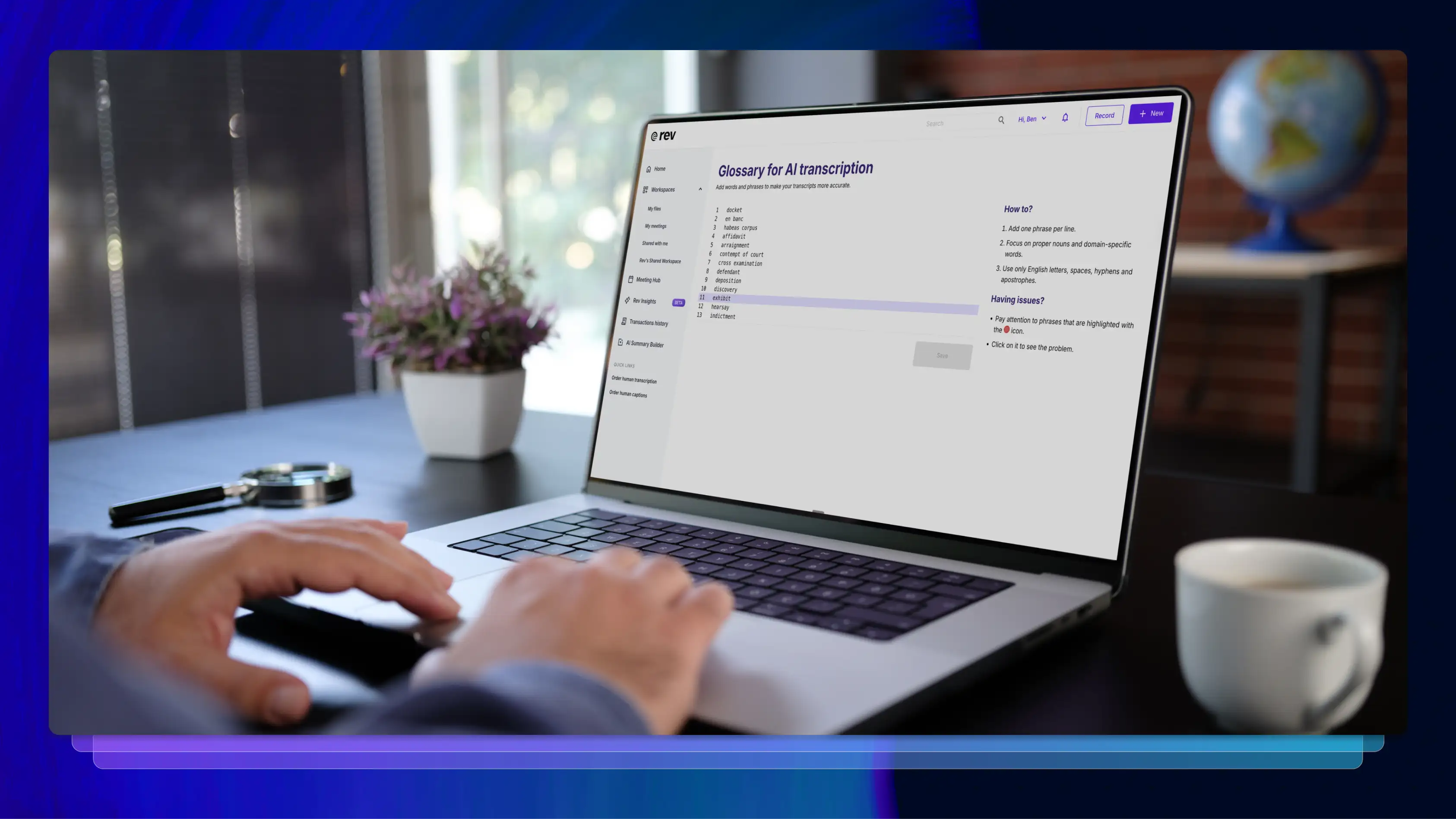
Rev’s custom glossary tools help eliminate these problems. With a shared list of names, phrases, and practice-specific terminology, you can dramatically improve transcript accuracy and limit the time you spend reviewing or correcting files.
Rev lets you build reusable glossaries, save multiple versions to your account, and attach the right one to any order. Whether you deal with criminal matters, civil litigation, or regulatory work, a tailored glossary ensures every transcript accurately reflects the terms your practice uses. Many legal teams report huge time savings simply by standardizing key names, case-specific terminology, and uncommon jargon.
“Having accurate written records of depositions, client interviews, or witness statements lets me quickly review key points and build arguments, rather than sifting through hours of audio,” says Robert Southwell, Criminal Defense Lawyer at Southwell Law.
“It's a massive time-saver for the whole team and ensures we don't miss crucial details. Plus, professional transcripts often pick up nuances that might get lost if you're just taking notes.”
Glossaries are supported across Rev’s services, including both human and AI transcription. If you rely on fast-turnaround transcripts, adding a custom glossary helps ensure niche terms are correct from the start. To learn how to set up your first glossary, visit our Glossary Support Page.
What Are The Most Common Legal Terms?
The most common law terms are ones like plaintiff, defendant, jurisdiction, evidence, and verdict. These concepts frequently appear in transcripts and legal documents because they describe the basic roles, processes, and decisions in everyday legal matters.
These terms may be common, but they still need to be captured correctly every time. Rev is built for legal workflows and reliably gets core terminology right, even without a glossary. For teams with specialized vocabulary, a glossary can add an extra layer of accuracy when needed.
What Are Some Criminal Justice Terms?
Some of the most common criminal justice system terms include arraignment, indictment, probable cause, felony, misdemeanor, and reasonable doubt. These terms describe the major stages of a criminal case. You’ll also see courtroom terms such as warrant, plea bargain, sentence, and probation, which outline how a case proceeds and what happens if a defendant is convicted.
Because criminal proceedings rely on precise terminology, accurate transcripts are an essential tool for attorneys, investigators, and courts. Rev’s custom glossaries help legal teams ensure that these high-stakes terms are captured correctly every time. As Jeffrey Reisman, lawyer at Jeffrey Reisman, puts it, “Rev is great when I need human transcription at high levels of accuracy, especially when dealing with technical language or multiple speakers.”
Put Accurate Legal Terminology to Work
Precision matters at every stage of legal work, and a shared list of key legal terms helps ensure your transcripts support strong case preparation. With Rev’s custom glossaries, you can standardize terminology, improve accuracy, and get transcripts your team can rely on.
Whether you're building a glossary for a single matter or clarifying terminology for a full practice area, Rev makes it fast, simple, and cost-effective.