Best Harvey AI Alternatives for Attorneys (+Accuracy Comps)
The best legal AI tools help attorneys address specific needs, optimize firm workflows, and improve client cases. See how these Harvey AI competitors compare.

.webp)
Several legal AI tools have cropped up over the years, promising to streamline lawyers’ workflows and save them time. One of the tools you’ve likely heard a lot about is Harvey AI, an AI assistant designed for legal and professional services.
The platform’s claim to fame is its domain-specific knowledge, having been trained on legal data and built on OpenAI’s GPT technology. However, its broad focus on document analysis, legal research, contract review, and drafting – along with its enterprise model – means it may not be suitable for all types of legal teams and their needs.
If you’re looking for Harvey AI alternatives, below is our breakdown of how similar legal AI tools compare.
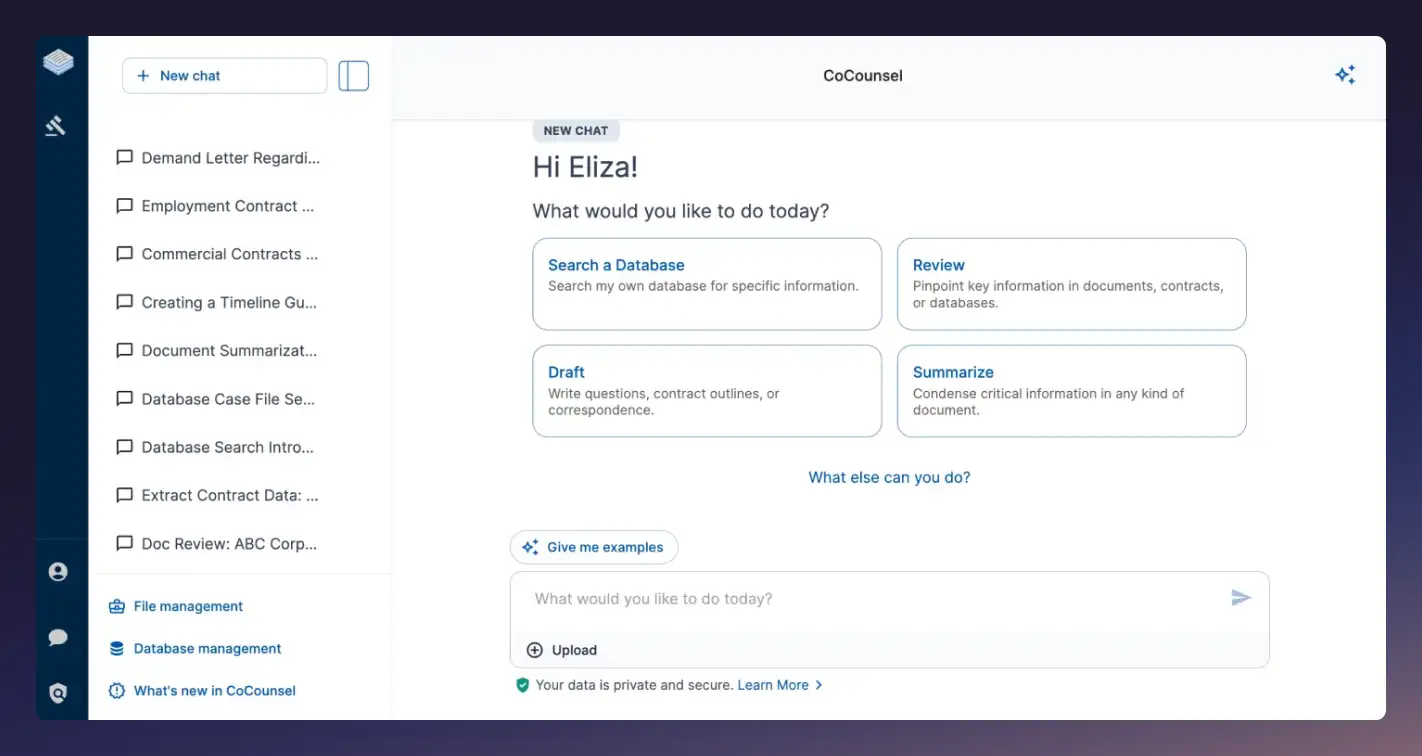
1. CoCounsel by Thomson Reuters
CoCounsel is an AI-powered legal assistant built on OpenAI’s GPT technology. The tool was trained specifically on legal content, including case law and legal materials.
Its biggest capabilities are document review, deposition preparation, contract analysis, and legal timeline creation. The platform is also trusted for legal research as it integrates with Westlaw Precision and provides verified citations.
CoCounsel is particularly valuable for litigation-focused firms and document-heavy practice areas, offering skills like automated contract risk identification, deposition outline generation, and comprehensive legal research memos. Unlike Harvey’s enterprise-only focus, CoCounsel offers more accessible pricing tiers while maintaining enterprise-grade capabilities, making it a strong Harvey AI alternative for firms that want powerful AI without committing to enterprise-level contracts.
Price: Starts at $225/user/month.
Accuracy: 89.6%
Pros:
- Established credibility from Thomson Reuters
- Access to Westlaw’s extensive legal database
- Offers deposition preparation tools
- Inline citations for verification
- More accessible than Harvey for mid-sized firms
Cons:
- Pricing higher than some alternatives
- Full research capabilities require Westlaw Precision subscription
- Core product doesn’t include case law research
- Limited to 50 results per database search
What Customers Say: “It is quick to search and allows for searches by citation, keyword, or phrase. It allows me to obtain case law and statutes very quickly and can copy and paste citations for research,” says G2 user James M.
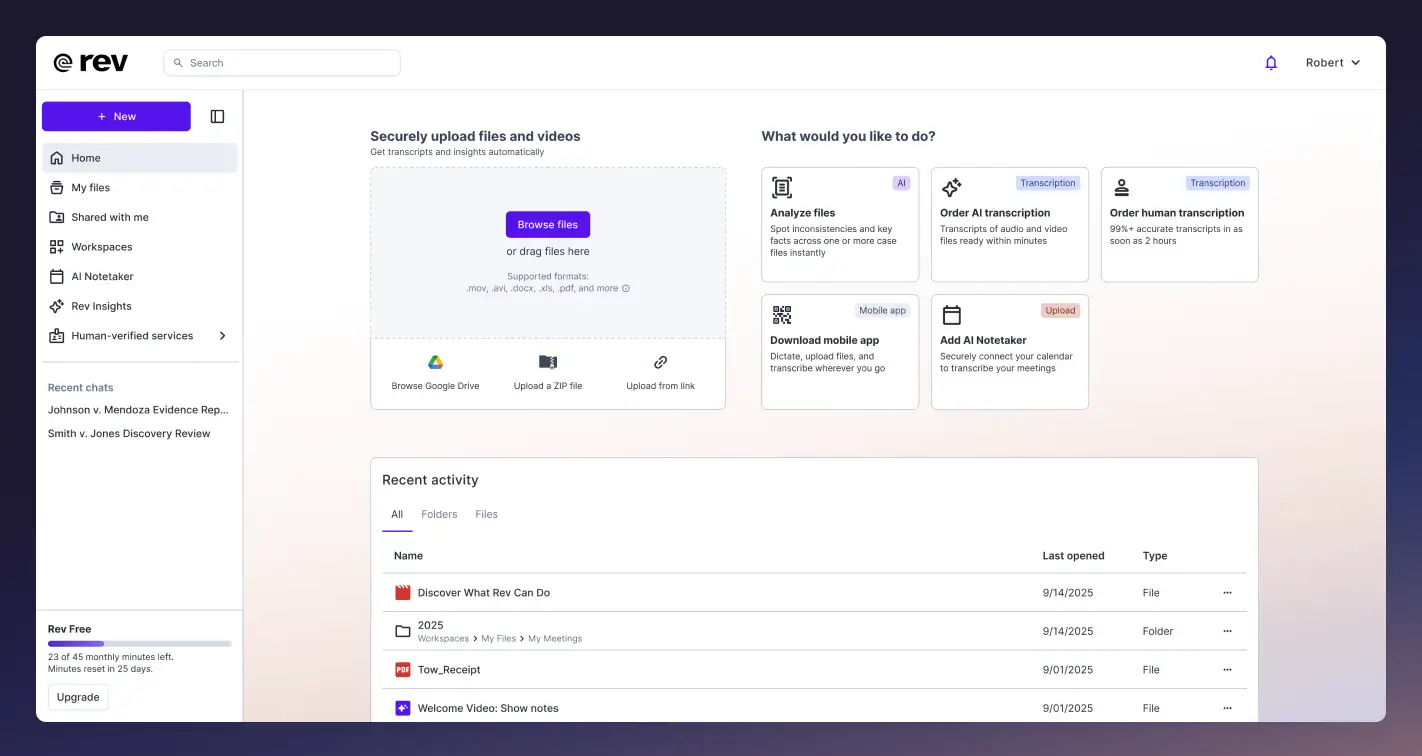
2. Rev
While Harvey offers broad legal AI capabilities, Rev focuses specifically on what general-purpose AI tools consistently fail at: legal-grade transcription accuracy. Rev’s speech-to-text achieves 96%+ accuracy with AI-only processing and 99% with human verification. This is a critical distinction when a single misheard word in testimony can change case outcomes. The high accuracy rate makes Rev essential for litigation work where Harvey’s document-focused AI falls short.
Firms can also use Rev to process and analyze multiple pieces of evidence at once. With Multi-File Insights, litigation practices can upload a combination of case documents, video interviews, and recorded statements. The platform’s AI insights help spot contradictions and patterns across multiple files, always including precise citations to the original source. The AI capabilities extend to prompts that help automate tasks, complete with industry-specific prompt templates or customizable, repeatable ones built for your firm’s workflow.
Price: Limited free tier, pay-as-you-go options, and paid plans starting at $29.99 per user/month.
Accuracy: 96%
Pros:
- Legal-grade accuracy far exceeds general AI tools
- Human-assisted quality control prevents costly transcription errors
- Processes deposition summaries in minutes versus days of manual work
- Multi-file analysis spots testimonial inconsistencies across depositions
- SOC 2 Type 2, HIPAA*, and GDPR compliant
- Handles audio and video evidence that document-focused platforms miss
Cons:
- Specialized for transcription and depositions rather than comprehensive legal AI
- AI summaries may require attorney review for accuracy
What Customers Say: “[The transcripts] help me recall the conversation, the action that I need to take or directives I need to give to others, and it can provide me with key points I need to use on direct examination of witnesses and cross examination of witnesses,” says G2 user Shelley T.
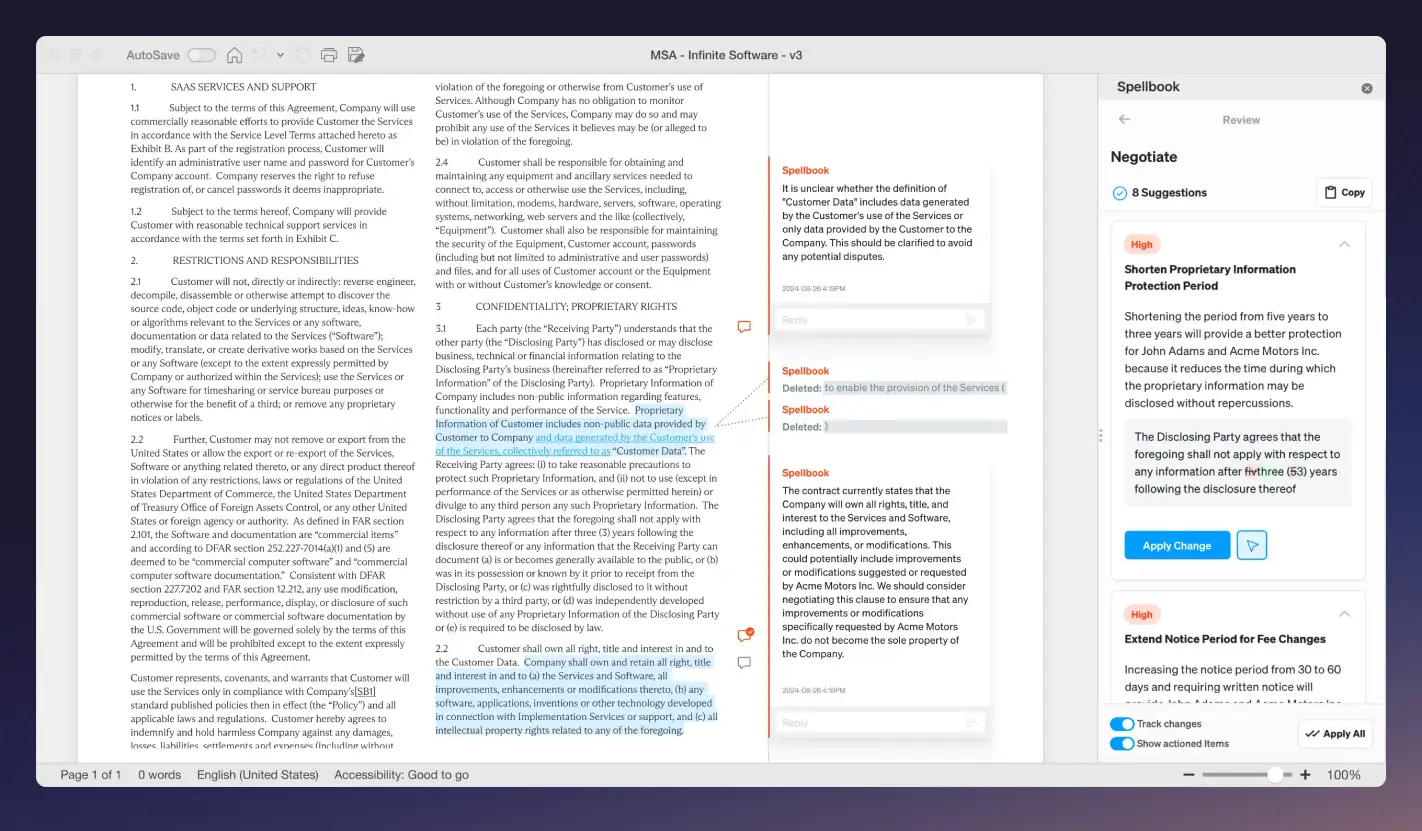
3. Spellbook
Spellbook is a Microsoft Word-integrated AI assistant specifically designed for commercial lawyers working on contracts. It provides AI-powered contract drafting, redlining, and review directly within Word’s interface.
The platform learns from your firm’s style and precedents, adapting to your tone, clause preferences, and risk tolerance in real-time. Spellbook stands out by comparing contracts against over 2,000 industry benchmarks. It also integrates with Practical Law for grounded, precedent-based suggestions rather than hallucinated content. Spellbook is a strong Harvey AI alternative for contract-focused work, offering better Word integration and more transparent implementation than enterprise-only solutions.
Price: Starts at $179/user/month for mid-tier plans (custom pricing based on team size and features; requires demo for exact quote). 7-day free trial available.
Accuracy: N/A
Pros:
- Seamless Microsoft Word integration means no workflow disruption
- Learns firm-specific style and preferences
- Compares contracts to over 2,000 benchmarks
- Strong security (SOC 2 Type II, GDPR, CCPA)
Cons:
- Custom pricing lacks transparency
- Primarily focused on contracts
- Learning curve for maximizing AI suggestions
What Customers Say: “Spellbook helps summarize complex contracts in very simple and non legal terms which is super useful for communicating with non lawyer-stakeholders in the company,” says Trustpilot user Jonathan C.
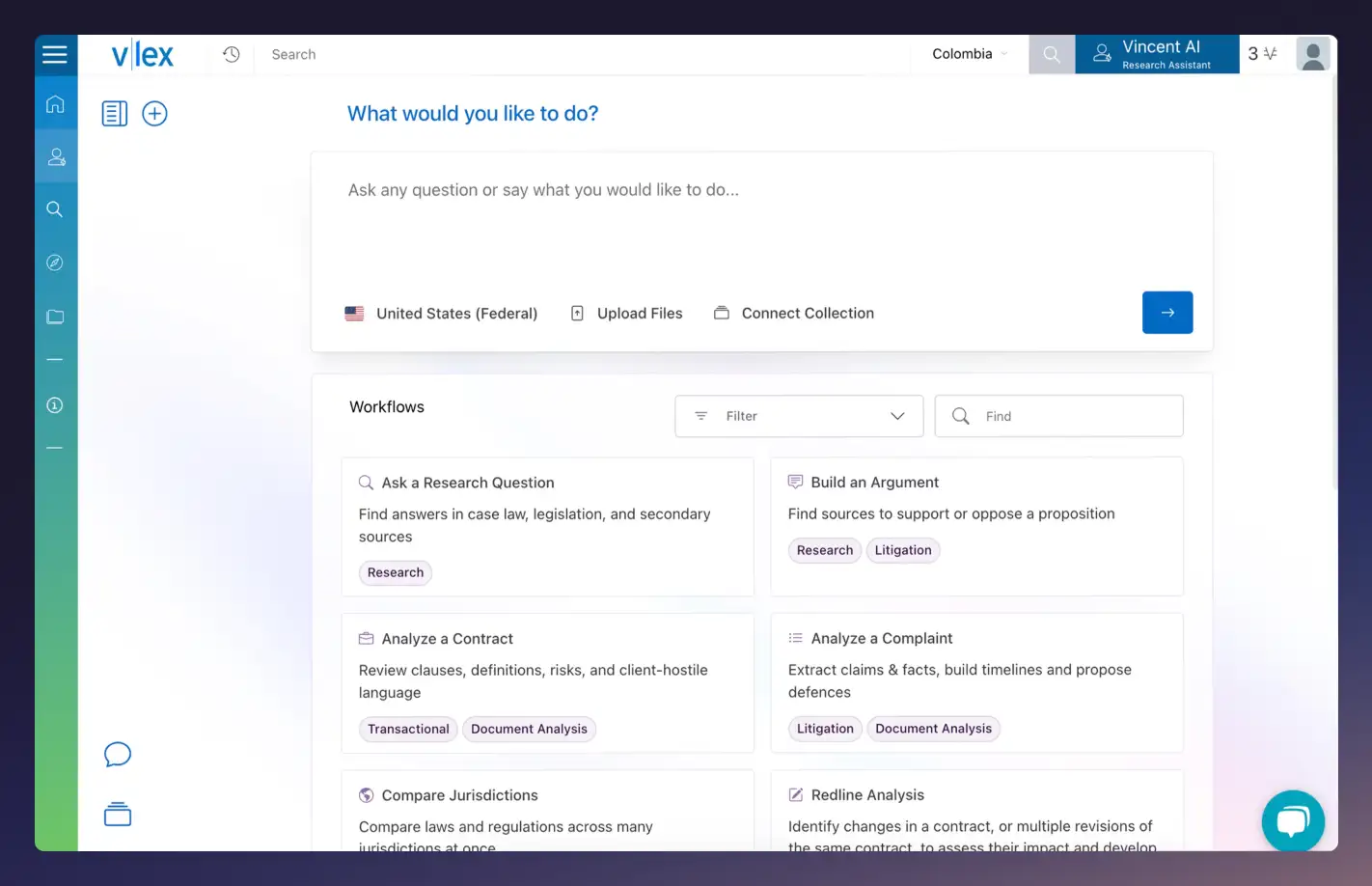
4. Vincent AI by Clio
Vincent AI is Clio’s enterprise-level research and intelligence platform. The tool offers AI-powered legal research within its practice management system. For Clio users, this integration is a convenient way to eliminate context-switching.
Vincent also offers over 20 pre-built workflows spanning research, transactions, and litigation intelligence. These structured, task-based workflows help streamline everything from contract and redline analysis to document comparisons.
Price: Clio Work (which includes Vincent AI, Clio Library, and deep Clio Manage integration) is $199/user/month.
Accuracy: 72.7%
Pros:
- Integrated with practice management features
- Access to over one billion legal documents across 110 jurisdictions
- Vincent Studio allows custom workflow creation
- Convenient for firms already using the Clio ecosystem
Cons:
- Less powerful if you use a different practice management software
- Enterprise features like Vincent Studio are not available to all tiers
- Less established legal research tool compared to alternatives like Westlaw/LexisNexis
What Customers Say: “I find the continuous rollout of new initiatives like Clio Pay and Clio accounting, along with powerful AI-generated integrations, valuable as they make Clio a one-stop solution for law firm management and profitability,” says G2 user Molly S.
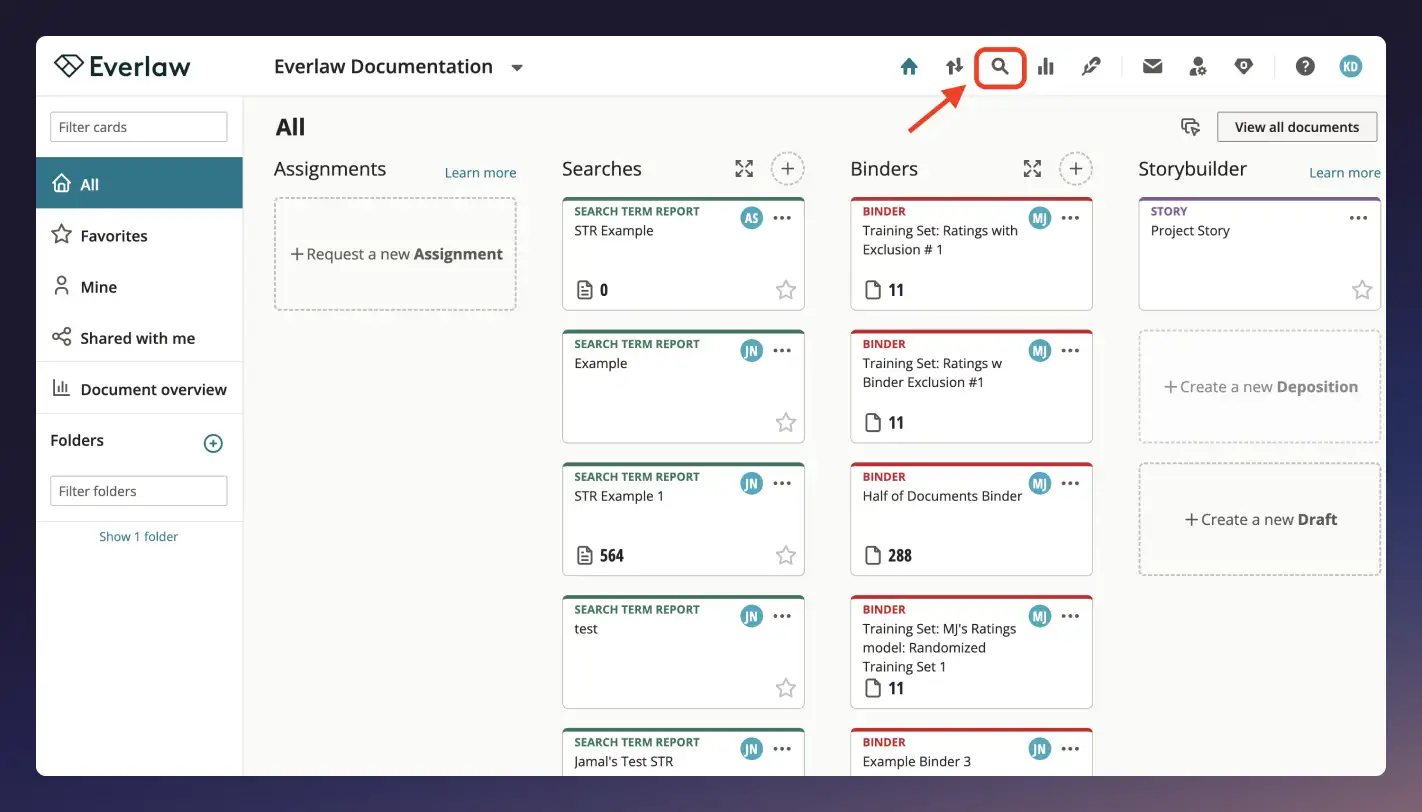
5. Everlaw
Everlaw is an e-discovery and litigation platform. Their recently launched Deep Dive, a generative AI feature, allows legal teams to ask questions across entire document collections and receive citation-backed answers in seconds. Deep Dive also reduces hallucination risks by searching exclusively within uploaded documents and explicitly states when it cannot find evidence.
Often compared to Relativity, Everlaw’s AI capabilities extend beyond research. Its core features include Review Assistant for document analysis, Writing Assistant for memos and deposition prep, Deposition Analyzer, and Coding Suggestions. Everlaw is best for litigation-heavy practices that need powerful e-discovery capabilities.
Price: Per-gigabyte pricing; custom quote required.
Accuracy: 85%
Pros:
- Deep Dive handles high file volumes
- AI features are included in base pricing
- Designed to minimize hallucinations
- SOC 2 compliant
Cons:
- Primarily focused on litigation and e-discovery
- Pricing lacks upfront transparency
- High learning curve for complex AI features
- Per-gigabyte pricing can be expensive
What Customers Say: “The predictive coding and document clustering aren’t very helpful features for my firm. I can see the predictive coding being helpful if we invest time into training the AI, but I don’t see the same potential payout for document clustering,” says G2 user Elijah H.
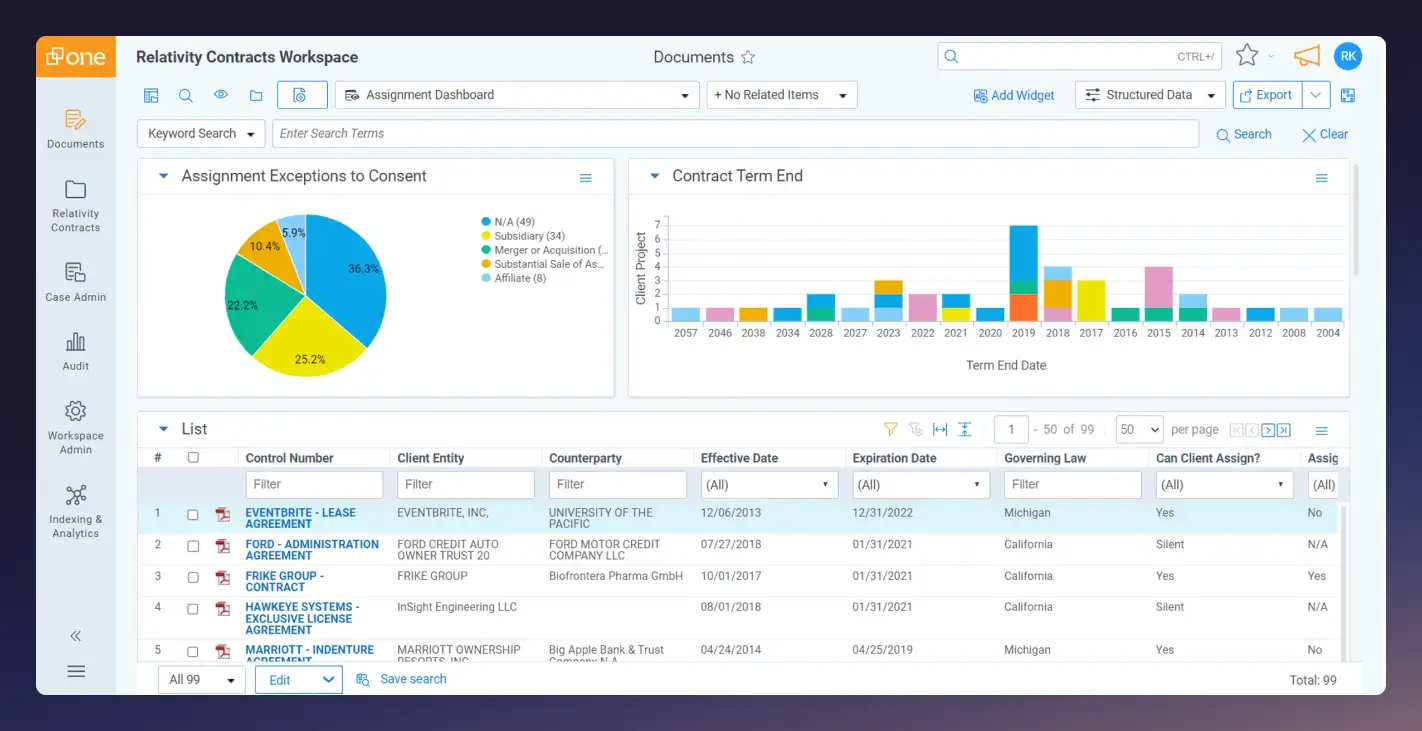
6. Relativity
Relativity is a global legal technology leader known for its e-discovery capabilities. The platform offers a comprehensive aiR (AI for Relativity) suite of generative AI solutions, which includes three products:
- aiR for Review: Document review and responsiveness determination
- aiR for Privilege: Privilege and work-product analysis
- aiR for Case Strategy: Fact extraction, chronology building, and witness prep
The aiR suite is capable of reviewing up to three million documents per day, and it also offers document-level citations with transparent explanations.
As a Harvey AI alternative, Relativity offers e-discovery depth with AI, making it ideal for organizations with substantial litigation needs. The platform is built on Microsoft Azure’s OpenAI services and offers enterprise-grade security with zero data retention.
Price: Custom per-organization pricing based on data volumes and workflows.
Accuracy: N/A
Pros:
- Processes up to three million documents per day
- Document-level citations with rationale
- FedRAMP authorized for government work
- Microsoft Azure integration ensures data security (ISO 27001, SOC 2, FedRAMP)
Cons:
- Less comprehensive than other legal AI tools
- Can be complex and expensive
- Custom pricing lacks upfront transparency
- Some features require prompt engineering skills
What Customers Say: “Due to its powerful functionality, the deployment environment is relatively complex, involving comprehensive skills and knowledge in hardware, software, systems, networks, and security,” says G2 user Tony W.
Why Use a Harvey Alternative?
You might want to use a Harvey AI alternative if you’re a solo practitioner, small firm, or mid-sized organization, as Harvey may be too expensive or complicated for your needs.
Key reasons to consider Harvey alternatives:
- Cost efficiency: More specialized platforms deliver strong value at a fraction of Harvey’s enterprise pricing.
- Accessibility: Most alternatives offer transparent pricing, free trials, and month-to-month billing rather than requiring sales demos and annual contracts.
- Specialization: Several tools offer deeper capabilities in specific practice areas. For example, Rev can be used for transcription and multimedia evidence analysis while Everlaw is for e-discovery.
- Workflow integration: Options like Vincent AI and Spellbook work within your existing tools.
- Firm size compatibility: Many alternatives are designed for solo practitioners and small-to-mid-sized firms, not just enterprise organizations.
- Transparent performance data: Independent benchmarks allow you to compare actual accuracy metrics rather than relying solely on vendor claims.
Harvey has established itself as a premium legal AI platform for large law firms and Fortune 500 companies, but the enterprise-level pricing and implementation requirements put it out of reach for smaller teams.
Beyond Harvey’s pricing, the platform’s broad approach may actually be excessive for firms with focused needs. For example, a litigation-heavy practice doesn’t need advanced contract benchmarking tools, just as a transactional firm has little use for deposition analysis. By choosing alternatives tailored to your firm’s focus, you avoid paying for features you’ll never use while gaining deeper expertise in the tools that matter most to your practice. Learn more about other Harvey alternatives, like Trialkit, on our blog.
Key Features To Look For In Your Legal Tech
The right legal AI software should enhance your existing legal work rather than complicate it, while providing verifiable accuracy and robust security. Focus on platforms that offer transparent citations, document-level verification, and explicit statements when they cannot answer a question.
Combined, these features offer legal AI architecture that’s designed to prevent the hallucinations that many general-purpose AI tools often generate. Your chosen tool should integrate seamlessly with software your team already uses — whether that’s Microsoft Word, practice management systems, or document repositories — to minimize disruption and maximize adoption.
Essential features for legal AI tools:
- Verified citations and sources: Prioritize platforms that search only within uploaded documents or legal databases to prevent hallucination. Tools should provide citations with page-line references, not generic, unverifiable answers.
- Practice area specialization: Match the tool to your work, whether that’s e-discovery platforms for litigation or transcription tools for depositions. Specialized tools are designed to be more powerful and effective than broad platforms.
- Security and compliance: Look for SOC 2 Type II, ISO 27001, HIPAA compliance, and zero data retention policies.
- Integration capabilities: Seamless connection to Microsoft Office, Google Workspace, practice management systems, or legal research databases.
- Transparent pricing: Clear per-user or per-GB pricing rather than opaque enterprise-only quotes.
- Human verification options: Ability to escalate AI outputs to human review for high-stakes matters.
- Batch processing: Capability to analyze multiple documents simultaneously for due diligence, discovery, or comparative analysis.
- Workflow customization: Tools that allow you to create firm-specific templates, precedents, and processes.
- Training and support: Access to comprehensive onboarding, documentation, and responsive customer service.
Steps To Optimize Your Firm’s Workflow
Selecting a legal AI tool requires a methodical approach. The process should balance your firm’s specific needs with practical constraints like budget and technical capacity.
Start by auditing your current workflows to identify the most time-consuming, repetitive tasks that AI could handle. Potential tasks to automate include document review, contract drafting, deposition summarization, or legal research. This assessment helps you choose specialized tools rather than overpaying for broad platforms with features you’ll never use.
Once you’ve identified your needs, take advantage of free trials to test two to three tools using actual case files. Measure time savings, accuracy, and user adoption during these trials, then select the tool that delivers the best combination of performance and value.
Implementation should be gradual. After a trial period, develop internal best practices and protocols. Then expand firmwide once you’ve proven ROI and addressed any ethical or workflow concerns.
Why Rev is the Best Harvey Alternative
There’s no shortage of tools available for legal teams. Harvey AI may be a comprehensive AI assistant, but its enterprise-focused approach makes it less accessible for small, mid-sized, and specialized firms.
The best legal AI tools meet your firm where you’re at, rather than asking you to change the way you work. If you’re looking for cutting-edge AI that won’t break the bank, Rev just might be the answer.
*HIPAA compliance in unlimited plans only