
6 Free Incident Report Templates For Lawyers & More
Download Rev’s free incident report templates for personal injury, law enforcement, workplace accidents, and more. Plus, learn how to write one correctly.


.webp)
A good incident report does two things: it captures exactly what happened while the details are fresh, and it creates a defensible record that holds up later—in litigation, in compliance audits, even in court. Without it, you risk muddling a strong timeline, getting claims dismissed, and a variety of other issues.
To help you get the documentation process down pat, we’ve put together six free incident report templates covering the most common professional use cases: personal injury law, law enforcement investigations, workplace accidents, HR, insurance investigations, and IT security. (We also have legal brief templates if you need those too)
If you’re in a hurry, use the button below to jump straight to the templates. If you want to understand what makes a report work, and how to create a robust one of your own, keep reading.
What Is An Incident Report?
An incident report is a formal written document that records the facts of an unexpected event such as what happened, when, where, who was involved, what was observed, and what actions were taken in response. It is not a narrative, an opinion, or an analysis. It’s a factual record.
Incident reports are used across industries, from law firms to boardrooms and everything in between. The format varies by context, but the purpose generally remains the same.
“A strong incident report should allow someone unfamiliar with the case to understand exactly what happened without needing extra explanation,” explains Jack Charman, Private Investigator at National Private Investigators.
Who Should Write An Incident Report?
The person who should write an incident report is the one closest to the incident. That way, the most accurate record of what happened is created as soon as possible. However, it’s important to keep in mind that more detail is often required from witnesses, supervisors, and other industry professionals.
Here’s what that means in potential real-world scenarios:
- Legal Matters: An attorney or investigator brought onto the case by any involved party.
- Law Enforcement Incidents: The officer or detective on scene.
- Insurance Investigations: The claims adjuster or insurance agent on scene.
- Workplace Injuries: The supervisor or the injured employee’s direct manager.
- HR Matters: The HR professional handling the complaint.
- IT Incidents: The IT team member directly involved in the incident, or a superior.
When Do You Need To Create An Incident Report?
An incident report should be created any time an unexpected event occurs that could affect safety, legal liability, employment status, or compliance obligations. This includes injuries, property damage, security breaches, harassment complaints, use-of-force incidents, accidents under investigation, and other unique events.
TLDR: If you’re asking, the answer is almost certainly yes. Failing to document an incident immediately creates problems that are much harder to fix down the line. You cannot recreate the immediacy of a firsthand account. A report written two weeks after the fact (or assembled from memory during litigation) carries far less credibility than one completed the same day.
1. Personal Injury Incident Report Template
Personal injury attorneys use incident reports as a cornerstone of case documentation. A strong personal injury incident report documents the scene, the injury (learn more about medical chronology on our blog), witness accounts, and any available evidence. It also captures the opposing party’s account, which can be critical for establishing liability.
Use this template at intake for slip-and-fall, vehicle accident, premises liability, mass tort cases, and product liability matters.
Best for: Personal injury attorneys, paralegals, and legal intake staff documenting client injury events for civil litigation.
2. Law Enforcement Investigator Incident Report Template
An effective incident investigation report needs to capture more than the surface facts. It needs to document the chain of evidence, note discrepancies between accounts, and create a record detailed enough to support both prosecution and any subsequent legal challenge.
This template is built for investigators and detectives, those who’re digging into the details of a case rather than patrolling the street. Complete this as soon as you can after an incident occurs, and return to it frequently to log evidence changes, contact witnesses, and update the case status.
Best for: Criminal investigators, detectives, and SIU professionals building investigative case documentation.
3. Workplace Accident Incident Report Template
This workplace incident report form is designed to capture the information you’ll need for any workers’ compensation claims, internal workplace safety reviews, or accident investigations that follow an accident.
This template works across industries: construction, manufacturing, office environments, retail, and anywhere else employees are at risk of injury. It documents the accident itself, immediate medical response, root cause factors, and the corrective action plan, which is the piece most likely to matter if a similar incident occurs in the future.
OSHA requires employers to document work-related injuries and illnesses, and retain those records for at least five years. So make sure you are up to speed on OSHA requirements before getting started.
Best for: Safety managers, supervisors, and teams documenting workplace injuries, near-misses, and OSHA-reportable events.
4. HR Incident Report Template
HR incident reports document employee-related events that don’t fit neatly into a physical injury framework: harassment complaints, workplace misconduct, discrimination claims, policy violations, hostile work environment allegations, and similar matters. These reports are both an internal documentation tool and, potentially, a legal record.
An HR incident report documents what happened, who observed it, and what actions were taken. The key objective is to refrain from drawing conclusions or assigning blame until an investigation is complete. Doing so protects both the organization and the individuals involved.
Best for: HR professionals, employment attorneys, and managers documenting workplace conduct complaints and policy violations.
5. Insurance Investigation Incident Report Template
Insurance claims investigators and Special Investigations Unit (SIU) professionals work cases that often hinge on documentation: is the claimed incident consistent with the physical evidence? Do witness accounts align? Is there a prior history that affects the claim?
A well-structured insurance investigation report documents the facts of the incident, flags inconsistencies for follow-up, and creates a record that can support a coverage determination, a negotiation, or litigation if the claim is disputed. For more guidance on insurance investigations, see our guides on policy limit investigations and insurance transcription services.
Best for: SIU investigators, claims adjusters, and insurance defense attorneys investigating disputed or potentially fraudulent claims.
6. IT Security Incident Report Template
An IT security incident report documents digital events that threaten systems, data, or operations such as breaches, unauthorized access, ransomware, and phishing attacks. This template is designed for IT and security teams that need a structured format for documenting incidents from detection through resolution—covering affected systems, response actions, and lessons learned.
Unlike other incident types, IT security reports often need to support multiple audiences simultaneously: internal leadership who want a clear summary, technical teams who need forensic detail, and legal or compliance teams who may require the report to meet regulatory documentation standards.
Best for: IT security teams, CISOs, and compliance officers documenting security incidents, data breaches, and system intrusions.
How To Create And File An Incident Report In 6 Steps
Regardless of the template you use, the process of creating a strong incident report follows the same sequence. Here’s how to do it correctly in just 6 steps:
- Respond first, document second.
- Secure the scene, address injuries, and stabilize the situation before starting paperwork. No report is worth compromising safety or delaying medical care. That said, start documenting as soon as it’s safe to do so—accuracy degrades quickly.
- Gather facts, not interpretations.
- Collect the who, what, when, where, and how from every available source: your own observations, witness accounts, physical evidence, and recordings. Use specific, measurable language and avoid blame, speculation, and characterizations.
- Interview witnesses immediately.
- Witness statements collected within the first few hours are significantly more accurate than those gathered later. Get contact information, statement summaries, and signatures. If the interview is recorded, note the file reference in the report.
- Document evidence and chain of custody.
- Photograph the scene, preserve physical evidence, and note the location of any recordings or digital evidence. For legal and insurance contexts, document who has custody of each piece of evidence and when it was collected.
- Complete the report in full.
- A partially completed incident report is almost as problematic as none at all. Missing fields become vulnerabilities in litigation, audits, and investigations. If a section doesn’t apply, note N/A rather than leaving it blank. That's part of a good evidence management strategy for audits and other types of legal events.
- Route and file according to protocol.
- Know your organization’s filing requirements before an incident happens. That way, you know exactly what to do when you finish an incident report, and there are no delays in the reporting process.
“Standardized reporting makes investigations easier to follow and harder to challenge,” explains Charman.
“When reports follow the same structure, supervisors can quickly spot missing information, and different teams can pick up a case without confusion. Over time, it helps identify patterns across cases, which is useful in repeat or long-running investigations. Most importantly, it forces clarity between what was directly observed and what was interpreted, which reduces the risk of reports being seen as unclear or biased.”
Incident Report Examples And What You Can Learn From Them
Here’s what separates a strong incident report from a weak one, illustrated through two versions of the same workplace injury scenario.
Weak Example:
“At approximately 11 am, employee John S. slipped and fell in the warehouse. He hurt his leg and was taken to urgent care.”
This report lacks specific information incident reports require. There’s no precise time, location within the warehouse, description of the cause, witness accounts, description of the injury severity, and no corrective action. If this incident led to a workers’ compensation dispute or litigation, this report wouldn’t provide much value.
Strong Example:
“At 11:14 AM on 11/02/2025, employee John S. (warehouse associate, 3 years in role) slipped on a wet concrete floor near the northwest loading dock (bay 4). A liquid spill from a burst container had been present for approximately 20 minutes prior to the incident; no wet floor sign had been placed. John fell approximately 3 feet to his right side, striking the concrete. He reported immediate pain in his right hip and lower back.
First aid was administered on site by supervisor Maria T. at 11:18 AM. John was transported to St. David’s at 11:40 AM for evaluation. X-rays were taken; results pending.
Two witnesses present: Frankie L, (Contact: 555-5555), and Kendell K (Contact: 555-555).
Photographs of the scene taken at 11:22 AM [file: 1234].
Corrective action: spill cleanup protocol revised; additional signage ordered.
Responsible party: Logistics Manager Lauren M. Completion date: 11/02/2025.”
The second version gives you a defensible record. It tells a complete story, uses specific and measurable language, documents the cause and contributing factors, captures witness information, and includes a corrective action plan. It’s the version that will hold up in an investigation.
Automating the Incident Reporting Process
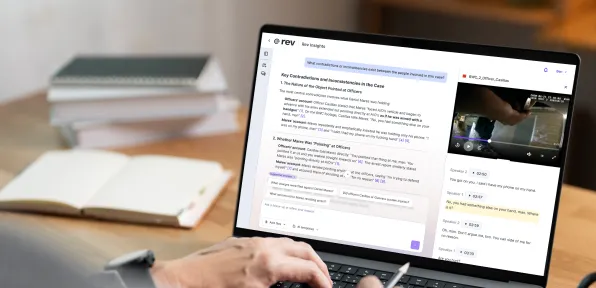
The hardest part of incident reporting isn’t filling out a form—it’s the investigation that precedes it. Witness interviews, recorded calls, surveillance footage, and field recordings all need to be reviewed, organized, and synthesized into a coherent account. That process is time-consuming, and the longer it takes, the more accuracy erodes.
AI-powered transcription and evidence analysis tools are changing how investigators and attorneys approach the documentation process. Rather than manually reviewing hours of recorded interviews or calls, investigators can automatically transcribe their files, search across all their documents, and flag key moments in an instant.
For legal and insurance professionals specifically, evidentiary standards matter. General-purpose transcription tools may get the words right, but they often don’t account for chain of custody, legal-grade accuracy, or cite all their sources. That’s where a purpose-built platform makes a meaningful difference.
Rev’s platform processes audio and video evidence with every output tied to a timestamp from the original recording—so when you cite a witness statement in an incident report, you can verify it.
Build A Strong Case Foundation
Whether you’re a personal injury attorney capturing the facts of a client’s accident, a detective building a case from recorded interviews, or an HR professional documenting a workplace complaint, the quality of your incident report shapes everything that follows.
Make sure you’re documenting properly by adding Rev to your tech stack. With Rev, you can easily turn recorded interviews, witness statements, and audio evidence into accurate, searchable, citable documentation you can build a strong case on.
Note: These templates are starting points and should be reviewed by a licensed attorney for use in specific jurisdictions. Individual requirements may vary.


.webp)
.webp)
.webp)