Educational Technology Trends Shaping Higher Education
Edtech is no longer just a competitive advantage. For many institutions, it's a legal necessity. Learn more about the biggest trends shaping the industry.


Higher education is in the middle of a technological revolution. From AI-powered tutoring to new federal accessibility mandates, the tools and rules shaping campus life are changing fast.
The DOJ finalized new ADA Title II regulations in April 2024, establishing enforceable tech standards for digital accessibility in education (due in April 2027-2028, population dependent).
TLDR: Edtech is no longer just a competitive advantage; it's a legal necessity.
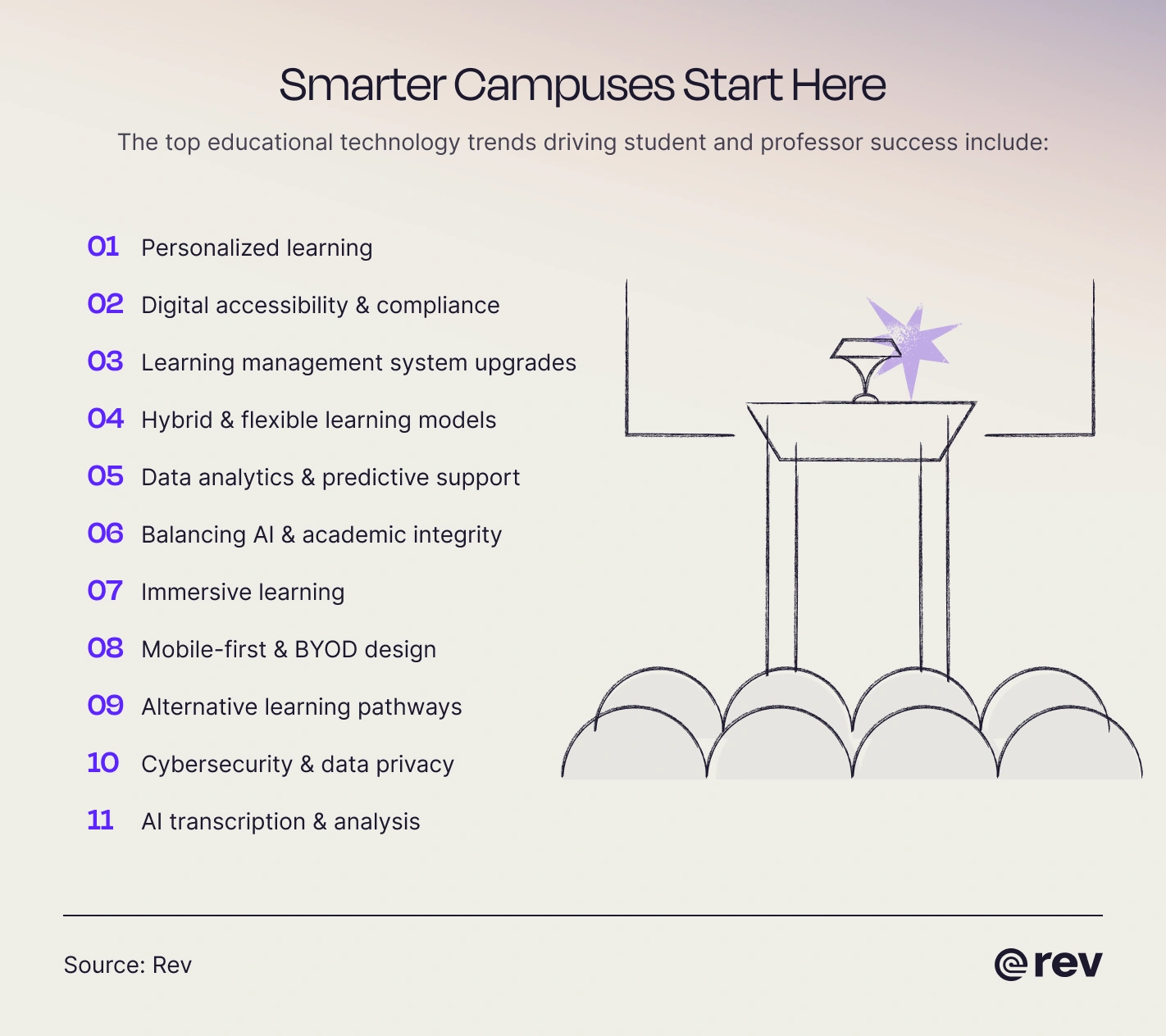
Institutions that keep pace with today's educational technology trends and accessibility guidelines won't just improve student outcomes. They'll meet critical legal obligations, too. Here's a look at the key trends defining higher education technology right now.
1. AI-Powered Personalized Learning
Artificial intelligence (AI) has moved from novelty to infrastructure, and it's reshaping how students learn.
Today's learning platforms use machine-learning algorithms to adapt content, pace, and difficulty to individual learners in real time. AI tutors can answer questions on demand, guide students through complex topics, and surface struggles before they become bigger issues.
According to the Digital Education Council's 2026 study, 92% of students and 79% of faculty already use AI tools on a regular basis.
For faculty, this means less time on routine support and more time on high-value instruction. For students, it means a learning experience that actually responds to them — not a one-size-fits-all curriculum.
“We're excited by the hugely positive impact AI can make in higher education, particularly when it comes to AI tutors and personalizing students' learning experiences,” says Sophie Thompson, Co-Founder and CEO of VirtualSpeech.
“We've already started seeing that when students receive feedback tailored to their individual performance and level, they feel more engaged and motivated to develop their skills. As the technology continues to evolve, AI will be able to provide access to quality, personalized learning and feedback across entire universities."
2. Digital Accessibility And ADA Title II Compliance
This is the trend every higher education institution must act on immediately.
The Department of Justice finalized new ADA Title II regulations requiring that all digital content meet WCAG 2.1 Level AA standards. That includes websites, mobile apps, LMS platforms, course materials, and videos. Videos now require both captions and audio descriptions — a requirement many institutions are severely underestimating.
“For years, institutions viewed ADA compliance as something you do one time and then put away. That model is breaking down quickly,” says Jayanand Sagar, Co-Founder and COO of Hyperbola Network.
“The institutions that are getting in front of this are approaching accessibility as an ongoing operation function…teams addressing accessibility as a system property may reduce their accessibility remediation backlog by 60% in one academic year.”
Tools like AI-powered captioning and transcription are among the fastest ways to close the compliance gap. Rev's video accessibility checklist is a good starting point for institutions to assess where they stand and get in compliance fast.
3. The Evolution Of The Learning Management System
Today's learning management systems (LMS) are evolving from static content repositories into adaptive learning ecosystems. AI-driven dashboards now track student engagement, performance trends, and mastery levels in real time. Predictive analytics can even flag dropout risks before a student ever misses an assignment.
The evolution of LMSs is one of the biggest trends in education, largely due to their sheer convenience. When data can flow freely between systems already in place across universities, both students and faculty benefit.
Using an LMS that supports this kind of integration is now an institutional priority — not just an IT decision. Not sure where to start? Check out Rev’s guide to choosing a learning management system.
4. Hybrid And Flexible Learning Models
Students expect flexibility when it comes to education. Institutions that offer hybrid learning options have a real advantage in both enrollment and retention.
In fact, Edtech AI news has shown that the U.S. makes up over 35% of global e-learning usage in the last few years, a shift that correlates directly with the expansion of mobile and flexible learning options.
For faculty, this shift means rethinking how lectures are captured, captioned, and made accessible to students learning on their own schedule. Investing in lecture transcription is one of the simplest and highest-impact steps an institution can take.
5. Data Analytics And Predictive Student Support
Institutions are sitting on enormous amounts of student data. The ones winning in this new digital learning environment are the ones actually using it.
Advanced analytics tools help advisors intervene early — sometimes before a student knows they're struggling. Institutions are connecting admissions data, academic performance signals, and engagement metrics to build proactive support plans from day one.
This shift toward evidence-based learning represents a fundamental change in how universities think about student success. It moves institutions from reactive to predictive, and from gut instinct to data-driven decisions.
6. Generative AI, Academic Integrity, And Assessment
Generative AI has ignited one of the most important debates in the edtech industry: how do you maintain academic integrity when a student can generate a passable essay in seconds?
Forward-thinking institutions aren't trying to ban their way out of this challenge. They're redesigning assessments and student performance metrics entirely. Oral exams, project-based evaluation, and AI-assisted feedback loops are replacing one-size-fits-all written tests. AI detection tools are becoming standard features in LMS platforms.
The goal is to prepare students to work alongside AI — not just avoid it. That means rethinking what skills we're actually measuring, and why.
7. Immersive Learning: AR, VR, And Simulation
Virtual reality (VR), augmented reality (AR), and simulations. Whatever you call it, this form of immersive learning is making its way from pilot programs into mainstream classrooms — and it's already proving its value.
Medical schools are using VR simulations for surgical training. Engineering programs are building virtual labs. History classes are recreating historical environments.
These aren't gimmicks. They're genuine instructional tools that deepen comprehension and improve engagement in ways traditional content can't.
As headset costs drop and cloud-based delivery matures, immersive learning is becoming accessible to institutions beyond well-funded research universities. It's one of the most exciting emerging technologies in education to watch over the next few years.
8. Mobile-First And BYOD Design
Students aren't learning at desks anymore. They're learning everywhere.
Mobile-first design — building edtech tools for smartphones specifically — is now central to successful platform adoption. The bring-your-own-device (BYOD) model has made it essential for every piece of content, every assessment, and every support resource to work seamlessly on any screen.
This also intersects directly with accessibility. Assistive UI, multilingual interfaces, and responsive design are baseline expectations in 2026 — not optional add-ons.
9. Micro-Credentials And Alternative Learning Pathways
The four-year degree isn't disappearing — but it's no longer the only credential that matters.
Employers are increasingly recognizing stackable credentials, digital badges, and industry certifications alongside traditional degrees. Platforms that support micro-learning are growing fast, giving students more affordable paths to relevant skills.
For higher ed institutions, this is both a challenge and an opportunity. Those who build flexible learning opportunities will attract learners who might otherwise skip a traditional four-year degree. But it will require a lot of work on the backend, as it’s essentially the creation of new programs from scratch.
Even so, alternative learning options are one of the most significant technological trends in education reshaping the market.
10. Cybersecurity And Data Privacy
More technology means more risk — and institutions are starting to treat security as the mission-critical issue it is.
Student data is highly sensitive. From academic records to financial information, universities are attractive targets for cyberattacks. And unfortunately, all it takes is one hack of internal systems to destroy both student and educator trust.
Institutions that can demonstrate rigorous data security practices (both internally and with external vendors) will come out on top here, especially as LLMs further integrate themselves into every part of the educational process. Bottom line: this is an area where cutting corners is not an option.
11. AI-Powered Transcription And Lecture Capture
One of the most practical and immediately impactful trends in instructional technology is AI-powered transcription.
Recorded lectures, classroom discussions, and webinars are valuable learning assets — but only if students can access and search them. AI transcription makes that possible. It also easily creates the captions and searchable text that ADA Title II compliance requires.
Transcription tools help professors extend the reach of their lecture courses, making content accessible to students who are deaf or hard of hearing, non-native English speakers, and those reviewing complex material at their own pace. Plus, it’s something that can easily be automated, so it won’t add much work to anyone’s plate.
12. Edtech Consolidation And Stack Rationalization
Institutions are drowning in disconnected tools. Districts and universities that brought in dozens of apps during the pandemic years are now rethinking their edtech stacks.
This consolidation trend is a healthy correction. It signals that the edtech industry is maturing — moving from rapid adoption to thoughtful integration. Institutions that audit their tech stacks honestly will likely find they can do more with less.
When beginning this audit, make sure to take into account what tools are actually moving the needle for productivity, analysis, and learning. Survey students and faculty, compare ROIs, and determine what can be consolidated. Then, you can begin to create a new tech stack that works for the real world.
Turning Trends Into Teachable Moments
Understanding these trends is only the first step. The institutions making real progress are translating them into action.
The key is intentionality. Don't adopt technology for its own sake. Adopt it because it solves a real problem, serves a specific population, or meets a compliance requirement you can't ignore. Basically, every tool you bring on should earn its place.
Here are some practical steps to get started:
- Audit your current tools
- Map what you have, identify redundancies, and assess whether each platform is delivering measurable results.
- Prioritize accessibility first
- With new ADA Title II rules on the horizon, start with video caption and audio description platforms to avoid lawsuits and fines.
- Involve faculty early
- Technology adoption fails when educators feel left out of the process. Build champions, not skeptics, by bringing them in at the start.
- Use data to tell a story
- Connect edtech investments to retention, completion rates, and student satisfaction outcomes.
- Consider integration needs
- Every new tool should connect cleanly with your LMS, SIS, and learning analytics platforms.
- Measure outcomes, not outputs
- Don't erode trust by counting logins. Instead, track what matters, including learning gains and student success milestones.
Balancing Tech And Analog In The Classroom
All of this technology is powerful. It's also easy to overdo it.
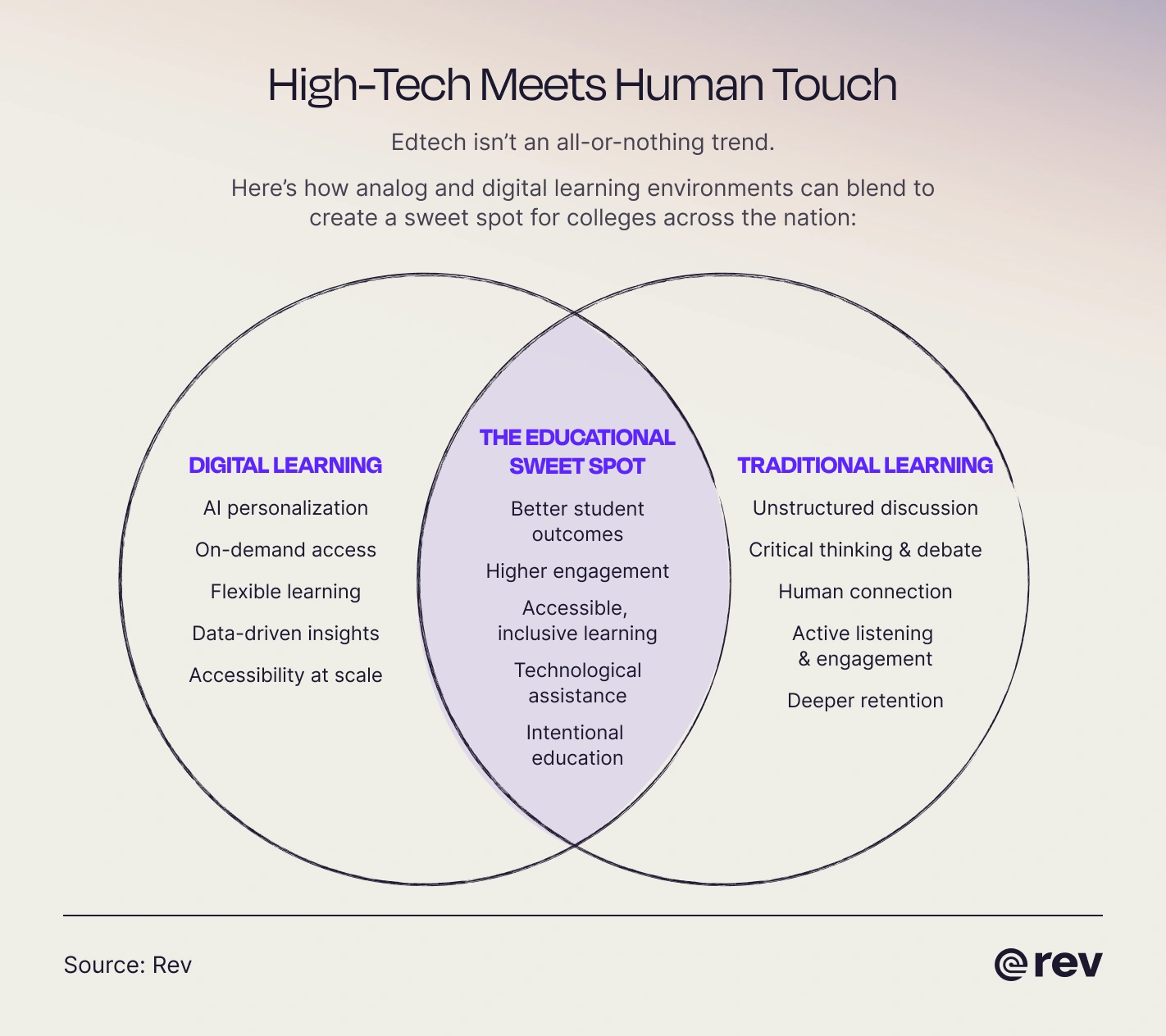
Students still learn best through conversation, debate, and hands-on activities. Research consistently shows that handwritten note-taking improves retention and that unstructured discussion builds critical thinking. A struggling student often needs a real conversation — not a chatbot nudge. These things don't have a digital equivalent, and that's okay.
The debate over edtech effectiveness often comes down to this: technology works when it frees up space for those human moments. It falls flat when it crowds them out.
“The biggest trends shaping the future of accessibility may also be hindering creativity, curiosity, open-mindedness, and thoughtfulness. Kids are increasingly utilizing AI to find answers, and even produce their work for them,” explains Adam Hart, from Notsus, a web browser for kids.
“The things they spend time learning are often more sensational than scientific or philosophical. The consequences brought forth from these trends also leave an opportunity to redefine our learning environments.”
The best educators in 2026 know when to close the laptop. They use technology to handle the repetitive stuff — grading, captioning, content delivery, compliance — so they can show up fully for the parts that actually require a human. That's the balance worth aiming for.
Looking Ahead: EdTech In 2026 And Beyond
The global educational technology market is projected to reach approximately $437 billion by 2033, driven largely by software and cloud platform adoption. That's not hype — it’s real numbers that reflect how deeply technology is now woven into how universities teach, operate, and serve students.
So what's coming next? A few things worth watching.
Agentic AI is on the horizon. These are systems that don't just answer questions — they take multi-step actions on their own. Think: an AI that drafts a student's support plan, schedules an advising appointment, and flags a financial aid issue, all without anyone clicking a thing. It's early, but it's coming.
Digital credentials are getting more standardized, too. That means employers will have an easier time recognizing alternative learning pathways — which could shake up traditional degree programs in a big way.
And regulation is tightening. AI in education is under increasing scrutiny around data privacy, algorithmic fairness, and student rights. Institutions that build governance structures now will be ahead of the curve when mandates arrive.
The bottom line: the institutions that thrive won't have the most technology. They'll be the ones using it most deliberately.
Higher Education Technology To Consider
If you aren’t sure where to start, here are some specific edtech tools worth putting on your radar:
- Canvas or Brightspace for your AI-integrated LMS platforms.
- Civitas Learning for predictive student success analytics and early-alert advising
- Turnitin for AI detection and academic integrity, however, it’s important to note that these detection tools aren’t always accurate.
- Google Workspace for Education or Microsoft 365 for collaboration, communication, and BYOD-friendly content delivery.
- Zoom or Panopto for lecture capture and hybrid learning.
- Cloudflare for Teams or Microsoft Defender for Education for cybersecurity that is built for institutional scale.
- Rev for AI-powered transcription, captions, subtitles, and document analysis.
The right mix will look different for every institution. But accessible and integrable should be your north star for any tool you add.

Start Turning Trends Into Results
The educational technology trends reshaping higher education aren't slowing down. Neither are the compliance requirements, student expectations, and institutional pressures that come with them.
The good news is, you don't have to navigate it alone. Rev helps colleges and universities build accessible, searchable, and compliant course content — faster than you'd think, and at a scale that works for your institution. Whether you're starting with lecture transcription or building a comprehensive accessibility strategy, Rev is built to support the way modern higher ed works.