
Focus Groups vs. Interviews: How to Perform Successful Market Research
Learn all about focus groups vs. interviews, including which is best to use for your market research or research project.


There are various methods you can use to conduct qualitative market research. Experienced market researchers understand that there are advantages and disadvantages to each method.
Two of the most common methodologies are focus groups and in-depth interviews. Yet, knowing the differences between focus groups and user research interviews, and deciding which one to utilize for your specific needs, would depend on a few factors.
Focus Groups for Market Research
Focus groups involve bringing a group of people together to provide feedback on a product. A moderator guides the session and interacts with the focus group participants, asking them questions about the product. The goal is to prompt an open and candid group discussion. Questions are pre-determined and used to get detailed responses from the group participants.
Focus groups help market researchers collect valuable data. For example, a focus group would be a good way to decide which features customers want on a new smartphone. Focus group sessions usually include about 10 participants and last for about 90 minutes.
Advantages of Focus Groups
- The diversity of focus groups ensures that multiple perspectives, backgrounds, and opinions are represented.
- Online focus groups are usually more affordable than in-depth interviews.
- This research method is also easiest to organize in a B2C setting.
- Focus groups are the best way to understand the role that group dynamics play in purchasing decisions.
- It is easy to conduct focus groups and generate results quickly. Light analysis of answers needs no coding – only the use of transcription services such as Rev.
Disadvantages of Focus Groups
- Focus group participants’ contributions may be disproportionate if there is an outspoken group member.
- There is also a lower average speaking time for each of the group members.
- Focus groups are difficult to organize for B2B settings.
- The participants may influence each other, which can affect answers.
- There is a strong possibility that a moderator’s bias can affect results.
In-Depth Interviews for Market Research
Another qualitative data collection technique is in-depth interviews. Researchers ask the recruited respondents questions and encourage them to provide insightful responses. In-depth interviews generally consist of open-ended questions, making them ideal for collecting meaningful data about a product or service.
For example, an in-depth interview would be a good way for the smartphone manufacturer to learn how a user finds the phone interface. These face-to-face interviews last anywhere between 45- 60 minutes. Unlike focus groups, where 90 minutes are allocated for up to 10 people to speak, the interviewee is actively participating the entire time.
Advantages of In-Depth Interviews
- Recruited respondents have a longer speaking time.
- In-depth interviews offer more detailed feedback for better data collection.
- Researchers can generate results using statistical data analysis.
- There is less chance for moderator bias than in focus group settings.
- Insights gathered from this feedback are usually more useful for the quantitative phase.
Disadvantages of In-Depth Interviews
- In-depth interviews are more difficult and complicated to organize.
- This research method is also generally more expensive.
- The data is more complex to interpret and usually needs special software or coding.
- Writing interview guides can be quite time-consuming; especially for an individual interview.
- This type of qualitative research is challenging to organize in B2B settings.
Which Research Method to Choose
Both focus groups and in-depth interviews can be useful for your research project, and each method deserves a place within the research process.
- Focus groups tend to be more useful in the initial stages of research. Group dynamics provide a powerful way to understand broader topics and generate new ideas.
- In-depth interviews are more suitable for the later stages of research. Interviews allow for a deeper dialogue between the participant and the researcher.
Your choice should be based on your budget, stage in the process, business settings, and overall requirements.
What About Online Focus Groups?
Online focus groups have created a powerful new opportunity for companies to reach more diverse populations more rapidly. Although typically smaller than traditional in-person groups, online focus groups are more flexible and, if conducted properly, can give you a wider range of actionable data.
Online focus groups have created a powerful new opportunity for companies to reach more diverse populations more rapidly.
Just a few of the many advantages of online focus groups include:
- Geographic diversity. In-person groups require participants to gather at a central location. Online group participants can be anywhere, enabling market researchers to gather opinions outside of urban hubs.
- Time- and cost-efficiency. You’ll be able to gather more data at a fraction of the cost. Recruiting is simpler and you don’t have the overhead cost of renting a facility or paying for refreshments.
- Focus and anonymity. Depending on the online focus group technique you select, some types of online research can result in participants speaking more freely, without distraction or peer pressure.
One potential downside of online focus groups is that populations who are technology-challenged will not be able to participate, skewing your sample to people with computer skills. Researching a product that requires a more tactile experience (like a food product or a complex gadget) may be better suited for a face-to-face experience than an online focus group.
The Types of Online Focus Groups
Synchronous online focus groups are real-time and are conducted via video or chat. They’re most similar to their live predecessor, in that moderators can easily direct the conversation flow, encouraging participants to build on each other’s comments.
Asynchronous groups are often called Bulletin Board Focus Groups (BBFGs), forums, or research communities. They typically run over several days and are used primarily when cost or timing are factors. The participants don’t see or interact with each other and these groups don’t need a human moderator. The groups can have as many as 30 participants, who respond to questions and visual prompts. They don’t have to be online at the same time. As a result, they are less interactive and don’t allow for on-the-fly adjustments or redirection.
Each has advantages and disadvantages.
Our focus here is the synchronous groups. Although they have been in use for close to two decades, rapid technology enhancements make conducting them simpler, faster, more cost-effective, and accessible to companies of all sizes. They have many of the advantages of in-person groups because they are fluid and allow for human interaction. Technology is simply the enabler. Especially when the group is well-moderated and the dialogue is recorded and transcribed, you’ll benefit from rich and deep customer-centric insights when analyzing your research transcripts.
Use Rev For Your Research
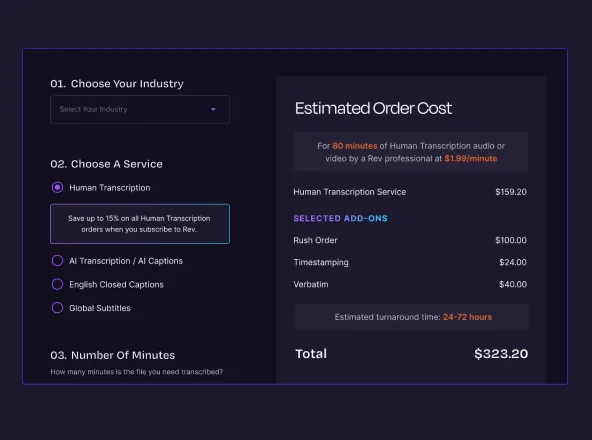
All of these methods can greatly benefit from transcription services, like those provided by Rev. Transcripts allow you to analyze everything said in your focus groups or in-depth interviews, with fully searchable text. Try Rev’s 99% accurate human transcription services or our more affordable AI-generated transcripts if you’re on a budget.