

AI for Legal Discovery: How to Improve the eDiscovery Process
Legal discovery is a critical yet time-consuming part of building a strong case. Here’s how paralegals can streamline the eDiscovery process with AI solutions.


The moment the legal discovery process begins, paralegals and lawyers alike are engrossed in hundreds (if not thousands) of pieces of evidence.
Nowadays, a major part of the discovery process is electronic discovery (eDiscovery), which involves finding, collecting, and reviewing digital evidence. And in an increasingly digital world, the sheer amount of digital data and channels to sift through eats into the little time law teams have to begin with.
That’s where AI comes in. eDiscovery AI tools have made it possible to not only cut down the time involved in the discovery process, but they can also help identify details or patterns that may have been overlooked while manually combing through massive amounts of evidence.
In this article, we’ll break down exactly what features to look for in AI tools for eDiscovery and how to use AI to improve the legal discovery process.
How Can AI Help Improve eDiscovery?
The biggest benefit to using AI throughout the discovery process is the time savings from cutting down your workload.
The tasks involved in eDiscovery include reviewing documents, drafting discovery requests, and identifying key pieces of evidence, all of which AI can assist with.
Here are some specific ways legal professionals can use AI tools to improve the eDiscovery process:
- Data collection: Instead of spending hours wading through hundreds of documents, paralegals can use AI to analyze those documents and collect critical data.
- Drafting legal documents: AI tools can speed up and standardize the drafting process, whether you’re crafting discovery requests, contracts, or email correspondence.
- Legal research: When you want to reference a specific case law or statute, AI tools can search through massive legal databases to identify relevant cases for you.
- Analyzing digital media evidence: Watching hours of interviews or listening to transcripts can take a significant amount of time from a paralegal’s day. Now, AI can analyze and summarize the key findings of media evidence.
- Tech-assisted review (TAR): Reduce human errors and oversight by using AI to review all of your documents and transcripts.
- Deliver increased accuracy: After spending hours reviewing massive amounts of data, it’s easy to overlook a key detail. AI tools can spot patterns, keywords, or inconsistencies faster and more accurately than legal teams alone.
While important to the overall success of a case, administrative tasks can take a lot of time away from key responsibilities like client counsel and case strategy – and legal professionals don’t have much time to spare.
In a recent survey, 47% of legal professionals reported that heavy workloads and long hours were the main contributors to burnout in the legal profession.
Using AI to alleviate the weight of administrative tasks and prep work involved in eDiscovery is the best way to optimize your legal team’s time and prevent the dreaded burnout.
“I actively train my paralegals to optimize their time by using AI tools, whether that’s to summarize depositions, analyze timelines, or detect inconsistencies across multiple transcripts,” says Cierra Wilson, attorney at Cierra Esq.
“This ensures I’m not paying them for hours of repetitive tasks; instead, their time goes into creating powerful case strategies and litigation summaries that move the case forward.”

Finding the Right Legal AI Tools
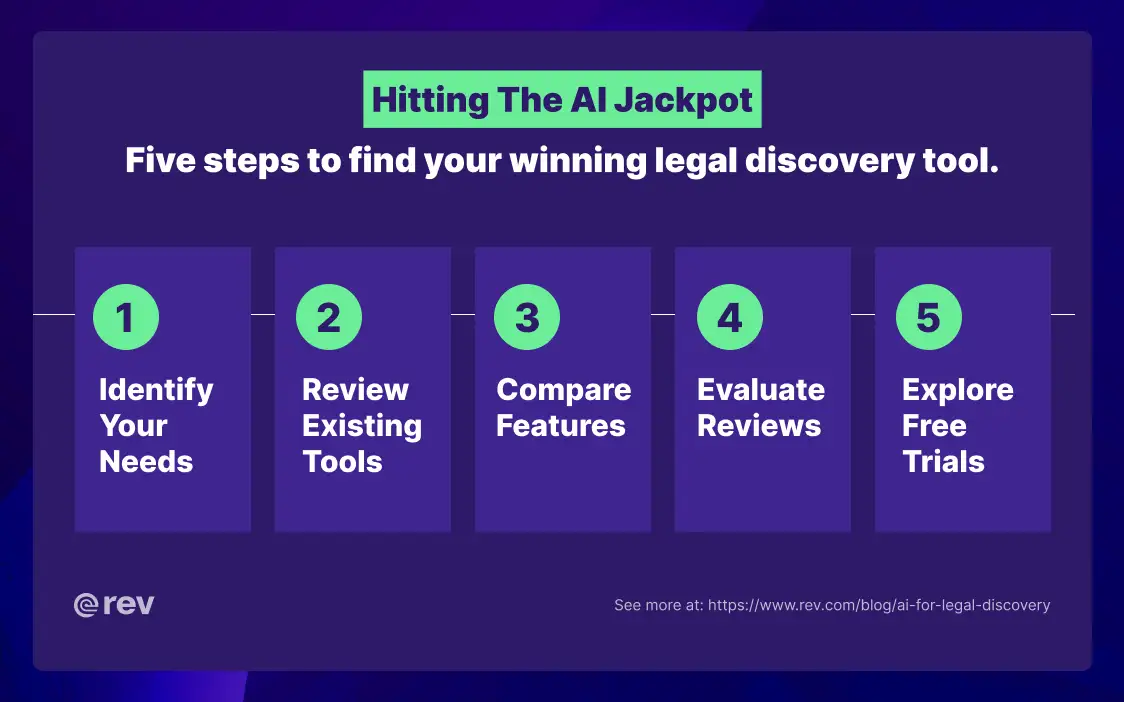
Not every tool is applicable to every legal team. Follow these steps to help you find the right legal AI eDiscovery tools to add to your workflow:
1. Identify Your Needs
Before you can choose the right tool for your team, figure out what exactly you need the most help with.
Is it drafting documents? Conducting legal research? Or maybe you want help reviewing all of your documents to identify patterns or key quotes.
Not sure what you need help with the most? Since you likely already track your time for billing purposes, you should be able to see which parts of the eDiscovery process your team spends the most time on. Identify the most time-consuming task and start there.
2. Review Your Existing Tools
Next, review your current system to see which tools you’re already using for eDiscovery. Evaluate how often your team uses each tool, what it’s used for, whether it has multiple functions or a sole use, and whether or not it’s saving time in the eDiscovery process.
This step helps you understand which of your existing tools bring the most value and which ones could be replaced.
Once you’ve narrowed down what you’re looking for, you can refine your search based on the specific features that will enhance your eDiscovery process, whether it’s a highly-specific evidence analysis tool or a broader AI platform.
3. Compare Features
Not all AI platforms are created equally. Some offer broad legal solutions while others deliver targeted features that integrate with other tools.
Here are examples of AI features to consider:
- Data collection and preservation: When you’re collecting digital evidence from countless sources – whether that’s PDFs that come through your inbox or scans and images an attorney has sent over via chat – it’s challenging to keep track of it all. AI can be used to collect and organize evidence by flagging relevant information and sorting it into a database.
- Review and analysis: Once you have a database full of evidence, AI can help you make sense of the information. Look for AI tools that use predictive analytics to review and analyze documents for relevance. This can help speed up the manual process of reading through every document and looking for facts or data that are relevant to the case.
- AI transcriptions: Another essential feature to look for is AI transcriptions. Not only does this eliminate the need for manual transcription or summaries, but the best AI tools can create searchable transcripts from depositions or other case-related audio and video files to help uncover case-changing evidence.
4. Evaluate AI Tools
Finally, once you’ve narrowed down what you’re looking for, compare your options.
Start by looking at review websites like G2 and Trustpilot to see what other legal professionals say about the tools you’re evaluating, especially if you’re considering a platform that offers a lot of features. Search for any use cases that specifically mention how they used the tool for legal discovery to ensure that it will actually help you work smarter.
You can also see if the platforms you’re considering offer free trials. This allows you to test out the tool for yourself and evaluate the usability, experience, and customer support before you commit.
Bonus Tip: Combine AI For Better Results
You aren’t limited to just one AI tool. Using multiple AI platforms allows you to work smarter and faster. Plus, many platforms offer integrations that make it easy for them to work together.
For example, you can streamline one of the most time-consuming eDiscovery tasks, analyzing digital evidence, by integrating an AI transcription tool with your video conferencing platforms. Then, use the AI transcription tool to auto-transcribe the video meetings and create shareable, searchable text. You can then input the transcription and data you collected into an AI writing tool to help draft legal documents, such as discovery requests or email correspondence.
The more you can streamline the eDiscovery process, the more time you have to focus on strategy and client counsel.
AI for Discovery: Concerns, Ethics, and Risks
Using AI for legal discovery is still a relatively new concept, and regulations around artificial intelligence are evolving as the technology does. That means best practices around implementing AI at your law firm should be continuously evaluated and revised.
The primary concern over using AI for the eDiscovery process is often around data security and privacy. Client confidentiality is non-negotiable, and cybersecurity is also imperative, so it’s important to be aware of how data is being protected once you upload it into AI platforms.

Addressing Challenges
Legal teams can address these concerns by carefully evaluating the tools they bring into their workflows.
First, consider the cybersecurity safeguards your law firm has in place, and familiarize yourself with the best practices. Then, look for tools that adhere to your firm’s policies.
The safest AI tools should offer built-in enterprise-grade security and encryption, and follow standard security and compliance regulations like GDPR, SOC 2 Type II, and HIPAA – especially if your firm handles Protected Health Information (PHI), as is the case in personal injury or medical malpractice cases.
The tools you’re considering should also be transparent about their compliance certifications. Any certifications or security audits the tool has received should be clearly outlined and accessible on its website for you to review.
The New + Improved AI Discovery Process
By and large, legal professionals who embrace AI for the discovery process and beyond are seeing positive results. 77% of lawyers who use AI are more productive, and 54% say that using AI reduced their feelings of burnout (and burnout is a big issue for paralegals too).
From the paralegal side, it may feel worrying that AI can handle a lot of the routine discovery work. But that doesn’t make it a replacement for the critical thinking and empathy paralegals bring to the job, says Ryan Perdue, litigator at Simon & Perdue Law.
“AI will certainly transform paralegal work, but I don't see it completely replacing the role,” said Perdue. “Paralegals provide critical human judgment, client interaction, and case strategy input that AI cannot replicate.”
Anna Blood, founder and attorney at Blood Law echoes this sentiment, adding that paralegals will still need to hone their strategic insights long into the future.
“The paralegal of the future will likely be a highly skilled professional who leverages AI tools to enhance their efficiency and effectiveness, focusing more on higher-level analytical and strategic contributions,” says Blood.
Increase eDiscovery Efficiency With AI
The legal discovery process is a critical stage of any case. The more evidence you can collect, organize, and analyze, the better chance you have of building a strong case. Establishing efficient eDiscovery processes ensures you not only save time, but don’t miss any key details. With AI legal solutions like Rev, you can streamline the eDiscovery process with searchable transcripts, multi-file insights, and AI-powered reviews.