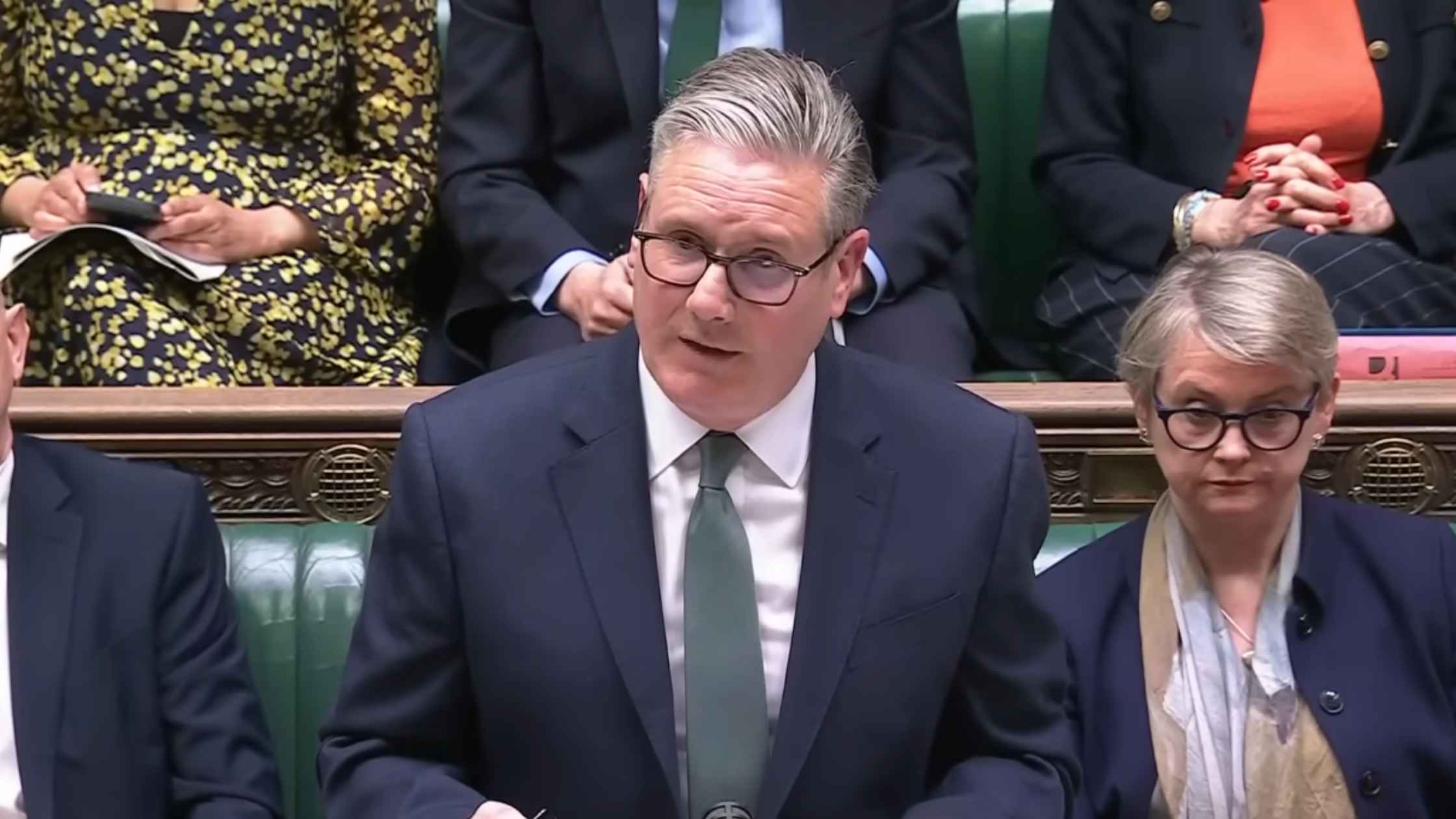
Keir Starmer (00:00):
... Necessary to honor the victims, the injured, and the families of Southport. Today's report, Mr. Speaker, is harrowing. It is difficult to read and I cannot begin to imagine the pain upon pain that it will cause the families that it affects. And our thoughts are with them today. And the Home Secretary will respond to the report in full, Mr. Speaker, after this statement.
(00:28)
Mr. Speaker, last week I visited the Gulf and I was able to thank in person some of the brave men and women who from day one of the US-Iran conflict have resolutely defended the interests of this country, its people, and its partners. I thank them again, Mr. Speaker, in this house for their courage and their service, and I'm sure the whole house will join me in those thanks. Mr. Speaker, whilst in the Gulf, I met leaders and senior military representatives across the region, including the Crown Prince of Saudi Arabia, the President of the UAE, the King and Crown Prince of Bahrain, the Amir and Prime Minister of Qatar. And in recent days, I've also spoken to the Sultan of Oman and the Emir of Kuwait. Across all of these conversations, I agree to deepen our engagement on both defense and economic resilience. Because Mr. Speaker, they all made it abundantly clear that the solidarity and strength of our partnership with them has been a comfort in these challenging times.
(01:39)
And we should not forget that the nature of Iran's response, the indiscriminate attack upon countries who never sought this conflict, the huge damage done across the Gulf to civilian infrastructure, with civilian casualties, is abhorrent. It has clearly shocked the region and all of us, and we must bear that in mind now as we lift our sights to the future. Because whilst the ceasefire between the US, Israel, and Iran is undeniably welcome, it is also highly fragile. The region remains on edge and a lot of work is required to reopen the Strait of Hormuz to deescalate the situation leading to a sustainable ceasefire. In pursuit of that goal, we call for Lebanon to be included urgently in the ceasefire. Diplomacy is the right path, and I welcome the talks taking place this week. Hezbollah must disarm, but I'm equally clear, Israel's strikes are wrong. They are having devastating humanitarian consequences and pushing Lebanon into a crisis. The bombing should stop now.
(02:59)
Mr. Speaker, we also put on record our thanks to Pakistan and other partners for playing such an important role in diplomatic efforts. We hope the process will continue without further escalation, and that applies to the running sore that is the Strait of Hormuz, shamefully exploited by Iran. All of the leaders that I met were crystal clear that freedom of navigation is vital and must be restored, no conditions, no tolls, and no tolerance of Iran holding the world's economy to ransom.
(03:40)
Because Mr. Speaker, the impact of Iran's behavior in the strait is causing untold economic damage. It's visible on every petrol forecourt in the country. My guide from the start of this conflict has always been our national interest. That's why we stayed out of the war and why we continue to stay out of the war. And that is why we are working now to restore freedom of navigation in the Middle East, because that is squarely in our national interest.Now, Mr. Speaker, quite clearly, this is not a straightforward task. It will take time. I met UK businesses in energy, shipping, insurance, and finance, and they are clear that vessels will not be put through the strait until they are confident that it's safe to do so. And that's why we're working around the clock on a credible plan to reopen the strait.
(04:46)
And Mr. Speaker, I can confirm today that together with President Macron, I will convene a summit of leaders this week to drive forward the international effort we have built in recent weeks, bringing together dozens of countries to ensure freedom of navigation in the Strait of Hormuz. The summit will be focused on two things. First, diplomatic efforts to bring pressure to bear for a negotiated end to the conflict and for the strait to be opened. Second, military planning, to provide assurance to shipping as soon as a stable environment can be established. And let me be very clear, this is about safeguarding shipping and supporting freedom of navigation once the conflict ends. Our shared aim here is a coordinated, independent, multinational plan. This is the moment, Mr. Speaker, for clear and calm leadership and notwithstanding the difficulties, Britain stands ready to play our part.
(05:56)
Mr. Speaker, let me now return to the impact of this conflict on our economy. We all know that the consequences will be significant and that they will last longer than the conflict itself. Now, we continue to monitor the effects and I remind the House that energy bills went down on the 1st of April and whatever happens in the Middle East, those bills will stay down until July. We're investing over 50 million pounds to support heating oil customers and fuel duty is frozen until September, all because of the decisions that this Government took at the budget. But Mr. Speaker, there's a wider point because we can't stand here in this house and pretend that a global shock threatening to hit the living standards of British people is somehow a novel experience. Britain has been buffered by crises for decades now, from the 2008 financial crash through austerity, Brexit, COVID, the war that still rages in Ukraine and the disastrous premiership of Liz Truss.
(07:14)
The response each time has been to try to return to the status quo. A status quo, Mr. Speaker, that manifestly failed working people who saw their living standards flat line and their public services decimated. So this time Britain's response must and will be different to reflect the changing world that we live in. That starts with our economic security, where during this conflict alone, we've capped energy bills, raised the living wage, strengthened workers' rights, and ended the two child limit that will lift nearly half a million children out of poverty. But Mr. Speaker, looking forward, it also means a closer economic relationship with our European allies because Brexit did deep damage to the economy.
(08:08)
And the opportunities we now have to strengthen our security and cut the cost of living are simply too big to ignore. It continues, Mr. Speaker, with our energy security where I say once again, oil and gas will be part of our energy mix for decades to come. But Mr. Speaker, we do not set the global price for oil and gas. And households across the country are fed up with international events beyond their control, pushing up their energy bills, and I stand with them on that. So we will go further and faster on our mission to make Britain energy independent. Because that is the only way we get off the fossil fuel rollercoaster and take control of our energy builds.
(08:59)
Finally, Mr. Speaker, we must strengthen our defense security. That means boosting our armed forces as we have with the biggest sustained investment since the Cold War. It means doubling down on the most successful military alliance the world has ever seen, the NATO alliance of which this party in government was a founding member. But it also means strengthening the European element of that alliance, taking control of our continent's defense more robustly, deepening our partnerships as we have done with our deals to build Norwegian frigates on the Clyde, Turkish typhoons in Lancashire, not only Mr. Speaker creating thousands of obscure jobs and opportunities for our defense industry right across the country, but also enhancing the way our armed forces can collaborate with our allies. Because Mr. Speaker, as the Middle East conflict shows once more, the world in which we live has utterly changed. It is more volatile and insecure than at any period in my lifetime, and we must rise to meet it calmly, but with strength.
(10:11)
That is exactly what we're doing at home and abroad. We are strengthening our security, taking control of our future, and building a Britain that is fair for all. And I commend the statement to the House.
Mr. Speaker (10:24):
Kemi Badenoch, Leader of the Opposition.
Kemi Badenoch (10:29):
Thank you, Mr. Speaker. And can I thank the Prime Minister for advanced sight of his statement? I would also like to pay tribute to our brave service men and women serving in the Middle East right now. Mr. Speaker, the Prime Minister is right that Britain did not start this war, but whether we like it or not, we are impacted by it and this is likely to get worse. The cost of borrowing has jumped, petrol prices are climbing, inflation is rising, and living standards falling. It is time to take decisive action in our national interest. Britain must focus on what is in our power to protect British citizens today. First, we must rapidly solve the energy crisis this war has caused in our country, and second, we must make sure that Britain is ready to defend herself in this new age. A nuclear armed Iran is an existential threat to the UK.
(11:26)
We should be in no doubt whose side we're on in this war, our allies in the Middle East and the United States. So I welcome the Prime Minister meeting some of those allies, and I also welcome his support for diplomatic efforts and military planning to restore freedom of navigation in the region. But we will need to go further than just talking. He says Britain stands ready to play our part. We can all see that we were not ready for this situation. Here's what we need to do now. First, we must take rapid action to increase our energy security and keep bills down, not just until July, but longer than that, permanently. Britain is particularly vulnerable to energy price shocks because we are killing domestic oil and gas production in the North Sea. Labor's policy of more expensive energy and de-industrialization at this time of crisis is dangerous and irresponsible.
(12:33)
It is also harming the defense industry. We must start drilling our own oil and gas in the North Sea, grant licenses for drilling in the Jackdaw and Rosebank fields and restore British production before it is too late. The Prime Minister says this won't impact international prices. This is more than international prices. This is about the domestic supply, especially of gas, all of which is used in this country. Supply matters. And finally, the government must cancel the proposed rise in fuel duties. Hiking taxes on motorists for the first time in 15 years, while prices are surging is a disgraceful decision. If Britain is to be a stronger country, it needs a stronger economy, not one being hammered by the highest energy prices in the developed world. So will the Prime Minister grant the oil and gas licenses and scrap the rise in fuel duty? I know he'll say that it's the Energy Secretary's job.
(13:32)
The Energy Secretary is not the Prime Minister. He is. He can instruct him to grant those licenses. But Mr. Speaker, secondly, to be ready, Britain must be able to defend herself, and that means we must be ready for these situations before they happen. France and Greece ... I don't know why they're laughing. I'm surprised they're laughing because last time I checked, France and Greece sent ships to protect our bases in Cyprus while our destroyer was stuck in Portsmouth. It was a national embarrassment on their shoulders and it should never happen again.
(14:15)
We need no further evidence that we are living in a more dangerous world than a decade ago. I'm sure Labor MPs will try and think of a way to make this my fault. Let me remind them. Yes, I know ... And it is preposterous, but let me remind them the historical illiteracy that is on those benches, governments of all colors, including those guys there, spent the peace dividend from 1989 when the Berlin war fell until the Ukraine war. And when that war came, the Conservative government responded rapidly and unequivocally. We didn't have anything stuck in Portsmouth when Ukraine was invaded. We trained tens of thousands of Ukrainian soldiers and equipped them with our missiles.
(14:59)
We increased defense spending every year since the war started, but the world has since become even more dangerous. Every serious person, Mr. Speaker, every serious person, especially in the military, agrees that Britain must now find a way to spend 3% of GDP on defense by the end of this parliament. After the election, many of the plans for spending were paused for Labor's strategic defense review. Nine months after publishing it, there is still no defense investment plan that explains how we will fund this. The Defense Readiness Bill is also nowhere to be seen.
(15:39)
The question is not whether we need to increase defense spending. The question is what tough choices we must make to do so. That is what is missing from the government's plan. The government has a plan for welfare spending until 2031, but no plans for defense spending. So I say to the Prime Minister, "Let's put party interest aside." I'm glad that they're laughing because I want the public to hear Labor MPs laughing when we say, "Let's put party interest aside." So please keep laughing. Go on, please keep laughing. I say to the Prime Minister, "Let's find the money to rearm. Let's identify the spending cuts. And if we reach agreement on a joint plan, we can all support those measures in Parliament."
(16:22)
Conservatives have already found savings to fund more than 20 billion pounds extra for defense spending. I am willing to work with him to go further. And in his response, Mr. Speaker, I'm sure the Prime Minister will be tempted to misrepresent my position and pretend that I demanded he join in the initial strikes. Yeah. Yes. I know they can't even resist the temptation. He and I both know that is not true, but let us get serious. Let's get serious. It is time for us to act decisively in our national interest. Let's show our allies what we bring to the table. Let's show our enemies that we are able and ready to defend ourselves. That requires a defense investment plan. So I ask the Prime Minister in conclusion, when exactly will the defense investment plan be published and what action is he taking to find the money to pay for it?
Keir Starmer (17:15):
Mr. Speaker, I noticed that her opening sentence has changed. She used to say, "We didn't start the war, but like it or not, we're in it and we should be in it." That was her position. Now she says, Well, they can't make their mind up. They supported the war without thinking through the consequences and now they're pretending they didn't support the war and they're against it all along. She challenged my position and she did the mother of all U-turns on the most important decision the leader of the opposition ever has to take.
(17:49)
Can I thank her for her support for the planning that we're doing with other countries? It is important. It has a number of components, the political and diplomatic component, the logistics as well in terms of getting the vessels through where we're working with the sector and of course the military component. We've been working on that for two or three weeks now and now bringing together with President Macron the summit later this week in that regard.
(18:13)
In relation to energy bills, Mr. Speaker, yes, we all want to get energy bills down and oil and gas will be part of the mix for many years, but it is because we're on the international market that our bills have gone up and that is the problem. The strait of Hormuz is a choke point for energy getting oil and gas getting to the international market. That's pushed the price up, that's being reflected in every household. And that's why Mr. Speaker, the only way to take control of our energy bills is to go faster on energy independence. Now, Mr. Speaker, the leader of the opposition used to make that argument. In 2022, she said this, "It is investment in nuclear and renewables that will reduce our dependence on fossil fuels and keep costs down." She changes her mind on everything. That was her argument and just like she pretends she wasn't in favor of getting involved in the war, now she pretends she wasn't in favor of keeping costs down.
(19:21)
And Mr. Speaker, she says that we must be ready. That's coming from a party that hollowed out our armed services. Mr. Speaker, on their watch, frigates and destroyers were reduced by 25%. Mine-hunting ships reduced by 50%. On their watch. And she lectures us about being ready, having hollowed out our armed forces and hollowed out our capabilities. We're investing 300 million more in shipbuilding and we've got 13 ships on order. That, Mr. Speaker, is the difference between the two parties. And Mr. Speaker, I hope that she and they will forgive me after 14 years of breaking everything under their watch, I'm going to resist the offer of joint planning from the government, from the party that crashed the economy, hollowed out our armed forces, crashed our public services. Thanks, but no thanks.
Mr. Speaker (20:22):
Emily Thornberry, Chair of the committee.
Emily Thornberry (20:22):
Thanks very much Mr. Speaker. The Foreign Affairs Committee has just come from a meeting with some of the Gulf ambassadors who are genuinely grateful for the help that Britain has given defending their countries and who also want to say how grateful they are that the Prime Minister visited the Gulf in an act of true solidarity. But when people heard the Israeli defense minister say that his war aims in Lebanon would follow the model in Gaza, our blood ran cold. Could the Prime Minister tell the House what role the United Kingdom can do to ensure a ceasefire in Lebanon and that Israel is stopped from taking over Lebanon south of the Litani river.
Keir Starmer (21:10):
Raising important question of Lebanon. I want to be really clear in relation to that. That should be included in the ceasefire and we're using every opportunity we can to make that argument and please, there's some diplomacy at the moment, but those attached should stop and it's really important that we're very, very clear about that.
Mr. Speaker (21:26):
Leader of the Democrats, Sir Ed Davey.
Sir Ed Davey (21:30):
Mr. Speaker, can I thank the Prime Minister for advanced sight of his statement? And can I join him in what he said about the horrific attack in Southport? Our thoughts are with the families of Bebe, Elsie and Alice, and with all those affected.
(21:44)
Mr. Speaker, "A whole civilization will die tonight." Words, I never thought I would hear from an American president. And though Donald Trump thankfully didn't follow through this time, these words are a stark reminder of how reckless, immoral, and completely outside the bounds of international law this president is. Regrettably, he is no friend of the United Kingdom. He's no leader of the free world. He is a dangerous and corrupt gangster, and that is how we must treat him. So will the Prime Minister advise the King to call off his state visits to Washington before it's too late? Because I really fear for what Trump might say or do while our King is forced to stand by his side. We cannot put His Majesty in that position.
(22:37)
And when it comes to Trump's latest cunning plan to blockade the Strait of Hormuz, that will only escalate this crisis and jeopardize the precarious ceasefire. So it's right that the UK is not joining Trump. And I welcome the Prime Minister convening a summit to offer an alternative to Trump's. We must work with our reliable allies in Europe and the Commonwealth and our partners in the Gulf to bring this conflict to an end and keep open the Strait of Hormuz. That is critical for tackling the cost of living crisis that's getting worse and worse for people in the UK. With petrol prices now up by more than 25p a liter and diesel up 49p since Trump started this war, cheered on let's not forget by the Leader of the Conservative Party and Reform. Does the Prime Minister recognize that families and businesses can't wait months for the government to step in and help?
(23:37)
So will he use the windfalls the Treasury is getting from higher fuel prices to cut the cost of living and keep the economy moving with action to slash bus fares and rail fares and cutting fuel duty by 10P today, bringing down the price of at the pumps by 12P a liter.
Keir Starmer (23:56):
Can I thank him for his question? And in relation to the language about destroying a civilization, could I really be clear with this house, that was wrong. A threat to Iranian civilians in that way is wrong. These are civilians, let's remember, who've suffered immeasurable harm by the regime in Iran for many, many long years. And that's why they are words and phrases that I would never use on behalf of this Government, which is guided by our principles and our values throughout all of this. Mr. Speaker, in relation to the King, the King's visit, the relationship between our two countries is very important on a number of levels. And often what the monarchy is able to do through the bonds that they build is reached through the decades and a situation like this. And the purpose of the visit is to mark the 250th anniversary of the relationship between our country and the United States. And that's why the visit is going ahead.
(24:57)
In relation to the blockade, let me be clear as I've been already in the last day or so, that we are focusing our efforts on opening in full the Strait of Hormuz because of the damage it's doing to economies around the world, including our own economy. That is why we've been working with other countries at various levels and we'll bring them together in a summit later this week. And we, the UK, will be not be joining the blockade that the President announced.
(25:27)
In relation to the help that is needed to families and households, obviously we put in place help for energy bills already and oil heating that is in place. But Mr. Speaker, we're keeping this under constant review as the situation evolves. The single most important and effective thing we can do is to deescalate the situation and work with others to get the Strait of Hormuz open. And that is why we're focusing so much of our efforts in that regard.
Mr. Speaker (25:49):
Mr Tanmanjeet Singh Dhesi, [inaudible 00:25:55].
Tanmanjeet Singh Dhesi (25:54):
Thank you very much, Mr. Speaker. I thank the Prime Minister for confirming that despite the significant unwelcome trolling and pressure from President Trump and Israeli PM Netanyahu, that the UK is not being dragged into this war and it is not in our national interest. Given that the US has now initiated the blockade of Iranian ports, can the Prime Minister confirm what steps are being taken to help deescalate the situation, whether it's to reopen the Strait of Hormuz so that goods can transit freely and that we can ease the cost of living pressures for our constituents and also what is being done to help deescalate the situation in Lebanon. And can he also confirm that any future UK involvement in the region will be strictly limited to defensive purposes only?
Keir Starmer (26:52):
Well, can I thank him and reiterate that we will not be dragged into the war. In relation to the steps we're taking, they're across a number of levels. It was central to the discussions I had in the Gulf States last week in terms of what we can do together to deescalate. Mr. Speaker, they are shocked and angry, frankly, that they have been attacked in the way that they have been attacked. They were not involved in the conflict and it's clear to them that they were targeted within hours at the beginning of this conflict starting and civilian infrastructure and civilians were targeted as well. And they're absolutely clear that targeting was put in place before the conflict started. So we're working with them, we're working across the coalition of dozens of countries now to deescalate and to get the Strait of Hormuz open just as soon as it's viable and credible to do so.
Mr. Speaker (27:44):
Father of the House, Sir Edward Leigh.
Sir Edward Leigh (27:48):
The Prime Minister may recall that on day one of this war, I supported his defensive attitude to it and said we couldn't change the regime from the air and we agreed. He's been proved right. But with apologies to Leon
Speaker 1 (28:00):
Trotsky, we may not be interested in war, but war is interested in us. So we all agree we have to rapidly re-arm. The trouble is that with the ever-increasing proportion of our entire economy taken by the state pension and by benefits, perhaps we can't afford to do it. So will he work with the lead of the opposition to take the necessary, perhaps unpopular decisions to return defense spending to what we spent in 1989, the end of the Cold War?
Keir Starmer (28:27):
Mr. Speaker, he's right to raise this and we've already raised defense spending, as he knows, in the most significant way since the Cold War. I've been clear in the Munich Security Conference that I gave a few weeks ago that we need to go further and faster and we will. I think in addition to the funding itself, I think it's really important that we take this opportunity to collaborate and cooperate with our partners, particularly in Europe, because if all European countries simply increase their spending without regard to the capability that they're using that spending on, we won't make the best of what we've got. And therefore, I'm making a dual argument, one in relation to the actual money we spend, but secondly, the way we need to collaborate in a way we haven't done, frankly, for decades in relation to this with our allies, particularly in Europe.
Sir Lindsay Hoyle MP (29:16):
Tamara Allen.
Tamara Allen (29:17):
Thank You, Mr. Speaker. I welcome the prime minister's call for Lebanon to be included in the ceasefire. 1,700 people have already been killed by Israeli attacks and over 1.1 million people have been displaced. At a time when aid budgets have been cut, including by our own government, will the prime minister commit to playing that international leadership role as he is doing in relation to getting a ceasefire, working with our European partners and others to support the humanitarian effort and increase support to those who are being displaced in the region, but also think about how we support countries in the global south that are now going to be hit very hard because of this crisis, because the impact of that will affect all of us if we don't take action at the international level.
Keir Starmer (30:08):
Can I thank you for raising this really important issue? And be clear, Lebanon must be included in the ceasefire and it's very important that we're clear about the principle behind that. I also accept that there must be more support on the humanitarian front. We've just put more money into the humanitarian support, but it's clearly a cause of concern in Lebanon, actually in the wider areas as she rightly points out.
Sir Lindsay Hoyle MP (30:32):
Andrew Mitchell.
Andrew Mitchell (30:34):
Thank you, Mr. Speaker. I think the prime minister should acknowledge, I'm sure that he does, that over the last 30 years, our armed forces have been hollowed out by governments of all parties as they have sought to take a peace dividend. But I'm afraid the chickens have come home to roost on his watch. So will he now commit to a huge and immediate uplift in defense spending, not just by vaporizing British soft power expenditure, we are talking of moving towards a 5% increase so that the government can play a full part in European defense and deliver on its first duty to its own citizens.
Keir Starmer (31:17):
Well, I agree that our armed forces now capabilities hollowed out over many years, in particular under the last government, I'm afraid to say. Ben Wallace, then defense secretary, was very clear about that. But he's right to say, now is the point at which we've got probably more conflict going on in the world now than most of us have seen in our lifetime. So that's why we have to increase defense spending. That's why we took the decision to increase to two and a half percent sooner than people thought we would, and that's already taking place. I made commitments at the NATO summit last year in relation to the further spending that we need to put in place. I stand by those commitments, we must go further and we must go faster.
Sir Lindsay Hoyle MP (32:04):
Afzal Khan.
Afzal Khan (32:05):
Thank You, Mr. Speaker. Firstly, let me say that thank you to the prime minister for your statementship. This weekend, so the Pakistani government step up and take global leadership by expertly hosting and mediating negotiation between Iran and America. The whole world is indebted to the noble efforts of Prime Minister Shehbaz Sharif, Foreign Ministry Ishaq Dar, and General Syed Asim Munir to achieve a ceasefire. Given Pakistan is a long-term ally of Britain, will the prime minister outline what sport he's giving the Pakistani government facilitate an agreement for long-lasting peace and stability in the Middle East?
Keir Starmer (32:47):
Can I reiterate my thanks to Pakistan for the role that they're playing? And I can tell the House that I spoke to the prime minister of Pakistan on Friday as we're going into the talks this weekend about the talks about, what support we could put in place. And the foreign sector spoke to her counterpart this afternoon. It's very important that we support this process and try to move it forward and not to let it escalate.
Sir Lindsay Hoyle MP (33:13):
Stephen Flynn.
Stephen Flynn (33:15):
The prime minister has absolutely right to condemn the abhorrent response of the terrorists in the IRGC, but I noticed from his statement that there's no explicit condemnation of the illegality of Donald Trump's actions. There's no explicit condemnation of the illegality of Netanyahu's actions. And despite having the entire Easter break to think about it, there is explicitly no new financial support for households on these isles whatsoever. Despite the fact then Ireland, they've put down 750 billion euros worth of support from motorists and farmers. The best he can muster is to continue to monitor the effects. Now I appreciate that he might not be in office for very much longer, but whilst he is, the public expect him to provide support. Why isn't he?
Keir Starmer (34:07):
Well, Mr. Speaker, I'll remind him that we put in support and protection for our citizens in the region by taking defensive action. He opposed that protection for Scottish citizens in the Gulf and they oppose taking any action whatsoever. It is only because we've stabilized the economy we are able to reduce energy bills. What if they do? They voted against the budget in which we put forward the money for this. So we will carefully do the work that we need to do to reopen the Strait of Hormuz, which the single most effective thing we can do in relation to household costs and to work for deescalation. I would have thought that he would have supported that, but unfortunately, again, he's on the opportunistic road rather than up the road to support what we really need to do.
Sir Lindsay Hoyle MP (34:57):
Deb Abrahams.
Deb Abrahams (34:58):
Thank you, Mr. Speaker. First of all, can I thank my right honorable friend for all that he's doing towards deescalating the conflict in the Middle East and also to agree with him in terms of not getting drawn into this conflict. But could I ask him about Palestine and particularly the West Bank? Does my right honorable friend agree with more than 30 former UK ambassadors that any bidder for contracts to design, build, or finance the E1 settlement expansions should endanger their business interests in and with the UK?
Keir Starmer (35:37):
Well, Clyde, thank you for raising this. And it's very important that we don't lose focus on what's happening in the West Bank Bank. It is deeply concerning and deeply worrying. And in relation to the E1 settlements, I made the position clear I think the week before last, and that remains at the position.
Sir Lindsay Hoyle MP (35:53):
Jeremy Hunt.
Jeremy Hunt (35:54):
Thank you, Mr. Speaker. In a crisis, governments have permission to do things that are not possible in normal times, but I'm worried that what the prime minister is going to bring forward will not meet the measure of the moment. Can he commit to the House that when it comes to energy policy, he will dramatically change it so that it focuses as much on cheap energy as clean energy. And when it comes to the desperate need to increase defense spending, will he look at serious welfare reform? That stops. Someone who is earning the national living wage, working full time, sometimes only getting half as much as someone on the three main benefits.
House Member (36:32):
Well said.
House Members (36:32):
Yeah.
Keir Starmer (36:33):
Can I thank him for his question? In relation to the cost of energy, yes, of course we have to focus on the cost of energy and there's simply no denying the fact that it's because we're on the international market that our energy prices are going up and down. And families across the country are really fed up with the fact that international events happen, which they can't control and their energy bills go up and down causing a cost of living crisis. That is because we're on the international fossil fuel market. There's no denying that and that will be the case so long as we're on that market because that controls the price. Putin and Iran control the price of the international market. And the longer we're on it, the more our families will be subjected to that.
(37:18)
We have to take control of energy bills. The only way to do that is through energy independence. It's the only way to do it. And that's why I think we need to double down on going faster and further in relation to that. Yes, of course, oil and gas will be part of the mix for many years to come. Been very clear about that, but equally clear that that won't have an effect on the price and the cost of energy bills. The only thing that will have an effect on the price and cost of bills is coming off the international market that we're stuck with. That's why the Strait of Hormuz is so important. We don't get that much energy in oil and gas coming through the Strait, but it's because we're on the international market that we're impacted by the fact that others do. That is the source of the problem, that's why we're working so hard to resolve it.
Sir Lindsay Hoyle MP (38:01):
John Trickett.
John Trickett (38:03):
Thank you, sir. Can I echo the comments about the president's statement on Easter Sunday, that in an evening he could destroy a two and a half thousand year old civilization. But on the question of the Straits of Hormuz, isn't it clear that the Straits were open before the president fully launches a legal war? And can I ask the prime minister to say quite clearly that no vicious military assets, our brave personnel would be putting at risk in a foolish idea to blockade the Straits even further, which came from the president yesterday.
Keir Starmer (38:38):
Thank you for that. Of course, Iran that's putting in the chokehold on the straight, that is wrong and the strength of feeling across the Gulf last week was very, very clear to me. I can assure him that we are not getting involved in the proposal to blockade the Strait. On the contrary, we're working with other countries to try and get the Strait open and fully open for free navigation. Something this country has championed for years and years and years.
Sir Lindsay Hoyle MP (39:04):
[inaudible 00:39:04] Hardy.
Ms. Hardy (39:05):
Thank you, Mr. Speaker. Today, the US president impersonated Jesus Christ. Last week, he pledged to wipe out an entire civilization. His warmongering in the Middle East is piling on the pressure from my constituents in Asia and Wharton, from prices at the pump, to mortgage increases in the midst of a cost of living crisis. So given the disturbing utterances from the occupant of the White House and the squeezing our living standards, surely the future is across the channel towards Europe. And I note that the prime minister gave a line, presumably for the local elections about alignment with Europe, but could he give more detail on what this means for defense and security and for prosperity?
Keir Starmer (39:48):
Well, a closer relationship with the EU and Europe was in our manifesto in 2024, which a very successful manifesto. And we've been working to that end ever since, which is why we had the first UK EU summit last year with agreed 10 strands. It's why I've been clear that we want to go further this year, not just in seeing where we've got to and what we've already agreed, but going further than that, because it is in our interest, whether it's defense, security, energy, or the economy to be closer to Europe and that's what we're endeavoring to do.
Sir Lindsay Hoyle MP (40:20):
Uma Kumar.
Uma Kumaran (40:22):
Mr. Speaker, can I thank the prime minister for his statement and welcome his convening of a summit of leaders alongside President Macron. Mr. Speaker, the situation in Lebanon is devastating. Israeli escalation has led to a grave humanitarian situation. The images of civilians being carpet bombed are horrifying. I want to reiterate what the Foreign Affairs Committee heard today. We met with ambassadors from the Gulf. They expressed their genuine appreciation for the prime minister's presence and Britain's continuing support. Can I ask the prime minister to continue to represent the voices of our constituents and to resist escalation, include Lebanon in the ceasefire, and to press for peace?
House Members (41:01):
Yeah.
Keir Starmer (41:02):
Can I assure that we'll make the case for Lebanon to be included in the ceasefire, and we will continue with our work to deescalate and not get drawn into this war.
Sir Lindsay Hoyle MP (41:10):
Keir Mather.
Keir Mather (41:10):
Well, Mr. Speaker, we all hear the prime minister's words about Lebanon, but surely the lesson of the last two and a half years is that his words and the words of anybody in this House have no impact on an Israeli government seemingly led by supremacist maniacs. Now before Easter, I asked the foreign secretary how many Lebanese was an acceptable number to see killed over the coming weeks. And we've learned over the Easter break that there's seemingly no upper limit before we're willing to act. So I wanted to ask the prime minister a simple question. Given that he proudly, quite rightly, proudly pointed to the part Britain is playing in defending other nations in the region, why have we not stepped forward to defend Lebanese civilians in the same way that we have others? And secondly, a simple question if you can't answer that one, does Lebanon have a right to exist?
Keir Starmer (42:04):
I'm grateful to him for raising this really serious issue. And I think the immediate focus has to be ensuring that Lebanon is in the ceasefire and being absolutely clear in our condemnation of the action that Israel is taking. We are working on that on a number of levels, but I always believe and continue to believe that we are stronger when we work with other countries and that's what we're endeavoring to do.
Sir Lindsay Hoyle MP (42:26):
Polly Billington.
Polly Billington (42:27):
Thank You, Mr. Speaker. I'm grateful for my honorable friend for his statement. And I note the emphasis he has on the no return to the status quo, particularly in relation to the importance of energy independence. Will he acknowledge that we are now entering a new energy era? And perhaps he agrees with President von der Leyen, who today has said, "Here is one thing that all these events are making clear. We are paying a very high price for our overdependency on fossil fuels. And the grim reality for our continent is fossil fuel energy will remain the most expensive option in the years to come."
House Members (43:03):
Yeah.
Keir Starmer (43:03):
Well, Mr. Speaker, that's the argument that I've been making and I believe to be right, it's the argument the leader of the opposition used to make, but she's U-turned on that as well.
Sir Lindsay Hoyle MP (43:13):
Richard Tice.
Richard Tice (43:14):
Thank you, Mr. Speaker. All our constituents are worried about the price of energy, the price of gas. But is the prime minister aware that the price of gas in the US has fallen 20% since the start of this war, while the price of gas in the UK has increased by 50%. Proving prime minister, that if we produce and consume our gas domestically, we can have much lower bills, proving why we must allow the consents for Jackdaw, for Rosebank and all of the oil fields across the North Sea and onshore as well.
Keir Starmer (43:52):
Mr. Speaker, I remind myself that his party's position was to fully support the war, go in with both feet, whatever the consequences. Now he says there are these consequences. Well, they should have thought about that before they adopted the policy of going straight in. But Mr. Speaker, on the question of energy and gas, yes, the price is subject to the international market because we're on the international market, that is why the sooner we have energy independence, the better.
Sir Lindsay Hoyle MP (44:20):
Tim Burr.
Tim Burr (44:23):
Thank you, Mr. Speaker. Trump's illegal war on Iran and his genocidal threat to kill a whole civilization, a part and parcel of a dangerous new US security plan. The Trump doctrine is based upon yet more war and tearing up international law, making the whole world less safe. Prime minister, given that, isn't it time for Britain to stop being a junior partner to the US and pursue a truly independent foreign policy? And should the very first step be to end all US access to British military bases for Trump's war on Iran?
Keir Starmer (45:09):
We have British civilians in the Gulf region, about 300,000, and they are at risk because of Iran's actions and it's my duty to ensure that we protect them. That is why we've taken action in our own right, particularly with our pilots. It is also why I've allowed the basis to be used for defensive purposes to prevent those attacks on our civilians as much as anything else who are in the region. And I'm never going to abandon them to their fate when there is incoming missiles and drones into the areas where they are living and where they are working. It's my duty to protect them and I'll continue to do so.
Sir Lindsay Hoyle MP (45:47):
[inaudible 00:45:48].
Speaker 2 (45:48):
Thank you. Mr. Speaker. Could the prime minister just remind some of his colleagues that the United States is a democracy and an ally. And Iran is an odious regime that could have ended the war this weekend had they agreed to give up their ambitions for nuclear weapons and to cease supporting their proxy terrorist organizations around the Middle East. And wouldn't it be helpful if the prime minister said a bit more criticism of the Iranian regime rather than supporting his colleagues and criticizing the United States?
Keir Starmer (46:22):
Mr. Speaker, in fairness, I've been very clear about the Iranian regime. It is odious, as he rightly points out, it is really important that they do not have the nuclear capability and that we deal with their proxies. And that has been the consistent position of this government and previous governments, to be fair. And it's been the way in which I put it from this dispatch box on many, many occasions.
Sir Lindsay Hoyle MP (46:44):
Sajid Javid.
Sajid Javid (46:45):
You very much, Mr. Speaker. I commend the prime minister for his efforts to keep the UK out of Donald Trump's latest dangerous attempt to end a blockade by creating another. I also commend Pakistan's attempt to broker peace and the UK governments work with now over 30 countries to pursuit a diplomatic solution. But if the state remains closed, what plans does the government have to protect UK households and businesses from impact on energy supplies, trade, and rising costs?
Keir Starmer (47:22):
Well, Mr. Speaker, we're planning for all contingencies, but I emphasize once again that our absolute focus has to be on getting the Strait open, having spoken to shipping, finance, insurance, et cetera. They're very clear with me that they're not going to be putting vessels through whilst there is a conflict, and therefore we must deescalate and come up with that credible plan. We will do that in conjunction with other countries, and that's why President Macron and I are convening the summit later this year. We're relating this week, building on the work we've been doing over the last few weeks.
Sir Lindsay Hoyle MP (47:52):
[inaudible 00:47:55].
Speaker 3 (47:54):
Mr. Speaker, in its statement, the prime minister said that he wanted to double down on NATO, but President Trump has attempted to use the NATO alliance or threat to withdraw from it to blackmail other NATO countries into joining his illegal endeavor in Iran. He's also threatened to annex the sovereign territory of another NATO member. He has said that NATO members weren't there for the US in Iraq. It is clear that the US is an unreliable partner in NATO. So will the prime minister announce when he is going to release the defense investment plan and will he explain how we can forge closer ties with our European allies who are more reliable?
Keir Starmer (48:35):
Mr. Speaker, thank you for his question. And first thing I'd say is it's very important that we defend NATO, it's the single most effective military alliance the world has ever known and we should do nothing to weaken it. I do think that there should be a stronger European element on defense and security. It's an argument I've been making for some time. It's particularly important now that Europe steps up with a stronger European element and we're working with our allies to do that.
Sir Lindsay Hoyle MP (49:03):
Alison Hume.
Alison Hume (49:06):
I thank the prime minister for his statement and his positive efforts on the issue of the Straits of Hormuz. Last week, I met with farmers in Whitby who are deeply concerned about the skyrocketing price of red diesel. In January, the fuel cost was 64 pence per liter and it has since doubled. With the busiest period of the farming calendar approaching, can the prime minister outline what measures the government is considering to support farmers impacted by these rising costs?
Keir Starmer (49:37):
Can I assure her that we have been looking at that in the various meetings we've been having, particularly the red diesel question looking at contingencies, but in addition to planning for those conditions, it is really important that we double down on our work to deescalate and to open up the Strait of Hormuz.
Sir Lindsay Hoyle MP (49:56):
Tom Tugendhat.
Tom Tugendhat (49:57):
Thank you, Mr. Speaker. May I quote the prime minister who told us just a few moments ago that the bills for energy are going to slay down until July, but he also correctly said that we do not set the global price for oil and gas. Is the prime minister making an enormous gamble on the energy price? And how much money has he set aside in order to ensure that bills stay down even if prices rise? I'm not sure if he's aware, but the last tanker to leave the straightforward moves and bring fuel to the UK docked only a few days ago, the last tanker to arrive in the US waters will be arriving in a day or two, and after that, we're on our own. Is he taking that bet and who's going to pay for it?
Keir Starmer (50:40):
Can I thank him for reminding the house that we are reducing energy bills, we have done that already by an average 100 pounds per household. And that will remain the case until the end of June until July of this year. It's very important that people hear that message because they are concerned and they're concerned to know that that will be the case, whatever happens in the conflict and it is. That decision was taken as a result of what we did at the budget last year where we'll be able to stabilize the economy and provide the money for it because we're bearing down on the cost of living.
Sir Lindsay Hoyle MP (51:12):
Paul Waugh.
Paul Waugh (51:13):
Speaker. Can I thank the prime minister for refusing to allow the UK to be dragged into America's war in Iran, a war that's in my constituents directly in the pocket and at the petrol pumps. But he rightly mentioned the people of Palestine earlier. And can I remind him that last week, the former heads of Shin Bet and Mossad security services and former IDF chiefs of staff described the ongoing settler violence against Palestinians in the West Bank as I quote government sponsored Jewish terrorism, which is not only a moral disgrace, but a fatal strategic blow to Israel's own national security. So can I urge the PM to condemn the settler violence, condemn Israel's refusal to tackle it, condemn Israel's expansion of illegal settlements, and also to back the pope who said that peace should be the priority.
Keir Starmer (52:00):
Can I thank him for raising the question of settler violence because it is disturbing, it is wrong, and it's escalated as he knows better than most. And that's been our clear position to call it out and to do everything we can in relation to that settler violence, which is getting worse by the day, not better by the day.
Nus Ghani (52:16):
Mike Martin.
Mike Martin (52:19):
Thank you, Speaker. The crisis has laid bare the parlous state of the British military. And Madam Deputy Speaker, the three main parties of government should put aside the blame game and accept that we all have played our part in getting the British military into the state that it's in now. For over a year, the Liberal Democrats have been asking for cross-party talks on how to get to 3%. I'm glad the conservatives have now joined us. We've spoken about defense bonds. I'm sure the conservatives have got ideas. I'm sure the government has ideas. Can we please, Madam Deputy Speaker, this could be the prime minister's legacy. Can we please get together in the national interest and talk about how to increase defense spending?
Keir Starmer (52:57):
Mr. Speaker, we do need to increase defense spending. I've been clear about that. But can I just make the case that our military have been hard at work throughout this conflict from within about two hours of the conflict starting. That means hours and hours of the pilots taking incoming missiles to safeguard our citizens, our interests in those in the Gulf. And when I was there last week, all of the leaders I met were at pains to thank us for what our military is doing. And we're too quick sometimes to run them down. They've done a lot of brave work, particularly in the last six to seven weeks, and I thank them for that work.
House Members (53:33):
Yeah.
Nus Ghani (53:33):
Derek Twigg.
Derek Twigg (53:35):
Thank you, Madam Deputy Speaker. Can I thank the prime minister for all his efforts, at least of course, in the last few days. I'm a little concerned that because many of us have a difference with the way President Trump talks and the actions he's taken in terms of Iran, and obviously it's something we don't agree with on this side of the House. I am not concerned that we shouldn't get mixed up in the fact between what President Trump [inaudible 00:53:57] and his view and what the Congress and Senate think in the United States of America, because when you talk to them, there is significant and overwhelming support for NATO and for Europe. And I think it's important we actually remember that because our relationship in America is very, very important, not least in terms of NATO. And I hope that the prime minister will comment on that.
Keir Starmer (54:17):
Can I thank him for that? He's right to draw attention to the broad support there is for NATO in the United States and always has been. And whilst it is true, we should do more for a stronger European element in NATO. We should never pull away from NATO, which I say has been the single most effective military alliance the world has ever known.
Derek Twigg (54:36):
Aphra Brandreth.
Aphra Brandreth (54:36):
Thank you, Madam Deputy Speaker. The war in the Middle East is having a real effect on my constituents in Chester South and Eddisbury from fuel to fertilizer. Prices are increasing and action needs to be taken to alleviate the consequences. While there are immediate steps that the prime minister and the chancellor should be taking, not least reversing the planned increase in fuel duty, the bigger picture involves reopening the Strait of Hormuz. What thought has been given to the role the UK can play in clearing the Strait of mines and in particular, did the prime minister raise the potential deployment of our autonomous mind sweeping capabilities, which are already in the region during his discussions?
Keir Starmer (55:16):
Can I thank her for her question? She's absolutely right in relation to opening the Strait and playing our part. There is the political and diplomatic element, but there is also the military capability. What we're doing with the countries that we've brought together in a loose coalition and we'll meet in person later this week is to look across those capabilities and draw them together. We do have capabilities when it comes to mind sweeping. We won't go into operational details, but she knows what they are. And obviously as we look across the board with President Macron and others, part of that exercise will be... And the military planners have been looking at this, to look at how we can pull together the capabilities of all the countries that are prepared to work with this on this. We've got
Keir Starmer (56:00):
... At least a couple of dozen that we've been working with for the last two weeks and we'll be doing that further this week.
Speaker 4 (56:05):
Calvin Bailey.
Calvin Bailey (56:06):
Thank you, Madam Deputy Speaker. I welcome the [inaudible 00:56:09] in supporting our regional partners and our national interest, in particular that of free navigation. But this lies out with our most immediate security problem, which is defending Europe from Russian attack in all of its forms. Does the Prime Minister agree with me that we should recognize Russian and Iranian cooperation and that we must not let this distract from our urgent need to collectively rearm and defend our country and the continent of Europe?
Speaker 4 (56:40):
Prime Minister.
Keir Starmer (56:41):
Well, can I thank you for drawing attention to this really important issue, which is the relationship between Russia and Iran and the assistance that Russia has given to Iran in relation to the intelligence that's being used during the conflict. And we must never lose sight of the fact that we're facing a war on two fronts and Russia is a huge threat to our continent and to our country.
Speaker 4 (57:08):
Lincoln Jopp.
Lincoln Jopp (57:08):
Thank you. Will the events investment plan be signed before the local elections on the 7th of May?
Keir Starmer (57:18):
Mr. Speaker, we're working to finalize the defense investment plan. It's really important that we don't make the mistakes the last government made. We inherited plans which were unfunded and not deliverable. And it's really important therefore that our plan is robust, that we're finalizing it, but it will be a robust plan that serves for the future defense and protection of this country.
Speaker 4 (57:43):
Yasmin Qureshi.
Yasmin Qureshi (57:44):
Thank you, Madam Deputy Speaker. We now know that an agreement was about to be reached on the uranium enrichment by Iran. However, Israel decides to bomb Iran as did the USA joining and doing an illegal, immoral, dangerous war of choice. And even during the ceasefire, which included Lebanon, Israel continues to bomb South Lebanon and Beirut, displacing millions of people. This is typical of Israel. Just before an agreement is reached, it kills negotiators and bombs the countries. Now, these are not far away conflicts. My constituents of Baltimore South and Walton are paying the price for it by higher fuel costs, raising mortgages and household bills. So can I ask the Prime Minister, what additional steps is he taking to help the constituents of my area, but also the country and the world to bring peace? Unlike of course, members operate there who seems to be finding it very amusing.
Keir Starmer (58:56):
Madam Deputy Speaker, that is precisely why we're working with other countries to deescalate the situation and get the Strait of Hormuz open. As I said in my statement, that is not going to be easy, but notwithstanding that challenge, we'll continue to do so.
Speaker 4 (59:12):
Ellie Chowns.
Ellie Chowns (59:13):
Thank you Madam Deputy Speaker. In the Prime Minister's 17-page statement, there was not one word of condemnation of the actions of the US. Despite the fact that they started this legal war and then last week, Trump threatened to wipe out an entire civilization. Now, the Prime Minister did rightly condemn the horrific Israeli attacks on Lebanon, but we all know that the war criminal Netanyahu just ignores what we say because there are no consequences. So will the Prime Minister take action? Sanctions on Netanyahu, withdraw all permission for the US to use UK bases and UK air spaces to make clear that we will not be an accomplice to the rogue actions of Donald Trump, which endanger us all.
Keir Starmer (59:56):
The US are using the basis to attack the Iranian capability to fire missiles into the region, including at our citizens and our nationals. You'll have seen the images going into hotels, going to the bases where our military are based. Is she seriously suggesting that we should reduce the protection for our people in the region and expose them to attacks they wouldn't otherwise be exposed to? That to me is a dereliction of duty and I will never do that.
Speaker 4 (01:00:32):
John McDonnell.
John McDonnell (01:00:35):
I actually think the house is at one with the Prime Minister with regard to the inclusion of Lebanon in the ceasefire. The problem that we face is that today there's been more airstrikes against the Lebanese and the Israeli artillery are now shelling Lebanese cities and towns. And for many of us, we feel it is because Netanyahu actually is out of control and Donald Trump is not willing to exert that control or influence to bring him into line. So can I suggest to the Prime Minister, in his next discussions with the European leaders that he's successfully convening, can he place on the agenda now a comprehensive European sanctioned strategy so that we can exert some influence on preventing Netanyahu, as I say, running out of control and actually creating problems for the globe, not just the Middle East.
Keir Starmer (01:01:32):
And I thank him for his question and clearly Lebanon should be included in the ceasefire. And let's be clear, these attacks must stop and we need to be really clear about that and we will work with our allies on both those issues.
Speaker 4 (01:01:42):
[inaudible 01:01:43]
Speaker 5 (01:01:44):
Okay. We know that the defense investment plan was originally due to be published last year. As it's a 10-year plan, will it be a 10-year plan from publication in this financial year, 2026, 27? And does that change the cost envelope? Is it a 10-year plan now or a nine-year plan in terms of the way it's being financed?
Keir Starmer (01:02:03):
Madam Deputy Speaker, I'm so sorry. It's a 10-year plan and it mirrors our strategic review. But of course, obviously it sits alongside the defense spending commitments that we have made and we're implementing with the 2.5% and the commitments that I made at the NATO summit last year.
Speaker 4 (01:02:22):
Apsana Begum.
Apsana Begum (01:02:22):
He has repeatedly been told the government has permitted the US to use British military basis for defensive purposes only, but amidst the widespread US targeting of civilian infrastructure in Iran, including schools, hospitals, and bridges. We have not been told how these restrictions work in practice. Could the Prime Minister confirm whether the US military aircraft have taken off from Aria Fairfield or Lakenheath carrying heavy munition payloads? If so, whether there is any US operational policy for action from our basis in place approved by this government, and if not, is it the case that the working definition of defensive action here is simply don't ask, don't tell?
Speaker 4 (01:03:07):
Prime Minister.
Keir Starmer (01:03:10):
Well, let me assure her in the house that isn't the position. It's for defensive action only. I'm particularly concerned to make sure we take every measure available to protect our nationals in the region and very many of them. Not only is it a defensive action, but it's monitored and has been monitored since the basis began being used.
Speaker 4 (01:03:29):
Dr. Al Pinkerton.
Al Pinkerton (01:03:30):
Madam Deputy Speaker, the Prime Minister is absolutely right to suggest that the tremors provoked by this conflict will reverberate long after the kinetic fighting has finished. And there's perhaps no greater example of that than in Cyprus where government officials all the way up to the level of the Prime Minister have questioned Britain's continuing sovereignty over our sovereign base areas and Cyprus. So can I ask the Prime Minister what he has done to reassure the Cypriots, to reassure the Cypriot government that Britain is a trusted and reliable neighbor and partner and that our continuing sovereignty is immutable.
Keir Starmer (01:04:05):
Can I thank him for raising this and assure him I've spoken to the president a number of times in this regard about the basis about security in particular, which is of course a concern to him and his public and those discussions are ongoing.
Speaker 4 (01:04:21):
Connor Naismith.
Connor Naismith (01:04:23):
Madam Deputy Speaker, this war which we are rightly playing no part in has my constituents fearing for the future, not least in terms of rising energy and fuel costs. And this underlines the crucial importance of bringing down the cost of energy and securing energy independence. But will the Prime Minister reassure my constituents in Crewe & Nantwich that while this government is rightly taking the necessary steps to provide us with long-term energy security through renewable energy and new nuclear, that the government will go further in the short term to tackle some of the profiteering that is happening and to directly support hard-pressed families and small businesses in my constituency with the cost.
Keir Starmer (01:05:05):
Yes, we will bear down on any profiteering at the same time as pushing forward at speed for energy independence.
Speaker 4 (01:05:13):
John Lamont.
John Lamont (01:05:14):
Thank you very much. I can ask the Prime Minister about one particular consequence of this war in the Middle Eastern, that's the rising cost of heating oil, diesel and petrol. Now, everyone is struggling. I've spoken to many businesses and people who are really struggling to pay their bills, but the UK government and Scottish government support is only for people claiming benefits. So when will the government reconsider this approach and ensure that everybody, working people and businesses are also getting sufficient support as well?
Speaker 4 (01:05:43):
Prime Minister.
Keir Starmer (01:05:43):
Well, Madam Deputy Speaker, we'll set out the plans as they develop. Some of the ways in which we protect and sport has to be universal. And in fact, the cut in energy bills that's through to the end of June is universal, but we're looking at the most appropriate support on a wider basis.
Rachael Maskell (01:06:07):
Dame Chi Onwurah.
Dame Chi Onwurah (01:06:09):
Thank you, Madam Deputy Speaker. Fresh from a weekend knocking on doors, I can confirm to the Prime Minister that on the streets of Newcastle, Central and West, there is no appetite for further involvement in this war. Now there are some, including apparently the leader of the opposition who say that while they might not have chosen to start the war, now that the bombs are flying, we have no choice but to support our allies. So can the Prime Minister confirm that President Trump's America is not a reliable ally, that the Prime Minister Netanyahu's Israel is not a reliable ally and that we have to work with our reliable allies in Europe to end this conflict and ensure that working people in this country do not pick up the bill.
Keir Starmer (01:07:00):
Madam Deputy Speaker, we work with Americans on a daily basis on defense security and intelligence. It's really important that I reiterate that position to the House. And of course, we're working with them in relation to the use of our basis to take the action that's necessary to protect our civilians and our nationals. At the same time, we need to work more closely with our European allies on defense security, on energy, and on the economy.
Speaker 4 (01:07:26):
Ben Lake.
Ben Lake (01:07:28):
The Prime Minister was right to mention the untold economic damage that this crisis has already wrote on households and businesses across the country due to increased fuel costs. But as you also share, my concerns and those of the agricultural sector, that a prolonged closure of the Strait may also feed through to higher food inflation. And can I ask him what measures the government is considering to help mitigate the potential consequences of a prolonged closure of the Strait of Hormuz?
Keir Starmer (01:07:52):
Thank you for drawing attention to that because there will be consequential impacts beyond the immediate impact on energy. And that's why we're monitoring, keeping under review the steps that we can take. But I go back to my opening point really, which is the absolute focus has to be on getting the Strait reopened as quickly as possible because all the time that is closed to free navigation, the damage that's being done is being compounded. And that's why it's really important that we work with our allies to that end.
Speaker 4 (01:08:23):
Justin Madders.
Justin Madders (01:08:24):
Thank you, Madam Deputy Speaker, last week, President Trump was making the most outrageous and dire threats in order to try and reopen the Strait of Hormuz. This week he wants to keep it shut. So I wonder if the Prime Minister can shed any light on what the United States strategic objective is behind this latest move. What can be done to reopen the Strait of Hormuz and what this government can do more to protect our people from the economic consequences of this mess.
Keir Starmer (01:08:52):
Let me be clear. I want the Strait open, not shut, and that is what we've been working on for the last few weeks and we'll continue to work on. And that's why when I spoke to President Macron yesterday, we proposed pulling together a leaders level summit later this year to continue the work they're already doing. But to be very clear with him in the house, that is to keep the Strait or to get the Strait fully open because that is the single most effective way to limit the damage that is being done to all of our economies.
Speaker 4 (01:09:19):
Dame Harriett Baldwin.
Dame Harriett Baldwin (01:09:21):
Thank you, Madam Deputy Speaker. When the Prime Minister was in the Middle East, did the subject of the UK's dependence on helium come up because it is an element which we don't produce in the UK and is vital for things like MRI scans in the NHS.
Keir Starmer (01:09:40):
Well, we did discuss a range of issues. I won't go into all of the details, but we did agree that where we're working together already, we should double down and do even more in relation to resilience in particular, which goes to her question both economically and defensively, and we'll take forward that work.
Speaker 4 (01:09:58):
Melanie Ward.
Melanie Ward (01:09:59):
Thank you, Madam Deputy Speaker. And I welcome the Prime Minister's continued clarity on the need for Lebanon to be included in the ceasefire. But Israel's tactics in Lebanon, forced displacement, evacuation orders, 165 children killed and 87 medical workers killed are straight out of their Gaza playbook. Does the Prime Minister agree that in Lebanon, as in Palestine, there must be proper accountability for these war crimes because this age of impunity puts us all in greater danger.
Keir Starmer (01:10:32):
Well, I'm grateful for our question. It absolutely shows why we must keep pushing for Lebanon to be included in the ceasefire. It's vitally important that we do so. And of course, there must be accountability for all the actions that are taken in any respect in this conflict.
Speaker 4 (01:10:48):
Christine Jardine.
Christine Jardine (01:10:49):
Thank you very much. Madam Deputy Speaker, I've been overwhelmed at the number of my constituents in Edinburgh West who written to me over the past two weeks about the situation in the Gulf. They are of course concerned about their energy bills and the cost of living, but overwhelmingly, they are outraged at the actions of all the actors in this, Iran, Israel, and the United States. And what they want from their government is more and stronger leadership on the international stage to open the Strait of Hormuz. So will the Prime Minister consider going to the United Nations with an emergency motion to the security council to get that done and to condemn the actions in the Middle East?
Keir Starmer (01:11:29):
Well, as she probably knows, we have been supporting measures in the UN over the last two weeks, particularly some of those that were put forward by our Gulf allies. And I had the opportunity to discuss those last week in the Gulf. We will continue to work with them and others on building the necessary coalition to do all that we can to get the Strait open.
Speaker 4 (01:11:48):
Stella Creasy.
Stella Creasy (01:11:49):
Thank you, Madam Deputy Speaker. May I welcome the tough stance of the Prime Minister in response to the demands of President Trump to get involved in this conflict and his commitment that Lebanon must be part of the ceasefire. Our constituents need us to give them hope that they will not have to continue to live in a world which is driven by the uncertainty of when the White House takes to truth social. We can do things to deescalate conflict, and one of those things is to support the two state solution in Israel and Palestine, which he knows is at the heart of much uncertainty in the Middle East. Given that the conduct of the settlers on the West Bank directly undermines the possibility of peace and the possibility of a Palestinian state, will he commit to including their conduct in his conversations about the ceasefire and how we can give hope to people in the Middle East and peace the people around the world?
Keir Starmer (01:12:44):
Can I reiterate to her in the house our support for the two state solution is the only way for a viable long-term peace in the region? And of course, the settler violence is a threat to that. It's wrong in principle in addition to that, and we'll continue to bear down on that.
Speaker 4 (01:13:00):
Greg Smith.
Greg Smith (01:13:01):
Thank you, Madam Deputy Speaker. For years, well before this conflict took place, members from all sides of this house have called on the government of the day to prescribe the IRGC. Whether it's been the Prime Minister answering or other ministers, there has always been a pivot to economic sanctions against the IRGC. We know that the Iranian regime have found ways through cryptocurrency and fake corporate structures to evade those sanctions. So what assessment has the Prime Minister made of the effectiveness of UK sanctions against Iran and on the presumption that those sanctions are failing, what precise action is he going to take to strengthen them?
Speaker 4 (01:13:46):
Prime Minister.
Keir Starmer (01:13:47):
Well, can I thank him for his questions? The RGC has been sanctioned in its entirety. In relation to what more we can do, obviously we've been looking at state-based threats, which will almost certainly require legislation who will be familiar with the review in that regard. So I think there are further things that we can do, and hopefully we can work across the house on some of those issues.
Speaker 4 (01:14:08):
Liam Conlon.
Liam Conlon (01:14:10):
Thank you, Madam Deputy Speaker. It's clear now there is no plan behind this reckless war, and the resulting energy crisis is going to have huge impacts both here in the UK and around the world. Can I thank the Prime Minister for his cool-headed approach in the face of pressure from the leaders of reform and the conservatives to follow the US blindly into this war? And does the Prime Minister also agree with me that it demonstrates how important it is that we finally get off the fossil fuel rollercoaster and continue our record investment in green energy?
Keir Starmer (01:14:43):
Thank you on both fronts. It was very important from the start that we made clear that we wouldn't be playing any part in this war, not least because of the consequences. And what the war has flushed out is the need to get off the international market and have independence of energy bills in this country.
Melanie Ward (01:15:00):
Iqbal Mohamed.
Iqbal Mohamed (01:15:01):
Thank you, Madam Deputy Speaker. My name is deputy speaker. British drones flew over Lebanon hours before and after the Israeli massacre, which killed at least 18 people in Beqaa Valley City among 300 people across the region that day. Madam Deputy Speaker, we know UK drones and surveillance flights have been used to feed operational information to the IDF during the genocide in Gaza. And it is deeply concerning that this may now be the case in Lebanon. Will the Prime Minister confirm if these flights were coordinated with the Lebanese army, was intelligent shared with Israel or with the United States? What is our armed forces' role in this land grab and ethnic cleansing and have any weapons applied by the UK to Israel been used in Lebanon?
Keir Starmer (01:15:45):
Madam Deputy Speaker, I've been clear throughout, and I'll be clear with him. This government is guided by the principle that any action we take anywhere in the world must have a lawful basis. And that's the principle I've applied throughout this conflict and throughout the time this government has been in power.
Speaker 4 (01:16:02):
Matt Western.
Matt Western (01:16:03):
Thank you, Madam Deputy Speaker. And can I commend the Prime Minister and also the leadership from Foreign Secretary and also the NSA, I'm sure, in the work that's being done. And welcome to news about trying to resolve the issues in the Strait of Hormuz, but I share concerns that have been voiced around the chamber here about the situation in Lebanon and also the West Bank. But closer to home, the Resolution Foundation have quoted that median working age households will be hit by 480 pound additional cost this year. What they're describing in my constituency is the cost of Trump. So will the Prime Minister explains more about what can be done to assist households here in the UK?
Keir Starmer (01:16:43):
Well, the single most important thing is to deescalate and get the Strait of Hormuz open. And that's why we're working so hard with other countries in order to do so because the impact that it's having on our economy and undoubtedly is affected by how long the Strait remains closed for, and that's why we have to focus on that.
Speaker 4 (01:17:02):
Harriet Cross.
Harriet Cross (01:17:03):
Thank you, Madam Deputy Speaker, the price of energy is obviously important, but as important is the security of supply. And whether the government like it or not, over 70% of our energy comes from oil and gas. And the events that they last month must be a wake-up call to them that we must secure our supply. Luckily, we do have a secure supply under the North Sea, but, and although his government ministers might say otherwise, his government's policies are meaning that we cannot produce it. When is he going to get serious about our energy security and end the ban on new licenses, end the EPL, permit Rosebank and Jackdaw, and finally get the UK drilling again?
Keir Starmer (01:17:45):
Mr. Speaker, oil and gas will be part of the mix for many years to come. I've been very clear about that. Oil and gas is being produced 24/7 every day in relation to our energy supply and it's really important that he does, that will be part of the mix. But equally, equally, if we're to get to energy independence, which we need to, we need to go further and faster on renewables.
Speaker 4 (01:18:08):
Sonia Kumar.
Sonia Kumar (01:18:09):
Thank you, Madam Deputy Speaker. And I welcome the Prime Minister's statement and commend his leadership in steering the UK, clear from the Iran conflict and blockade. During this war, healthcare centers, hospitals and ambulances have been attacked and the Iranians now face acute shortages of care and medicines. What action is the Prime Minister taking to press all parties to comply with international humanitarian law and end the attack on healthcare infrastructure?
Speaker 4 (01:18:35):
Prime Minister.
Keir Starmer (01:18:37):
Madam Deputy Speaker, let me be really clear. Any attack on healthcare infrastructure is completely unacceptable, and that is why we've been very clear in relation to our own actions and the actions of anybody else. They must have a lawful basis, and that's the starting point for all of the work that we're doing.
Speaker 4 (01:18:54):
Tim Farron.
Tim Farron (01:18:55):
Thank you, Madam Deputy Speaker, the Prime Minister rightly in his statement, referred to defense security and energy security, but he made no reference to food security, which feels like a glaring emission given the impact of the doubling of red diesel on the farmers who produce our food. And I wonder if he's even aware that outrageously England is now the only country in the UK and in the whole of Europe that does not use its farm payment scheme to actively support its farmers to produce food. In these troubled times, does he agree with me now that's a glaring emission also? Will he turn around and change it?
Keir Starmer (01:19:30):
Thank you for raising this. Food security is really important. I mean, it actually comes under energy security in a sense because it's the energy costs that are pushing or could have the effect of pushing in relation to food security. And that's why it's very important that we do focus where we are focusing on, which is deescalating the situation and reopening the Strait of Hormuz.
Speaker 4 (01:19:50):
Rachael Maskell.
Rachael Maskell (01:19:51):
Thank you, Madam Deputy Speaker, resulting to violence doesn't achieve anything that has left 2,000 Lebanese dead and 1.2 million displaced. And as the Prime Minister is demonstrating bilateral multilateral dialogue is the way forward to get progressive change. Instead of just looking at increasing the defense budget, would he also look at increasing investment in diplomacy and development, which is really crucial in this ever-increasing destabilized world?
Keir Starmer (01:20:20):
Well, can I thank her? And I think that the work we're doing with other countries has to start with the political and the diplomatic. Of course, we're looking at military planning, but you can't have military planning without the diplomacy because it's absolutely clear to me that the Strait of Hormuz will not allow for safe passage until there's a ceasefire in place and all of the sectors involved in vessels going through the Strait clear that they won't be putting their vessels through until that is the situation. So she's absolutely right about diplomacy.
Speaker 4 (01:20:53):
Neil Shastri-Hurst.
Neil Shastri-Hurst (01:20:54):
Thank you very much, Madam Deputy Speaker. The Prime Minister is absolutely correct to praise the service of our armed forces personnel and I join him in doing so, but they are being let down by the failure to deliver the defense investment plan. That failure can only be the result of either inertia or incompetence within government. Which one is it?
Keir Starmer (01:21:14):
I remember they hollowed out the armed forces. They hollowed out the armed forces. They didn't increase defense spending. The last time we're at 2.5% was under the last Labor government. Now we're under this Labor government. So appreciate all the advice, but after 14 years of failure, I don't really need that advice.
Speaker 6 (01:21:35):
Thank you, Madam Deputy Speaker. From Iran to Russia, the major security threats we face are pan-European challenges and the Prime Ministers referenced the need and our intention to work more closely with our European allies within NATO. Can he set out one more we can do to be ambitious with those allies on the continent to strengthen our defense and security partnerships, especially in the run-up to the EU, UK Summit in the summer?
Keir Starmer (01:21:58):
Well, I'm grateful. I do think there's more we can do on defense and security, particularly collaborating, cooperating about the particular capability in addition to the amount of money we're spending. And that's what we're focusing on with our allies in the EU.
Stella Creasy (01:22:13):
Jeremy Corbyn.
Jeremy Corbyn (01:22:16):
Thank you, Madam Deputy Speaker. Britain's military cooperation with the USA and Israel has enabled Israel to commit acts of genocide against the people of Gaza, the Palestinian people, and has enabled the United States to undertake this massive illegal bombardment of Iran. Could he assure the House that from now on, the military cooperation and supply of weapons and parts to both Israel and the United States will be suspended whilst this appalling war goes on in Iran, which is a danger, not just the peace of the whole region, but clearly a danger to the peace of the whole world?
Keir Starmer (01:22:50):
Can I assure him and the house that the permission to use our basis is strictly for defensive purposes, and in particular, to protect our nationals who are in the region. We've got two or 300,000 of our nationals in the region. Iranian strikes were coming into the region, into the Gulf states that I visited last week, hitting infrastructure, deliberately aimed at our service personnel, and it's my duty to protect them and I will continue to do so.
Speaker 4 (01:23:18):
Anna Dixon.
Anna Dixon (01:23:20):
Thank you, Madam Deputy Speaker. I'd like to join the Prime Minister in thanking our armed forces who are protecting British citizens in the Middle East and thank him on behalf of my constituents for his cool-headed leadership and firm decision not to join Trump's illegal war. Could he reassure my constituents worried about the cost of energy that he's doing everything within his power to secure peace, to reopen the Strait of Hormuz, and to ensure consumers are protected against rocketing energy prices?
Keir Starmer (01:23:50):
Can I give her that assurance? And that's what we've been doing particularly intentionally in the last two or three weeks, and we'll continue to do it later this week when President Macron and I host the summit
Keir Starmer (01:24:00):
... summit together.
Caroline Nokes (01:24:04):
Graham Stuart.
Graham Stuart (01:24:05):
Thank you, Madam Deputy Speaker. Going further and faster on renewables is entirely compatible with new licenses in the North Sea. My constituents, they can see that the prime minister has very little power to reopen the Strait of Hormuz and total power to order Jackdaw, Rosebank, and new licenses in the North Sea.
MP (01:24:21):
Hear, hear.
Graham Stuart (01:24:22):
How can he stand there and say that energy independence is the goal while he desperately tries to get oil and gas from elsewhere, which he could do little about, and refuses to overrule-
MP (01:24:34):
Hear, hear.
Graham Stuart (01:24:34):
... his insane Secretary of State for energy and make sure that we produce... I withdraw that, Madam Deputy Speaker, the crazy policies of the Secretary of State for Energy who insists on not producing it here. It makes no sense. Prime Minister, get a learning, get a teaching, but make sure it's not with him.
MP (01:24:51):
Yeah.
Keir Starmer (01:24:53):
As I say, oil and gas is part of the mix for many years to come. [inaudible 01:24:57] on Jackdaw and Rosebank, according to the legislative procedure, that's the right way to do it. We could legislate it, probably take longer. Mr. Speaker, Mr. Speaker, Mr. Speaker, that would be part of the mix, but the long term, the only way to get energy independence is to go further and faster on renewables, and that's what we're doing.
Caroline Nokes (01:25:17):
Barry Gardiner.
Barry Gardiner (01:25:20):
Japan, Turkey, China, and India have already been in negotiation with Iran to try and secure a safe passage for their vessels through the Straits of Hormuz. The prime minister was absolutely right to visit the Gulf States and their leaders, but he knows the importance of the straits to those economies. Did he receive any assurance from them that they would not try and negotiate with Iran to salvage their own economies? Because any tacit acceptance by them of the right of Iran to control the straits would set a terrible precedent and empower Iran's leverage towards its nuclear ambitions.
Keir Starmer (01:26:03):
Can I assure him on that front? Because this came up in all the conversations I had. There's absolute clarity amongst all the leaders that I spoke with that there mustn't be any conditions, mustn't be any tolls or anything that increases the chokehold in relation to the Strait of Hormuz. In relation to that strait in particular, very important to the Gulf, but also we fought for the principle of freedom of navigation for many, many years and for good reason.
Caroline Nokes (01:26:28):
Manuela Perteghella.
Manuela Perteghella (01:26:29):
Thank you, Madam Deputy Speaker. At the beginning of Trump's illegal war in Iran, we witnessed the bombing of the school, which killed at least 168 people, including 110 children. So can the prime minister tell the House whether the UK government has agreed a no-strike list of civilian infrastructure that must not be hit by US planes launching missions from UK military bases?
Keir Starmer (01:26:59):
Let me be really clear about that because there must be a lawful basis for anything we do. And that includes what happens from our basis, which is why I've been very clear about the use of the bases and why we're monitoring the use of the bases on the terms that we set out.
Caroline Nokes (01:27:15):
Andrew Lewin.
Andrew Lewin (01:27:16):
Thank you, Madam Deputy Speaker. Since we last met in this place, the President of the United States has had at least three positions in relation to the Strait of Hormuz. First of all, he said that it was not in his interest because the US didn't need it and didn't use it. Then he speculated that actually might be a good idea to have tolls on ships passing through the strait with Iran in a joint venture. And now, today, he's overseeing a blockade. Given those incredibly erratic comments, can I commend the prime minister for his consistent and calm leadership, which stands in such clear contrast? And can I ask the prime minister if he agrees with me that ultimately this conflict will be concluded, not by post on social media, but by patient and persistent diplomacy?
MP (01:27:57):
Hear, hear.
Keir Starmer (01:27:58):
Can I agree with him? And I think that is precisely why we're pursuing that patient diplomacy, which is an essential first step to getting the strait open and we'll continue to do so.
Caroline Nokes (01:28:09):
Caroline Johnson.
Caroline Johnson (01:28:10):
Thank you, Madam Deputy Speaker. Madam Deputy Speaker, I'd like to ask the prime minister about food security. In a response to an earlier question, he suggested that the answer to food security was to have further and faster on renewable energy. But does he recognize that carpeting some of the countries best, indeed some of the world's best farmland in Lincolnshire in solar panels is counterproductive to that aim?
MP (01:28:31):
Right.
Caroline Nokes (01:28:32):
Prime Minister?
Keir Starmer (01:28:33):
I don't think it's counterproductive, but just to be really clear, the most important thing on food security is getting the deescalation and the Strait of Hormuz open. And that's why we're convening a number of countries, have been for the last two and a half weeks and will do again later this week, to operate at all levels to try and get that done as quickly as possible. I understand the impact on the farmers in her constituency and across the United Kingdom, and that is why we have to have that absolute focus in the work that we're doing.
Caroline Nokes (01:29:00):
Ruth Jones.
Ruth Jones (01:29:01):
Thank you, Madam Deputy Speaker. And I thank the prime minister for his statement today. He will know that Yom HaShoah, a Jewish commemoration of 6 million Jews murdered during the Holocaust, begins tonight. We must never forget.
MP (01:29:14):
Hear, hear.
Ruth Jones (01:29:14):
But as this powerful memorial begins, Benjamin Netanyahu continues to flood international laws by bombing innocent civilians in Lebanon and intimidating Palestinians in the West Bank under the cover of the US-Iran situation. So what can the UK do to support the victims of Netanyahu and stop his ongoing destructive actions in all areas?
MP (01:29:35):
Hear, hear.
Keir Starmer (01:29:36):
Well, I thank her for her question. That's why it's so important that we stay anchored in our principles and our values, foremost of which is that any action that we take or support must have a lawful basis.
Caroline Nokes (01:29:48):
Brendan O'Hara.
Brendan O'Hara (01:29:49):
Thank you, Madam Deputy Speaker. Following his ill-conceived illegal war in Iran, President Trump has now sent the US Navy to block the Strait of Hormuz. Already this year, Trump has unlawfully invaded Venezuela and has threatened to annex Greenland, invade Cuba, and quit NATO. He even accused UK troops and those other allies of cowardice before launching an unprecedented attack on the integrity of Pope Leo. Clearly, there is nothing sacred or off limits to this man, yet there was not a single mention of Donald Trump in the prime minister's statement. So given the catalog of illegality and bullying, does a prime minister still believe that President Trump is a stable, reliable, and trustworthy ally?
MP (01:30:37):
Hear, hear.
Keir Starmer (01:30:38):
Can I remind him that every day, we work with the US on defense, security, and intelligence sharing? When I say the US administration, the US, I mean President Trump, he's the president, yes. We share intelligence on a daily basis. That intelligence, that safeguards many people in all countries across the United Kingdom. And it would be foolhardy, in my view, to give up that co-work that we do, which is vitally important and safeguards the lives and interests of so many people in this country on a daily basis.
MP (01:31:16):
Hear, hear.
Caroline Nokes (01:31:16):
Chris Webb.
Chris Webb (01:31:17):
Thank you, Madam Deputy Speaker. And I thank the PM for his statement today. The disruption in the Strait of Hormuz is having a real and growing impact on ordinary working people across the world and in my constituency of Blackpool South, who many are already struggling to make ends meet, something the prime minister and I discussed a few weeks ago when we met. So can the prime minister update the House and my constituents in Blackpool South, what steps he is taking to resolve this issue as quickly as possible?
Keir Starmer (01:31:44):
Yes. And I know this will be of interest to his constituents, many of whom are worried about what they're seeing on their screens, but also the knowledge that it may impact them on the cost of living. And I can assure them that that is the reason that we are working with allies to seek deescalation to get the Strait of Hormuz open. That isn't a remote issue. It's an issue which affects them, their cost of living and the bills in their households. And that is uppermost in my mind as I take these actions.
Caroline Nokes (01:32:09):
Lee Dillon.
Lee Dillon (01:32:10):
Thank you, Madam Deputy Speaker. The Lebanese health ministry earlier today confirmed 2,055 civilians have been killed since the start of this latest crisis, including 167 since Friday alone. So I joined the prime minister in calling for that urgent ceasefire to include Lebanon. But also, since this crisis has started, the treasury have received over 200 million pounds in additional VAT from fuel. So will the prime minister commit to using those funds here in the UK to mitigate the cost of living crisis that the crisis is causing?
MP (01:32:45):
Hear, hear.
Keir Starmer (01:32:47):
On Lebanon, his question underlines again why it's so important that Lebanon's included in the ceasefire. And of course, we're looking across the board at all contingencies in relation to the support that we can put in.
Caroline Nokes (01:32:59):
Lizzi Collinge.
Lizzi Collinge (01:33:00):
Thank you, Madam Deputy Speaker. My constituents absolutely horrified by the civilian toll of US, Israeli, and Iranian military attacks, including threats to basic civilian infrastructure. They're also very concerned about long-term domestic impact of the closure of the Strait of Hormuz, for example, on food prices. So firstly, can the prime minister reassure my constituents that UK bases will never be used to target civilians or civilian infrastructure? And secondly, can you reassure them that the government is planning for all possible domestic impacts?
Keir Starmer (01:33:30):
Let me give that assurance on both fronts. They're both very important points and I give that assurance.
Caroline Nokes (01:33:36):
Shockat Adam.
Shockat Adam (01:33:37):
Thank you, Madam Deputy Speaker. Oxfam has warned that the Gaza playbook is being repeated. The Israeli military is demolishing villages in south of Lebanon, displacing over 1.3 million people, killing over 2,000 and injuring over 6,400 people. Prime Minister, journalists are being killed by the Israelis. NGOs are being killed by the Israelis. The United Nation peacekeepers are being targeted by the IDF. So it's all good and well for the prime minister to say it's wrong. Can I ask what he's going to actually tangibly do to stop Israel's war machine in its tracks this time and do what he failed to do during the genocide in Gaza and say no to Israel and say no to Benjamin Netanyahu?
MP (01:34:14):
Hear, hear.
Keir Starmer (01:34:16):
Well, he's right. The attacks are wrong and it's important that we are clear on that. Lebanon should be included in the ceasefire. And we're clear on that. We need to work with our allies to follow through on both of those propositions.
Caroline Nokes (01:34:27):
Jayne Kirkham.
Jayne Kirkham (01:34:29):
Thank you, Madam Deputy Speaker. I want to send my thanks and thoughts to our military personnel, particularly the Cornish Merlin that's supporting our jets to defend British citizens since the Saturday after the conflict started.
MP (01:34:41):
Hear, hear.
Jayne Kirkham (01:34:42):
The Straits of Hormuz issue has underlined the massive importance of energy independence in this country. Can the prime minister outline how we are seeking to solve that crisis in the short, medium, and the long term, particularly considering the wealth of natural resources we have in critical minerals and energy in Cornwall?
Keir Starmer (01:35:00):
Can I just underscore the point she makes about the wealth in terms of that capability in Cornwall? And we do, in relation to renewables, need to go further and faster to make sure that we get energy independence. And that is important for her constituents and constituents across the country.
Caroline Nokes (01:35:19):
Claire Young.
Claire Young (01:35:20):
Thank you, Madam Deputy Speaker. The manufacturing businesses I visited my constituency recently are clear about the importance of both the availability and affordability of energy. The longer business waits for a plan, the worse the damage will be as investment plans are postponed and other costs are cut. So when will the government act to support businesses, particularly in energy intensive sectors like manufacturing, hospitality, and farming?
MP (01:35:49):
Hear, hear.
Keir Starmer (01:35:49):
Well, we have taken action in relation to particularly energy intensive businesses. I recognize that those that fall outside that protection are extremely concerned. The most important thing we can do for them is to reduce the cause of the energy prices going up, and that is to deescalate the situation and get the Strait of Hormuz open because that's the cause of the energy prices going up.
Caroline Nokes (01:36:13):
Jonathan Davies.
Jonathan Davies (01:36:14):
Thank you very much, Madam Deputy Speaker. The brutal Iranian regime is utterly appalling, but that is not a statement which is necessarily true of its ordinary citizens. So can I thank the prime minister for calling out President Trump's words about obliterating a generation, a civilization. The conflict has brought our energy security into sharp focus, which is why today's announcement, the 600 million pound deal with Rolls-Royce for small modular reactors is so important. It's good for the country and it's good for jobs for my constituents in Derby. So can I ask the prime minister to work further and go farther to ensure that the small modular reactor program is expanded and that it's brought to support our grid at pace?
MP (01:37:01):
Hear, hear.
Keir Starmer (01:37:01):
Can I thank you for raising that? The Rolls-Royce project is hugely important. I'm very glad that we're able to announce it today because that is the first of the SMR projects and it's really important that we take full advantage of projects like that.
Caroline Nokes (01:37:18):
Sammy Wilson.
Sammy Wilson (01:37:20):
Thank you, Madam Deputy Speaker. Given the threat that the Irani regime and its terrorist proxies in Lebanon present to world peace in the Middle East and beyond, doesn't Prime Minister not accept that action against that regime was inevitable to cut back their military ability and also their ability to blackmail the rest of the world through illegally stopping an important waterway? It has economic consequences for our own country, but would you accept that given the additional tax revenue which the government has brought from the increased fuel prices, that there is room to give extra support and the longer run, of course, extract their own oil and resources, get the tax from that and have a secure supply which can't be interrupted.
Keir Starmer (01:38:07):
Can I thank him? And look, the nuclear capability and the development thereof and the proxies is a threat of course that has to be dealt with. And the question is how that is dealt with. I've made my decisions based on the twin questions of whether any action that we take has got a lawful basis and a viable thought through plan. And those are the principles that have guided me, but it doesn't take away from the fact that those threats are there and we have to deal with them in the most effective way possible. And of course, we need to look at the support that we can put in for both businesses and individuals who are impacted by this conflict.
Caroline Nokes (01:38:44):
Josh Fenton-Glynn.
Josh Fenton-Glynn (01:38:45):
Thank you, Madam Deputy Speaker. Can I commend ongoing refusal to be drawn into this conflict? And can I ask the prime minister what steps we're taking to ensure that UK bases aren't used for offensive operations, and furthermore, won't be used for any ill-advised US blockade, which will be economically [inaudible 01:39:07] of the Strait of Hormuz?
Keir Starmer (01:39:10):
Can I thank him for that question? The bases are strictly for defensive purposes and we monitor that in order to make sure that that is and remains the case.
Caroline Nokes (01:39:18):
Brian Mathew.
Brian Mathew (01:39:22):
Madam Deputy Speaker, I thank the prime minister for his comments on Lebanon. We're seeing an Israeli military playbook from Gaza, collective punishment, forced displacement and attacks on health being used in Lebanon without meaningful action from the UK government. Will the prime minister please outline the specific steps his government will take to ensure an end to Israel's chronic immunity and impunity? Thank you.
Keir Starmer (01:39:50):
Well, in relation to Lebanon, I think the immediate focus has to be on ensuring the ceasefire does extend to Lebanon. That is crucially important. Obviously, there's some diplomacy going on at the moment, but we need to keep that firmly in mind and work with others, not only on the question of Lebanon, but on accountability, which goes with the principle that any action should have a lawful basis.
Caroline Nokes (01:40:12):
Peter Swallow.
Peter Swallow (01:40:13):
Thank you, Madam Deputy Speaker. And can I thank the prime minister for his leadership on this? Unlike certain other world leaders, it's clear that he recognizes the consequences that international crises have on the cost of living at home. My constituents are feeling that every time they go and fill up the car, and that's further made galling by the fact that in Bracknell, fuel is between 2 and 10 p more expensive than in neighboring towns. What conversations has the government had with the Competition and Markets Authority and the sector at large to camp down on this obvious unfairness?
Keir Starmer (01:40:48):
Well, I thank you for this question and I'm absolutely conscious of the impact this is having on fuel and therefore, people in his constituency and across the country. We are working on a number of fronts, one, to make sure there's absolutely no profiteering from this in relation to the price discrepancies, but also to ensure that we deescalate the situation, get the Strait of Hormuz open, which will be the most effective way to get those prices down, again, which will impact on everybody filling up their cars.
Caroline Nokes (01:41:17):
Jim Allister.
Jim Allister (01:41:19):
Prime Minister knows that his government's coffers have been swollen by hundreds of millions by the extra, particularly VAT, tax take on rising fuel prices. Would it therefore be unreasonable to expect a socialist government to practice some redistribution of wealth from government to hard-pressed vehicle users, farmers, businesses who are being crippled by the price hike in fuel. And today, surely, he can give some light to consumers by saying that instead of anticipating a restoration, an increase in fuel duty, he will announce a decrease in fuel duty.
Keir Starmer (01:42:10):
Well, we are looking at all contingents. It's important that we do so. And we will continue to do so. Mindful of the impact that he points out in his question, but there's no getting away from the fact that it is deescalation and getting the Strait of Hormuz open that is the single most important thing that we need to focus on at the moment.
Caroline Nokes (01:42:29):
Jim Dickson.
Jim Dickson (01:42:31):
Thank you, Madam Deputy Speaker. And can I thank the prime minister for the positive steps that the UK is taking to promote a negotiated settlement to the war and reassurance to shipping post-settlement through the Straits of Hormuz, but it is clear that the war, even thus far, will have a significant impact on British consumers. The prime minister has talked about very welcome measures to support residents with energy bills, and they'll be welcomed by my constituents in Dartford. But would he consider additional measures to support those who are most vulnerable, those on the lowest incomes with the cost of living going forward as a result of the impact of this war?
Keir Starmer (01:43:10):
Yes, we are considering what further support that we can put in place, and bearing in mind that deescalation is the single most effective thing we can do.
Caroline Nokes (01:43:24):
Graham Leadbitter.
Graham Leadbitter (01:43:26):
Thank you, Madam Deputy Speaker. The impact of this conflict is horrific for those in the line of fire. It is also having a significant financial distress for residents and businesses right across these isles. The prime minister stated that energy bills have gone down from the 1st of April. For tens of thousands of my constituents who rely on kerosene and LPG, that is not true. For tens of thousands of our constituents that use petrol and diesel to access essential services many miles from their home, that is not true. Will he correct the record on that and will he also tell us when he is actually going to do something to help those households that are in distress?
MP (01:44:03):
Hear, hear.
Keir Starmer (01:44:05):
[inaudible 01:44:05] and he'll know that we, in addition to bringing household energy bills down by 100 pounds from April until the end of June, we also announced the support putting in for oil, those that use oil to heat their homes. We need to look more closely across the board.
Caroline Nokes (01:44:20):
Ayoub Khan.
Ayoub Khan (01:44:21):
Thank you, Madam Deputy Speaker. President Trump told the world that this was about liberating the Iranian people, but you don't liberate people by murdering 165 Iranian childrens in this illegal attack. And what we are witnessing now is an absolute madness where Donald Trump seeks to implement collective punishment, not just on Iranians by closing the Strait of Hormuz, but the wider global community, including British families that are seeking a price rise in fuel, food, and utilities. So when will this prime minister build the courage and strength to state that the attack and the continued action is illegal under international law? And if he seeks to prevaricate, doesn't it just show how weak and embarrassing this government's become?
MP (01:45:07):
Hear, hear.
Keir Starmer (01:45:08):
We are one of the countries that are pooling together a coalition to deal with the impact of this by deescalating the situation and seeking to get the Strait of Hormuz open. That is the most important thing for his constituents, for my constituents, and people across the country.
Caroline Nokes (01:45:22):
Andrew George.
Andrew George (01:45:23):
Madam Deputy Speaker, first of all, I'd like to associate myself with remarks of the old member for [inaudible 01:45:29] with regard to the Cornish Merlin helicopters from RNAS. Culdrose in my constituency. The prime minister knows he has the full support of all the House when he says that he wants Lebanon included in the ceasefire, but surely he must accept that he can do a great deal more by first of all ensuring that no UK arms components ends up in the hands of the genocidal Netanyahu government. And secondly, by ensuring that there is absolutely no trade with the illegal settlements-
MP (01:46:01):
Hear, hear.
Andrew George (01:46:02):
... in the occupied Palestinian territories.
MP (01:46:06):
Hear, hear.
Keir Starmer (01:46:07):
I thank him for that. And as he knows, we've taken measures on both of those fronts in relation to the framework of law that we have in place.
Caroline Nokes (01:46:14):
Jim Shannon.
Jim Shannon (01:46:15):
Thank you, Madam Deputy Speaker. First of all, I think it's important that we do recognize the prime minister's efforts in the Middle East to try and find a way forward that's incredibly difficult and it should be recognized. There have been fuel protests in the Republic of Ireland just in the last week. Similar protests are planned for Northern Ireland and this week coming in. Last Friday, I spoke to the Ulster Farmers Union and some of the farmers expressing concern about the rise in the price of red diesel and also fertilizer. On the Saturday, [inaudible 01:46:41], the fishing sector told me they were concerned about the rise in diesel in their boats as well. And the HDV spoke to me last Friday and Saturday to express the same thing. Republic of Ireland have given some 5 million euros, 4 million sterling every day for now for the next 13 weeks to help those sectors. If they can do it, Prime Minister, please do the same for us in Northern Ireland and [inaudible 01:47:06].
Keir Starmer (01:47:10):
[inaudible 01:47:09] looking across the board at what support can be put in place and looking at all the contingencies, but there's no escaping the fact that if we don't do the international work to deescalate and get the strait open, then we're fighting an uphill battle, which is why we have to convene those countries and try to resolve what's a very challenging situation.
Caroline Nokes (01:47:28):
Adnan Hussain.
Adnan Hussain (01:47:30):
Thank you, Madam Deputy Speaker. If I may join the prime minister in recognizing and commending Pakistan's efforts to facilitate dialogue in the pursuit of peace. It is however regrettable that resolution has not yet been secured. I therefore ask the prime minister, what assessment has he made of the breakdown in US and Iran talks of Israel's role in the collapse of those talks and of the ongoing strikes in Lebanon? And will he condemn this continued hostility, which is creating a fresh humanitarian crisis in a region already torn apart by Israel's genocide of the Palestinians? And finally, does the prime minister acknowledge that it is long overdue that Israel's aggression in that region be forced to stop through sanctions and cutting of diplomatic ties?
MP (01:48:23):
Hear, hear.
Keir Starmer (01:48:24):
In relation to the talks, as I mentioned earlier, I spoke to the prime minister of Pakistan on Friday ahead of the talks. We've been in touch again since the talks broke down about the very issue he raises, which is the prospect of still trying to find a way forward. And we will work with the prime minister of Pakistan and others to try and ensure that we get that diplomacy as far as we can deescalate the situation in that way.
Caroline Nokes (01:48:52):
I thank the prime minister for his statement this afternoon. I'll allow a couple of moments for the front benches to swap over. Brings us to statement from the home secretary on the Southport Inquiry. Home Secretary.
Sonia Kumar (01:49:30):
Thank you, Madam Deputy Speaker. With permission, I would like to make a statement on the Southport Inquiry. I must thank all who participated in the inquiry and the chair, Sir Adrian Fulford and his team. Today, Sir Adrian published the report of the inquiry's first phase. This summer, the government will provide a full response. This will also cover Lord Anderson's Prevent review. Today, I will provide the government's initial reaction to an inquiry that exposes a series of tragic failures from which we must learn. We do so in the shadow of the events of the 29th of July 2024.