


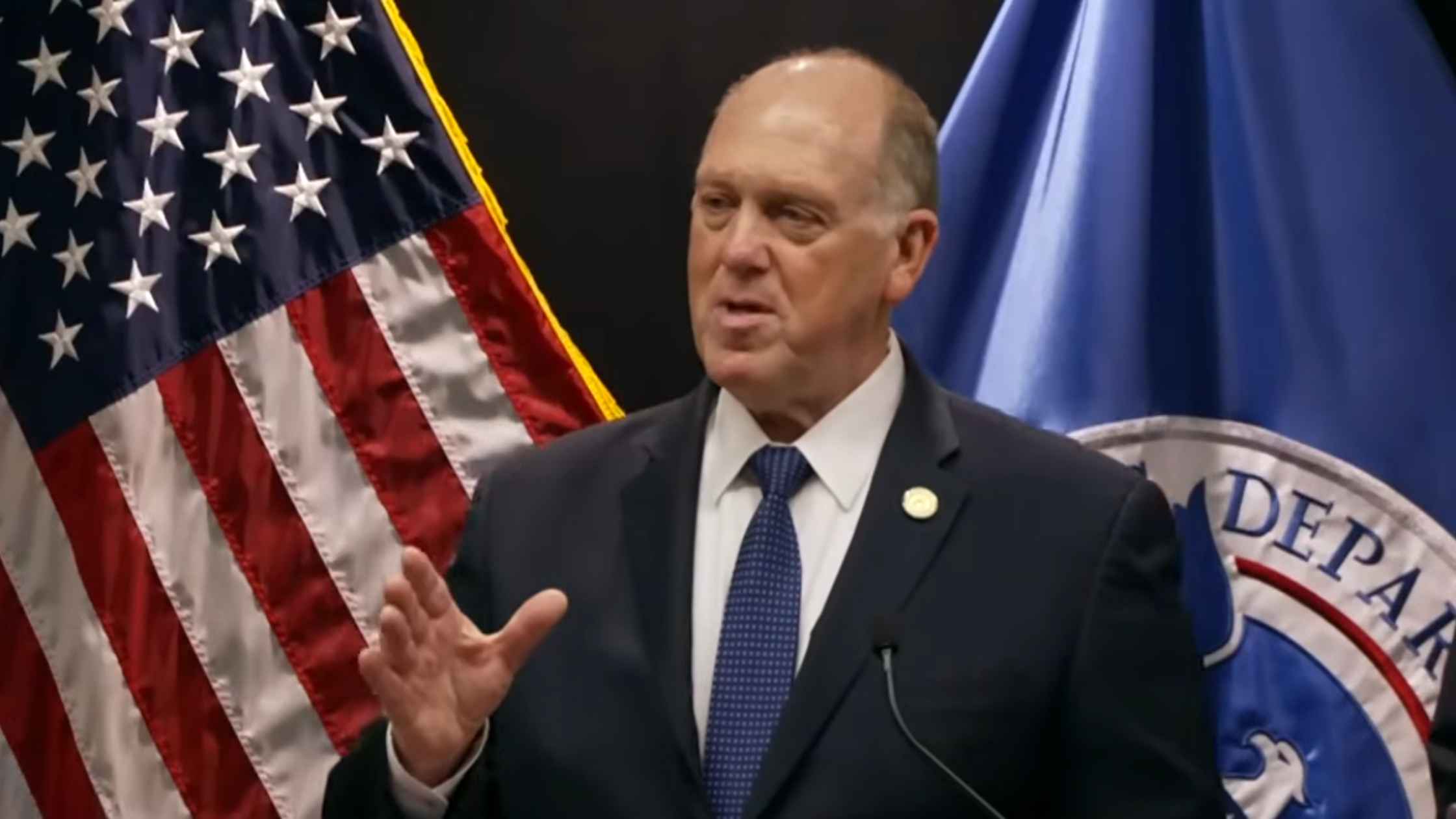
Tom Homan (08:48):
Good morning. Too early, isn't it? Look, I've been giving talking points and I don't like reading speeches, never have, but my chief of staff did put some stuff down here in writing just to make sure I don't miss anything. So I'm going to be reading a little bit, then we're going to open up for questions. I've been on the ground less than three full days. I got in here Monday. President of the United States called me Monday morning and asked me to deploy here. Got here Monday evening, and I'm staying till the problem's gone. But we've made a lot of progress, a lot of progress in the last three days. Marcos Charles, he's running ICE operations here. There you go. Rodney Scott, Commissioner of Customs and Board of Protection standing here beside me.
(09:52)
Good morning, I'm Tom Homan and the border tsar for President Trump. I'm here on behalf of the president, along with US Commissioners, Commissioner of US Customers of Border Protection, Rodney Scott, and Marcos Charles, who's leading the enforcement effort here right now. I've been on the ground since Monday to regain law and order in the city [inaudible 00:10:14], and work together to remove threats from the community. During the past administration, we all remember more than 10 million illegal aliens entered this nation. Many were national security threats, public safety threats. We can't remember were two million, two million known got aways. Two million people he paid more to get away. Why? That just scared the hell out of everybody. President Trump promised American people, including the residents of Minnesota, that he would work to ensure our communities are safe. And with that, this administration is absolutely focused on identifying removal aliens that pose a public safety threat and national security threats, and the numbers prove it, the dad approves it.
(11:05)
In the past few days, I've met with Governor Waltz, Attorney General Ellison, Mayor Frey, numerous police chiefs and sheriffs, and I have more to meet.
(11:17)
I'll also be continuing the dialogue with business and religious leaders in partnership with Minnesota. Your communities. I'll be meeting with them too because I want to hear what they have to say. In my meetings with folks so far, and most importantly the governor and the AG, the Mayor Frey, we didn't agree on everything. I didn't expect to agree on anything. I've heard many people want to know why we're talking to people who they don't consider friends in the administration. Bottom line is you can't fix problems if you don't have discussions. I didn't come to Minnesota for photo
Tom Homan (12:00):
... officer headlines. You haven't seen me. I came here to seek solutions, and that's what we're going to do. And we've come a long way, and we got some good wins for the people in Minnesota, I think, and for the administration and for the safety and security of this city. One thing we did agree on though, everybody I talked to agreed on, was that community safety is paramount. One thing we all agreed on was US Immigration Custom Enforcement is a legitimate law enforcement agency that has a duty to enforce the laws enacted by Congress and keep this community safe.
(12:44)
Like I've said many times for last several years, even before this administration, jurisdictions that refuse to cooperate with federal immigration authorities are sanctuaries for criminals. Sanctuary cities are sanctuaries for criminals, and endangers the residents of the community. To be clear, we did not agree with Minnesota State and local officials that they would be involved with immigration enforcement. I didn't ask them to be immigration officers. I'm asking them to be cops working with the cops to help us take criminal aliens off the street. What we did agree upon is not to release public safety arrests back in the community when they could be lawfully transferred to ICE. I'll speak more about that.
(13:38)
I will highlight that the Minnesota State prison system under the Department of Corrections have been honoring ICE detainers, and we appreciate that important collaboration and we're going to expand upon that. That decision has made Minnesota safer, not only for residents of Minnesota, but the men and women of law enforcement. Not just ICE, all law enforcement. Rather than arresting the same public safety threat, significant public safety threat over and over again, they agree to work with us to identify those people and remove them.
(14:18)
I'm also pleased to announce I had a very good meeting with Attorney General Ellison, and he has clarified for me that county jails may notify ICE of the release dates of criminal public safety risks so ICE can take custody of them, upon the release from the jail.
(14:44)
And let me tell you why that's important. I know people are a lot concerned about the manpower that's been set in law enforcement manpower. Look, I've said this many times before. I've said it for the last several years. Give us access to the illegal alien public safety threat and the safety and security of a jail. It's common sense. It's safer for the community. It's safer for the agent and it's safer for the alien, because anything can happen on a street arrest. It just makes common sense. And for the people that argue, while we're welcoming community, because we want victims and witnesses of crime that are here illegally, to feel safe to come to police without fear of their working with ICE. We're not going to talk to the victim and witness of crime. There's no problem there. They should feel safe to come to the police and ask for help. All we want is to talk to the person that local and state law enforcement authorities locked in the jail cell. They chose to lock this person up. That's who we want to talk to, the public safety threat. So the argument is that it protects victim and witnesses of crime. It's a bunch of crap. Victims and witnesses of crime don't want the bad guy back in their neighborhood either. So great progress with the attorney general and local sheriffs.
(16:23)
And one thing, when we have these agreements, it takes less law enforcement agents to do the job. One agent can arrest one bad guy in the safety and security of a jail, where he's behind the wire, we know we don't have weapons. But when you normally release that public safety threat, illegal alien back in the community, we have a job to do. We're going to arrest him. So we're going to find him. And what happens is now we got to arrest somebody on his turf. Who has access to who knows what weapons. Now we got to send the whole team out.
(16:59)
Cover the back door, cover the front door, officer safety reason. Then because of the hateful rhetoric and the attacks on ICE officers, now we got to send a security team behind the arrest team. So what could have been done with one person in the safety and security of jail, now we got 15, 16 people out there doing it. I know that causes stress in the community. So if we get these agreements in place, that means less agents on the street. More agents in the jail means less agents in the street. This is common sense cooperation that allows to draw down on the number of people we have here. Yes, I said it. Draw down the number of people here. Because we have the efficiency and safety of the jails in the prison.
(17:52)
Matter of fact, I have staff from CBP and from ICE working on a draw down plan. What does that look like based on the cooperation? What does that look like based on how many targets we have left to find? In my meetings with Governor Walz, AG Ellison, and Mayor Frey, as well as state and local law enforcement, again, I appreciate they all acknowledge that we do have federal immigration laws in this country that have been passed by Congress, and that ICE is in fact a legitimate law enforcement agency charged with enforcing those laws.
(18:28)
We're not making this up, folks. ICE is enforcing the laws enacted by Congress. They're a federal statute. That said, I'm not here because the Federal Government has carried this mission out perfectly, first thing I said to senior staff when I walked in here, this is what I told you earlier. I didn't come here looking for photo ops headlines. I come here looking for solutions. I do not want to hear that everything's been done here has been perfect. Nothing's ever perfect and anything to be improved on. And what we've been working on is making this operation safer, more efficient, by the book.
(19:11)
The mission is going to improve because of the changes we're making internally. No agency organization is perfect. President Trump and I, along with others in the administration, have recognized that certain improvements could and should be made. That's exactly what I'm doing here. As such, in meetings I've had with federal law enforcement managers, including ICE and CBP and other federal partners, as well as state and local officials, I have conveyed the president's expectations with regard to federal immigration enforcement efforts. We will conduct targeted enforcement operations. Targeted. What have we done for decades? When we hit the streets, we know exactly who we're looking for. Good idea where we may find them. You'll have a criminal history. You'll have their immigration history. A lot of information about this person that we get from numerous databases out there. Targeted, strategic enforcement operations.
(20:26)
That's traditionally been the case, and that's where we're going. That's what we're going to continue to do and improve upon that. With a prioritization on public safety threats. I want to be clear. I don't read a lot of social media. I don't read a lot of media, because I don't believe half of what I see. We are not surrendering the president's mission on immigration enforcement. Let's make that clear. Prioritization of criminal immigration doesn't mean that we forget about everybody else. That's just simply ridiculous. But when you have a criminal standing here and a non-criminal standing there, that criminal always should be targeted first, because he's a significant concern to the safety and security of the community. By and large, for decades, ICE and CBP have carried out their duties with integrity, professionalism, and compassion. That remains the expectation of President Trump and we will, I will, hold our agents and officers to that standard.
(21:29)
I'm almost done, and Tom can be Tom. As far as the agitators, that said, I want to reiterate and make very clear, I want to make it clear ICE and CBP officers are performing their duties in a challenging environment, under tremendous circumstances, but they're trying to do it with professionalism. If they don't, they'll be dealt with. Like any other federal agency, we have standards of conduct. They are sworn law enforcement officers working tirelessly to enforce our country's border security, immigration laws, protecting the interests of our country and preventing dangerous people from walking the streets of this nation when they're not supposed to be here to begin with. Men and women of ICE, I was a border patrol agent. I was an ICE agent. I was the first ICE director that came up through the ranks. I spent over 40 years doing this. These men and women that carry that badge and gun are American patriots.
(22:35)
They put their selves on the line for this nation every day. But I want you to remember, they don't hang their badge ... They don't hang their heart on the hook every day they come to work. They're mothers and fathers too. They're sons and daughters too. And if they've seen a fraction of the tragedies I've seen in my career, they take a lot of damage home every day. The things they've seen, especially on the border with border [inaudible 00:23:02].
(23:03)
People drowning in the river. Women being raped by criminal cartels. Giving CPR to a baby that was thrown in the river by the cartels because borders patrols came too close. So let's throw the baby in the river. That way the border patrol was concentrated on that so I can get away. These men and women see some terrible things, but I want to remember they're mothers and fathers too. Many of them are members as a community. God bless every one of them. The hostile rhetoric and dangerous threats and hate must stop. And we all agreed to that. All, everybody I met here today, tell you, we got to stop the rhetoric, the hateful rhetoric that has caused an increase in assaults. They have calls, because of that have to send security teams out with arrest teams, which surge the city with additional resources because of the rhetoric, because of the threats, because of the assaults. Again, with the agreements we've achieved in following through the agreements with the rhetoric dropping down, that allows
Tom Homan (24:00):
Just to pull more agents out once we feel the environment's safer. I begged for the last two months on TV for the rhetoric to stop. I said in March if the rhetoric didn't stop, there's going to be bloodshed and there has been. I wish I wasn't right. I don't want to see anybody die. Not officers, not members of the community and not the targets of our operations.
(24:46)
But the people out there don't like what ICE is doing. If you want certain laws reformed, then take it up with Congress. Again, ICE isn't making this up. They're enforcing laws and acted by Congress and signed by president. The same laws have been on the books for the last six presidents I worked for. I started with President Reagan and ending with President Trump. Every administration, we enforce the same laws.
(25:10)
If you don't like what ICE is doing, instead of protesting this building, go to protest Congress. Tell them you want changes. You have your First Amendment rights, I support that. You have the right to protest. I'm just asking you to keep it peaceful. But threatening law enforcement officers, engaging in impeding and obstruction and assault is never okay. And there will be zero tolerance.
(25:42)
You interfere, impede, assault an ICE officer, you will be arrested. Like I said a bit earlier in my meetings with Governor Walz and Ellison and Frey, as well as state and local law enforcement, I appreciate they acknowledge this, that public safety should be paramount.
(26:06)
The chiefs I've talked to committed to responding to 911 calls when protestors turn violent, agents are in a dangerous situation and there's assaults they have committed to upholding public safety and responding to the needs, not to enforce immigration law, but to keep the peace. With that, I call upon those officials to stand shoulder to shoulder with us to tone down the dangerous rhetoric and condemn all unlawful actions against law enforcement in the community. There are many ways your voice can be heard, express your feelings and affect change in the country without crossing that line. Political and other disagreements in this room should not be to the expense of public safety or the safety of federal law enforcement officers. In closing, I want to thank the state and local officials here in Minnesota I met with and the many I'm going to meet with. We've had meaningful dialogue.
(27:04)
And look, again, we didn't agree on everything, but we agreed on the things I just talked about. There's much more we can do. And I'm in continuous dialogues. I got many more community leaders to talk to. I've got many more sheriffs to meet.
(27:22)
President Trump wants this fixed and I'm going to fix it with your help. I want to thank President Trump for his unwavering commitment to public safety and prosperity of every American. Under the president's leadership, we have the most secure border in the history of this nation, which means less women are being raped, less children are dying crossing that border. Less fentanyl is getting in this country to kill Americans.
(27:53)
Less known expected terrorists are crossing into our country. And we don't have too many unknown [inaudible 00:27:57] we don't know who the hell they are. A secure border means we have stronger national security. A secure border saves lives. When 96% less people come in, how many women aren't being sexually assaulted by members of the cartel? How many people aren't dying making that journey? How many Americans aren't dying of fentanyl overdoses? How many women and children aren't being sex trafficked in this nation?
(28:22)
The data proves that and anybody can find that data. So God bless this great nation. God bless Minnesota. We can do better. And I think your local and state leaders meeting with me, we made some significant gains, significant coordination and cooperation, and you're going to see some massive changes occurring here in this city. Thank you.
Speaker 1 (28:52):
Right here. Thank you so much, Mr. Holman, Jovanda [inaudible 00:28:55] Rodriguez, Associated Press. Based on how you have described these changes in the mission, can you be more specific about the objectives of operational metro surge? If what you have described changes the parameters for interior enforcement only in Minnesota or also in Maine and other places? And finally, when would you consider that those objectives will be achieved and this operation will end? Is it in terms of agents on the ground, in terms of who you are targeting for arrests?
Tom Homan (29:23):
The withdrawal of law enforcement resources here is dependent upon cooperation. Like I said, one agent arrests one bad guy, a bad guy in the jail means less agents on the street. We have some agreements. We got more to talk about how we're going to implement those agreements, but as we see that cooperation happen, then the redeployment will happen.
(29:46)
Look, target enforcement operations should happen across the nation. That's what we've done for decades. And with target enforcement operations, I've done many, many of them, it just makes it safer for everybody. When we know exactly what we're looking for, what is his criminal history? What is his immigration history? Where's he live? Is he in an apartment complex versus a house? He's got a known record for having weapons. It's safer for everybody.
(30:15)
Then we know what type of resources we need to go. And it just makes the operation cleaner, more efficient, and it's proven less violence when we know exactly what we're getting into and we can take the necessary precautions to keep everybody safe.
(30:33)
Some of the operations that I've been involved in, we know there's children in the house based on surveillance. So we know you got to be a little bit different when you go into the house because there's going to be children present. So target enforcement operations, the way we've always done it, I think we got away from it a little bit and we want to make sure we do target enforcement operations. And look, I would say it again, we are not surrendering our mission at all. We're just doing it smarter.
Speaker 2 (31:03):
Shimon Prokupecz from CNN. Mr. Holman, how did we get here in terms of you had Greg Bovino, who was the face of this immigration operation, the mission, as you say, to having border patrol agents in the interior of this country, stopping US citizens, asking them for ID, creating this fear in places like Chicago and now here. And then finally, it took really the death of Alex Pretti for us to get here. How did that happen? Who made the decisions to allow this kind of operation to proceed in this way and to create such fear?
Tom Homan (31:47):
Well, look, the border patrol, the last four years under Joe Biden, we had an open border where 10, 12,000 people a day are coming across the border. Border patrol got overwhelmed, which means we sent thousands of ICE agents down there to help deal with that humanitarian crisis, to help secure the border. Now we have millions of people released in this nation, many unvetted. Now we got to find them. Before the Big Beautiful Bill, we had a total of just under 5,000 deportation officers to look for millions of people, many of them public safety threats. So yes, we needed border patrol to come and help on our mission now.
(32:25)
And reason for the massive deployment is because of the threats, because of the violence. Our officers need to be protected. If I'm on an arrest team, I'm going to a house, I got to be busy with that guy, the dangerous guy, and I can't keep looking over my shoulder at what's happening outside the house.
(32:42)
So we brought extra resources in to provide that security. And as I said, as we drill down in these great agreements we got and this great understanding we have it means less. So we can draw down those resources. When the violence decreases, we can draw down those resources. But based on the discussions I've had with the governor and the AG, we can start drawing down those resources as far as those looking for public safety threats being released and doing it in the jail with much less people.
(33:13)
So the draw-down is going to happen based on these agreements. But the draw-down can happen even more if the hateful rhetoric and the impediment and interference will stop. So border patrol, I was a border patrol agent, these men and women are patriots, God bless them. They're here to help us but the draw-down will come soon depending on when this actually... I see this in play, but the agreements we have alone is going to cause a significant drawdown.
(33:45)
So you're going to see a drawdown.
Speaker 2 (33:49):
You've been doing this for 40 years, just a follow up-
Speaker 3 (33:54):
First off, Ben Bergquam, Real America's Voice News. On behalf of the American people, I just want to say thank you to you and to all of the agents that are putting their lives on the line to go after the people that were allowed in in the last administration. We watched that happen in the media, the honest media, covered up by many of the media that are behind me. We want to say thank you and to all the men and women that are out there.
(34:13)
Can you talk to us about what's being done with the leadership on these Signal chats, on these WhatsApp chats that are organizing the attacks against you, the obstruction against you? Are we going to be arresting those individuals as well? And to the folks out there in America that voted for this, that want mass deportations because they saw a mass invasion under Joe Biden, what would you say to them?
(34:38)
How are we going to get to that point?
Tom Homan (34:41):
Well, first of all, about the organization and the funding of the attacks on ICE, I'm not going to answer a lot about that because I'm not going to show our hand, but they'll be held accountable. Justice is coming.
(34:59)
Again, we got to all remember, the questions we've seen and why are we here, what started this? Four years of a open border where millions of people are let in this country unvetted. Remember, let's not forget for four years, we were told the boarder was secure. Four years we were told the border is secure, and we all knew it wasn't. And I want this to be a positive thing we're doing here today.
(35:28)
I also want to remember, the politicians who are continually attacking us, where were they the last four years when the number of women, children, sex trafficking were at an all time high? Where were they when a quarter million Americans died from fentanyl coming across the border?
(35:46)
Where were they when women and children are dying making that journey? Where were they when over 4,000 families making that journey died,
Tom Homan (36:00):
... historic record. Where were they? Not a word. Now we're just trying to respond to what happened the last four years and keeping this country safe. And we're arresting a lot of public safety threats, taking them off the streets. Let's make this country safer. President Trump promised to make this country safe again, and that's what we're doing. But my two and a half days up here, we made a lot of progress. I think everybody agrees on the criminal and public safety threats. They agree it's much safer and easier to arrest an alien in the facility than send a whole team out in the field that's going to draw anger because now we got to send a bunch of people to do something that could have been done by one or two people.
(36:42)
And I've said this for years. I have no ill will to anybody in Minnesota, all the people I talk to. We're never going to agree on everything. We have different philosophies and different opinions on immigration, but we all agree this is the way to go to reduce safety, reduce crime. Not reduce safety, reduce crime and increase safety for our operations. More people in the jail means less people on the street. It's simple math.
Lana Zak (37:19):
Lana Zak, CBS News. Everybody I've spoken with agrees that if somebody has a violent criminal history and is a fugitive, they don't want them as their neighbor. But when you're talking about a targeted operation, are you talking about targeting people whose crime is coming to this country? Or is it a more specific definition now?
Tom Homan (37:42):
All operations will be targeted, but the prioritization are going to be criminal aliens, public safety threats, and national security threats. I've met with Marco and his staff. We got a lot of them. We got a lot of them to keep us busy. So that would be our focus.
Lana Zak (37:59):
But that is enough that that's what... There is not going to be a focus on people who have no other crimes except for their status.
Tom Homan (38:02):
If you're in the country illegally, you're never off the table. Prioritization doesn't mean you forget about everybody. Let me say this. If the message we send, as you enter this country legally, it's a crime. Don't worry about it. You can have your due process, show up in court, not show up in court, get ordered to move. Don't worry about it. Unless you commit a serious crime, you're good to go. If that's the message we send to the world, you're never going to fix this problem. The most vulnerable people in the world will make that dangerous journey like they did under Joe Biden administration. Over 4,000 aliens died making that journey.
(38:39)
And again, a significant increase in sex trafficking. Because when they did that and opened those borders up saying, "We're not going to detain you. We're going to give you free healthcare. We're going to fly to the city of your choice, put you in a free hotel room, give you three meals a day, and give you work authorization. We're just going to bring you in." And when they did that, they sent a message to the whole world, you can come and do this. And what happened? They overwhelmed the men and women of the border patrol where many days, 70% of agents were pulled off that line. 70%. You don't think the criminal carts had a field day with that? They created gaps for the cartels to do their activity. And that's why you seen the rise in fentanyl overdose. That's why you saw the rise in sex trafficking.
(39:18)
The two million plus known got-aways, why did they pay more to get away? Why didn't they pay less? Turn yourself in, get released within 24 hours. You get a free airline ticket to the city of your choice. We're going to give you a free hotel room and we'll give you free food and free medical care. And you're going to get work authorization in six months. Why did two million people choose to pay more not to take advantage of that giveaway program? They didn't want to be vetted. They didn't want to be fingerprinted. That scares the hell out of me. And it does still. The Trump administration with ICE and Secretary Noem and Marco Rubio and the intelligence community, Tulsi Gabbard, we're all working together to try to identify who these people are. And we've already found many of them. That's hard work to do, but there are national security threats walking this nation because of the last administration. And they are one of our main priorities too.
Speaker 5 (40:14):
Go ahead.
Speaker 4 (40:14):
Thank you. Can you please be specific about how many ICE and how many border patrol agents are currently operating in the state?
Tom Homan (40:23):
I think we're there three? Around 3,000? There's been some rotations. Another thing I witnessed when I came here, I'll share this with you. I met with a lot of people, a lot of the agents. They've been in theater. Some of these people have been in theater for eight months. So there's going to be rotations of personnel. Hopefully less now that we have some agreements, maybe we can make it more efficient and safe. But they've been in theater a long time. And so there's rotations happen all the time to get people out of there and go home, get some rest and see their families. Day after day, can't eat in restaurants. Day after day, having people spit on you and blow whistles at you. Day after day, having all these threats at you. Day to day, having people trying to interfere with you. Day after day. They're human.
(41:11)
So we've got to rotate these people and we've already rotated some, but my main focus now is draw down based upon the great conversations I've had with your state and local leaders. Again, I'm not a fool. I'm not walking away without seeing this put in place. But I take the word of the people I've met with. I think they're honest and I think they're good brokers that they want public safety protected. And they also want what's happening in this city to go away. And that's my goal.
Speaker 5 (41:44):
Last question in the back.
Joe Moller (41:45):
Joe Moller, Newsmax. The new video of Alex Pretti is now circulating. Your reaction to that, and do you think law enforcement could have played a role if, let's say Minneapolis police were able to respond to that? Have those top law enforcement officials said they'll help or do anything to help these agents around here?
Tom Homan (42:02):
I'm not going to comment on any of these shootings. I said from day one, from day one, I said on any of these shootings, as your career law enforcement officer, we'll let the investigation roll out, let the investigation play out and let it go where it goes. I'm not going to come out and make any comments that I think is right, wrong. Do I have an opinion? Yeah. My personal opinion, but I'm not going to share that with you. I'm going to tell you, let the investigation play out and see where it goes. But again, the President, one of the words he said to me, I came up here, he said he didn't want to see anybody die. The less interference, the less rhetoric, the less... I have buried border patrol agents and I buried ICE agents throughout my career, and the saddest thing I've ever done is hand a folded flag to a wife or a child. I don't want to see anybody die. Even the people we're looking for. I don't want to see anybody die. And despite what people think of Tom Holman, I say a prayer every night that everybody goes home safe. This isn't good. But I think my conversations the last two and a half days are leading us to a safer community, letting ICE officers operate in the safety and security of a jail more than on the street. I think anybody here with common sense would say it's safer to arrest a public safety threat in the safety and security of a jail.
(43:44)
And let me tell you, what is that going to result in? Less collateral arrests. When we go find that bad guy, when we find that bad guy, many times it's with others. Well, guess what? They're in the country illegally? We're going to force immigration law. They're coming too. You want less collateral arrest, less in the jail. But we're going to force immigration law. For the people that saying we're here to surrender our authority and the mission of enforcing immigration law, you are wrong. We're going to do target enforcement operations and we're going to prioritize the public safety threats and national security threats. That is we're here to do.
Speaker 5 (44:22):
Sir, no more questions. Go ahead. No more questions, guys. Thank you.