Donald Trump (00:01):
Pretty amazing.
(00:03)
Hello everybody.
(00:14)
Thank you very much.
(00:23)
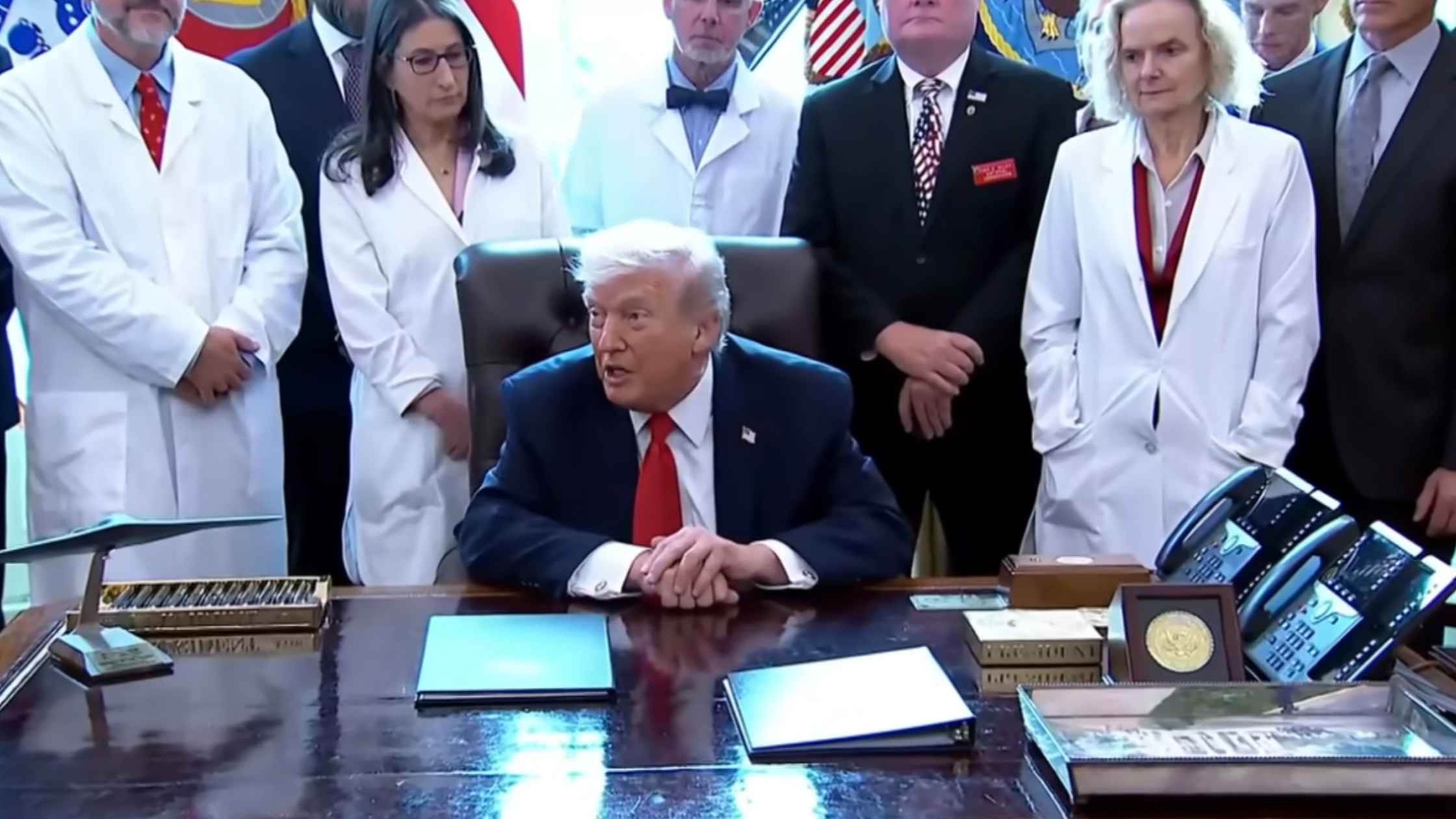
Well, this is a big day for many reasons and I have a very distinguished group of people behind me. Mostly medical people and brilliant people and they really know what they're doing. And I just want to thank them. They truly gave their lives in terms of the time and all of the incredible work they've done over the years and arriving at the position they have now. Most respected people in the country.
(00:52)
Today, I'm pleased to announce that I will be signing an executive order to reschedule marijuana from a schedule one to a schedule three controlled substance with legitimate medical uses. We have people begging for me to do this. People that are in great pain. For decades, this action has been requested by American patients suffering from extreme pain, incurable diseases, aggressive cancers, seizure disorders, neurological problems and more, including numerous veterans with service related injuries and older Americans who live with chronic medical problems that severely degrade their quality of life.
(01:39)
I can't tell you, I think I probably have received more phone calls on doing what we're doing. I don't think I received any calls on the other side of it, but hopefully this reclassification, which by the way, polls at 82%, will help many of those patients live a far better life.
(02:01)
We're joined today by Secretary Robert F. Kennedy Jr., who's doing a fantastic job, Administrator of Centers for Medicare and Medicaid Services, Dr. Mehmet Oz, the FDA Commissioner, Dr. Marty McCarry, Director of the National Institutes of Health, Dr. Jay Batacheria, and the Director of the National Institute on Drug Abuse, Dr. Nora Valko, as well as Dr. Elana Braun from the Dana Farber Cancer Institute, Duke University's, Dr. David Casaret, the National Commander of the American Legion, Dan Wiley, and my friend Howard Kessler. Howard, how are you feeling?
(02:45)
I'm telling you, he looks better than he did 20 years ago, but I don't want to go through what you went through to get there. It looks like you're doing great. I'm proud of you.
(02:55)
I want to emphasize that the order I am about to sign is not the legalization or it doesn't legalize marijuana in any way, shape, or form. And in no way sanctions its use as a recreational drug, has nothing to do with it. Just as the prescription painkillers may have legitimate uses, but can also do irreversible damage and never. If you look at some of the damage that can be caused, wreck lives and if it's abused, it's never safe to use powerful controlled substances in recreational manners. And especially in this case, if you take a look, illegal and unregulated drugs, very, very bad thing. So I've always told my children, "Don't take drugs, no drinking, no smoking, and just stay away from drugs." They would look at me and they said, "Dad would just stop saying that?" I would say every time I looked at it practically. Young Americans are especially at risk, so unless a drug is recommended by a doctor for medical reasons, just don't do it.
(04:06)
At the same time, the facts compel the federal government to recognize that marijuana can be legitimate in terms of medical applications when carefully administered in some cases. This may include the use as a substitute for addictive and potentially lethal opioid painkillers, and they cause tremendous problems. This can do it in a much lesser way, can make people feel much better that are living through tremendous pain and problems. Forty states and multiple US territories have already recognized the use of medical marijuana. This reclassification order will make it far easier to conduct marijuana related medical research, allowing us to study benefits, potential dangers, and future treatments. It's going to have a tremendously positive impact, I believe. We're also asking Congress to reconsider its classification of hemp derived CBD to ensure seniors can access CBD products they have found beneficial for pain and other reasons. Some people are literally dying with tremendous pain, and this can, in many cases, literally stop it, and they have their senses about them, as opposed to painkillers, which don't allow that. Don't allow them to die with dignity, frankly. I promise to be the president of common sense, and that is exactly what we're doing. This is really something having to do with common sense, and it's something having to do with the fact that so many people that I respect ask me to do. People that are having problems, big problems. They are having big problems with illness, with cancer in particular. I now want to ask Dr. Oz to say a few words followed by Dr. Braun, Dr. Kasare, Dan Wiley and Dr. Valka, and we'll sign the order as soon as they're complete, and we'll take some questions.
(06:10)
Please, go ahead.
Mehmet Oz (06:11):
Mr. President, thank you for always bravely pushing for common sense change, as you call it. So President Trump, Secretary Kennedy, have been pushing for change, their passion, their desire to help the American people, and they have relentlessly pursued this agenda throughout this administration. This also includes a deep passion for research. Gold standard research as Secretary Kennedy also says, but there's another side to the president that often isn't reflected in media reports, and that's the deep passion he has for the people in his life. And he has called me frequently about the people who are calling him, as he alluded to, who are saying that they've got problems and they got relief from some of the solutions we're talking about today. Howard Kessler, who's standing behind me here, who's a mutual friend of ours, was an early caller of the president. Many others have ever reached out as well. And Howard's been a passionate advocate for avoiding narcotics, especially in seniors and particularly seniors suffering from cancer. And that's a population that is a very important one. And it's a sympathetic population that's desirous of trying new ways besides some of the conventional approaches that have been tested by pharmaceutical companies, but have untoward side effects. At the beginning of the year, one of the first things the President told me, he doesn't actually tell you, he demanded from me, that my agency, CMS=
Donald Trump (07:29):
Nobody demands from him. Nobody. You have to know him.
Mehmet Oz (07:33):
… used all tools and his wherewithal to find a better way to help seniors. A passion for a population that has gotten left behind with these discussions. I promised that we would find an answer even though it had not been done before, and today we are delivering on that promise. Today, our innovation center at CMS is announcing a new model, an additional actions to give seniors access to cannabinoids. These are CBDs. They're not addictive, which many are already using to manage pain. There's some clinical evidence that's showing that CBDs provide relief from common conditions that affect Americans, including cancer symptoms, and chronic pain, and a slew of other problems that affect disproportionately seniors and our veterans. And six in 10 people who use the CBDs report that they improve their pain. I think all of those people are calling the President, judged on the number of calls pot in the support of what we're doing today.
(08:29)
And sometimes these decisions are difficult, and there's a reason this hasn't happened before. And there's a reason, Mr. President, that every president before you has whiffed on this issue. It's tough. And I know there's going to be a lot of discussion about it, that's why we're so passionate about making it clear that this patchwork that we're working within now, the laws and regulations, they're leaving patients and doctors without adequate guidance on the safeguards of how to use these products, even though they're still being used. At Medicare, we cover 68 million Americans, including people under the age of 65, and they did not have a way of providing these treatments until today. With the President's assistance, that's all changes. The innovation center models are going to allow millions of Americans on Medicare to become eligible to receive CBD as early as April of next year and at no charge if their doctors recommend them.
(09:20)
Thanks to the hard work of the entire CMS team, especially Abe Sutton and Gita Dio at the Innovation Center, the accountable care organizations in this country working in Medicare will be able to provide these products again at no cost to patients. Medicare Advantage insurers, and we've been calling them, are also agreeing to consider CBD to be used for the 34 million Americans that they cover. If you can hear my voice and you're over 65, you should pay attention to this executive order because it's going to touch your life. Again, this all becomes active after the first quarter of next year. These CBD products must first meet local and state quality and safety standards. They must come from legitimate sources and they must abide by other regulations of those states. With these boxes checked, patients can
Mehmet Oz (10:00):
… will be eligible for up to $500 of hemp derived products each year. This is the first government led testing of quality and outcomes for patients across different conditions, and it delivers on the need for more data collection, research into hemp usage. CMS is going to collect data, that's our job, on the patients that are being given these products by their physicians. In accordance with all the privacy and security regulations, we're going to analyze that data. We're going to make it publicly available to everybody to be able to analyze with us. If it shows promise, we will expand access to these products to even more conditions amongst Medicare and Medicaid beneficiaries. I want to thank not just the secretary, but Marty Makary.
(10:38)
We want a lot of companies who are doing this research that approached the FDA for formal approval. That is the right way to move forward. And Jay Bhattacharya, who's hiding in the back, he rarely hides, but Jay runs NIH and he's agreed to support initiatives to study the data that we're collecting. Howard Kessler, God bless you for being a pain in our sides. Mr. President, he's promised to stop calling you on this issue. He'll call you on other issues. And I thank you again from the bottom of my heart for taking a difficult stance.
Donald Trump (11:06):
Thank you very much.
Speaker 1 (11:09):
Mr. President, members of the cabinet, thank you so much for the opportunity to be here and for your leadership in rescheduling cannabis from schedule one to schedule three. This decision will accelerate scientific research and expand what can responsibly be studied. I'm a cancer psychiatrist and medical cannabis researcher at the Dana-Farber Cancer Institute. Over the past decade federal investment and research has helped transform cancer care. People are living longer than ever before. But cancer care is not only about treating the tumor, it's also about addressing the anxiety, the fear, the stress that can come with a diagnosis, symptoms that can interfere with treatment and make recovery much more difficult.
(11:53)
Many medications we use for acute anxiety carry significant risks, particularly in the older adults. That's why we're studying specific natural compounds found in cannabis, including the non-addictive cannabidiol to understand whether they can safely and effectively help manage anxiety during cancer treatment. Rescheduling allows us to ask these questions rigorously about dosing, about safety, and who may benefit most. This research reflects the best of federal investment, helping people not only live longer, but live better. Thank you, Mr. President, for supporting careful science-based research that puts patients first.
Donald Trump (12:33):
Thank you. Thank you, Doctor. That's beautiful, thank you.
Speaker 2 (12:37):
I'll add my vote of thanks, Mr. President. I never really thought this day would come. I met a patient about 20 years ago, a retired professor named Elizabeth, who came to my clinic. She was dying of pancreatic cancer, and she asked me then whether cannabis might help her. And I said no, because that's what I learned in medical school. She reached into a briefcase, took out a three-inch tall stack of articles, put them down on my desk and said, "Really? Doctor, you should read these. You might learn something." And I did read those articles. Every single one, I found a bunch more, and I did learn something. I learned that there actually is some medical benefit to cannabis that I had not anticipated, never heard about in medical school. Second, I learned that there was a lot we don't know. And third, I learned it's really, really, really difficult to do high quality, randomized controlled trials of a substance that's federally illegal.
(13:29)
This rescheduling has the potential to change all of that and to rewrite the way that we do research related to cannabis in the United States in three ways. First of all, it'll democratize the research process so that all academic institutions can participate in research, not just elite academic medical centers. Number two, it'll give patients and researchers access to highly refined, reliable sources of cannabis rather than relying on one or two sources around the country. And last but not least, it'll let us do the sorts of large scale randomized controlled trials that we do in oncology and cardiology, not dozens of patients, but hundreds or thousands of patients. That's how we learn. That's how we produce valuable knowledge that's useful in guiding treatment decisions. Mr. President, without you, this never would have been possible. And my patients and I and all of our families are grateful. Thank you.
Donald Trump (14:20):
Thank you, Doctor, very much. Thank you, Doctor.
Speaker 3 (14:21):
Mr. President, I am Dan Wiley, national commander of the American Legion representing 1.5 million veterans. We are the biggest, largest veterans' organization. We have 2.5 million members of our American Legion family. And I want to start by thanking you for your leadership on this issue. This issue is extremely important to the American Legion and I want to thank you on behalf of the veterans who are going to benefit from potentially the research regarding this issue. I also want to thank you for your VA secretary, Secretary Collins and his work on difficult veterans issues with us this past year. The VA has worked with us on our be the one mission, which is a mission to fight the epidemic of veteran suicide.
(15:12)
Veterans are disproportionately affected by conditions such as PTSD, TBI, depression, and chronic pain. And with this reclassification it will allow research to be conducted with regard to cannabis. There is anecdotal evidence that cannabis benefits these conditions, and now we'll have an opportunity to see if research does prove that it is effective. And if it is so, then it'll open up a whole new method of treatment for our veterans with regard to this particular issue. And so again, I just want to thank you for your leadership and thank you on behalf of the American Legion for this executive order.
Donald Trump (15:59):
Thank you. Such great people.
Speaker 3 (16:00):
Thank you very much, Mr. President.
Donald Trump (16:01):
They have suffered and will suffer a lot less now.
Speaker 3 (16:03):
You're right.
Donald Trump (16:03):
It is what I hear.
Speaker 4 (16:07):
Good afternoon.
Speaker 3 (16:07):
Anybody else, please?
Speaker 4 (16:09):
I'm Nora Volkow. I'm director of National Institute on Drug Abuse. And for us, that rescheduling opens the door to actually be able to accelerate the rate at which we can do research and discovery. And research is crucial in order for us to, for example, understand what may be and for whom the dangers of cannabis. Yes, cannabis can be addictive, and certainly people, adolescents and children may be the most vulnerable, but we cannot close our eyes to research and the opportunity that we are hearing from patients that for some of them, cannabis can solve their problem. And so what we need to do is do research, number one, to understand what are those conditions. Number two, in order to be able to optimally learn how to use it, and to understand number three, who is in danger? And it is knowledge that will allow us to optimally benefit, take the benefits that may be behind cannabis as research shows, but on the other hand, also enable us better to do prevention interventions to protect those that are most vulnerable, so thanks very much.
Donald Trump (17:13):
Great job. Thank you very much. Thank you, doctor. Bobby, do you have something to say?
Speaker 5 (17:21):
I'll just echo thank you, Mr. President. Thank you for your leadership and vision. And finally, getting to closure on this issue. This is a question, a scientific question that has divided our country for many, many years. And there are valid claims on both sides. On one side, patients and physicians that test that cannabinoids and THC can have miraculous effects on chronic pain, on epilepsy, on PTSD, on chemotherapy induced nausea. My friend, Howard Kessler, without whom we wouldn't be here today, has led this change in the schedule, but he did it because of his own experience in mitigating the impacts of chemotherapy. He has nothing to gain from this. He just saw something that worked for him, worked for thousands of other Americans and he wants to make it available to them. On the other side there are valid claims about the negative impacts about addiction, about psychosis, about adverse public health impacts, and impacts particularly on young people. The evidence on all of these is anecdotal and it's hypothetical because we have not been able to do scientific studies.
(18:52)
There is no standardized dosing. And if you don't have standardized dosing, any study that you do is comparing apples to pears. And we don't know the difference between botanicals and synthetics and all of these questions we're now going to be of an answer. Five administrations have promised to act on this issue. The Biden administration promised to do this and the proposal began during the Biden administration. It got mired down in the chaos and inertia and disorganization that… And I want to thank President Trump who made the promise during the 2024 election that he was going to come in and solve this issue, that he was going to take decisive action, and he has kept that promise today. And so thank you, President Trump, for your vision and for… And because of that, we will have answers very soon. This will finally allow us to study this issue and to answer these questions for the American people.
Donald Trump (19:51):
Thank you very much, Bobby. A good thing, Howard Kessler, a friend of mine, one of the most successful people in the country,
Donald Trump (20:00):
… country came to see me on more than one occasion actually. And he had some real difficulty about three and a half, four years ago. And he went through hell. And during his going through hell, he probably sampled everything you can sample when you're going through that, Howard. And he came to me, he said, "There's been nothing like this. We're going to have to take a good strong look at it." And that's what he asked me to do. And others have likewise said that, many others. I mean, again, I've never been inundated by so many people as I have about this particular reclassification. And I don't know that you have anything to say, Howard. If you'd like, you could say whatever you like.
Howard (20:48):
I just want to help the people 65 and over and make a difference in their lives. And we have machines and talent that could do it, not in eight year clinical trials, but in a year. And we're going to prove that may change the world really in healthcare. So thank you, Mr. President.
Donald Trump (21:06):
And I'm far younger than 65, so this does not pertain to me. Thank you. I don't want it. Okay. I'm not going to be taking it, but a lot of people do want it. A lot of people need it. And thank you, Howard, for-
Howard (21:20):
I appreciate it.
Donald Trump (21:21):
… really opening a lot of eyes. Okay. We'll sign it. We'll take some questions from the press. You can ask the doctor some questions. And it's an honor to do this. Well, that's a good one. Thank you. Thank you very much, everybody. Any questions, please?
Speaker 6 (22:07):
Mr. President, a health related question on your healthcare plan. You've said you want to make direct payments to Americans, but these Obamacare subsidies are expiring now in a matter of just a few days. More than 20 million Americans are now bracing for their premiums to skyrocket. Are you going to let this happen? Or will you intervene?
Donald Trump (22:24):
Yeah, they will skyrocket because it was never any good. I'd like to see the money that is going to the insurance companies by the hundreds of billions of dollars. Their stocks are up 1400%, 1800% and 1624%. Their stocks are up through the roof over a fairly short period of time because they're getting vast amounts of money. I want that money to go to the people directly and let the people buy their own healthcare. And they'll get much better healthcare than they get with the Unaffordable Care Act, as it's known by a lot of people. It is virtually unaffordable for people. It's a bad thing. We can have a great thing. Let the money go directly to the people and let them buy their own healthcare.
Speaker 6 (23:12):
But this is an urgent problem, Mr. President. Is there anything you can do now, Mr. President?
Speaker 7 (23:12):
Can I ask you, Mr. President-
Donald Trump (23:15):
This is going to be right now, as far as I'm concerned. Go ahead.
Mehmet Oz (23:18):
We just got data today. Do we have federal exchanges where people come shopping for the ACA? And the president hasn't heard this yet, but we've talked to the team. The percentage change from last year was down 2.7 to 2.8%. Not the massive numbers that have been predicted. And there's many possible reasons for this, but right now Americans are signing up for these programs, despite all the things that have been going on. 2.8% is a tiny fraction of what many had claimed would happen. And I think it speaks to the fact that American people appreciate these ACA plans are already subsidized over 80%. So it's a good deal, even if you don't get the extra 15, 20%.
Donald Trump (24:00):
It's a great solution to much better healthcare at a much lower cost. Yeah, please.
Speaker 6 (24:06):
But do you want Congress to extend these ACA subsidies?
Donald Trump (24:09):
Well, I'd like not to be able to do it. I'd like to get right into this and I'd ask Oz this question in particular, but I'd like to see us get right into this. I don't know why we have to extend. This could be done rapidly if the Democrats would come along. We have a problem. The insurance companies own the Democrat Party. They own it. And the Democrats having a hard time. They give a lot of money to the Democrats. Very little money to Republicans, by the way. A lot of money to Democrats. And they're going to have to decide, do they want to do the right thing or do they want to behold to the insurance companies? They're making a fortune. I want the money to go to the people. Go ahead. How would you say that?
Mehmet Oz (24:50):
I agree with the president. We have some ideas out there. Congress is working through some concepts, but I just want to emphasize that the ACAs are not imploding based on the data we just received from the federal marketplace.
Donald Trump (25:02):
This can go very quickly, actually. Yes, please.
Speaker 7 (25:04):
Mr. President, can I ask you, clarify something for me on the Federal Reserve. How many people are you interviewing for the Fed chairman and what did you think of Chris Waller?
Donald Trump (25:13):
I think he's great. I mean, he's been a man who's been there a long time, somebody that I was very involved with, sense of his career, and he's a fantastic man. I met him yesterday again.
Speaker 7 (25:26):
So how many people are you looking at?
Donald Trump (25:29):
We're talking to three or four. I think every one of them would be a good choice, honestly. We'll be making a decision pretty quick.
Speaker 7 (25:37):
Is Michelle Bowman on that list too? Are you going to interview her?
Donald Trump (25:39):
She's fantastic. She's a fantastic person.
Daniel (25:43):
Thank you, Mr. President. Some GOP lawmakers have written to you in recent days saying they're concerned this executive order could normalize drug use for youth. How would you respond to them?
Donald Trump (25:51):
You're talking about this particular today? Well, I think I'd let one of the doctors respond to it because they can do it a lot better than me, but I can only tell you that when you see polls of 82% of the people want this, when I have friends that are really, really sick and they've gone through, I guess you could say, fortunately I don't want to become too involved in it because I don't want it happening, but these are people that really know what's going on. Very smart people. This is one of the most successful people in the country and a very brilliant guy. And when they go through this horrible ordeal of cancer or other things, and they realize that this is something that makes them feel better without all of the side effects of some of the drugs where you're just totally knocked out and out of it, but I'd like to have one of the doctors maybe respond because people do it better than anybody.
Speaker 4 (26:43):
I'm Happy to respond. I mean, my answer is we have had cannabis scheduled for how long? And it hasn't protect neither the adolescents nor the adults. We have 20 million people in the United States with a cannabis use disorder. This is not legalizing it. It's making easier to do research so that we can use it when it is indicated and optimally.
Donald Trump (27:07):
So also a big part of this is research. In other words, you'll now have a much larger sample and you'll be able to see if it's as good as many people say it is. I mean, people say it is beyond good and you'll be able to find that out now.
Speaker 7 (27:22):
On housing, you talked in your address last night about housing. Are you still considering a national emergency over housing?
Donald Trump (27:28):
I'm looking at it. Yeah, I'm looking at it.
Speaker 7 (27:28):
What would that look like? What would that mobilize?
Donald Trump (27:30):
There's two thoughts on housing. You have a lot of people have housing that because we have such a strong time and such a strong market there, houses are very valuable. It's a big part of their net worth, their house. I don't want to knock those numbers down because I want them to continue to have a big value for their house. At the same time, I want to make it possible for young people out there and other people to buy housing. In a way, they're at conflict. In other words, you create a lot of housing all of a sudden and it drives the housing prices down. So I want to take care of the people that have houses that have a value to their house that they never thought possible, that have sort of made them wealthy and happy, and especially in their later years. Got to be careful with that. I want to keep them up. At the same time, I want to make it possible for people to go buy houses.
Daniel (28:27):
Mr. President, you announced the warriors dividend last night in your primetime speech, very patriotic, very generous. What was the rationale and the thought process? How'd you come up with the idea? What made you want to give back to [inaudible 00:28:40]
Donald Trump (28:40):
Well, 1776 was easy to come up with because we're actually at 1775. The number was 1775. And I said, "Wow, I think we can afford one more dollar." But they came up to me, it was $1,775. So I said, "Well, let's add a dollar to it. I think we can find that." And very simple, we've had a military that, in my opinion, by other presidents was not treated well. They're incredible. They're our finest people. They're protecting us. And because of tariffs, we're taking in billions and billions of dollars more than we ever have before, with no inflation, by the way, with no inflation. You saw the inflation numbers that just came out today, what great timing, practically no inflation. And yet we're taking in hundreds of billions of dollars, and this is small potatoes by comparison, but it's a way of taking care of our warriors, our soldiers, and I appreciate that question, Daniel. That was an easy one.
Daniel (29:44):
Karoline Leavitt, she just posted on the extra press secretary that the board members of the Kennedy Center voted unanimously to rename it the Trump Kennedy Center. What is your reaction to that?
Donald Trump (29:54):
Well, I was honored by it. The board is a very distinguished board, most distinguished people in the country, and
Donald Trump (30:00):
I was surprised by it and I was honored by it. We're saving the building. We saved the building. The building was in such bad shape, both physically, financially, and every other way. And now it's very solid, very strong. We have something going on television, I guess on the 23rd, December. I think it's going to get very big ratings. And the Kennedy Center is really, really back strongly. It's a very bad shape, very, very bad shape physically. And we were also to get Congress to put up a lot of money and other people to put up a lot of money. We had a lot of donors come in for record setting numbers. So we saved the Kennedy Center and I was really… This was brought up by one of the very distinguished board members and they voted on it and there's a lot of board members and they voted unanimously. So I was very honored by it. Thank you.
Reporter (30:52):
Mr. President, will you be seeking any authorization from Congress for any land attacks on cartels in Venezuela?
Donald Trump (30:58):
For any what?
Reporter (30:59):
For any land attacks on drug cartels in Venezuela?
Donald Trump (31:02):
I wouldn't mind telling them, but it's not a big deal. I don't have to tell them. It's been proven. But I wouldn't mind at all. I just hope they wouldn't leak it. People leak it. They are politicians and they leak like a sieve, but I'd have no problem doing that.
Reporter (31:21):
Mr. President. Mr. President?
Donald Trump (31:22):
Yes, please.
Reporter (31:23):
Mr. President, there's a meeting this weekend on Ukraine in Florida. What are you hoping will come out of that meeting?
Donald Trump (31:29):
Well, they're getting close to something, but I hope Ukraine moves quickly. I hope Ukraine moves quickly because Russia's there. And every time they take too much time, then Russia changes their mind. 27,000 soldiers were killed last month. Think of that. What do you think of that, doctor? It's 27,000, it's like a half a football stadium were killed in one month, and it's that way. It's anywhere between 20 and 30,000. Mostly soldiers, also some people from Kiev and other places. But largely it's the soldiers. They're losing their lives.
(32:07)
Nobody's ever said anything like this. It's the worst since World War II. And you've heard me say I settled eight wars, some going on for 35 years, one going on for 37, one going on for 32. And eight wars, and I thought this would be an easier one. This is because of the animosity, the hatred. It's a little bit more difficult than we thought, but there's a chance we can get this done maybe soon. Remember that 25 to 30,000 people being killed a month, young people being killed a month. Steve, please.
Steve (32:44):
When do you expect to make your announcement about the new Fed chair, sir? Before the end of the year, what are you thinking?
Donald Trump (32:50):
Over the next couple of weeks. I mean, I don't know before the end of the year but pretty soon.
Steve (32:53):
And then the Rocky Mountain North Carolina tomorrow night. Tell us what your message is going to be there, sir.
Donald Trump (32:59):
Say what?
Steve (33:00):
When you go to Rocky Mountain, North Carolina tomorrow night, what's your message going to be there?
Donald Trump (33:04):
Well, it's not going to be that much different from what I did last night. I mean, we've had tremendous success. We're bringing prices down. We inherited a mess, and part of what we inherited was the worst inflation in 48 years. I say history, but we had the worst inflation. It drove prices up, and now we're bringing those prices down. But I'll be talking about that. I'll be talking about the fact that we secured the border where literally nobody can come into our country illegally anymore. They came in from prisons and mental institutions and drug dealers and a lot of bad people from all over the world.
(33:39)
Venezuela emptied their prisons into our country. We had Tren de Aragua, which supposedly the doctors don't know this. It's the meanest gang of them all. Okay, doctor. You don't have to know about it. You got other problems. But they let a lot of bad people in here. And so I think I'll be talking about that. I think I'll be talking about the tremendous success we have by sending the National Guard into various cities. DC is the ultimate example. People walk to work and they thank me all the time. People in the White House, they just walk to the White House from 10 blocks away.
(34:16)
Before I came into office, they couldn't do that. They were getting badly hurt in many cases and beyond hurt, killed. So we were losing people. We were losing, on average, a person a week. Can you believe it? More. And now we haven't lost anybody in a long time. I consider the two people that get so badly hurt, the National Guard… That's a different city. That was terrorism. That was terrorism. And probably terrorism, maybe terrorism because they were unhappy with the tremendous success we've had because they don't want to see this country be successful.
(34:50)
But Washington DC now is a safe, beautiful city where the restaurants are booming, the town is booming. People walk to the restaurants with their wife or their children and have a good time. We were losing all the restaurants. We were losing our life in this. The whole heritage of Washington DC was down the drain and we brought it back. And now everybody's thrilled to be here. It's a part of the hottest country anywhere in the world. We've become, in 10 months, the hottest country anywhere in the world. And I say it all the time, we were a dead country one- and-a-half years ago.
Steve (35:31):
Did you expect to meet Prime Minister Netanyahu while you're down in-
Donald Trump (35:35):
Yeah, he would like to see me. We haven't set it up formally, but he'd like to see me. We've had great success. Peace in the Middle East, aside from everything else, we now have peace in the Middle East. Yeah, he'll probably come to see me in Florida.
Steve (35:46):
Egyptians as well?
Donald Trump (35:49):
I'd love to have them. El-Sisi, he's a friend of mine. Yeah, I'd love to have him. Thank you very much, everybody. Thank you.
Speaker 8 (35:57):
[inaudible 00:35:56]. Thank you, press. Let's go. Thank you, press. Thank you, press. Let's go. Let's go, keep going. Thank you. Thank you, press. Thanks, guys. Thank you. [inaudible 00:36:11].
Reporter (36:10):
And then this is especially Maine North Region 250 anniversary [inaudible 00:36:23].