


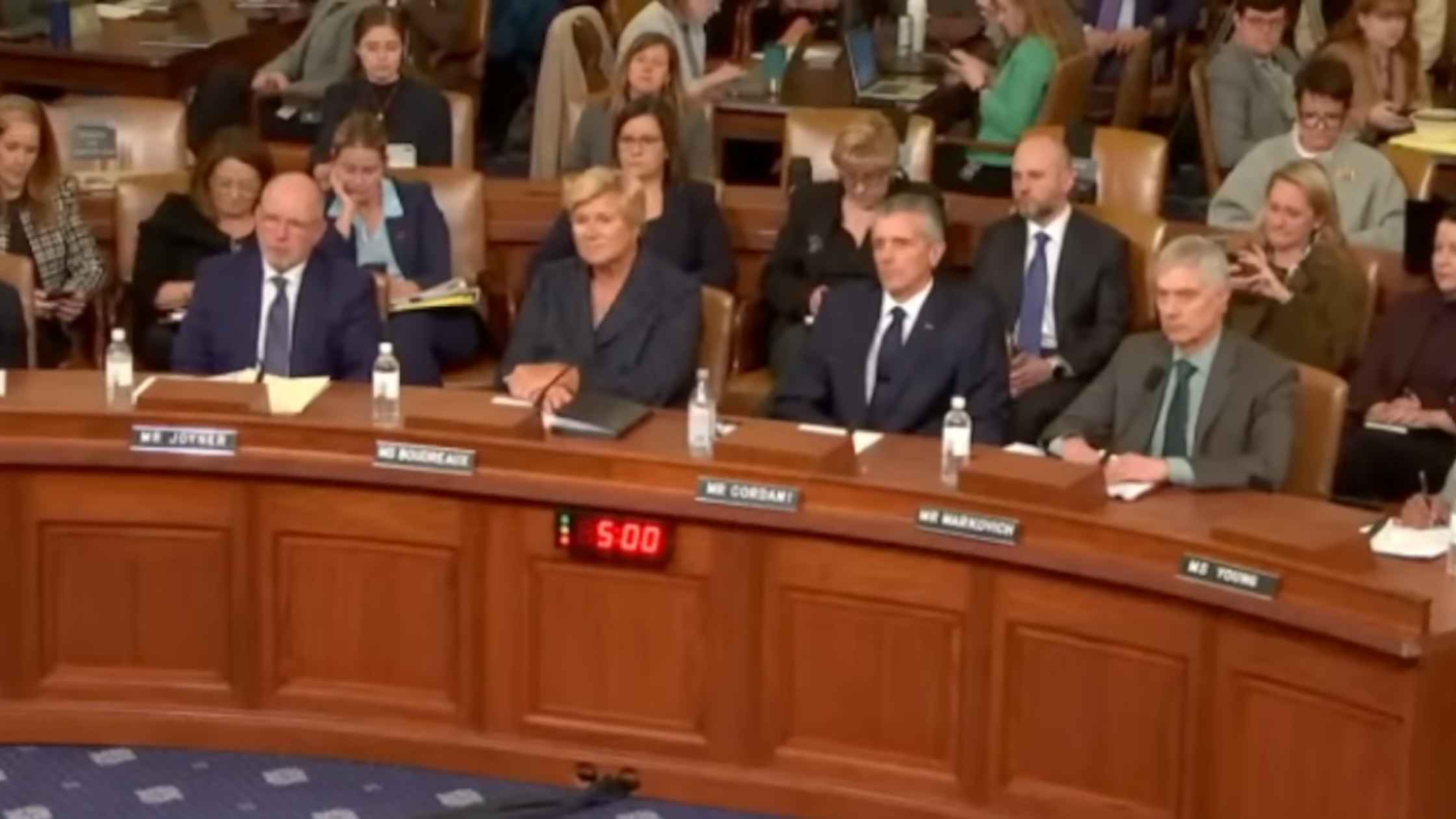
Speaker 1 (00:00:00):
(silence)
Speaker 2 (00:00:00):
... if Don gets there.
Jason Smith (00:38:02):
The committee will come to order.
(00:38:05):
Before we begin, I know that most of us have felt the impact of rising healthcare costs and that many of us have strong feelings about healthcare affordability. I also know that not everyone in this room will agree on every issue.
(00:38:22):
But I want to remind our guest and the audience that the chair is obligated, under the rules of the House and the rules of the Committee, to maintain order and preserve decorum in the Committee Room. Disruption of congressional business is a violation of the law and is a criminal offense. Violations will not be tolerated, and violators refusing to stop will be removed by law enforcement and subject to arrest.
(00:38:56):
I ask that we all abide by the rules and be respectful to our viewers and those in the room, including members of the audience and witnesses. I appreciate your cooperation in making sure that we have a civil discussion with our witnesses today.
(00:39:15):
I'd like to begin first by thanking our witnesses for voluntarily agreeing to appear before the best committee in Congress today. You were in another B committee earlier, but this is the real committee.
(00:39:32):
We are gathered here for one simple reason. Healthcare is increasingly unaffordable for American families, workers, and seniors. Today, the average family insurance plan costs roughly $27,000. Deductibles exceed $3,000 for individuals and as high as $10,000 for families. Obamacare premiums have climbed 80% in the last 10 years, and families on exchange plans are exposed to out-of-pocket maximums of over $20,000, while one and five medical claims are denied.
(00:40:18):
But it's not only in the exchanges which reflect just 7% of the population. The private employer marketplace that you all participate in and the more than 160 million Americans for whom you provide coverage is also experiencing the largest premium increase in 15 years. Health spending in America totaled $1.4 trillion in 2000. Today, it has tripled to $5.3 trillion. Nearly one out of every $5 in our economy is tied to healthcare spending. In short, Americans are paying more for coverage than ever before while getting less peace of mind and less access to care in return.
(00:41:14):
Ideally, insurers would help control costs and guide patients through our complex healthcare landscape. But today, patients are forced to navigate systems designed around insurer priorities, not patient needs. After paying thousands of dollars in premiums each year, families are forced to ask insurers for permission to access their own healthcare, only to face crushing out-of-pocket costs. There is not one single American that I have met that believes health insurers are effective at lowering costs.
(00:41:58):
This hearing is the first of more to come, examining the entire healthcare sector. Today, we will ask some of the largest health insurers why costs keep going up and how health insurers should make healthcare more affordable for all Americans, a question that my Democrat colleagues all but ignored when they were in the majority, and here are the results.
(00:42:24):
Americans are still struggling to afford just basic care. Health insurance premiums are exploding and patients are delayed and denied care every day. But instead of demanding answers, a senior Democrat reassured our CEO witnesses this morning saying, quote, "It's not your fault." Maybe because Democrats knows it's their fault because after 15 years of a Democrat-created health system under Obamacare, prices have only gone up, not down. They have only gone up.
(00:43:06):
I'd also like to remind my Democrat colleagues that these same corporations have exploited market power and vulnerabilities in federal programs to consolidate control, steer patient care, and maximize revenue. Three of the largest health insurance empires rake in nearly $1 trillion in annual revenue, pocketing tens of billions of dollars in profit. For this, their executives are rewarded with tens of millions of dollars in bonuses.
(00:43:44):
This is all made possible by the taxpayer. 90% of insurers' Obamacare revenue is taxpayer-funded. The tax break for employer-sponsored coverage is worth $4 trillion for health insurers, and Medicare Advantage insurers will receive more than $8 trillion over the next decade.
(00:44:09):
Yet patients, families and seniors still struggle. They struggle to afford care. Health insurers claim consolidation yields efficiencies and is necessary to survive regulation. It's not survival when three health insurers control nearly half of the market, and three PBMs control over 80% of drug benefits. Meanwhile, if efficiencies are meant to lower cost, why are insurers raising premiums, limiting competition, and shifting more costs onto families and taxpayers?
(00:44:52):
To be fair, blame can also be directed at federal mandates, draconian pricing rules and open-ended subsidies intended to expand coverage and make it more affordable. Over time, these policies in many cases have had the complete opposite effect. They have rewarded higher spending, complexity and consolidation. Government health insurance subsidies have drawn bad actors to fraud, like moths to a flame.
(00:45:23):
Large federal programs require clear guardrails and accountability. Sadly, sadly, you won't hear my Democrat colleagues grapple with the existence of fraud and abuse in our health system. They just want to cover it up with more taxpayer dollars, and that's a shame because acknowledging these problems is a necessary step toward reform.
(00:45:49):
Republicans are clear-eyed on reforming our healthcare system for the better. Last week, President Trump released the Great Healthcare Plan, his bold framework to lower cost for families and hold abusive middlemen accountable. We must restore affordability, strengthen competition, and ensure that federal health policy works for all patients and all taxpayers.
(00:46:19):
I look forward to hearing from our witnesses about what concrete steps they will take to address these challenges and how they are prepared to work with the committee in the future to lower healthcare costs for all Americans.
(00:46:34):
I'm pleased to recognize the Ranking Member, Mr. Neal, for his opening statement.
Richard Neal (00:46:37):
Thank you, Chairman.
(00:46:38):
As you might conclude, we have a different perspective on the issue that's in front of us. I want to thank you for the hearing, but a theme of this Congress has been Republican silence, as our colleagues on the other side rubber-stamp everything that the president says and does.
(00:46:57):
We're here for one reason, for sure, and the reason that we're here is because they've refused to extend these tax credits. When we hear that costs have gone up in the last three months, it's because the credits have not been extended. That's the reason. On this dias, we've been warned that the danger of DOGE's meddling with the American people's most private data, the other side acted as though we were hysterical. What do you have to say now that the Trump administration, who has admitted through court filings, that social security data was illegally shared for the purpose of election interference?
(00:47:37):
Then there's a silence on the affordability crisis created by the president. House Republicans have hamstrung their own ability to act, leaving the illegal tariffs in place. That's led to price hikes as well that imperil our global relationships. Trillions of dollars in retirement savings were wiped out 24 hours ago, and now they've been returned. That's the haphazard nature of modern governance with this administration.
(00:48:08):
To say that the president has laid out a healthcare plan, that's like Elmer's glue and bubblegum. And when the Speaker of the House was asked about the healthcare plan that he had put out, this is something everybody in this room can agree on. They put it out on Friday night. If there's anything that good is announced in Congress, it does not happen on Friday nights. We can be assured of that.
(00:48:40):
Where's the accountability? There's never been a Republican alternative to the healthcare plan that we put out with great competence and satisfaction with 24 million additional Americans receiving health insurance. They've attempted time and again to sabotage the system without a competing alternative of their own. Americans are angry about prices and increases, and we know the stories of coverage failures, and we have witnessed record profits. Costs have to come down. If they're serious about doing this, as they've stated, let's extend and expand the ACA tax credits.
(00:49:20):
Our Republican friends have no interest in strengthening healthcare or protecting patients. They use their signature legislation to slash $1 trillion, which will be readily felt at the end of this year as it relates to our hospitals. They've refused to extend the tax credits that we've asked for time and again, causing millions to forego health coverage this year, and they've been silent as the Trump administration wages an all-out war on public health and, yes, on science as well.
(00:49:49):
There's a crisis afoot all right, and instead of hearing from those who are struggling, they've said, "Let's bring in the CEOs to redirect the public's attention and to avoid accountability." You should be here to testify. It's important. It costs too much. But anything to distract from the stories like the one we're going to hear from Ms. Young later on today, a breast cancer survivor and a small business owner. Ms. Young knows exactly what these attacks on healthcare mean, soaring costs, shrinking coverage, and unnecessary stress.
(00:50:21):
The majority had all of 2025 to act all year to prevent premiums from doubling, tripling, except toppling. They chose not to. Democrats have offered numerous avenues to save the ACA credits and to lower cost, and let's be clear about the priorities, as Trump's prices include a $700 billion tentative plan to purchase Greenland. That money could be kept in healthcare costs that would help generations of Americans. The choice is clear for the American families, and they know it.
(00:50:55):
It wasn't already clear, but after that vote a couple of weeks ago, let me say something with great confidence. The ACA is here to stay. Those numbers are only going to grow as time goes on. That's because of people-first legislating. The ACA transformed healthcare. It opened up coverages. Is it perfect? Hardly. But if we would work together, there'd be an opportunity to make it play out the way we have fully intended, rather than this constant attack on the ACA, but never having an alternative of their own.
(00:51:28):
A reminder, it capped premiums at 8.5% of income and put an average of $2,400 back in family pockets. 94% of the enhanced tax credits go to households making under, under $200,000. Compare that to their tax bill, 37% of their benefits go to those same people.
(00:51:49):
The Republican signature tax law is underwater while the ACA continues to grow, and it continues to rise in popularity. The sabotage is an attempt to drag us backwards. We're not going to let that happen. There are real longstanding problems in healthcare, and we want to hear some answers today from our panelists as well. Insurers must step up, reduce cost, and that doesn't mean shifting burdens onto patients. Our focus should instead be on protecting care, expanding coverage, and bringing down costs.
(00:52:16):
Working together, we can strengthen the ACA, and just as we envision, make sure it's expanded to the very members of the American family who need it.
(00:52:26):
With that, I yield back my time, Chairman.
Jason Smith (00:52:28):
Thank you, Ranking Member.
(00:52:29):
I will now introduce our witnesses. We have with us Stephen Hemsley, is CEO of UnitedHealth Group. We have David Joyner, is chairman and CEO of CVS Health. We have Gail Boudreaux, is president and CEO of Elevance Health. And we have David Cordani, is president, CEO and chairman of the board of the Cigna Group. And we have Paul Markovich, is president and CEO of Ascendiun.
Paul Markovich (00:53:02):
[inaudible 00:53:04]
Jason Smith (00:53:04):
Yeah. Okay.
(00:53:06):
And we have ReShonda Young is a resident of Waterloo, Iowa, an owner of TnK Health and Nutrition.
(00:53:17):
Thank you all for joining us today. Your written statement will be made part of the official hearing record, and you each have five minutes to deliver your remarks.
(00:53:29):
Mr. Hemsley, you're recognized.
Stephen Hemsley (00:53:32):
Thank you, Chairman. Good afternoon, Chairman Smith. Oh, thank you.
David Joyner (00:53:39):
[inaudible 00:53:40]
Stephen Hemsley (00:53:40):
Good afternoon, Chairman Smith, Ranking Member Neal, Members of the Committee. Thank you for inviting me to testify today.
(00:53:50):
Every day, people count on our company, not just to help, help them when they're sick, but to help them when they're healthy as well in every stage of their lives. And we take that responsibility seriously. Like all of you, we are dissatisfied with the status quo, and know we must all do better. And so we are committed to doing exactly that, and that is in part is why I've returned to UnitedHealth Group as chief executive.
(00:54:18):
Our mission as a company is to help people live healthier lives and help the health system work better for everyone, better outcomes, better experiences, lower costs. Achieving these goals means being candid about why the cost of healthcare continues to rise.
(00:54:36):
The cost of health insurance fundamentally reflects the cost of healthcare itself. It is more an effect than a cause. If insurance costs are going up, even as we compete aggressively against other companies, it signals rising costs of health services and drugs and our rising volumes of care activity. And it is a fact hospital and drug spending has soared at three times the rate of inflation since before 2000.
(00:55:04):
We limit these pressures as much as possible. We use negotiations, data insights, better care coordination to moderate the cost of growth, improve outcomes, and protect access. And we focus on preventative care so people get care before a condition worsens or before becoming sick at all.
(00:55:26):
Insurance is the only sector in healthcare incentivized to keep the cost of care as low as possible while still seeking high-quality health outcomes for people and helping them avoid getting sick in the first place. And it's a virtuous circle. Generally, the healthier people are, the fewer health resources they need. We are innovating to make high-quality healthcare easier to find, simpler to navigate, and most importantly, more accessible and affordable.
(00:55:57):
Last year alone, we negotiated nearly $300 billion in savings for our customers. Without those efforts, recent premium increases would easily have been twice as high. Nearly 90% of our premiums go to direct medical care, including an Affordable Care Act plans. Our enterprise margins are only around 5% with Medicare, Medicaid, and ACA margins being far less than that.
(00:56:27):
Additionally, we have made notable progress in areas such as value-based care, which incentivizes better care and health outcomes and simplifies the experience, and in Medicare Advantage, which provides lower total costs than traditional Medicare with more benefits and lower overall cost to seniors, a majority of whom choose it each year.
(00:56:51):
We've introduced innovative health plans that offer people the information they need upfront, enabling them to comparison-shop for care. These plans often have no deductibles and no co-insurance and members pay an average more than 50% less in out-of-pocket costs compared to traditional plans. And employers offering these transparent plans are also seeing lower total costs. We're committed to extending these consumer-centric features wherever we can to consumers have more choice, more control, more transparency and certainty, and more value overall. We're mindful of the current moment and the debates about affordability in Congress and throughout the country, and we appreciate the current bipartisan talks focused on ideas around affordability, transparency, and a possible short-term tax credit extension. Because we want to continue to be part of the solution, with respect to ACA individual plans, we will voluntarily eliminate and rebate our profits this year for these coverages. I know there are aspects of our products and services that are still too confusing and complicated for people. We are intensely focused on setting a new standard of transparency, simplicity, and ongoing improvement as we continue taking costs out of the system and make healthcare more affordable.
(00:58:18):
In addition, we provided policy ideas in our written testimony intended to lower premiums, address rising health costs, and better align what we pay for healthcare with the rest of the world.
(00:58:29):
I look forward to our discussion today about what more can be done to improve affordability and expand the availability of quality care. Thank you.
Jason Smith (00:58:39):
Thank you.
(00:58:39):
Mr. Joyner, you are now recognized.
David Joyner (00:58:42):
All right.
(00:58:42):
Chairman Smith, Ranking Member Neal and Members of the Committee, thank you for the opportunity to share our perspective on the drivers of healthcare costs and the market and policy situations needed to address them.
(00:58:54):
CVS Health engages with millions of Americans every day in their communities, helping families struggling with an often confusing and disconnected system and the rising cost of healthcare. What's driving these costs is understood, greater demand for care, growing medical provider costs, and persistently high prices for hospital care and prescription drugs.
(00:59:15):
Every day, we are addressing the fragmentation and the underlying cost of care that starts by making care for Americans accessible and affordable, and most importantly, simplifying the patient experience at every point. Our 300,000 employees across the country work every day to meet this moment. CVS Health supports the committee's goal of addressing rising medical costs, and we want to be a partner in addressing these challenges.
(00:59:39):
We are working to ensure our members have access to the right care at the right cost, and we are expanding low-cost primary care, covering preventative care at no cost to patients, and offering free virtual care to eliminate the barriers to access. We are leading the industry in developing new solutions to lower cost, investing in technology to identify health problems before they become serious and tailoring treatment to individual patient needs.
(01:00:06):
Today, I'll share four ways we're making care more affordable and accessible. First, we're expanding access to coverage that rewards providers for keeping patients healthy.
(01:00:15):
Second, we're reducing administrative burdens, so instead of filling out forms, doctors can actually spend the time caring for patients all while driving lower administrative costs of care. We know denial of care is a major frustration for patients and their doctors, so we continue to reduce the number of claims subject to prior authorization, and by independent measures, we have the fewest number of services subject to it. When we do receive an authorization request, 77% are approved in near-real time, and that number continues to grow. For medications, nearly half are approved immediately, and for others, the average approval time decreased from three hours in 2024 to just 34 minutes today. CVS Health's bundle approach now gives providers one approval, covering medical procedures like repeat imaging and medication for specific conditions. For patients undergoing breast cancer treatment, that means a single authorization for an entire series of procedures.
(01:01:13):
Third, we're using competition to address the rising drug costs. We're aggressively promoting the use of biosimilars. We now have the vast majority of members paying $0 out-of-pocket for these once pricey drugs and has generated more than $1.5 billion in savings for our customers. And fourth, we're building a modern consumer healthcare platform that we will open to plans and providers. For patients, it's simple. One open app that allows them to own and manage their own healthcare. For 17 million monthly active app users, we'll schedule appointments, refill prescriptions, access preventative care all in one place, with the goal of helping them stay healthier at lower cost. For the healthcare system, it's a shared foundation we believe will make care more coordinated and affordable.
(01:02:03):
I took this role 15 months ago because I wanted to help shape the future of healthcare in this country. I'm proud of the work we've done so far to simplify the healthcare experience and to make care more affordable and accessible for American families.
(01:02:17):
I know there is much more to do. It requires health plans, providers, employers, all working together. That's why we support reforms that increase transparency, competition and innovation, particularly among hospitals and the pharmaceutical supply chain. We encourage policymakers to preserve flexibility for employers to offer benefits that meet their workforce needs and to avoid policies that reduce competition or add bureaucracy.
(01:02:43):
We want to work together, first, to explore solutions that bring younger and healthier people into the risk pools.
(01:02:51):
Secondly, expand the definition of preventative care to services that keep people healthy and out of the hospital, allowing people in high deductible plans to access these services in their pre-deductible phase.
(01:03:02):
Third, address the bad actors who are gaming the No Surprises Act. Centralizing eligibility, automating processes, and increasing oversight can address this abuse.
(01:03:13):
Fourth, accelerate the interoperability of health records to reduce the friction and to help patients manage their health.
(01:03:20):
And five, pass the ECAPS legislation, which allows the pharmacist to practice at the top of their license and receive Medicare reimbursement. This will benefit every pharmacy in the country while improving access for patients and reducing cost.
(01:03:36):
We welcome the committee's partnerships in these efforts as we continue to work to make healthcare more affordable for all Americans.
(01:03:42):
Thank you, and I look forward to your questions and to the additional hearings.
Jason Smith (01:03:46):
Thank you.
(01:03:46):
Ms. Boudreaux, you are now recognized.
Gail Boudreaux (01:03:49):
Thank you, Chairman Smith, Ranking Member Neal and Members of the Committee. I'm Gail Boudreaux, president and CEO of Elevance Health.
(01:03:58):
For over 80 years,
Ms Boudreaux (01:04:00):
We've served individuals, families, and communities. I appreciate the opportunity to be with you today on an issue that is weighing on households across the country, healthcare affordability. Families are frustrated by the rising cost of healthcare and they're right to be. Rising premiums and out of-pocket costs strain household budgets and cause people to delay care. This is personal and for many families it's frightening. We can all do better. Americans want solutions and we're taking concrete steps to deliver them. Our responsibility is to provide coverage people can afford, provide clear information in plain language about coverage and costs, and make timely decisions. This includes negotiating for fair prices that affect premiums and out of-pocket costs. Our role isn't just to explain costs. It's to act and it's to make healthcare easier to navigate for patients and doctors. Every redundant step and paperwork delay adds cost and frustration without improving care. Prior authorizations apply to about 3% of our claims. And since January 1st of 2024, we've removed more than 400 services from prior authorization requirements.
(01:05:43):
For what remains, we're expanding electronic prior authorization to reduce paperwork and speed decisions and using technology, including AI, to handle routine steps and move information faster while clinical judgment stays in human hands. The United States now spends more than $5 trillion a year on healthcare. Health insurance premiums are primarily shaped by medical care and drug costs and where care is delivered. When the prices charged for care rise, premiums and out of-pocket costs rise too. Hospital spending increased by nearly 10% in 2023 and again in 2024, the fastest rate in more than three decades outpacing inflation and wage growth. Prescription drug spending grew nearly 8% in 2024 and now represents a quarter of what employers spend on healthcare. Costs also rise when the same service is billed at a much higher price in a hospital setting than in a physician office or urgent care. Fraud, improper billing and administrative requirements also add costs that ultimately show up in premiums. We're focused on practical solutions that lower cost and make healthcare easier to navigate.
(01:07:27):
Our approach of coordinating medical and pharmacy benefits is helping employers lower medical and prescription drug costs, saving some employers up to $212 per person per month, underscoring our whole health approach. We also promote preventative care so problems can be caught early. And we work with doctors and hospitals to help patients get the right care at the right time and in the right setting. For example, our concierge care oncology program has lowered chemotherapy related hospital admissions by more than 60%. We're committed to being part of the affordability solution because when healthcare is too expensive, people delay care, employers struggle to offer coverage and families lose peace of mind. Keeping care within reach requires common sense reforms that address root causes, such as hospital price growth, rising prescription drug prices, unnecessary paperwork, and lack of transparency. With discipline and partnership, progress is possible. Thank you again for the opportunity to be here. I look forward to your questions and to working with you to make healthcare more affordable.
Jason Smith (01:09:05):
Thank you. Mr. Cordani, you are now recognized.
Mr. Cordani (01:09:08):
Chairman Smith, ranking member Neil, and members of the committee. Thank you for the opportunity to testify in front of you today on one of the most pressing issues facing American families and employers, which is the underlying cost of healthcare. My name is David Cordani. I serve as chairman and chief executive officer of the Cigna Group. As a global organization, we provide health services largely through employer-sponsored programs and unions, and we bring together health services that we seek to reduce overall costs, increase quality, convenience, and help to make healthcare easier to navigate. And while I'm personally proud of the work we've done, we've recognized that there is more to do in the future. At a high level, I'll identify three major categories where we see opportunities for further improvement. First, we must intensify our focus on the needs of patients earlier in the care journey, especially programs that prevent chronic disease in the first place and support long-term health. Second, we need to better align incentives for providers and pharmaceutical manufacturers that reward outcomes from interventions, not just the volume of interventions consumed.
(01:10:16):
And third, we must further leverage competition, which has proven to lower costs in America improve overall value for Americans. I joined Cigna over 30 years ago, and over that time I've seen amazing advancements in medical care, but I've also seen costs relentlessly rise at a much faster rate than inflation. Prescription drug prices alone have risen more than three times the rate of inflation over that time. And many Americans, as we know, feel that pressure every day, which is why this discussion is so important. Now, the US healthcare system generally provides rapid access to high quality care, but access is only meaningful if it's affordable. And an affordable system requires health plans, hospitals, drug manufacturers, physicians, and policymakers to work together, putting the patient at the center. At Cigna, we're focused on expanding access to preventative care and coordinating services around patients' needs and increasing transparency to enable people to understand how their healthcare dollars are being spent. Today, our system overwhelmingly pays for care after people become sick. Prevention and sustained engagement are still the exception in the overall cost equation, and we know a better approach works.
(01:11:27):
For people living with chronic conditions, for example, we've redesigned coverage and care models that support prevention and treatment adherence. This means lowering or eliminating the cost altogether for life-saving medications. It means coordinating medical, pharmacy, and behavioral healthcare programs, and it means giving patients real-time support to health programs to help them avoid complications. But expanding these solutions requires us to confront the underlying cost drivers as well. For example, since 2000, the cost of a hospital stay has grown 220%. In 2024 the median price of a new pharmaceutical launch in America was $370,000. That's up from $2,000 20 years prior, or a 12,000% increase. These prices put some of these critical treatments out of reach for families and employers, especially when competition is delayed or blocked. We also need to recognize there are broader forces at work. Our population is aging and more Americans are living with chronic conditions. This increases the underlying costs and therefore the premiums. Just as, for example, a rising fuel price on the economy would raise prices across a broad economy. At Cigna, we work tirelessly to be a counterweight to those pressures.
(01:12:46):
For example, our ability to drive competition amongst generic drugs has led to some of the lowest prices for generic drugs in the world. And where we could effectively harness competition with brand drugs, we're able to drive meaningful savings for patients. For example, we've been able to cap price of insulin at $25 a year in a program started in 2019. For example, we provide biosimilars to high cost medications at no cost to patients, and we are further modernizing prescription drug benefits to lower the cost at the counter by leveraging greater transparency. This focus on solutions matters when people at their most vulnerable. A cancer diagnosis, for example, we know is devastating for the patient and the family. We seek to build care models that eliminate out of-pocket costs and connect patients to top quality specialists supported by our focus on rewarding value over volume. Our goal is simple, the right care at the right time without financial stress. We recognize that no company or single sector could solve this alone.
(01:13:49):
As such, we stand ready to work with Congress, this committee and the administration, and partners across the healthcare system to further strengthen the US healthcare system, focusing on prevention, paying for value versus volume, and further aggressively leveraging competition for the benefit of patients. Thank you, and I look forward to your questions.
Jason Smith (01:14:06):
Thank you. Mr. Markovich, you're now recognized.
Mr. Markovich (01:14:09):
Thank you. Dear Chairman Smith, ranking member Neil and members of the committee, thank you so much for the opportunity to testify before you today. My name is Paul Markovich. I am president and CEO of Ascendiun, a nonprofit and parent company of Blue Shield of California. Our healthcare system is bankrupting and failing us. It's way too expensive, too impersonal, doesn't cover everybody, achieves inferior quality outcomes relative to other countries, and is mistrusted by too many Americans. This is unacceptable. We are all mortal, which means we will all need to use the healthcare system. When our loved ones need to do so, we want them to be able to afford it and then be treated the way they deserve to be. Our nonprofit organization describes this as a healthcare system that is worthy of our family and friends and sustainably affordable for everyone, or simply worthy of us. We're a long way from that ambition right now because there's too many times when the participants in the system, health plans, hospitals, physicians, pharmaceutical companies, and others put profits ahead of patients and fail to recognize how complex, inconvenient, and inefficient our current system is.
(01:15:27):
This leaves consumers, employers, and the government financially stressed and frustrated with the inconsistent and impersonal service that they receive. The good news is we can fix this if we have the collective courage and conviction to do so. It starts by recognizing that we must fundamentally change this flawed system, and we must take accountability, all of us, for doing so. We don't need more explanations for why healthcare costs so much or more attempts to blame others for the problems. We need to enact bold reforms as soon as possible to force everyone in the healthcare system to deliver greater health to Americans more efficiently. Specifically, there are four critical things we need to do. First, ensure every American has a comprehensive real-time digital health record, which will help personalize their health and dramatically reduce administrative costs. Second, break the do more, get paid more fee for service model and start paying for outcomes. Third, make prescription drugs accessible and affordable by eliminating kickbacks in the form of rebates, fees, and spread pricing. And finally, put the entire healthcare system on a budget. We need your help to make this a reality.
(01:16:54):
While it's possible for the healthcare industry to adopt changes on its own, based on my experience, including 13 years as a CEO who's been trying to drive change, I've come to the conclusion that the system will not fix itself. The healthcare system needs some tough love and clear direction, and I believe the American government is in the best position to provide both. I'm proud of the many things nonprofit Blue Shield of California has done to try and address this healthcare cost crisis. For example, to my knowledge, we are the only major health plan in the country to have voluntarily pledged to cap our profit at 2% of revenue and given back more than $800 million to our customers in our community as a result, actively supported legislation that allows the federal government to negotiate directly with pharmaceutical companies, move to a new pharmacy distribution model that does not rely on a pharmacy benefit manager, and finally supported a statewide office of healthcare affordability in California, which has put the California industry on a budget and has the authority to enforce it. But in the spirit of accountability, we have not done enough fast enough.
(01:18:12):
The average cost of a family health insurance policy, as the chairman pointed out, is now $27,000 or the cost of a new car every year. I and we are a part of the problem with the unaffordable, highly flawed healthcare system we have today, but I'm committed to doing our part to help fix it. We have an affordability crisis. Our healthcare system is broken, but we are not. On behalf of Blue Shield of California, I'm ready to work together to create a system that is truly worthy of us. Thank you.
Jason Smith (01:18:48):
Thank you. Ms. Young, you are now recognized.
Ms. Young (01:18:52):
Good afternoon. Chairman Smith and ranking member Neil, thank you for the opportunity to testify at this hearing on the impact of rising healthcare costs on patients and families and the role that health insurance plays in healthcare affordability. Today, I'm speaking as an individual, as a small business owner, and as a widow, someone who does not have the option of choosing an employer sponsored plan. That distinction matters because for millions of self-employed people, entrepreneurs, and small business owner, the Affordable Care Act Marketplace isn't a backup option, it's the only option. I run a small health and nutrition store, and I've got employees who I'm also responsible for and taking care of. There's no HR department to help me navigate benefits. The ACA Marketplace and Enhanced Premium Tax Credit are my safety net. In 2025, my gold plan health insurance premium was $94 per month. This year, upon the expiration of the enhanced tax credits, that same plan would cost me $ 592 per month. That's a difference of $498 every single month. Over a year, that's nearly $6,000. Balancing business expenses and personal needs leaves little room in my budget.
(01:20:15):
I simply couldn't afford this new rate and was forced to drop down to a bronze plan to maintain my coverage at a similar monthly premium. In doing so, my deductible went from 1,500 to 7,500, my out of-pocket maximum skyrocket to $10,000. And every step of the way, I'm on the hook for additional expenses. I have to pay 50% co-insurance instead of 25%. A regular doctor's appointment that costs me $15 last year will now cost me 50 or $100 if it's a specialist. I want to make something clear. This isn't about luxury coverage. This is about access to basic and essential life-saving and sustaining care. Like many Americans, I experienced an unexpected health crisis that solidified while going without health insurance is not an option. In 2024 I was diagnosed with breast cancer. I was stunned, and the journey to becoming and remaining cancer-free is not easy, but it was made easier because I knew I had high quality health insurance to fall back on. The premium tax credits brought me peace of mind, allowing me to focus on my health during one of the most difficult times of my life.
(01:21:33):
Before the ACA people with preexisting conditions were often priced out of coverage or denied altogether. Even today, without the enhanced premium tax credit, coverage may technically be available, but it's not often affordable or accessible. A $592 monthly premium is simply out of reach for millions of working Americans, especially entrepreneurs, gig workers, caregivers, and those with fluctuating incomes. The enhanced premium tax care credit is what bridges that gap. It's not a handout. It is a smart investment in public health, economic stability and entrepreneurship. It supports people who are working, people who are building businesses and contributing to our communities. It makes a huge difference to those individuals and their families and it's also for our whole health system. When people can afford coverage they seek care earlier and they manage their chronic conditions better. They avoid costly emergency room visits and they stay healthier longer.
(01:22:42):
As members of this committee and your colleagues in Congress debate the future of health coverage and care, I urge you to remember stories like mine because behind every line item and every budget projection is a real person, often a small business owner doing the math at our kitchen table asking, "Can I afford to be insured? Can I afford not to be insured? Can I afford to keep my business going if I get a medical diagnosis or emergency?" For me, fortunately, the answer to the first and last questions were yes because of the ACA Enhanced Premium Tax Credit. I hope you will continue to work to make that true for millions of Americans just like me all across the country. Thank you.
Jason Smith (01:23:25):
Thank you. I want to thank you all again for being here. We'll now move to the question and answer session. By a show of hands, my first few questions, it would be faster to know what's going on, but the first question is, which of your companies own or control a health insurance division? Raise your hand. Please keep your hand up if you also employ healthcare providers or own clinics, specialty pharmacies, or any other kind of medical practice or pharmacy. Please keep your hand up if you also own or control a pharmacy benefit manager. And please keep your hand up if you lead a publicly traded company at which you have a legal responsibility to maximize shareholder value. We've established on the record that the largest health insurance companies are not just insurers, they are also medical providers and pharmacies diagnosing and deciding treatment for patients. They're also PBMs, another form of middlemen managing drug benefits. They're increasingly controlling every aspect of our healthcare system.
(01:24:57):
This level of consolidation helps explain why Americans feel very anxious about their healthcare because the coverage they have, the drugs they rely on and the doctors they can see are increasingly controlled by the same corporate families. This level of control and consolidation is supposed to lead to greater efficiencies, lower premiums, and lower deductibles, but that's not what has occurred. In all of our districts, we are instead hearing from individuals who are being denied coverage for needed treatments. As just one example, a breast cancer patient from my home state in Missouri needed a shot to prevent against infection prior to her chemotherapy, but was denied by one of your companies and only received approval for the care after she already contracted an infection and was admitted to the hospital. With the rampant practice of treatment denials, as much as one in every five services for Obamacare plans and rapidly, rapidly rising costs coming from your hands, this is a yes or no question for each of you. Do you all believe you are doing what you need to do to lower cost and protect coverage of care? Mr. Hemsley.
Stephen Hemsley (01:26:41):
Chairman, I think we are doing an amazing job in terms of addressing that, but it is not enough. We could do more and I think we have to approach the totality of the system with that point of view.
Jason Smith (01:26:54):
Mr. Joyner.
David Joyner (01:26:56):
I absolutely believe we're doing everything we can do to make care more affordable and simple. It's what part of our purpose as an organization, and I have 300,000 employees that are committed to doing the same.
Jason Smith (01:27:09):
Ms. Boudreaux.
Ms Boudreaux (01:27:10):
Congressman, we have two core priorities to reduce the cost of care for the people we serve and to improve the simplicity in how to do business with us. We though believe that everyone, there is no simple solution and we need to work together with everyone in the health ecosystem to do better, as I said.
Jason Smith (01:27:28):
Mr. Cordani.
Mr. Cordani (01:27:30):
Mr. Chairman, we largely serve the employer sponsored market in the United States and most of that business is self-funded or fully transparent and we work every day to reduce the cost of care. Additionally, we just launched a new pharmacy benefit offering that is fully transparent, no rebate, no spread pricing that will further improve affordability, so we work every day to lower the overall cost of healthcare or deflect the medical cost trend on behalf of our employer clients.
Jason Smith (01:27:55):
Mr. Markovich.
Mr. Markovich (01:27:56):
No, because it just costs too much.
Jason Smith (01:28:00):
Thank you. Last week President Trump announced the framework for what he called the great healthcare plan with a major focus on restoring trust in the American health insurance system, requiring transparency and prices and justifying claim denials, disclosing what premium dollars are actually spent on, and holding middlemen accountable for shady kickbacks, and simply having you all communicate to patients in just plain English what they are paying for insurance, why and what coverage they get for that rather than hiding important details in the fine print. This mirrors and builds on what efforts Republicans and Congress have taken to lower cost and increased transparency for patients. This is a yes or no question for each of you. Will you commit to supporting legislation that supports the President's calls to truly bring transparency to health insurance, will crack down on fraudulent enrollments and hold insurers accountable for their excessive prior authorization and care denials? Mr. Hemsley.
Stephen Hemsley (01:29:25):
Chairman, we applaud the President's interest in this and focus. The ideas put forward could be part of meaningful change and solutions. We are aligned with the themes of those on transparency, accountability, addressing costs and improving the system, so we'd be supportive of that as part of a broad-based bipartisan solution to move forward in healthcare.
Jason Smith (01:29:52):
Mr. Joyner.
David Joyner (01:29:54):
Yeah, we share the President's and this committee's goal in reducing healthcare, simplifying it, using plain English and wish to interact with the patients, so yes, we are very much aligned with this committee as well as with the President.
Jason Smith (01:30:09):
Ms. Boudreaux.
Ms Boudreaux (01:30:10):
Chairman, we support transparency. We also support many of the tenants of the President's policies. We encourage us to make sure transparency is also available through hospitals and we have a priority across our company to simplify patients' ability to understand their coverage as well as the costs.
Jason Smith (01:30:31):
Mr. Cordani.
Mr. Cordani (01:30:33):
We support improving transparency, expanding choice and aligning incentives, so yes.
Jason Smith (01:30:38):
Perfect. Mr. Markovich.
Mr. Markovich (01:30:40):
Mr. Chair, I support all the principles that you outlined, and I particularly want to point out that in my opening statement, I referred to kickbacks as an issue.
Jason Smith (01:30:47):
I did. I appreciate your testimony, Mr. Markovich and your frankness. Clearly we aren't all doing everything that's possible to lower cost and cost for patients and take accountability. And so by saying that you would support this reform, you clearly are admitting that there's a problem. We all know there's a problem. That's why we're here. It's a shame it's taken a congressional testimony for you all to commit to putting patients over profits, but we can do better. And we have to do better for the American taxpayer, the American individual who is just trying to get by to put food on their table, closing their backs and gasoline in their cars. I recognize the ranking member.
Richard Neal (01:31:42):
Thanks, chairman. Thank you. Since you raised the issue, Mr. Markovich, I want to give you some numbers. In Massachusetts, 98% of the adults in Massachusetts have health insurance. 99.5% of the children in Massachusetts have health insurance and 99.7% of the seniors in Massachusetts have health insurance, so why did that happen? It happened because of a Republican governor, a Democratic congressional delegation, a Democratic legislature, the Chamber of Commerce, and the AFFL CIO who got together and said, "We've got to do something about the cost of health insurance." And by the way, what I've just described polls in the 70s in terms of satisfaction because we decided to work together, not to ridicule, not to scorn, not to mock, but to make it work for the American people and the residents of Massachusetts, for sure. I want to ask Ms. Young a question. You're here telling a pretty compelling story. It's becoming all too common for working Americans across our great country. You're a small business owner, breast cancer survivor, and someone who is struggling, as you noted, with rising healthcare costs.
(01:33:01):
And thank you for mentioning part of the glue that held the ACA together, we ended preexisting condition as part of the negotiation. How about keeping 26-year olds on their parents' health insurance, which was a major issue for Americans across our country. Your testimony detailing the out of-pocket costs increases that you're facing shifting to high deductible plans because our Republican colleagues refuse to extend these enhanced credits. You now have to pay $7,500 out of pocket plus premiums before insurance starts to cover your care. Almost 40% of the Americans in our collective family don't have $400 in their bank account for an emergency, and they're struggling to pay their bills every day while facing these rising costs and then trying to save for retirement. The question, what does this cost increase mean for you that you now have to pay insurance premiums and $7,500 of cost before your insurance starts paying for care because you now have to pay for more healthcare, how does that affect your other financial considerations like that important matter of saving for retirement?
Ms. Young (01:34:17):
It affects them greatly because obviously as a small business owner, I have to save for my own retirement and you start to weigh, do I pay for more health insurance or do I pay for retirement? Either way, I've got to make sure that I can take care of myself. And so I'm able to do both by having a higher deductible and out of-pocket expenses, but it's just a tough choice. You start to think about the quality of food that you're going to get because something has to get cut. Unfortunately, when you start to think, can I have the same quality of food? It's a bad day. It's a bad situation.
Richard Neal (01:34:56):
I can safely assume you're in favor of extending the affordable care credits.
Ms. Young (01:35:02):
Absolutely, yes.
Richard Neal (01:35:03):
Thank you. I yield back my time.
Jason Smith (01:35:05):
Thank you, Mr. Buchanan.
Mr. Buchanan (01:35:09):
Thank you, Mr. Chairman, and I thank our witnesses for being here today. The US is spending more, and we touched on this, more dollars on healthcare and we're getting sicker as a nation. Numbers and things I've looked at, we're on a list of 66 and crazy different lists, so I just want to mention, in fact, CMS reported last week that we spent 5.3 trillion. We touched base on a 7% increase. Our expensive healthcare system is reacting to illness instead of prevention. And that's kind of where I come from. I really do believe that we've got to prevent things before they start. They said 95% pick a number of cancers, if you're caught in the early stages, you don't get into the terrible expense and all the things that go along with it. Our incentive system
Mr. Buchanan (01:36:00):
... Is backwards. I was in business for 30 years before I got here and one of the most critical thing you could do is set up the right pay plan with your employees and everybody else. That right pay plan should be making people healthier, so you don't want to have benefits, because someone's diseased and they come in more often. You want them healthy and go out. So we got to set up the proper incentive. Our incentive systems are backward, fee for service is set up to pay the number of services provided, not the outcomes and the value to the patient. Premiums, out of-pocket expenses have risen incredibly in businesses. As I mentioned, I was in business for 30 years, had my last company, a thousand employees. And I can tell you one thing, setting up the right pay plan, as I mentioned earlier, is really critical to that.
(01:36:50):
But in doing a round table with about 30 of our smaller businesses in our community, I wanted to see where everybody were at on various issues, because I also at the time, this is a while back, chaired the chamber. And I got to tell you, it was unbelievable in that room, out of 30 people, how many had little or no insurance, because they couldn't afford it. One couple told me they were paying 3,000 a month. They own an Italian restaurant, 36,000 a year. How do those numbers work? So a business, especially small business, we need to do more. It's just got too expensive. We must do better for the taxpayer in there. The best way to bend the cost on the curve in my mind is affordability, is trying to get down where it's reasonable. But one of the things I've always talked to people about, you've got to be also, we got to encourage people in education, other things, to be the CEO of their own healthcare.
(01:37:47):
That's really critical, because you can't... I always tell my friends or people if they're open-minded, not everybody's open-minded. Get a physical every year in January. Start the year off right and figure out where you're at, make some tweaks and adjustment, but we've got to get into prevention. I've heard a lot of different discussion, but to me, at the end of the day, it costs you... You hear people getting cancer in their 40s and 50s and 60s. A lot of that, again, is preventable. So with that, let me just ask Mr. Joyner, your thought, one of the things we were talking about is affordability. What's your thoughts on that? What were you suggesting? What can we do more to make everything more affordable?
David Joyner (01:38:27):
So Congressman, I have 100% aligned with the way you think about the healthcare challenges today. The health status of our population is not great. So the prevalence rates of heart disease, type two diabetes, and certainly the oncology cases that you mentioned, many of these are preventable. So we are very much focused on-
Mr. Buchanan (01:38:49):
Someone I'll just mention quickly told me that 50% of people have their first heart attack, never see the next day. I walked out of that room and I thought to myself, this is a while back. I thought to myself, " I want to be on that side of it." And that's what got me into the physical. But go ahead.
David Joyner (01:39:04):
Yeah. So we have a prevention problem and wellness problem, but we also have an engagement problem. We have to get the population to engage in their health. So that's where you structure incentives. And you also use technology to help the member and/or the patients access their healthcare.
Mr. Buchanan (01:39:20):
How can you get your patients more engaged? Or have you had luck doing that? Because that's really critical to get them to buy in. Not everybody it will, but there will be some that might.
David Joyner (01:39:30):
So we launched a new digital app over the last year, and we believe that it is one turnkey solution that allows them to now manage all their health in one spot. The challenge today-
Mr. Buchanan (01:39:43):
And let me mention, I only got about 25 seconds. Let me mention also, we're promoting the idea of real food. A lot of this food is highly processed. There's no nutritional value. We've got to do everything we can for our kids. Kids today, they're claiming the obesity or whatever is at 20% where it maybe used to be three or 4%. So we've got to do more in that space as well. So what's your thoughts on that?
David Joyner (01:40:05):
I think it's the whole health. So I think it is food and nutrition. I think it's diet and exercise. I think it's also-
Mr. Buchanan (01:40:10):
What are you doing about it with your patients?
David Joyner (01:40:12):
So today we want to align with the provider. So we set up a structured relationship, so that the providers share in the outcomes. This is part of what we were talking about in terms of value-based care. But ultimately, it's when everybody on the care team is working towards the same common outcome, which is improving the health status of the patients, helping them navigate and deal with the complexity of the healthcare system. And we've actually made a difference. The companies and the businesses that we run and operate, we've actually been able to lower cost and improve the overall quality of healthcare for those individuals.
Mr. Buchanan (01:40:45):
Thank you. Appreciate it. My time is up.
Mr. Chairman (01:40:46):
Thank you. Mr. Doggett.
Mr. Doggett (01:40:47):
Thank you very much. Thank you for your testimony. Just as there's no miracle drug to cure every element, there is not a panacea to high healthcare costs. You're part of the challenge of addressing that, but hardly all of it. And how we end the system that cost Americans two to four times more than people in other developed countries for their healthcare, and yet we end up sicker with higher rates of obesity and chronic disease. I say you're only a part of the challenge, because while there's much talk of fraud, fraudsters take advantage of an inefficient system and lacks oversight by the Trump regime. More concerned with yelling fraud, as we have heard repeatedly here and on the floor of Congress, the regime and their enablers have been using fraud as an excuse for a cruel agenda of cutting access to healthcare for millions of Americans and blaming insurers.
(01:41:42):
In blocking the affordability credits, Republicans pointed to a recent GAO study on fraud, ignoring the fact that the fraud which was reported was documented as committed by hundreds of insurance brokers, not a mother out there seeking care for her sick child. Yet it is the child that suffers when this GOP agenda of yelling fraud really means replacing Obamacare with nothing care. I renew the challenge that I have made here and in the budget committee that if these Republicans are the least bit interested in preventing fraud, look beyond these insurance executives. Instead, get in a witness from the administration, which you have feared to provide in public session, like Dr. Oz, who can explain perhaps why the Trump regime reinstated 850 insurance brokers that had been suspended for wrongdoing last fall by the Biden administration. Let's hear whether CMS has issued a single civil monetary penalty for fraud, whether they are holding insurance brokers accountable in any way.
(01:42:48):
While Trump won't offer a penny of help to families struggling with marketplace premium hikes, he continues to pardon healthcare fraudsters and deny their victim's restitution. It's essential that the Senate pass our Democratic bill to restore the tax credits and the claim that he has some great healthcare plan is as phony as the dimensions of his plan over the last decade or so. This is simply a plan to shift money to insurers from one account to another. He claims he can give the money directly to the consumers, but a company like United, Mr. Hemsley, it is not limited to Obamacare policies. You have high deductible plans that you sell with health savings accounts. You have certainly Medicare Advantage plans, as many of you have, which I understand is perhaps the most profitable sector, and taking the money out of affordable healthcare credits and shifting it there is not going to change the status necessarily of insurance companies, but it will certainly hurt consumers.
(01:43:57):
And if you want a real example of waste and abuse, I think it is forcing Americans to pay for Medicare Advantage premiums for military veterans with the Veterans Administration actually providing the medical care. Yet the VA is prohibited by law from collecting a penny from any of your companies. That's a great business. An insurer collects the premiums, but the VA at taxpayer expense provides the care. Unfortunately, my bill put a stop to this nonsense, like other anti-fraud bills I've filed in this committee, cannot even secure a hearing. Mr. Hemsley, on a more constructive note, I would ask you one very narrow question about a distinguished surgeon in my community of Austin. Dr. Elizabeth Potter and the Redbud Surgery Center are located there in Austin. She's been unable to obtain in network status with United Health. She spends hours negotiating authorization to perform surgery at nearby hospitals, which lack the level of equipment and safety that she could provide at a fraction of the cost of the hospital.
(01:45:05):
I know you have many responsibilities. I would simply ask you to commit to personally investigate this situation, give you your folks the name and address, and engage in good faith negotiations and report back whether this matter can be resolved.
Stephen Hemsley (01:45:19):
We will do that, representative.
Mr. Doggett (01:45:20):
Thank you very much, and thanks to all of you. I would ask, Mr. Chairman, unanimous consent to put into the record my request to Dr. Oz to answer these questions about the fraudsters, which he's been unable to answer for months.
Mr. Chairman (01:45:35):
Without objection.
Mr. Doggett (01:45:37):
Thank you.
Mr. Chairman (01:45:38):
Thank you. Mr. Smith.
Mr. Smith (01:45:39):
Thank you, Mr. Chairman. Certainly thank you to our witnesses for voluntarily appearing here today. I think we are having conversations that need to be had, and I hope that we can work together for constructive solutions, that we can share thoughtful ideas, that we can recognize that I think everyone on this diocese wants our country to do better by the people as it relates to healthcare. I don't have to tell you, there are glaring problems that we face. Incidentally, Mr. Joyner, thank you for mentioning my bill, ECAPS, Ensuring Community Access to Pharmacy Services. I think that's one way that we could increase access, utilize the expertise of highly trained medical professionals more efficiently and effectively, and certainly as it would benefit the seniors and that access, both rural and urban. And I think of just the various descriptions of the problem at hand here of high premiums.
(01:46:40):
Now, I had someone describe the situation of the subsidy as we're shoveling government subsidies to paper over a problem. That's true. That it really, I think, conceals the problem at hand. I mean, I think back to before the ACA, the so called Affordable Care Act, that we had the high risk pool for those with preexisting conditions, and now that seems like a bargain compared to what the individual market is having to pay. And there were signs as all of the debate was happening in the run-up to the so called ACA, there were warnings that we better be careful in what this is going to do to the individual market, and here we are. Now, we've been learning a lot over the last couple of years, especially, but I'm concerned about just the abuses of the system and perhaps whether someone might want to call it fraud, someone might want to call it unintentional enrollment, the results are the same.
(01:47:49):
And we know that there's a large number of folks who have recently been eligible for zero premium plans. And recent studies have shown that in 2024, nearly 12 million ACA enrollees, up to 35% of all enrollees in ACA, did not log any claims or use their plans at all during the plan year. Now, I would like to think that there was absolutely no need, although I think it's generally a good idea to at least get an annual physical, but I'm genuinely curious, Ms. Boudreaux, do we assume that that many folks, 35% of those who are enrolled are just so healthy that they don't need to see a doctor at all?
Ms. Boudreaux (01:48:36):
Well, thank you for the question, Congressman. As we think about this overall, insurance is used for protection, as well as use. So our numbers, I share your concern about potential fraud and catching that, and making sure that we have integrity in the eligibility process. Our numbers show that it's roughly around 15% in total that we get our enrollment from the exchanges, both federal and state. The state exchanges we work directly with and do a bit better. Again, we share the issue of integrity, marketplace integrity around ensuring that eligibility has people eligible for these are in those programs, as well as we think a stable program requires continuous coverage, requires us to be able to deliver preventative care. And so, those are all really important pieces of keeping-
Mr. Smith (01:49:31):
Certainly the fundamental concepts of pooled risk are important, and I hope that we can have a good conversation about that too. Now, with all of these debates and various data points circling, I did come across some data here that, Mr. Cordani, I'm turning to you to perhaps offer some background and explanation. Now, it seems apparent that in 2024, your company, obviously, as most did, took a rate increase. I think one state under your plan saw a 40% premium increase. Now, in the earnings call on January 30th, 2025, you said that in 2024, that you returned $8.6 billion to shareholders through dividends and share repurchase. That seems glaringly imbalanced in terms of what needs to be done for rate payers, ultimately healthcare, and certainly shareholder priorities. Can you give us some background there? And because on the surface, it seems like shareholders receive great benefits, certainly at the considerable expense of patients.
Mr. Cordani (01:50:54):
Congressman, thank you for the question. Two different points. One, I think your initial comment is relative to the exchange business in the year you identified. The year prior to that, we lost a significant amount of money in that specific state, because we had an inordinate amount of growth.
Mr. Smith (01:51:09):
Okay. So other states, perhaps a lower increase, but certainly still an increase.
Mr. Cordani (01:51:14):
No increases, but meaningful increases. Point two is we've been in the Obamacare Exchanges since its inception in 2014, and we've only been profitable in two out of those cumulative number of years. To your broader point, the ability to purchase back stock in that timeframe was aided by divestitures of businesses. So we, over the last five years, we've divested several businesses, as well as successfully have been able to run our largely employer sponsored business. So I would ask you to disconnect the purchase of stock heavily correlated toward divestitures and operating cashflow. We have not made money in the exchange business for quite some time. And in the United States, the vast majority of customers we serve are in the employer sponsored market and in a self-funded way.
Mr. Smith (01:51:57):
I understand that. And my time has expired, but I'm concerned about the employer sponsored market, especially public sector, where expenses have gone up and coverage has gone down. Thank you. I yield back.
Mr. Chairman (01:52:07):
Mr. Thompson.
Mr. Thompson (01:52:08):
Thank you, Mr. Chairman. Thank you to the witnesses for being here today. I think it's pretty clear that too many Americans can't afford the insurance they need to even see a doctor, and this has got to change. Last year, Congressional Republicans cut a trillion dollars from Medicaid and they failed to extend the enhanced premium tax credits to make insurance more affordable for middle class Americans. All while they added over $4 trillion to the national debt to give a huge tax cut to corporations and some of the wealthiest people in our country. Now, 15 million Americans are losing their healthcare coverage. Some clinics and hospitals have already closed. More will be forced to close their doors this year. And I'd like to submit this article outlining some of those closures to the record. Congressional Republicans also failed to extend the Affordable Care Act's tax credits and hardworking Americans healthcare premiums just doubled or even tripled in this new year.
(01:53:14):
I've supported Medicare Advantage, but some of the actions by some insurance companies, some that are here today are very, very concerning. And I have three articles I'd also like to submit to the record, Mr. Chairman, on that issue.
Mr. Chairman (01:53:30):
Without objection.
Mr. Thompson (01:53:32):
These articles show that insurers are abusing Medicare Advantage. In one disturbing example, the Wall Street Journal noted Medicare Advantage companies are exploiting our veterans. And thank you, Mr. Doggett, for your legislation. If I'm not already a co-author, please add me to that. I'm a combat veteran and I use the VA services myself and I get great care from them, but many of my fellow veterans are preyed on by insurance companies who get them to sign up for Medicare Advantage programs, despite that the veterans get all of their care from the VA and they're not reimbursed. VA is not reimbursed. According to the Wall Street Journal, one in five veteran members of Medicare Advantage plans did not use a single Medicare service in 2021. Care provided at the VA is not billed to Medicare Advantage plans, which means your companies are collecting taxpayer dollars without providing a bit of care to many of our veterans.
(01:54:43):
82%... Also, I want to talk about prior authorization, because it's also concerning. 82% of physicians reported that patients abandoned needed treatments, because prior authorization requirements are too burdensome. The American Medical Association says that authorization delays have led to serious adverse events for their patients. And according to the California Hospital Association, nearly two thirds of prior authorization denials are overturned on appeal. Prior authorization increases administrative burden for our doctors and it's bad for our patients. And that's something that I believe you can do something about. So I have a question for all of you. Prior authorization is causing these problems, and many of your companies use AI algorithms to categorically deny care that must then be appealed without the input of a physician. I want to know what you're doing about that and how you can address it. And Mr. Hemsley, we'll start with you and go right down the line.
Stephen Hemsley (01:55:57):
Thank you, Representative. I think that is a great topic to bring forward. Our organization is focused on making the complexity and disruption of prior authorization much smoother and much easier. We do not use AI for anything other than administrative purposes. It is not applied for clinical applications whatsoever, and we are advancing an effort to really make the authorization real time and digital. Less than 2% of our total interactions require any authorization at all. And the overwhelming majority of those are administrative. Those are usually resolved. They are usually resolved by a document or something like that.
Mr. Thompson (01:56:42):
We're quickly running out of time, so if you could hurry along and everybody could get a word in.
Stephen Hemsley (01:56:46):
We are definitely in alignment with you on this. We would like to make this much more intuitive, simpler, modern, and we are on that course. We have four projects in the market today piloting this effort. And we also want to bring it to the rural community, where we think we can expedite the flow of funds and bring some relief to those communities.
David Joyner (01:57:09):
Congressman, we agree with you. We do not use AI to deny care. And we also believe that there are opportunities to improve the prior authorization process. We're committed to it, both reducing the numbers, as well as improving the data sharing with the providers to take the patient out of the middle.
Ms. Boudreaux (01:57:25):
We also do not use AI to deny claims or to deny prior authorizations. We also have clinicians involved, and we are committed to continuing to improve in the commitments we made. And we want to share data with care providers to make this safer, more affordable, and more connected. And we think there's a big opportunity to do that.
Mr. Cordani (01:57:45):
Congressman, in the commercial business that we operate, in excess of 95% of all the claim experiences have no prior authorization. For those that do, we've been able to successfully use AI to get to, yes rapidly, and now we have almost 78% of all those prior auth that need to transpire taking place immediately, but it is never used for a denial.
Mr. Markovich (01:58:08):
We have not and will not use AI to deny care. Prior authorization process today sucks. We all take accountability for it. We are fixing it by reducing the number of services that are covered, offering an online service, and standardizing electronic submission of data.
Mr. Thompson (01:58:24):
Thank you. There's a disconnect, Mr. Chairman, because the doctors that I talk to and hospitals I talk to are telling me something a little bit different. So I welcome the opportunity to work with you to figure this out and see if we can fix it. Thank you. I'll yield back.
Ms. Boudreaux (01:58:40):
Hopefully in the future, we'll be hearing from those doctors as well to get to the root of the problem. Mr. Kelly.
Mr. Kelly (01:58:45):
Thank you, Chairman. And I want to thank you all for being here today. I know your morning started off in a real pleasant launch as people start to talk about what they're paying for their healthcare insurance. One of the things that I want to bring out, everybody talks about healthcare, the prices are going up, the prices are going up, and healthcare insurance, the prices are going up. Taxpayers and hardworking Americans are all footing the bill. Before I got here, I was a car dealer and we knew that insurance was an essential financial product. Now, no one could drive off the lot unless they had insurance on their car. And I think we're getting to the point where anybody in life today doesn't want to get out of bed in the morning if you don't have some kind of healthcare insurance that's going to take care of you if something goes wrong.
(01:59:29):
Now, the need for insurance, it is more about the confidence that any illness or injury does not lead to a financial catastrophe. Affordable health insurance remains the cornerstone of competitive benefits package, serving as the primary driver for employee retention, and the most crucial factor in a worker's decision to accept or stay with an employer. My son now operates our family dealerships. We started back in 1953, and over that time period, we've had thousands of people on our team from time to time, and we've always tried to do the best in their interest as far as products that would help them, not only while they're with us, but also when they retire, that there's something there for them as well. Now, when I was talking to Brendan yesterday, I said, "I haven't been following it as close as I should. What are we paying for our healthcare insurance right now?"
(02:00:26):
Because yeah, we just got done talking to our agent. It's going to be $1.5 million this year. Now, $1.5 million used to be a lot of money, and to some people it's not, to me, it's huge. Now, the average American Family Plan costs a total of $27,000 a year unless somebody says that's enough to buy a reasonably placed nice car. I would debate that with them. There are some easy fixes that Congress could enact to make healthcare more affordable, more transparent, and more valuable. And I have introduced legislation called Improving Seniors Timely Access to Care Act with my colleague, Susan Delveney. Mr. Thompson, thanks for your comments, because that's exactly what we're talking about. This bill would make necessary reforms to prior authorization and Medicare Advantage. Lawmakers on both sides of the aisle, hundreds of healthcare organizations and Americans from all corners of the country agree, streamlining this process will allow our nation seniors to receive the care they are entitled to more efficiently.
(02:01:24):
This legislation modernizes the entire approval process to ensure seniors receive life- saving medical care that they have already earned. This bill has passed ways and means twice and has passed the House floor in previous Congresses. This bill has over 240 co-sponsors and numerous endorsements, including the endorsement of CVS Health. Mr. Joyner, thank you. To our other panelists, I would like you to please look at this piece of legislation. If it makes sense to Mr. Joyner, you're all in the same business. It would probably make sense to you all too. So please take a look at that. We have a lot of support on this, but we can't get anything done until we actually get it done.
(02:02:07):
Look, I don't know of another country in the world that spends more money on healthcare. And because of healthcare being expensive, healthcare insurance is expensive. I know in my own business, the more expensive product you drive, the more expensive the insurance is on that. The only thing is you can't leave the dealership without having insurance on that. What we really need, so when you heard about the piece that Mr. Joyner was on, I'd like you all to take a look at that and endorse it, so we can put that on the floor again and get it passed, and start making some progress in this. I want to thank you all for being here today. I know that at times, I witnessed years ago whenever Congress decided to bring the automakers in and criticize them very heavily, because they flew in their own private jets and they thought that anybody flying a private jet shouldn't be coming to Congress asking for taxpayers to support them.
(02:02:56):
I think we've reached a point. If we can get by being political and talk about good policy, this isn't about President Trump. It's not about President Biden. It's not about President Obama. It's about the American people and having healthcare insurance that they can afford, and that they can get the healthcare they need when they need it, without having to bankrupt themselves. So I would just ask you, please, you're in the business and it is a business and it's all math. When I look at the numbers, I say, "These numbers look really, they're staggering and looks like you're very profitable." I don't know what your net is. I know what the big figures look like. I say, "God, you had a hell of a year." I don't know what you netted out of it though. So the only thing I'm asking you, and I think whole committee is the same way.
(02:03:38):
Let's make sure we're working together to get the right kind of healthcare insurance for the people that we represent every day. I do not represent three quarters of a million Republicans. I represent three quarters of a million Americans. They're looking to us to get with you and make sense of what the most expensive thing in their life is. Chairman, thank you.
Mr. Chairman (02:03:56):
Thank you. Mr. Larson.
Mr. Larson (02:03:58):
Thank you, Mr. Chairman. And let me start by saying, thank you, Mr. Kelly. It's always refreshing in the committee to hear candor in a speech like that. And this is about the American people. And I'm, again, want to thank our witnesses for being here. Something preliminary that I'd like to get to that one of our colleagues asked. Mr. Markovich, they asked about the issue of people who don't use services in a year somehow of being fraudulent. This is something you mentioned in your written testimony. Could you take a brief moment to discuss that point?
Mr. Markovich (02:04:41):
Well, on average in any population we insure as a group employers, probably 20% or a little more than 20% of people don't have a claim in a given year. And in California, in the Affordable Care Act, we had approximately 18% who didn't have a claim. So we haven't really seen a big difference there. The last thing I'd say is that we work closely with Covered California to institute things like dual factor authentication, and so we are not seeing evidence of fraud in that state.
Mr. Larson (02:05:06):
So it's not fraud?
Mr. Markovich (02:05:08):
Well, not in California.
Mr. Larson (02:05:09):
Right. All right. Well, listen, thank you, Mr. Markovich. I also wanted Mr. Chairman to submit for the record, first to associate myself with the remarks of Mr. Neal. And I wanted to submit for the record this district court opinion from Maryland. And the opinion has to do with something we've been calling for on this side of the aisle, which are hearings. Frankly, like this one, where you're candid and people get to ask questions. It's a very simple thing that we're asking for also. We wanted a Elon Musk and DOGE to come before the committee and talk to us. Imagine, they don't have to talk to anybody. They are in every one of our agencies, but most notably social security, something all of you are familiar with. And they're there going over people's personal information. And this report by the Trump Justice Department says that those individuals have given information, something we have been saying on this side of the aisle is why they should be prevented.
(02:06:47):
To her credit, Trump's appointee said, "I would rather resign my position than allow people to have access to the personal data of more than 300 million Americans."
(02:07:16):
She was asked to leave and was replaced temporarily by an individual who in fact had already been suspended, because he had given information to private sector agencies. He was the person who was interim before our current, as I say, this screams and demands this committee, like we're sitting here today,
Mr. Larson (02:08:00):
Hey, to sit with DOGE and Elon Musk and Mr. Davis and ask those very questions about what has happened. You're going to be grilled on questions of what you're doing today, rightfully so. And I commend our colleagues and I commend the chairman for saying that there's going to be further discussions, bringing in the hospitals and the doctors and all because I wish we could say we had a plan from the other side, but we don't. But if we're going to be having hearings and we want to be candid and get to questions that need to be answered and actually work together bipartisanly for solutions, then we need to be able to honor a member's request. We have something that's called a resolution of inquiry that should provide this. Mr. Musk was able to avoid that because he's above the law. No one's above the law. We need answers to these questions. Thank you for being here to answer tough questions. I yield back.
Mr Chairman (02:09:17):
Thank you. Mr. Schweikert.
Mr Schweikert (02:09:19):
Thank you, Mr. Chairman. All right, let's have some fun with some math and plan design. And Mr. Hemsley, I'm going to direct most of this to you just because your organization's the biggest player in the space. We've been working on Medicare Part C, most of us know it as Medicare Advantage. In many ways, dollar wise, it is multiples of the debate of more subsidies on top of subsidies. This is the Med PAC report. And I know we all argue about what it actually says, but for a decade, I have in here basically it's saying, and I'm sorry, but we've read it a lot, so it's falling apart, that Medicare Advantage is coming in at 120% of fee for service. If you go back to 2005, when we actually started Medicare Advantage, it was supposed to come in at least 95% or less.
(02:10:21):
Is there a way an organization like yours, where you have very robust networks, how do I actually take a look at the externalities? And look, we're blessed to have a Bloomberg terminal, so we pulled up your reports and those things. Nine billion to AARP. We've been trying to calculate what you pay to brokers who have externality costs that don't actually provide healthcare service directly to that enrollee. If I came to you and said, " Let's go back to the original design, Center Frisk, 2005, where it's a managed care model, but the profitability comes from helping your population be healthier instead of scoring them as sicker or some of the craziness that goes on in the star ratings and some of the changes that happened during the ACA where in many ways they screwed up the incentives, and go back to a classic model of actuarily bid your population, build a model with government so we have some risk sharing if there's an externality of individuals who are remarkably expensive, so you maximize the efficiency in your bid."
(02:11:44):
How do we clean it up? Does it require multi-year enrollment so you can invest in the person to help them get healthier, help them with their BMI, whatever it is? How do we make Medicare Advantage work? And this is for the members of the committee. I know you've all read it. Over the next seven years, Medicare doubles in costs. We go from one trillion to two trillion. In six and a half years, the trust fund is gone. The Medicare trust fund is gone in six and a half years. That should terrify you, when you realize how much of the Medicare Part A trust fund actually goes to the Medicare Advantage population. Am I just rambling, Mr. Hensley, or is this something that your actuaries, our economists, we could build a model because our CBO says it's like 1.8 trillion in savings over 10 years if we could just realign the incentives?
Stephen Hemsley (02:12:49):
Well, actually, I applaud your interest in this, and I think it's very consistent with the spirit of others who have talked about really getting to solutions and getting to a better healthcare environment. And the Medicare program is so important. Medicare Advantage is, as you know, a very, very popular 95% approval rating with seniors. Seniors are opting for it. We do take issue with the Med PAC report and believe that the cost of Medicare Advantage is actually about 91% of fee-for-service Medicare. But I would be very open, and I'm sure the industry would be open, to exploring ways to make Medicare Advantage more effective and more impactful. We already pursue value-based care as the predominant way we approach that, which is a payment for outcome, and holding care providers accountable for the quality and the status of those that we entrust to their care. So I would respond generally that we would be very open and constructive.
(02:14:04):
Over the years, we have offered a number of ideas and we would like to continue to bring those kinds of things forward.
Mr Schweikert (02:14:09):
Mr. Chairman...
Stephen Hemsley (02:14:10):
Working with CMS.
Mr Schweikert (02:14:11):
My crazy request is, I am blessed with the Joint Economic Committee to have a couple healthcare economists. Send me a couple of your actuaries. Let's see if our math works, because the scale of spending and what we're up against debt and deficit wise because we've turned healthcare into financial engineering. That's most of this discussion here. It's not healthcare. It's who pays, who gets to be subsidized. I'm passionate. I want to revolutionize the actual delivery of healthcare so it's effective, affordable, and accessible, and that means making it about healthcare. So with that, Mr. Chairman, I yield back.
Stephen Hemsley (02:14:55):
We align to that spirit completely.
Mr Chairman (02:14:58):
Uberize healthcare, Mr. Schweikert. Mr. Davis.
Mr Davis (02:15:02):
Thank you, Mr. Chairman. And I thank all of our witnesses for the answers and comments that you have made. Ms. Young, I listened intently to your testimony with a great deal of interest. And one of the reasons that I did so is because you shared with us personal, real life experiences. No projections, no analysis, but the real experiences that you have shared. And I certainly agree that there are no simple solutions to very complex problems and complex circumstances. But I do believe that we live in a country that has the wealth, the technology, and the resources to make sure that every citizen has the opportunity to have good, solid healthcare that they can afford, and that if they can't afford it, then it ought to be provided to them anyway. And I know that may be a novel idea in the minds of some, but even though we are a capitalistic country, I still believe that we're able to do that.
(02:16:48):
We've made some progress, certainly over the last 50 years or so, and so we're not as bad off as we've been, but can you think of anything that would take us closer to this goal of what can we really do? I mean, we've discussed the issue, but what do you think we can really do to try and make healthcare more accessible to the average citizen in our country?
Ms. Young (02:17:26):
All right. Thank you, Mr. Davis. So my thought on what can be done is instead of looking at taking away benefits that really do benefit, like the premium tax credits, those benefit many people. And even though the ACA may not be perfect, instead of trying to dismantle something that is really working for millions of us, work together in a bipartisan manner to fix the things that are not perfect, but don't take away what's really helping so many of us. So I believe if we have the legislators working together in a bipartisan manner, forget all the Democrat, Republican, and everything in the middle, and then when we have health insurance companies and working with the drug companies and the doctors and everyone working together. Because right now everyone seems to be looking out for what's in their own personal best interests instead of the interests of regular Americans who put each person here to represent us.
Mr Davis (02:18:40):
Thank you very much. And quickly, if I could ask each one of our corporate executives just one sentence or one thing you think we can do to really make it more accessible. Mr. Hemsley, would you start?
Stephen Hemsley (02:19:02):
Yes. Thank you. And I very much appreciate the spirit in which you framed this. I think, really, if you could listen to everybody who testified and their prepared remarks, to everyone was in favor of changing the incentives towards outcomes and value, nobody went another direction. You've got consensus about a change in the direction of how we incentivize and pay for care, and it was also in the remarks of several that were made before we began. So I would say really getting behind that kind of a movement and really building the healthcare system around those themes. And I actually believe most of the companies here have already started in that direction.
Mr Davis (02:19:54):
Thank you very much. Our time is going to expire, so I'll yield back, Mr. Chairman.
Mr Chairman (02:19:59):
Thank you. Mr. Lahood.
Mr Lahood (02:20:01):
Thank you, Mr. Chairman, for having this hearing. I want to welcome our witnesses here today. As I travel around my district in Illinois, central Illinois and Northern Illinois, I continually hear about the rising cost of healthcare from families and farmers and workers and small businesses throughout my district. Premiums and out of-pocket costs continue to put pressure on household budgets, and too many of my constituents feel like they're doing everything right, but still falling behind. While our healthcare system and its costs remain complex, and we've heard that today, health insurers play a critical role within our system. By pooling risk and negotiating on behalf of millions of Americans, insurers shape what care patients can access and at what cost. Ultimately, I believe competition and transparency and innovation are the best tools to lower costs and improve care. But when markets become unreliable and manipulated, we have seen that those benefits don't always reach patients.
(02:21:03):
Much of your testimonies here today address factors other than insurance practices for the rising cost of healthcare. However, I view this as a comprehensive system where everyone shares responsibility to patients and families. We have also heard a lot about consolidation in healthcare and health insurance, both vertical integration with PBMs and medical practices, as well as large scale horizontal consolidation of insurers and its impact on patient choice and prices. In theory, this consolidation should make it easier to obtain lower prices from providers as your market power increases. Mr. Hemsley, my question is for you. United Healthcare covers roughly 53 Americans across its insurance businesses and processes hundreds of billions of dollars in medical spending each year. You are the largest purchaser of hospital and physician services in the country. What challenges do you see as preventing you from lowering prices during negotiations despite your sizable and increasing bargaining power?
Stephen Hemsley (02:22:16):
I'm sorry. That's an excellent question, and one in terms of real market reality. Our presence in the marketplace is leverageable in terms of getting good price and value for healthcare, but there is meaningful concentration in some markets and you need to provide sufficient access. So to achieve that level of access where there is concentration on the care health services side, health delivery side, there's only so far you can go so that you can make sure that people have the resources to go to for their care. And that creates a practical limit in terms of what you can do from a economic point of view.
Mr Lahood (02:23:05):
I want to switch to Medicare Advantage. Medicare Advantage, as we've heard from a few of my colleagues today, has become a popular choice for millions of seniors because it offers coordinated care, predictable costs, and additional benefits that traditional Medicare often does not. When it works well, it can deliver strong value for beneficiaries and taxpayers alike. At the same time, issues have been raised, ranging from allegations of improper practices like upcoding, to real world challenges seniors face navigating enrollment and coverage changes. My office recently assisted a constituent whose approved surgery was put at risk because of confusion about open enrollment and conflicting plan information, requiring my staff's intervention to avoid a lapse in coverage. Unfortunately, that is not a unique experience. These kinds of situations underscore how important clarity, accountability, and patient-centered administration are in Medicare Advantage. It's our responsibility on behalf of millions of Americans who have chosen Medicare Advantage plans to prevent this and address faults within the program.
(02:24:13):
I ask this for any of you on the panel to wish to answer, what steps are you taking now to ensure Medicare Advantage continues to serve as a valuable and affordable option for American seniors? Not all at once.
Mr Markovich (02:24:29):
Well, I'd go back to the points that I was making about getting a digital health record, changing the payments models to pay for outcomes, eliminating kickbacks. So the things I mentioned about Blue Shield of California members now can access a digital health record, which is what we're using to do the automated prior authorization. And we have gone to our own pharmacy model, which has saved some money. So there are some things that we are trying to do, and I do believe, and I'm happy to work with you, Congressman, on things that we could potentially change in the rules of the program to help support that.
Mr Lahood (02:25:00):
Anybody else?
Stephen Hemsley (02:25:01):
Again, I would use value-based care as the principle direction for Medicare Advantage.
Mr Lahood (02:25:07):
Thank you. I yield back.
Mr Chairman (02:25:08):
Ms. Sanchez.
Miss Sanchez (02:25:10):
Thank you, Mr. Chairman. I want to begin by thanking Ms. Young for taking time away from your business to be here today to testify about many of the experiences that I think millions of Americans go through in trying to keep their healthcare coverage. For our other witnesses, I want to say that it's no secret that Chairman Smith called you all in today to try to blame and distract from the fact that Republicans have cut healthcare coverage for 15 million Americans. 230 Democrats and Republicans, including three Republicans on this dais, voted to stop Americans' health premiums from doubling or tripling. So instead of pointing the finger at other folks, I think perhaps my Republican colleagues should look in the mirror when they talk about accessibility to healthcare coverage. Mr. Hemsley, I'm going to begin my questions. You announced today that you are reinvesting your profits to reduce premium increases for United patients this upcoming year in order to stave off the Republican's failure to extend the ACA tax credits. Is that correct?
Stephen Hemsley (02:26:17):
Thank you for bringing that up. We believe that given the desire to achieve coverage, that you are really gathered for, that in that circumstance, as you seek solutions, that we would forego profits and rebate them back.
Miss Sanchez (02:26:37):
So the answer is yes?
Stephen Hemsley (02:26:38):
Yes.
Miss Sanchez (02:26:38):
Thank you. Mr. Cordani, will Cigna also reinvest its profits to lower patient's skyrocketing premiums costs due to the failure to extend these tax credits? Simple yes or no will do.
Mr. Cordani (02:26:51):
Congresswoman, thank you for the opportunity. Today we cover about 1% of the exchange lives and we do not intend to make that commitment. As I noted, we've lost money every year, but two over the last 12 years.
Miss Sanchez (02:27:03):
Okay. But Mr. Cordani, respectfully, you were compensated $23.3 million last year, and what I'm seeing is perhaps the beginning of an industry-wide trend or commitment to try to ensure that patients don't go without healthcare. Is your answer still no?
Mr. Cordani (02:27:20):
Congresswoman, we made a pledge recently to reinvent the PBM offering for the marketplace, and it's going to reduce our earnings by 500 to $600 million next year. We've made that commitment. That comes out of every executive's opportunity next year. That will affect all the lives we serve, including those on the exchange, and we estimate that it will improve costs for every individual out of pocket. So we were seeking a much more scaled solution than for just the 1%.
Miss Sanchez (02:27:47):
Believe the answer is just still no. Ms. Boudreaux, will Elevance reinvest its 2025 profits to stave off the premium increases due to the failure to extend the ACA tax credits?
Miss Boudreaux (02:28:02):
Congressman, we are willing to look at any proposal, but I just want to be clear on expectations because as we've been discussing, this won't address the root causes of what drives premium up, which is the cost for services and the continuity of care.
Miss Sanchez (02:28:17):
Understood.
Miss Boudreaux (02:28:18):
We also did not make any money on the individual exchanges in 25, and we don't know how 26 will play out. So again, we want to be part of the solution, but want a meaningful long-term solution as well.
Miss Sanchez (02:28:30):
Yes. But Ms. Boudreaux, isn't it true that Elevance reported a $50 billion operating revenue this past year, primarily due to Medicare Advantage? I get the exchange is maybe not so profitable, but Medicare Advantage seems to be doing pretty well for your company. And your salary you personally made, about 20 and a half million dollars, and none of that can be reinvested to help patients keep their healthcare?
Miss Boudreaux (02:28:55):
Congresswoman, again, we are very interested in being part of the solution, Medicare Advantage. We also made a very minimal profit, not to the revenue...
Miss Sanchez (02:29:05):
Not $50 million?
Miss Boudreaux (02:29:05):
It's a highly regulated environment, very competitive. We seek, again, premiums a result of the costs that we pay underlying to support services and the members in those programs. We're looking at...
Miss Sanchez (02:29:19):
So then I take it the...
Miss Boudreaux (02:29:20):
Sustainable solutions, and again, want to be part of that solution.
Miss Sanchez (02:29:23):
Okay. I take it that the answer's no. I want to pick up where my colleague Lloyd Doggett discussed denials. It's outrageous to me that over 80% of prior authorization denials are overturned. I think that plan should be penalized for these inappropriate denials. I just want to give a very quick personal experience of that. I had knee replacement surgery earlier in the year last year, was supposed to start in home physical therapy immediately, had my own challenge being in pain and on pain medication with my insurance that denied me the in home physical therapy, although my orthopedist and every nurse said that it was critical to begin the physical therapy right away. And I'm a member of Congress and was on the phone battling with my own insurance company, which, by the way, members of Congress, to dispel any belief out there that we have the best healthcare in the world, I buy my healthcare off the DC Exchange.
(02:30:24):
I think that the prior authorization denials and then the fact that they get overturned on appeal so frequently means that these denials are purposely denying claims so that they're forcing people to prolong their care, which leads to worse outcomes, and I think that that is something that we really need to address. All of you need to really help address that. And with that, I will yield back to the chairman.
Miss Boudreaux (02:30:50):
Thank you. Mr. Arrington.
Mr Arrington (02:30:51):
Thank you, Mr. Chairman. Panelists, very concerned about the rising cost of healthcare, like everyone in this country is. The budget, chairman, I have the honor of representing my colleagues in that role, and there's no way we're going to reverse the curse and change our fiscal trajectory that is completely unsustainable if we do not address and bend the curve on the cost of healthcare. It's crushing our families, it's a drag on the economy, and again, it's a threat to my children's future, and we've got to do something about it. A third of the federal government's budget is healthcare. 50% of all healthcare dollars are controlled by Washington, DC. In the '80s, it was only 30%. Obviously medical inflation is outpacing all other goods and services exponentially, and it's unsustainable. One benchmark for the American people to get a sense of this explosion and cost, we spent $19 billion in 1975, around 5% of the federal budget today. Today, we're spending almost $2 trillion on healthcare, and it's a whopping one third of the budget, as I mentioned.
(02:32:09):
We've got to do something about it. We have to get the incentives right. We need the partnership with the private sector. I agree with my colleagues. Competition, choice, transparency. I mean, no central planning here or anywhere is going to deliver the kind of value that you can deliver if we put the incentive structures in place and guardrails so that everybody wins. But I don't believe that that balance has been struck. I want your expertise, your market, insurance market expertise on Obamacare because I do think that one of the problems with these perverse incentives directly flow from the creation of these tax subsidy, regulate, mandate programs. This was pitched, sold, as the Affordable Care Act. Premiums and deductibles have doubled since the inception of Obamacare. Shake your head up and down if you agree with that. Raise your hand if you agree that they have doubled premiums and deductibles since Obamacare, the inception of Obamacare. Okay. Everybody, because it's just math and it's just data. And when you add the subsidy to this from COVID, which doubled the cost to the taxpayer... By the way, didn't double the number of people that were getting this insurance. In fact, if you deduct the six and a half million people that are ineligibly on the program, maybe it's a third. Do you know how much on average the premiums have gone up on the exchange since my Democratic colleagues doubled down on the "Affordable Care Act"? Twice. So Mr. Hemsley, is Obamacare, are the costs within Obamacare more or less than the inception than when Obamacare was first passed? More or less?
Stephen Hemsley (02:34:23):
A representative the cost of all healthcare has increased.
Mr Arrington (02:34:28):
But has Obamacare's premiums gone up twice as much as those in the private market and with employer-sponsored insurance? Have they outpaced the private sector and employer-sponsored insurance plans?
Stephen Hemsley (02:34:42):
I can't say that they've outpaced.
Mr Arrington (02:34:43):
Well, does anybody know the answer to that question? You don't know the answer to that?
Mr Markovich (02:34:50):
Well, Congressman, in California, they haven't been dramatically different, but I can't speak to it nationally.
Mr Arrington (02:34:56):
Well, we have six and a half, according to CBOs, six and a half million ineligible people that are being subsidized by the taxpayer that are not legally eligible. By the way, there's also billions of dollars in fraud. There are dead people's social security numbers used to send the subsidy to your insurance company. And everybody else up here, my question is, do you know that fact? And if you do, what are you doing to stop it so we can steward tax dollars so we can make sure that the subsidy, as much as I think the underlying policy is flawed, is at least going to the people that it was intended to? What are you and your company, what are y'all doing to increase program integrity, prevent fraud, waste, and abuse of tax dollars?
Mr Markovich (02:35:53):
Well, fraud...
Mr Arrington (02:35:53):
Six and a half million ineligible people.
Mr Markovich (02:35:56):
Fraud is unacceptable everywhere. I'm proud of the work we've done in California where we've implemented things like dual factor authentication to verify eligibility, so we have not seen that kind of fraud issue at that level in California. And I'm happy to talk also offline about the things that we've done, I think, that have led to that result. Again, I can't speak beyond our market, but that's our experience...
Mr Arrington (02:36:18):
And I'm not picking on you, quite frankly. It's across the board. Somebody's not putting the controls in place and paying attention, and we've got to change that incentive structure for the sake of the taxpayer and our future taxpayers, who would be our children. So with that, I've gone over my time, Mr. Chairman. Thank you. I yield back.
Speaker 3 (02:36:38):
Thank you, Mr. Arrington. I want to inform members that the votes have been called on the House floor and I intend to call a recess following the end of my questioning period. Committee will be called back in order immediately following the vote series. I recognize myself now for five minutes. I had brain surgery myself five weeks ago, and I don't care if I was on dialysis, if I had an LVAD in, or if I was intubated, I was going to be here. I have been a physician for 35 years, and sadly have had a front seat to witness the decay and decline of one of America's largest industries, and that's the health insurance industry. I have had patients cry in my room, I have had physicians cry to me, throw up their hands in disgust and quit because of actions of our health insurance industry. Nothing you're going to say to me today is going to change that.
(02:37:28):
You have put profits above patients and you've put profits above those who care for patients. You're sitting here blaming hospitals, pharmaceutical companies, even physicians. There is blame to go around there, but you have squarely abused your privilege of authority to deliver healthcare to patients in this country. There are a few good actors in the industry. Mr Markowitz, I believe you're one of the good actors. If it were up to me, I would throw out all for profit systems in this country and turn everybody into nonprofit. It has gotten that bad. But you all have been very derelict in your duty and abused this position of authority. There has been systematic denial and delay of care. It took me eight denials myself to get a medicine that I need to exist. A year and a half. I'm a physician and a member of Congress. It took me eight times through CVS to get that medication. I didn't pull any strings, I did what I was supposed to do, imagine the average person in the country.
(02:38:29):
There's been a weaponization of prior authorization. You are killing people who are trying to deliver healthcare. There's been abuse with the Medicare Advantage plans. My God, I could talk about that for hours. Deceiving and extorting taxpayer dollars. The vertical integration that has occurred in this country is disastrous and criminal. There have been record profits. I don't want to hear about the fact you're not taking profits. We know how money gets moved around in these companies. The C-suite executive salary compensations is a slap in the face to the average American who goes bankrupt because they cannot afford healthcare. You all showed up last summer at HHS and you said to Secretary Kennedy, "Mea culpa. Yes, we've been doing things badly. We're going to fix things." I won't believe any of that until I see it, and so far I've seen nothing. Surprise billing. Bipartisan legislation passed into law by President Trump. You all own and keep millions of dollars that are owed to providers today that you're not paying them that have been adjudicated and in their favor. That is fraud.
(02:39:36):
United Healthcare, you guys give a wonderful thing that you're going to return Obamacare premiums. I doubt. I wonder and perplex whether it would have occurred if these hearings had not been there, but what about the billions of dollars that you've stolen from the American taxpayer because people were fraudulently enrolled during COVID? I don't see that money coming back. Medicare Advantage. You've made the diagnosis secondary hyperparathyroidism an amazing
Speaker 3 (02:40:00):
... amazing thing. 70% of your MA patients have it while 3% of fee for service patients have it. It's unbelievable. You've manipulated medical cost ratios by the way that you pay physicians and the way that you hide money through your PBMs. The vertical integration, you guys own PBMs, you own pharmacies, you own health agencies, physician groups. Good God, you own a bank. Why would insurance company own a bank? I had a very spirited discussion with Dr. Decker a couple years ago, and I outlined all the Wall Street Journal articles documenting the egregious practices that were going on by UnitedHealthcare. And all he had to say in an arrogant and audacious manner was, "We are doing nothing illegal." Well, right now, several of your organizations are under investigation for criminal and civil charges or for misconduct, and we'll see if things are not illegal. I am here with the outrage of the American people.
(02:41:03):
Right now, we're trying to lower drug costs. Will each of you... I'd like a yes or no answer. Will each of you commit to allowing TrumpRx or cost blood medications to go towards patient deductibles? Mr. Hemsley.
Mr. Hemsley (02:41:14):
[inaudible 02:41:19].
Speaker 3 (02:41:19):
I'll take that as a no.
(02:41:20):
Mr. Joyner.
Mr. Joyner (02:41:23):
Absolutely. If it lowers cost for Americans.
Speaker 3 (02:41:25):
Thank you. Ms. Boudreaux?
Ms. Boudreaux (02:41:27):
For the lowest cost and affordability, we're open to figuring out how to make sure-
Speaker 3 (02:41:30):
I hope it goes towards deductibles. I'll take that as a yes. Mr. Cordani.
Mr. Cordani (02:41:33):
Our newest offering would accommodate that. Yes, sir.
Speaker 3 (02:41:36):
Excellent. Mr. Markovich-
Mr. Markovich (02:41:37):
Yes.
Speaker 3 (02:41:38):
You don't own a PBM?
Mr. Markovich (02:41:39):
Yes.
Speaker 3 (02:41:40):
All right. Ms. Young, you got to skip on that one. I don't agree with Mark Cuban often, but we do agree that what needs to happen is that you guys need to be broken up. The vertical integration has destroyed competition in this country. And again, if I had my way, I'd turn all of you guys into dust. We'd start back from scratch. We'd have competition in the industry. We'd have associated health plans and we would have nonprofit hospitals rather than profit being put over patients.
(02:42:06):
Sadly enough, I'm not naive enough to believe that anything that's been said today is going to change boardroom behavior. I don't think it will happen. The bottom line is profit, and that's what's happened in this country. And this is where the American medical system compared to the rest of the world is sad comparatively. But finally, I am glad that we have a president in the office who doesn't care about special interest, who is willing to confront and tackle what I believe is unethical, unscrupulous, and unprincipled behavior of the American healthcare insurance industry. President Trump has said he's going to do it. I believe he's going to do it, and it is long overdue. With that, I'll yield back with my comments. Prior to recessing, I'd ask that members of the audience remain seated while the witnesses exit the hearing room. And I'll ask that this occur right now while the witnesses will exit. As announced, now the committee stands in recess until immediately following the vote series. Thank you.
Miss Boudreaux (03:23:11):
The hearing will come to order. Ms. Sewell.
Ms. Sewell (03:23:15):
Thank you, Mr. Chairman. First, I'd like to thank all of our guests for being here, and especially you, Ms. Williams. Your testimony was very powerful and is a reason why my colleagues and I are fighting for the 24 million Americans that depend upon the ACA. Unlike the billions of dollars that many of the insurance companies are making, many of the hospitals in underserved rural and urban areas, like the ones I represent in Alabama, do not see millions or billions in profits annually. In fact, many of the hospitals in my district operate either on thin margins or simply in the red. Some of my hospital administrators often pay staff out of their own pocket and operate month to month to month. This is especially true because Alabama, like nine or 10 other states, did not expand Medicaid. So our underserved urban and our underserved rural areas are really in dire straits.
(03:24:15):
Added administrative red tape and burdens do not make it easy for rural hospitals to receive timely payments. I've spoken in this committee time and time again regarding the painful Medicare Advantage prior authorization process that negatively affects DCH Regional Medical Center in Tuscaloosa, Alabama. Today, I want to share the experience of Hale County Hospital in Greensboro, Alabama, which is another facility that's in my district, but in the rural part of my district. Hale County Hospital has had ongoing issues with Medicare Advantage billing due to incorrect coding, delayed prior authorizations, retroactive denials, and quite frankly, the list goes on and on. UnitedHealthcare has a significant share of the Medicare Advantage in my district and marketplace beneficiaries receiving treatment at this particular hospital. United has also negatively contributed to the billing chaos. The ongoing problems related to billing, including inpatient visits being classified as observation, and even physical therapy services being filed under the hospital's home health services, have resulted in reduced payments to the hospital.
(03:25:31):
The hospital administrator has paid legal fees and currently is paying a revenue cycle consultant to assist with the thousands of claims that they're only given 30 days to address. These costs are additional unnecessary burden on our hospitals and the staff, and the hospitals describe it as a nightmare. Mr. Hemsley, I want to thank you. I had an opportunity to share with you what was going on in Hale Hospital, and you responded this week. In fact, the hospital informed me and my office that this was the first time that UnitedHealthcare had escalated their concerns, despite hundreds, hundreds of calls. According to Kaiser's Family Foundation, 3.2 million people... Well, 3.2 million prior authorizations were denied in 2023 in Medicare Advantage, and 81.7% of those that were denied were appealed, and upon appeal, were later overturned, which really begs the question, why were these claims denied in the first place?
(03:26:42):
So I really wanted to ask you, Mr. Hemsley, what are you and UnitedHealthcare doing to try to make sure that you meet the moment, especially in these small rural communities that I represent that didn't expand Medicaid in my state and literally depends upon timely payments and prior authorizations that are appealed, and then granted, takes 90 to 120 days for them to receive their payments. And it simply teeters them on the edge. And I know while I'm addressing this to UnitedHealthcare, all of you have similar concerns, or people back home who have similar concerns about timely payments and making sure that we're doing all that we can to get folks the help that they need.
(03:27:30):
So can you speak a little bit about what you're doing to address that?
Stephen Hemsley (03:27:33):
Sure. Thank you, and thank you for the issue and for bringing it up when we met, because once we know about something, we can address it, but...
Ms. Sewell (03:27:44):
You know, and I know that not everybody...
Stephen Hemsley (03:27:46):
I know.
Ms. Sewell (03:27:47):
... can appeal to their Congresswoman and have their Congresswoman call, which is why I think it's so important that we make sure that everyday Americans have access.
Stephen Hemsley (03:27:54):
Totally. So we are pursuing an effort about what we call real time kind of processing so that we cut through that complexity, most of which, as I indicated before, is administrative in nature, and not clinical. And I think that we can do more to own that and use technology more effectively. Sometimes it is more challenging in rural settings, but I think we're conquering that. We have a pilot out in four markets, four rural markets.
Ms. Sewell (03:28:25):
And we would love that pilot to come to Alabama. I think we talked about that.
Stephen Hemsley (03:28:28):
It is headed your way.
Ms. Sewell (03:28:29):
I think that at the end of the day, while lots of insurance companies have this problem, UnitedHealthcare is an outlier in the sense that you guys have the most. And so whatever you can do to continue to be responsive to the needs of the patients, I would suggest that you do.
Stephen Hemsley (03:28:50):
Totally agree.
Ms. Sewell (03:28:50):
Mr. Speaker, I know i, for one, am a member of Congress that will talk to the CEOs. And so I say to all the CEOs here, watch out and accept my calls when I call.
Speaker 4 (03:29:03):
You never surprised me, Ms. Sewell. Mr. Estes.
Mr. Estes (03:29:08):
Well, thank you, Mr. Chairman.
(03:29:10):
We're here today to discuss the economic reality facing American families, specifically why the efficiencies in modern healthcare don't translate into more affordability for the patients who pay them. In a healthy, normal market, you think vertical integration and scale would result in lower prices and a better patient experience, yet for the people of Kansas, the 2026 healthcare market is characterized as a physical and financial desert. Families in my district are facing finalized gross premium hikes of 26.6% with benchmark deductibles as high as 6,000 for individual and 12,000 for families. When we talk about consolidation, we aren't just talking about companies, we're talking about the loss of local options. In 2026, 14 Kansas counties now have only one single insurer left available to them. When a local hospital in a community like Derby, Kansas closes, it isn't just a business failure. It's a new permanent expense for every patient in that town.
(03:30:15):
A routine checkup has turned into an all day event, including lost wages and travel costs that weren't covered by insurance. This only adds to the affordability crisis where the patient pays twice, once through record high premiums, and again, through the increased cost of accessing healthcare through shrinking market. I hope you can help me understand why American taxpayers who contribute the bulk of your revenue, particularly for what seems to be the Unaffordable Care Act, are seeing a diminishing return in the form of high denial rates and soaring out of-pocket costs that are utterly unfair to them. I want to talk a little bit about vertical integration for the models that you have. We've talked earlier about, as companies, you own an insurer, you own a PBM, often own some physician practices. Those should be designed to drive efficiencies and lower costs. However, your own data shows that the multi-billion dollar investments in integration, you still have an increase in healthcare spending.
(03:31:21):
Nationally, it's up $5.6 trillion in 2025, and healthcare cost outpaced inflation by 300%, and insurance owned, specialty drugs, now cost patients three times more than it did a decade ago. Let's be clear. We have 15 years of the Democrats' Unaffordable Care Act, and this has been the result. Americans cannot afford their healthcare, and the Democrats only solution is to cut another blank check to the insurance to paper over the inflationary prices. One of the things I want to talk about is how do we... I know a couple of members up here have talked about the poor profit versus nonprofit aspect, but are there federal policies in place that capture returns? Are you relying upon the MLR or other provisions to capture returns? Maybe I'll just go down through the nonprofits.
(03:32:16):
Mr. Hemsley, is that true for you?
Stephen Hemsley (03:32:19):
Yes. We're subject to a wide spectrum of oversight in every aspect of our business, both the insured and the services side, that really oversee the economics and fair pricing across the board. So we are capped across all aspects of it, and also subject to care ratios.
Mr. Estes (03:32:43):
So Mr. Joyner, are you limited as well by MLR?
Mr. Joyner (03:32:46):
Yeah. The MLR cap supply to us as well, which is the only place where the caps actually exist in healthcare, is for the insurance companies.
Mr. Estes (03:32:54):
Ms. Boudreaux, is that fair?
Miss Boudreaux (03:32:55):
Yes. We compete in all of the markets you mentioned, and they're highly competitive, and they're highly regulated, and we are subject to minimum MLR from 80 to 85% in those markets, and also file our rates as part of this process.
Mr. Estes (03:33:10):
Mr. Cordani.
Mr. Cordani (03:33:12):
Sir, the vast majority of our business in the United States is for U.S. employers, and 85% of that is what's referred to as self-funded. So there's transparency back and forth with our clients, and that's the natural check that happens, because they have a choice to hire us or not, and which services. And the net of all that is approximately a 4% margin across our entire portfolio of businesses.
Mr. Estes (03:33:33):
So I know we're about to run out of time here. I think there's probably some reason that maybe we have some more discussion about, is the MLR driving you to raise your premiums because that's one of the ways you can raise profit. And I just think that's something that we need to come back to. We probably don't have time today. I try to get in one more quick question with Mr. Hemsley.
(03:33:54):
You're one of the bigger... Of the folks that are here, one of the bigger players in the Kansas market, and we've got a concern in Kansas about denial of claims. I mean, 26% of all claims are denied within the studies that we have. At the same time, we're having... A lot of rural hospitals that are closing. They're operating on a negative 19% margin while waiting 46 days to be paid. I mean, why are you targeting, or why is it taking 46 days to pay?
Stephen Hemsley (03:34:26):
Again, an excellent question, similar to your colleague. Part of it is a time to submission, but we are endeavoring to create a real time experience so that these can be collapsed. So we are moving in rural settings from about 30 days, which is the average to be paid, to less than 15. And that is going on in four markets right now. And we expect to expand that once we prove those pilots out.
Mr. Estes (03:35:01):
Thank you. That's a critical aspect for so many of the hospitals that I talk to...
Stephen Hemsley (03:35:04):
We understand.
Mr. Estes (03:35:05):
... that have to manage their cash flow. So.
(03:35:08):
Mr. Chairman, I yield back.
Speaker 4 (03:35:09):
Thank you.
(03:35:10):
Mr. Smucker.
Mr. Smucker (03:35:11):
Thank you, Mr. Chairman, for holding this incredibly important hearing to address the role that insurance companies have in the rising costs of healthcare for everyday Americans. The federal government sends hundreds of billions of dollars each year to private health insurers through Medicare, Medicaid, and ACA subsidies. It's a massive public investment. And I understand insurance companies, you want to make a profit, you want to do well. And in a free market, I would have no problem with that, but this is barely a free market. In fact, much of it is not. Americans, while this is happening... Americans are paying more than ever for coverage and they're experiencing worsening health outcomes while that's happening. We spend more on healthcare than any other country, but have lower life expectancy and higher rates of preventable chronic disease than our peers. At the same time, the nation's largest insurers are reporting billions of dollars in annual profits, profits ultimately supported by taxpayers and families paying higher premiums and out of-pocket cash.
(03:36:13):
If public dollars are holding up the system, what are the results? Why are insurers thriving while America's health is stagnating? Americans deserve lower costs, better health, and real accountability, not just strong quarterly earnings. Over the past decades, as I mentioned, families have seen premiums, deductibles, and out of-pocket costs rise year after year, even as insurers have taken in record revenues. I produce a chart, or have a chart that was produced by the budget committee, which shows health insurers stock prices since 2014, in the last 10 years, and correlates that with rising healthcare premiums, or insurance premiums, I should say. So there's a correlation between the premiums and where those dollars are going. It has resulted in higher profits and higher stock prices for health insurance companies. Your margins are protected, but for patients, their experience is higher premiums, higher cost sharing, and more difficulty accessing great care.
(03:37:19):
If we put one additional line, we would literally show declining health outcomes trending downward during that same time period. And you could argue, well, the stock market has done well during that period, but I have another chart. This shows health insurers' performance compared to other sectors, and you'll see that in just a minute. And you'll see that health insurers have outperformed the broader market in multiple different measures.
(03:37:49):
So Mr. Chairman, I'd also like consent to submit this data to the record.
Speaker 4 (03:37:55):
Without objection.
Mr. Smucker (03:37:56):
So while it's true that input costs have increased, several witnesses on this panel, including UnitedHealth, have spent billions in stock buybacks and shareholder distributions. Despite rising input, cost insurers have successfully preserved and grown shareholder value as those costs rose. So it's pretty hard to argue that this approach puts patients first. And as I mentioned, in fact, health outcomes for the average American have not improved and in many cases have worsened.
(03:38:26):
Mr. Hemsley, what evidence can you point to that patients, not shareholders, have been the primary beneficiaries of these business decisions? Your mic, please.
Stephen Hemsley (03:38:37):
Excuse me. I think that there are a number of points. One thing I would offer to point out is that we participated in the ACA exchanges for all of its duration, 12 years.
Mr. Smucker (03:38:47):
Yeah. And I guess what I will say is this is partly... In some ways, you're responding to the system that was set up, particularly in ACA, set up by Democrats, which has encouraged this, or allowed this kind of behavior.
(03:39:02):
Ms. Boudreaux, Elevance has grown massively with revenues over 170 billion, operates blue plans in many states, and owns pharmacy, behavioral health, and other subsidiaries. Families and workers in my district are not experiencing affordability gains. Premiums and deductibles continue to rise, even as companies like yours grow larger. Do you acknowledge that consolidation in healthcare industry, including your company's expansion into affiliated services, has not resulted in lower premiums or lower out-of-pocket costs for working families?
Miss Boudreaux (03:39:38):
Congressman, thank you. I appreciate the question about affordability, and I would say our strategy is grounded in whole health. And as we think about our strategy, we have diversified our company...
Mr. Smucker (03:39:49):
Do you think costs have gone down as a result of those strategies for families?
Miss Boudreaux (03:39:52):
Costs have gone up predominantly premium because we are paying more for inputs. And as you identified, the health status has impacted...
Mr. Smucker (03:40:00):
Do you think consolidation has reduced the amount of costs that have gone up?
Miss Boudreaux (03:40:04):
Consolidation actually should take friction out, drive affordability, and drive simplicity.
Mr. Smucker (03:40:09):
But it hasn't worked. You would expect, if a marketplace is working properly, that perhaps under consolidation, we would see lower, or at least slower growing premiums in highly concentrated markets, but that's just simply not happening today. But I see I'm out of time.
(03:40:25):
Mr. Chairman. Thank you.
Speaker 4 (03:40:26):
Thank you.
(03:40:27):
Ms. Chu.
Ms. Chu (03:40:29):
Ms. ReShonda Young, I want to thank you for your very poignant story about your ACA premium tax credits expiring, making your cost go up $498 a month in the midst of you being a breast cancer survivor. And you remind us that right now, millions of Americans are watching their healthcare costs explode because Republicans chose to let the ACA enhance premium tax credits expire. Families are being forced to downgrade their coverage, take on crushing deductibles, or go without care altogether. Small business owners like yourself, and self-employed workers, are being punished simply for trying to stay insured. In my home state of California, we can already see the consequences. Covered California has found that when people are forced out of silver plans and onto bronze plans because premiums have become unaffordable, out-of-pocket costs double on average.
(03:41:25):
For pregnancy and delivery, that means more than $3,800 in additional costs. For breast or prostate cancer, it means about $1,800 more just to get the same care. So I want to say this plainly, any minute this committee spends not focused on fixing this ACA premium crisis is a waste of Congress's time and the American people's time. We know what the problem is, we know what the solution is, and every day we delay, people pay the price with their health, their financial security, and their livelihoods.
(03:42:05):
Now, I'd like to turn to an issue that is very dear to me. Today marks the anniversary of the Supreme Court's Roe v. Wade decision, a landmark ruling that for nearly half a century, recognized a constitutional right to abortion. It's been four years since that right was stripped away, and the consequences have been devastating for people across this country, particularly those living in states with extreme abortion bans. In the wake of the Dobbs decision, access to contraception has become more critical than ever, as it's often the only remaining tool that women have to control their reproductive health. As chair of the Reproductive Freedom Caucus Contraception Task Force, I've spent years pushing back against the insurer non-compliance with the Affordable Care Act's contraceptive coverage requirement, but women are still being denied coverage for newer, innovative contraceptive products that are required by law to be covered at 100%.
(03:43:06):
Just in this last year, UnitedHealthcare and Blue Shield of California were both subject to enforcement actions and fines for illegally charging cost sharing or denying coverage for contraceptive care in direct violation of federal and state law. Under federal law, insurers are required to cover all FDA approved contraceptive methods, when prescribed by a physician, with a zero out-of-pocket cost to patients, yet many insurers remain persistently non-compliant, imposing formularies, administrative hurdles, and cost sharing that unlawfully restricts access.
(03:43:44):
So I'd like to ask Mr. Hemsley and Mr. Markovich, what can you do to remove the hurdles that your organizations have in place for contraceptive care? And will you commit to removing the hurdles that have made accessing contraceptive methods more difficult?
Ms. Chu (03:44:00):
Mr. Hemsley.
Stephen Hemsley (03:44:00):
Yes, thank you for the question. I was not aware of that situation specifically. We will abide by the law with respect to coverage in this area, and I will go back and make sure that that is enforced in our organization.
Ms. Chu (03:44:17):
I deeply appreciate that. Thank you. Mr. Markovich?
Mr. Markovich (03:44:20):
Oh, yes. We abide by all federal and state laws and regulations. We certainly will this one. And the only reason that happened is human error, and we just need to address it.
Ms. Chu (03:44:31):
Thank you so much. And now I'd like to ask about vaccines because we all know they are the most effective and cost-effective tools in modern medicine, preventing serious illnesses, reducing long-term healthcare costs and protecting public health.
(03:44:45):
But recently, HHS Secretary RFK made the ill-informed decision to drop the longstanding recommendation that infants be given hepatitis B vaccines at birth. Because of this seriousness of this move, I had a letter where 100 Democrats requested the GAO do a study on the ill effects.
(03:45:09):
One thing we do know is that it will damage many Asian American Native Hawaiians and Pacific Islanders who are only 7% of the US population, yet account for 60% of these cases. So, I want to ask each of the CEOs today, will your company commit to covering vaccines recommended by a patient's physician, including the hepatitis B birth dose vaccine with no cost sharing, regardless of whatever decisions there are, but because these are very important for public health decisions?
Mr. Markovich (03:45:43):
Yes.
Stephen Hemsley (03:45:46):
Yes. We abide by all historic vaccine coverage. We have comprehensive coverage. And we allow the consumer and the doctor to make the decisions.
Mr. Joyner (03:45:58):
Yes, there's no change to our policy.
Ms. Boudreaux (03:46:01):
Our coverage has not changed. We abide by all laws and also decisions to be made between clinics and patients, and we follow ACIP and [inaudible 03:46:09] society.
Mr. Cordani (03:46:09):
Similar for us, our policy has not changed. We have comprehensive coverage.
Ms. Chu (03:46:13):
I deeply appreciate those answers. Thank you.
Mr. Chairman (03:46:16):
Mr. Hern?
Mr. Hern (03:46:17):
Thank you, Mr. Chairman, for holding this hearing. Thanks to the witnesses for all being here today. It's been a long day for you. Appreciate you being here and answering questions.
(03:46:24):
Healthcare has changed drastically in my lifetime. While these great treatments and technologies have vastly improved, the complexity of healthcare has made it nearly impossible for Americans to navigate.
(03:46:35):
I continuously hear how individuals don't feel like they're in the driver's seat when it comes to their own healthcare. They feel that their HR departments choose their plan. Their plan chooses their doctors, and the patient is entirely left out.
(03:46:48):
The experiment of Obamacare has failed. It is the Unaffordable Care Act, and we see it in real time now. Patients want to be in charge of their healthcare. They don't want the government or the insurance companies controlling it. They understandably want to be their own decision maker.
(03:47:04):
The pressure is on everyone, on both sides of the aisle and across the industries, to lower the healthcare costs for all 344 million Americans. Not just spend 40, 50 billion a year on just a few, the 4%.
(03:47:21):
Ms. Boudreaux, what are you doing to support getting patients back in the driver's seat of the decision making process and how are you as CEO involved in improving beneficiary satisfaction and engagement?
Ms. Boudreaux (03:47:35):
Thank you for the question. As I shared, we have two priorities. One, to reduce the cost of healthcare and make the system simpler for everyone. For patients, we have dedicated a significant amount of resources around simplification, transparency, and really just common language so they can understand what they're getting, their other programs.
(03:47:55):
We've also invested significantly in technology to assist patients in making decisions and understanding their coverage and going on to our systems. Equally, we think it's important to invest with care providers so that we can share data to make real-time decisions, to make it simpler for patients to take them out of the middle. And so, those are all commitments that we think are important.
(03:48:18):
And finally, I would say really focused on prevention and health and paying for value so that we are focused on outcomes, not just activity.
Mr. Hern (03:48:28):
I want to highlight a particular story from a constituent back in Oklahoma. She's self-employed and has had the same gold level PPO plan since 2019. In 2021, she saw her neurologist in Oklahoma and was advised to go to the Mayo Clinic in Minnesota. She went to Mayo, got her test, saw a multitude of specialists, and was diagnosed with MS at 35-years-old.
(03:48:50):
And while that was hard news to hear, her health insurance covered nearly all of the services she received at the Mayo Clinic, so she wasn't hit with a huge hospital bill.
(03:48:59):
Two years later, she had new symptoms, as once again, was advised to go to the Mayo Clinic. This time, she was hit with nearly a $10,000 bill. Turns out her gold level PPO plan was no longer covering out of-state services, even if the services were not easy to come by in her home state.
(03:49:16):
The next year, she saw her premiums increase nearly 60%. She, like many others, are now paying more for less. And it's not just the marketplace. Americans on employer-sponsored plans are experiencing the same exact thing. I think it's fair to say with the massive amounts of federal tax dollars insurers collect, that you bear some of the responsibility to fix the healthcare affordability issue in this country.
(03:49:38):
You all are very talented CEOs. You get paid well. You have great companies. We've all got to be in this together. While it's input cost, we all understand how the insurance markets works, whether it's auto insurance, home insurance, life insurance, health insurance. We all have to work together to address all costs.
(03:49:55):
Mr. Cordani, I understand that input costs are rising, but the American people are fed up with the rising premiums and out of-pocket premium costs or pocket costs. As the insurer, what is your answer to the Americans that are in the room and those who are watching and those who will watch this for a long time, both today's hearing and here and in Energy and Commerce this morning, that they believe that they're paying too much for far too little?
Ms. Boudreaux (03:50:23):
Thank you for the question, sir. First, we believe there's an affordability crisis, and it starts with the cost crisis we've been talking about. For the American people to get the best possible healthcare, we need to make it easier for individuals to actively manage their health with their physicians and stay healthy or lower their health risk in the first place.
(03:50:40):
There are many bright spots around that in the employer-sponsored marketplace, and harnessing technology and bringing more personalization is mission-critical relative to that.
(03:50:49):
On the other side, if one is dealing with a chronic illness, helping individuals have total access to the medications that are life-sustaining at low or no costs are mission-critical. And then lastly, determining whether or not an individual wants to be self-navigated in the healthcare system or physician-navigated. If you want to be self-navigated, supporting them with the tools to make decisions. And then supporting them with a physician, if you want to be physician-navigated, actively paying the physician on clinical outcomes in support of those individuals.
(03:51:18):
We find that the best outcomes for Americans happen when we are able to harness each one of those three initiatives. When we don't, we have more variability. We have people in a healthy at-risk status that end up in a chronic or an acute situation. When we harness those, we get better outcomes for the benefit of Americans and lower or more sustained costs.
Mr. Hern (03:51:37):
Mr. Chairman, thank you so much, and I yield back.
Mr. Chairman (03:51:39):
Thank you. Mr. Kustoff.
Mr. Kustoff (03:51:41):
Thank you, Mr. Chairman, and thank you for the witnesses for appearing today. In preparation for today's hearing, and I went through all your testimonies where you cite all the different reasons for rising cost and healthcare. There was an article in the Wall Street Journal. The headline is generic drugs should be cheap, but insurers are charging thousands of dollars for them.
(03:52:08):
It's an article dated September 2023 by Joseph Walker. Let me read a couple of sentences. It starts out by saying that cancer drug Gleevec went generic in 2016 and can be bought today for as little as $55 a month, but many patients' insurance plans are paying more than 100 times that. CVS Health and Cigna charge $6,600 a month or more for Gleevec prescriptions, a Wall Street Journal analysis of pricing data found. They are able to do that because they set the prices with pharmacies, which they sometimes own.
(03:52:54):
So, Mr. Joyner, if I could with you, for the people who are watching this hearing, can you explain the logic in charging $6,600 a month for that drug when they could get it generically for as little as $55 per month?
Mr. Joyner (03:53:12):
Yeah, Congressman, that's a very good question. And I would say back in 2023, there was what we would call cross-subsidized pricing where the generics subsidized the brand.
(03:53:23):
So, it was the way in which we contracted with our clients. We made a commitment and actually have been migrating towards a new model, which actually moves closer to the acquisition cost, which solves the problem and solves the issue that was described in the Wall Street Journal.
(03:53:38):
So, it wasn't the Wall Street Journal article. It was our movement to try to create more transparency. Not just for the client, but ultimately moving the price and the acquisition costs closer to the consumer. So, the consumer transparency is where the market has moved to, and we believe we've been the leader in the market to accomplish that.
Mr. Kustoff (03:53:57):
I don't know that anybody who's watching would understand what you said. So, let me ask you a different way. Would you concede that charging $6,600 for a generic drug that can cost the consumer $55 per month is not logical?
Mr. Joyner (03:54:12):
I completely agree. But I would just say that from a client contract standpoint, we created significant savings for the clients. And that is why, and that's what prompted the push towards now moving to consumer transparency. And again, as a leader in that push, we believe we've actually solved the problem on behalf of the consumer and the clients.
Mr. Kustoff (03:54:33):
Mr. Chairman, I'd ask that this Wall Street Journal article be submitted for the record without objection.
Mr. Chairman (03:54:38):
So moved.
Mr. Kustoff (03:54:41):
Mr. Joyner, if I could, let me ask you a different question. Let's assume that we have an Aetna insured, and she walks into a MinuteClinic to get treatment, and her prescription is filled by CVS Caremark. Can you walk me through the cash flow on that?
Mr. Joyner (03:55:03):
It would work very similar to how healthcare works today. And I would say from a coordination standpoint, and from a consumer experience, we have basically taken the process, the scheduling, and the logistics out of the consumers' hands. We've actually improved the way in which they're able to access low cost healthcare, which is the MinuteClinic. It is a low cost retail acute clinic setting to deal with cough, cold, and flu. And then now they have the convenience of getting a prescription next door. So, from a customer experience, completely better than what exists today by having to go to potentially two or three different settings in order to get the same treatment for the flu and/or for some virus you may have.
Mr. Kustoff (03:55:47):
Got it. Walk me through the cashflow from the time that the payment hits Aetna all the way down the chain in that scenario.
Mr. Joyner (03:55:57):
So, MinuteClinic would charge their service, although that is contracted with the client. So, as we look downstream, we offer no cost plans to our customers. So, in some respects, it could be zero for the consumer to go to a MinuteClinic.
(03:56:13):
And because now we are actually also prescribing, we are migrating to very low-cost products. So, this would include the highest generic dispensing rate, which actually is, in many respects, less than $5, $8 for the medication. So, it's a really value oriented transaction.
(03:56:33):
And I think the consumers have really positive experience with their MinuteClinic, and they have very positive experience with the pharmacist, feeling like they have a care team that is focused on their health and focused on getting them healthy for the conditions they have.
Mr. Kustoff (03:56:48):
I'll let the consumers see if they understand what you just said. Thank you very much. I'll yield back.
Mr. Chairman (03:56:54):
Gentlemen yields. Ms. Moore.
Ms. Moore (03:56:59):
Thank you so much, Mr. Chairman. And let me just start out by thanking Ms. Young for her very compelling testimony. Let me just say that small businesses account for 46% of private sector jobs, and they account for over half of all new jobs in any given year.
(03:57:18):
And as a matter of fact, between 2023 and 2024, 89% of all new jobs were created by small businesses. So, small businesses have an outsized impact on the United States gross domestic product. And though my colleagues, Republicans, have tried to destroy and undermine the ACA since its inception, not only would it impede healthcare, but it would be a Draconian blow to our economy. So, I just want to thank you for being here.
(03:57:54):
We've heard all kinds of reasons and excuses of blame shifted on whose fault it is that healthcare premiums are so high. Some just quite frankly say, "Oh, it's because of Obamacare. It's the 20 million people and job creators that have caused the problem."
(03:58:16):
We've heard that it was bad actors, higher utilization, intensity of care. I was listening. Bureaucratic red tape, medical devices, pharmaceutical companies, and of course the villainous triplets, waste, fraud, and abuse.
(03:58:35):
But I really, I was about to just scream hallelujah and do the holy dance around here when I heard Chairman Smith ask all of you all whether or not you engaged in this sort of vertical integration of services like owning PBMs and surgical clinics and banks that finance healthcare systems.
(03:59:03):
And so, I'm wondering just very quick, if any of you think, I know this is a sacred cow perhaps, but do you think that that contributes at all to the higher costs, the vertical integration? Yes or no? Quick. Nobody wants to answer, okay.
(03:59:22):
How about the profits that the health insurance companies get? None of you really talk about much about how that may contribute. And of course, CEO compensation. Nobody wants to answer that, okay. No problem.
(03:59:41):
What about you say, I heard you say, particularly you, Ms. Bordeaux, say that competition would help lower the cost curve. So, I'm wondering if you support the notion of, say, a public option where we'd have some bureaucrat making, say, $250,000 a year, 1% of the $25 million you guys make. Do you think that competition like generic drugs, that that would reduce the cost curve at all?
Ms. Boudreaux (04:00:16):
Thank you for the question. No, I don't support a public option because we haven't seen where it exists lower premiums and the actual impact of-
Ms. Moore (04:00:26):
You don't think that a public option would provide the competition? You said that all of you all are in competition. You don't think the public option would be a competition for your companies?
Ms. Boudreaux (04:00:36):
So, we support competition, but a public option in the states where we [inaudible 04:00:39] is not-
Ms. Moore (04:00:40):
It would be a competition for you. Let me just ask you this. How about transparency? An MRI might cost 1,500 bucks at 10:00 AM, and at 4:00 PM, somebody else walks in and their MRI will cost $2,500. Do you think that the lack of transparency has any contribution to rising costs? We don't know what the value and cost is of medical products.
Ms. Boudreaux (04:01:16):
We support transparency, and for that very reason, we think consumers have a right to know and compare costs. We try to help them do that with support on our websites, but we also need, we would strongly recommend that also hospitals' transparent prices become available in a similar way.
Ms. Moore (04:01:32):
I would agree with you. I would also agree with what so many of my colleagues on a bipartisan basis has said about prior authorization. I mean, I know physicians personally who've spent hours on the phone debating and begging you guys to give them authorization.
(04:01:49):
Just recently, I knew a patient who was 30-years-old, had brain surgery, and had to be on... And they went in and found that she needed two stints instead of one in her brain. They were on the phone for hours begging you all to let them keep her in the ICU overnight.
(04:02:10):
So, it's not really clear to me that we can bend the cost curve at all if some of the sacred cows that you all have are not just laid down to die.
(04:02:25):
I thank you all for your patience. Thank you, Mr. Chairman, for your indulgence, and thank you for your patience here all day. We've kept you a long time. I yield back.
Mr. Chairman (04:02:35):
Thank you, Ms. Moore. I now yield to myself for questioning. Thank you all for being here today. Year after year, my constituents in Bucks and Montgomery Counties in Pennsylvania are seeing, like so many districts across America, rising healthcare costs that are not isolated to just health insurance premiums, but rather all aspects of care and treatment.
(04:02:54):
Small businesses have been forced to make tough decisions to address insurance costs. And our seniors, largely living on fixed incomes, have increasingly had to pay more for essential medications and treatments. And has been mentioned by so many of my colleagues, the rapid horizontal consolidation and vertical integration of virtually all aspects of the healthcare industry have intensified the need for transparency and the adoption of policies to ensure that insurers are acting as responsible stewards to people's hard-earned money.
(04:03:27):
With the three largest health insurers controlling 40% of the commercial and the Medicare Advantage market, as well as the three largest PBMs controlling 80% of the pharmacy benefit market, there are legitimate concerns by a lot of our residents back home on how patients will be adversely impacted by this unprecedented market power.
(04:03:50):
Patients must continue to have access to robust provider networks and comprehensive and affordable drug formularies. As many of you know, states have been increasingly adopting policies for state regulated health insurance plans to address the increasing cost for patients, both in private and public marketplaces.
(04:04:11):
In fact, over 20 states have now adopted legislation to cap monthly out-of-pocket costs for insulin in state regulated plans. In my home state in Pennsylvania, for example, state regulated health plans now cover comprehensive biomarker testing, leading to more targeted treatments such as precision medicine, which can lower cost for cancer treatment and improve quality of life.
(04:04:37):
My first question is regard to a bipartisan bicameral piece of legislation. Just need to know if anyone's opposed to it. It's referred to as the Patients Deserve Price Tags Act. 61% of non-Medicare patients get their insurance through their employer, yet these employers are unable to see their own claims data for their employees.
(04:04:59):
Again, it's a two-party bill in both chambers. Is anyone opposed to that legislation? Okay, thank you.
(04:05:07):
Mr. Hemsley, given UnitedHealth Group's geographic footprint and your testimony on value-based care, what trends are you seeing across states that have been effective in addressing the affordability crisis in healthcare? Can these efforts be in any way replicated at the federal level? For example, the instance I just gave you in the state of Pennsylvania.
Stephen Hemsley (04:05:32):
Well, thank you for the question. If the pursuit of a value-based care model where we have been able to establish that for a long enough period of time, we've seen kind of a reduction of about 200 basis points, about 2% in the cost trends. In populations that we've been able to manage, we've been able to have continuity of care over them, being able to get them to the right care at the right place at the right time, get them in a better condition of health. We have seen that cost trends for them do step down. Our experience has been about 200 basis points.
Mr. Chairman (04:06:16):
Thank you, sir. Next, I want to discuss steps being taken to address the burdens in care created by prior authorization, as well as step therapy requirements. Mr. Cordani, can you speak to Cigna's reform surrounding your prior authorization policy and how these changes, you believe, will translate into better care for patients and reduce the administrative burden for providers who are already facing, as we've heard today, significant administrative burdens and challenges?
Mr. Cordani (04:06:45):
Congressman, thank you for the question. Approximately 95%, a little over 95% of all of our customer experiences in the commercial market are not exposed to prior authorization, so around 4%, 4.5% or so.
(04:06:58):
First, we committed to reduce the number of activities that were exposed to prior authorization. This past year, we reduced that number by 15%. Second, advanced automation and interaction with providers, we have about 78% of all prior authorizations now are immediately or near immediately, meaning within seconds, determined and resolved.
(04:07:18):
And we are committed to further reduce the total number of prior authorizations and increase that number from 78% to 90% in the foreseeable future. So, reducing the number, getting to near real time, and then ensuring that a clinical professional always looks at the residual items that need to be manually reviewed.
Mr. Chairman (04:07:35):
I think I speak on behalf of the vast majority of Americans that we need to get back to the basics, get back to the basic doctor-patient relationship. All of this horizontal consolidation, vertical integration has really created so many burdens, so many barriers, so many cost drivers that are not necessary. And that's got to be our goal here.
(04:07:52):
And I yield back. And now I yield to Ms. Miller from West Virginia.
Ms. Miller (04:07:57):
Thank you, Mr. Chairman, and thank you all for being here today. I know it's been a long day. In my home state of West Virginia, distance, provider shortages, and limited hospital capacity already makes accessing care a challenge, and affordability is really inseparable from access.
(04:08:17):
Insurance companies frequently cite drug costs as a driver of premium increases, but according to the insurance industry's own data, brand medicines make up less than 10 cents of every premium dollar. While hospital consolidation and drug prices do play a role in overall healthcare costs, I want to focus today on factors within insurers control.
(04:08:43):
Analysis shows that administrative overhead, insurer profit margins, and PBM related practices account for a significant share of premium spending. Roughly 16 cents of every premium dollar goes to profits and administrative costs, making overhead the second-largest category of premium spending. Without profit, you close your doors.
(04:09:07):
I understand that. I own a business. But this exceeds spending on medicines and physician services. That being said, Mr. Hemsley, can you walk us through the top insurer driven drivers of premium growth and explain why patients, especially in rural areas, are paying more while getting less access?
Stephen Hemsley (04:09:30):
Well, again, a very good question, Representative. Thank you for bringing it forward. As we have said, the input costs, more than 70% of the total cost, actual cost of healthcare services, have been inflating at a rate of three times the normal general inflation rate for more than 25 years. And that has created very significant pressure.
(04:09:59):
Businesses like ours have reduced those cost trends. Those are net of us taking $300 billion of costs out of these increases by better negotiations, by better data, by better coordination, and you still get these significant cost increases.
(04:10:22):
Those are by far the largest factors. Agree completely that we can get a better system and that we all have a role to play in it, but it is the cost trends and the compounding impact of these trends being higher than general inflation that is really driving the affordability crisis.
Ms. Miller (04:10:41):
But West Virginians are already stretched thin by rising premiums, deductibles, and out of-pocket costs, and prescription drug pricing is also a major contributor to that burden. Data specific to West Virginia shows that Medicare program is being charged outlandishly different prices for the exact same drug within the same timeframe.
(04:11:03):
For example, Imatinib, a leukemia drug, was billed to Medicare on the low end at $75 and in the high end exceeding $8,000. These prices are not set by patients or providers, but by the insurers and their vertically integrated PBMs.
(04:11:23):
Some would allege that disparities are the result of insurers gaming the medical loss ratio, gaming like that, to artificially inflate medical spending, allowing the profits to flow through affiliated entities while driving up costs for seniors and taxpayers.
(04:11:41):
Mr. Joyner, what effect do these pricing practices have on West Virginians who rely on these drugs to survive? And how do you justify such extreme price variations for the same medication when your company controls the ben-