


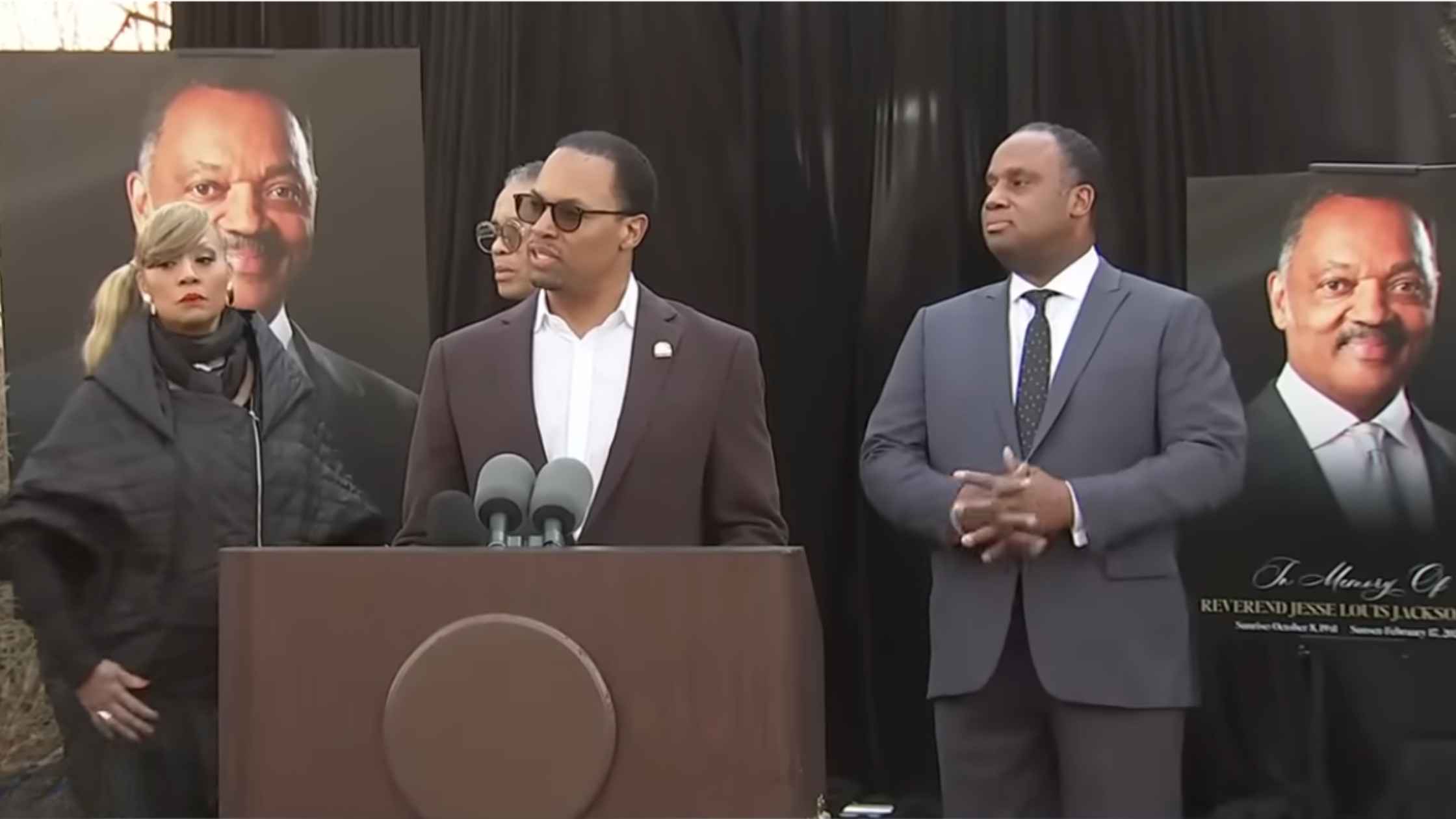
Speaker 1 (00:00):
Reverend Jackson's legacy reshaped the moral and political landscape of our city. So today you'll hear from his greatest gifts, his children, Jesse Jr. Jonathan Santita, Yusef will all talk about the celebration of his life. So thank you all for coming. We're going to start with prayer. Bishop Meeks is going to start us with that prayer. Thank you.
James Meeks (00:23):
Shall we pray? Our Father and our God, we pause this morning with heavy hearts, but with delightful spirits. We pause to thank you for the life of our giant, our leader, our hero, the Reverend Jesse Louis Jackson. We thank you for the impact that he has had on this nation and for the impact that he will always have. We thank you for his wife. We thank you for his children who stand here and we pray, God, that you would give them strength. We ask that you would lead the family. We ask that you would guide them. We ask that you would encourage and comfort them. So thank you for letting us be up close and personal to a man who can never be forgotten. The Reverend Jesse Louis Jackson, we love you. In Jesus' name. Amen.
Speaker X (01:19):
Amen.
Yusef Jackson (01:19):
Amen. Amen. Thank you. And is she here?
Speaker X (01:29):
Be careful. [inaudible 00:01:32]. You're okay.
Yusef Jackson (01:34):
Thank you and good morning to everyone for coming out. My job is simply to offer a warm thank you to you and to so many people. My first thank you is to the Reverend Jesse L. Jackson Sr. my father, our dad. We call him Leadership, we call him Reverend. He has set such an example for us and our city and our family. He has been a lion among lions, stubborn to the very, very end for his body of work that allows us this opportunity at one level to unite the country and our city. We give him thanks and we give him grace. I ask that you join me in given Reverend Jesse L. Jackson, a rousing round of applause.
(02:23)
Thank you to the tens of thousands, perhaps millions of people here at home and around the world who've taken interest in my father's health with visits and messages, your thoughts and sincere prayers at home and in church throughout his life. Really, especially over the last 10 years of his courageous battle with progressive supranuclear palsy. The last two years, the degree's progression has been acute and so have the care assignments. Thank you to my father's volunteer assistance and the daily healthcare providers at Lifestyle Options and others who helped him maintain his daily schedule. As a disease began to more severely compromise his speech and mobility, he required more. Thank you to the care team and administrators at JourneyCare who helped him maintain, who helped us maintain his dignity and comfort over the last few months to the healthcare administrators at Lifestyle Options who were caring and flexible enough to amend their schedules and amend my Father's Care schedule to ease the burden of the daily Care schedule on my eighty-one-year-old forever-dutiful mother Mrs. Jacqueline L. Jackson to the medical staff and administrators at Northwestern Memorial Hospital, Shirley Ryan, the emergency room to security teams on behalf of each of us, we thank you. We sincerely thank you. May God bless and keep you. May he offer grace for your holy healthcare work.
(04:05)
Our father is a man who dedicated his life to public service, to gain, protect, and defend civil rights and human rights to make our nation better, to make the world more just our people, better neighbors with each other. Born in Greenville, South Carolina in 1941 in the throes of Jim Crow, he quickly became maladjusted to injustice. He challenged those entrenched southern systems of poverty and racial inequality, landing in jail at seventeen-years-old, protesting for the right to use a public library. He won that battle. He kept winning these fights against injustice and inequality all of his life through college, continuing the work to lead students to segregate lunch counters in Greensboro, North Carolina, to helping secure voters rights, leading the marches across the Edmund Pettus Bridge at the second and third marches in March, 1965 to his work in Chicago. His tireless efforts with ministers and businessmen and Operation Breadbasket, Operation, PUSH, PUSH Excel and onto his national work with the Rainbow Coalition, the Rainbow/PUSH Coalition, and the Wall Street Project.
(05:23)
On the field of life, his shoes were well-worn, his uniform dirty with the stripes of imperfection as he did his best to live up to his Christian calling. Reverend Jackson would say, "it is my religion that makes me political, not my politics that makes me religious." And we, his family and the many others touched by him, inspired by him, are left obligated to continue his work to make our nation a better place for all through the techniques and tools and policy goals and platforms that he championed and left us to use. And so now his soul is freed to be with our mighty ancestors. His remains left to be honored and remembered for his sacrifice.
(06:28)
I offer you the words of my siblings, starting with Santita Jackson, followed by Jesse Jackson, followed by Jonathan Jackson and then Jesse Jackson Jr. Thank you very kindly.
Santita Jackson (06:44):
What a blessing it is to be here today.
Yusef Jackson (06:46):
My mind Santita.
Santita Jackson (06:47):
As Reverend Jackson, who we call leadership. We called Reverend, but he wouldn't listen to me when I'd call him Reverend. He demanded that I call him daddy.
Yusef Jackson (06:57):
My mind.
Santita Jackson (06:58):
Because he said, I am that black men take a real knock for not being involved fathers. Although the CDC showed us that black men are the most involved fathers in America, M more involved than white fathers, Hispanic fathers. And our father took fatherhood very seriously. He took that charge. It was his charge to keep. And so today, we celebrate his life. Although his body is absent from us, his spirit suffuses and infuses us and it charges us to continue with the work.
(07:31)
Indeed, he has run his race. Let me just say this. He is a seminarian. I've seen him referred to as Jesse Jackson, Jesse Jetstream. Remember Mike Royko? Yes. But you must remember that he was first a seminarian. He turned down an opportunity to be a law student at Duke University Law School. And he came here and became a seminarian. And Dr. King saw something special in him because he was organizing with Reverend James Bevel. And he said, I see something special in you. Saw a semester before he got his master's in divinity, which he ultimately finished. He went on to work for Dr. King. So he had a godly calling, but he had an assignment from Reverend Dr. Martin Luther King, which he never wavered from throughout his life. There is no one who's been more faithful to the mission of Reverend Dr. Martin Luther King-
Yusef Jackson (08:27):
My mind.
Santita Jackson (08:28):
... then Reverend Jesse Lewis Jackson.
(08:33)
And so it is today. While we have heavy hearts, we have buoyant spirits-
Yusef Jackson (08:37):
My mind.
Santita Jackson (08:38):
... because we do know where our father is. We do know that he took one deep breath and leapt into the arms of Jesus who carried him to the throne of God to the grace.
Yusef Jackson (08:49):
My mind.
Santita Jackson (08:51):
There is no more. Yes sir, boss. There is no more shaming. There is no more blaming. There is no one looking down on him anymore. There is no one who has, the criticisms don't matter now. Because now he is with God.
Yusef Jackson (09:10):
My mind.
Santita Jackson (09:11):
I can see Dr. King welcoming him in and saying, son, I told you you were going to do it. I can see Reverend Bevel. I can see Hosea Williams. I can see my mama Tibby, my great-grandma Tibby. I can see Grandma Helen. I can see my grandmother Gertrude. I can see Noah Robinson, his father. I can see his stepfather, Charles Henry Jackson. I can see so many people. I can see Mabel, I can see major. I can see the Moore family. I can see so many people who are saying, "You kept that charge. You were faithful servant. Well done." May he rest in peace, but may his spirit live forever and let us continue the work everyone. That is what he would want us to do. Amen.
Yusef Jackson (09:54):
Amen.
Jonathan Jackson (09:57):
Good morning.
Speaker X (09:59):
Good morning.
Jonathan Jackson (10:01):
I come to you as the son of Reverend Jesse Jackson and the son of Jacqueline Jackson. And I give a very special thank you. We have an attitude of gratitude. This city has given us so much. This nation has given us so much indeed the world. And my father poured all that he had his full measure into this country, into this city. So first of all, thank you, Chicago. This is where my father was planted. This is where he called home. For the millions of people that have given my father prayers, we are grateful. My father's lived a long life and the words that he shared with me constantly in this latter part of his life is to remind people that he was a long distance runner.
Yusef Jackson (10:43):
My mind, Jonathan.
Jonathan Jackson (10:44):
He ran the full measure of the race. And now this mantle of standing up for freedom, standing up for dignity, standing up for those that have been marginalized is now passed on. Not to be inherited by a person, but to be taken over and taken up by another generation. It is a continuous fight. As we see the rollbacks of our rights that he's fought so hard for are now being challenged. He will continue to fight. And in that spirit, I can hear the ancestors of old saying, before I'd be a slave-
Yusef Jackson (11:19):
My mind.
Jonathan Jackson (11:19):
I would be buried in my grave,
Yusef Jackson (11:21):
Say it, Jonathan. Jackson
Jonathan Jackson (11:23):
And go on to be with my Lord.
Yusef Jackson (11:24):
Yes, sir.
Jonathan Jackson (11:25):
My father comes up from the Jim Crow South.
Yusef Jackson (11:28):
Yes, sir.
Jonathan Jackson (11:28):
In his lifetime, he was arrested trying to visit a public library. My father grew up in a part of the country where there were segregated water fountains and segregated graveyards. So let's not measure the man by where he ended, but think about where he had to start. And he's a transformative figure. And most of all, I come to you just simply as a son. I've had to try to fix my language. In the last day. I caught myself yesterday saying my
Jonathan Jackson (12:00):
... parents, and now I have to say, "My parent."
Yusef Jackson (12:04):
Come on, boy. Come on.
Jonathan Jackson (12:07):
So I thank God for 60 years of being able to have both parents. Thank God that he is now resting in the arms of a very beneficent and loving God. And I thank God for all of you that have prayed for my father and given him a gracious and a long life. And I thank him for being a champion runner for justice.
Yusef Jackson (12:33):
Thank you. My sister Ashley will address now.
Ashley (12:38):
Good morning, everyone.
Yusef Jackson (12:39):
Good morning.
Ashley (12:40):
Just want to say thank you so much for your prayers. It's been, obviously, a challenge, but I think we all feel the magnitude of this loss, but also the magnitude of a life well lived. And it's such an honor to be standing up here with my siblings. And just thank all of you deeply from the bottom of our hearts for the love and support you've given our family at this time, and we share our love with all of you. Thank you.
Yusef Jackson (13:03):
Thank you.
Jesse Jackson Jr. (13:09):
Let me begin by expressing our appreciation to everyone who's gathered today. I want to acknowledge the absence of my little sister, our little sister, Jackie Jackson, who would love to have been with us today, but she will be back in Chicago in the not too distant future. I'm particularly proud of my siblings, who under these circumstances have risen to the occasion of sharing with everyone exactly who our father is. And over the next week, week and a half or so, you will learn a lot more about the intimate nature and relationship that we all have with one of the most extraordinary human beings who's ever lived.
(13:46)
With that said, I think the task of the business of going forward is in small measure going to fall largely on Yusef and, in small measure, on me. Dad believed that funerals were not for the dearly departed. He believed funerals were for the living. He believed that they were great gathering meetings. And no two lives in human history will have the same number of people attending their funerals or the same people will be at their funerals, because your friends ain't my friends. My friends ain't your friends. We don't know the same people. You don't know the same people that I know. Do not bring your politics out of respect to Reverend Jesse Jackson and the life that he lived to these home-going services. Come respectful and come to say thank you.
(14:50)
But these home-going services are welcome to all, Democrat, Republican, liberal, and conservative, right wing, left wing, because his life is broad enough to cover the full spectrum of what it means to be an American. We only ask people to come and be respectful in the context of the extraordinary life that he lived. Dad would've wanted us to have a great meeting to discuss our differences, to find ways of moving forward and moving together. And if his life becomes a turning point in our national political discourse, amen. Amen.
(15:44)
And so, Dad's home-going services, which are difficult for all of us to accept, are just that. A national, an international gathering and meeting of people, and people, most importantly, from our community, who uplifted him and put him on a perch that allowed him to share a vision with the world and to share vision with all people. And so, the business, again, funerals are not for those of you who have an opinion. The people who are coming to pay their respects to Jesse Jackson ain't coming to your funeral. They're coming to his funeral because of the life that he lived, and because of the phone calls that he made, and because of the lives that he changed, and because of the people that he touched.
(16:41)
And so when people say, "I'm coming to speak or to be present, and to pay my final respects to Jesse Jackson," we ask all to respect that, because that was the life that is Jesse Jackson. My brothers and sisters are due a level of congratulations for the caregiving that each of them have provided over the course of Dad's illness. Caregivers in the United States are an unrecognized commodity in the United States, that are not covered by any healthcare program in this nation.
(17:19)
Each of us, in our own way, have come to appreciate that the $550 billion to $625 billion a year, that those of us who have to change our careers, change our lives because we simply don't want to turn our loved ones over to just any old body is a factor in our nation's healthcare debate. And so, I'm hoping that Congressman Jonathan Jackson will look at caregiving through his service in the Congress of the United States and find creative ways to do something about that. With that said, let me just conclude on this point.
Yusef Jackson (17:55):
Jonathan's over there.
Jesse Jackson Jr. (17:56):
Oh, I'm sorry.
Jonathan Jackson (17:59):
Look over there.
Jesse Jackson Jr. (18:00):
Yeah. Any expansion of the Affordable Care Act will include vision, because I can't see the way I used to see. Jonathan's over here. Shit. My apologies. I'm particularly proud of the work that they did, the labor that they put in. I was there at 12:35 AM, when Dad took his last breath. At 12:37. I said, "Mom, Dad is not breathing." She didn't believe it. She said, "Go on. Tell him. He'll go back to sleep. Tell him to wake up in a couple of hours." "No, no. Dad's gone, Mom." Mom got up and began calling everyone and notifying the world. His last breath is not his last breath.
Yusef Jackson (18:44):
My my.
Jesse Jackson Jr. (18:46):
Each of us, in our own way, shape, and form, if you're a woman in journalism, in large measure, it was Jesse Jackson who helped knock down that door. I remember when Chicago only had Fahey Flynn, Joel Daly, Floyd Calvert, Walter Jacobson. Jesse Jackson helped challenge ABC, CBS, NBC, and the majors to expand the industry to include women and to include women of color. And when I think about some of the great national TV hosts and the fact that African-Americans have been anchor persons, Jesse Jackson helped knock down those doors.
(19:28)
When I think about black McDonald's owners, and Burger King owners, and Black car dealerships, and those who become Pepsi franchise owners and Coca Cola owners, when I think about the expansion of the Voting Rights Act from 1965 to the present and the 62 African-Americans who presently serve in the Congress of the United States, and the half dozen United States Senators, some of whom just got there, it was Jesse Jackson who went to Reagan. It was Jesse Jackson who went to subsequent presidents and asked for the extension of the Voting Rights Act of 1965. And so, we expect a grand meeting of people who are beneficiaries of the life and the work of Jesse Jackson. We expect it from the far right, and they are welcome if they come respectfully. And we expect it from the far left. Honor Mrs. Jesse Jackson. This is her request. Thank you very much.
Yusef Jackson (20:23):
Thank you.
Alex (20:23):
We'll take questions.
Jesse Jackson Jr. (20:31):
From the mic, Alex.
Alex (20:32):
Okay. Thank you. We'll take questions starting now, and we will wrap it up when we're ready. If you have questions after that, Mary Datcher is the one you need to reach out to. Okay.
Speaker 2 (20:44):
What are the plans?
Alex (20:46):
I'm going to call on those. You can start.
Speaker 2 (20:49):
Okay. Good morning.
Alex (20:49):
Good morning.
Speaker 2 (20:55):
What are the plans? You said that this gathering will be open to all. You say that this gathering will be open to all. What facility, what place, what city will hold all? And what is the timeline that you're thinking of when this gathering will be?
Yusef Jackson (21:11):
You got it. Thank you. I'm going to need some help on the details from Alex. But we intend to have a fulsome celebration celebrating the tremendous life of our father, Reverend Jesse L. Jackson Sr. We anticipate that services will begin in earnest next week. There will be a component of lying in state at the Rainbow Push Coalition headquarters, and then we will be at a church venue that's large enough to accommodate a lot of people, as many people as we can.
(21:37)
But we think between the lying in state and the accommodation of services at the church, along with a final celebration at a Saturday morning forum at Rainbow Push Coalition, that should be adequate. We'll do our best to accommodate as many people as we can with seats. For those who don't have seats, you'll be invited to stand with me, because I'm sure I'll probably be standing somewhere. But we'll do our best to accommodate everyone.
Alex (22:03):
And there's a website, thejessiejacksinlegacy.com. Those details in will be posted probably by the end of the day, so please look out for those details. And Nicole.
Nicole Johnson (22:17):
Hi. Good morning. Nicole Johnson, WBEZ. So, much has been talked about how the Reverend was shaped by Chicago and the Reverend shaped Chicago. Can we talk more personally about the community that supported him growing up, especially when he was traveling a lot? How did the community lean in institutions, people? Even feeding, watching the children, what did that look like?
Jonathan Jackson (22:39):
Well, thank you so much. We call our church Home Fellowship Missionary Baptist Church. My father was a seminary student and had to get groceries, stood in the Fellowship Missionary Baptist Church food pantry under the leadership of Reverend Clay Evans. They struck up a lifelong friendship. He called him his senior pastor. Reverend James Meeks has been a dear pastor and friend as well. And we've been graced, if you will, sustained by the church community. So many people have poured into. And so, never forget that my father never held public office. He ran for public office, never elected.
(23:17)
And it was been through the generosity of people that has sustained a civil rights organization. And it was modeled after the leadership of Reverend Martin Luther King, challenging both for having personal salvation and fighting for social salvation, moving the church beyond the stained-glass windows out into the people, that the true mega church is in the body of people. It's not in the walls of a building. And so it was a transformative ministry, if you will, quite innovative. And we honor that tradition and all those ministers that have been the liberators. Some people would try to reduce it to call them liberals, but they were the liberators. When I see in the Congress,
Jonathan Jackson (24:00):
I was on the elevator the other day with the current governor of Virginia, Abigail Spanberger, a former congresswoman, now a female governor from Virginia. And she says, "I made Jesse Jackson buttons in 1988 when your father was running." When Vice President Kamala Harris says, "In my Camry, I had a Jesse Jackson bumper sticker." We see the progress that women made that felt the empowerment when my father challenged the Democratic platform in 1984 to put a woman on the ticket, and Geraldine Ferraro was able to make a breakthrough. And that's just on gender equality, but also on racial and economic. There's so many fronts, but on the personal front, we started in the food line here in Chicago and the church.
Yusef Jackson (24:48):
Yes, sir.
Jonathan Jackson (24:50):
The church was there. And so when he leaves out on the slogan of, "I Am Somebody," that's a call for your own self-dignity, understanding African-American history Month, community or culture been beaten down for so long, dismissed and now trying to be erased again. It was telling people to affirm your dignity, stand up for yourself. And his final mantra on, "Keep hope alive," to let people never feel darkness, to know that God is the light, and to keep striving for something more perfect and that God, when you put your hand in his, that he will definitely see you through. So I hope I answered your question. Thank you.
Speaker 4 (25:30):
We'll hear from Michelle.
Michelle Relerford (25:31):
Thank you. Michelle Relerford, NBC 5 News. Oftentimes when people transition, you don't get a warning. You don't get a time to say thank you. You don't get a time to say goodbye. You said, I heard you talk about how he was stubborn until the very end. We know there were months in and out of the hospital since November. He's a leader for this world, but this is your dad. What was it important for you as his children to let him know? What was the message you wanted to make sure to send to him in this time?
Yusef Jackson (26:01):
Yeah, thank you so much. It is a painful question to ask. It's something that we've pondered a lot, and I'll try to be brief to allow more questions to be answered. But God gave my father some extra innings. His death did not come without warning to us, yet we're still painfully unprepared emotionally. My mother was wrong when she told me, "Yusef, if you're not guilty, you won't feel the emotional sadness that some people have when a loved one leaves." And I think I still feel that emotional sadness because I loved my father so much, and he had a personal relationship with everybody he met. He was just that kind of fellow. I saw a lady on the news this morning who lost one of her relatives in the E2 fire, and she talked about how that night after the fire, he drove around with her looking for her sister from hospital to hospital, and he wouldn't leave until they found her sister.
(26:58)
He was just that kind of guy. And so I think what we tried to do in the moments that we had with my father, one was to continue to extract the wisdom from him to make sure that we were prepared to continue the work going forward. And I will say profoundly in his pain, he never talked about his pain. He never talked about his thirst even after he wouldn't have a drink for eight days. He never talked about his hunger after he wouldn't eat sometimes. People, sometimes he wouldn't eat for 14 days, and he'd bounce back, and he'd wake up talking about wanting to feed other people. And so what sustained his life in those last days was not his desire for more life, but his desire for more service.
(27:42)
And so as I, in particular take over the reins of the Rainbow Push Coalition, it is the patience to serve, the temperance to serve, the courage, to serve the, making yourself one with Christ in understanding his mission to serve that he impelled upon us. And then I think for us, each of my siblings and my mother, we wanted to give him comfort, that it was going to be all right. That he has taught us enough to continue his work. And so with that, we thank him in so many ways. If I had a thousand tongues, I couldn't thank him enough.
Speaker X (28:18):
Yes, hi.
Santita Jackson (28:19):
If I could add this. We never expected to have our father past 39. Men in his line of work, didn't make it past 39, Medgar, Malcolm, Dr. King. My prom night, he said, "I'm so happy that I have this moment because Malcolm, Medgar, Martin didn't have this opportunity." So every opportunity that we had, and I think that all of my siblings can attest to this. We always said, "I love you."
Yusef Jackson (28:52):
Yes.
Santita Jackson (28:53):
We did not go to bed angry. Well, we might go to bed angry, but we didn't carry grudges. He didn't like that. But if we could give you something as a takeaway, always tell the people that you love that you love them.
Yusef Jackson (29:11):
Yes.
Santita Jackson (29:11):
So when he was in his moment of need, he didn't need to hear that from us. He felt it, and we felt it from him because he never hesitated to tell us and show us that he loved us.
Evelyn Holmes (29:27):
Okay. Yes. Hi. Evelyn Holmes from Channel 7. There's been a lot of conversation about the Reverend's legacy, and I'm not sure that that could truly be articulated through words considering the expanse of it. But what I'd like you to do is if you could talk a little bit about what concerns you have moving forward, the work that has been done. You've already alluded to that. How do you fill that void? How do we keep moving forward with his vision and the vision for equity and inclusion?
Jonathan Jackson (29:59):
Well, thank you so much. I had the opportunity to speak as the co-chair at the National Prayer Breakfast, and you bring up the question of how do we ... and you bring up the ... And I had to ask myself, "What would my father want me to do?" Someone asked me how did I get that position to be the co-chair of the National Prayer Breakfast. I said, "It was easy. Nobody wanted it." And so diversity, equity, inclusion has been a major part of my father's work. These are the on rails, if you will, the guard rails to fight against racism and to bring about inclusion to make this a better country. And so I started my remarks off in the Latin. I said, "[foreign language 00:30:43]." Once you spell Dei in Latin, it's spelled D-E-I.
(30:51)
So we've never retreated from the term DEI. Seven days after the president was sworn in on January 20th, 2025, my colleague Congressman Cleo Fields, who's a protege of my father, we started the Diversity, Equity and Inclusion caucus. So it is something that we're unashamed of. We look forward to the debates on the United States Congressional floor. It's something we cannot retreat from. Off of the voting floor in the United States Capitol, women only got a restroom in 2011.
Audience (31:24):
Wow.
Jonathan Jackson (31:27):
The first woman to graduate from the Citadel graduated in 1999. We can't say we've made enough progress on race and equity and racial justice. We've seen the effects of the DOGE cuts. They targeted African-American women disproportionately. When we see the retreat on these programs, they are harming our healthcare studies, our access to academia. It's wrong to tell the Northwestern University that they're going to be held hostage and have to pay a $75 million fund to retreat. So we're not backing up.
Yusef Jackson (32:01):
Yeah.
Jonathan Jackson (32:02):
We can do this in civil discourse. And so this is part of the work, and it's just not one man or one woman's work. It's everybody that's felt challenged to speak up, speak out. We're against censorship of comedians. We're against the rollback of the racial and economic progress that we've made. We're going to have more time to talk to that. I just want to focus on the responsibility of a son. I am so proud that it's our loss, it's heaven's gain, and the legacy that my father leaves behind. And I want every child that's listening and watching this, that Reverend Jesse Jackson didn't start in this house.
Audience (32:40):
Come on.
(32:40)
Come on, Jon, come on here.
Jesse Jackson Jr. (32:44):
Take your time, Jack. Sorry.
Jonathan Jackson (32:50):
That he would tell you, Jesse Jackson's his third name.
Yusef Jackson (32:54):
My mind now.
Jonathan Jackson (32:57):
For the children that have to be adopted and stepfathers and lives have to be transformed, we come from that lineage. We've been in the food pantry, and that's our calling, that's our mission, and that's what we're going to fight for.
Yusef Jackson (33:12):
We will take two more questions, and I will tell you, I have a lot of talent. We have a lot of talent in this family. So you guys probably call on who you want to ask to answer the question. So we'll take two questions for you.
LaDonna Raeh (33:26):
LaDonna Raeh with WVON 1690. Our condolences to the family. And we want to know your father started so many things and he finished many others. But there is a responsibility that we have as a community to continue with his legacy. And no matter what the government is trying to do with removing and rolling back and minimizing, we want to continue to uplift and elevate. How do you propose that we do that ongoing, not while it's hot, but ongoing for years and generations to come?
Jesse Jackson Jr. (34:04):
Mrs. Jackson will be making some requests of the governor and the mayor of the city of Chicago on the appropriate ways to remember the legacy of Jesse Jackson and the work that he's done for our city and for our state. I'll let Mrs. Jackson make those requests at the appropriate time.
Speaker 3 (34:20):
Last question. My question is just about the youth that are ... This is the wrong microphone. For the young people that are standing watching you right now and are just learning maybe about your father's legacy. You talked a lot about the division that we are feeling in our country right now. How can they move forward and try to overcome that feeling of the divisiveness that we hear so much about and your father fought against?
Ashley (34:47):
Well, I think that Dad unmistakably was known for his discourse. And I think that we've spoke at ad nauseam about the fact that our generation, Gen Z years, Gen Alpha, Millennials have the responsibility to remain in discourse with one another. Because if we're not in proximity to one another, we can't solve the nation's crises at this time. So I think I speak on behalf of Dad that we're urgently called to continue discourse and to remain in conversation because our proximity is what's going to keep us moving forward in this time. He's always been proximal to all of you, proximal to all of us, and that's the work that our generation is required to do moving forward.
Speaker X (35:24):
One last question.
Jesse Jackson Jr. (35:27):
Let me associate myself with what Ashley had to say, but let me also be candid because I'm old enough to remember along with Santita and Jonathan, all of it. The caricature that you've created as a media of who our father is not the reality of who we know him to be. So what's happening now on social media is more accurate depiction of the work of Jesse Jackson, and it's happening and occurring without you. That's the truth. Because institutional
Jesse Jackson Jr. (36:00):
Institutional media has historically controlled the narrative-
Audience (36:03):
Come on, yeah.
Jesse Jackson Jr. (36:04):
... of who Jesse Jackson is. You've made him to be more controversial than he is, than he was.
Yusef Jackson (36:13):
Smart boy. Come here.
Alex Sims (36:13):
Hi, hello.
Audience (36:13):
Can I say something?
Yusef Jackson (36:13):
Almost.
Alex Sims (36:13):
One second, one second.
Jesse Jackson Jr. (36:18):
You've made him less multinational than he is. You've tried to make him someone from a side of town and not universal.
Audience (36:30):
That's right.
Jesse Jackson Jr. (36:32):
Today, the King of England-
Audience (36:35):
Come on here.
Jesse Jackson Jr. (36:36):
... has issued a statement about the life of Jesse Jackson-
Audience (36:38):
Come now.
Jesse Jackson Jr. (36:39):
... and its importance. One newspaper's hung up on how many mayors he confronted. All of them were small by comparison-
Audience (36:51):
Come on!
Jesse Jackson Jr. (36:51):
... to Jesse Jackson.
Audience (36:52):
Tea.
Jesse Jackson Jr. (36:53):
He knew as they came and went that he was the constant and our community could count on that. And so again, the caricature of who you think he was compared to the reality of the education campaign that is taking place independent of you-
Audience (37:14):
Come on.
Jesse Jackson Jr. (37:16):
... is what's taking place. And as that figure begins to emerge in contemporary thinking, I'm confident that the people ... My mother said it this way, "History is going to be far kinder to Jesse Jackson than the life that he lived."
Yusef Jackson (37:34):
My, my, my.
Alex Sims (37:34):
This is our last question, please.
Yusef Jackson (37:38):
Last question.
Alex Sims (37:38):
Last, last.
Cheryl Corley (37:38):
Cheryl Corley from National Public Radio. Losing a parent is so difficult no matter when it happens-
Jonathan Jackson (37:45):
It is.
Cheryl Corley (37:45):
... so my condolences to you. And I think that family never ask people what they can do for them. So I want you all to say what Chicago and the nation can do for your father and what they can do for you as a family.
Audience (38:09):
That's great.
Yusef Jackson (38:12):
I'm sorry. Did you want ...
Santita Jackson (38:13):
Oh, yes. We can share.
Yusef Jackson (38:14):
Okay.
Santita Jackson (38:14):
That'd be great.
Yusef Jackson (38:15):
I thought you were calling me up because ...
Santita Jackson (38:16):
No, no, honey. We're just-
Yusef Jackson (38:16):
She was telling me to look over.
Santita Jackson (38:16):
No, no. We're all together here. We would ask for your prayers because prayer changes things. We would ask that you keep your families together because strong families build strong communities, build a strong world. We would ask you that you'll just love somebody.
(38:38)
One of the things that we have learned on this journey is just how much love there is in the world. We will walk through airports, walk down the street, and people will touch us, people we don't even know. And they just say, "Tell your father that we love him. Tell them that we're praying for them." And they are from every walk of life.
(39:02)
Yes, you saw President Trump give a nice tweet about Reverend Jackson yesterday because Reverend had the genius of turning foes into friends. He said, "You don't have enemies. We have opponents. But through it all, we must always speak to each other. We must keep the lines of communication open." But that's not just something that you do in your politics. That's something that you do in your personal life.
(39:28)
Believe me, we have a large family and we've got a lot of opinions and sometimes we do not see eye to eye, but through it all-
Jesse Jackson Jr. (39:39):
Sometimes?
Santita Jackson (39:41):
A lot of times.
Yusef Jackson (39:45):
Yeah, come on.
Santita Jackson (39:45):
But we love each other. The Bible commands you not to like each other-
Audience (39:50):
Love each other.
Santita Jackson (39:52):
... but to love each other. And our mother and father said, "I've got these children. Everybody's not going to be right, but I'm not going to have discord under this roof." Now what we're going to do, we're going to work it out and we're going to get along. And if we can take that from here into the rest of the world, I think it will be a better place.
Yusef Jackson (40:16):
Yeah, thank you. Thank you very much for ... I'm going to give a final thank you as we've taken our last question today. Alex Sims will be in charge of our media relations for the family group. I think Jesse and Jonathan and Santita each have their own media relations team with your congressional office and with your campaign office. Santita, I believe with your radio show as well. But Alex will help to manage press relations for the group. If you'd like us individually or as a group, you can work with Alex Sims on that.
(40:47)
I'll just offer a final thank you. We couldn't stand here strongly without the strength that you're displaying to us right now. I thank you for coming out to join us, to celebrate the life of our father. I will tell you that strength and spirit is a two-way street. And so the stronger you are for us, the stronger we can be for you.
(41:09)
I want to just offer one piece of an answer to a question that was intimated there. And I talked to my father about this all the time. His legacy will not be passed on through blood necessarily. He has trained us and we will do the very best that we can. But men like Jesse Jackson and people like him, they pass their work through the spirit. And you too can have the spirit of Reverend Jesse L. Jackson.
(41:42)
So you ask us, what can Chicago do? What can the nation do? What can the world do for our family? And I offer you this. Learn, learn, learn the work and life of Reverend Jesse L. Jackson. Follow in the path that he offered. He was a trailblazer for you. He cut down trees to leave a path for you. And his path was voter registration education, fighting to end systemic poverty, education. He left the tools for us to do the work that he was doing. Learn him, follow in his footsteps, and together we can make the world a better place. Thank you very kindly.
Alex Sims (42:42):
Jacksonlegacy.com for more information on arrangements. Mary Datcher right here, as well as Darlene ... Where's Darlene?
Darlene (42:50):
Right here.
Alex Sims (42:51):
Right here. Can help with further questions. Thank you all.