

Bill Hagerty (00:00):
... for Congress to understand how Treasury is prioritizing its activities, where efficiencies are being realized, and how performance outcomes are being measured. That understanding will help ensure that this subcommittee aligns resources with the areas of greatest need and greatest impact. This budget request also reflects the consequential legislation Congress passed and the president signed into law last year, the Working Families Tax Cuts Act, which was an incredible victory for all hardworking Americans. Recent IRS data shows that tax refunds this year are substantially higher than years prior, putting more money back into the pockets of hardworking Americans.
(00:35)
The Working Families Tax Cuts Act also made adjustment to how certain income is treated, including relief on items like tips and overtime, as well as expanded deductions for seniors and working families. These changes require Treasury and the IRS to create new guidance, to update systems, and to ensure that taxpayers can easily comply with these most welcome changes. In that vein, I was pleased to see that this budget request does not focus on maintaining the status quo. Rather, it addresses the department's responsibility to implement these major policy reforms, and it ensures that Treasury has the tools needed to carry them out efficiently.
(01:12)
Beyond tax administration, this budget also reflects a broader effort to strengthen America's economic position globally. For far too long, unequal, non-reciprocal trade policies have handicapped American businesses, leading to persistent trade deficits and the erosion of our domestic industrial base. Decades of asymmetric policies have also undermined our nation's capacity to produce critical goods, like ships and pharmaceuticals, and it's made us increasingly dependent on competitors like China. This administration has taken great strides in resetting the global trade market by negotiating a multitude of international trade agreements and continuing to push an America-first agenda. Digital assets and their related technologies present new opportunities for economic growth, for capital formation, and for value storage. Properly deployed, these digital technologies will facilitate safe, secure, and instantaneous payments. America must be the global leader in this sector if we want to retain our position as the world's reserve currency.
(02:12)
Our nation has demonstrated that it can lead innovation across any industry when it's provided with the regulatory certainty that's necessary to grow and to invest. That's why last year, President Trump signed into law my stable coin legislation, the GENIUS Act, which provided regulatory clarity to help the US remain a leader in digital assets and financial innovation. Your department, Mr. Secretary, played a critical role in the success of this legislation, particularly Luke Pettit and Tyler Williams on the development, joined by Jonathan Greenstein on the implementation.
(02:43)
President Trump understands the crucial role that this industry will play in our nation's economic development and international leadership. The president has asked Congress to provide clarity through technology-neutral regulations and transparent government decision-making to foster a robust and vibrant digital economy. I'm encouraged by the efforts underway at the Department of Treasury to carry out this objective, and I'm grateful for your support for sensible stable coin policy as we seek to promote US leadership in digital assets and financial technology while protecting the economic liberty of Americans.
(03:17)
Our nation also benefits from constructive relationships with our allies. This subcommittee is grateful for your daily work negotiating tariffs that preserve our strong relationships with those allies. The other side of that coin is countering our adversaries through financial intelligence and sanctions. While Treasury's role in the intelligence community is rarely in focus, its unique capabilities help safeguard the integrity of the American financial system and ultimately strengthen America's military power.
(03:43)
Treasury's responsibilities today extend well beyond traditional finance. I appreciate your work and look forward to continuing to partner with you to ensure that the department has the tools it needs to succeed. And I look forward to your testimony, Mr. Secretary, but before you begin your testimony, I now want to turn to my colleague, the ranking member of the subcommittee, Senator Jack Reed.
Jack Reed (04:02):
Well, thank you very much, Mr. Chairman, and Mr. Secretary, thank you for joining us today. I look forward to your testimony, which comes at a moment where the world is in a great deal of turmoil. We're prompted in part by the administration's fiscal policy, its illegal tariffs, and its decision to go to war with Iran. While President Trump upends the economic apple cart, Americans are paying more at the pump and for other everyday necessities. At the start of the Iran War, gas prices averaged about $2.98 per gallon. Now Americans are forced to shell out over $4 a gallon at the pump. Inflation hit a nearly two-month high in March while grocery and housing costs remain too high. The cost of living is simply not sustainable for the American people.
(04:54)
Mr. Secretary, it seems that President Trump has abandoned the interests of regular Americans, and your fiscal year 2027 budget request continues this worrying trend. The fiscal year 2027 budget request for the Treasury Department totals $11.5 billion, a 1.5 billion or roughly 12% decrease from the enacted level. While the request provides increases to several Treasury offices, it cuts funding for the inspector general, grants for community development, and enforcement of our tax laws. The proposal slashes IRS funding by $1.4 billion. This is on top of the $1.1 billion cut sustained in fiscal year 2026, last year. The IRS has pushed out more than 28,000 employees since the start of the Trump administration, and this proposal would shrink the workforce by another 4,000. This is simply irresponsible. You come from the business world, and no successful company would under- invest in its revenue collection mechanism.
(06:04)
The IRS itself acknowledges that every dollar the agency invests in enforcement brings $11 back from tax cheats, so your own agency admits that cutting IRS staff and funding, particularly its enforcement budget, costs American taxpayers and helps tax dodgers. Indeed, cutting IRS funding is a proven windfall for the rich and puts our country on a dangerous fiscal path.
(06:29)
Yet, the IRS's budget request proposed is to cut enforcement exams on high-income individuals by 50% in fiscal year 2026 compared to fiscal year 2023. This will help wealthy taxpayers evade billions of dollars in taxes each year. The IRS should prioritize providing better service to American households, not help rich Americans game our tax system.
(06:57)
Secretary Bessent, suffice it to say, the administration's policies, including the IRS budget request, are clearly putting our economy and the economic security of average Americans at risk. I look forward to your testimony and your candid answers to our questions, and once again, I thank you, Mr. Secretary, for joining us today. Thank you.
Bill Hagerty (07:16):
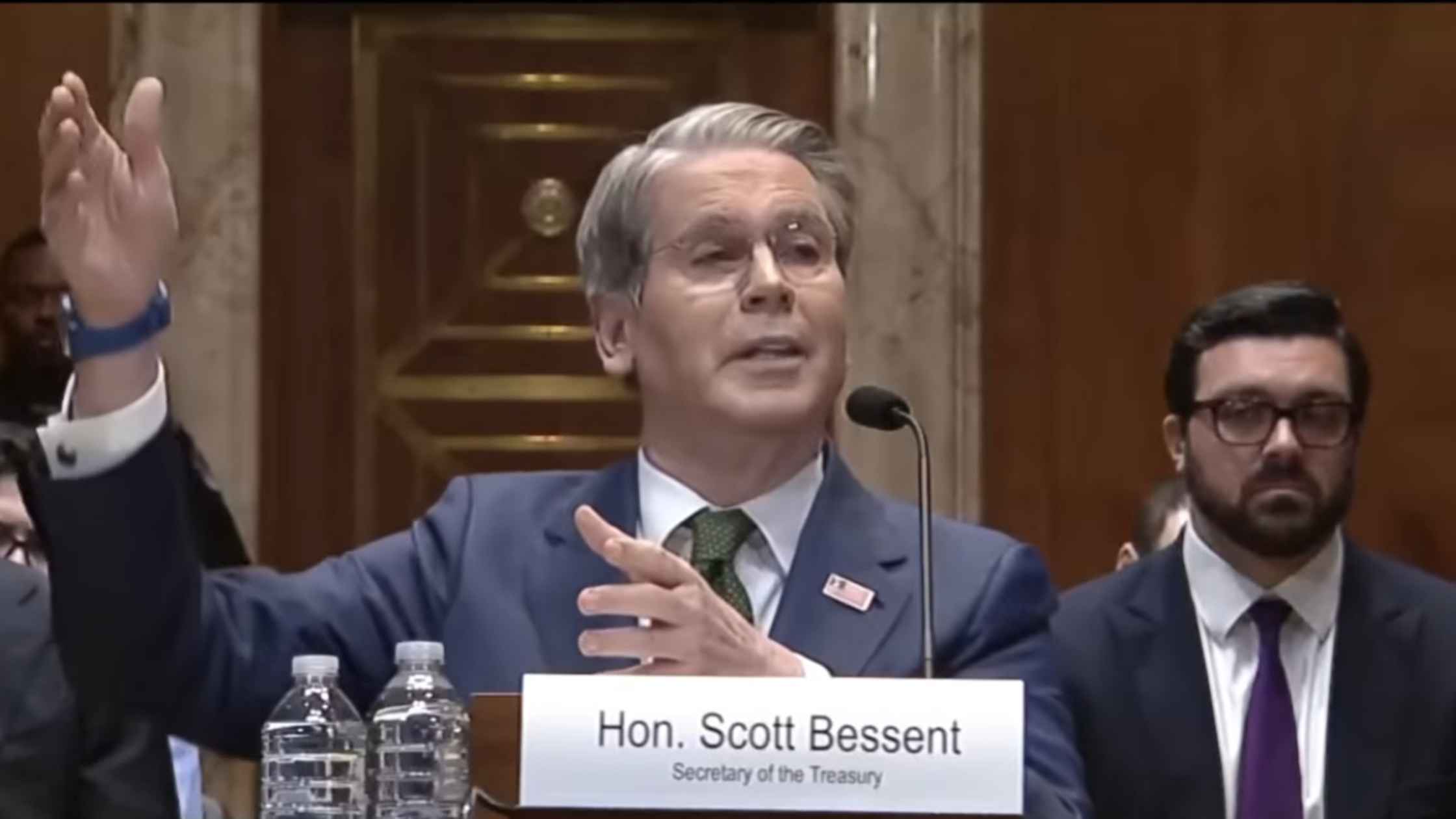
Now I'd like to recognize Treasury Secretary Scott Bessent. Before becoming our 79th... Excuse me, before becoming our 79th secretary of the Treasury, Secretary Bessent had a successful career as a fund manager of one of the world's largest global macro investment funds before creating his own investment firm. Secretary Bessent believes America is unstoppable because its economy is unstoppable, an economy built on the deepest and most liquid markets in the world. Secretary Bessent, if you could please keep your remarks to five minutes, it'll allow more time for questions. Your full written statement will be included in the record. Secretary Bessent.
Scott Bessent (07:49):
Chairman Hagerty, Ranking Member Reed, and members of the subcommittee, I'm grateful to join you today. Treasury is committed to working with Congress to protect our nation's financial systems, spur job growth, and strengthen the economy. The fiscal year 2027 president's budget request for Treasury demonstrates our commitment to boosting growth, promoting efficiency within our agency, and targeting illicit actors that threaten our national security. Treasury's budget request represents a 12% decrease from the enacted level while still building on the success of fiscal year 2026 to continue strengthening the US financial system.
(08:27)
Along with managing our own discretionary budget, Treasury is charged with managing core financial functions and payment operations for the US government. I take that commitment very seriously, not only ensuring that every dollar in our budget is thoughtfully executed, but also that every dollar collected, deposited, or disbursed through Treasury is secure and timely. I would like to begin by highlighting the Treasury Department's effort to ensure accountability and deliver results for the American people. There's no better example of delivering meaningful change for everyday Americans than President Trump's Working Families Tax Cuts, of which over 60 million returns, 60 million, claimed at least one of President Trump's signature new tax cuts this filing season. By enacting no tax on tips, no tax on overtime, and new tax cuts for seniors on Social Security, we are delivering tax relief to working families.
(09:20)
This season, over seven million filers have claimed no tax on tips, with an average deduction of over $7,000, over 28 million filers have claimed no tax on overtime, with an average deduction of over $3,100, and over 34 million seniors have claimed the enhanced deduction for seniors, with an average deduction of over 7,500. The legislation not only delivered historic tax relief, but also began building long-term financial security for future generations through initiatives like Trump Accounts, of which nearly 5.5 million accounts have been opened with over 1.3 million children eligible for the $1,000 pilot program contribution. Trump Accounts demonstrate this administration's pledge to invest in the workforce of tomorrow, giving them an ownership stake in the success of the nation.
(10:09)
As you know, filing season ended on April 15th. I'm happy to report that new leadership at the IRS has resulted in improved business processes and an increased focus on meeting private industry benchmarks for customer service. Our increased focus on digital-first taxpayer experience has resulted in lower call volumes as taxpayers increasingly find the information they need online and increased adoption of direct deposit, which will expedite the refunds for years to come. The budget request continues to streamline and modernize IRS operations funding to encourage automation and technology investment while ensuring taxpayers are met where they want to be by offering multiple service options.
(10:53)
Although the request for IRS represents a modest decrease, we are still able to maintain current services and implement new initiatives aimed at improving customer experience and making tax compliance easier. We have introduced two new metrics for modernizing how IRS performance is measured, introducing a [inaudible 00:11:12] service rate and enterprise service completion rate better aligns performance measurement with how people interact with the IRS today. Additionally, the budget request targets inefficiency and duplicative spending through reductions in areas that have been operationally ineffective. I want to ensure that every dollar of taxpayer funding supports mission critical work.
(11:34)
By making targeted reductions in specific areas, we can enhance investments in national security by bolstering critical cyber capabilities, sanctions, and combating illicit financial activity. Treasury's Office of Terrorism and Financial Intelligence is at the forefront of America's fight against foreign adversaries, and the additional funding would expand Treasury's ability to trace, detect, and sanction financial networks acting in bad faith. The request also includes a small investment to advanced institutional expertise and digital assets, housing finance, global financial markets within Treasury's departmental offices. This is particularly important with the implementation of the GENIUS Act, landmark legislation that created the first ever regulatory framework for stable coins. As I shared earlier, I am committed to working together to continue building on the success of the last fiscal year and look forward to your questions.
Bill Hagerty (12:30):
Thank you, Mr. Secretary. I'd now like to turn to our main chair [inaudible 00:12:32] Collins.
Susan Collins (12:36):
Thank you very much, Mr. Chairman. Mr. Secretary, welcome. You mentioned just now in your testimony the importance of consumer customer service and your efforts to improve it. Along with other members of the main delegation, I sent you a letter last month opposing the closures of two taxpayer assistance centers, one in Bangor, Maine, one in Augusta, Maine. The Presque Isle center in Northern Maine has already been closed for some time. These closures mean that someone from my hometown of Caribou, Maine, who needs in-person service, faces a 10-hour-plus round trip to the nearest taxpayer assistance center in Portland. That's the last remaining TAC in the entire state of Maine. That's just not reasonable, particularly when you consider that Maine has the oldest population by median age in the country. We have areas of the state where internet service is simply not available, and we have older adults who, even if it is available, may not have access to computers or to the skills that they need to use that method of getting help.
(14:24)
And I will also mention that I met recently with the taxpayer advocate in the state of Maine, and he too expressed his concerns about what the closures of these centers would mean in terms of providing customer service. Has the IRS evaluated what the impact of closing down all of these taxpayer assistance centers except the one in Southern Maine would be on people living in other parts of the state, particularly our older adults in rural areas.
Scott Bessent (15:07):
Senator, thank you for your leadership on this and the entire Maine delegation. I have instructed the IRS to look into this, and we will be getting back to you. System-wide, only 10 centers were closed. I believe that one of the centers that was closed was already unmanned, but we will get back to you, and we will remedy this 10-hour problem. So thank you for bringing it up to our attention. We look forward to working with you.
Susan Collins (15:40):
Thank you so much. It really is a problem given the size of our state. I want to bring up another persistent problem in the state of Maine, and that is we have been the location for literally hundreds of illegal marijuana grow houses that are linked to transnational criminal organizations based in China, and we really need a whole-of-government approach. Earlier this year, I secured language calling for a State Department led report on PRC-linked criminal syndicates and the illicit drug trade. Where Treasury comes in is there's money laundering involved, and I want to thank Treasury for providing some expertise through FinCEN, through the IRS, but it still remains a huge problem. And our sheriffs in Maine have been terrific in trying to close down these grow houses, but we need more federal help. We've had some from Treasury,
Susan Collins (17:00):
... some from the Justice Department, DEA. We're talking about over 200 of these illegal grow houses, and as I said, there is a link to money laundering and the fentanyl trade as well. Could you talk a bit about how the department is working to address this dangerous operation?
Scott Bessent (17:31):
Yes, Senator. Since you brought this to our attention last year, IRS Criminal Investigations and FinCEN are both involved in supporting local law enforcement and working with federal agencies to combat these problematic operations in Maine. Staff from these team have, as you said, they have specialized financial forensic and intelligence expertise, and we want to help local law enforcement dismantle these money laundering operations. So I look forward to ongoing dialogue and, per your request, I will personally look into what is going on, especially with IRS Criminal Investigations who are able to move on operations like this very quickly.
Susan Collins (18:18):
Thank you very much, Mr. Secretary. Thank you, Mr. Chairman.
Bill Hagerty (18:22):
Thank you, Chairman. Thank you, Mr. Secretary. That was very encouraging to see your personal engagement on this critical issue, not just for Maine, but for the entire nation. Senator Reed.
Jack Reed (18:32):
Mr. Chairman, do you want to go first?
Bill Hagerty (18:36):
I'll let you. Then I'll come after to you.
Jack Reed (18:37):
Thank you. Mr. Secretary, as I mentioned in my opening statement, your budget once again cuts IRS enforcement activities. Your own congressional justification states that every dollar spent on enforcement provides an $11 return for the American taxpayer. So that given that your own request shows as extraordinary return on investment, why does the budget cut enforcement by nearly $900 million?
Scott Bessent (19:07):
Sir, the data does not support that because we cut the budget and enforcement recoveries were up 12% last year.
Jack Reed (19:19):
Well, if you increase the budget, you would presumably have even more. I mean, the obvious point, which I stressed in my testimony is that you're basically scheduling fewer and fewer enforcement actions, particularly against those who are very well endowed and may have either directly or indirectly made mistakes on their tax reform. So it seems to me obviously that more effort would produce more resources.
Scott Bessent (19:54):
Well, I think that that may be the one school of thought, but we haven't seen that in educational outcomes. We haven't seen that in healthcare outcomes, that more money equals better outcomes. And at the IRS thus far, we believe in outcomes. We recovered that in enforcement, the top five enforcements recovered $2 billion. And as I said, the enforcements last year are the up to almost 41 billion. So I think that during the Biden years in the IRA, that there was a scoring gimmick that was used and brought in a lot of enforcement officers.
(20:39)
And again, the fact's on the ground to get to be a senior enforcement officer takes 10 or 12 years and to bring in the new officers at one year, two years have almost no expertise and don't result in better outcomes. What we have found is meeting the taxpayers where they are and using technology, we have pushed back their tax returns and say, "We believe there is an error here and you will be audited. Why don't you fix it in advance?"
Jack Reed (21:13):
Well, Mr. Secretary, I think it's not efficiency or even more revenue you're seeking. You're seeking, I think, to disable the ability for the federal government to reach all who are not being completely honest with their tax returns, particularly those that have the most to pay, the wealthiest in the country. As I mentioned also in my testimony, or my statement, I should say, sir, the gas prices are up more than 30% and they're above $4 a gallon. And the nonpartisan Tax Foundation estimates that President Trump's tariffs were essentially a $1,000 tax on American households, and that's a nonpartisan organization.
(22:01)
So you have a situation in which also healthcare is usually expensive for people. About 17 million Americans are seeing increases because of the Big Beautiful Bill. Consumer sentiment is at record low. You recently claimed that in their heart of hearts, consumers feel good, but that's not supported by polling that is constant and accurate. And the idea that consumer spending is up doesn't recognize I think that the top 10% of the richest families account for 50% of consumer spending. So how does all this help families solve the key price of affordability in the United States today?
Scott Bessent (22:54):
Senator, I agree. After the Biden years and the 21.5% CPI level increase, the Americans were reeling. I can tell you that it is my belief that when we talk about gasoline, that the crude market is currently in what is known in the energy business a very steep backwardation, which means that the future prices are much lower than we are at present. I think the conflict will end. I think gasoline prices will come back to where they were or perhaps lower as they did. President Trump has shown that he is good at getting energy prices down and that our energy dominance agenda has the lowered prices.
Jack Reed (23:40):
How fast will the prices of gasoline come down?
Scott Bessent (23:44):
Again, that is path dependent on when the war and the conflict end.
Jack Reed (23:50):
Well, from a perspective of the Armed Service Committee, it's not likely end soon. Thank you.
Bill Hagerty (23:58):
Mr. Secretary, again, welcome. I'd like to stay on the topic that the ranking member raised with respect to technology deployment. Your extensive business career, I'm sure you've made a number of investments over your career, and when you've made technology investments, you expect a payback, don't you?
Scott Bessent (24:19):
Yes, Senator.
Bill Hagerty (24:20):
And that payback would come, for example, in the form of higher service levels, wouldn't it?
Scott Bessent (24:25):
That would be one of the appropriate metrics.
Bill Hagerty (24:28):
Greater productivity, perhaps.
Scott Bessent (24:31):
Greater productivity, higher customer satisfaction.
Bill Hagerty (24:34):
And lower cost to execute.
Scott Bessent (24:35):
Yes.
Bill Hagerty (24:36):
I just think that fits in, and I applaud your efforts to invest in ways that would generate a payback. And I fully expect to see the type of decrease in terms of our outlays over time, assuming the technology is deployed effectively. So thank you for that. Now I'd like to turn to a topic that is obviously one that we work together very, very closely on, that's the GENIUS Act. Effective implementation of this law is vital for strengthening U.S. leadership in digital financial technology. I want to commend the Treasury Department again for moving quickly to propose its first implementing regulation earlier this month. That proposal builds on the advanced notice of proposed rulemaking the Treasury issued last September. That notice sought public comment on a wide range of matters related to implementing the GENIUS Act.
(25:18)
In your budget request, I was pleased to see targeted resources dedicated to carrying out the GENIUS Act. And to support this work, department offices are requesting $1.8 million and six full-time employees. These funds are focused on rulemaking and governance with an emphasis on efficiency. Additionally, the Financial Crimes Enforcement Network, FinCEN, is seeking $3 million and 10 full-time employees to drive innovation and establish national leadership in digital assets and stablecoins. Secretary Bessent, if you could just take a moment to comment on why these funds are necessary to implement the GENIUS Act.
Scott Bessent (25:50):
Senator, to meet our obligations under the GENIUS Act, Treasury has already made two public requests for comment published under two notices of proposed rulemaking and a written report we have delivered to Congress and to continue to work effectively internally, and with our regulatory partners and other agencies, we have requested this additional funding.
Bill Hagerty (26:13):
Makes total sense. As the GENIUS Act is implemented, I want to make certain that you'll ensure that the Treasury Department works with my staff on any necessary fixes as rulemaking is carried out.
Scott Bessent (26:26):
Yes.
Bill Hagerty (26:27):
Thank you. I want to now turn to the discussion to your decision to cancel contracts with Booz Allen Hamilton regarding concerns about how poorly they safeguarded sensitive taxpayer information. I appreciate your leadership on this matter, and I want to better understand how Treasury and the federal government more broadly should be addressing contractor accountability. If you could just walk us through the factors that led to your determination that contract termination was the most appropriate response to deal with Booz Allen in this case.
Scott Bessent (26:56):
Again, this was one of the largest data breaches in IRS history. As I have repeatedly said, my priorities at the IRS are customer service, collections, and privacy, and this was an egregious attack on the privacy of the thousands of American taxpayers, many of whom this was presented as a leak of the very richest taxpayers when in fact their employees' tax returns were also leaked. And we think that the vetting process for this contractor who got into the IRS, I believe he went in with the determination. This was premeditated and his employer failed to screen them. And we no longer have confidence in that firm's ability to screen, vet, and deploy contractors within the IRS or indeed the entire Treasury Department.
Bill Hagerty (27:58):
Well, I would absolutely agree with you. The cancellation of these contracts is wholly warranted. And given Booz Allen's role in facilitating politically motivated criminal acts, breaches of sensitive information, it's a disgrace. That firm obviously failed miserably. And if you think about it, this isn't the only time an employment of a government contractor has done something malicious, politically motivated with the intent to weaponize the information that they have access to.
(28:25)
And I think building on your leadership at Treasury, I'm going to continue to work with officials across the administration to ensure that adequate safeguards are in place to prevent this type of politically motivated breach of public trust. Further, we're going to have to ensure that outside contractors, as well as career personnel, are held accountable when they do violate the public trust or otherwise attack or undercut America's elected representatives. Now I'd like to turn to another topic, and that's the Working Families Tax Cuts Act and the refunds and the economic interests that have been promoted there. The act delivered on the president's commitment to put more money into the pockets of hardworking everyday Americans. It not only prevented the largest tax increase in our nation's history, it also delivered the largest tax cut on record. It advanced President Trump's agenda by removing taxes on tips, overtime, and social security benefits. Now, we're a week past the conclusion of the filing season. I just would like you to please share with us how the average refund for calendar year 2025 compares to the prior year and what that means for our working Americans.
Scott Bessent (29:28):
Well, the average refund, as we collate the final numbers is up between 11 and 13%. We do not have the numbers now, but my inclination is going to be that those filers who use Schedule A, that their refunds would be up more than the average. And just to give you some numbers, Senator, this year we received over 155 million returns. Over 60 million filers used Schedule A for one of the president's four signature policies. Also, they have the deductibility of interest on auto loans for American-made cars. The average tax cut for filers benefiting from the signature tax cuts was $800.
(30:17)
Over seven million filers, the no tax and tips received an average deduction of over 7,000, no tax in overtime, over 3,100, car interest loan deduction, 1,800, and the seniors deduction, 7,500. And importantly, we are now up to 98% of taxpayers who file electronically, and those who filed electronically, 90% of them received these refunds within 21 days.
Bill Hagerty (30:46):
Great news. Senator Coons.
Senator Coons (30:48):
Thank you, Chairman Hagerty, Ranking Member Reed. Thank you, Secretary Bessent. I'll have three questions for you this morning about sanctions, CDFIs, and direct file. We're about seven weeks into the war with Iran. And I wondered, Mr. Secretary, given that your department enforces sanctions, if you have a sense just how much Iran has gained through sanctions relief since the war began, I'll tell you, estimates are $14 billion. Now, President Trump's described the Obama-Iran deal as a disaster and a scandal because of the money Iran got, which was about 1.7 billion.
(31:26)
I don't know how you describe 14 billion, but you don't have to read The Art of War to know that helping your adversaries gain money while you're at war is a terrible idea. And it's shocking to me that the countries currently profiting from the release of sanctions are our enemies. No country's profited more from this war than Russia. Oil and gas prices are up nearly 50% since February, and it'd be bad enough if Russia were just profiting from higher global oil prices, but your Treasury Department lifted sanctions on Russian oil, giving them an extra 150 million a day in revenue.
(32:03)
And those funds are going not just to kill Ukrainians, but Russia's using its profits to support Iran with drones and intelligence to kill our troops. So look, to summarize, I find it hard to believe that we are continuing to relieve sanctions pressure on Russia and Iran. I was encouraged when last week you said that the department would not extend the sanctions relief for Russia, yet the next day that was reversed. Can you give me any brief idea why it's a good idea to relieve sanctions on Iranian and Russian oil?
Scott Bessent (32:41):
Good. With pleasure, Senator. The $14 billion is a myth and unfortunately a DNC talking point that I've been subjected to many times. If anyone would like to show me where that 14 billion comes from-
Senator Coons (32:53):
I look forward to an exchange of details on that, Mr. Secretary.
Scott Bessent (32:56):
We can exchange it in a very public forum.
Senator Coons (32:58):
I'm not the DNC. I'm the Senator from Delaware.
Scott Bessent (33:01):
Well, on every talk show and every senator seems to have that [inaudible 00:33:06]-
Senator Coons (33:05):
Do you disagree that Iran has received significant additional revenue from their sales of oil because of sanctions relief?
Scott Bessent (33:11):
I couldn't disagree more.
Senator Coons (33:13):
Okay. Do you disagree that Russia has received significant additional revenue from the sanctions relief?
Scott Bessent (33:19):
I couldn't disagree more.
Senator Coons (33:21):
Okay. Why did you relieve the sanctions against Russian and Iranian oil?
Scott Bessent (33:26):
Think of it this way, sir. There's the Strait of Hormuz.
Senator Coons (33:29):
Familiar with it.
Scott Bessent (33:31):
There is oil to the [inaudible 00:33:33].
Senator Coons (33:31):
Yep, left and to the right.
Scott Bessent (33:32):
To the right that Treasury was able to, just as you are concerned about gasoline prices for the American consumer and for our Asian allies, as are we, Treasury was able to create the more than 250 million barrels on the water. And the way to think about this is as they came in today, the oil prices are at $100. If we had not done
Scott Bessent (34:00):
And that sanctions early, they might have been at 150, because the world became very well supplied. So if Russia was selling their oil at a 20% discount, I can tell you that 100% of 100 is less than 80% of 150, and the American consumer has been better off.
Senator Coons (34:21):
The folks in Delaware are buying $4 a gallon gas today. I don't see that we've seen a significant reduction in the price of the pump or the price on the world markets, but I have two more questions I want to get to. And I look forward to disputing with you the details. I believe that Russia and Iran have benefited from the release of sanctions. And when you said, "We're not going to extend sanctions relief," and then were reversed, I was deeply disheartened because we shouldn't be funding Putin's war machine.
Scott Bessent (34:47):
I would like to tell ... That was as a result ... Last week was Bank Week, World Bank and IMF Week. And on Wednesday, it was my belief we would not do it, I was approached by more than 10 of the most vulnerable and poorest countries in terms of energy, and they ask us to extend that sanction and it's only for 30 days.
Senator Coons (35:09):
30 days, 4.5 billion to Putin's war machine. Two quick more questions. The CDFI funds, I was encouraged by your comments in support of CDFI last year. I am one of 32 senators, bipartisan senators, who are co-sponsors of the Danes Warner Afford Act, which strengthens the CDFI Fund. Delaware, like most states, has a housing affordability crisis. Every dollar provided by treasury to CDFIs crowds in $8 in private investment. I think they are a proven bipartisan effective way to help build affordable housing in rural and urban communities. I'm perplexed by your budget proposal, which would cut over 200 million, more than 60% cut, to this successful program. Could you tell me briefly, why?
Scott Bessent (35:58):
First of all, that was an OMB apportionment. The funding-
Senator Coons (36:02):
So you don't support it?
Scott Bessent (36:03):
The funding is now 280 million, and I do support the new 100 million program on the in rural areas. And I can tell you that part of the CDF program had lost its way in terms of a partisan agenda. And we can see, for instance-
Senator Coons (36:20):
Mr. Secretary, I have one last question for you, and I don't think funding affordable housing is a partisan agenda. Direct file. You spoke compellingly about an interest in making the IRS easier to access, more efficient, yet you shut down the direct file program. I was very disappointed by that. More than 300,000 taxpayers used it last year. It is a quick, free U.S. government provided way to file taxes. The average American who has simple tax filing spends $270 and 13 hours filing their taxes through paid services. Direct file saved the average participant 160 bucks, 90% rated it favorably. And the alternatives are run by for profit tax prep companies designed to steer filers towards paid alternatives. Why'd you shut down direct file when it was free and easy to use?
Scott Bessent (37:13):
Well, it wasn't free, and the-
Senator Coons (37:16):
Direct file was free to taxpayers.
Scott Bessent (37:19):
Not to the American people. It's $138 per person. So $72 million for, as you said, about 300,000 taxpayers. There is an alternative, which is a public private partnership, Free File, which is free to the American people. The end filers, over three million people use that. And for a direct file, more than 60% of the people who started their application didn't finish it.
Senator Coons (37:48):
Thank you for those answers, Mr. Secretary.
Scott Bessent (37:50):
Thank you.
Mr. Chairman (37:51):
Thank you. I'd now like to turn it to Senator Fischer.
Sen. Fischer (37:54):
Thank you, Mr. Chairman. How much time do we have for questions?
Mr. Chairman (37:58):
Five minutes.
Sen. Fischer (37:59):
Thank you. Welcome, Mr. Secretary. I know that Treasury and IRS have been busy working on new guidance for the many great policies that are contained in the Working Families Tax Cut Act. And one of those policies is my paid family medical leave program, that tax credit. This credit provides a general business tax credit to employers to meaningfully offset the cost of providing paid family and medical leave to their employees. And I was proud to champion this back in 2017 as the first federal paid family and medical leave policy in this country, in the United States. I also was particularly proud that it happened under Republican leadership. I was also proud that the Working Families Tax Cut, I was able to enhance it and make it permanent now. And this is a big deal, and I think we should tout it.
(38:59)
My team's been working with yours and we are eager for the updated IRS guidance to be released. That'll be critical to ensuring that employers can accurately claim tax credits and deductions, and employers are eagerly awaiting the publication of this guidance. Mr. Secretary, do you have an estimate on when this guidance will be published, and can you work to ensure it is prioritized to expand access to paid family and medical leave for American workers?
Scott Bessent (39:31):
Senator, thank you for your leadership on this fantastic program. And it's an important part of the Working Families Tax Cut. So issuing the guidance to implement the Section 45S, the paid family medical leave credit is a treasury and administrative priority. As you mentioned, our office of tax policy have worked very well with your staff on outstanding Section 45S issues. We've also met with the various stakeholders, and we are working diligently and hope to issue guidance early this summer.
Sen. Fischer (40:09):
Thank you. I know our teams have been in touch with each other, and I'd like to have a meeting if we could as soon as possible on that. Do you think our teams can work to get something set up on that?
Scott Bessent (40:21):
With pleasure.
Sen. Fischer (40:22):
Thank you, sir. I recognize the department's budget request. It decreases funding for the community development financial institutions, the CDFI fund that's there, and I want to take a moment to point out the good work that the 11 CDFIs in my state do in investing in those rural communities in the vastness of the state of Nebraska. The institutions, they take on the risk to serve those who are otherwise often overlooked, or cannot be served by bigger financial institutions. They're sustaining daycares in small communities of just over 300 people. They're keeping retail stores in rural down towns, initiating new businesses on the Winnebago and the Omaha Reservations in Northeast Nebraska, and they're supporting efforts to increase that rural housing developments, which is so needed. Last year, treasury certified CDFI's programs were statutory, and earlier this month announced plans for a new program rules to ensure compliance with federal law. Can you talk about your plan for CDFI moving forward?
Scott Bessent (41:47):
Sure. So again, we want to make sure that it is doing what it is designed, and not loaded with a partisan wishlist. We also want to make sure that the CDFI program is free of waste, fraud and abuse. There's a CDFI [inaudible 00:42:10], which has been a very ... Turned out it was fraud auto lending to minority communities. So we want to avoid that. And I think what will be very engaging for the people in Nebraska, will be the new hundred million that has been allocated for rural areas.
Sen. Fischer (42:34):
I appreciate your focus on that, because many times these rural communities are left out. And so I appreciate that focus and your acknowledgement of that, sir. Thank you.
Scott Bessent (42:46):
Senator, I'm from a rural community, so I appreciate.
Sen. Fischer (42:48):
It. I know that. You have a good understanding of what's involved. As you know, my colleagues on the other side of the aisle, they provided IRS with $80 billion in a one-time funding as part of the Inflation Reduction Act. However, since then, Congress has agreed, on a bipartisan basis, to rescind over half of those funds, most recently in January with the enactment of the FY26 appropriations bills. Your budget request notes that the IRS expects to exhaust the IRA funding in FY28. Can you talk about the department's plans for transitioning back to a place where the IRS is budgeting and relying on the regular appropriations process, rather than through this one-time really massive infusion of funds?
Scott Bessent (43:44):
Well, it was really a scoring gimmick for the misnamed IRA, the Inflation Acceleration Act, and we are bringing it down. A large part of it we have found was in the data processing system, which is $50 billion. The upgrade is $50 billion over budget. So using common sense, lowering the number of outside contractors, and the refocusing the efforts, we now have the data processing under control, about two billion of the reduction is in that area. So we think it is going to be more efficient. We are meeting the taxpayers where they are, and the online inquiries, they are up 60% this year.
Sen. Fischer (44:37):
Thank you for your work on that. Thank you, Mr. Chairman.
Mr. Chairman (44:40):
Senator Van Hollen.
Sen. Van Hollen (44:41):
Thank you, Mr. Chairman. Mr. Secretary, I wanted to ask you a little bit about your recent conversations with folks in the government of the UAE. As I'm sure you probably know, President Trump and his family have done a very brisk business with the UAE over the last few years. There was the $500 million that Sheikh Tahnoon, the UAE's national security advisor and brother of the president, invested in World Liberty Financial, which is the Trump family crypto venture right before the president's inauguration. There was the $2 billion in World Liberty stablecoin that Sheikh Tahnoon used to invest in Binance, a deal that effectively handed World Liberty $2 billion in cash at the same time that the United States government relaxed our export controls on high-end AI and ships to UAE companies.
(45:42)
And now, I understand that the UAE is looking for a swap line. The war in Iran has already cost us dearly. In my view, it's been a huge mistake, made us less safe and a lot worse off. In addition to lives lost, we're talking about over a billion dollars a day in taxpayer money. We're talking about higher gas prices, higher prices overall. And now, we understand that the UAE is asking you to provide them a swap line through the exchange stabilization fund. Mr. Secretary, can you talk about this request and whether or not you expect to support it?
Scott Bessent (46:36):
Senator, I would dispute much of what you early said and any linkages to this swap line. Many of our Gulf allies have requested swap lines. You would've just read about the UAE, and swap lines, whether it's from the Federal Reserve or the Treasury, are to maintain order and the dollar funding markets, and to prevent the sale of the U.S. assets in a disorderly way. So the swap line would both benefit the UAE and the U.S., and as I said, numerous other countries, including some of our Asian allies, have also requested them.
Sen. Van Hollen (47:22):
Mr. Secretary, you said you disputed some of the facts that I presented. Do you dispute the fact that Sheikh Tahnoon, through his company, invested $500 million in World Liberty Financial just before the president was ... No, you contest that?
Scott Bessent (47:42):
I'm unaware of that.
Sen. Van Hollen (47:43):
You're not aware of that?
Scott Bessent (47:44):
I'm not aware of that.
Sen. Van Hollen (47:44):
Okay.
Scott Bessent (47:46):
I dispute your linkages.
Sen. Van Hollen (47:48):
Are you aware of the other transaction I mentioned that essentially two billion-
Scott Bessent (47:53):
I am not.
Sen. Van Hollen (47:53):
Seriously?
Scott Bessent (47:53):
I'm not.
Sen. Van Hollen (47:55):
I mean, it's been so widely reported, Mr. Secretary, and been the subject of lots of questions. In fact, I believe I've asked you about this in the past. Let me go back to the issue of how funds are being used at the IRS, because part of the purpose for providing the IRS with some additional funds, was specifically to go after very high end individuals, taxpayers who are not paying their taxes, not paying what is due to the good of the country. And as a result of that, according to CBO, we're actually going to see deficits go up. So deadbeat, rich people will get away not paying their taxes, deficits go up, but the direct file was intended to give working people a little bit of relief, and it did save on average 160 bucks and got very good reviews in terms of people's experience with it. It does go to the larger question of the IRS, which has lost 27,000 employees through actions, such as RIFs, the deferred resignation program and early retirement. 27,000 employees left because of those actions, right?
Scott Bessent (49:20):
Yes, sir. Which there was quite a bit of bloat during the Biden years.
Sen. Van Hollen (49:24):
Really?
Scott Bessent (49:24):
We were just getting back to a more normalized level.
Sen. Van Hollen (49:27):
So Mr. Secretary, you had to hire a lot of those people back, right?
Scott Bessent (49:32):
We hired some people back in specific areas. Not a lot of those, sir.
Sen. Van Hollen (49:35):
Yeah. But how much did it cost to both first let people go, and then go back and have to rehire a bunch of them?
Scott Bessent (49:46):
Again, it was not a bunch of them, and we have made very large gains in technology.
Sen. Van Hollen (49:53):
Are you aware of the fact that the Treasury Inspector General for Tax Administration released a report in January showing how the IRS service delivery has declined because of these changes? Have you seen that?
Scott Bessent (50:10):
What I've seen, Senator, is that the Democrats said that the filing system was going to be a disaster. It's been a home run, and what you are nitpicking me on now, is the difference between answering a call in six minutes and nine minutes. And sir, let me tell you the way the calls used to work, that the IRS under the Biden administration would answer the call in six minutes, and a taxpayer would be on hold for 20 or 30 minutes. Now, when the taxpayer's call gets answered, they get serviced right away. So it's a false equivalent.
Sen. Van Hollen (50:41):
Mr. Secretary, what you've done is provided a windfall to very wealthy people who don't pay their taxes.
Scott Bessent (50:48):
Senator, why would I do that? Why would I do that? What is your theory of the case, Senator?
Sen. Van Hollen (50:51):
Because this-
Scott Bessent (50:51):
What is your theory of the case?
Sen. Van Hollen (50:54):
Because this, Mr. Secretary ... No, because this administration ...
Mr. Chairman (50:58):
The Senator's time has expired this interview.
Sen. Van Hollen (50:59):
... has
Sen. Van Hollen (51:00):
... as time after time-
Sen. Husted (51:01):
Mr. Secretary-
Sen. Van Hollen (51:03):
... tilted the tax code in favor of very wealthy-
Bill Hagerty (51:04):
Senator Husted.
Sen. Husted (51:05):
Thank you, Mr. Secretary. I am a big proponent of using technology to make our lives more efficient, improve customer service, get better outcomes, more compliance, all of those things. And certainly the IRS is a place that it can happen. I can tell you when I was Secretary of State of Ohio, we did business filings and ran elections. And we took a paper process and turned it into a digital process and improved customer service. Forming a new business in Ohio used to take four days now, and then it took four hours. Over the course of six years with attrition and early retirements, we cut the size of the staff in half, reduced fees by 21%, and no longer needed any tax dollars to finance our agency.
(51:59)
So I know firsthand how you can use technology to reduce headcount and improve outcomes. And government needs to do more of this. So thank you for your willingness to lead and put technology in place to do this. I know that in looking at your budget request at the IRS, that it is reduced, but you have seen the evidences, as you said in your testimony, that revenue is up 12%, even though the amount of expenditure was down.
(52:31)
Okay. So I know from my experience and from your experience, we're seeing how technology can improve outcomes and improve customer service, compliance, and friendliness to the consumer. Can you give us a little more insight on how analytics and AI and new emerging technologies can do this at the IRS, across ... and maybe even suggest other areas in the government that we could do more work like this?
Scott Bessent (53:02):
Well, we only have five minutes in terms of the other areas of the government. And Senator, I want to congratulate you because much of what you did in Iowa, I think Iowa is kind of a sleeper state.
Bill Hagerty (53:14):
Ohio.
Sen. Husted (53:15):
It's Ohio-
Scott Bessent (53:15):
Oh, sorry. Ohio.
Sen. Husted (53:15):
... but we're just one of those Midwestern-
Scott Bessent (53:17):
Sorry. In Ohio. But Ohio too is a sleeper state in terms of the manufacturing that is growing there. And what we are doing at the IRS is turning it into a digital first agency. 98% of the returns will be filed online now up from 97. And the efficiency there is vast. Paper processing cost of going from 45 million to 20 million. And we're phasing in more electronic payments for faster, more secure electronic payments. As I told the Senator from Maryland, the other thing that we are doing is that we actually, using electronic filing, can go back to a taxpayer and say that, "You will likely be audited if you submit this tax return. Would you like to redo it in advance?" And it comes back in a much more satisfactory status and prevents an audit, increases revenues. And as you brought up, the enforcement actions are up 12% this year, over $40 billion. And the top five enforcements resulted in more than $2 billion.
Sen. Husted (54:36):
Nobody wants somebody to cheat on taxes. Everybody wants to have a better experience with the IRS. These technologies seemingly are accomplishing that. Do you think that we're ... At just the beginning of this, how much more efficiency can we get?
Scott Bessent (54:52):
Sir, I think that $50 billion has gone down the drain in terms of overspending in technology at the IRS. The upgrade program has been going on since the '90s. I think we finally have a handle on it. And I think that between new technologies, between the upgrades and getting the 12 ... I believe there are 12 IRS systems that were not able to talk to each other, will result in better collections, better privacy, because this is how things leak out is old data systems, and a much better taxpayer experience.
Sen. Husted (55:31):
Okay. And then finally, thank you for that. We have a hundred percent tax credits of donations up to $1,700 under the Working Family Tax Cut Act for vouchers, school scholarships to scholarship granting organizations. Can you tell me how many people we expect to use this and how are the scholarship granting organizations chosen?
Scott Bessent (56:04):
They apply and are certified by the IRS. We do not have the total data on that yet, but I will get back to your office on that. But I think this is a very important new program.
Sen. Husted (56:15):
Yeah, it would be ... We really want to understand how the scholarship granting organizations are chosen, what the rules are around that. I want to understand that. So thank you and thank you for your service.
Scott Bessent (56:26):
And we've worked with many states like yours to coordinate the state effort with the federal effort.
Bill Hagerty (56:35):
Senator Boozman.
Sen. Boozman (56:40):
Thank you, Mr. Chairman, and thank you, Senator Reed, for having this very important hearing. We appreciate you being here. We also appreciate your responsiveness when we have a problem, you and especially your staff that do a great job. I want to thank you all for your leadership on digital asset policy. And I agree with your recent op-ed that we need to pass legislation.
(57:08)
On the Senate Agriculture Committee, I'm pleased with the bill that we reported out of committee and look forward to working with my colleagues in banking. While we're still working to address important issues like ensuring the CFTC is fully constituted and has adequate resources, I believe we can address those issues and reach a bipartisan agreement, which is very, very important. Can you talk about why it's so important that Congress pass digital asset legislation?
Scott Bessent (57:38):
Senator, when the United States leads in best practices, safety and soundness in the financial world, whether it's our banking system, our securities, or now digital assets, it's important for the US to lead for several reasons. One, US leadership over the long term secures the primacy of the dollar as the reserve currency. Two, our best practices will emanate to the rest of the world because what had happened is digital assets were in dark, unregulated places and they will come into the US and we will be able to use our anti-money laundering and the KYC and have a much better handle on digital assets, both for payments. And I think this is going to be a very important payment rail. And again, the US has to lead here. We are the technological leader in the world. We should be the payments leader in the world.
Sen. Boozman (58:45):
Very good. And we appreciate your help in pushing that forward. I've heard concerns from commodity groups about 24/7 trading in commodity derivatives, that that will hurt the liquidity and price discovery in the underlying real-world commodity markets. Will you commit to working with all stakeholders, especially commodity end users and financial regulators on the issue?
Scott Bessent (59:12):
Yes, sir.
Sen. Boozman (59:14):
Very much. I also want to talk about designation of clearing houses as systemically important financial market utilities, SIFMUs. As you know, SIFMUs have access to Fed deposit accounts, which gives protections from margin money collected from farmers and hedgers. However, not all clearing houses are designated as SIFMUs as the Federal Reserve has been looking at new ways to provide access to deposit accounts, to non-bank firms. Will you work with the Fed to look at whether the needs of non-designated clearing houses might be considered?
Scott Bessent (01:00:04):
Yes, sir. With pleasure, because I think it's very important that the integrity of these clearing houses be maintained.
Sen. Boozman (01:00:11):
Very good. That's all I have. Thank you all very, very much.
Bill Hagerty (01:00:14):
Thank you. Thanks, Senator Boozman. I want to thank you, Mr. Secretary. I want to thank you, Mr. Secretary, for appearing before the subcommittee. We appreciate your time, your attention. Members will have one week to submit their questions for the record. Mr. Secretary, we'd appreciate if the department can answer those questions as promptly as possible. The subcommittee meeting is adjourned.
Speaker 1 (01:00:31):
Thank you.